
Diva Audio Venus Network Cable Review
Diva Audio is a brand new company with its research and development base in Taiwan. The core team comes from a background in network equipment and electronics. Consequently, their product focus is primarily in networking and digital audio. They have currently launched three products: Diva Isolation Footers, the EX-7 Network Switch, and the subject of this review – the Venus audiophile-grade Network Cable.
Besides the Venus network cable, I have personally used and listened to the other two products, and their sonic performance is excellent. I must say that Taiwan’s technology is by no means lagging behind. I’ve heard that Diva Audio is about to launch a DAC, which is quite exciting.
An Audiophile Diva
Where does the brand name Diva Audio come from? “Diva” is Italian, originally referring to a celebrated female opera singer, the most famous and respected vocalist in the opera world. Later, it became widely used to refer to the most famous women in theater, film, and popular music – in layman’s terms, a superstar or “diva.”
Naming the brand “Diva” is not only assertive but also carries a gentle and refined quality. It’s quite a creative name for audio equipment.
Diva Audio’s logo is designed as δIVA. δ is the lowercase of the fourth letter of the Greek alphabet Δ (delta), and it also looks somewhat like a musical note on a staff, a clever design indeed.
Quality You Can Actually “See”
Let’s bring the focus back to the Venus network cable.
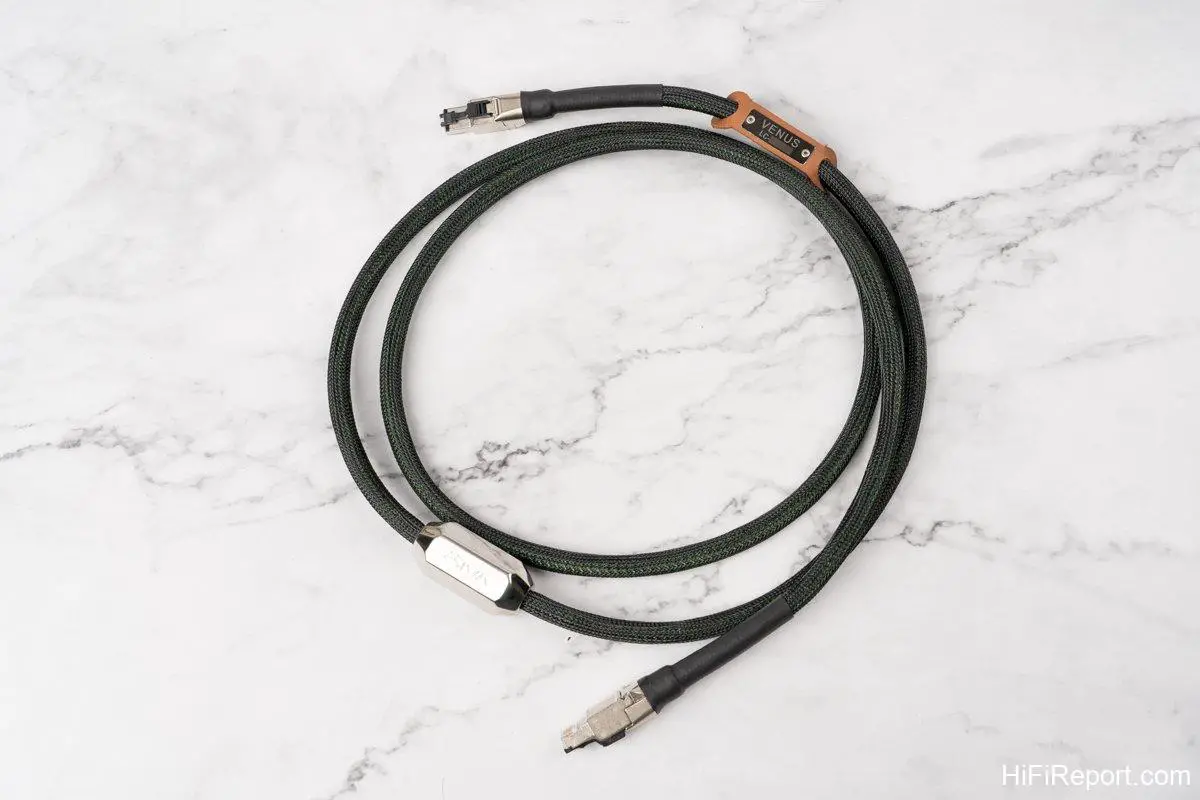
The industrial design and build quality of the Venus are impressive. The dark green exterior looks understated and sophisticated, luxurious without being ostentatious. The polished stainless steel collar on the cable is etched with the brand logo δIVA. It’s said to be the result of a very precise metal processing procedure to achieve such a delicate texture. Although this stainless steel ring probably has no actual impact on the cable’s performance and sound, it serves as a finishing touch to enhance the overall perceived value.
The true value of Venus lies “within,” but I’m not referring to expensive or rare conductors, nor layers upon layers of shielding, or a special or complex structure. Instead, it’s about the outstanding test data.
Test data is crucial for network cables, especially for those with higher transmission speeds and bandwidth. High standards in data performance are essential to ensure accurate data transmission.
What is measured? Items include bandwidth, propagation delay, attenuation, Attenuation to Crosstalk Ratio (ACR), Return Loss, Headroom, etc. These are all necessary measurements for a network cable. Meeting the standard is considered (qualified), ensuring stable data transmission. However, Diva Audio believes that a good audiophile network cable is more than just meeting standards; it needs to exceed them, and exceed them significantly, to achieve excellent sound quality.
Every Venus cable produced, regardless of length, undergoes instrument testing to ensure it meets high standards before leaving the factory. The test report for each cable is included in the packaging and given to the buyer, making the quality truly “visible.”
Precision Manufacturing Process
During the development of Venus, Diva Audio also sourced many currently well-known audiophile network cables, both expensive and inexpensive. Each was measured and auditioned. Some had excellent test data, while others were average. According to their findings, cables with better data generally sounded better. Venus, however, had the best data. And the sound? We’ll discuss that in the listening session section.
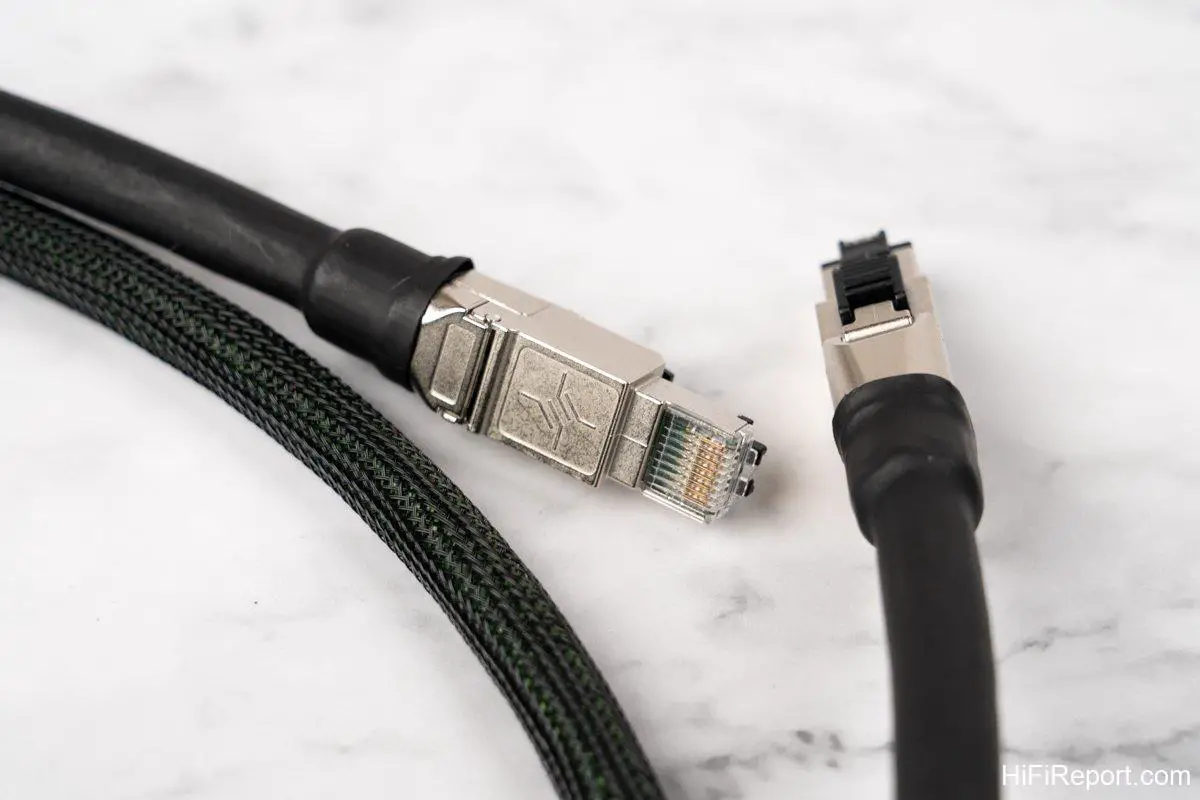
The intriguing question is, how can one create a network cable with specifications that exceed standards? Diva Audio hasn’t revealed too much, only stating that Venus’s conductors are oxygen-free copper, using a standard four-pair twisted-pair structure, and terminated with German Telegartner RJ45 connectors. Other than that, they remain tight-lipped.
My guess is that Diva Audio’s approach is to pursue precision in every manufacturing process, ensuring accurate twist pitch and rigorously implementing shielding to minimize crosstalk and interference.
Noticeably Superior Performance
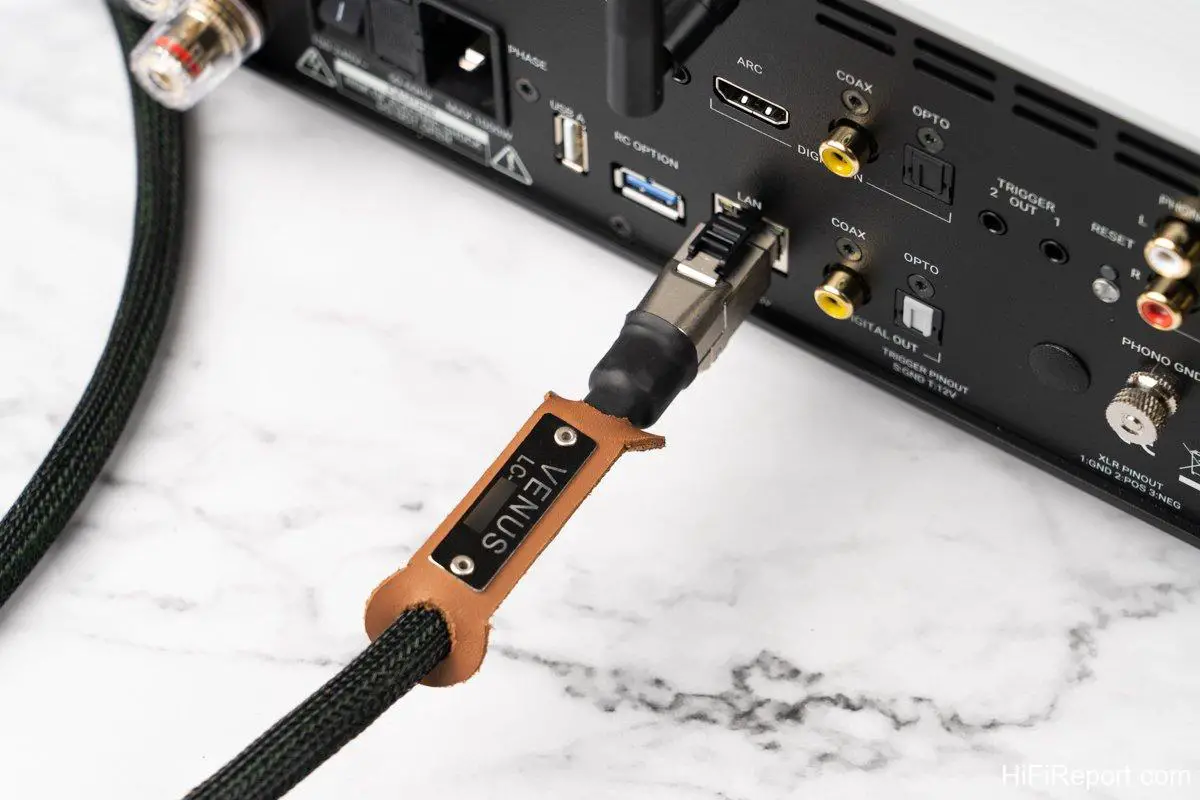
The listening session took place at my home. The source was a Lumin U2 Mini streaming transport, connected to a Holo Audio Spring 3 DAC via USB cable. The music server was an Intel NUC computer running Roon. Both the U2 Mini and NUC were connected to a network switch. The Venus cable was installed between the U2 Mini and the switch. The reference cable was a CAT-8 network cable from the professional brand Linkomm.
After a simple comparison, the answer was immediately clear: Venus was noticeably superior to the reference cable in all aspects.
“Huh? With such a price difference, isn’t it expected to be superior?” Yes, superiority is expected, but Venus’s improvement is more pronounced than other high-end network cables I’ve heard before.
Take the 2016 Hi-Fi Show Commemorative CD as an example, which includes live concert recordings of Lü Shao-Chia conducting the NSO at the National Concert Hall. Listening to track 1, the overture from Verdi’s opera “The Force of Destiny,” the soundstage presented by Venus was immediately opened up compared to the reference cable. It was taller and more expansive, but without losing density. It remained cohesive and substantial, yet brighter, more vibrant, and with better clarity.
Venus not only clearly expressed the height of the soundstage and made the orchestral structure more organized, but also rendered different sections and instruments with better layering and more distinct and precise positioning.
Furthermore, the sonic images became more concrete, with sharp outlines and a strong sense of physicality. The timbre was brighter and more transparent.
At the same time, the low frequencies also improved, not only with clearer lines and agile responsiveness but also with ample quantity and depth, and good density, achieving a comprehensive performance.
Enhanced Clarity in Imaging and Soundstage
Another example is track 2, “Villanelle,” the first song from Berlioz’s song cycle “Les Nuits d’été” from Linn’s Super Audio Collection Vol.7. The vocalist is a mezzo-soprano, accompanied by strings and woodwinds.
Through Venus, the vocal presence was excellent, seemingly leaping out from the orchestra and standing clearly center stage. The vocals were smooth, harmonious, and rich with chest and abdominal resonance, with a lush timbre full of beauty, making it very comfortable to listen to.
In addition, the relative positions between the vocalist and the orchestra were clearly conveyed, and the layers within the orchestra in the background were also distinctly rendered.
Track 3 is the third movement of Chopin’s Piano Concerto No. 2. When I listened with the reference cable, the soundstage became more confined and less open. The sections were closer together, making the sound feel heavier. Although it seemed quite cohesive, the layering and separation were actually not as good.
Moreover, the piano notes from the reference cable were heavier and less agile. The clarity and crispness of the key strikes were noticeably worse, a bit muddy, and the dynamic contrast was not as good, making the music sound less lively.
Switching back to Venus, the soundstage immediately opened up to both sides, and the musical picture became brighter. The lightness of the key strikes was excellent, with nimble speed, clear differentiation between light and heavy, and distinct dynamics, especially the sense of force. Venus clearly outperformed in terms of timbre’s brilliance and transparency, as well as the soundstage’s transparency.
The reference cable was actually not bad, but a comparison immediately revealed a significant difference.
Music Instantly Comes Alive!
Next, I played the title track from Danish jazz vocalist Sinne Eeg’s album “Beauty Of Sadness.” Listening with the reference cable, the shimmer of the cymbal taps at the beginning was weaker, and the subsequent strings were also drier and flatter. The separation between instruments and vocals was poorer, the sonic image was more two-dimensional, and the soundstage depth was shallower. Overall, the sound quality was just more ordinary.
Upon switching to Venus, the music instantly came alive! The dynamic variations and shimmer of the cymbals were better, and the moisture of the strings was immediately enriched. The bass notes were more concrete, and the subtle undulations of the sound were also noticeably better because the quietest parts were clearer. The timbre of vocals and instruments was richer, the realism was better, the texture was cleaner, purer, and more transparent, and the fluidity was also better. The overall quality jumped up a level. The improved clarity of the background enhanced the depth, front-to-back layering, and openness of the soundstage. The reverberation was richer, and the spatial contours were conveyed more clearly.
In short, Venus made the music sound more vivid and realistic, and also more enjoyable to listen to.
Good Sound, Not Mysticism
For Diva Audio, good sound is not mysticism, nor is it a matter of tuning tricks. Everything is derived from scientific validation. Because electronic engineers don’t understand mysticism, they only understand circuits and technology. Venus is a product based on rigorous measurements and actual listening.
It is indeed different from other audiophile network cables, waiting for your discovery and appreciation.
Specifications
* Type: CAT-6A RJ45 Network Cable
* Conductor: Oxygen-Free Copper