
Divini Audio TRANS-Z Speaker Cable Review
Over the past couple of months, I’ve noticed a significant influx of new audio products from Taiwan entering our review space. It’s clear that domestic audio manufacturers are steadily enhancing their R&D capabilities, with sound quality and aesthetic taste gradually catching up to imported audio gear. Among these Taiwanese manufacturers, Divini Audio, under the Tianle umbrella, has always been one I deeply admire.
Their products not only exhibit impeccable craftsmanship but are also packed with genuine substance. What’s even more commendable is their consistent commitment to reasonable pricing, allowing domestic enthusiasts easier access to high-quality products. It’s genuinely hard *not* to support such ‘Made in Taiwan’ brands!
Divini initially made a name for itself in the audio world with its loudspeakers, but more recently, their cables have become a main focus. I recall my very first encounter with a Divini product being their Logos flagship USB cable. Even back then, I held profound respect for the brand.
Not only did its appearance and sound quality rival imported cables, but the manufacturer had actually spent three years *just* developing the perfect USB connector – something even many foreign manufacturers struggle to achieve!
The truth is, besides the conductor itself, the most direct factor affecting transmission efficiency is the connector. Everyone understands this principle, but due to development cost considerations, most cable manufacturers opt for off-the-shelf components. Divini’s emphasis on the connector, however, foreshadowed the great potential of their cable lineup.
Introducing the TRANS-Z Speaker Cable
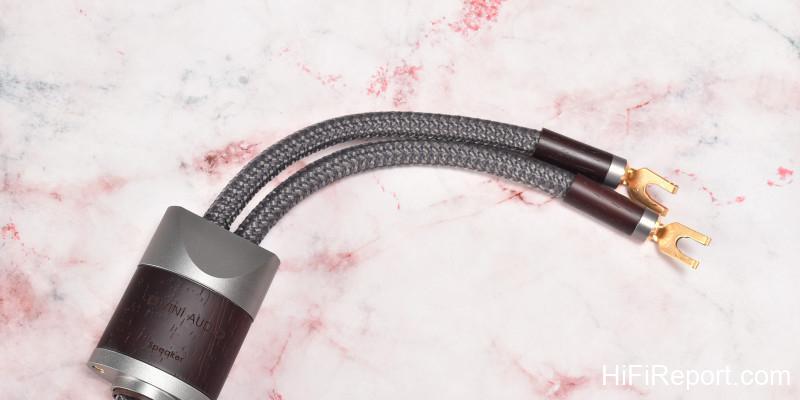
The product sent by the manufacturer this time is the Divini TRANS-Z speaker cable, which currently holds the flagship position in their range. This cable features a novel design where the positive and negative conductors are separated into independent runs, then twisted together. This configuration is likely intended to enhance noise isolation and prevent crosstalk between the positive and negative signals.
Build Quality and Design
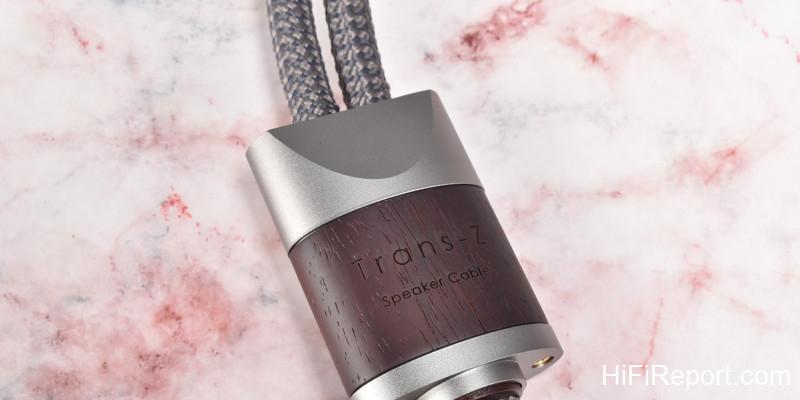
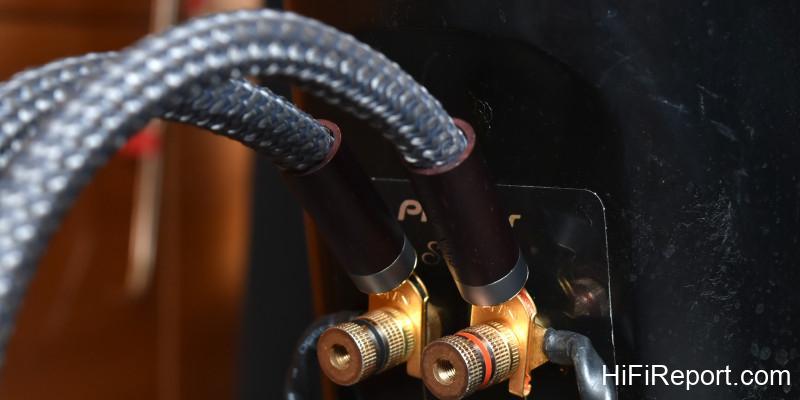
The build quality of the TRANS-Z is exceptionally refined, carrying forward Divini’s signature aesthetic. The connectors and splitters are crafted from matte-finished steel, giving them a substantial feel in hand. Adding external redwood casings not only provides a warm, boutique visual appeal but, according to the manufacturer, the heavy splitters also help equalize resonance between the two conductors. The natural wood material itself offers excellent vibration damping.
The Innovative Spade Connectors
The spade connectors used on the TRANS-Z are also quite unique and clearly engineered with meticulous detail. Observing them from the side, you’ll notice the spade’s interior is hollow. Its structure is formed by folding a copper sheet, with a special silicone material sandwiched in between. The positive and negative poles are differentiated by red and black markings. Why go to such lengths for a spade connector?
The two main factors influencing a connector’s conductivity are the conductor material and the contact area. This spade connector is designed specifically to address these two crucial points. First, we know that pure copper and pure silver offer the best conductivity, but these materials are too soft and can easily deform from frequent plugging and unplugging of the cable. This is why most manufacturers use brass or bronze instead.
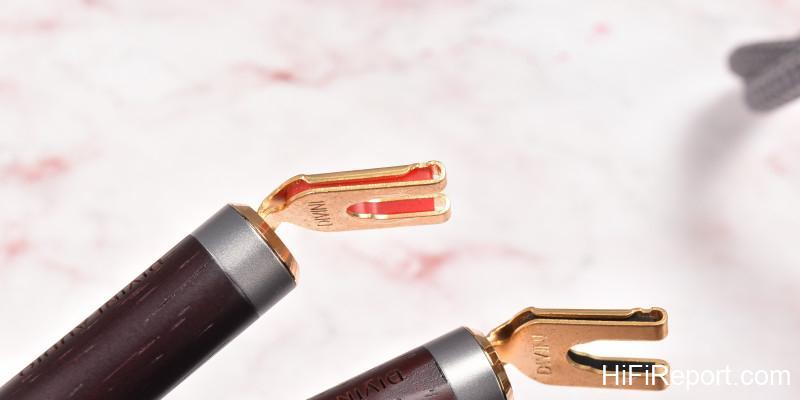
However, the TRANS-Z’s spades use not just pure copper, but 4N oxygen-free copper – which is quite remarkable! How exactly did the manufacturer achieve this? It turns out Divini spent years experimenting with various connector structures, finally finding the optimal solution in 2018: inserting Teflon material between the copper sheets for support.
This not only strengthens the connector but also allows the soft oxygen-free copper sheet to slightly deform under pressure from the terminal, creating a perfect fit that maximizes contact area and significantly reduces transmission impedance.
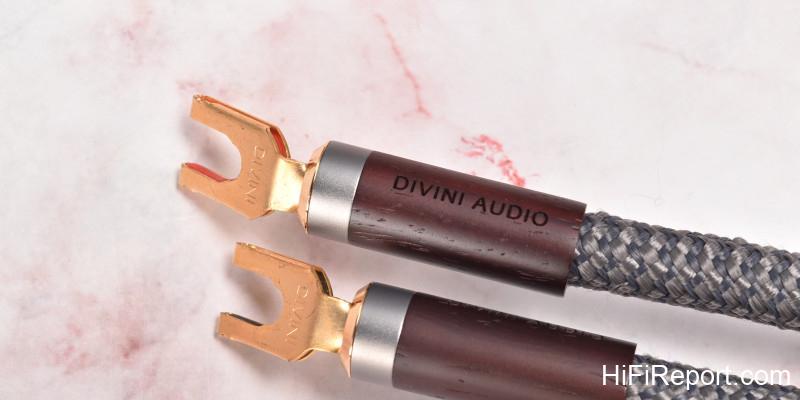
The new TRANS-Z connectors have further refined this by replacing the Teflon with a special silicone material. According to the manufacturer, this new silicone combines hardness and elasticity, resisting outward expansion under pressure and offering stronger support.
The connection between the connector and conductor is made via crimping, welding, and screw locking, followed by a thick gold plating on the surface of the connector to prevent the pure copper from oxidizing, ensuring optimal conductivity indefinitely.
Conductor Technology
Moving on to the TRANS-Z’s conductors, they utilize 7N (99.99999%) OCC single-crystal copper. Each individual cable run contains a total of 7 conductor strands, insulated with two layers of PE and PVC. The arrangement of these conductors is also carefully considered: a main, thicker conductor in the center, surrounded by 6 thinner secondary conductors. This configuration is likely designed to provide the speaker cable with abundant energy while reducing the skin effect.
Generous amounts of PVC and cotton thread filling are added between the conductors. Besides providing effective vibration damping, this also ensures perfect, consistent spacing between the conductors, stabilizing capacitance and inductance. The outer layer is a final PVC jacket, which maintains a certain degree of flexibility for the cable run, followed by the grey dust net we see externally.

Thus, while the TRANS-Z speaker cable appears quite substantial on the surface, it is surprisingly easy to bend during installation, making routing simpler for the user and balancing excellent sound with practicality.
Listening Test Setup
For my listening tests, I used a COS D10 streamer/preamp paired with a Keces S300+ power amplifier, driving our in-house Pioneer S-1EX floorstanding speakers, comparing the TRANS-Z to our standard reference cables. Upon initial listening, the TRANS-Z’s sound was remarkably neutral. It wasn’t the type of cable that immediately grabs you with overt enhancement, but after just a few tracks, the music began to sound incredibly real and natural.
The accuracy of both instruments and vocals was exceptionally high!
Overall Sound Impressions
Listening for an extended period, I identified three key strengths of the TRANS-Z. First, its transient response across the entire frequency range is outstanding, bringing music vividly to life. The resolution in the midrange is particularly high, presenting textures that are full-bodied and dense. Second, it creates an incredibly dark musical background, allowing instruments to be beautifully separated and localization to become exceptionally clear.
Third, it offers direct and unconcealed detail reproduction. In large orchestral pieces, the layering of instruments from near to far is distinct, allowing the listener to effortlessly focus on every musical detail without needing to strain.
Performance with Different Music
Starting with smaller ensembles, I first played “Landslide,” the second track from jazz vocalist Stacey Kent’s album “Breakfast on the Morning Tram.” The vocal outline was sharp and intimate, with subtle breaths and tonal shifts rendered delicately and naturally. I could clearly hear the richly textured throat details, creating a sense that the singer was performing right in front of me.
Despite the directness of the lip and teeth sounds, there was no sense of harshness; the voice remained consistently soft and sweet. The acoustic guitar accompaniment had a full, sweet granularity, allowing me to feel the elasticity of the plucking and the clear resonance of the soundbox up close.
Similarly, playing the Beethoven Cello Sonata No. 5 performed by Italian cellist Marco Ceccato, the background became incredibly dark after swapping the cables – a transparency utterly devoid of any impurities. At this point, the delineation of instruments felt deeply incisive. I also perceived that the instrument positioning was no longer flat or rigid but conveyed a three-dimensional sense of distance and contrast.
Furthermore, this cable’s rich character rendered the cello texture beautifully! I could hear a solid, full-bodied presence without any hollowness. The bow strokes conveyed clear vibrational pulses of the strings, sweeping away any previous fuzzy or rough sensation. The texture of the instrument became sharper, and the wood’s resonance felt denser, creating a vivid, lifelike texture against the black background.
When playing string pieces with the TRANS-Z, there was no artificial coloration in the mid and high frequencies, resulting in remarkably accurate instrument timbres. For instance, on Giuliano Carmignola’s album “Vivaldi Con Moto,” the violin lines were full-bodied and focused, exuding an unadorned sweetness. The high-frequency harmonics and sheen were presented without any artificial embellishment, yet sounded so natural and real.
The “winter melon fuzz” often used by audiophiles to describe this quality of sound aptly applies here. The playing was also accompanied by a rich sense of air, with each bow stroke feeling distinctly etched into the space, vivid and three-dimensional. The harpsichord accompaniment, which often sounds dry and thin, now presented a crisp, plucked texture with rich elasticity.
Finally, I must particularly praise the TRANS-Z’s bass performance. It falls into the category of being clear, fast, and exceptionally well-controlled. When I played “Playing God” from the progressive metal band Polyphia’s album “Remember That You Will Die,” the electric bass and kick drum delivered rapid-fire impact.
The bass wasn’t just meaty and deep; its stopping power was precise and incisive, without any hint of sluggishness, providing an incredibly fluid rhythm to the track’s complex arrangement. Without bloated bass energy, the incredibly fast guitar playing also retained a distinct, granular texture. Regardless of how unrestrained the performance, it always sounded completely poised, without any sense of strain. For rhythmically intense popular music, it was exhilarating!
Conclusion
This TRANS-Z speaker cable, in terms of both technical design and sound quality refinement, is every bit the equal, if not superior, to imported cables. It is a genuinely unbiased, absolutely neutral cable. If you are a cable enthusiast seeking cables with flamboyant highs or thunderous bass, it might not be your cup of tea. But if you are looking for a speaker cable that delivers a full-bodied sound, accurate timbres, and is rich in musicality, then the TRANS-Z would be an ideal choice.
Specifications
* Type: Speaker cable
* Conductor: 7N OCC single-crystal copper
* Shielding: None
* Conductor Gauge: 5.2mm sq x 3
* Outer Diameter: 12.5mm x 3