
Divini Audio Trans-Z Speaker Cable Review
Divini Audio has been a highly active audio brand since its inception. Its product line is extensive, encompassing almost everything except powered equipment. They also distribute renowned foreign drivers and consistently innovate, demonstrating robust R&D capabilities that bring forth new and often stunning products.
The Trans-Z speaker cable under review is no exception, being a brand new offering that makes a striking first impression simply with its appearance.
Separated Positive and Negative Conductors
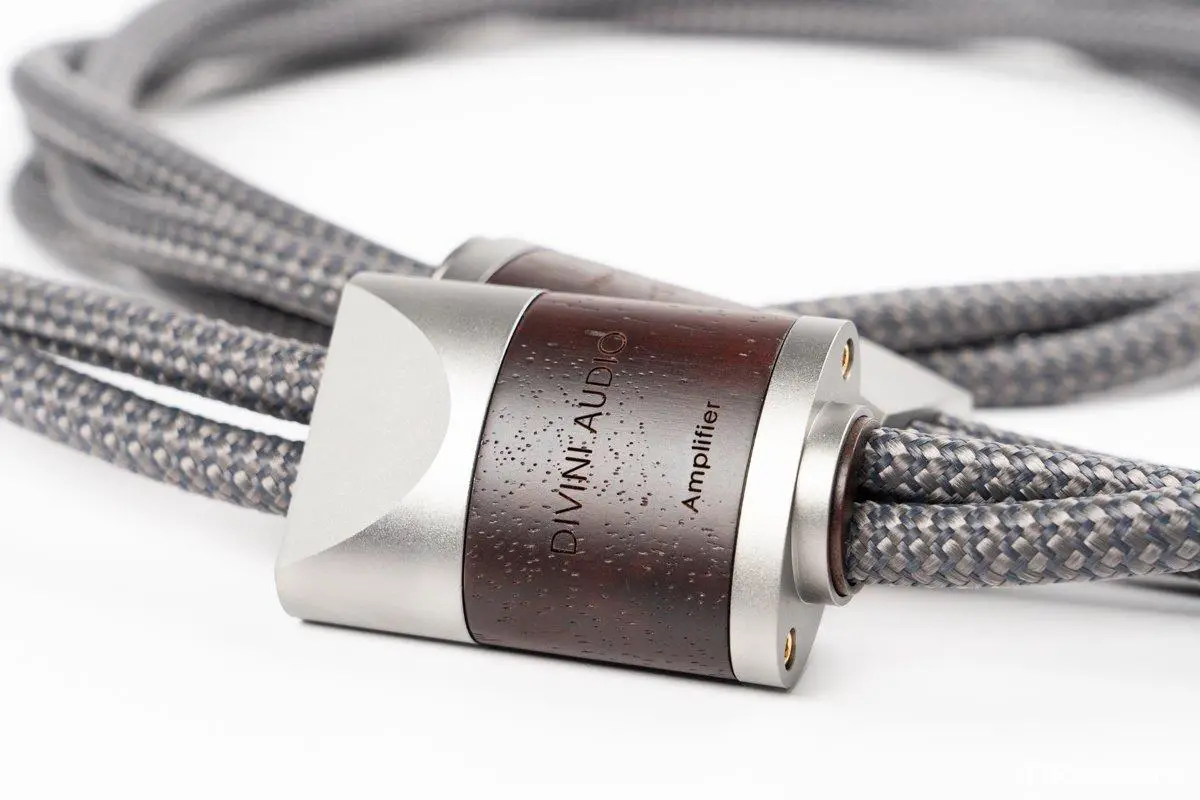
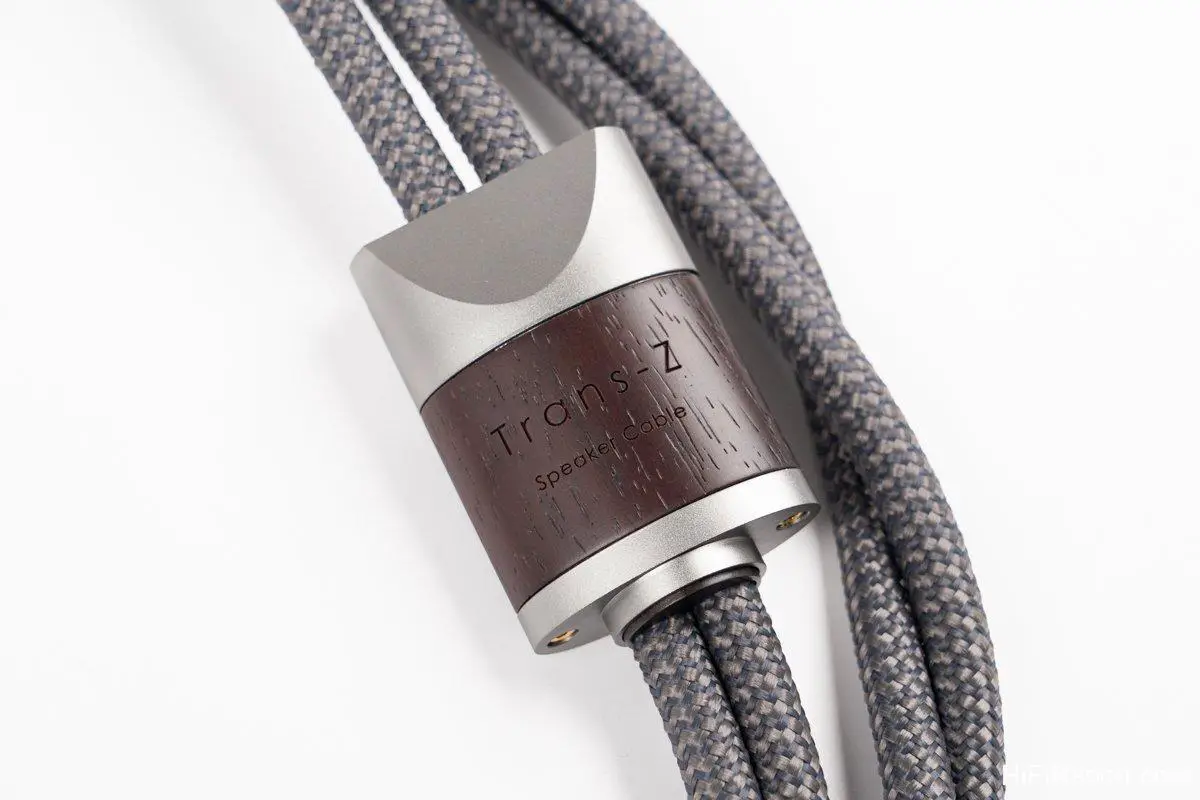
The newly launched Trans-Z is Divini’s current flagship speaker cable. Its most distinctive visual feature is the adoption of a split-wire design, where the positive and negative conductors are completely separated into two independent cables. These two cables are then loosely twisted together and secured with a custom-made splitter. The overall cable assembly has a substantial feel.
Beyond the visible exterior, the internal structure of the Trans-Z is also quite unique.
Its conductors are made of 7N (99.99999%) purity OCC single-crystal oxygen-free copper, which is among the finest conductors available for audio applications, ensuring exceptional signal transmission performance.
The Trans-Z conductor consists of 7 strands. Six of these strands are wound with finer OCC copper wires, while the remaining strand is wound with a thicker OCC copper wire. All seven strands are double-insulated.
The six finer strands encircle the central thicker strand in a surrounding configuration, with damping threads interspersed within, creating a specialized internal geometry.
These seven strands are further encapsulated with another layer of insulation and finally enclosed in a braided shielding mesh, resulting in the gray cable we see externally.
Custom-Designed Y-Plug
Divini cables have always been committed to using their own in-house designed connectors, and the Trans-Z is no different. Notably, the Trans-Z utilizes Divini’s newly designed Y-plug, featuring a clever design unlike any Y-plug I have encountered before.
When disassembled, this Y-plug can be broadly divided into three parts: the Y-pin, the outer shell, and the structural body.
Among these, the Y-pin is paramount, serving as the intermediary between the speaker cable conductor and the speaker terminal, and thus the primary path for signal flow. The structural body facilitates the connection between the Y-pin and the outer shell.
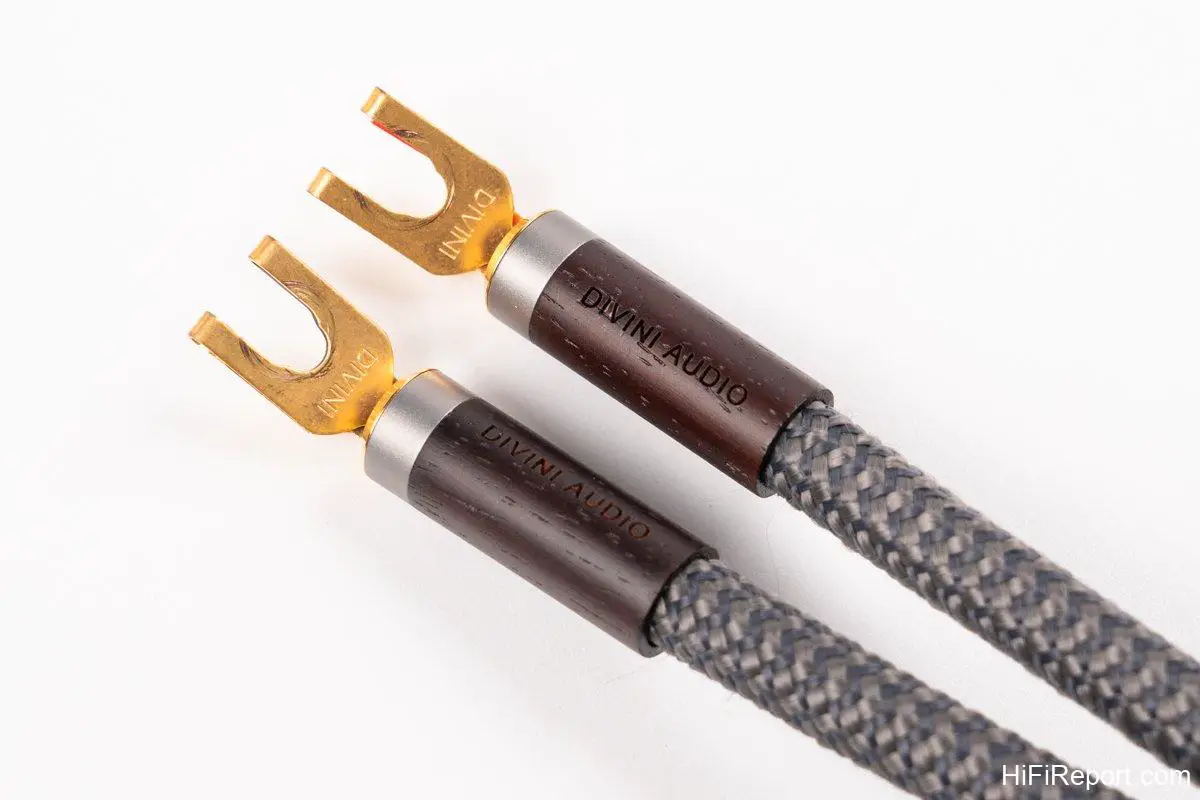
The Y-pin is essentially a copper sheet, connected to the conductor through crimping, soldering, and screw-locking methods.
This seemingly simple copper sheet is the result of two years of R&D by Divini.
It is crafted from oxygen-free copper, differing from the red copper commonly used in standard Y-plugs.
Red copper typically has a purity of only around 2N, whereas oxygen-free copper can achieve higher purities, inherently offering superior conductivity compared to conventional Y-plugs.
However, one might wonder if the softer nature of oxygen-free copper compared to the hardness of red copper would make a Y-plug made from oxygen-free copper prone to deformation. This is not the case, as Divini employs a unique structural design to overcome this.
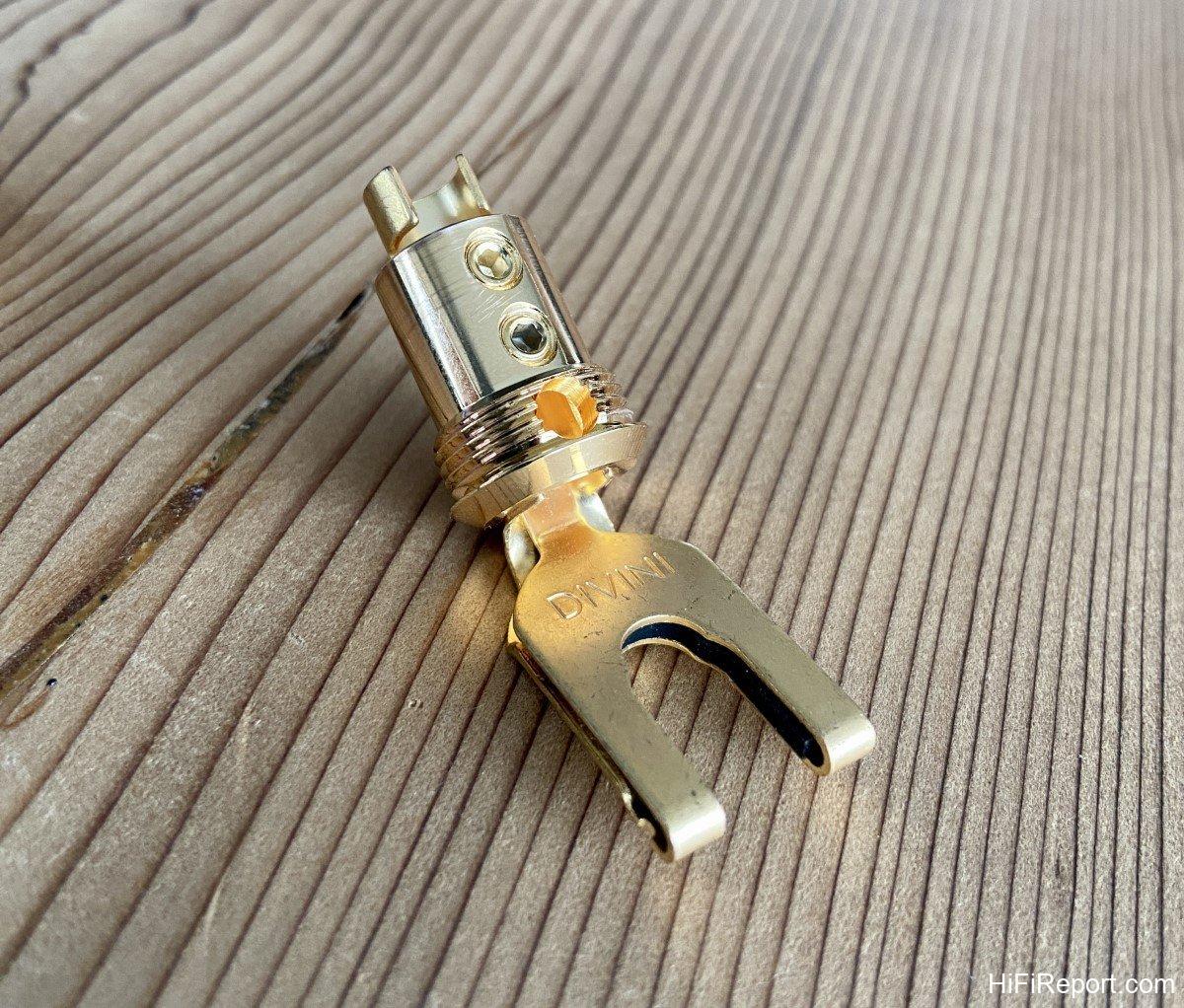
The Y-pin is formed by folding an oxygen-free copper sheet to create the Y-shape. A silicone sheet, colored red for positive and black for negative, is inserted into the fold’s gap. This reinforcement allows the Y-shape to withstand clamping forces. Coupled with the substantial thickness of the copper sheet itself, it prevents deformation even when the speaker terminal nuts are tightly fastened.
Furthermore, the silicone insert provides cushioning, preventing direct hard-on-hard contact when the speaker terminal nut clamps onto the Y-plug. This makes tightening easier and requires less effort.
The Y-pin and conductor are joined using a combination of crimping and screw-locking, with the crimped area subsequently soldered for absolute secureness.
While the principle of this copper sheet might seem straightforward, its production is complex, requiring eight stamping processes to achieve its final shape, resulting in considerable manufacturing costs.
After forming, it undergoes nickel-free gold plating to impart a smoother high-frequency response.
Immediately Impressive Performance
The listening evaluation was conducted in the HiFiReport listening room. I used an Intel NUC i3 mini-PC as a Roon Core server, with a Telos EMP serving as the streamer, connected via USB to a North Star Design USB DAC32 DAC. Amplification and speakers were provided by a Linear Acoustic LAV-60 MKII integrated amplifier and Wilson Audio Alexia 2 loudspeakers.
The Trans-Z is directional, clearly marked with “Speaker” and “Amplifier” labels on the splitters at each end to guide correct connection.
Even before A/B comparison with a reference cable, the Trans-Z impressed me immediately. It was an eye-opening experience. The sound possessed a sense of realism, or directness, making vocalists and instrumentalists sound more tangibly present in the room. The barrier between me and the sound seemed to diminish.
For example, in Tom Jones’ rendition of “Did Trouble Me,” the ambience of the recording venue is very apparent, adding to the music’s vibrancy. The image solidity is excellent, with clear outlines and three-dimensional forms, resulting in outstanding separation. Crucially, this clarity isn’t achieved by shrinking image sizes for increased spacing. The image size is appropriately scaled, with distinct size differences between instruments. The soundstage cohesion is remarkable, effectively highlighting the musical focus. Soundstage width and openness are also commendable, presenting a well-defined soundstage without sacrificing listening ease.
The Trans-Z’s bass performance deserves special mention – it is exceptionally high quality. It is clear, agile, and possesses just the right amount of weight, with rapid decay and responsiveness, avoiding any sluggishness. It is articulate, powerful, and possesses substantial depth, neither overly polite nor brutish and uncontrolled.
Switching to my reference Tromba Marina OCC-1 speaker cable revealed excellent overall musicality and liveliness, but the richness of tonal textures, ambience, and realism were less pronounced. The outline definition was also less precise. This highlights the Trans-Z’s impressive detail retrieval capabilities.
Balanced Sense of Pace
Moving on to Stewart Goodyear’s performance of Tchaikovsky’s Piano Concerto No. 1, the opening orchestral tutti immediately demonstrated the Trans-Z’s aptitude for handling complex musical arrangements. The layering and separation of orchestral sections were superb, and the smooth energy delivery and balanced sense of pace rendered the music with a clear, well-organized structure, making for a thoroughly enjoyable listening experience.
Similarly, listening to Chen Pi-Hsien’s performance of Beethoven’s Piano Sonata No. 32, the articulation of each keystroke was remarkably concrete and three-dimensional, significantly clearer than I had previously experienced. The high and low registers of the piano were distinctly differentiated, in terms of both position and note size.
The piano tone was slightly drier, not of the crystalline or lush variety, which emphasized texture and detail, lending a more grounded, direct quality.
With the Ebene Quartet’s “Fiction” album, the Trans-Z’s dry texture and brisk response enhanced the sharpness of fortissimo string passages. Lines were clearly etched, and dynamics were precisely defined, making the music sound more intense and exhilarating.
In track 2, “Amado Mio,” and track 3, “Nature Boy,” the cello features pizzicato passages, and track 3 also includes rapid drumbeats. These tracks further confirmed the Trans-Z’s high-caliber bass performance. It is not only tight, fast, and clearly defined with controlled decay, but also richly detailed and layered, making the music more dynamic.
Worthy of High-End Systems
To further explore the Trans-Z’s potential, I upgraded the amplification to Accustic Arts Tube PREAMP III preamplifier and AMP V power amplifier, and readjusted the speaker placement and listening position.
Revisiting Stewart Goodyear’s Tchaikovsky Piano Concerto No. 1, the soundstage immediately expanded significantly. This further highlighted the Trans-Z’s strong advantages in energy and coherence. It not only made the music sound grander but also presented the orchestral sections with even greater clarity in layering, localization, and separation, with richer detail.
The Accustic Arts pre-power combination offered greater scale and power, along with a softer texture and more harmonious sound compared to the LAV-60 MKII integrated amplifier. However, the Trans-Z’s character remained consistently tight, cohesive, fast, and detailed. Tonally, it leaned towards realism and naturalness, with a touch of warmth, avoiding coloration and faithfully conveying the characteristics of the connected equipment.
Next, I played Patricia Barber’s “The Cole Porter Mix” album. Track 1, “Easy To Love,” is a light and lively song with an accompaniment of guitar, piano, pizzicato double bass, and drums. Through the Trans-Z, the bass notes were clear and bouncy, with a quick decay. The slightly dry tone made the strings sound taut, as if the musician was plucking with force.
The Trans-Z once again demonstrated excellent low-frequency resolution, clearly delineating the shape of the drums, the resonance within the drum shells, and the positions of different drums.
Furthermore, details such as the vocalist’s articulation, sibilance, breath sounds, and the spatial reverberation of the recording venue were sufficiently rich and natural. Image sizes were realistic, without exaggeration. Overall, it performed comprehensively across the board.
Capturing the Essence of Hard Bop
The most captivating experience was listening to Art Blakey and The Jazz Messengers’ “Caravan.” The Trans-Z brilliantly showcased the exuberance and dynamism of hard bop. To reproduce hard bop effectively, speed is crucial, but more importantly, the speed needs to be consistent across all frequency ranges, preventing a sense of rushing.
Additionally, the weight of each frequency range must be appropriate, especially in the high frequencies. Highs need to have substance to avoid harshness at higher volumes.
The Trans-Z excelled in both aspects, allowing it to convey Art Blakey’s “Caravan” with such precision.
The drum sounds were distinct and well-defined, each drumbeat decaying quickly. The kick drum had a powerful, visceral impact, and the bass was articulate and clean, without any muddiness.
The trumpet had excellent energy without being aggressive and possessed a dense texture and warm tone. Even the trombone sounded tight and fast.
I turned up the volume continuously, and the atmosphere became incredibly energetic, yet without any hint of sharpness, harshness, or stridency, allowing me to fully immerse myself in the essence of hard bop, as if transported to a 1960s jazz club performance.
Faithful Reproduction
The Trans-Z can be described as a master of creating an exciting atmosphere, and the reason is simple: faithful reproduction. It not only conveys abundant information, faithfully recreating the original musical event, but also avoids adding any coloration or subjective sonic flavoring. Through the Trans-Z, I could hear the performers’ intentions and the recording engineer’s vision, and deeply feel the musical atmosphere, becoming involuntarily moved.
Divini has once again successfully created a high-quality cable. The series also includes a PT-Z power cable, utilizing the same conductors and similar structure. What is its sonic performance? Please look forward to our upcoming review.
Specifications
* Type: Speaker Cable
* Conductor: 7N OCC
Reference Equipment
* Source: Intel NUC i3 / Telos EMP Music Server Streamer
* DAC: North Star Design USB DAC32
* Amplification: Linear Acoustic LAV-60 MKII Integrated Amplifier, Accustic Arts Tube PREAMP III Preamplifier, Accustic Arts AMP V Power Amplifier
* Speakers: Wilson Audio Alexia 2
* Cables: Tromba Marina OCC-1 Speaker Cable
* Accessories: Tiglon TMR-2 Audio Rack / MYSTJ Audio CMS Audio Rack / ASI Tuning Devices