
Dynaudio Focus 50 Review
Let’s take a moment to revisit the evolution of Dynaudio’s DSP active loudspeaker lineage. They pioneered the field in 2012 with the introduction of the Xeo series, featuring the Xeo 3 bookshelf and Xeo 5 floorstanding models. While this marked their debut in home audio DSP active technology, Dynaudio had already been leveraging DSP crossover techniques in their professional active monitors since the 1980s, accumulating a wealth of experience in this domain.
Just two years later, following the immense popularity and success of the Xeo series, Dynaudio pressed on to launch the second generation. This included the Xeo 4 bookshelf and Xeo 6 floorstanding speakers, later joined by the even more compact Xeo 2, perfectly suited for desktop use. Key improvements focused on enhancing wireless transmission stability and boosting resolution support from the first generation’s 24/48 to 24/96.
Furthermore, the top panel incorporated volume indicator lights and physical control buttons. Starting with this generation, the Xeo series offered three equalization options—Neutral, Wall, and Corner—allowing for optimal setup based on speaker placement.
Concurrent with the second-generation Xeo release, Dynaudio also unveiled the higher-tier Focus XD series. This lineup comprised the 200 XD bookshelf speaker and the 400 XD and 600 XD floorstanders. In terms of product positioning, Dynaudio considered the Xeo series not quite Hi-End level, reserving that distinction for the Focus XD, which featured superior drivers and built-in amplification, truly meeting Dynaudio’s criteria for Hi-End audio.
Frankly, at the time, I disagreed with Dynaudio’s assessment. In my listening experience, the Xeo’s playback capability easily surpassed any system at a comparable price point. Their claim of it not being Hi-End was likely intended merely to differentiate it from the newly introduced Focus XD series; in reality, the Xeo’s performance undoubtedly met Hi-End standards.
In 2018, the Xeo series evolved to its third generation, offering the Xeo 10 and Xeo 20 bookshelf speakers alongside the Xeo 30 floorstander. The primary enhancements included the addition of optical and analog wired inputs on the rear panel, the integration of Bluetooth connectivity, and significantly increased output power from the built-in amplifiers.
Fast forward to 2022, Dynaudio streamlined its product lines, consolidating its wireless streaming DSP active speakers into the brand-new Focus series we’re discussing today. This new lineup includes the Focus 30 and Focus 50 floorstanders, and the Focus 10 bookshelf speaker. The Xeo series, having successfully completed its mission, was phased out.

Technical Principles Inherited from Previous Generations
Now, let’s consolidate the key technical highlights of the Xeo and Focus XD series mentioned above. Firstly, the first-generation Xeo was introduced in 2012, a time when streaming platforms like Spotify and Tidal weren’t yet truly mainstream. Consequently, the first-generation Xeo lacked network streaming capability. In fact, none of the subsequent Xeo generations featured integrated network streaming until the Focus XD, which supported Wi-Fi and Spotify Connect.
However, like the previous Xeo models, the Focus XD required a separate small box to act as a signal receiving hub, which then wirelessly transmitted the digital signal to the speakers for decoding and playback.
Secondly, as noted earlier, although Dynaudio began using DSP technology in their active monitors back in the 1980s, they consistently emphasized that DSP digital processing should not be used excessively to avoid negatively impacting the original music signal. I believe this principle was a crucial factor in the excellent sound quality of both the Xeo and Focus series throughout their iterations.
Thirdly, while Dynaudio drivers boast exceptional performance, capable of handling high sound pressure levels and power without distortion, they have consistently been perceived by audiophiles as notoriously difficult to drive. However, the Xeo and Focus active speakers, employing DSP digital crossovers and driven by integrated amplifiers, fully unleash the potential of Dynaudio’s drivers.
This allows them to achieve the optimized playback performance meticulously calibrated by the factory – another key to the superb sound of the Xeo and Focus series.
Fourthly, from the very first generation of Xeo, Dynaudio opted for a digital direct amplification architecture that bypasses an internal DAC to drive the speaker units. This means the digital music signal, after undergoing DSP digital crossover processing, is directly amplified in PWM format, only converting to analog at the very last moment before driving the drivers.
This eliminates the DAC conversion step, representing arguably the most direct and efficient method of digital signal processing and amplification. This approach is a significant technical feature that distinguishes the Xeo and Focus series from many other active speakers in their class.
Key Advancements in the New Focus Series
So, what breakthroughs does the latest generation Focus bring? Firstly, this new Focus series finally liberates itself from the need for a separate wireless transmitter box. The speakers themselves are equipped with built-in Ethernet and Wi-Fi network interfaces, allowing for direct streaming via wired or wireless connection.
The supported network transmission protocols are comprehensive, covering virtually everything: in addition to basic UPnP streaming, they support Roon Ready, Airplay 2, Chromecast, Spotify Connect, Tidal Connect, and Bluetooth wireless transmission. Put simply, any music you can access online can be played through the Focus series speakers in the most intuitive and straightforward manner using your phone or computer.
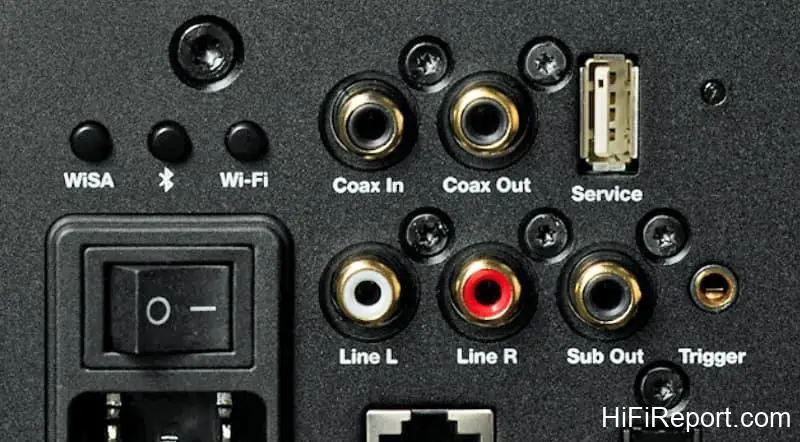
Secondly, the physical input terminals on the new Focus series are much more complete. They include one Toslink optical digital input, one RCA S/PDIF coaxial digital input, a set of RCA analog inputs, and even a dedicated Sub Out analog output terminal for a subwoofer. The two speakers can be connected via a wired RCA digital connection (supporting up to 24/192 resolution) or through stable WiSA wireless technology (supporting up to 24/96).
Naturally, Focus series speakers can also receive wireless transmission from WiSA-enabled digital sources.
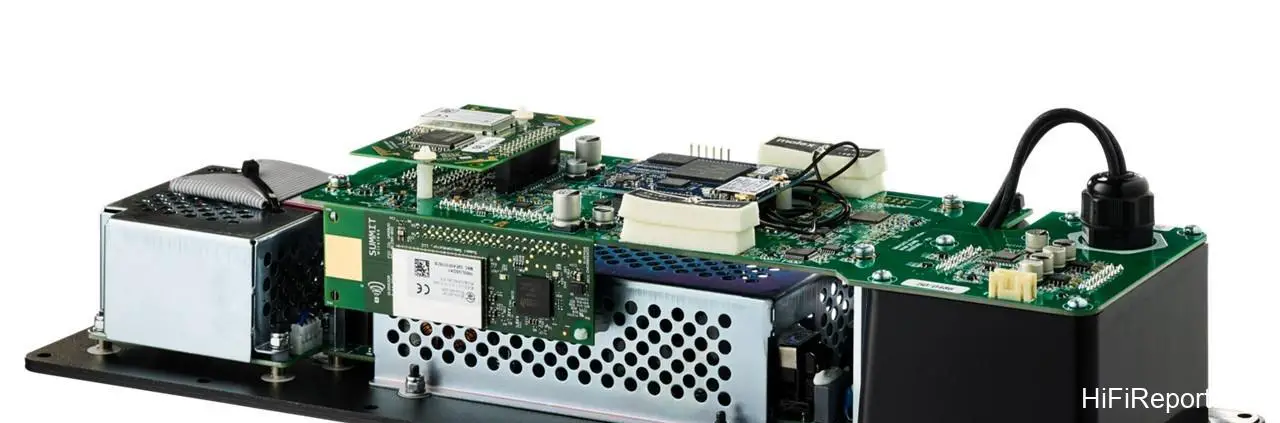
Thirdly, previously Dynaudio had not elaborated on the amplifiers built into the Xeo or Focus XD. This time, they have clearly announced that the new Focus utilizes custom-designed Class D power modules from Danish company Pascal. This same technology is also employed in Dynaudio’s own high-end Core professional monitors. Notably, the output power of the built-in amplifiers in the Focus series has seen a significant increase.
Compared to the previous Focus 600 XD, which featured three 150W amplifiers, the Focus 50 reviewed here incorporates one 110W, and two 280W amplifiers, driving the tweeter, midrange, and the two woofers respectively. The total output power for a stereo pair reaches a formidable 1,340W.
Fourthly, the new Focus boasts enhanced DSP processing power and offers more sophisticated functional settings. Beyond the three equalization states (neutral, near wall, corner) selectable based on speaker placement, it also includes preset bright and dark equalization adjustments. If your room has heavy absorption, you can switch to the “bright” setting which slightly boosts the high frequencies. If the room has excessive reflections, the “dark” setting can be chosen.
For further room acoustic correction, you can opt to purchase Dirac Live. Most interestingly, the Focus series can automatically detect whether the speaker grilles are attached. If they are, the high frequencies might be slightly attenuated, and the Focus will automatically compensate. A blue light on the front panel indicates that this function is activated.
Driver Technology: Leveraging High-End Heritage
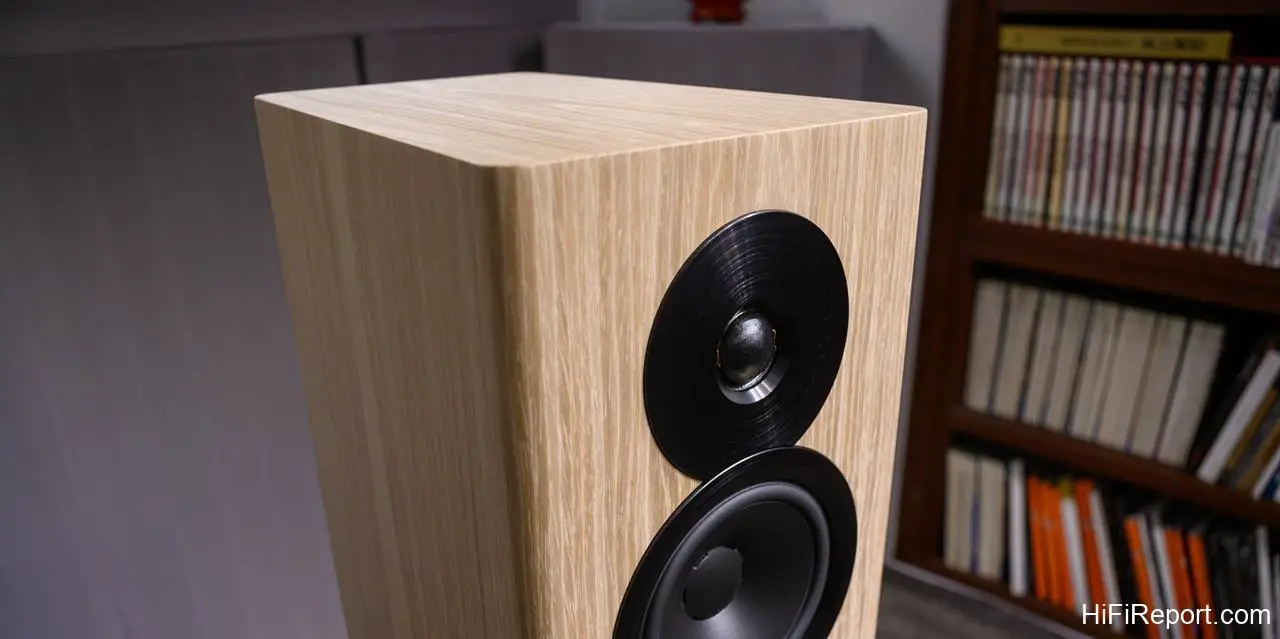
In addition to the functional and technical advancements mentioned, the drivers in the new Focus series fully inherit technology from Dynaudio’s high-end speakers. The 28mm soft-dome Cerotar tweeter is a specially developed unit. Its diaphragm incorporates the Hexis structure from Dynaudio’s high-end Confidence speakers behind the diaphragm, which rapidly dissipates back-wave pressure, effectively reducing resonance interference for clear, natural, and non-fatiguing high frequencies.
The 6-inch midrange driver is derived from the Contour 60 speaker. Besides utilizing Dynaudio’s exclusive one-piece MSP diaphragm, it features a powerful neodymium magnet, lightweight aluminum voice coil, and fiberglass voice coil former. This not only significantly enhances driver control but also allows for the reproduction of the most subtle and sensitive musical signals.
The factory specifically emphasizes that this midrange driver possesses full Contour-level capability, indicating its outstanding characteristics.
The two 7-inch Esotec+ woofers similarly inherit the technical architecture used in drivers from the Confidence and Contour series. It’s worth noting that because these two woofers only need to reproduce frequencies below 390Hz, lightweight construction isn’t the primary design consideration. Consequently, across the entire Focus series, these woofers are the only drivers using pure copper wire for their voice coils, maximizing low-frequency reproduction capability.
Listening Experience: Unlocking Full Potential
Moving on to the actual listening test, to highlight the minimalist system architecture championed by the new Focus, the distributor, Taifu, truly streamlined the setup to the extreme. The listening room contained only a pair of Focus 50 speakers and nothing else. By simply connecting to the Focus 50 speakers wirelessly via UPnP using a mobile phone, music could be streamed and played. In essence, the entire system requires only a pair of Focus 50 speakers, their power cables, and a smartphone.
Dynaudio claims that even someone completely unfamiliar with network streaming can set up the entire system and start enjoying music within five minutes!
Naturally, there are more advanced ways to utilize the Focus series speakers. You can pair them with higher-end streaming transports or CD transports, using digital outputs to the Focus for playback. Listening to vinyl is also possible; simply connect your turntable system via the Focus’s RCA analog inputs.
While the music signal does undergo an analog-to-digital conversion process, its impact on the sound is barely perceptible, allowing the warm, full-bodied characteristic sound of vinyl systems to fully shine through. If you want to pair them with a TV to replace the built-in speakers, while the Focus doesn’t have eARC-enabled HDMI ports, if your TV supports WiSA technology, you can receive and play the TV’s audio signal via stable WiSA wireless transmission.
The powerful bass of the Xeo 3 ten years ago remains etched in my memory. To what extent can the fully evolved Focus 50 floorstander push low frequencies? This was the primary question I wanted answered during this listening session. First up was Beyoncé’s “Partition.” The opening electronic bass descends like a depth charge – a rare example of a pop recording containing true extreme low-frequency information.
The Focus 50 not only fully extends this electronic bass into the lowest registers but also exhibits exceptional control. The bass layers are distinct and completely free from muddiness or confusion. Clearly, the factory specification of 20Hz (±3dB) low-frequency extension isn’t exaggerated.
Upon reviewing the design of the Focus series, I realized that all three models feature a sealed cabinet design. This is quite uncommon for Dynaudio speakers. It’s apparent that Dynaudio believes the built-in amplifiers in the Focus series are powerful enough to fully unleash the potential of their drivers, thus not needing to rely on bass-reflex designs to artificially boost bass quantity. Adopting a sealed cabinet design allows for a more linear, clear, and layered bass performance.
Next, I listened to “Midnight Sky” by Miley Cyrus. The bass impact in this track is particularly solid and powerful. The Focus 50 revealed a bass character different from my previous experiences. The bass quantity wasn’t overwhelmingly voluminous; instead, the focus was on presenting clear layers and a more complete low-frequency extension.
Frankly, when tuning the sound profile, Dynaudio could easily have deliberately added more mid-bass quantity to make the overall reproduction more immediately appealing. Especially with the Focus series’ DSP digital processing, tweaking the overall sound character would be effortless. However, since its founding in 1977, Dynaudio has consistently adhered to the principle of full-range balance as the highest tuning law, never deliberately adding extra emphasis to the mid-bass.
This steadfast tuning philosophy is still evident in the Focus 50 during this audition.
Does this mean the Focus 50’s mid-bass isn’t exciting enough? Don’t misunderstand. Challenging it with the more demanding soundtrack to “Angels & Demons,” particularly the sections with continuous low-frequency impacts, I initially expected the Focus 50’s bass to be somewhat reserved. But to my surprise, the bass I heard was as impactful as heavy artillery fire.
It was astonishing that the air moved by the combined four 7-inch woofers in the pair of speakers could literally shake the air in the entire listening room. This demonstrates that the Focus 50’s mid-bass is by no means conservative; its quantity is extremely precise. Unwanted muddy bass doesn’t blend in with the bass that should be present in the recording, leading one to mistakenly perceive the bass as particularly abundant.
However, when the music calls for majestic low-frequency expression, the Focus 50 absolutely holds nothing back, unleashing its full power.
Listening to bassist Nenad Vasilic’s album “Bass Room,” the rich, full-bodied, substantial, and bouncy plucked bass throughout, accompanied by exquisitely recorded percussion, makes this album an absolute favorite for audiophiles for demonstrating bass.
The Focus 50’s performance once again declared Dynaudio’s tuning philosophy: outside of what’s in the recording, there is no deliberate addition of bass that shouldn’t be there, but the bass that *should* be there is delivered completely and without reservation. The plucked bass notes presented by the Focus 50 were not only larger and fuller with abundant quantity than I had previously heard, but the speed of attack and decay was also incredibly agile.
Such clear and fast bass is undoubtedly a characteristic only achievable with the powerful control of the built-in amplifiers coupled with the sealed cabinet design.
How large is this listening room at Taifu? I estimate it to be about 10-12 pings (approx. 33-40 sq meters or 350-430 sq ft), which is actually quite a large space for the Focus 50. Yet, the Focus 50’s bass quantity was perfectly sufficient to fill the entire space without being diluted. During the audition, Taifu specially paired the Focus 50 with a factory-recommended subwoofer to demonstrate the performance with a sub.
Setting up the Focus 50 with an external subwoofer is incredibly simple; using the dedicated Control App, you just set the Focus 50’s high-pass crossover point to 80Hz, entrusting the subwoofer with reproducing frequencies below 80Hz. Listening to Van Halen’s classic “Hot for Teacher,” featuring rapid double-kick drums at the beginning, adding the subwoofer did indeed make the kick drums feel more solid and powerful, slightly compensating for the Focus 50’s marginally lower bass density issue.
However, for playing most music in spaces up to 12 pings, the Focus 50’s bass is definitely sufficient. Only if you particularly crave bass, or if you are using them in a larger space, would you need to consider adding a subwoofer.
With the bass test complete, let’s turn our attention to the performance of the vocal midrange. The Focus 50 is the only three-way design among the three Focus models. With the addition of a 6-inch midrange driver, the crossover point between the midrange and tweeter is raised to 4.7kHz, avoiding the 2-3kHz frequency range where the human ear is most sensitive.
Although the factory recommends keeping the distance between the two Focus 50 speakers no more than four meters, listening to vocal performances in this large room, even with the speakers spaced further than four meters apart, the vocals still clearly appeared in the center of the soundstage, and the full, cohesive sense of their form remained perfectly intact.
Listening to “Iceberg” by the band “Four Pens,” the female vocals possessed a warm, delicate texture like natural pure cotton – precisely the captivating sound quality Dynaudio is known for. I was surprised to find that the Focus 50 active speakers, utilizing DSP digital crossover, completely inherited this classic characteristic.
Listening to Franck’s Violin Sonata performed by pianist Maria João Pires and French violin master Augustin Dumay, compared to my previous listening experiences, the Focus 50 presented the string mid-highs with an appropriate degree of richness and weight, entirely devoid of any overly thin, stiff, or sharp issues.
However, the transitions in bowing technique didn’t become sluggish due to the added thickness; rapid staccato passages remained agile, and the tone quality was incredibly smooth and refined. Pires’ piano treble notes also possessed a warm texture, yet the high-frequency harmonics were still outstanding, with each treble note radiating a warm luster like pearls. It’s clear that the new generation of Dynaudio soft-dome tweeters contributes immensely to the mid-high frequency performance.
Market Positioning and Value Proposition
For most Hi-End loudspeaker manufacturers, active speakers utilizing DSP digital crossovers are typically positioned below their top-tier passive models. However, Dynaudio has not limited itself in this way. The new Focus series not only incorporates driver technology from their top-of-the-line models but also features more powerful built-in amplification and more refined DSP digital crossover and processing technology.
The Focus 50 reviewed here, with its three-way design, delivers balanced performance across all frequencies and a more complete low-frequency extension. If you’ve ever thought Dynaudio drivers were difficult to drive, the Focus 50, with its optimized DSP digital crossover and active architecture, represents the ultimate product to unlock the full potential of Dynaudio drivers and completely embody the sound philosophy Dynaudio has pursued for 46 years.
What’s astonishing is that the new Focus 50, with its comprehensively upgraded capabilities, is priced even lower than the similarly sized and structured 600 XD launched in 2014. Can you assemble an audio system with performance approaching the Focus 50 at a similar price point? My answer is the same as my feeling after listening to the Xeo 3 ten years ago: the Focus 50 is absolutely the most capable and highest value option in its price range.
Specifications
* **Type:** 3-way, 4-driver, DSP active wireless streaming sealed floorstanding speaker
* **Launch Year:** 2022
* **Drivers:**
* 28mm Cerotar tweeter × 1
* 15cm MSP diaphragm midrange driver × 1
* 18cm Esotec+ woofer × 2
* **Frequency Response:**
* 20Hz-22kHz (±3dB)
* 18Hz-36kHz (-6dB)
* **Crossover Points:** 390Hz, 4.7kHz
* **Built-in Amplifiers:** 110W × 1, 280W × 2
* **Standby Power Consumption:** 2W
* **Maximum Power Consumption:** 280W
* **Digital Inputs/Outputs:**
* Toslink optical input × 1
* RCA digital coaxial input × 1
* RCA digital coaxial output × 1 (for connecting two speakers)
* **Analog Inputs/Outputs:**
* RCA input × 1
* Sub Out output × 1
* **Dimensions (WHD):** 1140 × 215 × 305mm
* **Weight:** 33.5 kg