
Ediscreation Firebird LPS Linear Power Supply Review
The demand for high-quality DC power supplies has grown rapidly in recent years. This is largely due to streaming becoming the primary listening method for audiophiles. However, the bundled DC power supplies for many home network devices, such as wireless routers, network switches, NAS devices, music servers, and NUC mini-PCs, are often of mediocre quality, bottlenecking audio performance. Upgrading these power supplies can significantly improve both sound and image quality, making external DC power supplies of all kinds a focal point for audio enthusiasts.
Among the numerous options on the market, the Ediscreation Firebird LPS stands out as a top contender.
CNC Machined Aluminum Chassis
Ediscreation currently offers three linear power supplies. Two are standard versions, differing in output amperage (6 amps and 10 amps). The third is the flagship Firebird LPS reviewed here.
Regardless of their level, these three linear power supplies share a common design characteristic: they offer only a single output voltage. This contrasts with other brands that typically provide two or three switchable voltage options to accommodate different devices.
Why this design choice? Isn’t it less convenient? Naturally, it’s for the sake of sound quality. Focusing on a single task allows for a higher degree of refinement.
Therefore, the Firebird LPS is available in three versions: 5V/10A, 12V/10A, and 19V/6A. The unit I received for review is the 12V version, featuring three output ports on the rear panel and comes with three handcrafted OFC DC power cables, each 1.5 meters long. It can simultaneously power up to three 12V devices.
Despite its compact size, the Firebird LPS is far from unassuming. Its chassis is precision-machined from a solid block of aluminum using CNC technology, resulting in a remarkably dense and rigid enclosure.
Internally, the chassis is meticulously designed to house only the toroidal transformer and the power circuit board. These two sections are connected by a channel, utilizing the aluminum material as a natural barrier to isolate noise.
The unibody chassis also provides excellent vibration damping, protecting the sensitive circuitry from microphonic interference—a dual benefit.

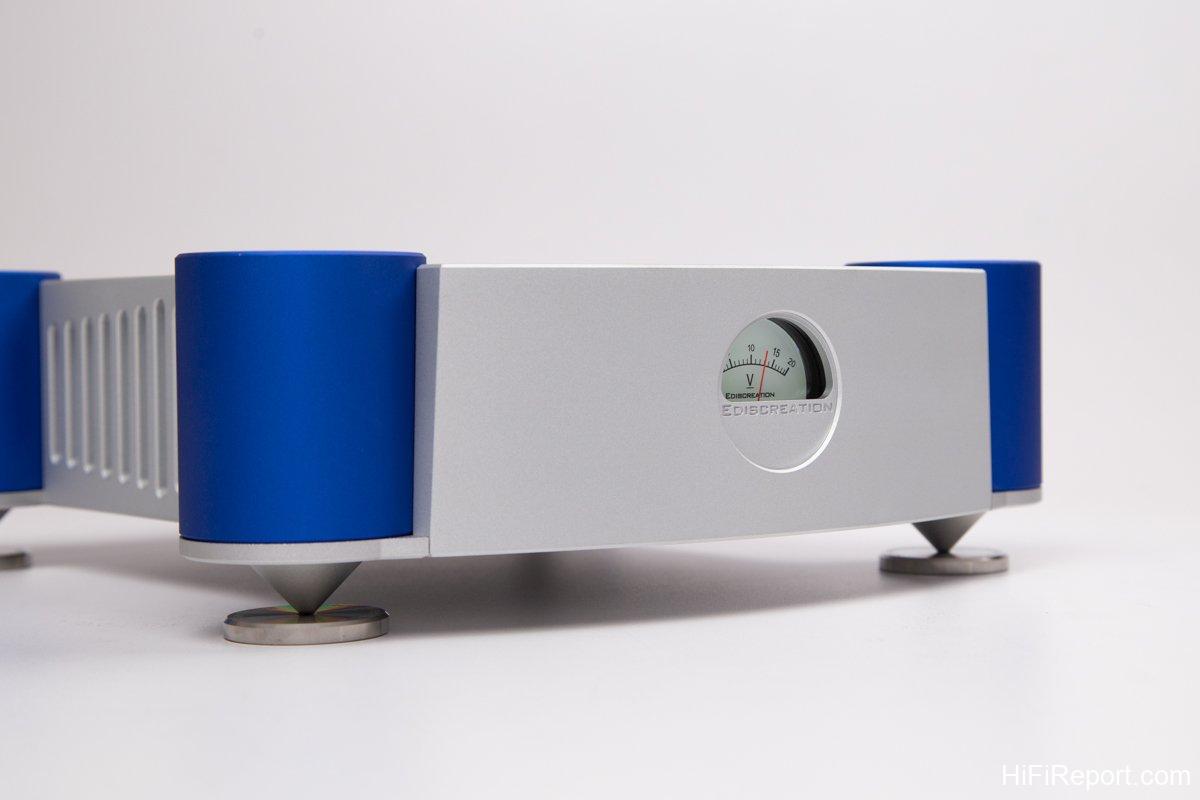
Externally, the Firebird LPS features blue cylindrical feet at each corner, each also machined from solid aluminum billets.
These cylindrical feet do not directly contact the chassis but sit on the base plate and are secured to the bottom panel via cones.
Each cylinder top has a recessed groove, allowing for stable stacking of multiple Firebird LPS units, effectively channeling vibration downwards and preventing mutual interference—a truly ingenious design.
Discrete Components Circuitry
The Firebird LPS incorporates several sophisticated design elements.

It proudly boasts a fully discrete component circuit design, eschewing IC chips. This approach is claimed to deliver higher power output while maintaining extremely low noise levels. Indeed, the measured ripple noise is remarkably low, at just 0.02 mVrms.
The toroidal transformer is a custom-made, grounded isolation transformer, further enhancing noise isolation.
Internally, it utilizes premium Mundorf capacitors with a substantial 30,000 uf capacitance, chosen for their sonic characteristics.
The AC input IEC inlet is a Furutech FI-03R, renowned for its quality and reliability.
The front panel features a refined and compact meter, displaying the output voltage and adding a touch of visual appeal. The meter is backlit, and the backlight can be switched off via a rear panel switch.
Furthermore, the Firebird LPS is equipped with comprehensive protection circuitry, safeguarding against short circuits and overheating, ensuring operational safety.
Listening Tests: Two Scenarios
Now, let’s move on to the listening impressions.
To facilitate my evaluation, Top Sea Audiophile, the distributor, kindly provided additional Ediscreation components, including the DC version of the Silent Switch OCXO network switch (the standard version is AC powered), the DC version of the Fiber Box II optical network isolator, and the Extreme version of the Fiber Box II. This allowed me to conduct comprehensive listening tests.

My evaluation was divided into two parts: First, I compared the Firebird LPS and a Mean Well medical-grade switching power supply when powering a DC version Silent Switch OCXO network switch, to assess the differences. Second, I compared the combination of the “DC version Fiber Box II + Firebird LPS” against the AC-powered Extreme version of the Fiber Box II, to determine if the Firebird LPS offered further enhancement.
The listening tests were conducted in my home listening room, using the following equipment: an Intel NUC running Roon Core, an AURALiC Aries G1 streaming transport, a Holo Audio Spring 3 DAC, a Holo Audio Serene preamplifier, a NuPrime Evolution One power amplifier, and Aurum Cantus Grand Harmony loudspeakers.
Silent Switch OCXO Network Switch: Clarity and Naturalness
Based on my previous experiences comparing linear and switching power supplies, linear power supplies generally offer a cleaner sonic texture, a quieter and blacker background, and more focused and three-dimensional imaging with better density. However, switching power supplies sometimes exhibit advantages in overall ease, dynamic expression, and soundstage openness.
The Firebird LPS is different; it excels across the board! For instance, when playing mezzo-soprano Karen Cargill’s performance of Berlioz’s “Nuits d’été” song cycle, specifically “Villanelle,” with its chamber orchestra arrangement of strings and woodwinds, the Firebird LPS + Silent Switch OCXO combination presented an excellent and naturally open soundstage, comparable to, or even more open than, the Mean Well switching power supply.
Moreover, the Firebird LPS seemed to elevate the soundstage slightly, improving the sense of height and expanding the vertical and horizontal dimensions, enhancing the overall sonic perspective.
Furthermore, the Firebird LPS sharpened the focus and contours of sonic images, making them more solid and defined. This resulted in improved separation, allowing me to more effortlessly discern the relationships between different instrumental sections.
Additionally, the Firebird LPS noticeably smoothed out the edges of sonic textures, as if polishing away roughness or fine lines. This not only improved tonal quality but also made the music feel more agile and vibrant.
I also perceived an increased sense of air and ambience from the recording venue. Perhaps it introduced a subtle sense of background activity or richer reverberation, contributing to a more live-like feel.

The textures of various instruments became clearer and richer, including subtle nuances in the vocalist’s articulation, vocal timbre, and vibrato, all rendered with enhanced clarity.
Switching back to the Mean Well switching power supply, the musical presentation immediately seemed to become less defined, and the sense of vitality diminished. The overall atmosphere became subdued, less vibrant, and even a bit lethargic. While the music remained enjoyable, the listening pleasure was noticeably reduced. The soundstage also seemed to contract somewhat, highlighting the Firebird LPS’s superior openness and expansion. It’s truly remarkable!
Enhanced Musical Energy
Next, I played the second movement of Bruckner’s Symphony No. 9 from the “Tutti!” orchestral compilation. The exceptional transparency and focus of the Firebird LPS + Silent Switch OCXO combination immediately commanded my attention. The opening pizzicato strings had improved brilliance and a crisper texture, sounding more concise and articulate. The images of each instrumental section became more focused, slightly reduced in size, further enhancing separation. The soundstage depth increased significantly, with clearer layering between front and rear sections, and wider horizontal and vertical expansion, lending a greater sense of scale to the symphony. The brighter sheen made the brass instruments sound more glorious, and the timpani’s definition, impact, and elasticity improved. The orchestra sounded more cohesive, with a more unified energy, resulting in a more powerful presentation.
In short, the entire musical performance became more dynamic, more dramatic, and more exhilarating.

I believe symphony enthusiasts will undoubtedly appreciate this! What about popular music? I played “If You’re Leaving” from Jonathan Lee’s “Rational & Sensual Works Concert” album, featuring drums, electric bass, piano, keyboards, and other instruments. With the Firebird LPS, the drum sounds noticeably gained focus, with clearer outlines, making the placement of different drums more distinct. The drum sounds also became more impactful and the striking force more pronounced.
Similarly, listening to “Li Xianglan” from Sandy Lam’s Cantonese album “Walk With Me,” which features nylon-string classical guitar and cello accompaniment, both instruments occupying the mid-frequency range and not inherently bright in timbre. However, through the Firebird LPS, the guitar’s tonal texture became purer and cleaner within its warmth. The note articulation became clearer and more pronounced, as if the fingerpicking and plucking forces were intensified.
Furthermore, Sandy Lam’s vocals gained improved transparency, enhanced clarity, and a lighter quality. Breath sounds, vocal nuances, and spatial information were more clearly presented, with greater depth, making the sense of space more concrete and defined.
Improved Imaging and Soundstage Definition
The synergy between the Firebird LPS and the DC version Silent Switch OCXO network switch is truly remarkable. But how much better is the Firebird LPS when paired with the DC version Fiber Box II optical network isolator compared to the Extreme version Fiber Box II, which already has a high-quality built-in linear power supply? Let’s investigate.
For detailed information and a review of the Fiber Box II optical network isolator, interested readers can refer to the article “Ediscreation Fiber Box II Optical Network Isolator.”
I positioned the Fiber Box II between the network switch and the AURALiC Aries G1 streaming transport, using A/B comparisons to assess the difference between the DC and Extreme versions.
Playing Jennifer Warnes’ “In The Still Of The Night,” the Extreme version sounded slightly warmer, with a soundstage positioned slightly forward and shallower in depth.
The overall lightness of the music was slightly less than the DC version, but frankly, it still sounded excellent.
Switching to the DC version, the vocal image became more substantial, and the bass plucking had more pronounced note definition, as if the strings were tightened, making the sound more agile. In the string prelude, the layering of front, middle, and rear sections became significantly more distinct, with clearer positioning and separation. Simultaneously, the soundstage’s three-dimensionality, spatial definition, and depth were all rendered with enhanced clarity. The tonal texture became more transparent, making the music feel lighter and the air seem fresher and cleaner, resulting in a more refreshing listening experience.
Switching back to the Extreme version, in comparison, the separation of the front, middle, and rear layers of the accompaniment was slightly less defined, and the bass tone was slightly warmer and the note outlines slightly less sharp. However, these were only discernible differences in direct comparison. Without comparison, both versions are superb!
The Price of Sonic Excellence
The Firebird LPS delivers improvements not only in resolution aspects like imaging, soundstage, positioning, and separation, but also effectively enhances sonic texture, smoothness, overall atmosphere, and musical vibrancy. It provides users with precision while maintaining an easy and natural listening experience—its greatest strength.
You might find the Firebird LPS’s single output voltage limiting, restricting compatibility with a wider range of devices and making it less convenient to use. But this is the compromise Ediscreation has made for superior sound quality, isn’t it? If your budget allows and you demand uncompromising quality, consider the Firebird LPS as a serious option. It is unlikely to disappoint.
Specifications
* Type: Linear Power Supply
* Outputs: 3 (same voltage)
* Output Voltage: Three models available: 5V/10A, 12V/10A, 19V/6A
* Dimensions: 278 × 90 × 302 mm (W×H×D)
* Weight: 10 kg