
EPSON EH-LS300 Laser TV Review
The EH-LS300 comes with a more accessible price point and specifications aimed squarely at the general consumer rather than the dedicated enthusiast. Its marketing approach is also distinct, initially launching on the Zeczec crowdfunding platform to capture the attention of the public interested in new technologies, offering early birds a highly favorable price. This strategy is well-justified for Epson, as Laser TVs are inherently designed for casual use.
They offer the significant benefit of projecting a large image from an ultra-short distance, providing great utility, a fact many people are yet to discover. The EH-LS300 effectively fills this market gap.
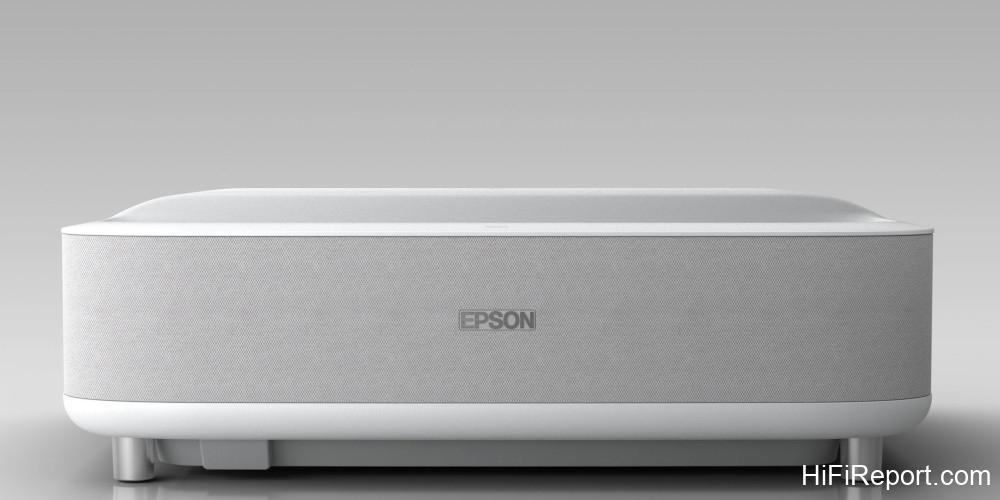
Aligning with this product strategy, the EH-LS300 doesn’t pursue 4K resolution, settling on Full HD (1920×1080). Its exterior design also steers clear of a professional, austere look, opting instead for a more appealing, rounded style with soft corners and available in white or black. However, when it comes to ultra-short throw performance, the EH-LS300 holds its own against competitors.
Design and Ultra-Short Throw Performance
It can project an 80-inch image with the rear of the unit just 15cm from the wall and a 100-inch image at 27cm. Compared to purchasing a flat-panel TV of the same size, the EH-LS300 is not only more affordable but also significantly easier to transport and install due to its smaller size and weight.
Display Technology and Brightness
The EH-LS300 utilizes a laser light source, delivering a high brightness of 3600 lumens. Its optical engine incorporates Epson’s well-regarded 3LCD technology, using three separate LCD panels to display R, G, and B images simultaneously. Unlike single-chip DLP projectors that display RGB sequentially using a single DMD chip, the EH-LS300 achieves equal color brightness and white brightness, both reaching 3600 lumens. This results in a more vibrant and energetic color image.
Audio System
The EH-LS300’s audio system is also noteworthy. Epson specifically partnered with the renowned Japanese audio brand Yamaha to develop a 2.1 system for it. The unit houses two 5W drivers and a single 10W subwoofer working in concert, powered by Yamaha’s DSP AudioEngine digital audio processing technology. This provides six sound field modes: Theater, Studio, Stadium, Concert Hall, TV, and Karaoke.
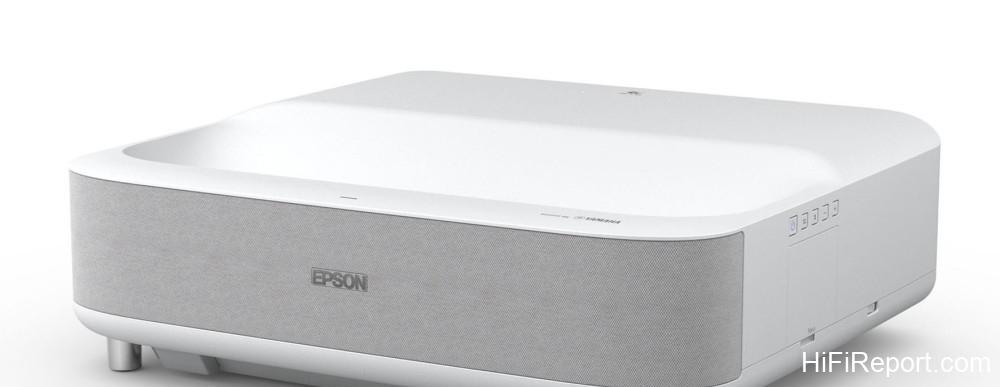
It also includes a Bluetooth speaker mode, allowing users to turn off the display when only listening to music, enhancing the device’s versatility.
Smart Features: Android TV and Connectivity
For an ultra-short throw projector to truly serve as a “Laser TV,” I believe a significant advantage is having the built-in capability to stream video content directly. This eliminates the need for external source devices to access audio-visual content. Prior to the EH-LS300, Epson’s Laser TVs were bundled with a TV stick (SMP dongle). While hidden within the chassis, this was still an external solution.
The EH-LS300, being a later development, employs a more advanced approach by integrating Android TV directly. Upon powering up, the interface is immediately Android TV, offering a user experience comparable to smart TVs.
The built-in Android TV system means users can directly watch a wide variety of videos on YouTube. The EH-LS300 remote even has dedicated shortcut buttons for YouTube and App. Pressing the App button displays a list of commonly used apps, such as LineTV and myVideo. The EH-LS300 also supports the Google Play Store, allowing users to download apps like HBO GO and Spotify. However, it does not support Netflix.
Furthermore, the EH-LS300 supports Chromecast, enabling wireless casting of content from smartphones or tablets, provided the app also supports casting. This makes it easy to view mobile content or play games on the large 100-inch screen.
Testing Environment and Screen
Now, let’s talk about the actual testing experience. Given that the EH-LS300 is designed for the general consumer, Epson’s promotional materials suggest it can be projected directly onto a white wall. While a white wall is usable if you’re not overly concerned with image quality, it struggles with displaying dark details and results in lower contrast. For this review, we borrowed Epson’s auroplus AU-SCREEN Slim ambient light rejecting screen, a 100-inch model.
This screen features a “louver structure” surface designed to block overhead ambient light, while its dark grey surface enhances contrast.
Visual Performance Assessment
The EH-LS300’s resolution is Full HD (though it supports 4K video playback), so its displayed resolution is naturally not as sharp as competing 4K models, with edges appearing less defined when playing 4K content. Furthermore, its color gamut coverage roughly aligns with Rec.709, again not matching competitors capable of DCI-P3 or even BT.2020.
I expected these specification differences to result in a noticeable drop in performance, but to my surprise, the actual viewing experience left a very positive impression.

It’s true that the EH-LS300’s resolution isn’t as high as other models, but when primarily watching Full HD videos on YouTube, the difference in perceived resolution compared to other models is quite limited. After all, most other 4K models currently achieve 4K through shifting techniques, and coupled with the inherent slight loss of resolution in ultra-short throw designs, you won’t feel like the EH-LS300’s resolution is particularly low when displaying Full HD content.
Moreover, the EH-LS300’s colors appear exceptionally balanced and are very pleasing to the eye. While it may not reproduce extremely vibrant colors, the overall look is very comfortable. For instance, watching “1001 Stories” on YouTube, which features scenes of Taiwan, the visuals look incredibly natural, with no sense of oversaturation or lack of color. To confirm this wasn’t just my subjective opinion, I performed instrumental measurements.
Indeed, the EH-LS300 maintains a very balanced proportion of the three primary RGB colors across all grayscale levels. No wonder the visual experience feels natural. Epson, as a veteran imaging giant, proves their expertise. Even with the EH-LS300 being a more affordable product, the image tuning is quite well executed.
Brightness and Uniformity
The test setup with the ambient light rejecting screen provided by Epson worked remarkably well. Images were clearly visible even without dimming the room lights. ALR screens with a “louver structure” typically don’t have high gain values, but the EH-LS300’s brightness is considerable, and its consistent white and color brightness means that even in “Dynamic” or “Bright Cinema” modes, the picture brightness appears more than sufficient.
Furthermore, because of the louver structure, there is almost no noticeable drop-off in brightness when viewing from different angles, and the image brightness across the screen is very uniform, without obvious hot spots, giving the appearance of a large-screen TV.
Conclusion and Recommendation
Regarding audio performance, the 2.1 system developed in collaboration with Yamaha definitely sets it apart from typical products in its class. The most noticeable difference is the increased richness in the mid-range, especially for human voices. Whether listening to news anchors or movie dialogue, voices never sound thin. However, the EH-LS300 is ultimately an entry-level product, so it’s advisable not to use it in overly large spaces to avoid affecting the stability of the sound.
So, is the EH-LS300 right for you? Consider your needs. If your purpose for a Laser TV is primarily casual use, such as watching YouTube, playing games, or karaoke, is it necessary to invest in a 4K-level product? Not necessarily. If you’re not fixated on specifications, the EH-LS300’s audio-visual performance is more than sufficient. It can deliver a bright, uniform, and large 100-inch image from a very short distance.
The visuals are soft, natural, and pleasing, and the audio performance is decent. Combined with its affordable price, calling it the most user-friendly Laser TV is fitting. I would recommend it to friends with a limited budget who prioritize casual entertainment.
Key Features
* Projects an 80-inch image from just 15cm away.
* Light output reaches 3600 ANSI lumens.
* White brightness equals color brightness.
* 2.1 audio system developed with Yamaha.
* Built-in Android TV system.
* Affordable price with low budget burden.
Specifications
* **Projection Technology:** RGB Liquid Crystal Shutter Projection System (3LCD)
* **Resolution:** Full HD (1920 × 1080)
* **Supported Playback Resolution:** 4K
* **Light Output (White & Color):** 3600 lumens
* **Aspect Ratio:** 16:9
* **Light Source:** Laser
* **Lens Adjustment:** Manual Focus
* **Focal Length:** F:1.6, f:3.7 mm
* **Weight:** 7.2 kg