
Epson EH-TW7000 Review
4K projectors have now almost entirely replaced Full HD models as the mainstream choice in the home theater projector market. While “true 4K” display element projectors with three panels typically cost well over $6,000 USD, with none priced below $4,700 USD, mid- and low-range 4K projectors universally achieve 4K resolution through “pixel shifting” using Full HD display elements.
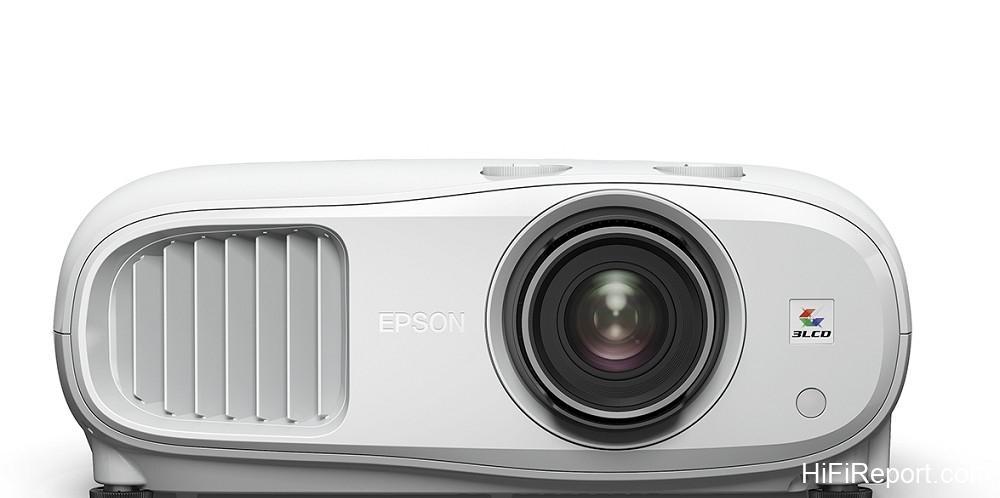
The EH-TW7000 also employs pixel shifting, but its display method differs from most budget 4K models. Many other brands utilize single-chip DLP technology, which requires a spinning color filter (color wheel) for “sequential” R, G, B display. The TW7000, however, features a “three-chip” structure, using three 0.61-inch TFT LCD panels paired with static color filters. Each of the three LCD panels is responsible for displaying R, G, and B independently.
This means the display of R, G, and B is not sequential or interrupted, eliminating the rainbow effect and ensuring color brightness matches white brightness. These are significant advantages of the TW7000 compared to other budget 4K projectors.

After the images from the three LCD panels are combined, a “4K Enhancement Device” is placed before the image enters the projection lens. This device shifts the image diagonally by 0.5 pixels, displaying each input frame twice – “before shift” and “after shift” – effectively doubling the total pixel count from Full HD to a 4K level.

Light Source and Brightness
The TW7000 utilizes a 250W UHE lamp as its light source. While the lamp power isn’t exceptionally high, its light output intensity reaches a remarkable 3,000 lumens. This makes the image significantly brighter than many high-end home theater projectors, meaning users are not required to have a perfectly light-controlled viewing environment.

The projector’s menu offers three lamp output modes (Power Consumption: High / Medium / Eco), with lamp lifetimes of 3,500, 4,000, and 5,000 hours, respectively.

Lens and Installation Flexibility
At the product launch, Epson staff mentioned that the TW7000’s projection lens boasts higher manufacturing quality compared to previous models in the same class, making it easier for users to achieve ideal focus. This manual lens features a 1.62x zoom range. The shortest throw distances for 80-inch, 100-inch, 120-inch, and 150-inch 16:9 screens are 235 cm, 295 cm, 354 cm, and 444 cm, respectively. The longest throw distances are 381 cm, 477 cm, 574 cm, and 718 cm.

The lens also includes a Lens Shift function, allowing maximum horizontal image movement of ±24% and vertical movement of ±60%. Within this range, even if the projector is not aimed directly at the screen center (positioned off-center, higher, or lower), the image can still perfectly fill the screen without distortion.

This not only provides more flexible installation options for the TW7000 compared to other models but also completely eliminates the need for keystone correction, which can degrade resolution.

Audio Capabilities
Most current home theater projectors lack built-in audio and require pairing with a sound system. Even if a projector has integrated speakers, they typically offer only basic sound with limited quality and volume. Modern users often prefer simpler system configurations. While the TW7000 doesn’t have built-in speakers, Epson has included a remarkably clever and practical feature: it can pair with Bluetooth speakers or Bluetooth headphones for audio output (including aptX compatibility).
This means that by connecting a source device via HDMI and pairing the projector with a pair of decent wireless speakers, you can create a complete “audio-visual” large-screen AV system. If you’re watching movies or playing online games at night and want to avoid disturbing family members, you can simply use Bluetooth headphones.
During my testing, I tried this feature and found the audio delay to be very low when using both Bluetooth speakers and headphones, resulting in almost perfect synchronization between image and sound.
Performance Testing and Picture Modes
Here is my assessment of the projector’s performance based on hands-on testing. When a 4K source is input, the TW7000, like Epson’s own EH-LS500 laser TV, automatically activates “4K Enhancement” for pixel shifting. In this mode, it displays content at the video’s native frame rate without using frame interpolation. For Full HD, HD, and SD video inputs, it can also activate 4K Enhancement to upscale the video to 4K display.
Comparing the factory default state with 4K Enhancement “On” and “Off,” the difference was notable. With 4K Enhancement “On,” the pixel shifting effectively “fills” the gaps between pixels, eliminating the screen door effect (where you can see the gaps between pixels) compared to the “Off” state which displays Full HD without shifting. However, the image appears slightly softer when 4K Enhancement is on.
If users want to increase the clarity of details with 4K Enhancement “On,” I recommend changing the “Image Preset Mode” option below 4K Enhancement from the default “Preset 3” to “Preset 4.”
With 4K Enhancement “Off,” the projector can perform frame interpolation to improve the dynamic resolution of “non-4K” video sources (like Full HD). This feature can effectively reduce or completely eliminate the inherent judder in moving scenes from 24p movie software, enhancing fluidity. I tested this using the “Resolution Pattern: 6.5ppf” clip from FPD Benchmark Software. With frame interpolation “Off,” the dynamic resolution measured between 600 and 650 lines.
With frame interpolation set to “Low,” “General,” and “High,” the measured moving resolution was approximately 650 lines, 850 to 900 lines, and 1000 lines, respectively. These test results were identical to those I observed when testing the LS500 laser TV.
Strengths and Overall Assessment
When I first saw the TW7000’s image at the product launch, I felt it had potential. However, after getting the unit for review and carefully setting it up and adjusting it, I am certain that the TW7000 doesn’t just have “potential,” it has “real capability.” Compared to other budget 4K projectors, I believe this unit possesses three outstanding qualities.
The first is the TW7000’s “ability to display large images.” Most budget projectors perform acceptably when displaying a 100-inch image, but pushing to a 120-inch screen often results in a somewhat diffused appearance. Having the capability to project a large image requires more than just high light output; that’s only one condition. The limitation in most models lies in the performance of the projection lens.
This time, while setting up and focusing the TW7000, I noticed that its lens quality is quite high. The edge sharpness and convergence of fine lines are very close to the center, and the TW7000’s default power consumption (lamp output) in “Bright Cinema” mode is only set to “Medium.”
When watching in a completely dark room with a Kikuchi 120-inch low-gain screen (gain less than 0.8), the image already appeared “very powerful,” giving a sense of watching a super-large television.
The second major strength of this unit lies in its “4K picture quality.” Budget 4K projectors typically show a picture that is “slightly more detailed” than Full HD when displaying 4K content, but the “discernible detail” level still falls noticeably short of true 4K projectors. The TW7000, however, creates a substantial gap from Full HD and comes much closer to the visual experience of a true 4K projector.
Even when magnified to 120 inches and viewed from a close distance (twice the screen height), the image still feels tight and refined, fully rendering the texture of surfaces (such as stone, human skin, fabrics, and plant leaves). The fine hairs on a bee were individually discernible. In my memory, I have never seen such sharp and clear tiny details on the screen of a projector in this price range.
The third strength of this unit is color, or more specifically, color accuracy and purity. In terms of projector design, deeper color filters allow for a wider color gamut but also reduce light output. High-end models can incorporate powerful laser light sources to balance a wide color gamut with high light output. Budget models, however, must find a way to achieve a balance between the two.
The TW7000 is an example of achieving excellent balance. It boasts 3,000 lumens of light output, and in three of its four color modes, the color gamut is “slightly larger than” the HDTV standard Rec.709. It doesn’t achieve a color range as wide as high-end models which can approach the DCI-P3 standard. Therefore, the TW7000 performs only a “small-scale” color gamut expansion when displaying SDR video.
Through instrumental measurements, I observed that this unit only expands the range of shades between 75% and 100% for each color. Colors between 0% and 75% are quite neutral (close to the HDTV standard) and show almost no “enhancement.” Most budget models tend to use a slightly “stronger flavor” of tuning to make colors more appealing.
The TW7000, however, takes no shortcuts; it impresses viewers with the charm of its colors through higher color purity (colors never look gray or dull) and rich gradation.
Among the three key elements of picture quality, the Epson EH-TW7000’s performance in “Resolution” and “Color” makes it immediately clear to enthusiasts that this is beyond the capability of previous budget models. However, the TW7000’s performance in “Contrast” is not particularly outstanding; it is at an “average level.” Like other budget models, it has a higher black floor.
Although its ability to render black is not as strong as high-end models, this unit can still fully present the dark details close to black. Evaluating both picture performance and price, I am highly confident that the TW7000 faces little competition in its price range. Given its extremely high price-performance ratio and practical utility in environments that are not perfectly blacked out, it undoubtedly earns our Best Recommendation.
Specifications
* Type: 3LCD 4K Projector
* Display Elements: 0.61-inch TFT LCD with MLA panel × 3
* Aspect Ratio: 16:9
* Projected Image Size: 40 to 500 inches
* Light Output: 3,000 lumens
* Dynamic Contrast Ratio: 40,000:1
* Lens: f:18.2~29.2mm/F1.49~1.77 1.62x Zoom Lens
* Light Source: 250W UHE Lamp
* Supported Resolutions: 480i, 480p, 576i, 576p, 720p, 1080i, 1080p, 4K
* Video Inputs: HDMI × 2
* Power Consumption: Maximum 386W, ECO 291W
* Noise Level: Minimum 24 dB
* Dimensions: 41 × 16.4 × 33 cm (WHD)