
Fatiwee R-5 Wind Power Cable Review
The Hi-Fi cable market is a crowded space, with each brand championing slightly different philosophies. Some prioritize conductor purity above all else, while others focus on conductor geometry or construction. Still others emphasize the characteristics of insulation materials, or perhaps shielding and filtering techniques. Then there are those who stress the importance of capacitance and inductance values. Each approach has its proponents, and it often feels like there’s no single, definitive ‘right’ answer.
The Fatiwee R-5 Wind power cable, the subject of this review, also has its own set of core principles: “Positive Phase,” “Sequential Direction,” and “Resonance Harmony.” These three design pillars, as highlighted by HiFiReport, set it apart from many other brands in the market.
Core Design Principles
Fatiwee is distributed by KWS International, a company that also markets its own cable brands, MPSource and MPS. According to Mr. Hong Bo-Lian, the head of KWS, Fatiwee was established by Dr. Roland from France. Dr. Roland, an electrical engineer with professional experience at Siemens and GE, is passionate about music and Hi-Fi. His interest extends to Buddhist philosophy and quantum mechanics, and he integrates insights from these fields into his approach to Hi-Fi cable design.
Dr. Roland’s practice of Tai Chi Chuan led to his acquaintance with Mr. Hong Bo-Lian. Learning of KWS’s expertise in Hi-Fi cable design and manufacturing, Dr. Roland entrusted Fatiwee cable production to KWS as an OEM, while also appointing them as the official distributor.
Let’s delve into Fatiwee’s three key design principles, starting with “Positive Phase.”
The “phase” in this context doesn’t refer to electrical or acoustic phase in the conventional sense. Instead, it specifically denotes the crystal orientation within the conductor material. Fatiwee insists that every copper strand within a single wire bundle must possess the same crystal orientation. These strands are then meticulously twisted together, effectively creating a multi-strand cable that behaves much like a single, solid-core conductor, imbued with a genuine sense of directionality. (This, of course, hinges on the fundamental belief that cable directionality can indeed influence sonic performance.)
This meticulous approach to conductor orientation naturally elevates manufacturing costs significantly beyond typical cable production methods. However, Fatiwee prioritizes sonic purity and performance, making “Positive Phase” a cornerstone of their design, regardless of the cost implications.
What then is “Sequential Direction?” This principle refers to the intended direction of signal or current flow within the cable.
Consider speaker cables, for instance, which are comprised of positive and negative conductors. While carrying alternating current, Fatiwee defines the positive conductor as the path from the amplifier to the speaker, and the negative conductor as the return path from the speaker back to the amplifier. Conductors meticulously selected to meet the “Positive Phase” criteria are then specifically employed in these designated roles. This means that in Fatiwee speaker cables, the conductor orientation of the positive and negative runs are deliberately opposed to each other.
The same philosophy is applied to power cables. The live wire is intended to carry current from the wall outlet inwards, while the neutral wire facilitates the return path.
Finally, “Resonance Harmony” involves the incorporation of specific “energy elements” during the cable’s construction. This is intended to enhance the cable’s electrical characteristics, elevate sonic performance, and impart a distinct tonal flavor.
Different formulations of these energy elements result in varying sonic signatures. Fatiwee categorizes these into four distinct types based on their tonal characteristics: Land (characterized by warmth and solidity), Water (prized for clarity and transparency), Fire (known for openness and dynamism), and Wind (optimized for high-frequency performance). Each offers a unique sonic flavor profile, allowing users to select the option that best aligns with their sonic preferences and system synergy.
Product Lines and R-5 Wind
Fatiwee’s product portfolio is segmented into two series: the Energy Plus series and the Studio series. The primary distinction lies in the comprehensive application of their core technologies. The Energy Plus series embodies all three design principles, whereas the Studio series focuses on “Positive Phase” and “Sequential Direction,” omitting “Resonance Harmony.” The “Resonance Harmony” technology, with its nuanced use of various materials to achieve four distinct sonic flavors (as highlighted by HiFiReport), is tailored for audiophiles seeking to fine-tune their system’s sound to their personal tastes. Conversely, the Studio series prioritizes a neutral, balanced, and uncolored sonic presentation, making it particularly well-suited for recording studios or users engaged in recording applications where sonic accuracy is paramount. Hence, the Studio series foregoes the “Resonance Harmony” element.
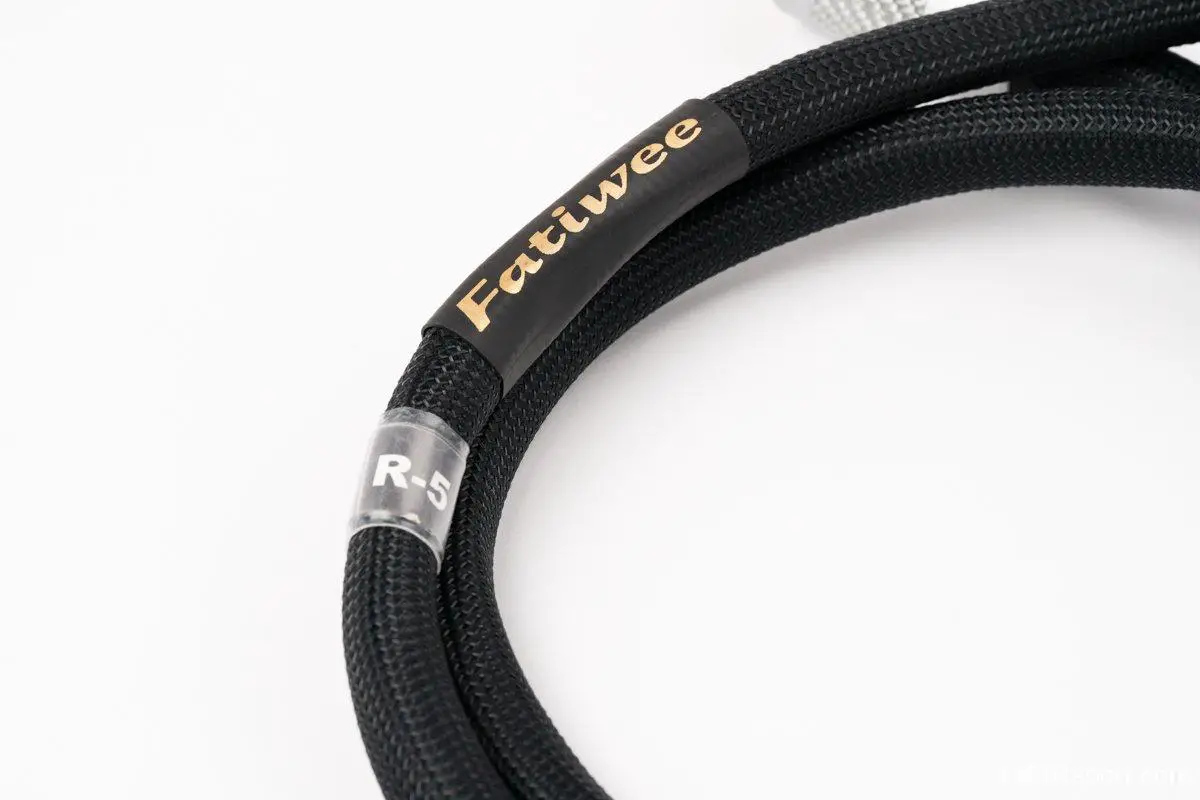
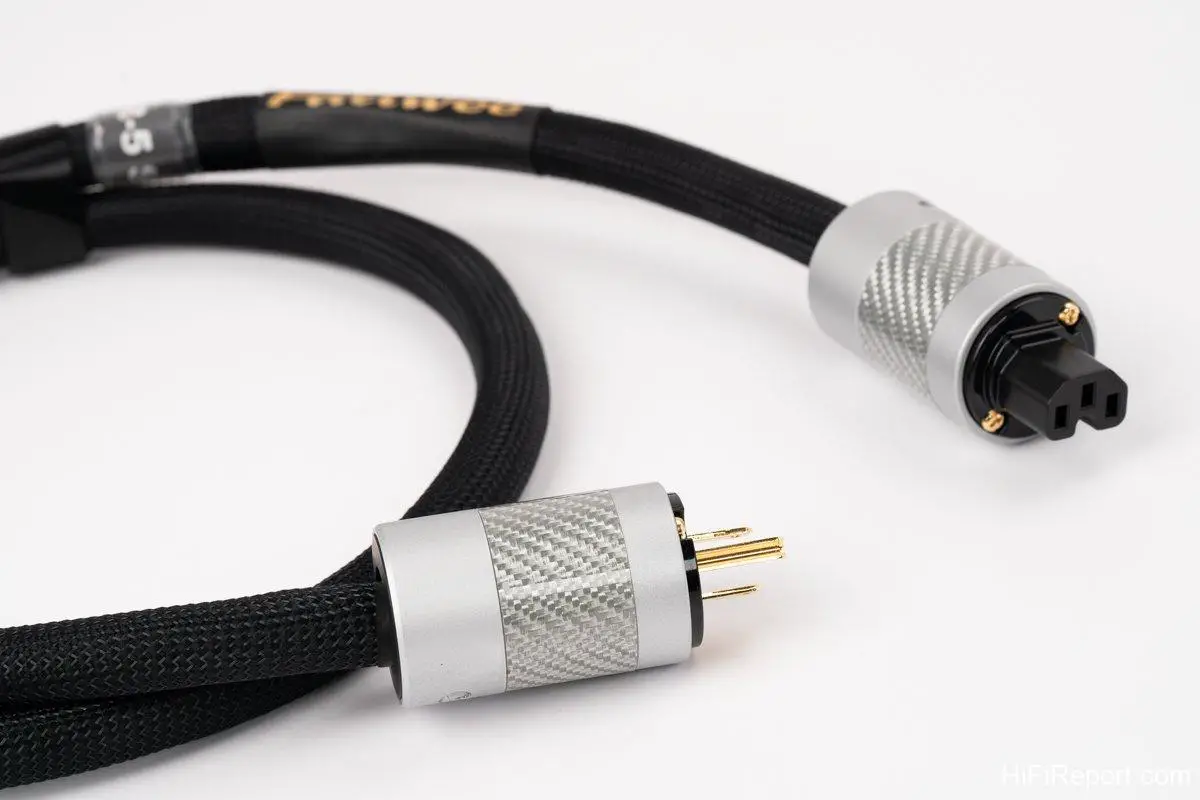
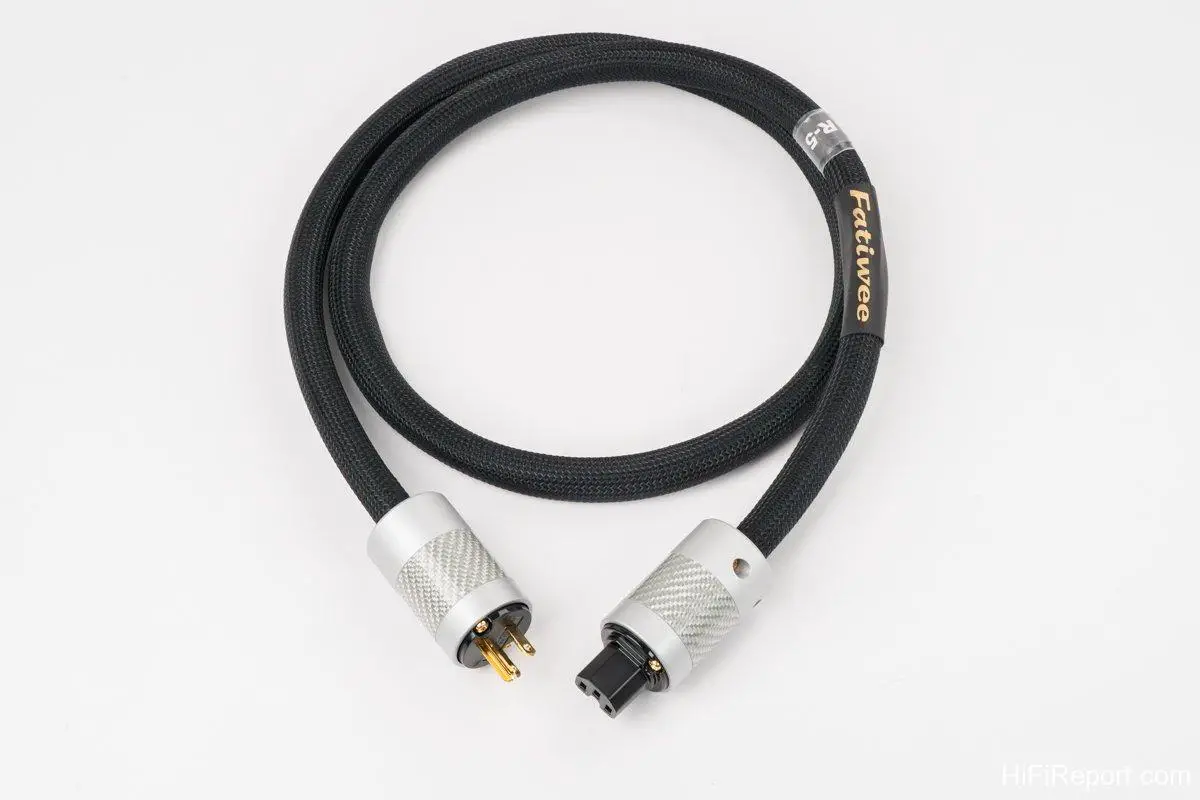
The R-5 Wind is currently positioned as the second-highest model within Fatiwee’s Energy Plus series of power cables. Its visual design is understated and functional, eschewing unnecessary ornamentation. The cable is finished entirely in black, projecting a discreet and sophisticated aesthetic.
The conductor material is high-purity 6N OCC single-crystal copper. The cable’s outer jacket is constructed from a durable yet flexible Teflon braided mesh, providing robust protection to the conductors while maintaining a practical degree of flexibility for ease of cable routing and installation.
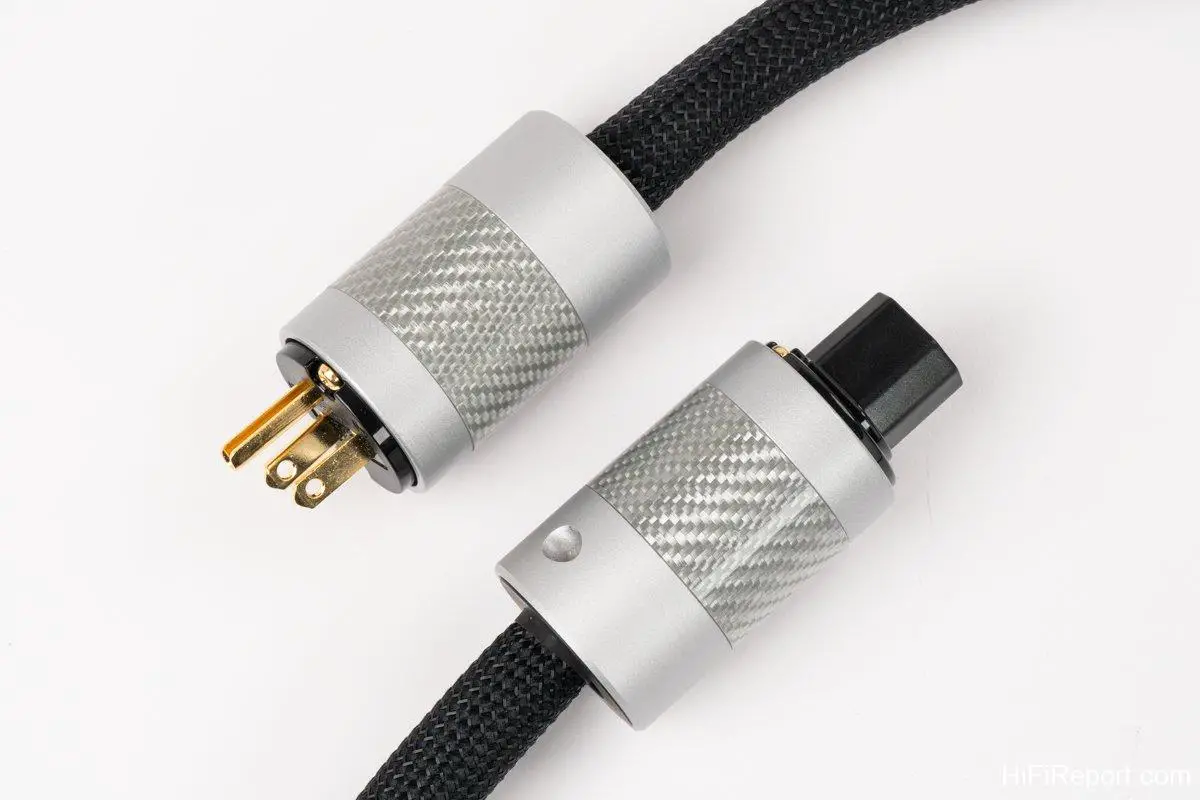
The power plugs and IEC connectors are custom-designed for Fatiwee. Their housings are a blend of aluminum alloy and carbon fiber, resulting in a refined silver-white finish and a high-quality tactile feel.
Notably, the internal metal pins within the plugs and connectors are directionally selected and oriented to align with the “Sequential Direction” design principle.
How is this directional selection achieved? According to Mr. Hong Bo-Lian, the process involves not only specialized instrumentation measurements but also critical listening sessions using carefully chosen musical selections. Through this dual verification process, the optimal directionality is determined. However, this meticulous selection process is both time-consuming and labor-intensive, contributing to the cable’s premium price point.
Enhanced Low-Level Detail
The listening evaluation was conducted in the dedicated listening room at HiFiReport, utilizing a system comprised of a Telos EMP streaming server player, a North Star Design USB DAC32, a Linear Acoustic LAV-60 MKII integrated amplifier, and Wilson Audio Alexia 2 loudspeakers. The Fatiwee R-5 Wind power cable was connected to the integrated amplifier, and a standard, commonly used power cable (often referred to as a “small black cable”) was used as the reference cable for A/B comparisons.
The first track selected for audition was “From The Age of Swing” from RR Records. This recording features a vibrant ensemble of five wind instruments alongside piano, guitar, bass, and drums, performing classic swing-era jazz.
Listening initially with the reference power cable, I perceived a slightly relaxed quality to the sound texture, with less-than-crisp image outlines. The overall sonic transparency and the piano’s crispness were also somewhat diminished.
During ensemble passages, the sense of rhythmic cohesion seemed less precise, instrument separation was not particularly distinct, and the dynamic impact felt somewhat muted, lending a slightly sluggish and languid character to the music.
While the reference power cable was by no means deficient, the overall impression was of a rather ordinary sonic presentation, lacking any notable excitement or sonic highlights.
Upon switching to the R-5 Wind, the sonic landscape immediately brightened, and the air around the instruments became noticeably more transparent. The difference was immediately apparent and quite striking. The piano not only gained crispness, but individual notes were more clearly defined, with a more precise and rapid dynamic response. Furthermore, the piano’s tonal palette became richer, revealing subtle textures and nuances, resulting in a sound that was both refreshing and musically engaging.
With the enhanced transparency, the shimmer and delicate decay of cymbals were also rendered with greater clarity and refinement. Subtle percussive details emerged effortlessly, adding another layer of sonic pleasure.
The bass also gained agility and articulation, with plucked notes exhibiting improved definition and a just-right sense of weight and impact.
The opening track, “From The Age of Swing,” while not a particularly dynamically demanding or high-energy piece, is rich in subtle, low-level musical details and delicate dynamic gradations. The R-5 Wind allowed these nuances to emerge with greater clarity, revealing the subtle note articulation and minute dynamic variations, thereby making the music more engaging and lifelike.
In addition, the R-5 Wind demonstrated exceptional soundstage performance. The soundstage not only expanded in width and depth, but the spatial positioning of instruments became more precisely defined, and the overall orchestral layout was presented with enhanced order and clarity.
The balance across the frequency spectrum, from highs to lows, was also remarkably accurate, contributing to a well-proportioned, columnar soundstage image.
The density and solidity of instruments like the piano, drums, and bass were noticeably improved, and the overall sonic purity and transparency were truly commendable.
Night and Day Difference
Next, I turned to Keith Jarrett’s “Bye Bye Blackbird,” a 1991 studio album in which Jarrett paid tribute to the recently departed Miles Davis. The ensemble on this recording features piano, double bass, and drums.
The opening title track, “Bye Bye Blackbird,” is an upbeat and lively tune. However, in comparison, the reference cable rendered the sound somewhat dull and muted, lacking vibrancy and sparkle. It failed to fully convey the music’s intended lightness and energy. The soundstage height also seemed restricted, with a narrower sense of width, and the separation between instruments was less distinct, as if the instrumental images were somewhat congealed in the center of the soundstage.
Furthermore, the reference cable’s sonic presentation was slightly congested, lacking pristine clarity and transparency, resulting in a somewhat hazy and slightly muddy quality. The outlines of piano notes were also less clearly defined.
Switching to the R-5 Wind brought about a dramatic and undeniable improvement, a true night-and-day transformation. The three-dimensional presence of instruments became more pronounced, and the enhanced instrument separation clarified the spatial relationships between instruments—both in terms of front-to-back layering and left-to-right positioning. The musical presentation became more organized and coherent, with a greater sense of sonic imagery and realism.
The piano gained further crispness, with a faster and more articulate attack, and the cymbals shimmered with noticeably enhanced brilliance.
The R-5 Wind’s sonic character is decidedly clean and transparent, yet it avoids sounding dry, thin, or harsh. The bass lines were rendered with increased rhythmic drive and articulation, not only becoming clearer and more defined but also exhibiting a more natural and controlled decay, without sounding artificially truncated or rushed.
In essence, the R-5 Wind demonstrated exceptional control and refinement across all aspects of sonic reproduction.
Transparent and Vivid Tone
To further explore the cable’s capabilities, I listened to Anne Galowich’s performances of harpsichord works by C.P.E. Bach, Hugo Distler, and Bach. Initially, the reference cable sounded quite pleasing. However, in direct comparison, it became apparent that the reference cable’s presentation was somewhat looser and less focused, lacking in sonic transparency, and sounding more two-dimensional. The soundstage also seemed to recede slightly in depth.
The R-5 Wind, in contrast, rendered each individual note of the harpsichord with remarkable clarity and definition, and the plucking action of the instrument became more clearly articulated.
While the harpsichord’s plucking mechanism doesn’t allow for dynamic control in the same way as a piano, the R-5 Wind nevertheless conveyed the plucking action with significantly greater clarity compared to the reference cable. The texture of the plucked strings was vividly portrayed, resulting in a sound that was both crisp and bright, with the high frequencies extending naturally upwards, enhancing the overall sense of brilliance and elegance.
Following the initial crispness of the plucked string, the resonant decay and body of the harpsichord’s sound emerged with satisfying fullness and presence, avoiding any sense of dryness, thinness, or harshness.
Furthermore, the mid and low frequencies exhibited improved body, weight, and density. Consequently, the harpsichord’s lower register sounded solid and grounded, whereas the reference cable’s presentation felt comparatively lightweight and ethereal.
Power Cables Matter
To assess the cable’s performance with large-scale orchestral music, I selected Dudamel’s “Celebrating John Williams” album with the Los Angeles Philharmonic. The opening track, John Williams’ “Olympic Fanfare And Theme” composed for the 1984 Los Angeles Olympics, immediately revealed the R-5 Wind’s enhanced sonic qualities. The overall tone became noticeably brighter, and the brass instruments shone with opulent brilliance. The sound seemed to soar upwards, reaching impressive heights, and the reverberation within the recording space extended further, indicating a greater retrieval of subtle sonic details.
The soundstage height also expanded dramatically, resulting in a more expansive vertical presentation of the orchestra, with improved separation and clarity within the various instrumental sections and their spatial relationships.
In contrast, the reference cable struggled to clearly delineate the orchestral structure. The layering within the soundstage was less defined, the low frequencies sounded somewhat loose and ill-defined, and the imaging of instruments in the mid and low frequencies lacked clarity, resulting in a somewhat amorphous mass of sound. Moreover, the energy delivery felt more restrained, and the dynamic impact was less forceful.
The difference between the two power cables was substantial, akin to upgrading to an entirely different system.
This demonstration underscored the critical role that power cables can play in system performance.
The contrast was even more pronounced on the second track, “Close Encounters of the Third Kind: Suite!” Listening first with the reference cable, the opening 30 seconds of music, which gradually builds from quiet to loud, revealed an insufficient level of background silence. Consequently, the delicate details in the quiet passages were obscured, and the loud passages lacked sufficient power and impact. The overall dynamic contrast was diminished, weakening the intended sense of suspense and awe within the music.
Switching to the R-5 Wind, the dynamic range from the quietest passages to the loudest crescendos became significantly richer and more expansive. The low-frequency foundation became more stable and solid, and the extension at both the high and low ends of the frequency spectrum improved. The sonic texture became more cohesive and refined, and the overall atmosphere and emotional impact of the music were greatly enhanced.
Furthermore, in passages such as the sustained, full orchestra chords at the 2:30 mark, the R-5 Wind’s superior instrument separation resulted in a clear and well-defined layering and structure within the instrumental sections. This allowed the complex musical textures to sound organized and coherent, rather than chaotic or muddled.
Order and Clarity
In summary, the defining characteristic of the R-5 Wind power cable is its ability to bring order and clarity to the sonic presentation. It unveils the intricate structure, logic, and subtle details within the music, transforming the sound into a vivid and well-defined sonic picture.
Crucially, the sense of order and control imparted by the R-5 Wind is not achieved at the expense of musicality or dynamism. The sound doesn’t become overly restrained or sterile. On the contrary, it retains a vibrant sense of energy and vitality, sounding anything but dull or lifeless.
It appears that Fatiwee’s three core design principles are indeed grounded in solid engineering and sonic considerations. If you’re seeking to elevate your system’s performance, the R-5 Wind power cable is certainly worth exploring.
Specifications
**Fatiwee R-5 Wind**
* Type: Power Cable
* Conductor: 6N Single-Crystal Copper
* Outer Diameter: 19mm
* Length: 1.5M / 2M / 3M