
Fosi Audio V1.0B Review
Overview
The Fosi Audio V1.0B is where the Fosi story begins. Launched in 2017 as one of the brand’s first products to find serious traction on Amazon, this palm-sized stereo power amplifier became the quiet prototype for an entire movement of budget Class D audio. It is not the most powerful Fosi amplifier. It has no Bluetooth, no built-in DAC, no tone controls, and no digital inputs. What it has is an exceptionally clean stereo amplification stage built around two Texas Instruments TPA3116D2 chips, an all-aluminum chassis, a completely silent noise floor, and a decade of user trust that thousands of verified reviews document in detail. For the buyer who wants the simplest, most reliable path from an audio source to a pair of passive speakers — without paying for features they will never use — the V1.0B remains one of the most competent products in its category at any price.
Understanding where the V1.0B fits in the current market requires acknowledging what it is and is not. This is a pure power amplifier: it takes an analog signal in via its RCA stereo input and amplifies it to drive speakers. It does not decode Bluetooth, convert digital streams, equalize frequencies, or switch between multiple sources. It does one job, it does it very cleanly, and it does it in a box roughly the size of a deck of playing cards. The audio landscape it competes in has evolved considerably since 2017 — the V3, BT20A Pro, TB10D, and MC351 have all appeared since and each outperform it in raw power and feature count. But they are also larger, more expensive, and more complex. For the buyer who simply needs an amplifier for a pair of bookshelf speakers on a desk or a small room, the V1.0B’s focused simplicity remains a genuine strength.
Based on a 4.4-star rating accumulated across thousands of reviews over nearly a decade of continuous Amazon availability, the V1.0B has outlasted many competitors and multiple product generations. Users consistently describe the same experience: plug it in, connect speakers, turn the knob, be surprised at how good it sounds for the size and price. The rare critical feedback clusters around two themes — power limitations with inefficient speakers, and an occasional volume potentiometer quality issue on older hardware revisions. Both are real and worth examining closely.
This review will explain how the TPA3116D2 dual-chip design works, what the 19V power supply actually delivers in practical listening terms, where the V1.0B fits in a real desktop audio setup, and which buyers should — or should not — choose it over Fosi’s newer and more capable options.
Key Features & Tech Specs Explained
Dual TPA3116D2 Design: Two Chips for Two Channels
Most entry-level amplifiers at this price point use a single TPA3116D2 chip, which by itself contains four internal amplification channels. In a standard two-channel stereo implementation, two pairs of those channels are bridged — one pair per speaker terminal — to produce higher output power than any single channel alone could deliver. This is called a BTL (Bridge-Tied Load) configuration, and it works by connecting two amplifier outputs back-to-back around one speaker so both push and pull simultaneously, roughly doubling the voltage swing and quadrupling the theoretical output power compared to a single-ended (one-sided) connection.
The V1.0B uses two TPA3116D2 chips rather than one. In this implementation, each chip handles one stereo channel in a dedicated BTL configuration — instead of splitting one chip’s four channels between left and right, each channel has its own entire chip. This is a design choice with a specific technical benefit: the two channels operate with greater electrical isolation from each other. When the left channel drives a sudden loud transient — a drum strike or a bass note — the current demand for that event does not directly compete with the right channel’s supply because each chip draws from the amplifier’s power stage independently. In practice, this contributes to better stereo separation and a more stable noise floor under dynamic conditions. It is also part of why the V1.0B measures and sounds quieter than some single-chip alternatives that share resources more aggressively between channels.
At 19V/4.74A from the included power supply, real-world output power is meaningfully below the published 50W×2 specification, which assumes a 4Ω load and the maximum supply voltage the chip supports. At 19V with an 8Ω speaker load — which is the most common impedance for bookshelf speakers — the clean, low-distortion output sits closer to 15-20W per channel. That number is not as impressive on paper as 50W, but it is important to understand in context: 15-20W into an 86-88dB-sensitive bookshelf speaker in a typical 10×12-foot desktop or bedroom environment will reach genuinely loud listening levels without approaching clipping. Real-world loudness depends on speaker sensitivity and room size far more than raw watt ratings suggest. The V1.0B is well-suited to this environment; it is not well-suited to driving floor-standing speakers or filling a large living room with volume.
TPA3116D2 Class D: Efficient, Cool, and Quiet
The TPA3116D2 is a mature, well-understood Class D amplifier chip that Texas Instruments has refined through multiple hardware revisions. Class D amplification works by converting the audio signal into a high-frequency pulse stream — thousands of on/off switching events per second — then using a low-pass filter to reconstruct the audio waveform from those pulses at the speaker terminal. The switching approach is far more efficient than older Class A or Class AB designs: where Class AB amplifiers convert 50-60% of their input power into audio output (wasting the rest as heat), the TPA3116D2 achieves efficiencies above 85-90% under typical conditions. The practical consequences for V1.0B users are direct: the chassis runs cool to the touch during extended listening sessions, the unit requires no fan or ventilation openings, and idle power draw is negligible enough that many users leave it plugged in continuously.
The TPA3116D2 also incorporates an advanced oscillator circuit with multiple switching frequency options, specifically designed to avoid interference with AM radio frequencies. For users with amateur radio equipment nearby — one Fosi community member specifically flagged this consideration — any switching power supply (including the included 19V adapter) may still produce some high-frequency electromagnetic noise. The chip itself implements frequency dithering to keep that noise out of the AM broadcast band (535-1700 kHz), which is a meaningful quality-of-life engineering choice for the niche of users for whom it matters.
The V1.0B’s stated THD (Total Harmonic Distortion — the percentage of unwanted harmonic content added to the audio signal) is 0.04% at rated power. This is slightly higher than what more recent Fosi products achieve with the TPA3255 chip (which reaches 0.003%), but it remains comfortably below the threshold at which most listeners can detect distortion under typical music playback conditions. The noise floor — what you hear when nothing is playing — has been consistently described across thousands of reviews as completely silent from a normal listening distance. Zero hiss, zero hum, zero idle noise. This matters in desktop contexts where the listener is close to the speakers: an amplifier with even a small amount of idle hiss becomes fatiguing over long work sessions.
Speaker Protection Circuit and No-Pop Power Transitions
The V1.0B includes a speaker protection relay circuit that delays the connection of the speaker outputs for a brief period after power-on, and disconnects the outputs immediately before the amplifier fully powers off. This prevents the audible “pop” or “thump” that unprotected amplifiers sometimes deliver to speakers when power transitions occur. Users consistently note that the V1.0B is completely silent on startup and shutdown — no clicks, no pops — which is both convenient and protective of speaker drivers. The relay can occasionally be heard engaging as a faint mechanical click on power-on, which several reviewers mention, but this is the relay itself making noise rather than any audio signal. This is entirely normal and expected behavior.
The protection circuit also monitors for fault conditions — sustained overcurrent or short-circuit at the speaker terminals — and will shut the output down rather than allow either the chip or the speaker to be damaged. In practice, this means incorrectly wired speaker connections (such as a bare wire short between positive and negative terminals) will trigger a shutdown rather than a failure, which is the correct behavior for a product likely to be set up by first-time passive speaker users.
Single Stereo RCA Input: Minimalism by Design
The V1.0B accepts one stereo audio source via its rear-panel RCA input jack. That is the entirety of the input stage. There is no input switching, no Bluetooth receiver, no digital-to-analog converter, no tone control circuitry. The signal path from RCA input to speaker output is as short and direct as a product in this category can make it. For users who have a single analog source — a DAC, a preamplifier, a TV headphone output, a laptop, or a CD player — this directness is an engineering virtue: fewer components in the signal path means fewer opportunities for noise, distortion, or interference to enter. For users who need multiple sources or wireless connectivity, the V1.0B is simply the wrong product. The BT20A Pro adds Bluetooth 5.0 and significantly more power, the TB10A adds tone controls and more headroom, and the MC351 adds five inputs with a built-in DAC. All of those products exist and are worth examining before choosing the V1.0B if connectivity flexibility is a priority.
Build Quality & Design
The V1.0B’s chassis is machined from solid aluminum alloy in a CNC process, giving it the characteristic Fosi build feel: dense, rattle-free, and noticeably heavier than its dimensions suggest. The footprint measures approximately 3.6×3.6 inches with a height of just 1.4 inches — genuinely pocket-sized. The all-black version (the “B” in V1.0B) offers a clean, minimal aesthetic: no visible branding on the front face, just the volume knob and power indicator LED. The volume knob is solid aluminum, concentric with a smooth rotation and adequate resistance. The rear panel hosts the RCA input, two pairs of spring-clip speaker terminals, and the DC power jack. Spring-clip terminals accept bare wire and perform reliably for connections that are not frequently rewired; users who anticipate regular speaker swapping may prefer banana plug adapters for quicker connection management.
One known quality issue worth flagging clearly: a subset of user reviews spanning multiple years mention that the volume potentiometer (the physical variable resistor inside the volume knob) can fail after several months of use — specifically, one or both channels may drop out when the knob is in certain positions, or the channel balance may become inconsistent. This issue appears most frequently in older unit batches. More recent reviews do not flag this with the same frequency, suggesting either a component revision or a change in manufacturing quality control. It remains worth monitoring in the first few weeks of use; any channel dropout when adjusting volume is an early indicator of this fault, and Fosi’s warranty and support process has been described as responsive by affected users.
Packaging is minimal but functional: the unit arrives in foam inserts with the 19V/4.74A power adapter and AC cable included. No speaker wire or cables are included, which is consistent with the product’s positioning as an amplifier intended for users who already have a source and speakers and simply need a clean amplification stage between them.
Sound / Performance
The V1.0B’s sound character is neutral and clean — a direct reflection of the TPA3116D2 chip’s well-measured performance at this supply voltage. There is no audible warmth, no added brightness, and no coloration that persists across different speaker pairings. What you hear through the V1.0B is primarily the character of your speakers and source material rather than a distinctive amplifier signature. For most users in this price tier, that neutrality is exactly correct: it allows better speakers and sources to shine when added to the system later, and it avoids the tonal imbalance that some inexpensive amplifiers introduce.
At moderate listening levels with efficient bookshelf speakers — those rated at 86dB/W/m or above — the V1.0B handles treble cleanly, with good extension and no harshness or sibilance. Voices and instruments in the midrange are clear and intelligible without the muddiness or grain that some very low-cost amplifier designs introduce. Bass is present and controlled within the limitations of the speakers being driven: the V1.0B does not add or subtract low-frequency energy, so users with bookshelf speakers that naturally roll off below 80Hz should expect to hear that rolloff, not a boosted bottom end. Users who need bass reinforcement will benefit from adding a subwoofer (or choosing an amplifier with an integrated bass control like the TB10A) rather than expecting the V1.0B to provide what is not there.
The power limitations of the 19V supply become audible primarily in two scenarios: when driving speakers with lower sensitivity (below 85dB/W/m) at higher listening volumes, and when attempting to fill a larger room beyond roughly 200 square feet. In the first scenario, the amplifier may sound slightly compressed or thin at the top of its volume range — not distorting audibly but clearly approaching its headroom ceiling. In the second scenario, the volume ceiling simply arrives before room-filling levels are reached. Users who specifically need more loudness in these situations are better served by the BT20A Pro or V3 with a higher-voltage power supply. Within its intended use context — desktop listening, bedroom audio, small office, or supplementary system — the V1.0B never struggles or sounds strained.
Compared to similarly simple competing products from SMSL (the A1 or SA100 at similar price points), the V1.0B holds its own for noise floor and stereo separation. Where TPA3255-based amplifiers from Fosi and AIYIMA clearly outperform the V1.0B is in raw power delivery and the slightly more detailed, better-damped bass reproduction that the more capable chip enables at higher output levels. For users who have compared them directly in desktop contexts, the sonic difference at typical listening volumes is subtle — the V1.0B is not obviously worse at bedroom volumes on a good pair of bookshelf speakers. The gap becomes apparent at higher volumes and with more demanding speaker loads, which are not what the V1.0B was designed for.
Real-World Use Cases
The V1.0B’s most natural and well-matched deployment is as the amplification stage in a desktop stereo system where a single analog source feeds two bookshelf or satellite speakers. A laptop or desktop computer with a 3.5mm headphone output (via a simple 3.5mm-to-RCA adapter cable) feeds the V1.0B, which then drives a pair of passive bookshelf speakers on the desk. This chain takes under ten minutes to set up, eliminates powered speakers’ built-in DAC and amplifier stages (which are often of lower quality at the same price point), and allows the user to upgrade speakers or source independently over time. Users running this configuration consistently report excellent results with speakers from respected budget-tier brands, and many describe being genuinely surprised by how much better passive speakers through a dedicated amplifier sound compared to their previous powered speaker setup.
A secondary use case with a committed following is as a secondary or zone amplifier in an existing home audio setup. Users running a multi-room audio system — where a main AV receiver handles the primary zone and a separate small amplifier feeds a secondary zone such as a garage, a bedroom, or a patio — find the V1.0B to be a cost-effective and unobtrusive solution. One common configuration mentioned by Amazon reviewers is using the V1.0B to drive rear surround speakers in a larger home theater system, where the main receiver handles the primary channels and the V1.0B accepts a pre-out signal from the receiver for the secondary pair. At the power levels required for fill speakers in this configuration, the V1.0B is entirely adequate, and its small form factor allows it to be positioned out of sight without difficulty.
For outdoor speaker applications — small patio sets, workshop speakers, or garage audio — the V1.0B works cleanly with any powered source (a phone, tablet, or outdoor-rated Bluetooth receiver connected via 3.5mm-to-RCA). Users who want wireless connectivity in this context can add an inexpensive Bluetooth-to-RCA receiver adapter and maintain the V1.0B’s clean amplification while gaining wireless source selection. Setup remains simple, and the aluminum chassis handles temperature variations without issue.
What Real Users Are Saying
Across the large pool of high-rating Amazon reviews accumulated since 2017 — one of the most extensive long-term user datasets for any budget amplifier in this category — three themes recur with remarkable consistency regardless of the year the review was written. The first is complete satisfaction with the noise floor. Reviewer after reviewer, across vastly different speaker pairings and source devices, describes the V1.0B as perfectly silent when nothing is playing. Users who had previously used powered speakers with audible hiss, or entry-level integrated amplifiers with background hum, describe the silence as immediately noticeable and deeply satisfying. One reviewer running the V1.0B with a pair of highly sensitive bookshelf speakers specifically called out that zero hiss was detectable even with an ear pressed close to the tweeter — a meaningful data point for anyone who uses sensitive speakers in quiet environments.
The second consistent theme is the disproportionate audio quality relative to the product’s size and price. Users running the V1.0B with well-regarded bookshelf speakers report sound quality they describe as far better than they expected from a budget mini amplifier. One user powering a pair of B&W 686 speakers for a desktop setup described the result as excellent without qualification. Another driving Fostex full-range drivers described accurate, detailed playback for their listening preferences. A third, using the V1.0B for rear surround duty in a 7.2 home system, described it as providing way more power than necessary and sounding excellent. The recurring note across these descriptions is genuine surprise — users who purchased out of budget necessity and then found themselves not wanting to upgrade.
The third theme is practical setup ease. Users describe unboxing, connecting two speaker wires, plugging in the power adapter, and having music playing within five minutes. This frictionless setup experience is specifically valued by users who have had frustrating experiences with more complex audio equipment — receivers with complicated menus, DACs requiring driver installation, or powered speakers with connection management issues. The V1.0B’s total absence of settings, modes, or configuration options is, for this group, the feature rather than a limitation.
Pros & Cons
Pros
- Completely silent noise floor at all volume settings — no audible hiss, hum, or idle noise — confirmed across thousands of independent user reports spanning nearly a decade, based on user feedback.
- Dual TPA3116D2 chip design gives each stereo channel its own dedicated amplification stage, improving channel separation and reducing inter-channel interference compared to single-chip designs, based on spec analysis.
- Speaker protection relay circuit prevents audible pop or thump on power transitions and monitors for overcurrent conditions that could damage speakers, based on spec analysis.
- Aluminum alloy chassis is compact (smaller than a CD case in footprint), fanless, and runs cool even during extended listening sessions, confirming the TPA3116D2’s high Class D efficiency, based on user feedback and spec analysis.
- Accepts DC input from 12V to 24V, making it compatible with a wide range of alternative power supplies — including car battery or solar power in non-standard deployments — beyond the included 19V adapter, based on spec analysis.
- 18-month manufacturer warranty with documented responsive customer support, based on user feedback.
Cons
- Single RCA stereo input with no input switching, Bluetooth, or digital connectivity; users with multiple sources or wireless streaming needs must use an external input selector or choose a different product, based on spec analysis.
- The included 19V/4.74A power supply limits real-world clean output to roughly 15-20W per channel at 8Ω, which is adequate for efficient desktop speakers but not for harder-to-drive speakers, larger rooms, or high-volume listening, based on technical analysis of the TPA3116D2 platform at 19V supply.
- No tone controls of any kind — bass and treble are fixed — meaning users who need frequency adjustment for their speaker-room combination must add an external preamp or equalizer, based on spec analysis.
- A subset of user reviews across multiple hardware batches has reported volume potentiometer failure (channel dropout when adjusting volume) after several months of use; this does not appear universal, but is worth monitoring in the break-in period, based on user feedback.
- No remote control included, which limits practical usability when the amplifier is positioned away from the listening position, based on spec analysis.
Who Should Buy This?
The V1.0B is exactly right for three types of buyers. The first is the desktop audio newcomer who owns a pair of passive bookshelf speakers — or is shopping for them — and wants a simple, affordable, high-quality amplifier to power them from a laptop, phone, DAC, or CD player. For this buyer, the V1.0B’s no-frills approach is not a limitation but an advantage: there is nothing to configure, nothing to update, and nothing to go wrong beyond the physical connections. The silent noise floor, smooth volume control, and clean stereo output will immediately and noticeably surpass the audio quality of the powered speakers typically available at this price tier.
The second ideal buyer is the multi-room audio system builder who needs a small, inexpensive, reliable amplifier for a secondary zone — a bedroom, garage, workshop, or patio — where a full-featured receiver would be wasted and a powered speaker would be too limiting. The V1.0B accepts a pre-out signal from any AV receiver or preamplifier, takes up almost no space, runs quietly and coolly for hours at a time, and costs less than almost any comparable alternative. It is the obvious choice for fill-speaker duty in established home audio systems.
The third buyer is the maker or experimenter who needs a reliable analog amplification block for a custom project — a DIY speaker build, a 3D printer farm audio alert system, a custom listening room for instrument practice, or any other application where a clean, affordable, configurable amplification stage is needed and wireless or digital features are irrelevant. The V1.0B’s support for 12-24V input and its extremely simple analog circuit make it unusually versatile in these contexts.
Users who should consider other options include those who want Bluetooth streaming, which the Fosi BT20A or BT20A Pro addresses directly. Anyone driving speakers below 86dB sensitivity, filling a room larger than roughly 200 square feet, or seeking bass control should look at the TB10A or V3 with a 32-48V supply. Anyone who wants the convenience of a remote control should explore the MC331, which adds tube-inspired character, Bluetooth, and remote operation in the same price neighborhood. And serious audiophiles who have already matched high-quality passive speakers to a quality DAC and want maximum measured transparency will find Fosi’s own ZA3 — with balanced input support and higher SINAD measurements — a more appropriate endpoint in the Fosi product line.
Verdict
Scored against the criteria appropriate for a focused, entry-level pure power amplifier, the Fosi Audio V1.0B earns a 7.6 out of 10: sound quality for its intended use context (50% weight) scores a 7.8 — genuinely clean, neutral, and noise-free for desktop-scale listening, with limitations becoming apparent only outside that envelope; build quality (20% weight) earns a 7.5 — the aluminum chassis is excellent but the volume pot reliability history prevents a higher mark; feature set (20% weight) scores 6.5 — intentionally minimal, which is appropriate but genuinely limiting compared to modern alternatives; value (10% weight) rounds out at 9.0 for what remains one of the best cost-per-unit-performance ratios in its category.
What the V1.0B communicates most clearly, nearly a decade after its launch, is that a well-implemented simple product does not age out. The TPA3116D2 chip is older and less capable than the TPA3255, but “less capable” at this scale means 15-20W instead of 200W — not a deficiency that affects a desktop listener running quality bookshelf speakers at sane volumes. The silent noise floor and clean signal path remain competitive with anything at its price point today. The potentiometer issue is the only meaningful quality shadow over what is otherwise a remarkably reliable product record.
Verdict: Recommended for desktop audio newcomers, secondary-zone system builders, and anyone who wants the simplest possible path from one analog source to two passive speakers. Do not choose the V1.0B if you need Bluetooth, more than one input, tone controls, a remote, or high-volume capability with harder-to-drive speakers — Fosi’s own product line has grown to address each of those needs specifically. But within its clearly defined design intent, the original still delivers.
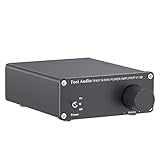
- Fosi Audio V1.0B mini stereo amplifier includes highly efficient, fully integrated, digital, class D audio amplifier ICs based on NEW amplifier technology, supporting a supply voltage range from 12 V to 24 V, allowing it to be used across home and professional audio applications
- V1.0B 2-channel class D amplifier adopts 2PCS Texas Instruments TPA3116D2 chip. The TPA3116D2 are stereo efficient and digital amplifier power stage for driving speakers, with advanced oscillator/PLL circuit employs a multiple switching frequency option to avoid AM interferences. High-performance effectively improve output power and audio quality
- Advanced circuitry design, built-in speakers protection circuit, solid aluminum chassis, the home Hi-Fi integrated amplifier create clear and clarity sound, no audible noise, dead silent when nothing is playing through it