
Fyne Audio F1-8 Standmount Loudspeaker Review
Established in 2017, Fyne Audio is undoubtedly one of the youngest companies in the audio industry today.
However, their research and development capabilities are exceptionally strong, because Fyne Audio is not staffed by novices.
President Andrzej Sosna (affectionately known as Anji) is a seasoned audio veteran with over 20 years of experience at Tannoy. He assembled a team of experienced professionals from the British audio scene, including many former Tannoy employees. Among them is Dr. Paul Mills, an engineer renowned for his expertise in coaxial speaker design.
This is a new team, but not just any team—it’s an all-star lineup. They came prepared.
Fyne Audio initially launched the F300 and F500 series to penetrate the market and build brand recognition.
The F500 series, in particular, allowed consumers to acquire genuinely well-designed coaxial speakers at an accessible price point, leaving few competitors in the market.
Leveraging both technological prowess and price competitiveness, Fyne Audio successfully established its reputation with affordable products.
Everything proceeded according to plan.
Subsequently, Fyne Audio began introducing the high-end F1 series, starting with the F1-10 and later the F1-12.
The F1 series represents the pinnacle of Fyne Audio’s engineering expertise. From the technologies employed to the exquisite craftsmanship, it embodies the summit of Fyne Audio’s artistry.
Following this, they introduced the sub-flagship F700 series, incorporating flagship technologies and bridging the gap between the F1 and F500 series.
It seemed the F1 series was complete, but unexpectedly, in the second half of 2020, Fyne Audio launched two standmount loudspeakers: the F1-8 and F1-5.
Cue the fanfare! The main event is about to begin.
Standmount Dynamics and Bass
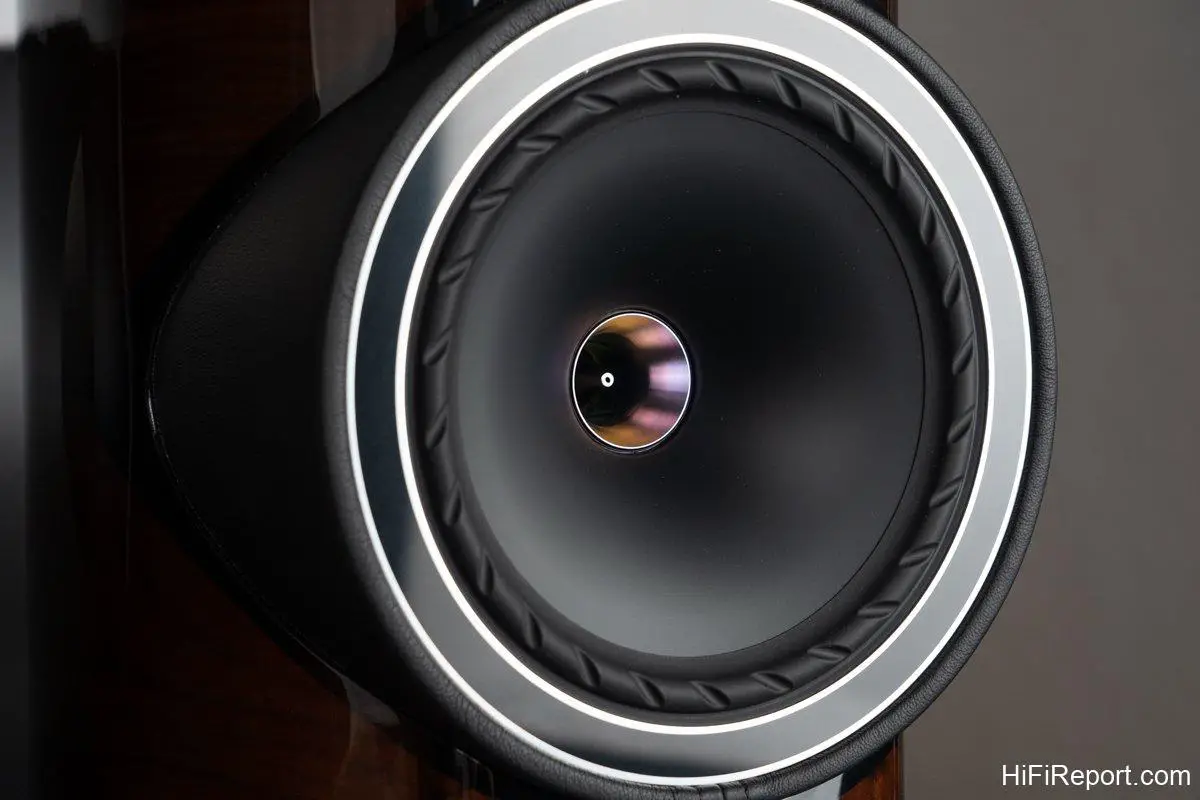
The numerical designation following “F1” in the F1 series—12, 10, 8, 5—corresponds to the size of the IsoFlare coaxial mid-bass driver in inches. Despite being a standmount design, the F1-8 boasts an 8-inch mid-bass driver, resulting in substantial size and heft.
While the manufacturer refers to them as “Standmount” loudspeakers, the term “bookshelf” is still commonly used.
Standmount loudspeakers, with their larger bass drivers and cabinet volume, are capable of producing more powerful dynamics and deeper bass.
Their performance often rivals that of small floorstanding speakers, even approaching the scale of medium-sized floorstanders.
After listening to the F1-8, I am convinced that Fyne Audio’s engineers aimed to achieve precisely this level of performance.
IsoFlare Point Source Driver
As a member of the flagship F1 series, the F1-8 inherits almost all of Fyne Audio’s most advanced technologies.
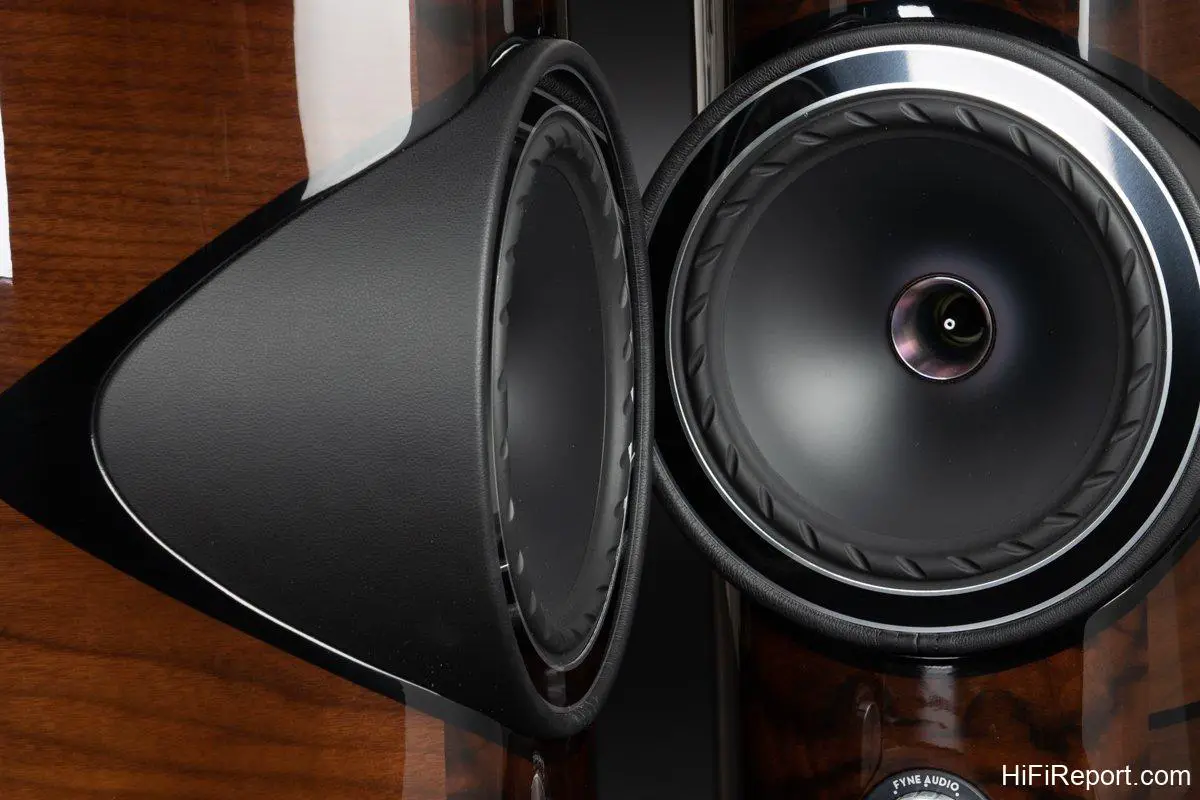
The foremost of these is the IsoFlare coaxial point source design.
A coaxial driver positions drivers responsible for different frequency ranges along the same axis, typically with the tweeter at the center and the midrange or mid-bass surrounding it.
Since the high and low frequencies originate from the same point, it creates a point source. This configuration ensures more coherent time alignment between high and low frequencies, resulting in a more natural sound.
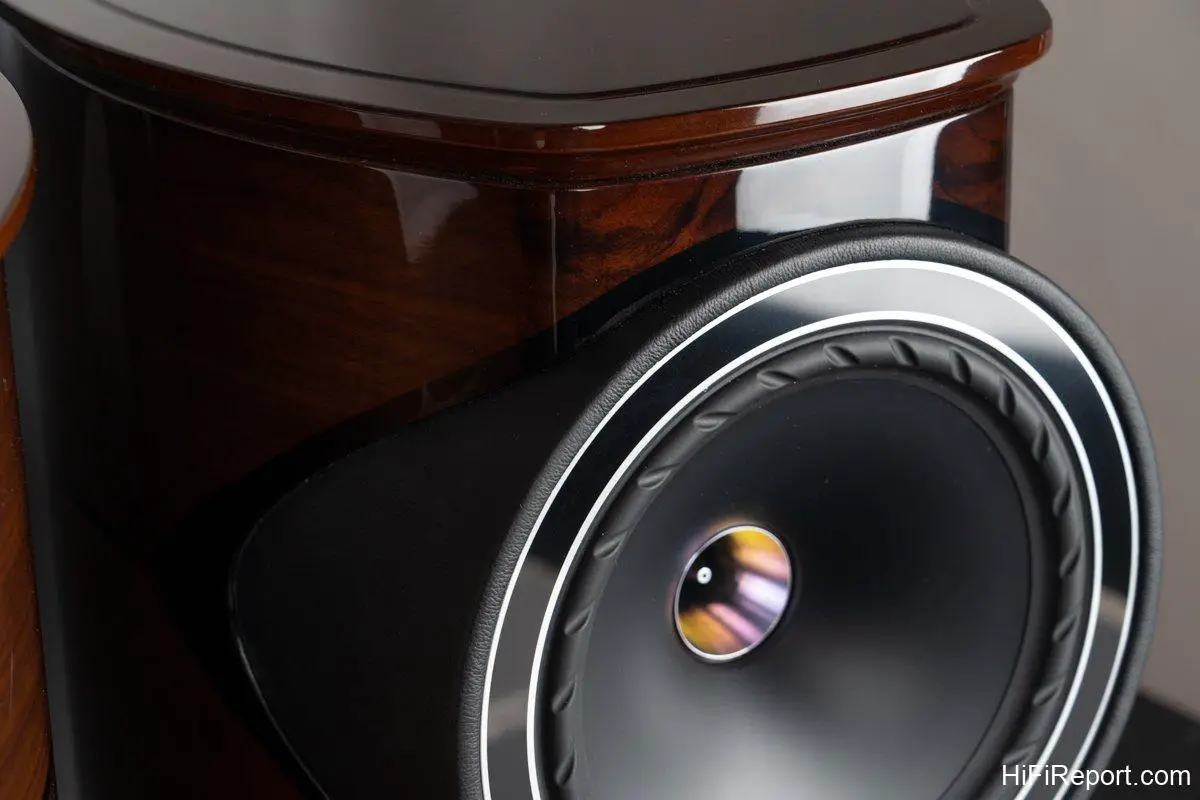
The coaxial driver in the F1-8 features a 25mm magnesium alloy dome compression tweeter. The tweeter employs a high-pressure resistant aluminum voice coil wire and a Kapton voice coil former, driven by a ferrite magnet.
The tweeter is positioned behind the mid-bass driver, with soundwaves guided through a metal waveguide.
The surrounding 8-inch (200mm) mid-bass driver utilizes a composite fiber paper cone diaphragm. The cone profile is computer-optimized to act as a waveguide, contributing to a smoother overall frequency response.
The mid-bass driver features a rectangular copper voice coil wire and an aluminum voice coil former, also driven by a ferrite magnet.
The entire IsoFlare coaxial driver unit is mounted on a high-rigidity cast aluminum chassis to eliminate unwanted vibrations.
Furthermore, a specialized damping structure is placed between the driver and the cabinet to further minimize vibration interference.
FyneFlute Surround Technology
The mid-bass driver of this coaxial unit also incorporates a distinctive fluted surround, a technology Fyne Audio calls FyneFlute.
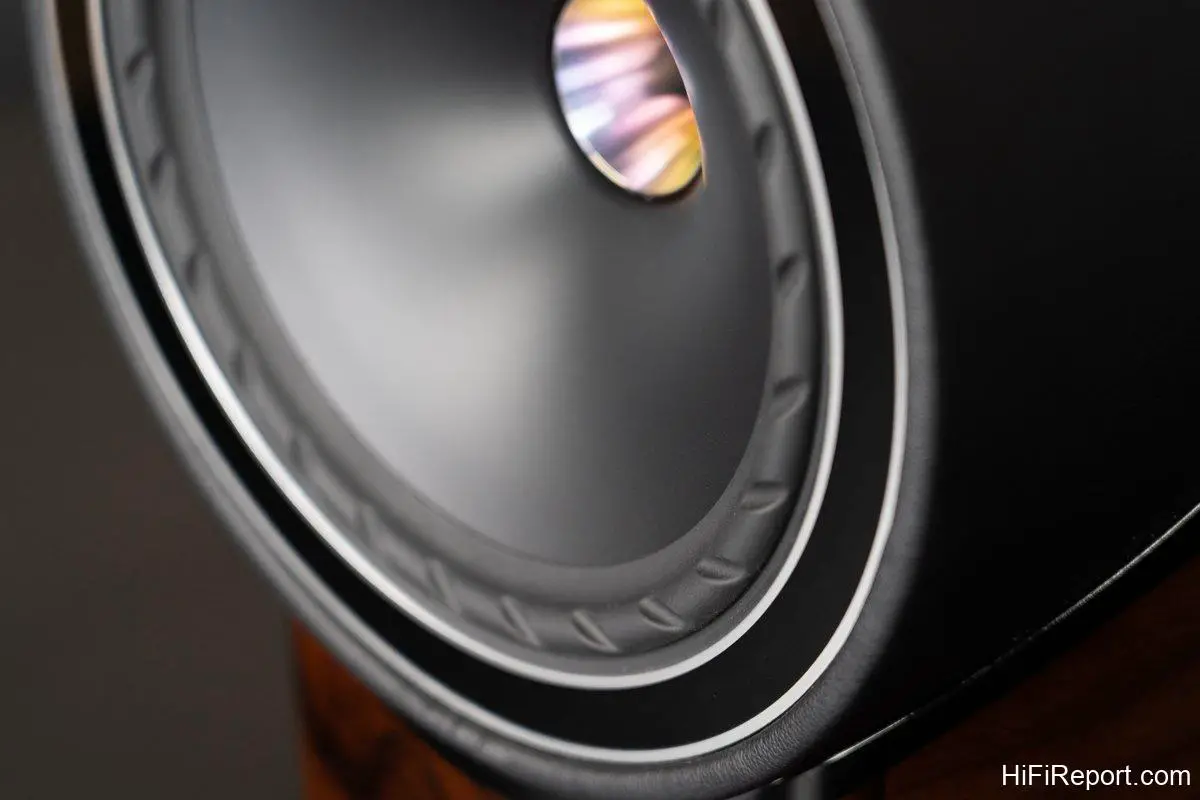
This surround with its unique three-dimensional corrugation pattern is also found in the F300, F500, and F700 series loudspeakers, and can be considered one of Fyne Audio’s signature technologies.
This design helps to reduce distortion caused by surround resonances.
However, the F1-12 and F1-10 do not employ this design. Due to their larger driver diameters, they utilize a corrugated surround for more agile response.
Fyne Audio emphasizes that while all are IsoFlare coaxial drivers, the designs vary significantly across different series. They don’t simply apply a single technology or design universally but tailor each driver design to best suit each specific series.
Coaxial drivers may seem straightforward, but overcoming the mutual interference between the two drivers during operation is actually quite challenging.
BassTrax Tractrix Port System
The second key technology is the BassTrax Tractrix low-frequency diffusion system.
Conventional bass-reflex loudspeakers typically use a simple port tube as the reflex channel, positioned at the front, rear, or bottom, with either one or two port openings.
Fyne Audio takes a more sophisticated approach.
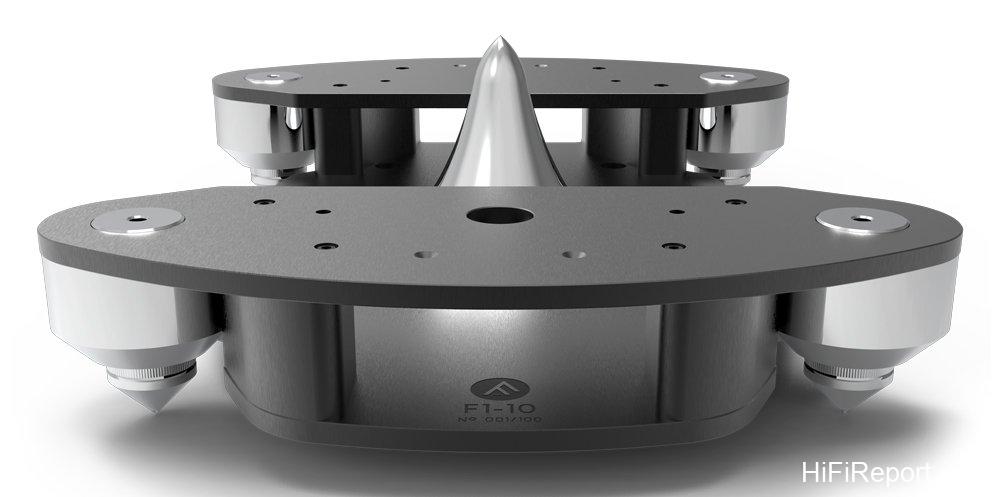
They designed a dual-cavity system that combines a reflex port channel with a cone-shaped diffuser at the base, resembling a volcano.
According to the manufacturer, the additional loading cavity acts as a damper, reducing potential cabinet resonances from escaping through the reflex port and affecting the overall frequency response.
The cone-shaped diffuser at the bottom helps to disperse low frequencies exiting the port, deflecting them at a 90-degree angle and distributing them evenly in a 360-degree pattern, without energy loss.
Fyne Audio points out that this cone-shaped waveguide device actually dates back to the 1920s. However, Fyne Audio has applied this technology to bass reflex ports as a low-frequency airflow diffuser.
This design helps to effectively integrate low frequencies with the listening space.
(Image source: Fyne Audio official website)
Premium Crossover Components and Presence Control
The third notable technology concerns the crossover.
What’s so special about the crossover? When speaker manufacturers discuss their crossovers, they typically highlight features like component quality, vibration isolation, and topology.
Fyne Audio essentially follows this pattern.
The company states that the F1-8, like other F1 series products, uses what Fyne Audio considers the best components, including ultra-low-loss air-core inductors, non-inductive film resistors, Claritycap PP capacitors, Neotech PC-OCC single-crystal copper wiring, and WBT Nextgen™ speaker terminals.
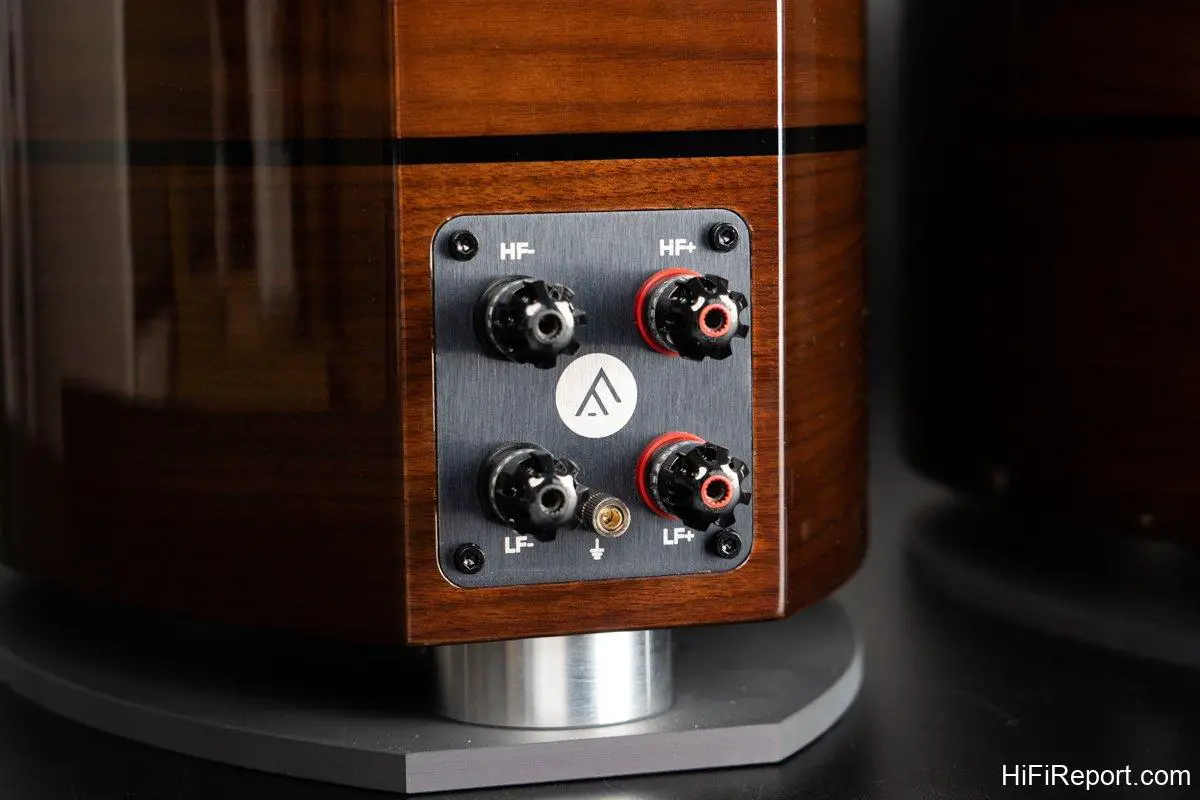
Two sets of speaker terminals are provided, allowing for bi-wiring or bi-amplification.
After assembly, the crossovers in the F1 series loudspeakers undergo deep cryogenic treatment to relieve stress in components, wiring, and solder joints.
Furthermore, Fyne Audio has added a fifth speaker terminal for grounding to the F1 and F700 series loudspeakers.
Fyne Audio believes that the metal frames of speaker drivers act like antennas, picking up faint electromagnetic waves that can affect the magnetic field of the driver’s magnetic system and degrade sound quality.
Therefore, they have added a grounding wire to the drivers. During use, simply connect the grounding wire to the amplifier chassis or a grounding terminal.
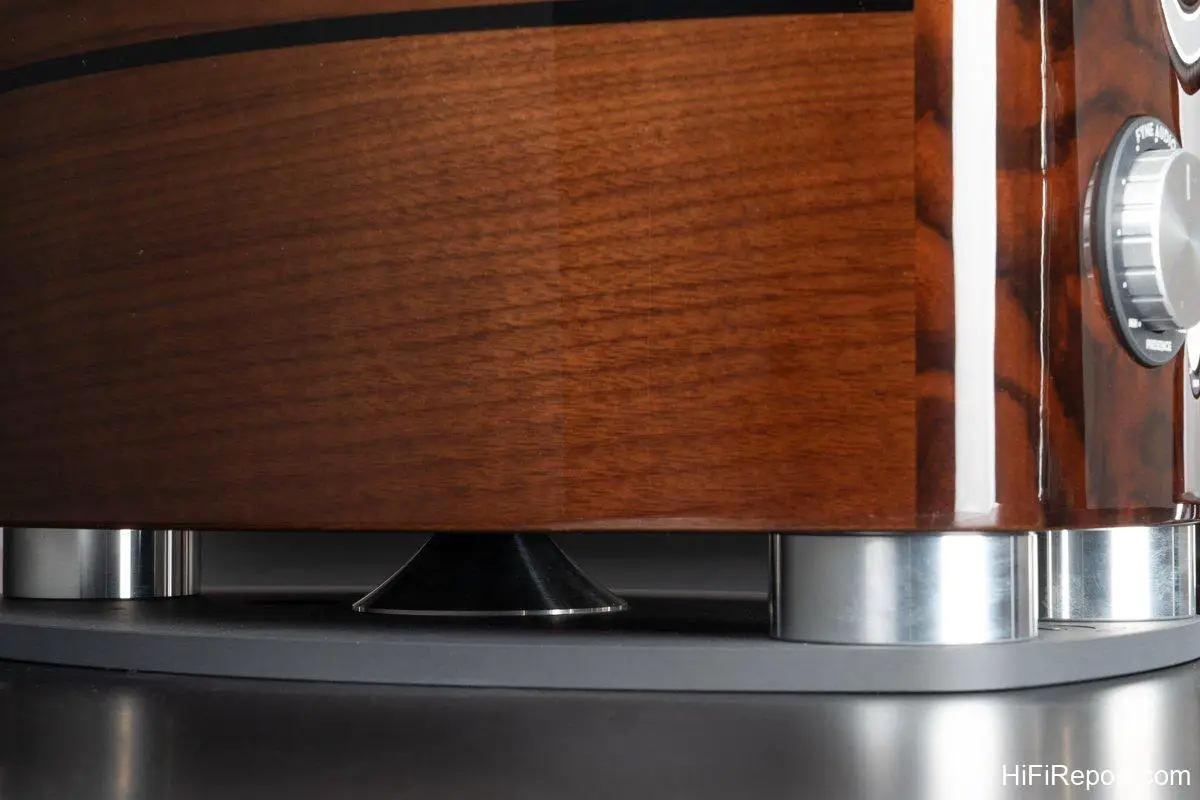
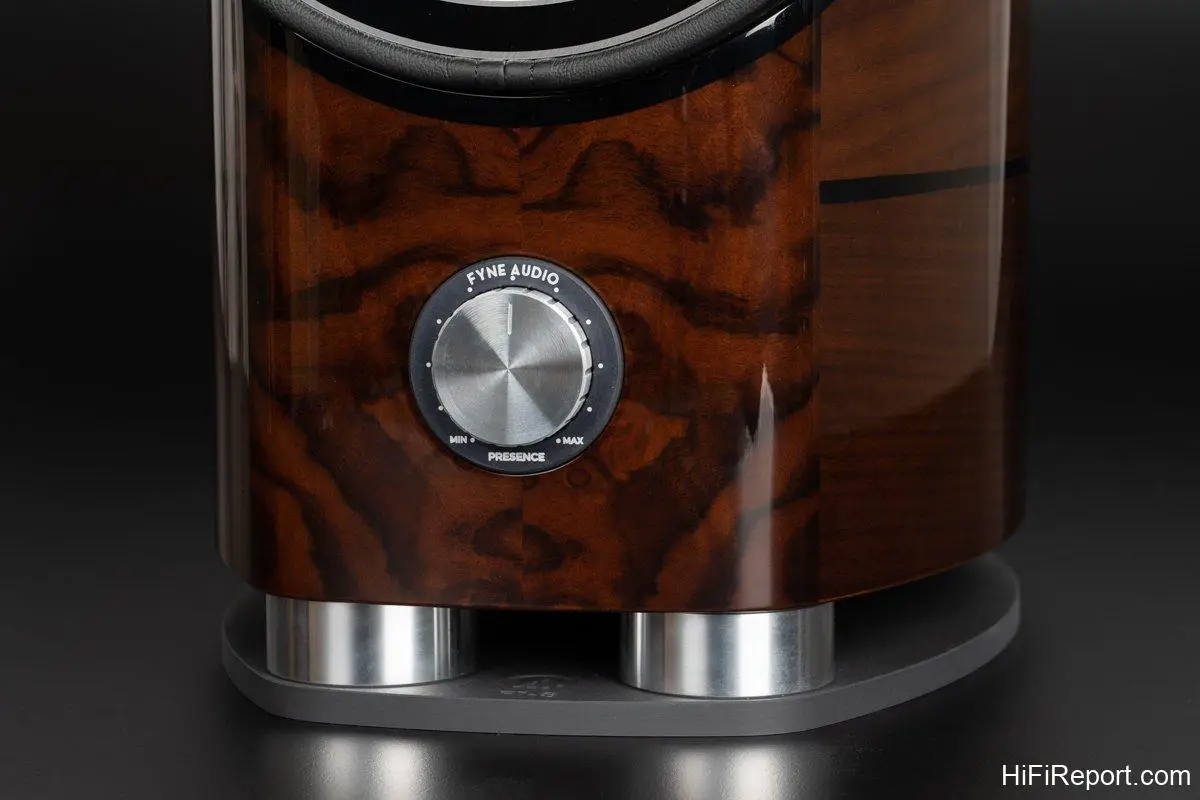
The F1 series crossovers offer a feature not found in the F700 series: tweeter adjustments, including Energy and Presence controls.
The Energy control adjusts the 750Hz – 26kHz frequency range with a +/-3dB range, while the Presence control adjusts the 2.5kHz – 5kHz range, also with a +/-3dB range.
The flagship F1-10 and F1-12 floorstanding models are equipped with two sets of stepless knobs to adjust both parameters, while the F1-8 and F1-5 only have Presence control.
My recommendation for use is to first set the knob to the center position, then roughly position the speakers according to your usual listening preferences. Afterward, fine-tune the Presence control and make slight adjustments to speaker placement.
As for speaker placement and Presence settings, it’s a matter of personal preference. Everyone’s room is different, system pairings vary, and preferred sound signatures differ. The goal is personal enjoyment.
Fyne Audio understands audiophiles’ desires, and adding this adjustment feature enhances the fun of fine-tuning.
Non-Parallel Curved Cabinet and Exquisite Craftsmanship
Fyne Audio’s design team has been designing loudspeakers for many years. While the F300 and F500 series still employed traditional rectangular cabinets with only slight curves on the front baffle, the F1 series adopts a more costly construction. The cabinet features a fully curved design, eliminating parallel surfaces to reduce internal standing waves.
Despite the large driver size, they utilize a periscope-like design, extending the coaxial driver beyond the main cabinet body. This keeps the cabinet width within a manageable range.
Upon closer inspection, the craftsmanship of the Fyne Audio F1-8 is remarkably refined. The woodworking, edge finishing, jointing, and overall assembly are executed to a very high standard. The use of different materials creates a collage effect, combining metal, wood, leather, and fabric, enhanced by meticulous handcrafting and a uniform gloss finish, adding to the F1-8’s premium feel.
The red walnut wood veneer exudes an elegant and classic aesthetic.
Rich Energy, Grand Soundstage, Vivid Detail
In the HiFiReport listening room, I used a YBA Passion CDT450 CD transport, paired with a Merging NADAC as the source. Amplification was provided by a Soulnote P-3 preamplifier and EAR Yoshino 509 MK2 power amplifier.
Both the source and amplifier were chosen to strike a balance between musicality and precision, ensuring a harmonious blend of musicality and sonic performance.
Although the standmount Fyne F1-8, like bookshelf speakers, requires stands for use, its substantial size, ample cabinet volume, 8-inch mid-bass driver, and compression tweeter contribute to a sound with rich energy and a grand soundstage, far from being diminutive.
Benefiting from the magnesium alloy dome compression tweeter, the F1-8 delivers abundant mid-high frequency energy, rendering details with exceptional vibrancy. Subtle and delicate sounds in the music are reproduced with clarity.
Due to the metal tweeter and compression driver coupled with a metal waveguide, the F1-8 portrays the metallic textures of instruments more convincingly than typical soft dome tweeters. Metallic timbres are particularly vivid, imbued with brilliance and sparkle.
The mid-bass region exhibits a texture that is both supple and elastic. The sense of spaciousness in the sound is exceptional for a standmount loudspeaker, surpassing even many small floorstanding models.
Therefore, the Fyne F1-8 needs some breathing room to fully reveal its strengths.
When adjusting the room and speaker placement, I casually put on the RR *Tutti!* orchestral sampler disc. As I gradually cleared the space around the F1-8s, reducing reflections and diffractions, the soundstage opened up bit by bit. The sense of spaciousness expanded, the layers in the music became clearer, the details were more precisely delineated, and the tonal colors and textures became even more realistic.
Presence Control for Fine-Tuning
Early in the listening session, while adjusting speaker placement, I started experimenting with the Presence knob.
There is no fixed rule for setting this control. Everyone’s room acoustics, speaker placement, and sonic preferences are different.
Fyne Audio cleverly provided this fine-tuning option, allowing users to tailor the F1-8’s sound to their specific needs and tastes.
After some experimentation, I ultimately chose to turn the knob counter-clockwise by about one notch. This setting worked well for classical music, pushing the soundstage slightly back and making the sound smoother.
For genres like pop, rock, or blues, you might adjust it towards the center or even clockwise to add more energy to the music.
However, ultimately, it’s a matter of personal taste—like adding salt or pepper to your food. You have to experiment to find what works best for you.
Lively and Realistic Textures, Stunning Percussion
Once everything was set, it was time for serious listening.
I started with the *Tutti!* sampler disc.
The first track, “Dance of the Tumblers” from Rimsky-Korsakov’s opera *The Snow Maiden*, is a lively piece with rich percussion and rapid orchestral passages. The full and rich low strings, as recorded, always make for an enjoyable listen.
The percussion, in particular, was incredibly lifelike, with even the most subtle sounds coming through clearly.
During the B section’s repetition, there’s a woodwind solo. The bassoon’s volume is not loud, and it’s positioned slightly further back, but the auditory sensation of the reed vibrating was remarkably realistic.
The brass instruments’ intensity also soared. The impact of the bass drum was substantial.
For a standmount loudspeaker to deliver this kind of scale and impact, the F1-8 is truly impressive.
The second track, “Intermezzo e Humoreske” from Chadwick’s *Symphonic Suite*, fully showcases string textures.
When the violin section played, the delicate yet supple texture, with a gentle sheen, was beautifully rendered. The F1-8’s compression tweeter brought a vivid and bright brilliance, a sonic character distinct from metal dome/cone tweeters, ribbon tweeters, or AMT tweeters. Compression drivers deliver a more energetic and vibrant high-frequency presentation.
The weighty and solid low strings were present with ample quantity but without being excessive.
Fyne Audio dealers should definitely play this record for potential customers. After hearing the vibrant and intricate percussion, most are likely to be ready to buy.
Dynamics and Soundstage Beyond Expectations
The excellence of the F1-8 with orchestral music was further confirmed by the new John Williams *in Vienna* album.
This album, featuring John Williams conducting the Vienna Philharmonic, not only boasts outstanding recording quality but also exceptional performances. Of all the orchestras the maestro has collaborated with throughout his career, the Vienna Philharmonic may be the most exceptional.
Thus, what you hear on this album is not just film scores, but independent orchestral masterpieces.
My favorite track is the second one, the theme from *Close Encounters of the Third Kind*. The opening music, full of fantasy, avant-garde, modernity, dissonance, and conflict, gradually builds from the subtlest beginnings to a grand crescendo. The mysterious, unknown, eerie, and even frightening atmosphere is palpable in those conflicting sounds, solidifying and expanding.
Listen to the heavy and coarse timbre of the tuba, the piercing high notes of the violins, the penetrating sound of the piccolo, the layers of sound building upon each other, ultimately forming a towering wall of sound.
After a tender string interlude, the next section begins. Interspersed with a five-note motif, the music unfolds into a majestic and vast cosmic exploration.
From the opening bars to the powerful ensemble passages, the dynamic range is enormous, and I derived immense listening pleasure from the F1-8’s ability to convey this.
John Williams’s arrangement, layering voice upon voice, harmony upon harmony, counterpoint upon counterpoint, builds a robust sonic structure and weaves a tapestry of vibrant colors.
Magnificent! This was my close encounter of the third kind with the Fyne Audio F1-8.
Precise Imaging, Clear Focus, Realistic Texture
If you value precise imaging and soundstage localization, Fyne Audio’s coaxial design should deliver satisfying results.
I previously listened to the F501 and then the F703 at another location. One from the F500 series, the other from the F700 series, and now the flagship F1 series.
They share design elements, but the higher the series, the more rigorous the design and the higher the demands.
The F1-8’s imaging and localization performance is truly first-rate. I’ve already illustrated this with orchestral music, and I want to emphasize it again with chamber music.
Playing Schubert’s “Trout” Quintet, performed by Renaud Capuçon and others, each of the five instruments occupies its own space, with clearly defined sonic outlines.
The violin’s nimble and flowing lines, the delicate texture of the bow against the strings, are vividly portrayed. The warmth and resonance from the violin’s body bring sweetness and joy.
The piano is crystalline and transparent, with clearly articulated notes.
The cello, with its rich and nasal timbre, exhibits even more pronounced bow-on-string texture than the violin.
When the double bass enters, its deep and full sound provides a solid foundation for the music.
The F1-8 is a standmount loudspeaker, but its bass performance rivals many small floorstanding models. It has not only quantity and depth but also resolution and texture.
This makes it easy to understand why Fyne Audio so emphasizes their BassTrax Tractrix bass diffusion system—because it is genuinely effective.
Bass with Quality, Quantity, and Resolution
In fact, simply mentioning the downward-firing special bass-reflex port design is not enough to fully explain the F1-8’s outstanding bass performance.
The coaxial mid-bass driver also plays a crucial role.
The FyneFlute fluted surround should not be overlooked either.
Fyne Audio is not the only manufacturer that focuses on the surround. Others also enhance driver responsiveness by manipulating the three-dimensional shape and material thickness of the surround, aiming for faster driver response and more linear operation.
Regarding this aspect, it’s difficult for me to pinpoint exactly what sonic characteristics are directly attributable to this design. However, I can tell you that the F1-8’s bass, while not necessarily “fast, tight, and precise” in the most extreme sense, does have speed, impact, and elasticity.
For genres like hard rock or metal, it might not fully satisfy the cravings of hardcore enthusiasts.
However, for blues, pop, or for more eclectic music lovers, this balanced mid-bass and bass performance, rich in musicality, is very appealing.
Drum Sounds: Bouncy, Elastic, and Lush
For example, listening to Lee Ritenour’s *6 String Theory* album, the drum sound isn’t about aggressive intensity. Instead, the round, full, solid, bouncy, and lush drum sound is more flavorful.
Listening to the second track, “Am I Wrong,” featuring Keb’ Mo’, Keb’ Mo’s vocals are full and substantial, with excellent presence and ample detail, making both vocals and harmonica sound incredibly lifelike. The drum sound, in particular, is a quintessential example of bouncy and elastic.
On the next track, “L.P.,” in addition to the fiery guitar interplay, the drum kit is relentlessly active. The drum sound is bouncy and full, solid and substantial, yet without any harshness. The thumping sound of the kick drum is captivating.
As for the guitar dialogues, the F1-8’s colorful sound imbues the guitars with vivid personalities.
The rendition of the blues classic “Give Me One Reason” is also exceptionally brilliant.
The slightly forward vocals bring the listener closer to the music.
The guitar, enhanced by effects pedals, echoes Robert Cray’s vocals with a full-bodied tone.
If I owned a pair of F1-8s, I would definitely listen to blues more often.
Immersive Surround and Envelopment
When playing Celine Dion’s 1995 *Live in Paris* concert recording, the Fyne F1-8 vividly recreated the high-energy live atmosphere.
The album captures numerous instances of audience cheers and applause. These screams, shouts, and clapping, when played through the F1-8s, not only sound more fervent but also create a strong sense of surround and envelopment.
With proper placement, the F1-8s easily disappear in your listening room. This characteristic alone, in reproducing audience reactions, is enough to transport you to the concert venue.
Furthermore, performers in concerts invariably give their all to energize the atmosphere and ignite audience excitement.
On this album, the same songs, when sung by Celine Dion, sound even more dynamic and energetic compared to her studio recordings. They may lack some of the nuanced refinement, but they gain a more direct and unvarnished quality.
This is precisely what the F1-8 excels at. Celine Dion’s vocal image is large and full, her vocal texture vivid and clear, and the sound has significant impact when she unleashes her power.
It’s not just the drums that have impact; the vocals do too.
Moreover, the instrumental textures of the accompanying music are also lively and spirited. The drums are solid and elastic. As I mentioned earlier, the F1-8 excels at reproducing drums.
The keyboards and guitars together create a vibrant tapestry of colors, characteristic of amplified instruments’ rich sonic variations.
This is the F1-8: energetic, unrestrained, and full of vitality. And you can further enhance this energy with the Presence knob.
Fyne, it’s really a fine thing.
Fyne Audio, despite being founded only in 2017, has created one miracle after another in a short span of time.
The flagship standmount loudspeaker F1-8 demonstrates a scale and authority approaching that of floorstanding speakers. This is a declaration, proclaiming Fyne Audio’s research and development prowess. It’s also a gauntlet thrown down to other high-end loudspeaker manufacturers—can you do better than me? It is also an invitation, inviting you to enter the musical world of Fyne Audio—Fyne, it’s really a fine thing.
Specifications
* Type: 2-way bass-reflex coaxial standmount loudspeaker
* Drivers: 25mm magnesium dome compression tweeter + 200mm IsoFlare paper cone mid-bass coaxial driver
* Frequency Response: 33 Hz – 34 kHz
* Sensitivity: 91 dB
* Impedance: 8 ohms
* Crossover Frequency: 1.8 kHz
* Recommended Amplifier Power: 30 – 180 watts
* Dimensions: 470 × 280 × 441 mm
* Weight: 15.2 kg