
Ideon eos Streaming System Review
My first encounter with the Ideon brand was about a year ago.
At the time, the manager of the HiFiReport Audio store, Young Cai, sent me a box and said, “Try this out first and tell me what you think. We can decide about writing a review later.” It was a small, unassuming device in a black and white box with a product photo on it, bearing a cryptic name that left me utterly bewildered: 3R USB Renaissance mk2 Black Star.
Below it was a line of text proclaiming: “The hi-end game changer.” What a bold claim! What on earth was this thing?
Discovering Ideon Through the 3R USB Renaissance
The exact product name was “3R USB Renaissance,” specifically the MK2 Black Star Edition, manufactured by Ideon Audio. The brand? Never heard of it. The edition? No clue what “Black Star” meant. The product itself? After staring at it for ages, all I gathered was that it had something to do with USB transmission.
Yet, Ideon dared to call themselves a “game changer” in High End audio. That piqued my interest. I took the 3R home that very day and couldn’t wait to hook it up to my system. Half an hour later, I called Young Cai to tell him that this device, the 3R USB Renaissance, genuinely made a difference. It yielded a blacker background, more focused sound, clearer imaging, better separation, sharper detail, and finer texture. Digital streaming sound quality was noticeably improved after passing through it.
The 3R USB Renaissance has three main functions, all starting with the letter ‘R’, hence the name 3R. These functions are Redrive, Reclock, and Regenerate – meaning it re-drives, re-clocks, and regenerates the USB signal. In short, its purpose is to isolate noise, strengthen the signal, and improve timing accuracy for USB-based streaming. This last point, USB timing correction, is what Ideon considers key to achieving excellent digital streaming sound.
USB wasn’t originally designed for audio transmission, yet it’s the most ubiquitous interface. Every computer or computer-based server is equipped with a USB port. Furthermore, it can transmit higher-specification digital signals than S/PDIF or AES/EBU – not only higher bit depth and sample rates but DSD as well. So, while not the ideal interface, USB is the most common.
Therefore, improving the accuracy of USB transmission is a major challenge if one wants to elevate streaming playback quality. Ideon recognized this, and the 3R USB Renaissance was created for this very purpose.
In fact, Ideon also offers three higher-end products with similar functions: EOS Time, Absolute Time, and Absolute Time V. For these premium products, Ideon drops the mystery and simply calls them “Time,” directly pointing to the crucial function: USB timing correction.
My introduction to Ideon began with the 3R USB Renaissance, and thus with USB timing correction. However, besides their “Time” USB clocks, they also have DACs highly praised by veteran enthusiasts and media, which, combined with their proprietary streaming player, form Ideon’s “trinity.”
So, starting from the 3R USB Renaissance, I continued my exploration into Ideon’s digital prowess, beginning with the three-piece eos system.
Ideon Trinity — The Three-Piece System
Ideon offers two three-piece systems: the flagship Absolute system, comprising the Absolute DAC ε digital-to-analog converter, Absolute Time re-clocker, and Absolute Stream streamer; and the more affordable eos system, launched in 2023, which includes the eos DAC, eos Time, and eos Stream.
Besides these, they have three standalone units: the high-end DAC/preamp IΩN, the entry-level decoder Ayazi MK2, and the entry-level advanced USB signal regenerator 3R Master Time Black Star.
Ideon’s product naming is rather interesting. On one hand, they use Greek letters to signify their Greek origins (e.g., Absolute DAC ε); on the other, they don’t necessarily capitalize the first letter (e.g., ‘eos’ is written as ‘eos’, not ‘Eos’ or ‘EOS’ – I haven’t made a mistake).
Six Key Design Principles
Ideon’s ambition with the eos DAC is to bring the technologies used in their Absolute and IΩN models down to a more affordable price point, offering a “reference-class” option for those with limited budgets.
Their product design adheres to several important principles:
1. Exclusive use of linear power supplies.
2. Emphasis on ultra-low noise and stable power delivery.
3. Independent power supplies for critical circuits.
4. Continuous re-clocking.
5. Isolated signal inputs and stable, high-current output.
6. Careful selection of audiophile-grade components.
These are the six pillars of their design philosophy.
Simple, Unassuming Chassis Design
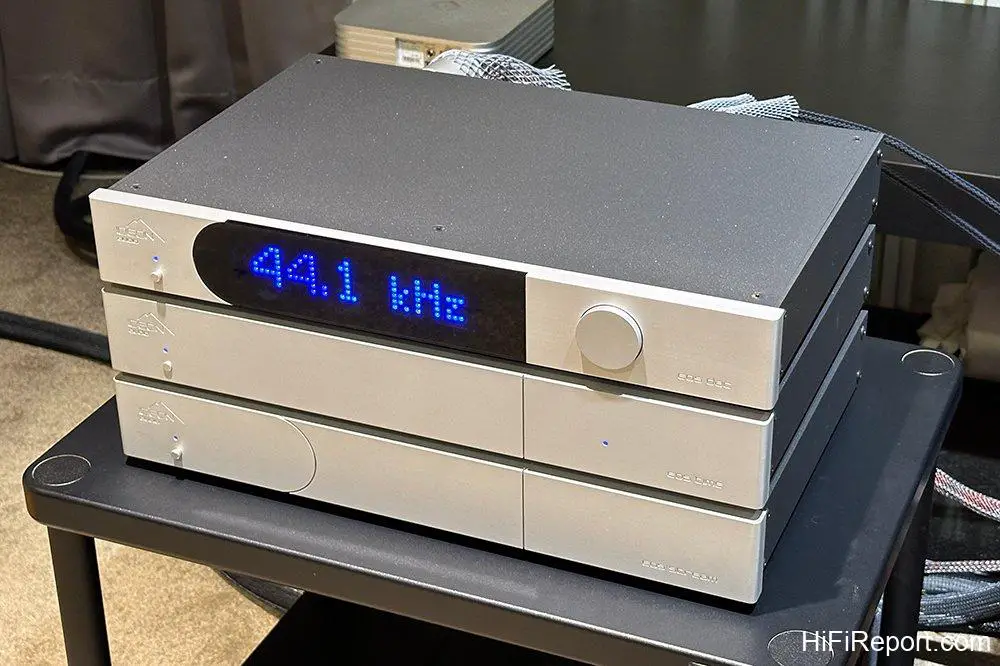
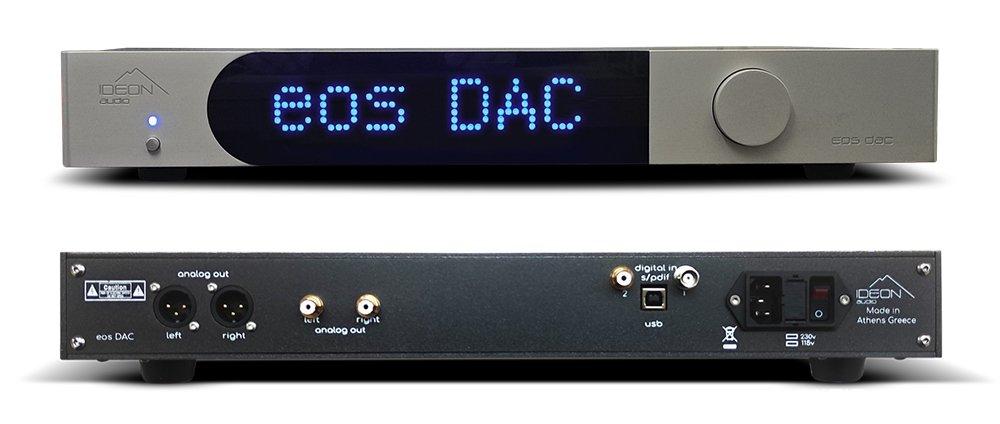
The overall design of the eos DAC is minimalist, with the highlights concentrated on the front panel. The thick aluminum fascia features curved edges on both sides. A large display occupies the central area, using blue LEDs to show the current sample rate. To the left of the display are the power switch and etched Ideon Audio logo, while to the right is a selection knob and the etched ‘eos DAC’ lettering.
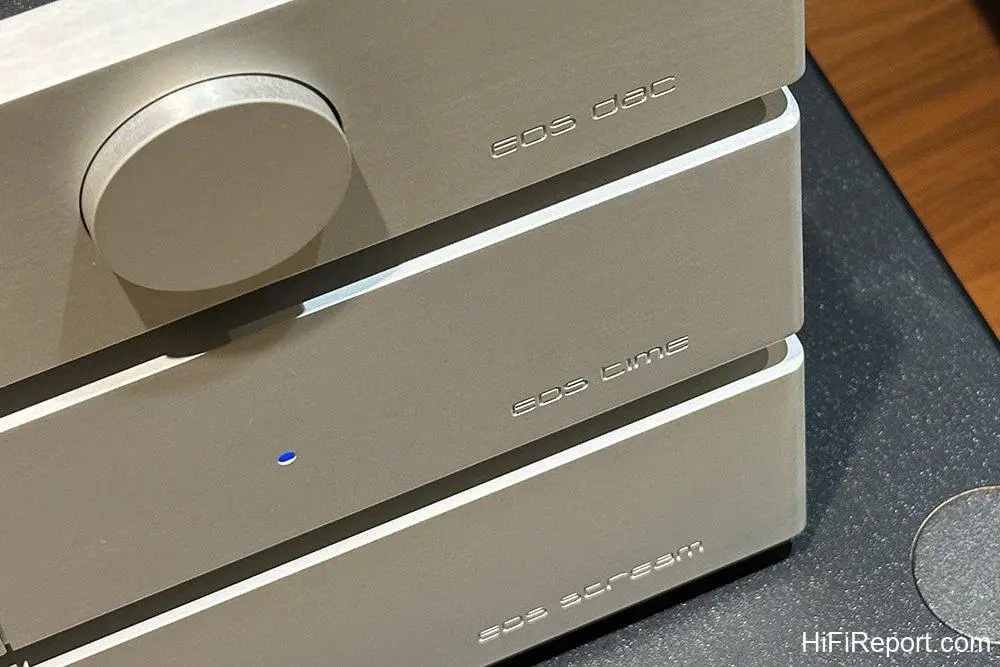
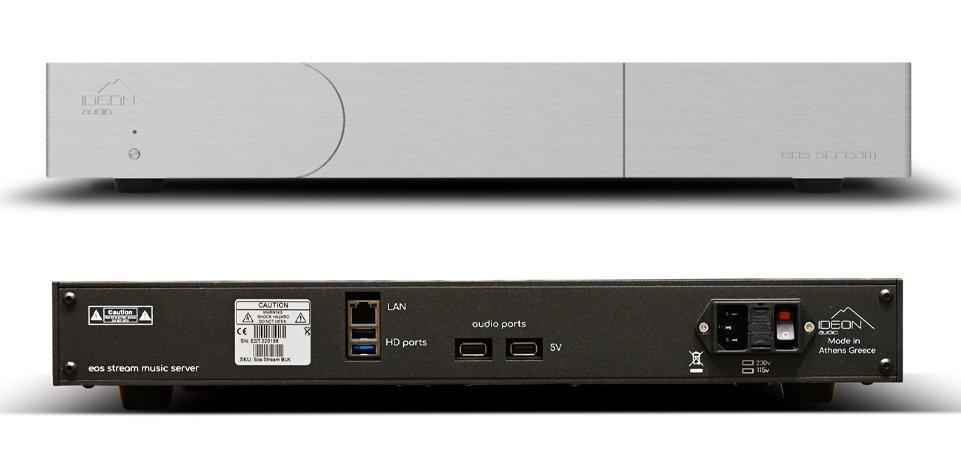
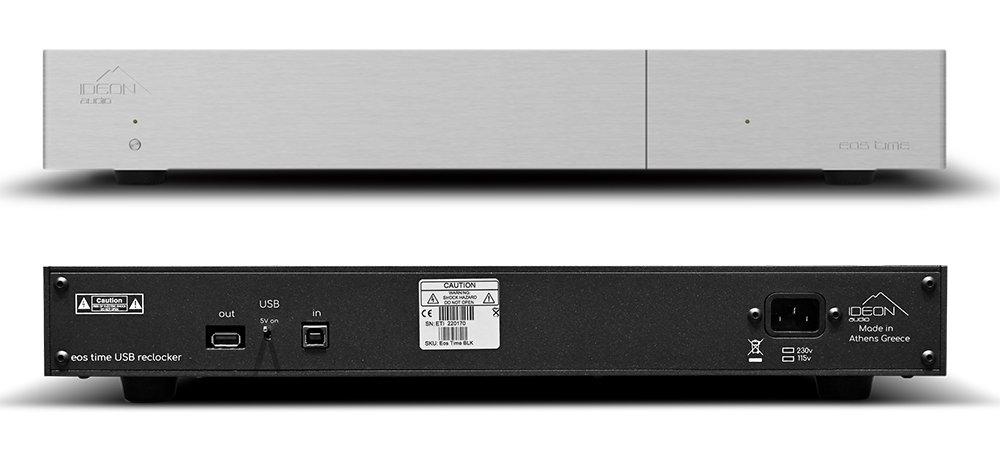
Paired with a black matte finished chassis, the style is understated and doesn’t flaunt its capabilities, yet the robust construction instills a sense of security. This same external design is carried over to the eos Stream and eos Time, though the latter two omit the screen, resulting in an even plainer front panel.
eos DAC’s Focus on USB Digital Input
Compared to typical commercially available DACs, the eos DAC’s digital inputs are much simpler. It has only one USB Type B input, plus one coaxial and one BNC input. There are no optical, AES/EBU, or I2S inputs whatsoever.
For Ideon, streaming playback isn’t the future; it’s the present. Their products are designed specifically for streaming. “We want to make digital file playback sound its absolute best, and we want to offer products at every price point, from entry-level to top-tier.”
Given that the product is primarily designed for streaming, there’s naturally no need for many other digital inputs. While some may have reservations about USB, Ideon has effectively solved the USB issue through their 3R “Time” technology.
Custom-Written Decoder Chip Drivers with Future Upgradeability
The manufacturer hasn’t explicitly stated which decoder chip the eos DAC uses, but they did reveal it’s a high-speed 8-channel ESS chip known for its high signal-to-noise ratio of up to -120dB. The specific chip isn’t the main point; what matters is that the chip’s driver software is written in-house by Ideon, just like the software in their flagship Absolute DAC ε. Furthermore, the firmware can be updated in the future, giving the unit longevity.
The eos DAC supports decoding up to PCM 32bit/384kHz and DSD 512, which is more than sufficient for high-resolution streaming playback.
Exclusive “Triple Distillation” Method to Eliminate Digital Noise
As mentioned earlier, Ideon places particular importance on USB streaming transmission. They have designed a circuit called the “Triple Distillation” for the USB digital input, which employs three stages of noise reduction to eliminate any digital noise at the input stage.
The manufacturer states that this technology was previously used in the Absolute DAC ε and has now been ported to the eos DAC. They even quipped, “We have declared war on any linear or non-linear distortion and noise.”
Built-in Femto Clocks and Latest USB Codec
Eliminating digital noise is the first step; ensuring accurate timing is the next. The eos DAC incorporates the same femto-level clocks as the higher-tier IΩN DAC, featuring ultra-low jitter and ultra-low phase noise characteristics. It uses a total of three such clocks. For optimal performance, each clock has its dedicated power path.
The USB input module also uses a brand-new USB codec, delivering zero jitter, ultra-low noise, extremely fast processing speed, and natural sound reproduction. If streaming from a Windows-based computer, the new driver is optimized for low latency and low CPU load, and its buffer depth can be adjusted to match the characteristics of the source computer, achieving bit-perfect playback.
Fully Symmetric Balanced Analog Circuit with Meticulously Designed Power Supply
Once the digital side is processed, the eos DAC employs a fully symmetric balanced analog circuit after conversion. No capacitors are used in the signal path to avoid any potential negative impact on sound quality, aiming for a more realistic, accurate, and natural analog output. The analog circuit’s power also comes from a dedicated power supply.
Everyone knows that a stable, sufficient, and clean power supply is paramount in audio circuit design. Ideon has designed multiple multi-stage power supplies and separated the power delivery for each section of the circuit, using low dropout regulators and ultra-low ESR audiophile-grade capacitors to achieve ultimate clarity and linearity.
eos Stream: Flagship Technology Descends
Regarding music servers, Ideon’s first product in this category was the flagship Absolute Stream. For a significant period, no other servers or players were released. It wasn’t until the introduction of the eos system in 2023 that they launched their second music server, the eos Stream. Why such a long gap? Ideon’s goal is to make digital streaming playback sound free of the “digital” character, differentiating it from other streamers or music servers on the market. They believe they achieved this goal with the Absolute Stream and wanted to figure out how to create an affordable second product that still met their standards.
First: Eliminate Noise, Starting with Power
Ideon’s primary goal was to eliminate noise as much as possible. To achieve this, they designed the circuitry to minimize internal noise generation and also simplified the eos Stream’s operating system to prevent excessive CPU computation from creating noise. Subsequently, they focused their efforts on the power supply.
Ideon’s linear power supply for the eos Stream is designed for low noise and provides multiple outputs to supply different voltages needed by various parts of the circuit, aiming for independent power delivery as much as possible. Furthermore, during the development of the Absolute Stream, they discovered that the transient current quality of the CPU power supply was a crucial factor affecting sound quality, with significant results. Therefore, they replicated this approach in the eos Stream, using ultra-low ESR bypass filter capacitors. They also employed Silicon carbide diodes, which have lower operating noise, to further enhance sound performance.
Second: Eliminate Jitter Through Femto Clock Re-clocking
In addition to noise elimination, Ideon also strives to minimize jitter in the eos Stream. This is accomplished through a re-clocking circuit based on a femto-level clock. This specially designed re-clocking circuit is also built on an upgradeable and updatable platform, allowing for future optimization as technology advances.
The eos Stream can accommodate an internal SSD and can also connect to external hard drives via two USB 3.0 ports. Besides playing “local” music files (whether from the internal drive, external drives, or NAS), it supports all major streaming music platforms, including Tidal, Qobuz, Spotify, and internet radio playback.
The eos Stream performs all the functions expected of a music server, but Ideon aims for it to be superior to others in its emphasis on low noise and low jitter.
eos Time: An Enhanced 3R, Upgraded All Around
The third unit is the eos Time. As shared at the beginning of the article, this external clock generator specifically designed for USB streaming playback is arguably Ideon’s most unique product. My description simplifies it somewhat, because, as you’ll recall, it builds upon the “3R” concept: Redrive, Reclock, Regenerate the USB signal.
The functionality of the eos Time is essentially the same as the 3R USB Renaissance I’ve used. Compared to its smaller siblings, the Renaissance and Master Time, the eos Time features a more advanced clock, a more sophisticated power supply, and more luxurious components. Specifically, the power supply uses three ultra-low noise linear power supplies capable of outputting an ultra-low noise digital signal of 600mA via the USB port. Internally, it also employs programmable chips running Ideon’s proprietary code, including controlling USB port activation, debugging, and timing.
The eos DAC, eos Stream, and eos Time form a three-piece system with identical chassis sizes and similar external designs, differing only in their front panels. The eos DAC has a control knob and a display, the eos Stream has a curved decorative etching, and the eos Time only retains a single LED indicator.
Luxurious Listening Setup — Pink Faun 2.16 Ultra as Roon Server
To showcase their three-piece design, Ideon promotes it this way on their official website, displays it at trade shows, and HiFiReport Audio also adopted this approach. If you prefer, you can, of course, stack them separately. However, stacking the three-piece system together makes a more emphatic visual statement about synergy.
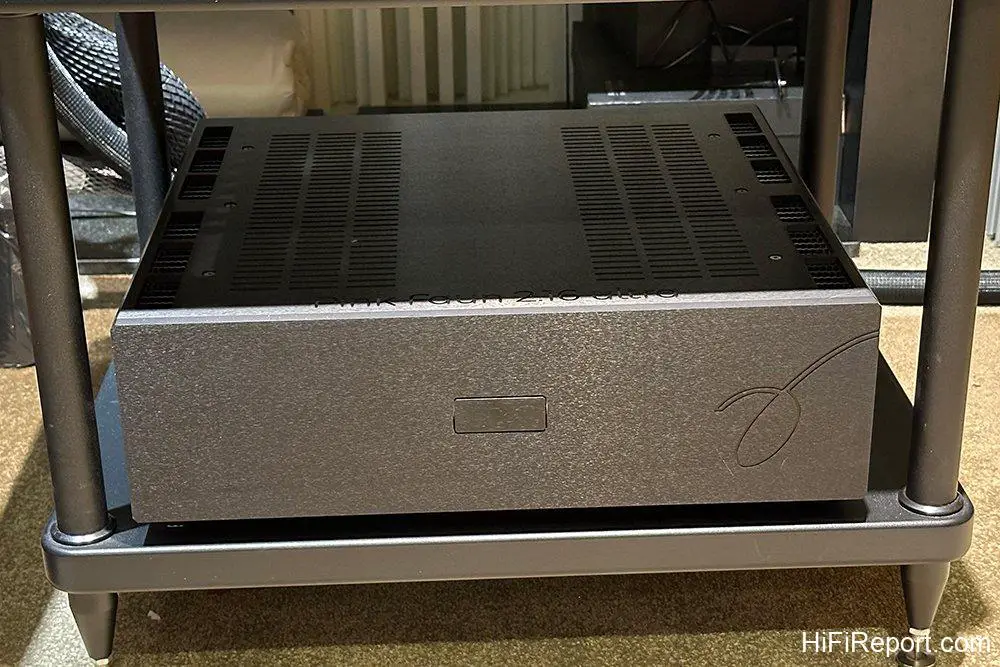
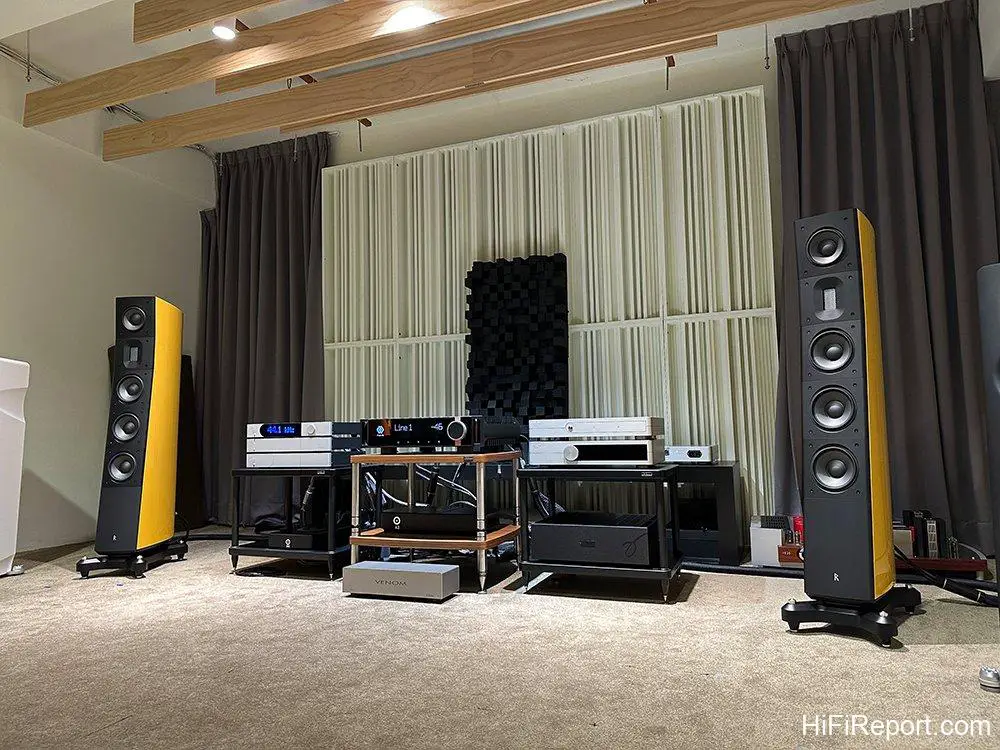
During my listening session at HiFiReport Audio, they were indeed stacked like this. Since the Ideon Stream cannot function as a Roon Core/Server, a very luxurious Roon Core/Server was used: the High End Dutch streaming server, the Pink Faun 2.16 Ultra. However, the streaming playback portion was still handled by the eos Stream; the 2.16 Ultra served purely as the Roon Core/Server. (Truly extravagant!)
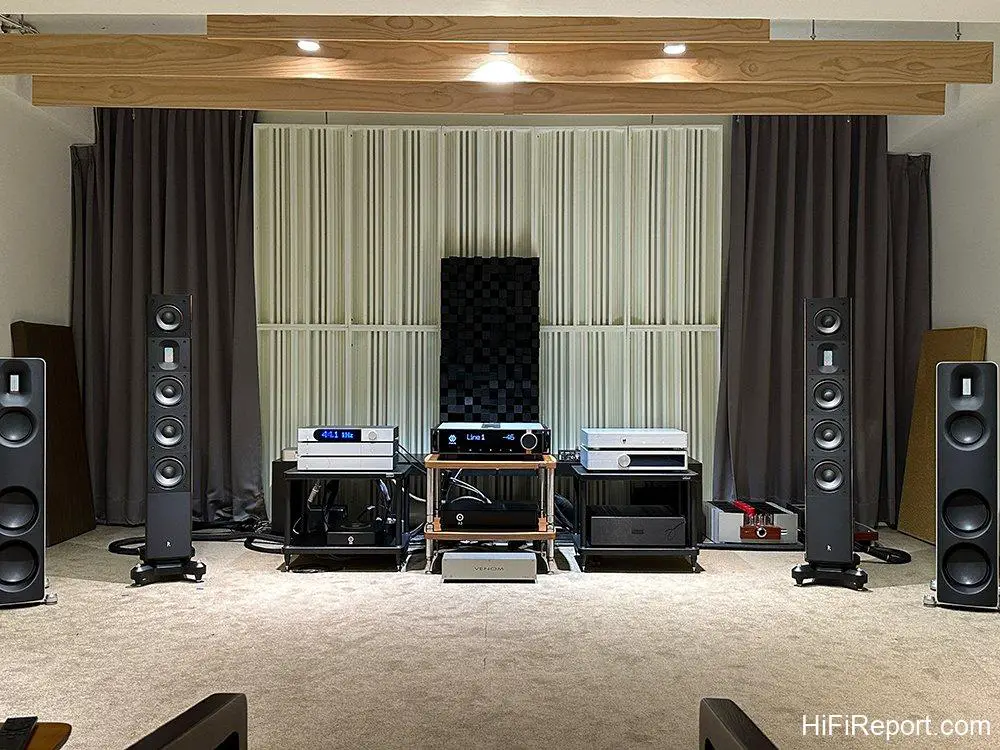
Aavik I-880 by Flemming Powering Raidho TD 3.2
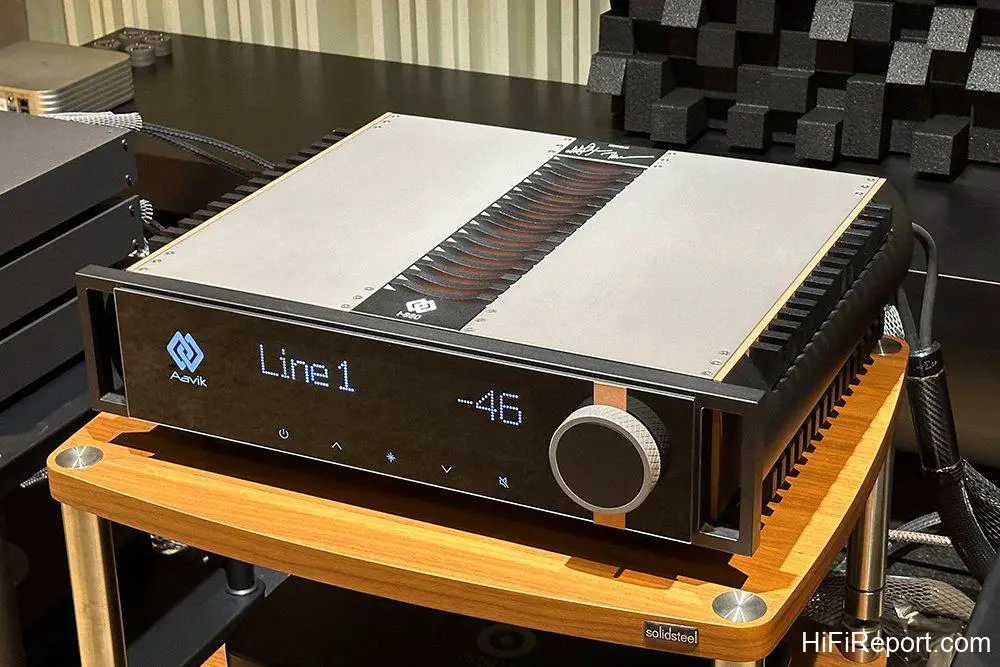
The amplifier used was Aavik’s latest flagship integrated amplifier, the I-880. This is a groundbreaking work by audio design master Flemming Erik Rasmussen since joining Audio Group Denmark. The most astonishing aspect of the I-880 is that, despite its appearance, it is a pure Class A 200W amplifier – something few would believe possible.
Aavik has historically favored Class D amplification, not only for its high energy efficiency and cool operation, allowing for reasonably sized amplifiers, but also because Aavik’s owner, Michael Borresen, believes Class D can sound excellent (like their own) and offers great drive and speed, aligning with his sonic philosophy. However, Flemming is a staunch believer in Class A amplification. The meeting of these two perspectives, after some back-and-forth, resulted in the I-880, which integrates both their aesthetic viewpoints.
As for the speakers producing the sound, they were the Raidho TD 3.2. Raidho speakers tend to look quite similar, with the key difference lying in the driver quality. Their drivers are designed and manufactured in-house. The TD series speakers use titanium voice coils and have a special magnetic system design, ensuring the drivers achieve precise piston movement. The TD 3.2 is a smaller floorstanding speaker in the mid-range of the TD series, with a tall, slender profile that sacrifices width for cabinet depth to gain volume and low-frequency extension.
Lively Sound, Great Balance, Rich Expression, Open Soundstage
The afternoon listening session began with Anne-Sophie Mutter, Yo-Yo Ma, and Daniel Barenboim’s performance of Beethoven’s Triple Concerto. The first movement opens with the lower strings, creating a sense of unease. The deep strings roll and breathe; the layering of the low frequencies is truly astonishing. The Raidho speakers appear tall and thin, and their woofers are small, yet they deliver surprisingly good bass response that is both deep and clean. This opening passage with the lower strings is excellent proof of that.
Then the orchestra seems to awaken, like the breaking dawn, rising in a crescendo, layer upon layer, instantly elevating the musical emotion. Listening to this successive build-up of sound is delightful; the musical thickness is excellent, as is the transparency and vitality. The balance is wonderfully struck, with no sense of sacrificing one quality for another.
In the Triple Concerto, the cello takes the lead, eloquently stating the first theme, followed by the violin with a richer melodic development, and finally the piano enters. Listening to the cello solo here, it’s sticky and dense. Yo-Yo Ma’s playing is always gentle in tone, full of emotion, and very vocal – and this is no exception.
Mutter’s violin, on the other hand, is highly expressive, with a sharp and decisive tone, the playing precise and crisp – which is her characteristic style. As for the piano, perhaps because he is also conducting, Barenboim is more restrained, maintaining dialogue and interaction with the violin and cello with fluid playing, exercising more control in his personal expression.
Ah, the interplay between the three performers and their three instruments, how they express their individual characteristics in their musical interaction – if you listen carefully, you can perceive it all. But I must say, although I’m very familiar with this recording, hearing it at HiFiReport this time was genuinely different.
How was it different? The system’s superb resolution provided an excellent sense of presence, unfolding spatial dimensions that gave ample room for the orchestra’s various sections. The bright, lively sound made the music more vibrant, creating a greater sense of being in the performance space.
The Ideon eos system, paired with the Aavik I-880 and Raidho TD 3.2, presented a confident, expansive, and assured charm. Based on a bright and lively sonic foundation, it simultaneously delivered resolution, weight, density, and substance. The music drove straight through to the recapitulation and then the coda, powerful, glorious, and grand, inspiring an urge to shout “Bravo.”
Handling Complex Passages with Ease, As If Standing on the Podium
When playing “John Williams in Vienna,” the piece “The Flight to Neverland” is built around two themes. The structure seems simple, but the orchestration is quite complex. The relentless musical rhythm flows rapidly, creating a colorful palette, which is a significant test for the orchestra’s ability to play together. The Vienna Philharmonic is playing here, so naturally, this is no problem.
Listen to the silky texture of the strings, the nimble and agile woodwinds, the glorious feeling created by the brass, and the timely, pointillistic accents from the percussion – the weight of the timpani strikes, the crisp shimmer of the triangle. The music builds layer upon layer, with each layer clear and distinct, without confusion. The soundstage is clear, as if one can see through everything. The various sections enter in order when they appear, the music is fast-paced and complex, yet I could grasp the progress of the entire piece without hesitation, as if I were standing on the conductor’s podium overseeing everything.
The next piece, the suite from “Close Encounters of the Third Kind,” is a great dynamic test. The opening, discordant and slightly sharp musical notes, foretell the arrival of an unwelcome guest, full of the unease of the unknown. The arrival of the alien mothership is similarly depicted with rapid, discordant ensemble playing, glissando creating an eerie atmosphere, but with even more powerful sound effects, revealing the immense size of the mothership and creating a strong sense of oppression.
In this large section of music, the orchestra plays mostly in the high register to create tension, while simultaneously supported by a rich low end. John Williams’ orchestration technique here is truly masterful. Just as the tension reaches its peak, a transition leads into a gentle new theme. Again, the violin leads with playing in the mid-high register, but the gentle tone is completely different; here, the violin is not only romantic but even carries a hint of sweetness. This development builds until the iconic five-note motif from “Close Encounters of the Third Kind” appears, bringing the music to a climax.
Ultimately, the music concludes as the aliens depart and the spaceship flies into the vast cosmos, the music transitioning from grand and majestic to quiet and extended. The dramatic dynamic shifts throughout this piece undoubtedly test the ability of an audio system to reproduce it.
The Ideon eos system’s capacity to process digital information is truly excellent – clear, orderly, with all musical information not only explicitly presented but also in proper proportion and naturally balanced. I am not simply piling on adjectives; after playing several large orchestral pieces successively – the intricate soloists in the Triple Concerto, the kaleidoscopic ensemble in “The Flight to Neverland,” coupled with the wildly fluctuating dynamics of “Close Encounters” – this eos system largely satisfied my requirements for reproducing these pieces. I spent a lot of space describing the musical nuances because I am conveying all that the eos system allowed me to perceive.
The more the Ideon eos system deciphered, the more I heard, and the higher my satisfaction became. All I can say is that listening throughout, everything was captivating!
Like a Bite of Premium Ice Cream, Tasting Rich Flavors
Being able to handle large-scale music with composure is already impressive. When it comes to smaller ensembles, it can also reveal rich detailed information, restoring not just the recording but also the live atmosphere. Take Yo-Yo Ma and Kathryn Stott’s performance of “Shenandoah” as an example. This American folk song, after arrangement, takes on a contemplative, refined, and condensed character.
The piece opens with single piano notes, after which the cello uses pizzicato to hint at the theme, followed by the piano playing the theme in chords, leading into the cello’s arco playing, at which point the piece formally unfolds. Listen to the piano notes – solid yet rounded, with rich, lingering decay, sounding truly beautiful. The excellence of this texture is evident from the opening single notes to the subsequent chords.
The cello also speaks volumes, but the moment the opening pizzicato appeared, I knew something was different. The subsequent cello playing merely reinforced this initial impression. This system’s density and resolution are absolutely top-tier, yet the sound is neither lean, cold, harsh, nor digital. On the contrary, the sound I heard was as if the playing was happening right in front of me – so real, so tangible.
The Ideon eos’s sound is not only dense and focused but also retains a smooth texture. It’s like the difference between premium ice cream and ordinary ice cream; the former is full of creamy flavor, rich and dense in texture, while the latter is full of ice crystals with a bland flavor and aroma. Both are ice cream and both are cooling, but the taste is different. The EOS is like tasting a bite of premium ice cream; its sonic composition is rich, solid, and leaves a lingering impression. Because of this, the music it creates is not only lively but also real, and full of breath.
Effortlessly Reproducing Piano’s Rich, Layered Timbres and Dynamics
Let’s spend a little more time on piano reproduction. The way a piano produces sound is more complex than many instruments. Striking a key activates a mechanism where a felt-covered hammer hits the strings. The strings’ vibration, coupled with the resonance of the piano body and surrounding strings, creates a rich sound. Because the sound production is based on string vibration, the piano is classified as a string instrument. However, the strings vibrate because they are struck by hammers, so the piano sound also carries the force and impact characteristic of percussion. This is the first layer of difficulty in reproducing piano music.
Additionally, players can control the force and speed of their keystrokes – their “touché” – and use pedals for sustain and damping. They can also employ chords and ensemble playing to create even more complex sound organizations. This is the second layer of playback difficulty.
The piano reproduced by the eos system, along with the Aavik I-880 and Raidho TD 3.2, fearless of these challenges, naturally overcomes these layers of difficulty. Taking Ivo Pogorelich’s performance of Mussorgsky’s “Pictures at an Exhibition” as an example, the “Promenade” segment has a stable rhythm and confident piano notes. As I mentioned earlier, this system, with a balanced approach to density and weight, provides the natural sound quality that should be present.
Furthermore, it can reproduce the richness of sound, especially the sense of color; this is particularly evident when chords are played. In the “Gnomus” section, the forte dynamics combined with short notes, followed by thematic development with low bass accompaniment, result in excellent combined sound effects. The “The Old Castle” segment appears simple but is a test for the performer in how to reveal layers of timbre and maintain the musical structure at a slow tempo.
The eos is fully capable of resolving the palette of vivid, colorful, rich, and layered tones Pogorelich sculpted here. Coupled with the reproduction by the Raidho TD 3.2, the piano timbre is wonderfully varied and shimmers brilliantly.
In the “Bydło” segment, the heavy chords carry substantial weight, and the sound of the vibrating strings is clear and rich. As the intensity increases, the richness of the sound also grows with the volume. The low frequency here is not only deep but also cleanly deep, without any muddiness. The clear and distinct sound of vibrating strings, clear under its high resolution, also has a rich, wet quality, not feeling dry at all, only feeling that the piano sound is so real, so tangible, as if it were right in front of me.
“Catacombs (Cum mortuis in lingua mortua)” is a variation derived from “Promenade,” with one hand playing tremolo and the other playing the melody. The melody formed by long notes, sustained through pedaling, causes the piano notes to stack one upon another, creating a layered color effect akin to transparent watercolors, creating a hazy and dark atmosphere. “The Hut on Fowls’ Legs” is both frantic and powerful playing. The impact of the forte sections, and the brilliant passage descending from the high register, bring out the “steel” quality of the piano (referencing the metal radical in the Chinese character for “piano”).
Concrete Vocal Portrayal, Fluid Vocal Lines, Strong Ability to Unearth Subtle Information
When reproducing vocals, it is also highly capable. The EOS can vividly portray the singer’s form and appearance, the fluidity of their vocal line development, and various vocalization details. For example, when playing Sara Bareilles’ album “Brave Enough – Live at the Variety Playhouse,” the live recording faithfully captures Sara Bareilles’ singing.
Listening to the details of her voice and the variations in her vocal technique, when she sings high and loud, her voice is powerful, solid, focused, and has penetration; when she sings softly and gently, whether it’s the resonance in her throat or a touch of nasal sound, or the ending and transitions of phrases, the entirety of her singing is completely reproduced. These descriptions can be verified in “Manhattan.”
Another example is the song “Goodbye Yellow Brick Road,” where the music starts peacefully and gradually becomes impassioned. Listen to how Sara uses nasal resonance, throat resonance, and chest cavity resonance, as well as vocal techniques, to express the nuanced emotions in the song. In the latter part of the song, as the intensity of her singing increases, the power of the piano playing also increases, and the two intertwine to create a more intense emotion.
Furthermore, Sara is playing an electric piano here. Although the sound is very similar to a piano, the notes sound large and full. On a good enough system, you can clearly distinguish that this is not a real piano, but an electric piano. As I mentioned earlier, a real piano’s sound is produced through complex mechanical structures. The sound production principle of an electric piano is different, more akin to an electric guitar, using electromagnetic principles with pickups sensing vibrations and converting them into electronic signals, which are then amplified by an amplifier and reproduced by speakers. Although it can also display variations in force, the texture is different, and the range of subtle expression in timbre is also different.
Do you also care about noticing those subtle details in recordings and performances? I believe the Ideon eos system can help.
A Brief Summary — This Rich Sound Might Make You Mistake It for a High-End R2R DAC
Having listened this far, allow me to interject a couple of points. The sound of the eos DAC is truly special at this price point. It possesses excellent resolution, abundant information, clear details, solid density, distinct lines, and focused imaging. However, at the same time, its sound is not cold, hard, dry, or digital in the slightest.
When playing the piano, the notes are rounded with moisture and luster, combined with confidently expansive and composed dynamic swings – this is high-level piano reproduction. When playing vocals, the sound is dense with warmth, and focused yet substantial, making one mistake it for an R2R DAC. In reality, it is not. Ideon is truly impressive.
Excellent Spatial Sculpting Ability, Clearly Defining Distance and Direction
“A Star Is Born” contains many recordings with a strong sense of live performance. We can perceive the drums and electric guitar typical of popular music, as well as the spatial depth created by ambient sound effects designed for the live feel. While this isn’t a truly live recording, the atmosphere is so strong that it sounds as if you are right there. Taking “Shallow” as an example, in the movie’s performance scene, the audience is buzzing non-stop. Those cheers from the audience have a very realistic sense of distance, and the direction is clear. The eos system’s ability to sculpt space is truly outstanding.
The vocal characteristics of Bradley Cooper and Lady Gaga are also clearly rendered here. The sound images are focused and dense, while having ideal thickness for support. The sound doesn’t become lean despite the high density, yet it fully conveys the variations in power. The drums in the latter part of the song are powerful and full-bodied; the impact is truly excellent.
Listen to the Drums, the Trumpet, the Bass – Details Are So Clear
For a truly live feel, one must listen to actual live recordings. Listening to Marcus Miller’s “Tutu Revisited,” the muted trumpet sounds slender and has a sharp edge. The drum kit produces various drum sounds – the solid fullness of the kick drum, the crisp snap of the tom-toms. I’ve always enjoyed how Raidho speakers reproduce drums; the speed and impact are simply different from other speakers.
Furthermore, listening to the kick drum here, it’s not just relentless pounding; it serves as an accent and support. The sound of the pedal lightly pressed, causing the beater inside to strike the drumhead, creates a visual picture, and even has a sense of breath. High End audio seeks precisely these details – information that is present but usually overlooked, yet it can be unearthed and reproduced.
In this Fusion Jazz performance of “Tutu Revisited,” both the trumpet and alto saxophone have a distinct metallic quality, a bright and brassy tone that is truly lively and energetic. As for the electric bass notes, they are clean and sharp, like bullets sprayed forth – solid yet tight, deep yet revealing texture. How could such Fusion not be captivating? The electric bass at the beginning of “Aida,” like the two-note motif of a great white shark, is followed by the electric guitar and trumpet, supported by the relentless rhythm of the drum kit, bringing out the energy of the music with an improvisational style. The drum sound at the beginning of “Tutu” is powerful and fierce; the presentation of speed and force is truly impeccable. And amidst this vibrant musical performance, there is no confusion, but rather clear and orderly layers and structure visible.
It’s Already Femto, Do You Still Need eos Time? Of Course, It’s Essential!
Finally, I want to mention that during the listening session, I asked Young Night from HiFiReport to help me compare the sound with and without the eos Time. Since I previously had experience with the 3R USB Renaissance, I was confident that the eos Time would be effective.
However, both the eos DAC and eos Stream claim to have built-in femto-level clocks. If they’re already “femto,” would adding the eos Time still make a difference? Or would it make a big difference? Would the difference be immediately audible? After a three-stage comparison of “connect, disconnect, reconnect,” I can say: Yes, it still makes a significant difference.
Frankly, you don’t even need to go through all that trouble; listening to a piece for 20 seconds is enough to notice the difference. However, I needed to write a review and compare several tracks extensively, so it took some time. The direction of the difference is actually quite similar to using the 3R USB Renaissance. Audibly, the sound is noticeably more focused and solid; the imaging is more concrete and clearer; the layers are more transparent and orderly; the space is more open and expansive; and the dynamic swings are more pronounced with higher contrast. With the addition of the eos Time, the music becomes three-dimensional, tangible, lively, clear, precise, and clean.
I didn’t feel comfortable asking Young Night to compare the difference between the 3R USB Renaissance and the eos Time on the spot. However, adding it versus not adding it truly makes a difference – a very noticeable difference, easily detected, a difference that makes it impossible to go back once you’ve heard it.
Surprises in Every Track, Eagerly Awaiting the Next Listening Session
All listening sessions must eventually come to an end. As I listened, I typed my impressions into my keyboard, and before I knew it, it was almost seven in the evening. I had spent four or five hours here at HiFiReport, including taking photos, listening to music, writing notes, and chatting about experiences – it didn’t feel that long at all! The afternoon was just too enjoyable.
Every piece of music was familiar to me, yet every piece, played through the Ideon eos system, felt new, adding previously unheard information that brought surprises with every track. Before leaving, I booked my next listening session. In a week, I will return to listen to the Absolute system, Ideon’s flagship system. This afternoon, the eos system brought immense satisfaction. What wonders await when I listen to the flagship?
Specifications
Ideon eos DAC
* Type: Digital-to-Analog Converter
* Digital Inputs: RCA Coaxial x1, BNC x1, USB x1
* Analog Outputs: RCA x1, XLR x1
* Supported Sample Rates: Up to PCM 32bit/384kHz, DSD 512
* THD: <-110dB * Channel Separation: >124dB
* Signal-to-Noise Ratio: >120dB
* Dynamic Range: 20Hz – 20kHz 132 dB (FS), 130 dB (AFS)
* Dimensions: 460 x 70 x 295 mm (WxHxD)
* Weight: 10kg
Ideon eos Stream
* Type: Streaming Player (Transport Only)
* Supported Sample Rates: Up to PCM 32bit/384kHz, DSD 512
* System SSD: 120GB
* Internal Hard Drive: Optional 1~4TB
* Digital Outputs: USB x2
* Inputs: Ethernet
* External Hard Drive Input: USB 3.0 x2
* Dimensions: 460 x 70 x 295 mm (WxHxD)
* Weight: 10kg
Ideon eos Time
* Type: USB Signal Regenerator
* Input: USB Type B (High Speed 2.0, 400Mb/s)
* Output: USB Type A (High Speed 2.0, 400Mb/s)
* Supported Formats: Full PCM, DSD support
* Dimensions: 460 x 70 x 295 mm (WxHxD)
* Weight: 10kg