
Innuos Pulse Streamer Review
When it comes to digital streaming brands, Innuos is hard to ignore.
After a few years of regrouping, they have returned to the market.
The re-emerged Innuos boasts a more complete product line, capable of providing users with a comprehensive streaming solution.
Founded in 2016, Innuos was recognized by HiFiReport, who introduced the brand in the second year.
Back then, Innuos launched four music servers under the Zen/Zenith name, featuring a built-in slot-loading optical drive and hard drive, capable of ripping and storing CDs.
Thanks to the built-in storage, it could also function as a Roon Core.
It was indeed a Hi-Fi streaming device designed with high-level IT technology, coupled with a reasonable price, promising a bright market future.
Just then, Innuos seemed to fall silent.
HiFiReport, usually proactive in product promotion, also ceased their activities. It turned out Innuos had changed direction, deciding to switch to direct sales, leaving HiFiReport with no choice but to accept the situation.
However, the audio market is a niche—or even a very niche—market. Few manufacturers who forgo traditional sales and marketing paths succeed.
Devialet had once entertained this idea, but eventually returned to audio distributors. Innuos did the same.
Fortunately, they came back. Devialet itself is a complete system; once sold, the transaction is complete.
Innuos is different; it needs to be paired with other audio equipment. Direct sales are hardly suitable for this. In any case, it’s good they are back.
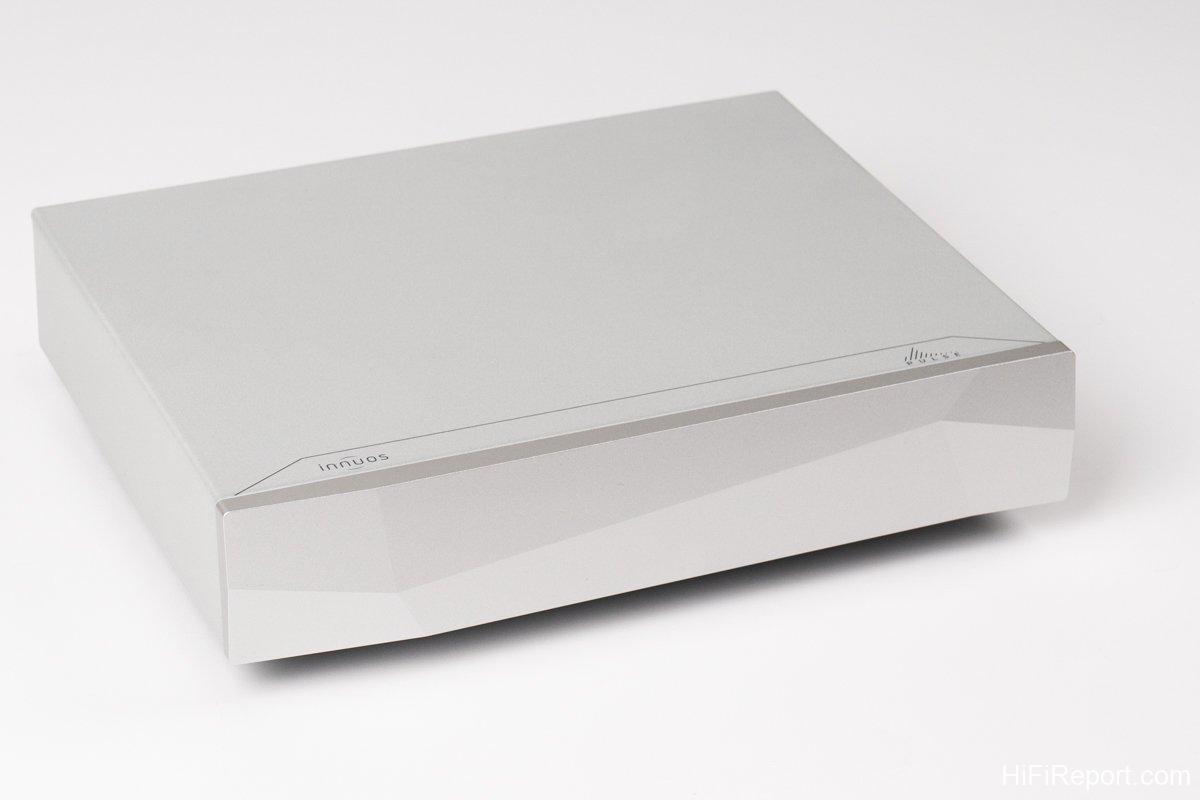
The geometric patterns and three-dimensional folded lines on the front panel are a major characteristic of Innuos.
Innuos Product Lineup
The current Innuos boasts a complete product line. The original Zen/Zenith series remains, with clear product positioning as music servers with built-in optical drives and hard drives.
Stepping down, omitting the CD ripping optical drive and built-in hard drive, is the Pulse series.
For those seeking the ultimate, the two-piece flagship playback system, Statement, serves as a statement piece.
Beyond players and servers, they have also launched the Phoenix series, comprising the Phoenix NET switch and the Phoenix USB reclocker.
This comprehensive product line reveals Innuos’ ambition to cater to various market needs.
For more introduction to Innuos, including product features and design philosophy, please refer to the report on the “Innuos Product Briefing.”
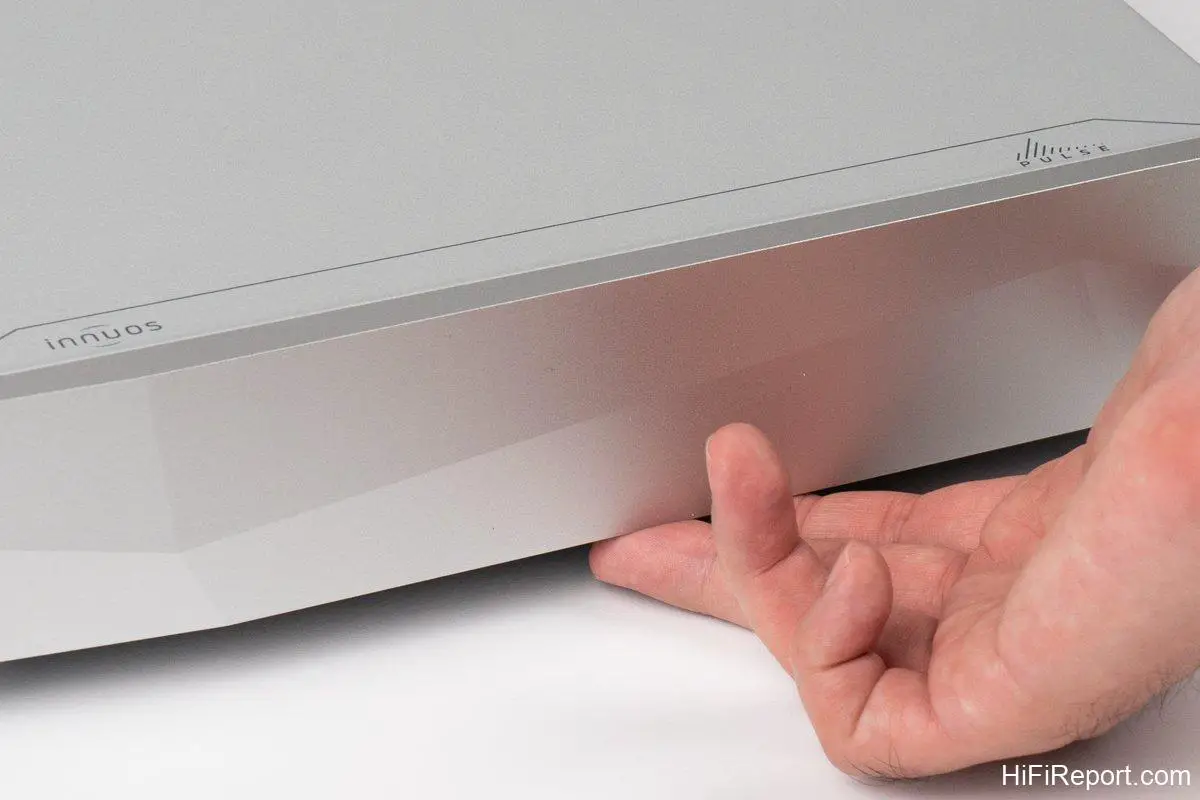
In addition to the main power switch on the rear panel, there is also a power switch at the bottom edge of the front panel. The switch only requires a short, light touch; no long press is needed.
Pulse Series Trio
Innuos’ ambition is grand, but my scope of writing must be narrow.
The Pulse streamer I am reviewing undoubtedly belongs to the Pulse series.
This series consists of three products: Pulse Mini, Pulse, and Pulsar.
With Pulse as the mainstay, Pulse Mini is smaller in size, with an external power supply, but it adds a DAC designed by M2Tech, making it the most convenient choice for beginners.
Pulsar significantly enhances the built-in power supply and adds the Phoenix USB reclocker.
As for Pulse? It firmly establishes itself in the mid-range, providing simple yet sophisticated streaming transport functionality.
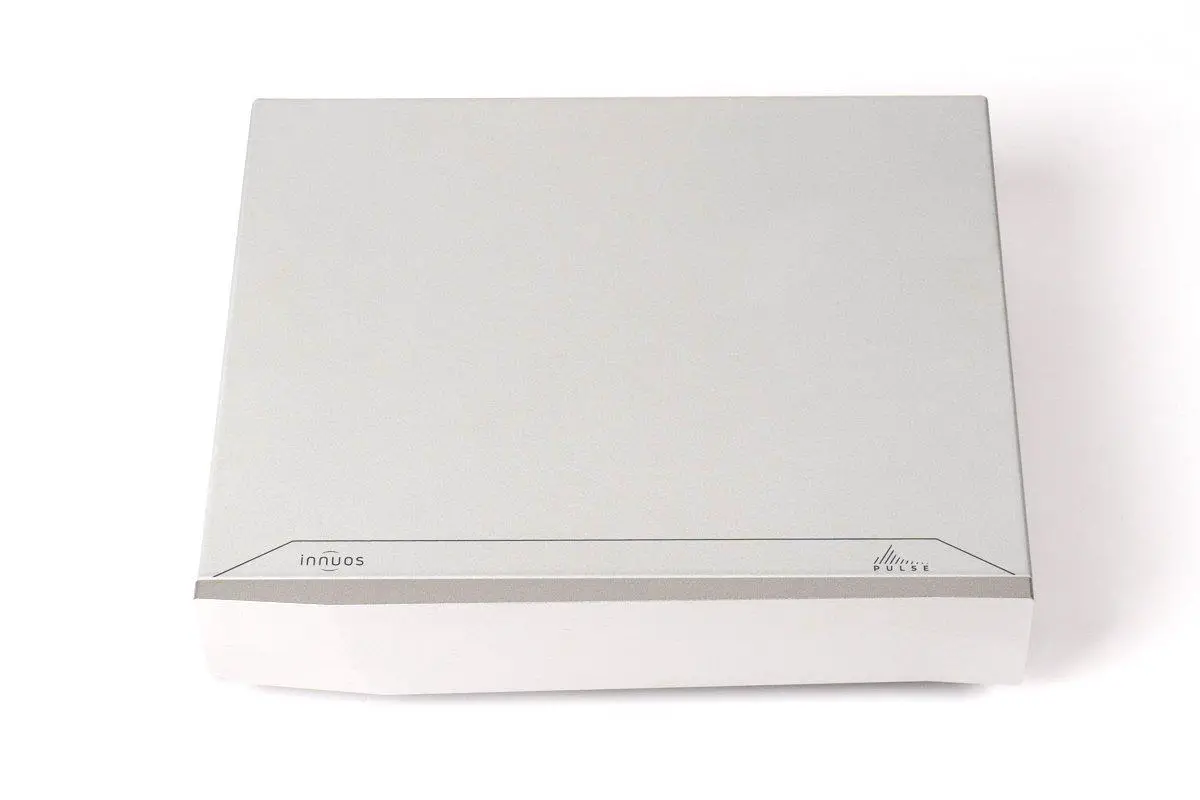
The Innuos Pulse features a solid chassis with precise joints.
Despite its small size, it weighs nearly 5 kilograms and feels substantial in hand.
Appealing Design, Solid Build
Like all Innuos devices, Pulse sports a minimalist and refined appearance. The three-dimensional folded lines on the front panel create light and shadow variations under illumination, showcasing ingenuity.
The solid chassis boasts excellent joint precision.
Despite its compact size, it weighs nearly 5 kilograms, feeling quite hefty.
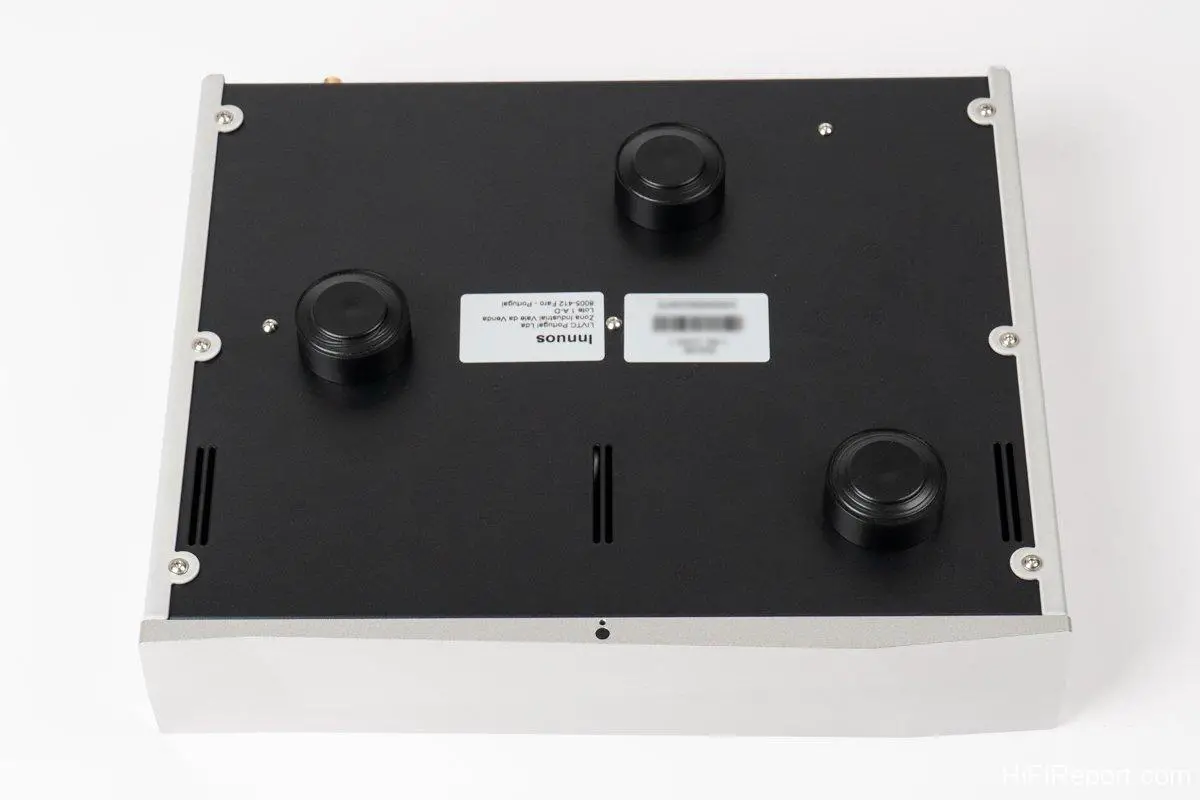
The large footers at the bottom are not arranged in a regular four-corner or two-front-one-rear configuration. Instead, they are strategically placed based on the equipment’s weight distribution, fully demonstrating the Hi-Fi spirit.
The large footers at the bottom are not arranged in a regular four-corner or two-front-one-rear configuration. Instead, they are strategically placed based on the equipment’s weight distribution, fully demonstrating the Hi-Fi spirit.
Versatile Digital Outputs
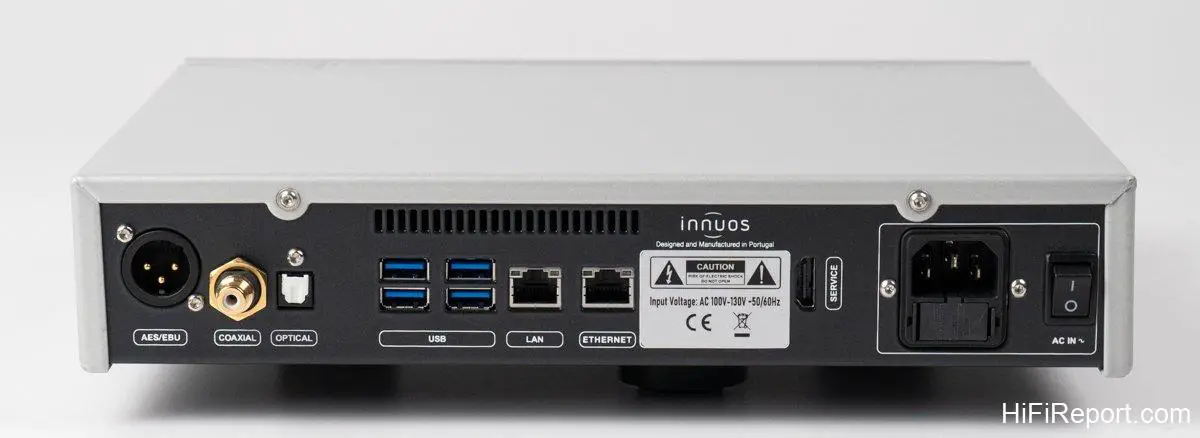
The rear panel output terminals include one set each of optical, coaxial, and AES/EBU digital outputs, immediately setting it apart from using a computer as a digital transport.
Additionally, it is equipped with four USB 3.0 ports, which can be used for digital output or connecting external storage devices.
Coaxial, optical, and AES/EBU outputs support PCM transmission up to 24bit/192kHz, while USB supports up to 32bit/768KHz PCM and DSD 512 Native formats.
The rear panel output terminals include one set each of optical, coaxial, and AES/EBU digital outputs.
Additionally, it is equipped with four USB 3.0 ports, which can be used for digital output or connecting external storage devices.
High-Quality Power Supply by Renowned Designer
Further evidence of its status as a fusion of IT and Hi-Fi, Pulse’s computing core utilizes an Intel Pentium N4200 quad-core processor with 8GB of built-in memory.
This allows for rapid processing of large music database information, with 4GB dedicated to music playback, ensuring both functional stability and sound quality performance.
Furthermore, while IT products rarely emphasize component quality, Innuos highlights the audiophile-grade components in Pulse.
At the power socket, a medical-grade filtering IEC socket is used.
The power supply employs an audio-grade toroidal transformer, which is epoxy-sealed for vibration damping.
The transformer is also wrapped in copper foil and black Mylar tape to isolate magnetic leakage interference.
The power supply further utilizes over 40,000 uF of Mundorf filtering capacitors and custom-wound inductors.
Is this meticulous enough? Innuos calls this power supply circuit RECAP2 LPS. And who is the designer of this linear power supply? None other than Dr. Sean Jacobs, the founder of Custom HiFi Cables. Many audio manufacturers commission him to design power supplies; the power supply inside Pulse is also his creation.
The Innuos Sense App operates stably, with a clear user interface and logical structure.
Operation Modes Explained
In terms of usage, Pulse offers two modes: standalone mode and endpoint mode.
This is my first time using Innuos equipment (using it at a store doesn’t count, as it’s pre-configured). I’ve never encountered a streamer that distinguishes between operating modes before.
In “standalone mode,” Innuos Pulse acts as the central hub of a streaming audio system. Users control it with Innuos’ proprietary Sense App to play music files from NAS, stream music from online platforms, or listen to internet radio.
In “endpoint mode,” Pulse is connected to a music server, becoming an “endpoint” or “zone” within the streaming system.
Selecting this mode leads to a submenu with three mutually exclusive options: “Innuos Endpoint” for pairing with Logitech Squeeze or other Innuos servers, “Roon Endpoint” for use with Roon Core, and “HQPlayer Endpoint” for use with HQPlayer server.
Once selected, only that function can be used.
In my familiar Auralic Lightning DS playback platform, or the Raspberry Pi-based Volumio platform, I can freely switch between Roon Bridge and their native playback software without pre-configuration.
Initially using Innuos Pulse felt a bit unfamiliar.
However, for a heavy Roon user like myself, setting it up once and not needing to switch isn’t too troublesome.
If you are not a Roon user, it’s also fine. The playback platform provided by Innuos has a simple interface, intuitive operation, and smooth workflow, making it easy to get started quickly.
If you prefer using a computer or controlling it on a large screen, you can enter the IP address in a browser to access the web control interface.
This is an overview of the two usage modes, standalone mode on the left, and endpoint mode on the right.
In “endpoint mode,” there are three usage methods: pairing with Innuos music servers, pairing with HQ Player servers, and using Roon Core as a Roon Bridge.
The left image shows system information in “endpoint mode” as a Roon Bridge, and the right image shows information in “standalone mode.”
The IP address you find can be entered into a computer browser to operate in browser mode.
The middle image shows the system options bar, where firmware updates are also located.
Surprisingly Delightful Sound
I still adopted my most привычный way of listening to music, setting Innuos Pulse to “endpoint mode” and controlling it through Roon.
Digital output was via USB, passing through the Ideon 3R USB Renaissance mk2 Black Star before connecting to the Audiobyte Black Dragon. Like the Innuos Phoenix USB, this is also a USB reclocker.
The sound of Innuos Pulse was surprisingly delightful.
How delightful? The sound is warm, smooth, and moist, full, three-dimensional, and layered.
These six adjectives roughly summarize it.
To elaborate further, its sound is clean but not at all cold or harsh. It has plenty of detail but doesn’t overemphasize it.
In terms of soundstage presentation, depth is more pronounced than width. Often, the sonic image feels slightly recessed.
This is where I was pleasantly surprised.
My previous impression of Innuos was that of a hardcore IT technology company. However, actual experience reveals that they emphasize musicality.
Listening to music through Innuos Pulse, it is easy to be moved by the music and drawn into it, rather than superficially focusing on the sonic characteristics.
That’s why I say its delightful sound exceeded my expectations.
The playback interface provides complete and clear information.
Lush and Warm Strings
Taking Rick Stotijn’s cello performance, paired with Camerata RCO’s rendition of Vivaldi’s Double Cello Concerto as an example, the first movement, Allegro, is full of joy. The double cellos bring a rich, warm, and full sound, the orchestra is skillful and agile, and the harpsichord maintains the rhythm of the basso continuo with a brilliant tone.
Listening at a louder volume, the balance, refinement, and harmony are delightful and joyful.
The string instruments presented by Pulse are lush and full, warm and substantial.
Are there details? Yes, but the details are not intended to magnify the bowing texture. Instead, they convey the joy of performance through complete information.
The joy in the music, the joy in the performance, and the joy that fills my heart as I listen.
Warmth Enhances Vocals
Listening to “Fado,” an album of Iberian Peninsula songs with a jazzy flavor, the Fado songs here are more modern and softer, less melancholic.
However, the full and concrete sonic image, along with the ample details that sculpt the vocals and articulation, make the singing extremely moving.
In the opening of “Com que voz,” João de Sousa’s vocals emerge first, followed by the gentle entry of the bass clarinet. It’s truly mournful.
The vocal cavity is clear, the texture is real, and the timbre is truly captivating.
This album is already enjoyable. Bastarda, a Polish trio with a unique instrumentation, and João de Sousa’s feminine and deep voice are both distinctive. Now, with the warmth of Pulse’s support, it becomes even more magnetically charming.
Standalone Mode Preference?
Listening to Renaud Capuçon’s new Mozart Violin Concerto album, where he performs as both soloist and conductor of the Lausanne Chamber Orchestra.
The music opens with Mozart’s characteristic directness. The orchestra powerfully and energetically plays the first theme, followed by the solo violin.
Subsequently, the orchestra and violin echo and repeat the theme, leading into the second theme.
The development of the entire exposition is seamless. The stark contrast between the cheerfulness of the first theme and the melancholy of the second theme is a common technique in Mozart’s music.
In the development section, fragmented themes are interwoven with transformed themes, making the musical atmosphere colorful and emotionally stimulating.
Pulse presents a clear orchestral image that recedes into the background, creating a more layered stage order.
The solo violin has a solid and full form, with a smooth sound line. It is dashing and elegant when developing themes, especially the long violin solo in the recapitulation section, which is truly vivid.
It was on this piece that I discovered something perplexing: using “standalone mode” and playing through Innuos Sense, the sound is cleaner and more transparent than with Roon.
Honestly, it’s just a slight difference (or perhaps a tiny bit), but it changes the transmission of musical emotion.
Using a computer browser for operation, the interface design is actually very similar to Innuos Sense, but with a larger screen.
Computer users can take advantage of this.
Why Isn’t This on Your Shopping List?
My first experience with Innuos, encountering Pulse, left a good impression.
Its refined, minimalist, and exquisite appearance undoubtedly possesses high WAF (still don’t know what this is? Damn men!).
Its solid and stable build, along with specially designed vibration-damping feet, and a high-quality power supply designed by an expert and filled with premium components—isn’t this the embodiment of Hi-Fi spirit? The smooth and logically clear App operation interface greatly enhances the user experience.
The elegant and rounded, warm and aesthetically pleasing sound delivers a musically rich listening experience.
Combining the above four features, plus the “Made in Europe” (Portugal) origin advantage, while maintaining a reasonable price, if you are stepping into the streaming realm for the first time, or planning to upgrade from a lower-end streamer, doesn’t Innuos Pulse deserve to be on your consideration list?
Specifications
* Type: Streaming Player
* Digital Outputs: Coaxial SPDIF (up to 24bit/192KHz PCM), Optical SPDIF (up to 24bit/192KHz PCM), AES/EBU (up to 24bit/192KHz PCM), USB (up to 32bit/768KHz, DSD256 DoP, DSD512 Native)
* Interfaces: RJ45 × 2, USB 3.0 × 4
* Supported Formats: WAV, AIFF, FLAC, ALAC, AAC, MP3, MQA
* Endpoint Mode: Connectable to Innuos Music Server, Logitech Media Server, or HQPlayer Server
* Control Interface: Innuos Sense app
* CPU: Intel Quad Core N4200
* Memory: 8GB
* Compatible Streaming Functions or Services: Qobuz, Tidal, Internet Radio
* Dimensions: 300 × 74 × 250 mm (W×H×D)
* Weight: 4.9 kg