
In-Akustik NF-204 Micro Air Interconnects Review
If you’re chasing that elusive sense of “airiness” in your audio, the newly released NF-204 Micro Air interconnects from German manufacturer In-Akustik should definitely be on your audition shortlist. These cables not only incorporate “air” into their design but also impart a palpable sense of “air” to the music itself.
Air Technology Trickle-Down
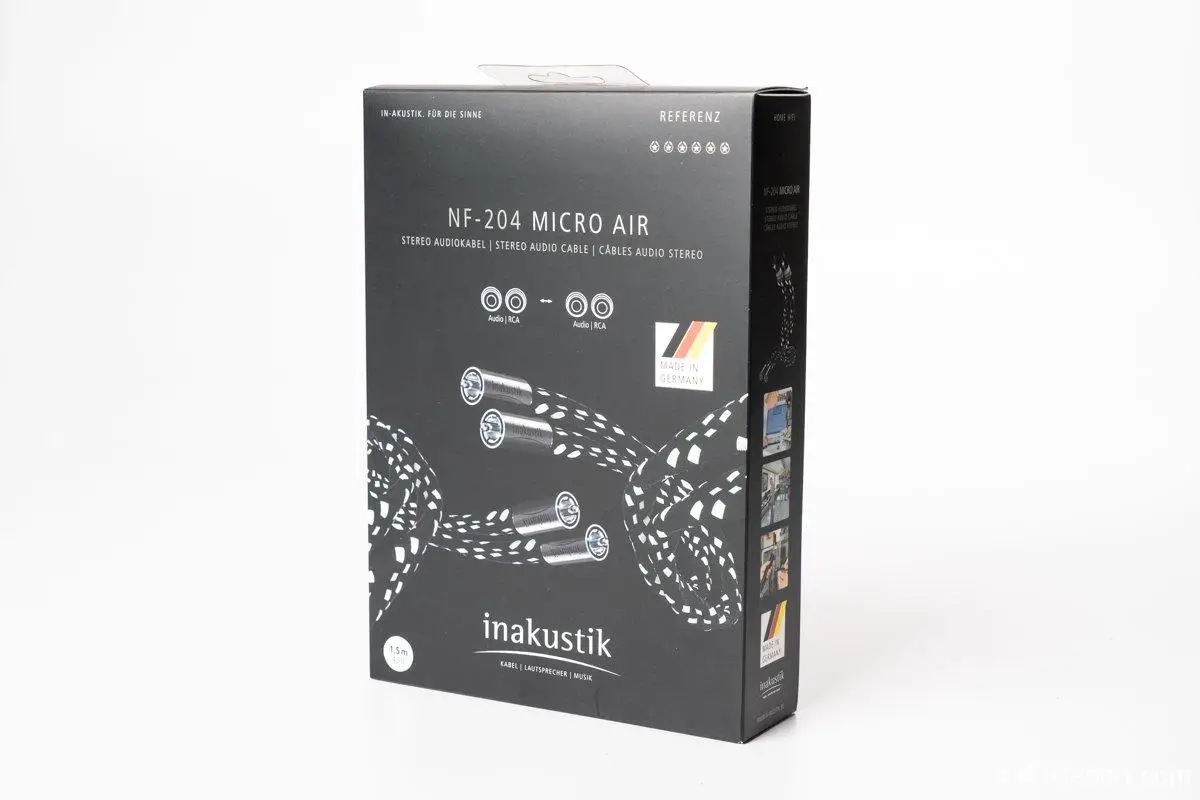
The full product name is Reference NF-204 RCA Micro Air, but that’s quite a mouthful. Even with copy-paste at my disposal, such a lengthy name is cumbersome to read. So, let’s simply call them NF-204.
Within In-Akustik’s product hierarchy, the highest echelon is designated “Referenz.” This series features the unique Air-Helix skeletal support structure design. This innovative approach aims to bring the dielectric constant of the cable as close as possible to the minimum value of 1, akin to air, thereby minimizing capacitance. This Air-Helix technology is exclusive to In-Akustik; no other brand currently employs it.
However, the Air-Helix construction is entirely handcrafted, a time-consuming and labor-intensive process that results in a premium price tag. To democratize the benefits of air insulation, In-Akustik has trickled down the core principles to the “Reference” series, making the NF-204 a near-flagship interconnect.
Sporting the “Micro Air” moniker, the NF-204 also incorporates air insulation. In-Akustik’s journey with air insulation began in 1999 with their first-generation Air Technology, which incorporated hollow PVC and PE insulation layers, leveraging air as a dielectric. This technology evolved through four generations, culminating in the top-tier “Referenz” series in 2015. The NF-204, however, utilizes a technology closer to the 2011 Air Technology generation. It features a PE jacket around the conductors, further enhanced by PE Micro Mech to create air-insulated layers.
While both the “Referenz” and “Reference” series employ the same fundamental Air Technology, the primary distinction lies in the volume of air incorporated. The NF-204 achieves a more accessible price point largely due to a greater proportion of machine-driven manufacturing. The flagship “Referenz” series is almost entirely handcrafted, with minimal automation. In contrast, the NF-204 benefits from more automated processes, reducing manufacturing costs and making high-end Air Technology more attainable. Perhaps the slightly reduced air volume in the insulation is why it’s termed “Micro Air.”
Concentric Copper Conductors
Beyond Air Technology, the NF-204 introduces another innovation: “Concentric Copper” conductor arrangement. The NF-204’s conductor consists of 19 copper strands in total. A central core is surrounded by a ring of six strands, and an outer ring of twelve strands completes the arrangement. This precise, coaxial arrangement of the 19 copper strands gives rise to the “Concentric Copper” technology designation.
Is this technology complex? Examining the conductor cross-section provided by In-Akustik, the NF-204’s concentric copper arrangement exhibits remarkable regularity. The contact points of each copper strand form concentric circles. In contrast, multi-strand copper conductors lacking Concentric Copper technology exhibit irregular strand arrangements. Their contact points cannot form concentric circles, indicating a lack of uniformity. These irregular contact points in conventional multi-strand conductors can become sources of minute signal interference and distortion.
Refined Manufacturing Process
Why is it that conventional multi-strand copper conductors often exhibit irregular arrangements, while In-Akustik achieves concentricity? The answer lies in the manufacturing process. Traditional multi-strand wire drawing is a single-step process, making it challenging to achieve precise strand arrangements. However, the NF-204 conductor undergoes a two or three-stage drawing process. The first layer around the central core is created, followed by the second layer. Specialized tooling ensures that the third layer of copper strands is precisely placed in the gaps, resulting in a regular, concentric arrangement.
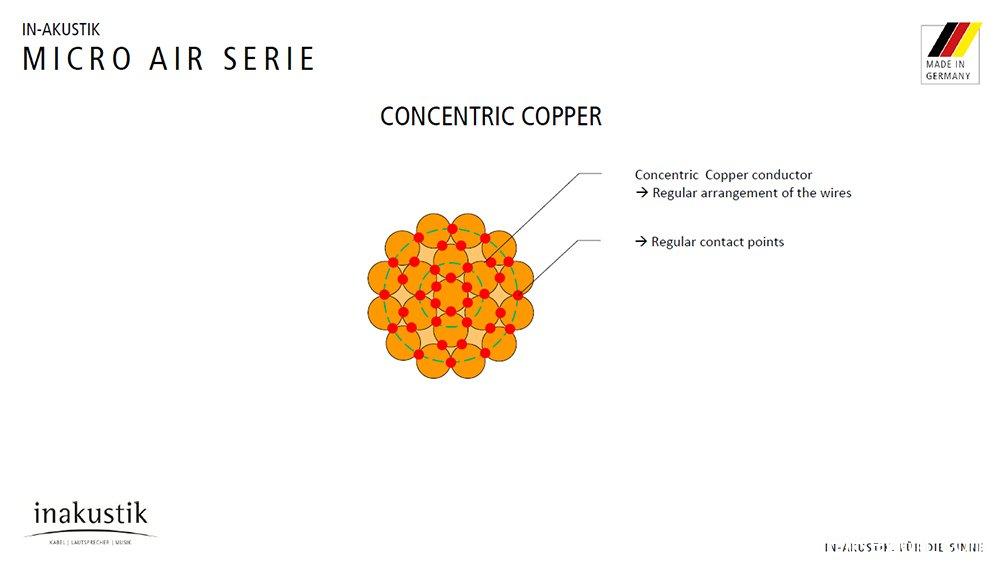
“Concentric Copper” is not necessarily a complex concept, but it is a more labor-intensive manufacturing approach. The goal is straightforward: to achieve a regular, concentric arrangement of conductors, thereby standardizing the contact points between strands and minimizing signal interference and distortion in multi-strand conductors.
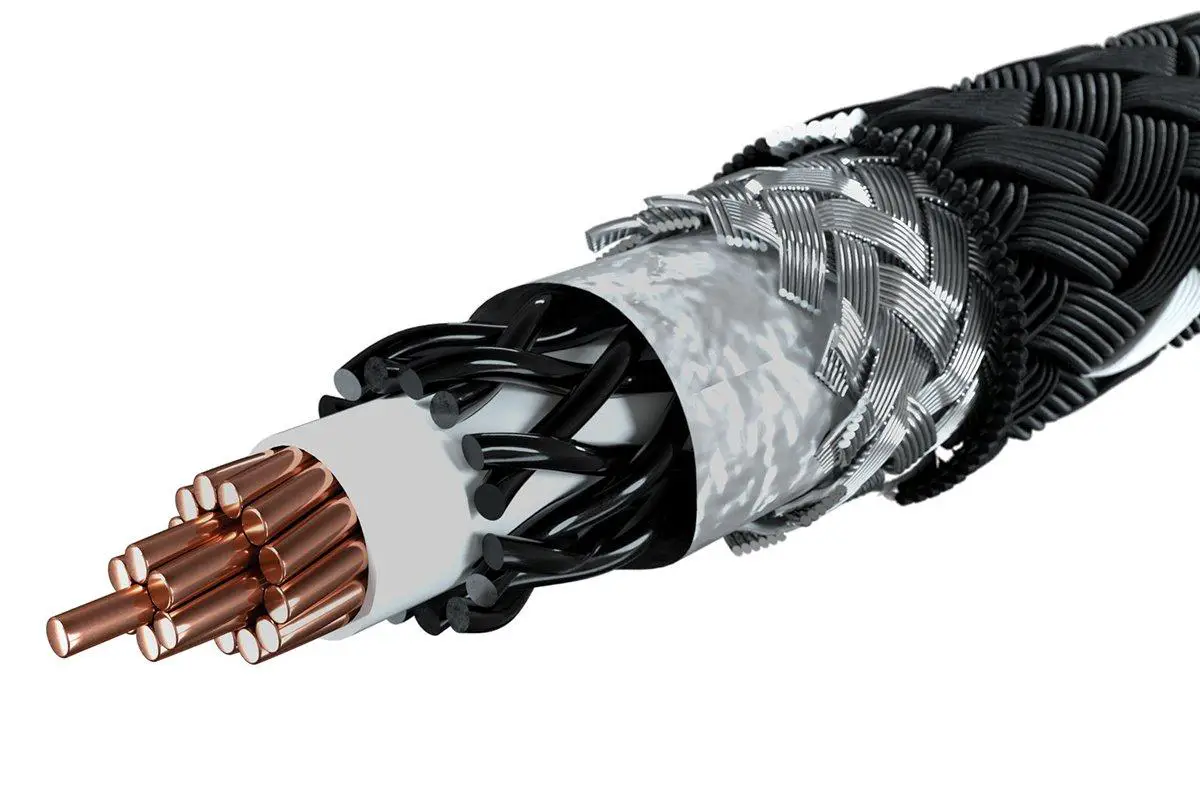
The cross-sectional diagram of the NF-204 from the manufacturer reveals a complex structure. At the center are the 19 copper strands, surrounded by a Peek insulation layer. The black mesh-like material is Peek Micro Mech, creating air gaps for insulation. An outer layer of metal foil and a ground mesh, finally enclosed by a shielding layer, complete the construction.
Low Capacitance for Reduced Distortion
Compared to the top-tier “Referenz” series, the NF-204 incorporates slightly less “air.” However, its technology still significantly reduces the dielectric constant compared to conventional PVC or PE insulation. The dielectric constant directly influences a cable’s capacitance: a higher dielectric constant leads to higher capacitance, and vice versa.
Air boasts the lowest dielectric constant, at a value of 1 (vacuum is technically 1, but air is very close, often rounded to 1). PVC typically ranges from 3.5 to 4.5, PE from 2.2 to 2.4, and Teflon at 2. The flagship “Referenz” series, with its full air insulation, achieves the ideal value of 1. The “Micro Air” technology in the NF-204 reaches a value of 1.65. This demonstrates the significant improvement of Micro Air over conventional PVC or PE insulation in reducing dielectric constant and achieving low capacitance.
Why is low capacitance so crucial in cable design? Capacitance, or capacitive reactance (measured in ohms, like resistance), refers to the build-up of electrical charge within the cable’s shielding. Unlike resistance, which doesn’t affect frequency response, capacitance can. Technically, high capacitance can darken the sound by impacting frequency response. Low capacitance, conversely, minimizes frequency response distortion, preserving the integrity of the signal. In essence, In-Akustik’s relentless pursuit of low capacitance is aimed at minimizing distortion and interference during signal transmission.
Distortion is the nemesis of any audio system, pervasive in every component, from equipment to cables. Everyone in the audio world is constantly battling distortion!
Physics Not Voodoo
Are you feeling a bit overwhelmed by the technical details? Perhaps because I’m getting tired of writing about them! But the core technologies of the NF-204—Micro-Air and Concentric Copper—are inherently technical. In-Akustik’s motto is “Physics Not Voodoo,” emphasizing their commitment to scientifically grounded cable design, not esoteric claims. Their technical approach is rigorous. Even during my visit to their German factory, I was immersed in a full day of technical training.
Okay, let’s set aside the physics for a moment and focus on the listening experience with the NF-204. In the HiFiReport listening room, I connected the NF-204 between an Audionet Pre G2 preamplifier and Papworth M200 power amplifier, driving Wilson Audio Alexia 2 loudspeakers. Coincidentally, Audio Technica’s high-end AT-DAC100 DAC and AT-BHA100 headphone amplifier arrived at the editorial office during the review period. This provided an opportunity to evaluate the NF-204 in a headphone system as well, which further highlighted its “airiness.”

Clear and Transparent Airiness
What exactly is “airiness” in audio? It’s the sensation of a clear and transparent soundstage reproduction. Audio systems rely on loudspeakers to move air, generating sound waves that transform recordings into audible music. However, various stages within the audio chain can introduce distortion and interference, hindering the clarity and transparency of the reproduced music. The NF-204, being a low-distortion interconnect, contributes to reducing these impediments. While you might not quantify the precise reduction in distortion, you can clearly perceive the music becoming more transparent and the soundstage expanding, which audiophiles often describe as “airiness.”
Take, for example, Cecilia Bartoli’s “Live in Italy” album, specifically Handel’s “Lascia La Spina.” This live recording captures a performance in Italy’s oldest Olympic Theatre (Teatro Olimpico), with the orchestra intentionally using period instruments. The music begins with strings and harpsichord, an intimate chamber ensemble. With the NF-204 in the system, the sense of space noticeably expands. The soundstage gains depth, width, and height. The period instruments, with their delicate timbres, benefit from the NF-204’s detailed rendering of high-frequency nuances, enhancing the “airiness.” The delicate chime of the harpsichord and the sustained notes of the strings weave a tapestry of subtle sounds. Bartoli’s voice is firmly anchored in the airy space, her enunciation and vocal inflections rendered beautifully and with emotion.
The NF-204 doesn’t artificially inflate the size of the soprano’s voice or instruments. Instead, it presents the proportions and scale of vocals and instruments with precision, allowing the vibrant musical notes to float freely in the air.
Enhanced Airiness with Top-Tier Headphones
Switching to the Audio Technica AT-DAC100 and AT-BHA100 headphone system, the NF-204 continued to deliver its characteristic “airiness.” Listening to Bartoli’s “Lascia La Spina” again, headphones, being in close proximity to the ears, offer less of a spacious 3D soundstage compared to loudspeakers. However, they reveal even finer musical details. With the NF-204, subtle breaths from the musicians and the soprano’s vocal intakes become more prominent than with loudspeakers. The nuances of her vocal delivery become more intimate. The NF-204 doesn’t impose much of its own sonic signature, instead faithfully transmitting the musical signal. I didn’t perceive a warming of the tone or a thickening of the sonic texture with the NF-204. Its clarity and transparency, however, were immediately apparent.
Is the NF-204 truly neutral? To test its low-frequency performance, I selected “Tricycle.” The track begins with delicate piano notes, followed by a powerful drum entrance that establishes a brisk rhythm. Compared to interconnects I typically use, the NF-204 exhibited a faster transient response and cleaner bass. The speed was almost aggressive, particularly during the initial drum attack in “Tricycle.” At high volumes, the NF-204 delivered clean, fast, and impactful drums, effortlessly handling the dynamic swings. Throughout the track, and especially during the drum solo, the NF-204’s clean, fast bass rendered the drums with exceptional clarity. The consistent bass line from the electric bass, without chord changes, allowed the drum solo to take center stage. With the NF-204, the drums were punchy and powerful, yet the underlying bass notes remained distinct and articulate, maintaining clear mid-bass resolution even during demanding passages.
Neutral and Uncolored Sonic Character
Returning to the loudspeaker system, I played Ayado Chie’s “To You” album, focusing on her rendition of “Imagine.” The NF-204 presented a pristine sonic character. It’s difficult to describe the NF-204 as making the sound thicker, brighter, or bass-heavy. Instead, I would say it presents the details of the recording with clarity and neutrality.
Ayado Chie’s voice possesses a distinct soulful quality, reminiscent of African-American singers, even with a hint of Japanese accent in her English. Her vocal style is uniquely soulful. During the brief silence after she begins singing “Imagine,” the NF-204 reveals a remarkably quiet and black background, making the subsequent line, “There’s no heaven,” sound even more impactful. The delicate piano accompaniment and its dynamic interplay with her vocals create an intimate atmosphere. I could almost visualize Ayado Chie seated at the piano, accompanying herself, freely interpreting “Imagine” with both voice and piano under her control.
Moving on to a classic Japanese jazz recording, I chose the Three Blind Mice album “Misty.” The analog tape hiss, inherent in the original recording, persists in the digital transfer. The NF-204 doesn’t mask these details. The piano solo intro reveals this subtle hiss beneath the large, distinct piano notes—a hallmark of Three Blind Mice recordings, known for close-miking techniques, sometimes even placing microphones inside the piano to capture the immense piano sound. The NF-204 excels in revealing musical detail. The plucked notes of the double bass are substantial and well-defined, without blurring or becoming muddy. The delicate brushstrokes on the drums are constantly present, harmonizing with the clear, voluminous piano notes. The NF-204 doesn’t impose its own character but faithfully transmits the signal, without boosting bass or treble. It presents a clear, pristine musical picture, offering a transparent and expansive soundstage.
Restoring Clean Airiness
After spending time with the NF-204, I consider it a sonically neutral and uncolored interconnect. If you seek to use the NF-204 to add bass weight or brighten the treble, it might not be the solution. However, for systems with excessive bass or an uneven frequency balance, the NF-204 could act as a corrective force, restoring a more neutral and balanced sonic profile. The NF-204’s frequency response is remarkably even, without added coloration. If your system exhibits loose bass, the NF-204 can tighten and refine it. When the bass becomes more controlled, the midrange and treble benefit, becoming clearer and cleaner. The NF-204’s most significant strength is its ability to reproduce the “airiness” in music, providing an expansive and transparent soundstage, and restoring a sense of clarity to your audio system.
Specifications
* Type: RCA Analog Interconnect Cable
* Conductor: Concentric Copper Structure
* Shielding: Double Shielded
* Standard Lengths: 0.75 m, 1.0 m, 1.5 m