
Integra DRX 2.4 7.2 Channel Surround Receiver Review
Integra surround receivers occupy a market position in the upper mid-range and beyond, primarily targeting discerning audiophiles and professional installers. These receivers are engineered to integrate seamlessly with a variety of home automation systems, catering to custom installation requirements. Therefore, while the DRX 2.4 is positioned as Integra’s entry-level offering, its price point places it in the mid-to-high tier when compared to certain Japanese brands.
However, it’s a case of getting what you pay for. The DRX 2.4 justifies its price with a comprehensive feature set and impressive audio-visual performance, ensuring a richly rewarding home entertainment experience.
8K Upscaling
The DRX 2.4 provides 7.2 channels of amplification, delivering 80 watts per channel. It natively supports object-based audio formats like Dolby Atmos and DTS:X, facilitating the creation of up to a 5.2.2 channel home theater setup.
On the video front, the DRX 2.4 is equipped for 8K passthrough and HDR10+ compatibility. It features 6 HDMI inputs and 2 outputs. Notably, 3 of the inputs are HDMI 2.1 specification, supporting 8K/60Hz signals, while the remaining 3 inputs are HDMI 2.0b, handling 4K/60Hz.
The dual HDMI outputs are designated as Main and Sub/Zone 2. The Main and Sub outputs can simultaneously handle 8K/60Hz and 4K/120Hz signals, whereas the Main and Zone 2 outputs support 8K/60Hz and 4K/60Hz respectively.
The main HDMI output also incorporates eARC (enhanced Audio Return Channel) functionality, simplifying connection to compatible televisions for lossless audio transmission back to the DRX 2.4.
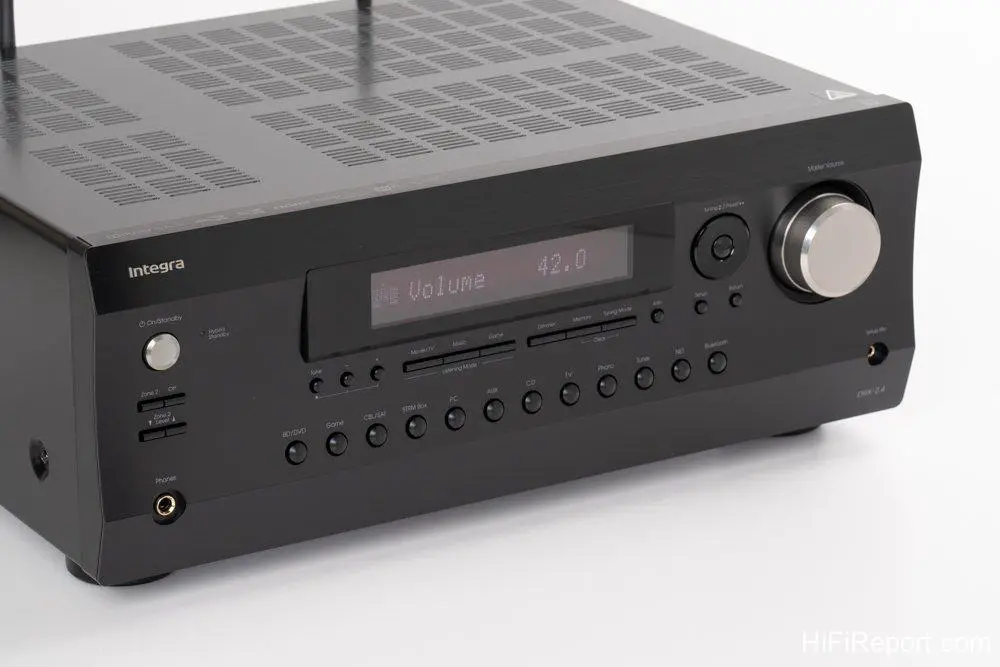
A standout feature of the DRX 2.4 is its video upscaling capability. It can upscale incoming 4K content to 8K resolution, and 1080P content can be upscaled to either 8K or 4K, ensuring compatibility with the latest, high-resolution displays and allowing users to enjoy the enhanced clarity of 8K visuals.
Extensive Network Features
Network capabilities are a significant strength of the DRX 2.4.
It offers flexible placement options thanks to both wired Ethernet and Wi-Fi wireless network connectivity.
Control versatility is a key aspect, with support for a wide range of platforms including DTS Play-Fi, Google Chromecast, Apple AirPlay 2, Sonos, and Roon Ready. Integra also provides its own remote control app for managing streaming music, giving users ample choice in how they interact with the receiver.
Voice control is also on board, with compatibility for Amazon Alexa, Google Assistant, and Apple Siri, enabling hands-free music selection and playback. For even simpler operation, Bluetooth is available, featuring bidirectional transmission, allowing all family members to easily stream music from their smartphones.
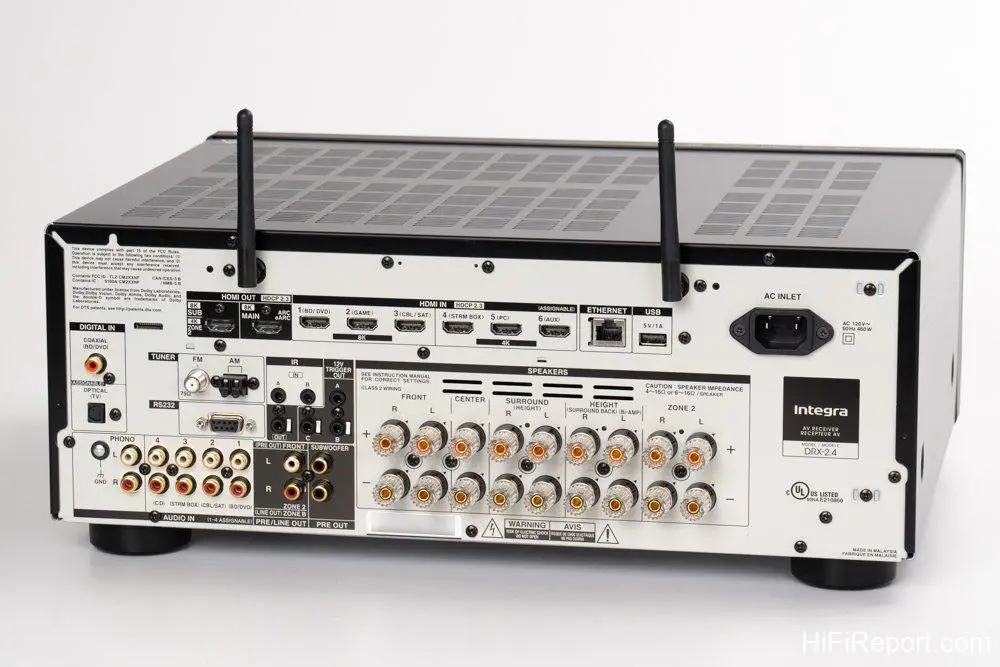
The DRX 2.4 grants access to a plethora of streaming music services, including Amazon Music HD, Spotify, TIDAL, TuneIn, Pandora, and Deezer, among others.
For high-resolution audio enthusiasts, the DRX 2.4 naturally supports hi-res playback. Via network streaming, it can handle files up to DSD 11.2 MHz and 24-bit/192 kHz PCM, fully meeting the demands of today’s high-resolution audio formats.
Versatile Connectivity
The DRX 2.4’s connectivity extends well beyond its network features.
It boasts RCA analog inputs, digital coaxial, and digital optical inputs, facilitating connections to a wide array of legacy and modern audio sources.
A front-panel USB A input allows for direct playback of music files from USB storage devices. Furthermore, a dedicated MM phono input is included, catering to vinyl enthusiasts and those seeking a touch of analog warmth.
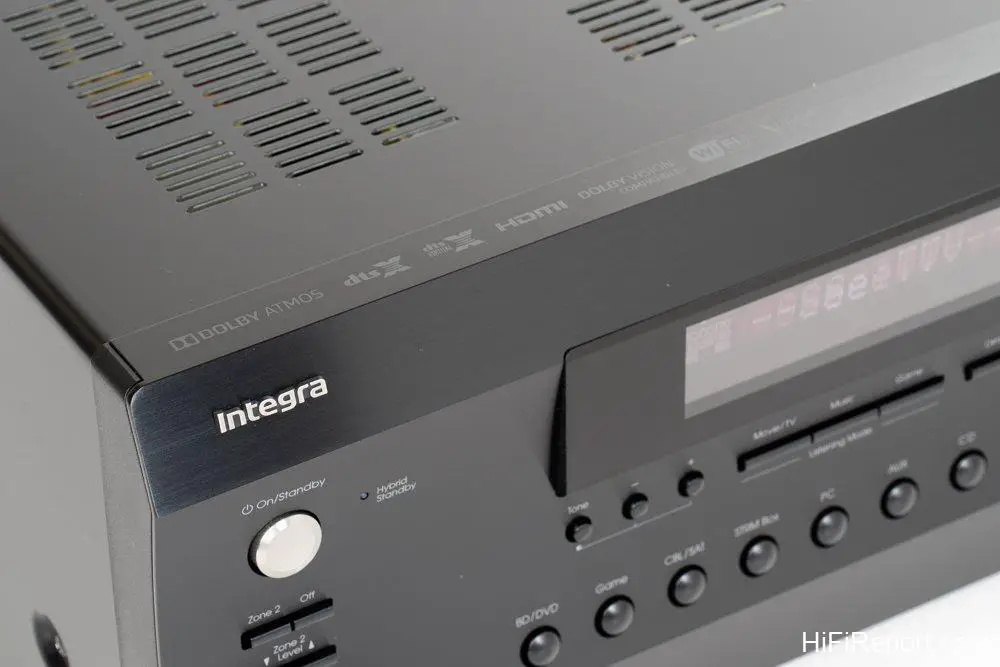
For personal listening, a front-mounted 6.3 mm headphone output is provided for immersive, private listening sessions.
The DRX 2.4 even incorporates FM and AM radio tuners, ensuring that listeners can enjoy their favorite broadcast stations.
In essence, the DRX 2.4 is designed to be a central hub for all home entertainment needs. Its comprehensive suite of audio and video connections ensures compatibility with virtually any source device, both old and new. It can also power a two-channel, two-zone audio system, even directly driving Zone 2 speakers, providing flexible multi-room audio capabilities.
Atmos Enabled Speaker Optimization
Moving on to multi-channel speaker setup and automatic room correction, the DRX 2.4 employs the AccuEQ automatic room calibration system. Using the included measurement microphone and following the on-screen prompts, a single point measurement from the primary listening position (the “sweet spot”) is all that’s needed for quick and effective calibration.
Before initiating the measurement process, the DRX 2.4 needs to be informed of the speaker configuration. It supports a wide range of setups, from 2.1, 3.1, 4.1, 5.1, 6.1, and 7.1 to immersive configurations like 2.1.2, 3.1.2, 4.1.2, and 5.1.2, offering remarkable flexibility. For systems with overhead channels, the installation location of these speakers must also be specified – whether they are in-ceiling (front, middle, or rear), wall-mounted above the main speakers, or Dolby Atmos Enabled speakers placed atop the main speakers. Accurate information is crucial for the DRX 2.4 to perform precise analysis and correction.
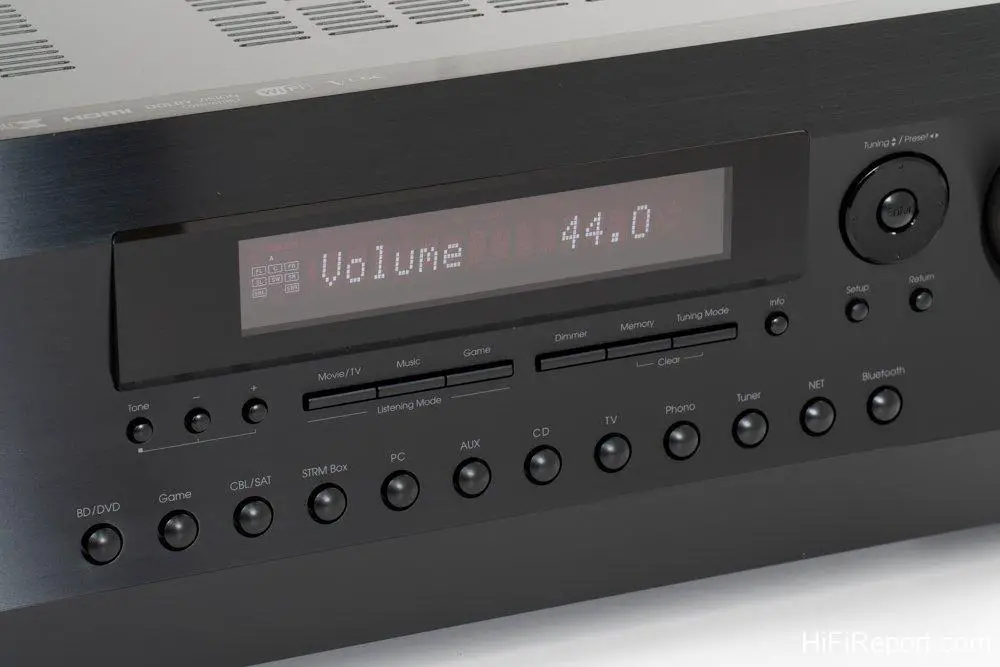
If overhead speakers are not used, the amplifier channels assigned to them can be reconfigured for bi-amping the front main speakers, maximizing power delivery to these critical channels.
Recognizing that many home environments are not ideal for installing in-ceiling speakers, Dolby Atmos Enabled speakers have emerged as a practical solution. These speakers are designed to be placed on top of existing main speakers, projecting sound upwards at an angle to reflect off the ceiling, simulating overhead sound effects even without physical ceiling speakers.
The DRX 2.4 includes a dedicated function called AccuReflex specifically for Dolby Atmos Enabled speakers. AccuReflex enhances the reflected energy from these speakers and corrects phase anomalies, resulting in more precise and focused overhead sound reproduction.
Immersive Sound Field
The listening evaluation was conducted at HiFiReport. Due to the suspended grid ceiling in the listening room, in-ceiling speakers could not be installed. Therefore, a 5-channel configuration was used, comprising BestVox LS3/6 three-way bookshelf speakers for the front channels, a Divini KIT-M bookshelf speaker for the center channel, and Acoustic Energy AE100 bookshelf speakers for the surround channels. Speakers were positioned according to the standard ITU-R layout. AccuEQ automatic calibration was run initially, followed by subtle manual adjustments to individual channel levels based on listening impressions. Within a short time, a cohesive and immersive sound field was achieved.
The BestVox LS3/6 speakers, with their classic, British-inspired aesthetic, proved surprisingly well-suited for multi-channel applications. Their 8-inch woofers and generous cabinet volume deliver low-frequency extension down to 42 Hz with ample output. Consequently, even without a subwoofer, the bass felt satisfyingly full. This indicates the DRX 2.4’s capable driving power and sonic weight. Crucially, the sound remained comfortable and smooth, devoid of harshness or edginess, while still providing ample detail – a highly satisfying performance.
Using the “Audiosphere” segment from the Dolby Atmos test disc as an example, the visuals depict a disc-like object surrounded by pulsating orbs synchronized with the music. As the orbs illuminate, musical notes emanate from those locations, demonstrating directional sound cues, timbres, and distance. Through the DRX 2.4’s playback, the timbre was warm and rich, the sonic images were full-bodied and substantial, and the overall frequency balance was pleasingly full, while retaining necessary agility and dynamism. While acknowledging that the inherent warmth of the sound is largely attributable to the speakers, it nonetheless reflects the DRX 2.4’s solid mid- and low-frequency performance, enabling this type of sonic presentation.
Impressive Performance
Next, the “Amaze” segment from the Dolby Atmos test disc was played, featuring rainforest ambience with thunder and rain. The DRX 2.4 effortlessly distinguished the various sound effects, accurately conveying their movement, size, and distance. Even without a subwoofer, the low-frequency impact of the thunder was substantial, providing a solid foundation. High frequencies were appropriately bright, and the overall frequency extension felt natural and effortless, demonstrating the DRX 2.4’s headroom and composure.
Another segment, “Horizon,” features even more complex and dynamic soundscapes, including spacecraft flybys, speeding sports cars, cascading waterfalls, and concert crowd noise. Pushing the volume higher, the DRX 2.4 maintained stable and consistent power delivery, preserving a composed and controlled soundstage. Sonic density increased, and layering remained distinct and clear, without collapsing into muddiness or chaos – everything remained firmly under control. This highlights that despite being positioned as an entry-level model, the DRX 2.4’s performance is genuinely impressive and should not be underestimated.
Specifications
* Type: 7.2 Channel Surround Receiver
* Output Power: 80 watts (8 ohms, 20 Hz–20 kHz, 0.08% THD, 2ch driven, FTC)
* Frequency Response: 10Hz – 100kHz / +1 dB, -3dB
* Analog Inputs: RCA high-level x 4, MM Phono x 1, FM, AM
* HDMI: Input x 6, Output x 2
* Digital Inputs: Coaxial x 1, Optical x 1, Network RJ45, USB
* Signal-to-Noise Ratio: 106 dB (LINE, IHF-A)
* Speaker Impedance: 4 Ω – 16 Ω
* Supported Audio Formats: 5.1.2 channel Dolby Atmos and DTS:X
* Streaming Audio Sampling Rate: Up to 24 bit / 192kHz PCM, DSD 11.2 MHz
* Dimensions: 435 × 174 × 376.5 mm (W×H×D)
* Weight: 9.6 kg