
IsoAcoustics GAIA Isolation Feet Review
Do you own floor-standing speakers? What kind of feet or spikes are you using underneath them? Are you satisfied with the original spikes that came with your speakers? If you asked me these questions, I might not be able to answer immediately.
Without prior experience of swapping and comparing, how would one know if the original spikes are good or bad? Who knows if changing the spikes will improve the sound? Precisely for this reason, Fully Inspired Audio, the distributor of IsoAcoustics, has consistently showcased their products at audio exhibitions in a compelling way: by setting up two pairs of identical speakers, one using the original manufacturer’s spikes and the other using IsoAcoustics isolation feet.
In front of the listening position, there’s a switcher, allowing you to instantly compare the difference between “with” and “without” IsoAcoustics feet, all within the same audio system and listening space.
If you’ve visited audio shows in the past couple of years and stepped into Fully Inspired Audio’s room, you’ve undoubtedly experienced this difference firsthand.
Car Tires Analogy
Are the original spikes that come with speakers really that inadequate? Not necessarily.
IsoAcoustics uses the analogy of tires on a sports car to illustrate their point.
Even the most advanced supercar needs to collaborate with tire manufacturers to design specialized performance tires, rather than the supercar manufacturer trying to make tires themselves.
Similarly, speaker manufacturers should focus on designing speakers, while the specialized task of vibration isolation accessories should be entrusted to IsoAcoustics.
Brand Credibility: Founder’s Expertise
Is IsoAcoustics professional? Compared to many other vibration damping material brands, they are definitely considered professional.
Firstly, the founder, Dave Morrison, spent 20 years working as an acoustic space engineer at the Canadian Broadcasting Corporation.
He drew inspiration from broadcast centers built upon 3,000 isolation mounts and dedicated himself to researching speaker and audio equipment vibration control, leading to the establishment of IsoAcoustics.
Therefore, the founder’s background in professional engineering lends significant credibility to the brand.
Scientific Validation: NRC Testing
Secondly, IsoAcoustics submitted their products to the National Research Council Canada (NRC) for scientific testing. They presented the effectiveness of IsoAcoustics isolation feet through data and openly published these measurement results on their official website.
Taking the GAIA isolation feet as an example, reports from NRC demonstrated through frequency response measurements in an anechoic chamber that GAIA does not alter the original frequency response of any speaker within the 20Hz-20kHz range. Furthermore, using laser vibrometry to scan the speaker surface point by point, it was proven that GAIA can reduce the transmission of resonant energy. Compared to conventional metal spikes, speakers using IsoAcoustics GAIA exhibited significantly lower overall resonance velocity and vibration amplitude.
They even conducted an interesting experiment comparing three isolation methods: standard spikes, GAIA feet, and suspending speakers with elastic cords.
The results showed that the isolation effect of GAIA feet was similar to that of elastic cord suspension. However, the manufacturer pointed out that while suspension could control vibration, the sound lacked clarity, a problem not encountered with GAIA.
These experiments confirmed three things: IsoAcoustics GAIA effectively suppresses vibration, its effectiveness is superior to standard spikes, and it does not alter the original tonal character of the speakers.
Industry Recognition: OEM Partnerships
Precisely because of IsoAcoustics’ professionalism and reliability, an increasing number of audio manufacturers are collaborating with them. IsoAcoustics also lists these partners in detail on their website, including both home audio and professional equipment brands.
It’s foreseeable that the number of OEM brands will continue to grow. According to the latest news, Focal, a well-known brand, will also use IsoAcoustics-designed feet on their Maestro Utopia speakers.
Undoubtedly, IsoAcoustics is to speakers and audio equipment what Pirelli and Michelin are to sports cars – mutually complementary and enhancing.
Product Range: Home Audio Solutions
For home audio, IsoAcoustics’ product line includes Delos and zaZen isolation platforms designed for turntables, Aperta isolation stands for bookshelf speakers, and Arpeta SUB isolation stands for subwoofers.
Beyond these, there are also individual Orea, GAIA, and GAIA Titan isolators.
Orea has the broadest application, suitable not only for speakers but also for audio components.
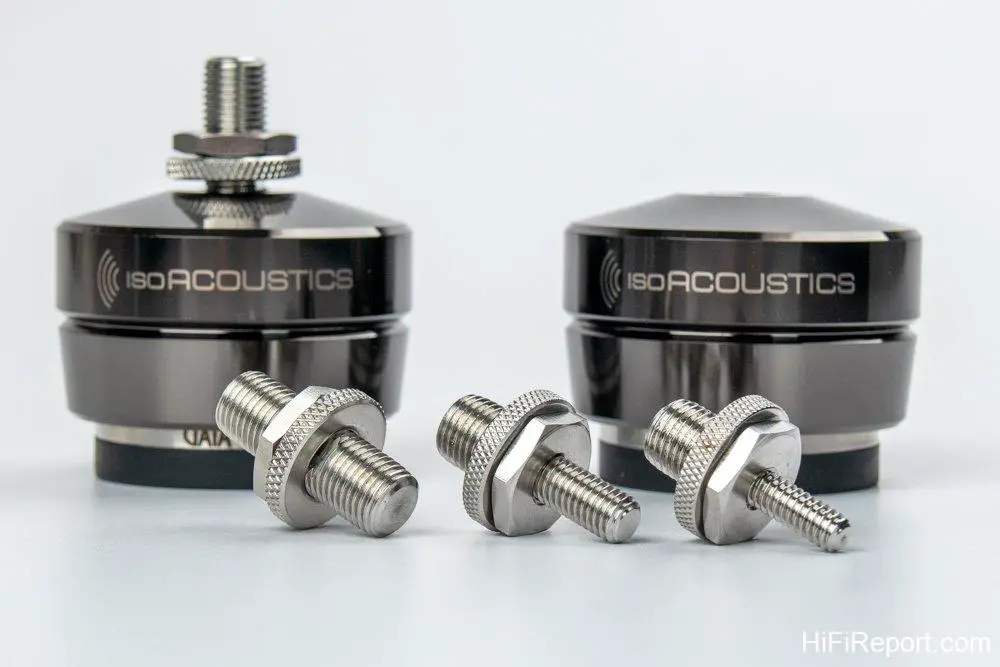
GAIA and GAIA Titan are designed specifically for floor-standing speakers, and come with three sizes of studs (M6, M8, 1/4 inch) to attach to the speaker base. GAIA is for general speakers, while GAIA Titan is specifically engineered for heavyweight speakers exceeding 100 kg.
Lin Chi-Yu has already written a review of Orea, noting its significant effectiveness on both CD players and bookshelf speakers.
Editor-in-Chief Guo reviewed GAIA Titan with his own Wilson Audio Alexia 2 speakers, attesting to its effectiveness.
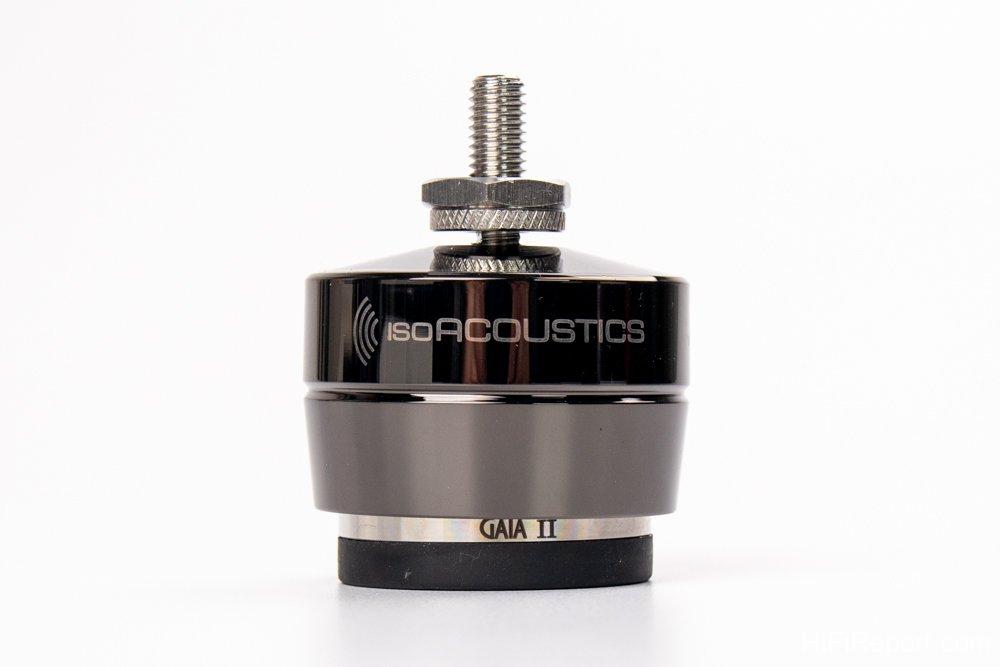
Now, it’s my turn to review GAIA.
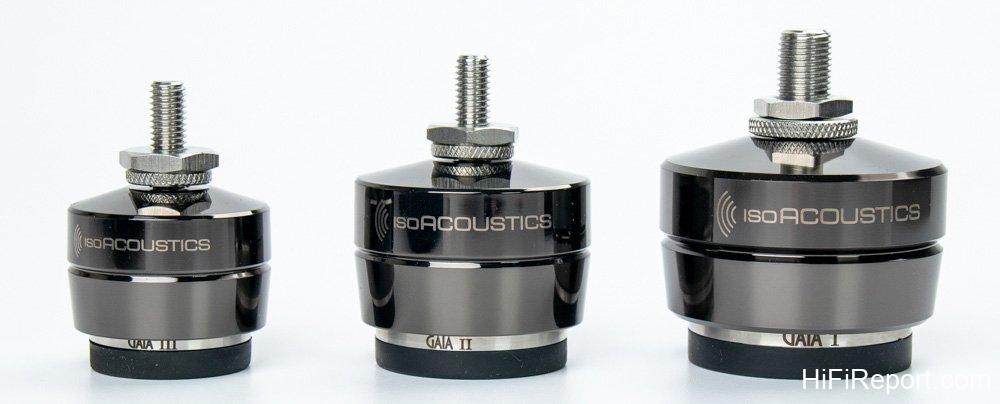
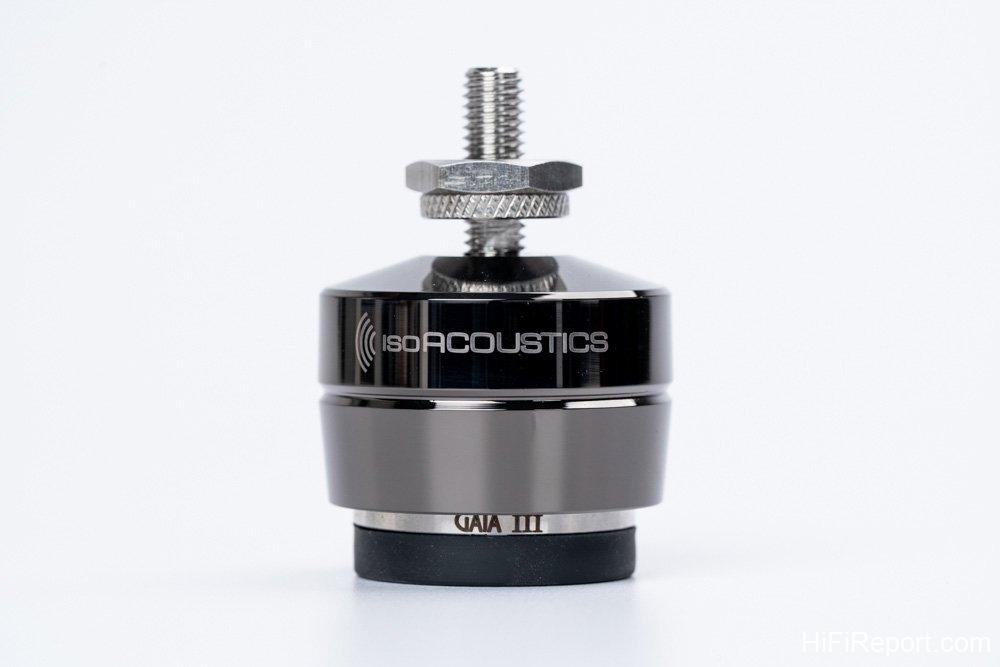
GAIA is available in three models, with GAIA III having the lowest weight capacity, rated for a maximum of 32 kg per set of four.
GAIA Selection: Choose the Right Fit
GAIA, like GAIA Titan, is sold in sets of four, unlike Orea which is sold individually.
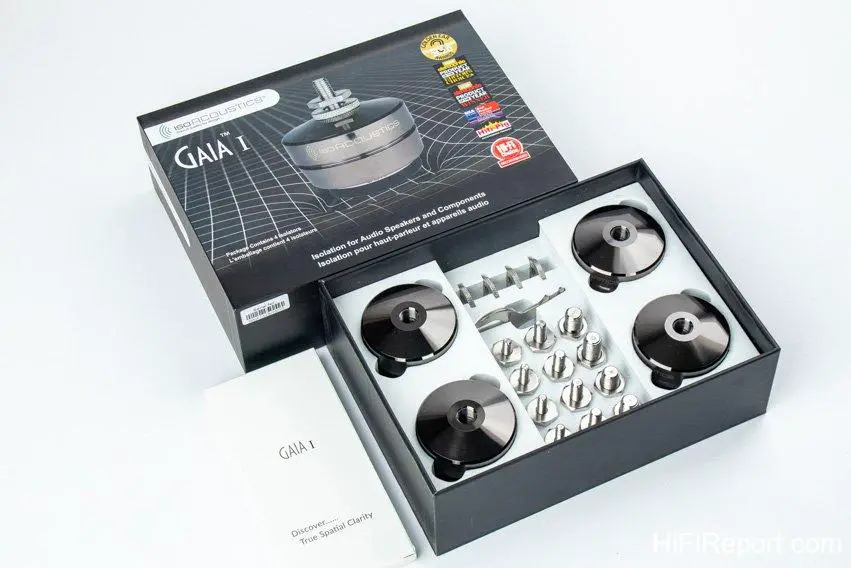
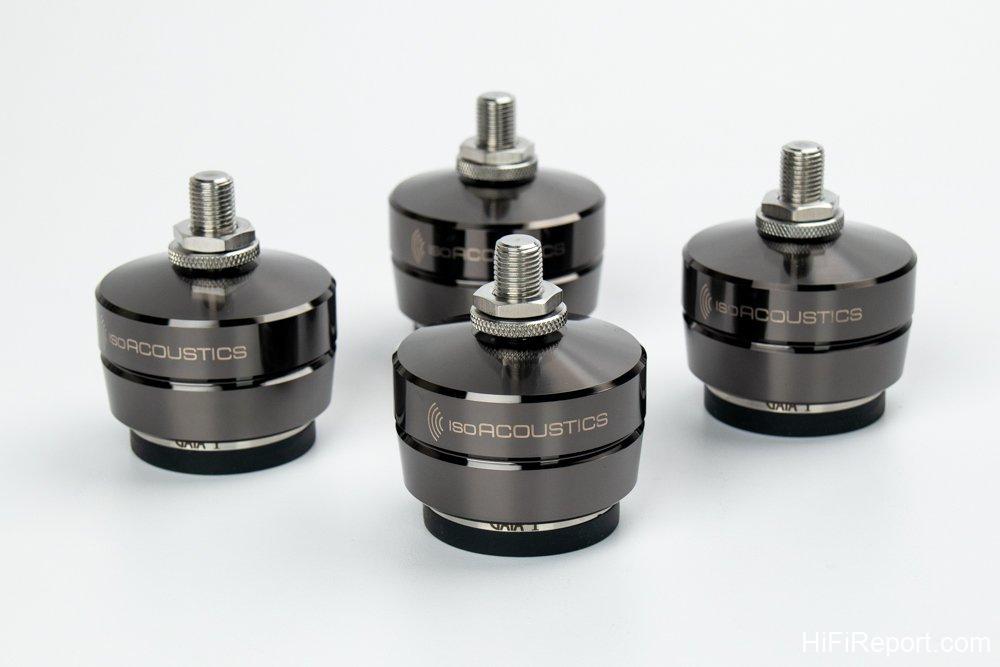
Based on weight capacity, GAIA is divided into three models: GAIA III with a lower weight capacity, a maximum of 32 kg per set of four; GAIA II with a higher capacity, a maximum of 55 kg per set; and GAIA I with the highest capacity, up to 100 kg per set.
Users should select the most suitable GAIA model based on the weight of their speakers. It’s not about buying the most expensive or largest one; it’s about choosing the best fit.
The manufacturer also advises that if the speaker weight is close to the GAIA’s maximum weight limit, within 10% of the limit, it’s recommended to choose the next higher GAIA model to ensure optimal isolation performance.
GAIA II has a higher weight capacity, a maximum of 55 kg per set.
GAIA I has the highest weight capacity, up to 100 kg per set.
GAIA Design: Stainless Steel with Patented Structure
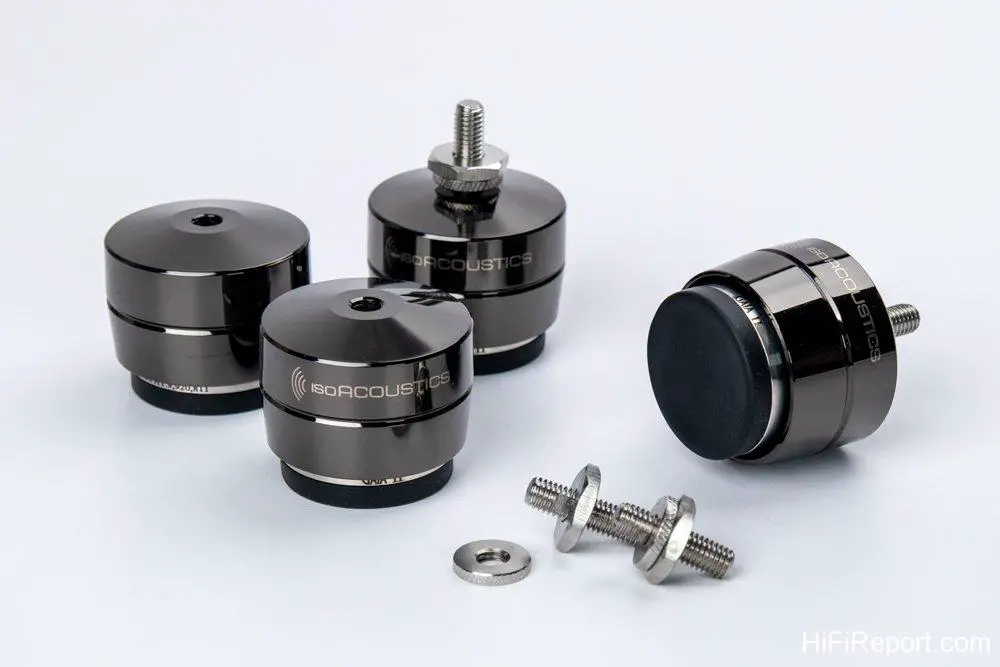
Similar to other IsoAcoustics products, GAIA features a stainless steel housing, further enhanced with a dark chrome plating for a more premium appearance.
The base is made of a rubber-like black soft damping material for contact with hard floor surfaces.
Is the structure really that simple? Of course not.
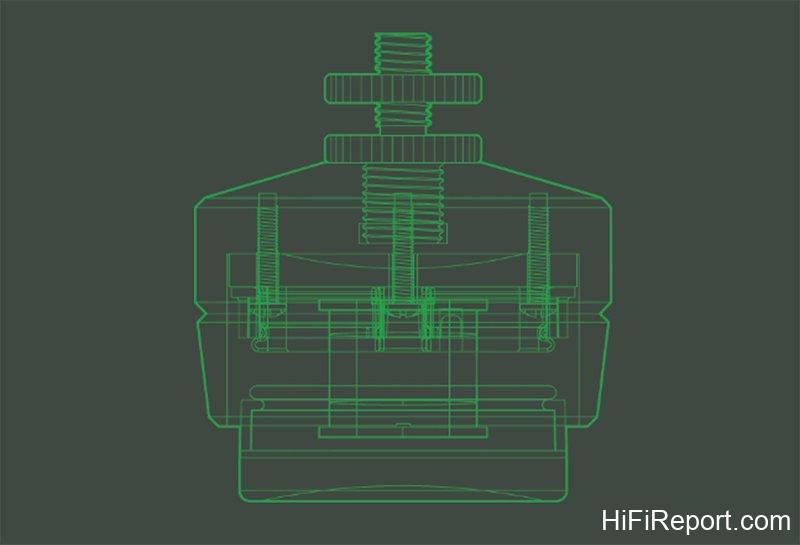
The manufacturer doesn’t detail the internal structure but provides a 3D structural diagram on the official website, indicating that GAIA is not as simple as it looks externally, featuring a multi-layered patented internal design.
This multi-layered structure is what enables GAIA to resist vibrations from both vertical and horizontal directions. Paired with the soft damping material, it further reduces vibrations fed back from the floor.
IsoAcoustics recommends that consumers choose the most suitable GAIA rather than the largest model to maximize the effectiveness of this complex structure.
Test yourself: If your speakers weigh 40 kg, which GAIA model should you buy? Remember: choose the most suitable, not the largest.
Vibration Solution: Beyond DIY Tweaks
Is it effective? Extremely effective! The change is very noticeable! No wonder Fully Inspired Audio has been so successful selling IsoAcoustics products.
And no wonder Editor-in-Chief Guo bought them for personal use, even acquiring several different sets.
Generally speaking, any type of isolation material will produce some effect.
Aren’t there DIY tweaks like using coins, teacups, or black rubber pads as isolation? Using these readily available items as isolation materials merely changes the overall resonance of the speaker, resulting in a change in sound, but it doesn’t truly address the vibration issue.
If you enjoy the fun of “sound alteration,” you can continue experimenting with these methods.
However, if you want to genuinely confront the problem and solve it, IsoAcoustics is worth considering.
A New Level: Beyond Expectations
To confirm GAIA’s effectiveness, I brought two sets of GAIA II home for testing.
My speakers are Jean Marie Reynaud Abscisse Jubile, weighing 30 kg, which is close to the upper limit of GAIA III. Following the manufacturer’s recommendation, I opted for the larger GAIA II.
Installation is easy. It has two locking nuts, the upper nut for contact with the speaker and the lower nut for contact with GAIA.
During installation, it’s crucial to pay attention to the orientation, ensuring the IsoAcoustics logo faces forward, which is related to the structure and vibration conduction.
The original spikes of Abscisse Jubile were quite ordinary, and I replaced them early on with Soundcare SuperSpikes.
Although these are also spike structures, the material is better, and they come with integrated discs, preventing floor scratches and making micro-adjustments on tile floors convenient.
Over the years, I haven’t felt any issues, and the sound clarity and soundstage layering were indeed clearer, more defined, and more transparent than with the original spikes.
I thought I could rest easy after switching to SuperSpikes, believing Abscisse Jubile was performing at its best. It wasn’t until I used IsoAcoustics GAIA that I realized Abscisse Jubile had even greater potential.
Enhanced Clarity: Wider, Deeper Soundstage
After installing GAIA II, the clarity and transparency of the sound improved significantly – lines became clearer, images sharper, layers more distinct, tonal gradations finer, and details more pronounced.
Everything became clearer.
The entire musical picture became not only clearer but also more transparent, making the music richer and more vibrant.
Furthermore, the soundstage expanded wider and deeper, and the sense of stage presence became more defined.
This, in turn, enhanced the emotional impact of the music, better recreating the atmosphere of a live performance.
All these improvements only became apparent after adding GAIA II. I realized that the sound I previously thought was good still had considerable shortcomings.
Deeper Listening: Clearer Soundstage Vision
Take Herbert Blomstedt conducting the Leipzig Gewandhaus Orchestra in Schubert’s Ninth Symphony as an example.
After using GAIA II, the musical picture opened up completely. The depth deepened, the width widened, and even the height seemed to increase.
Within the expanded soundstage, the arrangement of instrumental sections became even clearer. In the crescendo from soft to loud, the orchestra’s energy release was more composed and confident. The control over dynamics was more precise, and even at high volumes, the stability and clarity of the sound remained.
When the melody was led by the main instrumental sections, the accompanying parts in the background were light and gentle, embellishing the melody in progress. The layers depicted were remarkably distinct and clear, without any ambiguity or obscurity.
It also made the bass lines more defined. When the low strings emerged, the previously somewhat loose bass now became not only more concrete but also more present, with a more elastic texture, seemingly even deeper.
Compared to before, this improvement was truly substantial.
The same recording, played on the same system, produced such a significant difference.
Refined Texture: More Delicate Sound
Switching to smaller ensembles, whether vocals or chamber music, it’s easy to notice GAIA II’s enhancement of sonic imagery and the increased clarity of sonic textures.
Listening to Brahms’ Cello Sonata No. 1 performed by Helen Grimaud and Sol Gabetta, the texture of the cello’s sound during bowing became clearer. The sound created by the friction between bow and strings, combined with the resonance of the soundboard, became more distinct with the assistance of GAIA II.
Does increased detail and clarity lead to harshness? No.
To my ears, the sound actually became more refined.
Combined with the enhanced brightness, the sound became not only detailed but also more exquisite.
As for the piano, the piano notes sounded more solid and brighter. When the bass notes lingered, the reverberation of the vibrating strings became more vivid.
Consequently, the melancholy conveyed by Brahms through E minor in this piece now seemed to have deeper layers of meaning, with sorrow intensified.
Unveiling Recording Details at Home
Eva Cassidy’s “Nightbird” album can also attest to the effectiveness of GAIA II.
Against a blacker background, the sound becomes more prominent and clearer, with sharper outlines and better separation.
Take “Ain’t No Sunshine” as an example. Besides Eva Cassidy’s own guitar, there are accompanying musicians.
Being a live performance in a small venue, imperfections are inevitable, not just from performer errors but also from equipment limitations.
Occasional noises are now more apparent. Do you enjoy “bug hunting”? With GAIA II, these bugs have nowhere to hide.
As for Cassidy’s vocals, the vocal lines are clear, and the power is delivered freely. Especially when singing high notes, the force almost pushes the recording equipment to distortion, revealing the true emotion of the performance.
In “Fields of Gold,” the added reverb creates a more spacious sound, deepening the song’s atmosphere.
GAIA II addresses speaker vibration issues, allowing the system to resolve more information, not only vocal details and performance nuances but also recording techniques.
No wonder IsoAcoustics’ professional isolation products are so successful.
To Buy or Not to Buy: The Question
What to do? I’m caught in a Hamlet-like dilemma.
To buy or not to buy? IsoAcoustics GAIA II is not cheap, priced at NTD 11,000 per set of four, and a pair of speakers requires two sets, totaling NTD 22,000.
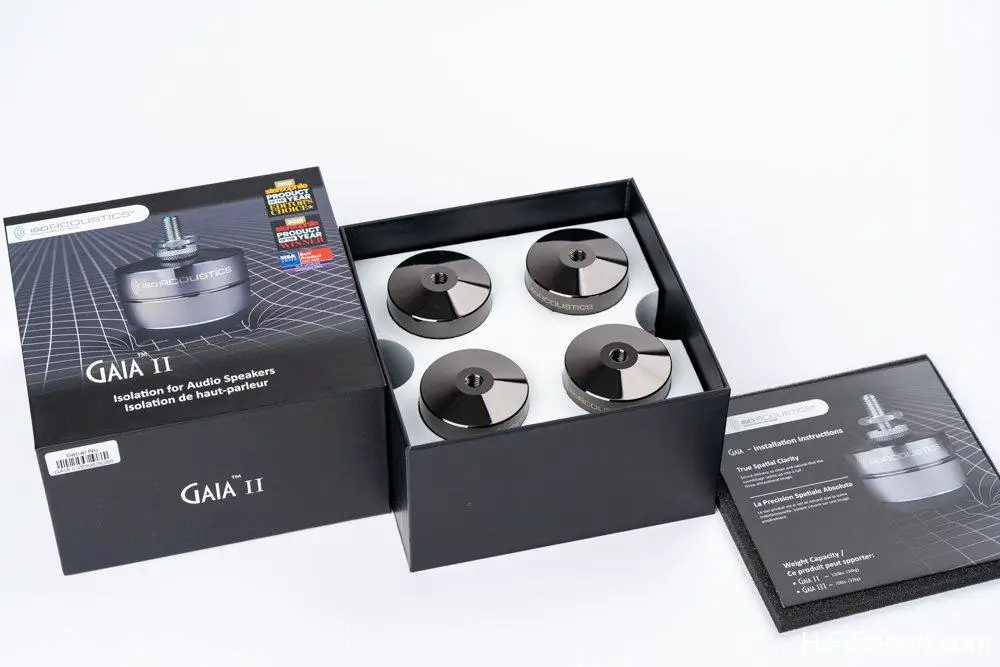
Compared to my current Soundcare SuperSpikes, it’s more than four times the price.
However, considering its benefits—the clarity that unveils the sound, the transparency that dispels the fog, the expanded soundstage, and the redefined lines and images—these changes are comparable to upgrading a DAC, amplifier, or even speakers.
For only NTD 22,000, such benefits are attainable. Considering myself an audiophile and music lover who cannot live without music, the investment in GAIA II is not expensive at all—it’s not an investment in audio equipment, but an investment in oneself.
I don’t have time to worry about your system’s vibration issues, nor do I have time to care about what you’re still considering.
I’ll solve my own problem first—”to buy or not to buy” is no longer a question.
Specifications
* **IsoAcoustics GAIA Series Type:** Isolation Feet
* **Models / Maximum Weight Capacity per set of 4 / Dimensions (WxH):**