
JMR Orfeo Grande Review
One day in late May, a message popped up on Line, from Box, asking if I had heard the JMR Orfeo Grande yet.
I had heard that JMR would be launching the Orfeo Grande this year to commemorate the company’s 55th anniversary, and had heard as early as spring that an order had been placed, but the Orfeo Grande was nowhere to be seen even at the (exhibition – assuming audio show).
I truthfully replied, “Not yet.”
Box quickly responded: You must find a chance to listen to it; it’s a completely different landscape from the Voce Grande.
Seeing Box’s recommendation, I became genuinely curious.
“Do you have one there?” Unexpectedly, Box said he had lent the speakers to a customer who was currently using Orfeo Jubile and wanted to compare the differences between the two.
Oh dear, after finally looking forward to the Orfeo Grande, the speakers were lent out. No choice but to wait a bit longer.
More than a month later, I suddenly remembered this and sent a short message to Box, “Are the speakers back?” Shortly after, I received a brief reply, “Yes.”
I felt a surge of joy. Ah, I really must go and have a good listen.
Finally, with some free time after the audio show, I quickly arranged with Box to listen to the Orfeo Grande.
For an introduction to the Orfeo Grande, please refer to my previous report, “JMR Orfeo Grande Launch Event.” That article thoroughly describes the design and construction of the JMR Orfeo Grande, so I won’t repeat the details here, but only list the important differences between it and the Orfeo Jubile.
Orfeo Grande vs Jubile
First, the mid-bass drivers are different.
Many of JMR’s floor-standing speakers in recent years have adopted a 2.5-way design, with two woofers. One woofer connects with the tweeter, responsible for all frequencies below the crossover point, allowing the bass to roll off naturally, while the lower woofer supplements only the low frequencies.
This design is also found in both the Orfeo Jubile and Orfeo Grande.
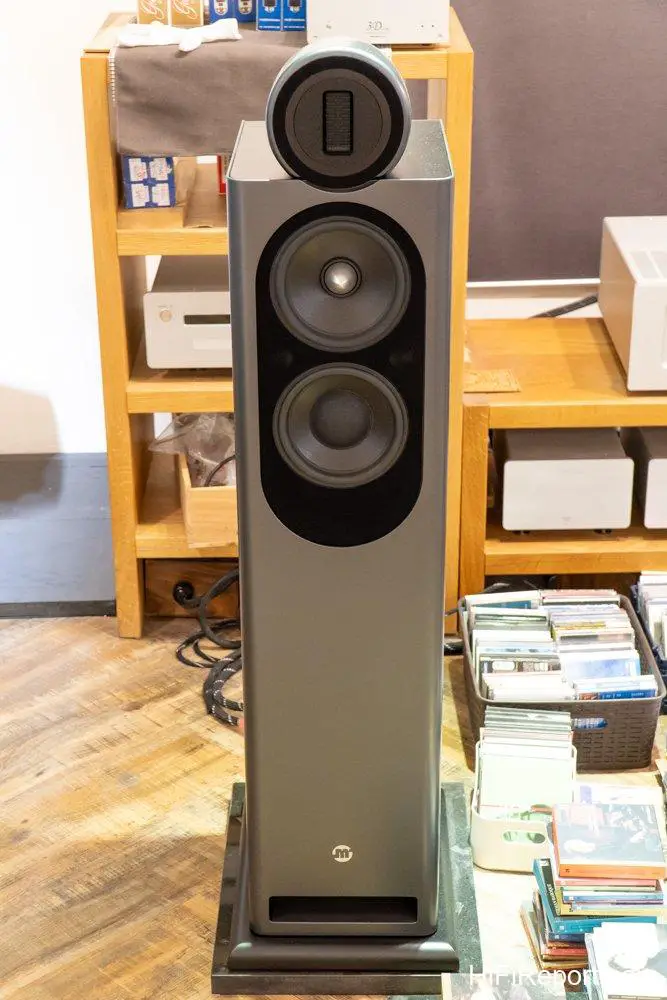
Although both share the same diaphragm technology for the two woofers (and mid-bass drivers), constructed from 7 layers of carbon fiber and Peek, and both undergo plasma treatment on the inner surface.
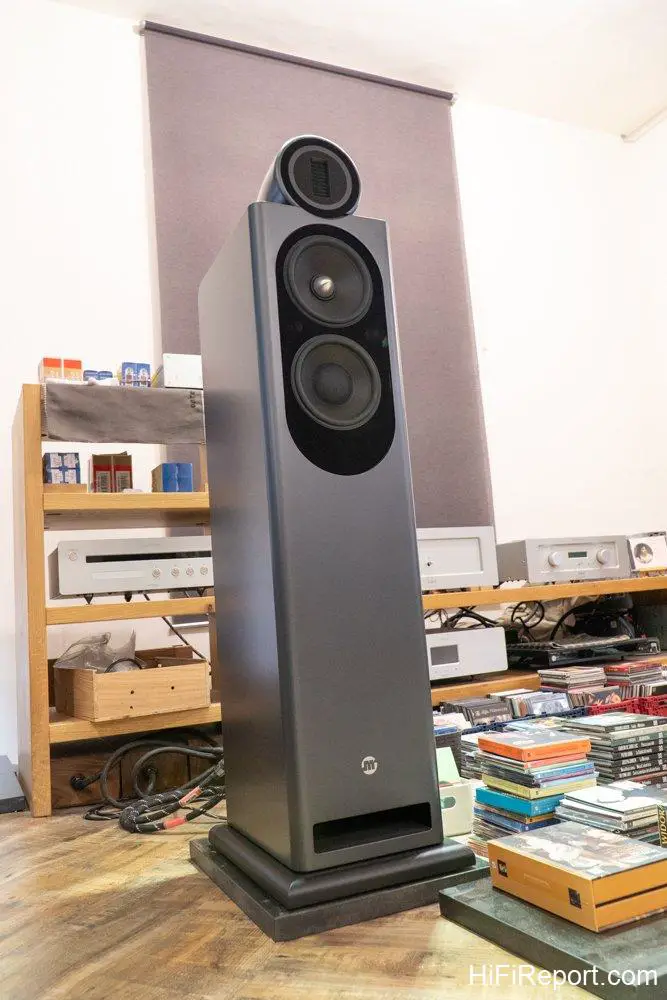
However, the upper mid-bass driver on the Orfeo Grande is different from the Orfeo Jubile’s driver, which has a hemispherical dust cap in the center. The Orfeo Grande’s driver features a bullet-shaped metal phase plug in the center. This serves to reduce eddy currents at the base of the cone, resulting in cleaner sound, and also provides heat dissipation for the rear magnetic system, preventing distortion.
This mid-bass evolution makes the Orfeo Grande’s sound cleaner, more transparent, and more precise.
Second, the cabinet structure is different.
The cabinets, shapes, forms, and constructions of these two Orfeo speakers are largely similar. However, while the Orfeo Jubile has an all-MDF wood cabinet, the Orfeo Grande has an additional layer of U-shaped aluminum alloy plating on the outside of the MDF cabinet.
This is not for aesthetics (although it does look more visually interesting), but to suppress—or rather, to attempt to control and guide—the conduction of vibration energy within the cabinet, directing it towards the special acoustic load (triangular transmission line cabinet, suspended vibration-isolating baseplate) designed within the cabinet.
Third, the crossover has been redesigned.
The crossover point settings for Orfeo Jubile and Orfeo Grande are different. The Orfeo Jubile’s tweeter and mid-bass crossover is set at 3,500Hz, while the low-pass crossover for the lower woofer is set at 400Hz.
For the Orfeo Grande, the tweeter and mid-bass crossover is lowered to 2,200Hz, and the low-pass crossover for the lower woofer is also lowered to 200Hz.
This adjustment significantly reduces the mid-high frequency range that the mid-bass driver is responsible for, lessening its burden of reproducing so much of the mid-high frequency spectrum.
On the other hand, the lower woofer is only responsible for frequencies below 200Hz, reducing the overlap with the upper mid-bass driver. This results in a cleaner sound in the area where the bass and midrange frequencies meet.
The driver changes certainly have an impact, but the crossover point adjustments also contribute to the different sonic characters of the two pairs of speakers.
Fourth, a grounding terminal has been added.
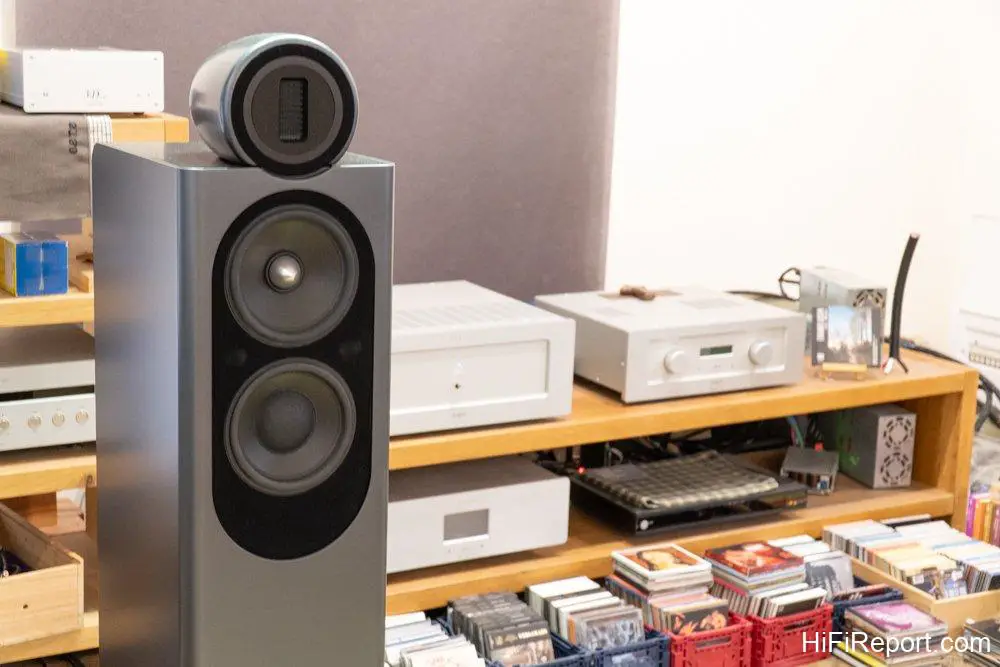
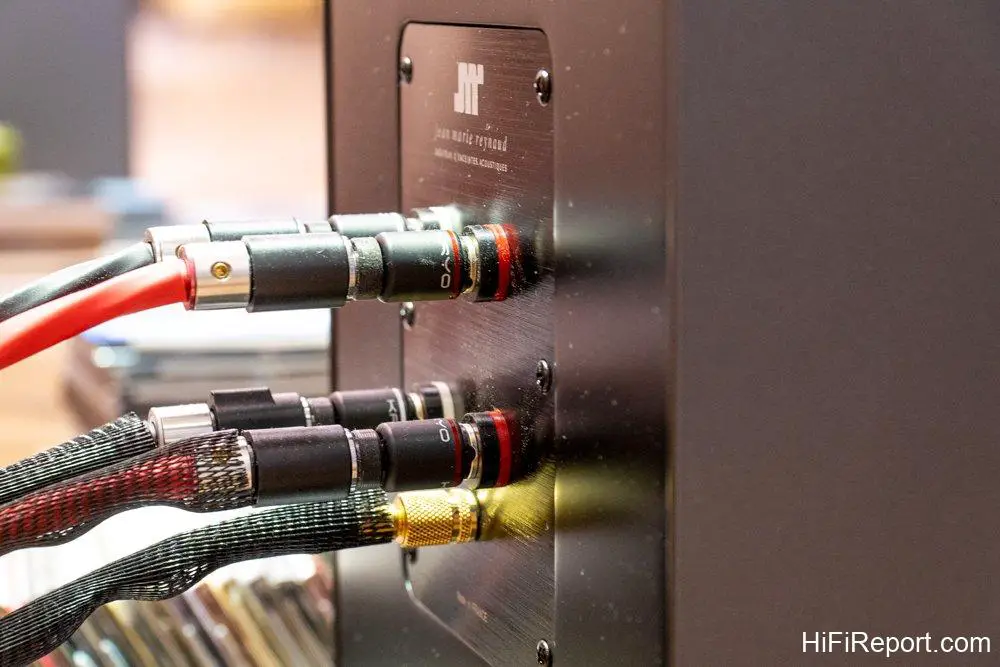
Since the Voce Grande, JMR has once again added a fifth binding post on its speakers for grounding purposes.
This design dates back to the era of the old boss, Jean-Marie Reynaud, who included grounding terminals on his classic Offrande design.
Now, his son and successor, Jean-Claude Reynaud, has rediscovered this “Fifth Element” for the Grande series.
This grounding terminal is connected to wire-wound resistors on the crossover and can also discharge static electricity from the drivers.
When connecting, it must be connected to a true earth ground or a simulated earth ground box. The sound becomes clearer, and transparency is significantly improved.
This grounding terminal is not found on the Jubile series, but it is present on every model in the Grande series, from Voce to EMP and Orfeo.
Fifth, a suspended vibration-isolating baseplate.
This design, if not earth-shattering, has certainly overturned many of our preconceived notions.
We generally believe that speakers should be placed stably and that wobbling is undesirable.
However, starting with the Voce Grande, JMR began designing “wobbly speakers.”
This is all due to that seemingly ordinary baseplate.
This baseplate, at first glance, doesn’t seem much different from the Orfeo Jubile’s baseplate, but in reality, it’s quite sophisticated.
The Orfeo Jubile’s baseplate is simply a machined MDF board, a design that existed during the time of JMR’s old boss. Its purpose, besides adding a layer to break vibration conduction, was to increase the surface area so that the speaker could stand more stably.
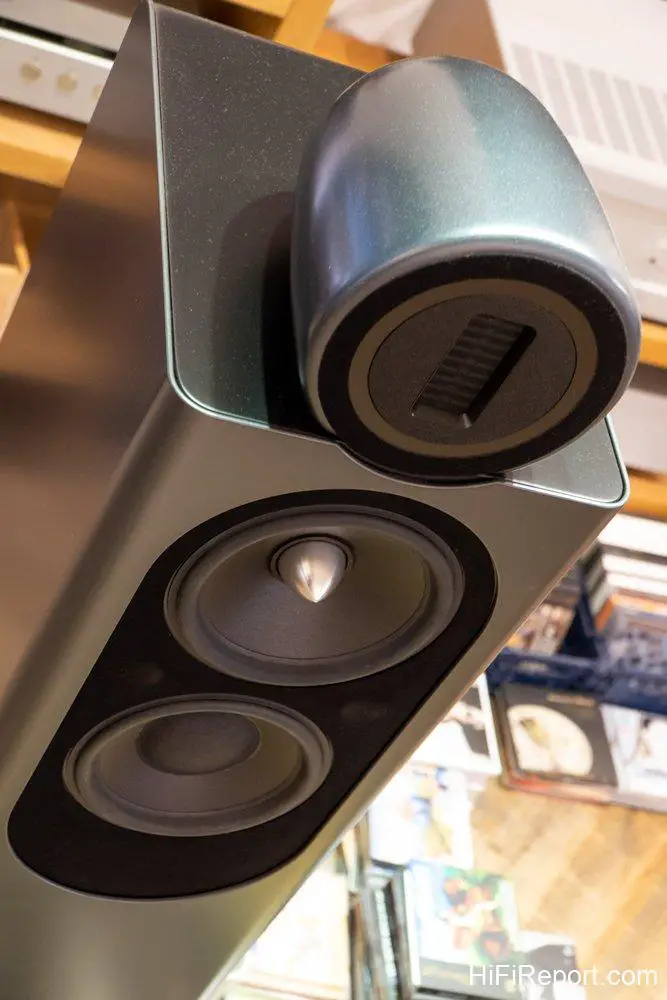
But in the Grande series, this baseplate is internally filled with soft damping material. Vibration energy is converted into heat and dissipated through this soft polymer, so that speaker vibrations are not transmitted to the floor, causing resonance.
The manufacturer states that this design helps the bass become more natural and controlled.
Furthermore, JMR has quirky ideas about what to put at the bottom of the baseplate.
Generally, speaker bottoms are fitted with metal spikes or feet, but JMR has prepared not only a set of metal spikes for Orfeo Grande users but also a set of Teflon pads.
The manufacturer states that Teflon pads can preserve the midrange information in the music more perfectly and completely than metal spikes.
This new design in the Grande series is also absent in the Jubile series.
Five Evolutions, Worth $18,290
These five evolutions—one, two, three, four, and five—have increased the price of the Orfeo from $13,919 for the Jubile to $18,290 for the Grande (the special “Bright Night Blue” finish adds an extra $1,550), a price difference of approximately $4,371, an increase of over 30%, making it JMR’s most expensive speaker in its 55-year history (excluding the active Adara).
To be the most expensive, it must have the capability. Jean-Claude calls the Orfeo Grande “the most successful speaker JMR has made, drawing on 55 years of experience.”
As for whether it is truly worthy of being called “the most successful speaker,” I will gradually tell you.
Experiencing JMR the French Way at HiFiReport
The listening session took place at HiFiReport, located in an alley on Anhe Road, Taipei. Its proprietor, Box, succeeding the late Mr. Lin Chu-Wei, continues to write and paint musical images pieced together from French records, and also carries the agency for Audiomat and Real Cable, as well as being a JMR dealer.
Speaking of French audio and music, HiFiReport is the most important promoter, always has been, and still is.
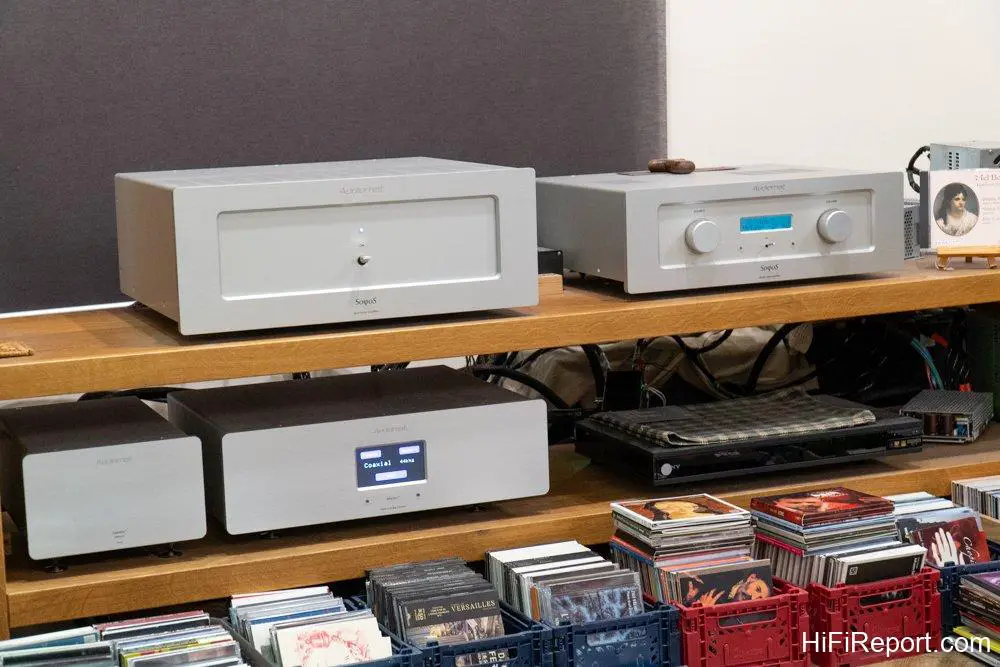
Box paired the Orfeo Grande with Audiomat tube amplifiers, which he also distributes.
In France, Audiomat is regarded as one of JMR’s standard pairings. Many JMR enthusiasts in France, and myself at home, use this combination—Audiomat Adagio + JMR Abscisse Jubile.
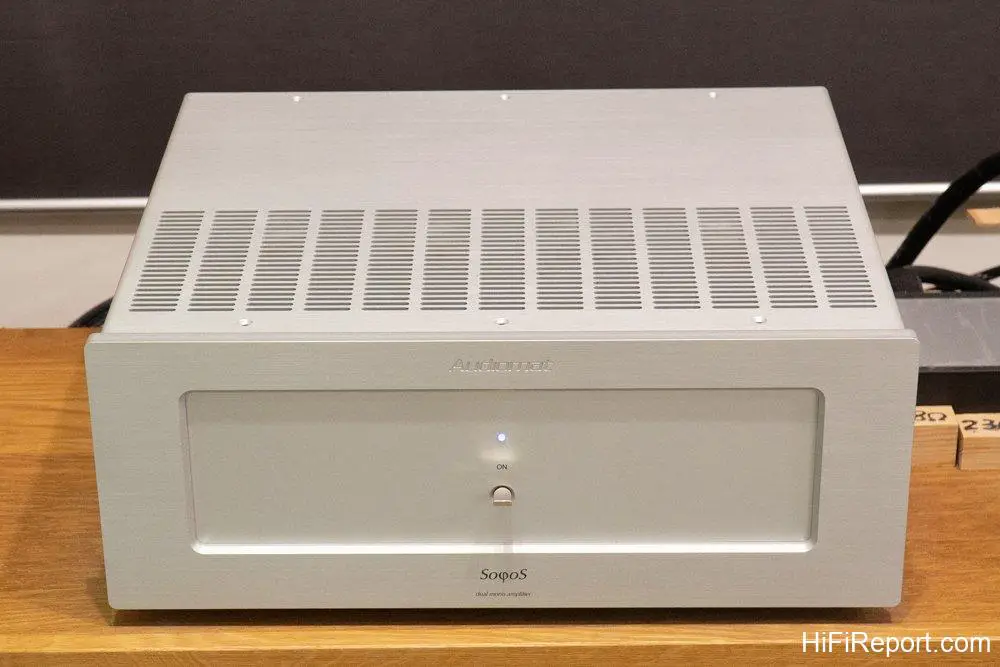
Box brought out the Sophos flagship pre- and power amplifier set, launched two years ago. This is a product that Audiomat has been developing for many years and is the best pre- and power amplifier they have ever made.
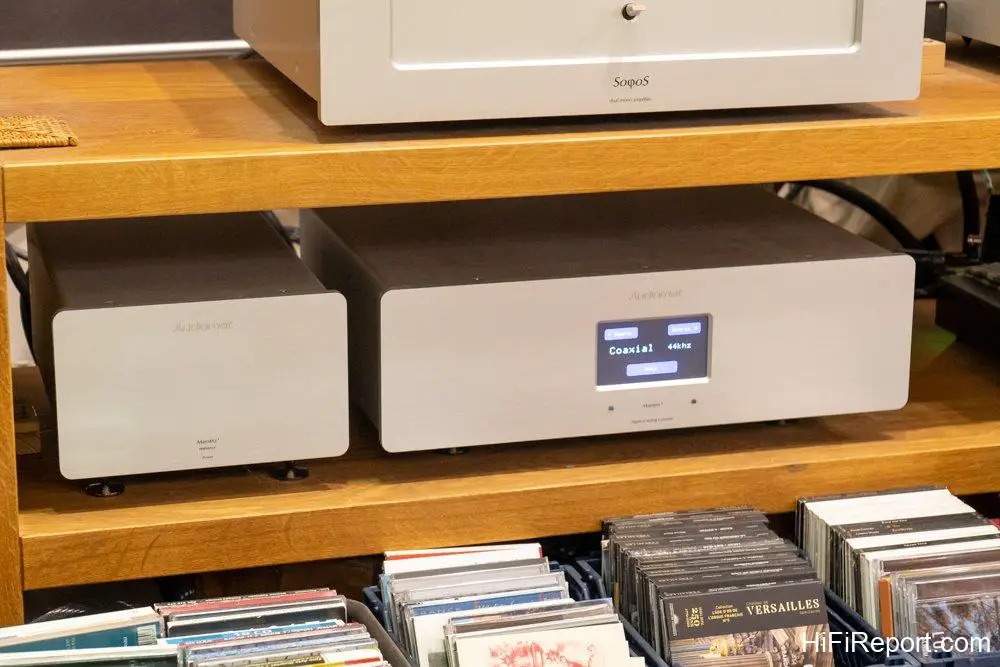
Audiomat Sophos Pre-Power Amps, Paired with Maestro 4 Reference DAC
The Sophos preamplifier uses two 5AR4 tubes for rectification and four ECC99 tubes for signal amplification, all JJ tubes. It also features XLR balanced inputs and outputs, which are rare for Audiomat.
As for the Sophos power amplifier, it uses four ECC99 tubes for driving and four KT88 tubes in push-pull configuration, delivering 40 watts of Class A output per channel. It can also be switched to triode mode, reducing the maximum output to 20 watts.
Audiomat amplifiers are often equipped with two sets of speaker outputs, facilitating bi-wiring connections.
At the listening session, Box used two pairs of Real Cable’s flagship Chambord SP II speaker cables to connect to the Orfeo Grande, along with a volcanic rock grounding box.
For the source, Box used a heavily power-supply-modified Sony Blu-ray player as a transport. This is a practice that started with the previous proprietor, Mr. Lin Chu-Wei, and now a group of enthusiasts has followed suit, even sharing modification experiences with each other.
The DAC responsible for decoding was Audiomat’s newly launched Maestro 4 Reference two-piece flagship DAC, featuring a separate power supply design. Digital decoding supports up to PCM 32bit/384kHz and DSD 5.6 MHz. The Maestro 4 Reference is notable for its astonishing capacitor bank, truly representing the concept of an over-powered DAC.
Achieving Ideal Balance Between Richness and Refined Tone
HiFiReport itself is a record store, with records filling every wall. Naturally, there’s no need for streaming.
Moreover, in Box’s view, only physical records can truly deliver music.
Therefore, everything I listened to that day was from HiFiReport’s distributed catalog. And I went a step further, asking Box to be my DJ, selecting CDs that he felt would best help me understand the Orfeo Jubile.
The boss was not afraid of a challenge. He first put on a beautiful duo album, titled “Paris 1900: The Art of Oboe.” This is a series from Anches, featuring pianist Laurent Wagschal performing with different wind instrumentalists. This particular recording is in collaboration with oboist Alexandre Gallet, featuring many rare yet beautiful oboe pieces.
The Orfeo Grande presented this simple duo configuration with a clear picture.
The mellow texture of the oboe sounded truly captivating. The first track, “Scenes Ecossaises” (Scottish Scenes) by French composer Benjamin Godard, depicts pastoral scenery. The graceful and tranquil melody directly highlights the oboe’s texture. The sound density was excellent, yet not lean. What unfolded was a healthy and gentle musicality.
The third movement is a Highland march, with rhythmic music.
The piano’s heavily struck chords were rich and powerful, and the string vibrations produced clear and ample resonance.
The Orfeo Grande achieved an ideal balance between richness and clarity in the bass.
And the oboe’s even more melodious singing clearly demonstrated the strengths of JMR’s use of AST air motion tweeter in terms of tonal expression—rich and precise in color.
Capable of Resolving Any Subtle Sounds
Box then played a solo violin album, featuring Swiss violinist Rachel Kolly d’Alba performing Bach’s three partita suites.
Rachel Kolly d’Alba’s bowing is very steady, making each note particularly clear and precise.
The violin coalesced into a clear form, with a bright and rich tone.
When the bow quickly stroked the strings, the friction sound of the bow hair meeting the string was heard first, with a hint of metallic texture, followed immediately by the rich resonance from the violin body.
The Orfeo Grande’s ability to dissect these sound details is truly remarkable, a step above the Orfeo Jubile.
Initially, the Orfeo Jubile stayed at my home for nearly a month, and I was very impressed with it. But for two reasons, I didn’t choose it later and bought the Abscisse Jubile instead. One of the reasons was the transparency and resolution of the sound.
JMR speakers’ resolution isn’t about producing “hissing” sounds all the time; they don’t.
But the sound texture and composition they resolve are very intriguing.
The Orfeo Jubile’s performance in presenting subtle sounds and tonal details is slightly inferior to the Abscisse Jubile, but the Orfeo Grande surpasses the Abscisse Jubile in this regard.
If I were to pinpoint where the Orfeo Grande is stronger than the Abscisse Jubile, it would probably be that the Abscisse Jubile’s sound quality is slightly softer, while the Orfeo Grande’s sound quality is denser and more solid. The sound, therefore, feels more assertive.
How does it compare to the Voce Grande? My experience, and Box’s view, is that the Voce Grande has even better density, and the delineation of sound lines is even more defined and sharp. It’s a speaker with an astonishing ability to analyze musical information.
In contrast, the Orfeo Grande’s sound is less analytical and more emotionally engaging.
Dense Texture with Delicate Tones and Clear Layers
The above listening experiences were equally evident when playing Harvey Billaut and Guillaume Coppola’s piano four-hand performance.
The first track was the “Spanish Dance” from Falla’s opera “La vida breve” (The Brief Life).
Piano four-hand performance, compared to a solo piano performance, can produce richer and more brilliant tones due to the more abundant voices.
As soon as the piano sound started, ah, yes, this is JMR’s piano sound! When I auditioned the Orfeo Jubile, I was amazed by its vibrant and pure tone, truly conveying the beauty of piano performance.
And my purchased Abscisse Jubile presents all the richness in the piano sound with even greater transparency.
This time, however, the Orfeo Grande combines the transparency of the Abscisse Jubile with the grand scale of the Orfeo Jubile, plus the clean texture of the JMR Grande series, making this four-hand performance exceptionally wonderful.
The highs are bright and colorful, and the bass chords are weighty yet not muddy. Those notes without pedal are fast yet distinct. The sense of layering created by the four-hand performance was also heard in an orderly and uncluttered manner on the Orfeo Grande.
The density of the piano tone surpassed even my Abscisse Jubile. This dense sound texture, also apparent in the Orfeo Jubile, is even cleaner and more refined in the Orfeo Grande.
Brahms with Grandeur and Clarity
When playing large-scale orchestral music, the Orfeo Grande’s strength over the Orfeo Jubile and my Abscisse Jubile became clear.
Box played a Brahms piano concerto, a version collaborated by Monte Carlo Philharmonic Orchestra and French pianist Philippe Bianconi.
The first movement of No. 1 already revealed much.
The opening prelude, lasting over three minutes, is filled with the tangled emotions in Brahms’ heart. The sudden loud sounds, followed by the solemn ensemble, the power, the scale, are simply beyond what my Abscisse Jubile can portray.
The string texture is dense, and the forceful bowing amplifies the emotions.
The viola and cello murmur softly, creating an atmosphere of unease and melancholy.
Monte Carlo Philharmonic Orchestra performs with a more decisive and rational approach. Even though it lacks some of Brahms’ intense emotions, it maintains ideal ensemble transparency.
When the piano enters, the piano tone is mellow, with a slightly warm luster, and the lingering notes are ethereal, blending into beautiful sounds.
The bass chords, combined with pedal work, create a piano sound that is both weighty and substantial.
This is the beauty of JMR’s piano sound, the grandeur of the Orfeo, and the clarity of the Grande.
Wonderful, truly wonderful.
Transparent Layers, Lively Sounds, Effortless Dynamics
When playing Mahler’s Symphony No. 4, conducted by Philippe Herreweghe and performed by the Orchestre des Champs-Élysées, the expansive and deep soundstage unfolded by the Orfeo Grande was very captivating.
In the HiFiReport style first movement, two themes are introduced in the exposition. One is the first theme with a pastoral flavor, opened by the sound of bells.
Only to hear the bell sounds falling in the rear of the stage, instantly expanding the depth of the soundstage.
The theme with a cheerful atmosphere, layered by strings, woodwinds, and various voices, creates a lovely picture.
Even more beautiful strings are in the second theme. Listening to the delicate and gentle violin section, listening to the rough and deep low strings, and the occasional oboe and woodwind accompaniment, it is truly enchanting.
No. 4 is considered the most gentle and pleasant of Mahler’s symphonies. However, the ensemble, counterpoint, and harmony that Mahler wrote in it are still rich and varied.
The Orfeo Grande presents all the subtleties in this first movement with a clear, vivid, and lively approach.
The transparent layers, lively sounds, and natural tones are very similar to what I hear at home.
However, the Orfeo Grande’s sound texture is richer and denser, and the dynamic performance is also more effortless.
Having said that, without the support of the Sophos pre- and power amplifiers and the Maestro 4 Reference DAC, how could such beauty, combining both elegance and refinement, be fully achieved?
The Resonant Harp is Truly Captivating
Then Box played a Ravel chamber music album for me. This album is quite interesting. First, it includes all of Ravel’s chamber music works that incorporate woodwinds or harp. Ravel didn’t write many such works, just enough to fill one CD.
Secondly, the performers on this record are all French musicians from the Berlin Philharmonic Orchestra, hailed as the “French core of the Berlin Philharmonic.”
Box played the first track, “Introduction and Allegro,” for me. The full title of this piece is “Introduction and Allegro for Harp, with String Quartet, Flute and Clarinet Accompaniment.” The clarinet sings softly at the beginning, and the image of breathing and breath control is very vivid.
The engaging strings, the vibrato of the bowing, make the strings sound more emotional.
The harp first plays arpeggiated chords frequently, then leads into the main melody section, re-presenting the themes revealed earlier.
The harp plucking, its sound resonant, has both the lingering aftertaste of metal vibrations and the crispness of percussion. In terms of tone, it is as warm as jade; in terms of melody, it is as smooth as mountain streams.
The Orfeo Grande’s performance of this resonant harp is truly impressive, with a richer texture and higher density.
Vivid Vocal Image with Rich Information
Before leaving, I asked Box to play some vocals. He chose Edouard Lassen’s art songs for me.
Lassen was born in Denmark but grew up in Belgium. After graduating from the Brussels Conservatory, he also won the Prix de Rome. Later, he spent most of his time in Weimar, Germany. Therefore, this CD includes German art songs (lieder).
The Orfeo Grande outlined a clear contour. The lead tenor’s vocal line is clear and distinct, with rich vocal details.
Listening to German art songs, you don’t have to force yourself to listen to disgusting swallowing sounds to hear details. German pronunciation requires every consonant to be clear, so you can easily hear many sound details.
The Orfeo Grande uses a wealth of information to depict the images of those vocals and articulations.
Conclusion: The Most Comprehensive and Outstanding JMR
This was truly a splendid and exquisite omakase meal.
Box step by step showcased what he considered the most wonderful aspects of the Orfeo Grande, and I step by step fell into that dreamlike vortex.
Now, asking me how I feel about Jean-Claude calling the Orfeo Grande the best JMR speaker ever made? I can confidently answer, yes.
Its performance is the most comprehensive among all JMR speakers priced over 5,000 Euros.
It can showcase the momentum and scale of a floor-standing speaker, while maintaining transparency and clarity across the entire frequency range. It has both clear outlines and forms, and a rich and dense texture, capable of making sounds seem truly present.
Compared to other members of the Grande family, the Orfeo Grande has better bandwidth performance, especially in downward extension. Compared to the namesake Orfeo Jubile, the Orfeo Grande’s sound is more refined and cleaner, like a combination of the strengths of the Orefeo Jubile and Abscisse Jubile.
Thoughts: Its Brilliance Depends on Your Listening Preferences
However, when it comes to product pricing, I can’t help but feel concerned for the Orfeo Grande.
Priced at $18,290, it’s neither too high nor too low, but it falls right into a fiercely competitive market segment.
Many major speaker manufacturers have speakers priced between 10,000 to 15,000 Euros. Some are core products, while others are entry-level models from high-end brands.
JMR has placed its flagship Orfeo Grande in this price range, directly entering the most competitive battlefield in the market. Moreover, considering JMR’s annual production volume and brand recognition, objectively speaking, the Orfeo Grande’s situation is actually disadvantageous in this battle.
However, from the perspective of a classical music lover and someone accustomed to deep listening, the appreciation platform provided by the Orfeo Grande is a threshold that others find difficult to surpass.
Although the manufacturer never claims that their speakers are only for listening to classical music, what they emphasize is something rarely mentioned by others: tone and musicality. They do not seek to give you overwhelming energy but focus on pursuing exquisite tone, ultimate refinement, and reproducing the true texture of instrument sounds.
If you read the manufacturer’s introduction to the sound characteristics of the Orfeo Grande, you will know where JMR is different from others.
As a JMR speaker user, even working in audio media, I find it really difficult to find other brands that can exhibit such elegant and refined temperament.
If what you pursue on your musical listening journey is the same as mine, then you will definitely find unprecedented satisfaction with JMR speakers.
As for the Orfeo Grande, it is the top-tier set menu, offering you all the achievements that JMR can achieve at once.
Specifications
* Type: 3-driver 2.5-way triangular transmission line floor-standing speaker
* Drivers: AST air motion tweeter (25mm x 60mm) x1; 180mm woofer x2
* Frequency Response: 30Hz~25kHz (+/-3dB)
* Impedance: 4 Ohms (minimum 3.9 Ohms)
* Sensitivity: 91dB/W/m, 2.83V
* Power Handling: 90~300W (400W peak)
* Crossover: 6/12/12 dB/octave
* Crossover Points: 200Hz, 2,200Hz
* Dimensions: 1180 x 240 x 330 mm (H x W x D)
* Weight: 45 kg