
KDSG Record Weight Review
Sixth-Element is a dedicated audio manufacturer that has been fully immersed in audio tuning accessories for decades. With “3D Quantum Tuning” as their core technology, they have recently developed the exclusive A.I.S. Acoustic Programming. In the past two years, they have successfully entered the Japanese market, consecutively winning annual awards from Japanese magazines MJ and Accessory, achieving remarkable results. The KDSG record weight I am reviewing this time, while appearing as a traditional vinyl record weight, is packed with Sixth-Element’s quantum tuning technology.
Two Years to Develop Record Weights
Sixth-Element spent over two years developing two vinyl record weights. The high-end model is called KGT, and the one I am reviewing, KDSG, is the more affordable option.
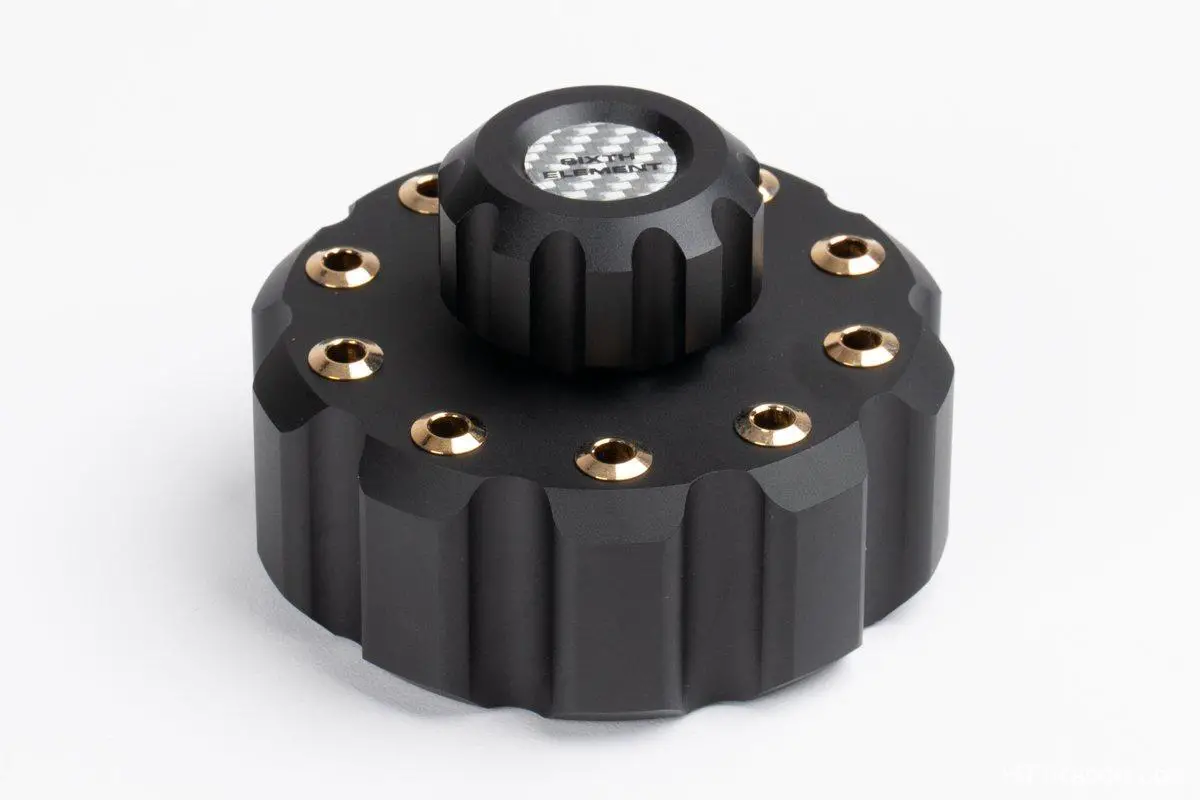
What are the differences between them? The KDSG is made of aluminum-magnesium alloy and weighs 375 grams, while the KGT is made of brass and weighs a substantial 1,080 grams. Furthermore, the KDSG has a matte black finish, resembling the popular colors of modern sports cars, giving it a cool look. The KGT, on the other hand, boasts a luxurious rose gold finish.
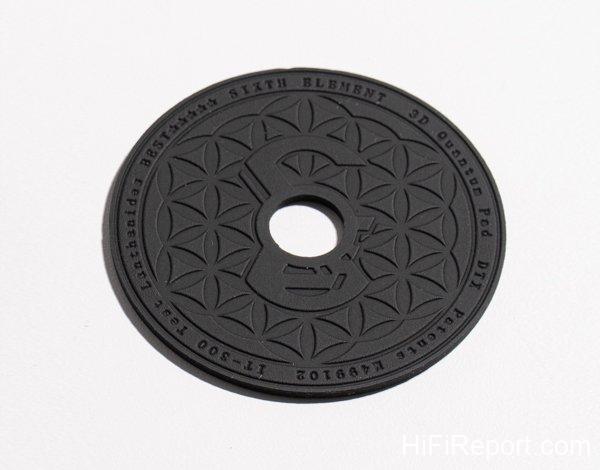
Both record weights come with additional small circular damping shims and ST-X 3D quantum stickers for users to experiment with.
A vinyl record player is a “pure analog” music source. Therefore, almost any “analog” modification will bring about changes in sound. Examples include changing the headshell material or adding a record weight to the center of the vinyl. Even placing a felt mat or graphite mat on the turntable platter can alter the sound. Whether these changes are positive or negative depends on the tuning of the vinyl record player. This is why we rarely write reviews of vinyl record players, unless it’s a turntable we’ve purchased for personal use. The reason is the sheer number of variables in analog systems, making it easy to fall into self-promotion.
While objective reviews of vinyl record players are challenging, reviewing related accessories is relatively easier. The turntable itself is a known standard, and adding accessories allows us to observe changes in sonic thickness or soundstage depth, providing a basic reference point.
So, when the editorial department received the KDSG and asked if vinyl accessories were reviewable, I naturally agreed. Moreover, the editors unanimously decided to assign analog vinyl-related products to the editor-in-chief – after all, my experience with vinyl goes way back.
(Might as well say “old,” no need to beat around the bush).
Record Weight as a Sound “Accessory”
I often tell friends who play vinyl that record weights are like clothing accessories. You can choose them based on your mood. There is no “best” record weight, only record weights with different sonic characteristics. Consequently, there are many types of record weights. Generally, we first consider weight; some are heavy, some are light. Others emphasize composite materials, such as Harmonix from Japan, which uses a brass base with a wooden top. Regardless of the type, record weights alter the resonant point of the vinyl record through their mass and material, making certain frequency ranges clearer. But what is the “correct” weight for a record weight? Unfortunately, there is no definitive answer. The groove depth and width of vinyl records are related to the music’s bandwidth and volume, and the material density of vinyl records also varies. Therefore, I often advise friends to buy several record weights, both light and heavy. This way, you have options to choose from and match when listening to music, making the experience more enjoyable.
This also explains why Sixth-Element, after developing the brass and luxurious rose gold KGT, also launched the KDSG. The three-fold difference in weight between the two makes things interesting. Some turntables are suitable for heavyweight record weights, in which case KGT is the choice. Others can only use lighter record weights, making KDSG the better option.
Regarding record weight selection, there is only one type I “don’t recommend,” which is the screw-on type that locks onto the spindle. My old Oracle Delphi came with a locking record weight. While it could press the record center very tightly, somewhat similar to a vacuum platter effect, the thickness of record center labels varies. Sometimes, tightening it too much would exert excessive downward force on the record center, causing the record edges to warp upwards. I accidentally damaged a few records this way. Later, I only dared to place the record weight on top without locking it.
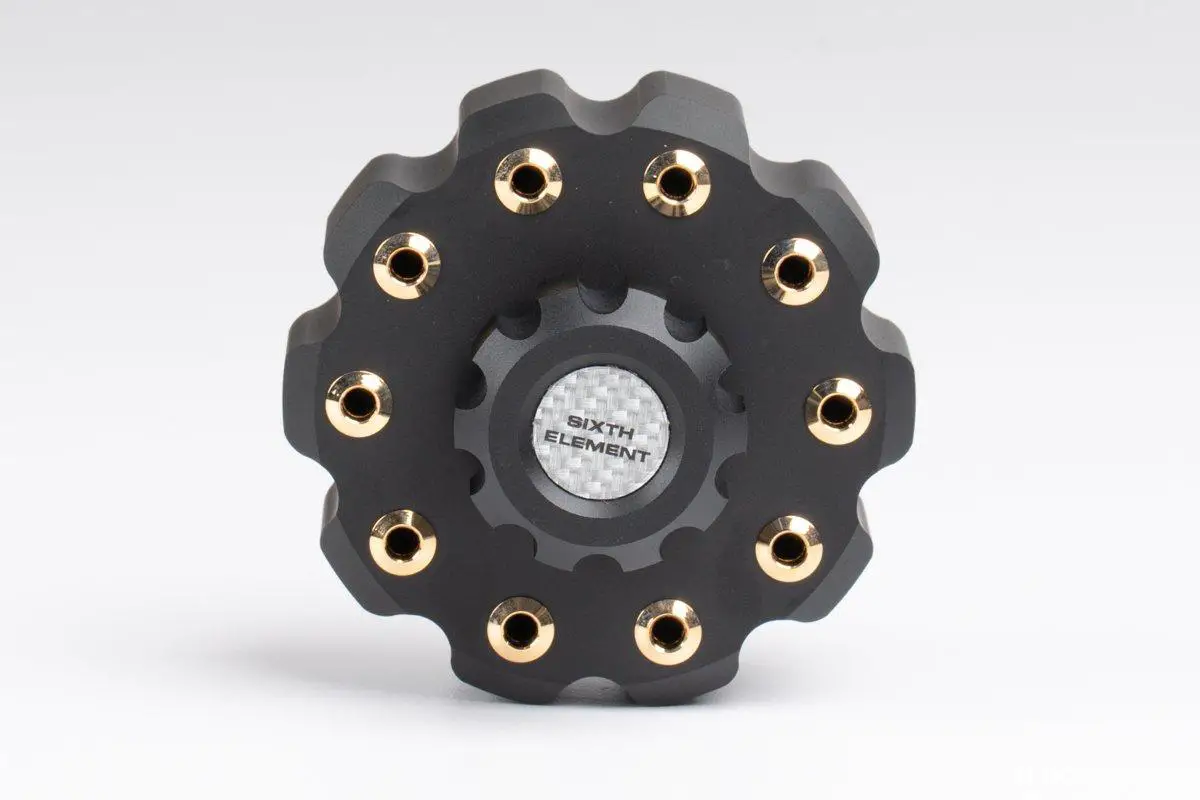
The KDSG’s exterior is exquisitely crafted, showcasing top-notch machining technology. Its structure consists of a large and a small circular aluminum-magnesium alloy piece combined into one. Around the large metal base, there are 10 brass-colored slots incorporating A.I.S. acoustic programming. The manufacturer suggests that when not used as a record weight, it can serve as a grounding device. However, if you regularly listen to vinyl, it’s unlikely you’d leave the KDSG aside for grounding purposes. Moreover, for grounding, you can purchase dedicated grounding equipment. This grounding function seems more like an added feature for occasional experimentation.
Quantum Field Tuning Design
To machine and electroplate the exquisite KDSG is not too difficult given ‘s machining capabilities. Paying a high price for manufacturing can certainly achieve a high-quality exterior. However, Sixth-Element’s unique technology lies in its 3D quantum tuning. Whether it’s the ST-X 3D quantum stickers or the accompanying small circular shims, they all incorporate lanthanide elements. These elements are said to achieve sound purification through an invisible quantum field.
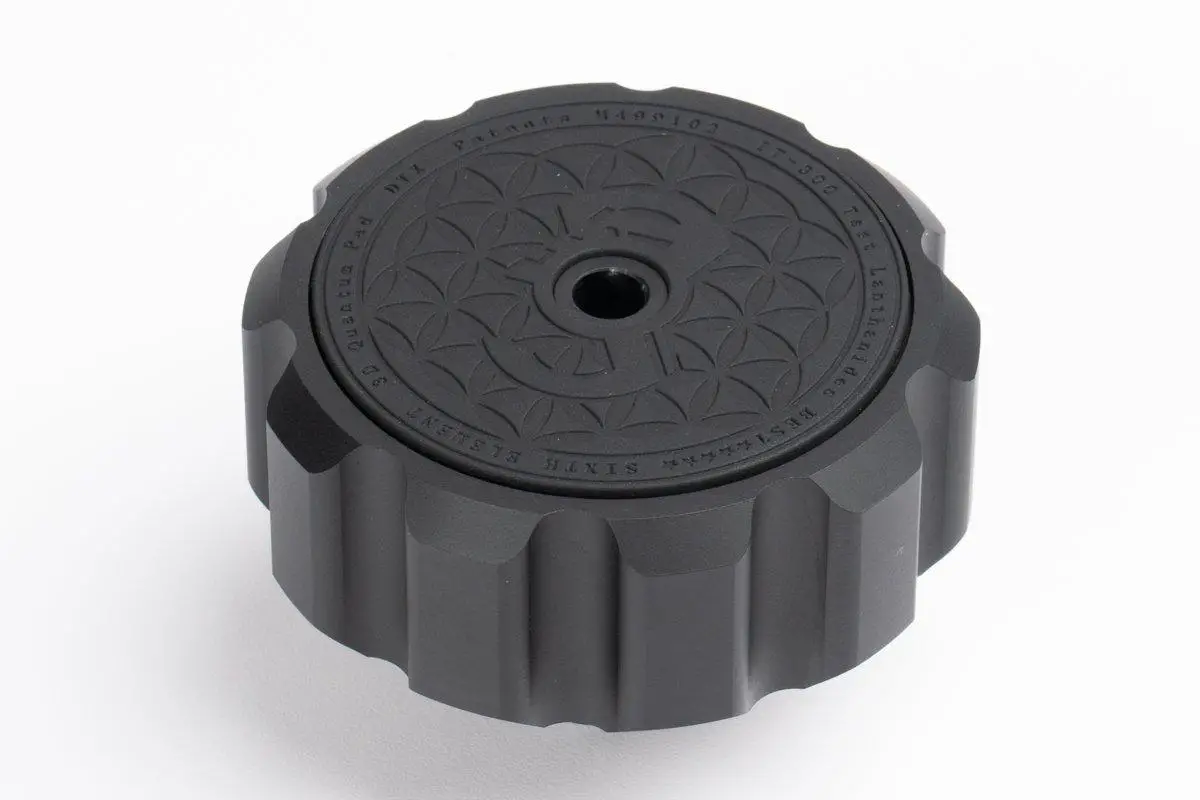
Where are these lanthanide element designs hidden? First, inside the silver-white carbon fiber sticker at the very center of the KDSG. Second, the DTX “small circular” quantum damping shim attached to the bottom of the KDSG. Third, Sixth-Element also includes a DS-1 3D “medium circular” shim, which can be placed under the KDSG during use.
Success in Japan
I know many people dismiss quantum tuning as pseudoscience. I myself don’t fully understand it, so I specifically interviewed Mr. Shu, the owner of Sixth-Element, and observed an experiment demonstrating spark plug ignition in a car engine. This served as evidence of the intangible effects of quantum fields. Simply bringing Sixth-Element’s quantum ball close to the spark plug enhances the ignition effect, making the electric arc brighter and the sparking sound louder. This experiment, designed by Mr. Shu himself, demonstrates the existence of quantum fields. I believe countless people have doubted the intangible quantum field over the years, which is why Mr. Shu took the initiative to create this demonstration machine, allowing skeptics to witness it firsthand.
If you are still skeptical about quantum tuning, let me mention Sixth-Element’s achievements. In 2019, they entered the Japanese market and won annual awards from both MJ Musen and Accessory magazines. Furthermore, they received another award in 2021. This shows that good products do not go unnoticed. Although quantum tuning technology is often considered voodoo science by some, the fact that they have been continuously promoting it in the audio market for over thirty years, and even competing internationally, gaining recognition from Japanese audio media and successfully entering the Japanese market, suggests that there must be some basis to their quantum field tuning technology. Even if you don’t understand the theory, you can directly trust your ears.
Can you hear the difference? The difference is immediately noticeable. If not, no one would buy it, let alone build a brand.
Moreover, as I mentioned, vinyl record players are purely analog devices. Any change will alter the sound. So, regardless of the special lanthanide element quantum field, the KDSG’s mass change alone will affect the vinyl sound. However, the addition of quantum tuning is what sets the KDSG apart and is Sixth-Element’s valuable know-how.
Of course, I cannot definitively say whether the mass change of the KDSG or the quantum field tuning has a greater impact. I can only rely on my listening experience to describe the sonic changes brought by the KDSG.
Testing on Different Turntables
The KDSG was tested in HiFiReport’s in-house listening room. Currently, the editorial department has two active vinyl record players: a Linn LP-12 Klimax and an Elac 90th Anniversary Miracord 90.
The LP-12 is a suspended turntable (soft platter), and the Miracord is a direct-drive turntable (hard platter). Intentionally collecting two vinyl record players with different design principles is to allow editors to understand the sonic differences between them.
Usually, I don’t use a record weight with the LP-12 because suspended turntables are sometimes sensitive to heavy weights. Too much weight can compress the suspension, causing the low frequencies to lose elasticity. However, when listening to the Miracord 90, I always use a Clearaudio record weight, which weighs approximately 360 grams, slightly heavier than the KDSG. So, I started testing the KDSG with the Miracord 90.
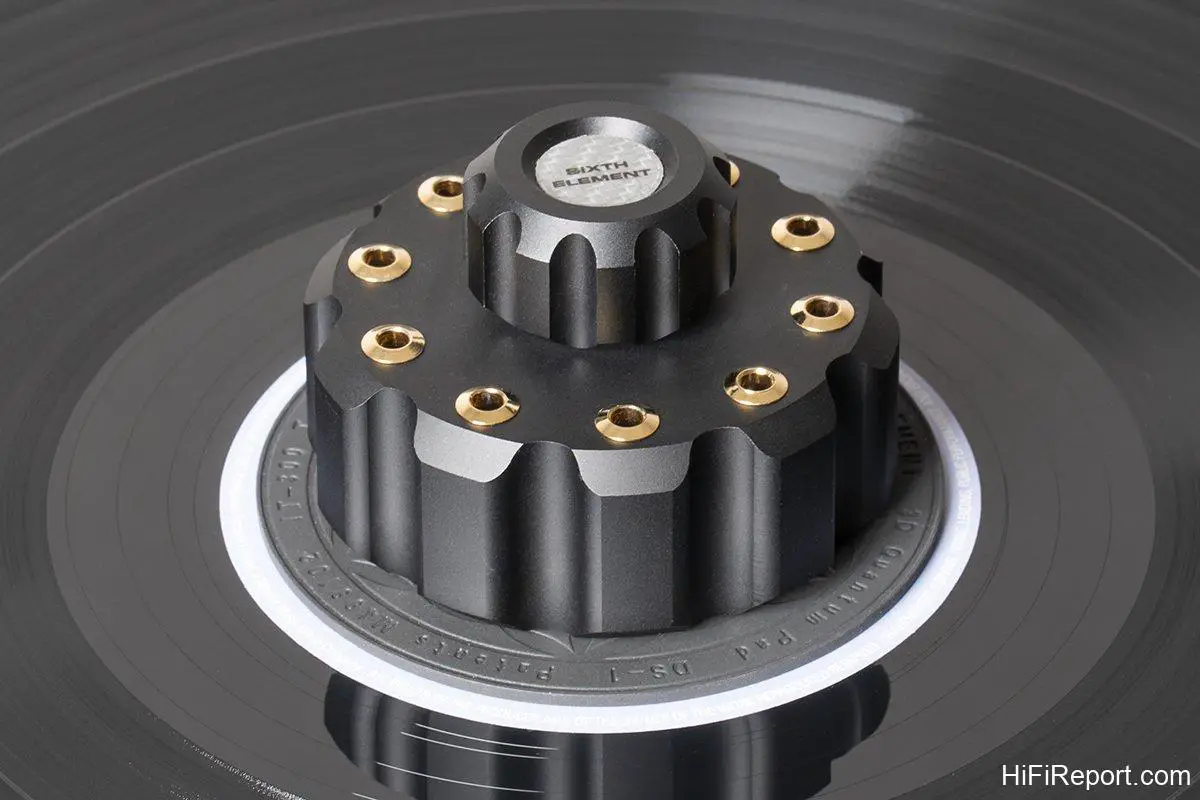
The standard way to use the KDSG is to place the “medium circular” shim in the center of the record and then place the KDSG on top of the “medium circular” shim, allowing the “small circular” shim at the bottom to adhere to the “medium circular” shim, enhancing the quantum tuning effect. When changing records, you must stop the turntable. However, I am accustomed to changing records without stopping the turntable, directly swapping records to keep the platter constantly rotating, avoiding the need to restart. But with the “medium circular” shim added in the center, sometimes when I lift the record, the “medium circular” shim comes up with it and then falls off. I had to change my habit and stop the turntable every time I changed records.
Of course, you can choose not to use the “medium circular” shim. But with it, the two shims containing lanthanide elements combined will provide better damping, and the quantum field tuning effect should also be enhanced.
I tried a few times without the “medium circular” shim, and the effect of tightening the low-frequency lines was somewhat different. It was better with the “medium circular” shim, but this was a subtle improvement. The most significant change comes from the KDSG itself. The “medium circular” shim is more of a finishing touch.
Improved Bass Definition and Dynamics
What are the differences? Mainly in the definition and dynamics of the low frequencies. I’d like to use Oscar Peterson’s “We Get Request” as an example. In “Quiet Nights and Quiet Stars,” the opening features double bass pizzicato, piano playing the theme, and light jazz drum work. Without the KDSG, the double bass has a larger presence but is relatively less defined. With the KDSG, the shape and lines of the plucked bass strings become tighter and denser. The delicate hi-hat cymbal sounds from the jazz drums are crisper, bringing out a more transparent soundstage. Or, to put it another way, without the KDSG, the sound is richer. With the record weight, the sound becomes more lively and brisk.
To easily compare the differences of the KDSG on the Miracord 90 and LP-12 Klimax, I used the EAR 868 PL preamplifier and EAR 509 II power amplifiers, paired with Wilson Audio Alexia 2 speakers. The LP-12 Klimax has a built-in phono stage, directly connected to the high-level input. The 868 PL’s phono stage was used for the Miracord 90. This setup allowed me to easily switch between the two turntables for listening.
Significant Effect on Miracord 90
The KDSG worked well with the Miracord 90. Now it was the LP-12 Klimax’s turn. Being a three-point suspended turntable, I was slightly concerned that the 375-gram KDSG might be too heavy. As soon as I placed it, the LP-12 Klimax’s platter noticeably sank a bit. Checking the movement between the tonearm and the platter, it seemed okay. Listening to “Quiet Nights and Quiet Stars” again, the direction was the same. The bass lines were tightened up nicely, the soundstage became more transparent, and the sonic image appeared more vibrant.
The KDSG’s weight is not particularly heavy for a record weight, about medium weight. I suspect the heavier KGT might not be suitable for the LP-12 Klimax. However, even though the KDSG is not too heavy, placing it on the platter still slightly affects the rotation speed. Fortunately, both turntables I use have automatic speed correction functions. The Miracord 90 is easier to observe. The speed adjustment knob has indicator lights. A white light indicates the correct speed. If a green light illuminates, it means the speed is drifting. It’s best not to play music and let the platter spin for a few more rotations to automatically correct itself. Every time I placed the KDSG, the turntable would indicate incorrect speed. After about 1-2 seconds, the turntable automatically corrected to the correct speed. This indicates that the KDSG’s mass does have a slight impact on the speed, slightly slowing it down. Remember to check. My situation is simple; both turntables automatically correct, so I just need to wait a few seconds before listening.
Let’s try some music with more aggressive bass. Listening to Stevie Ray Vaughan’s “In Step,” specifically “The House Is Rockin’.” It’s a standard twelve-bar blues, but in Stevie Ray Vaughan’s hands, it becomes wild and explosive. Listening with the KDSG, the snare drum’s impact is truly powerful. Behind the wild blues, the electric bass line is relatively relaxed. After a keyboard solo, the protagonist Stevie Ray Vaughan’s electric guitar takes over. It’s said that during recording, they connected all the guitar amplifiers in the studio, pushing the volume to maximum. Every musician was surrounded by the massive electric guitar volume. This explains why the drums are so explosive. The musicians’ emotions were heightened by the energy of the electric guitar, truly making it “The House Is Rockin’.” The recording studio was shaking, and even a Shure SM58 microphone was damaged by the vibrations. While testing the KDSG, I couldn’t help but reminisce about the recording story of this album, imagining the scene of the entire studio being shaken by the electric guitar volume, and my mood was also lifted.
Subtle Effect on Soft Platter Turntable with Gentle Music
Let’s try something gentler, Carol Kidd’s “All My Tomorrows.” The version I have is the 20th-anniversary edition, paired with the LP-12 Klimax, which should be the perfect match! Place the “medium circular” shim and then the KDSG on top, switch to the speed correction setting, wait a few seconds, and then lower the stylus.
The music of “Don’t Worry About Me” starts vividly. With the KDSG, the bass is denser, and the sonic image is more solid, sounding more energetic. However, without the KDSG, it sounds more relaxed and laid-back. When listening to gentle jazz, both setups sound pleasant in their own way.
I think it’s because the music is relatively light and mellow, not as demanding on audio performance. Also, the music’s bandwidth is relatively narrow, so whether the KDSG is used or not, both sound enjoyable in different ways.
Greater Difference on Miracord 90 (Revisited)
Since Carol Kidd’s recording bandwidth seemed limited, let’s switch to classical music. Listening to Mutter and John Williams’ “Across The Stars,” with the Miracord 90 taking center stage. Switch to 45 RPM, wait for the indicator light to turn white, indicating correct speed (the turntable has an optical speed detection and control system). Listening to “Rey’s Theme,” the theme song of the female protagonist from “Star Wars: The Force Awakens.” The music begins with a lively violin melody, followed by deep double bass underpinning. The Alexia 2’s bass response is ample, and the double bass notes are full and rounded. The brass section in the background and the violin solo echo each other. Good, let’s add the KDSG.
Place the “medium circular” shim and the KDSG sequentially on the vinyl record, restart the Miracord 90, and listen again. The violin’s tone is slightly softer, and the focus seems better. But the biggest improvement is in the double bass. The size feels a bit smaller, but the tightness and focus are better, making the entire musical scene more vivid.
If your vinyl system has sufficient bass quantity but you feel the focus is weak and the shape is blurry, the KDSG should be very suitable.
Enhanced Cello Articulation
Let’s listen to Du Pré and Barenboim’s “Haydn Cello Concerto No. 1.” Switching to the LP-12 Klimax. Listening directly without the KDSG. The orchestra’s solo passages in the mid-high frequencies have a comfortable richness, showcasing the dignified balance of the Classical period music. Du Pré’s cello solo enters, immediately stealing the limelight from the orchestra. The subtle changes in bow pressure and intensity are captivating on the LP-12 Klimax. After listening to the exposition, I wondered, would adding the KDSG make it even better? It already sounds fantastic! But let’s still try it. Stop the turntable, place the “medium circular” shim and the KDSG, restart, let the speed stabilize, and lower the stylus. The sound is indeed different. The density is slightly higher. The cello solo’s form seems tighter, and the subtle nuances of the fingerwork seem richer. However, comparing the difference between the Miracord 90 and LP-12 Klimax, I feel the change with the KDSG is more noticeable with the Miracord 90, while the difference with the LP-12 Klimax is relatively smaller.
Noticeable Bass Improvement
Finally, I want to reiterate an old adage: “Any record weight will bring about changes in sound.” Any alteration in an analog system will change the sound. The question is whether the sonic direction is what you want or like. Otherwise, there wouldn’t be so many record weights with different weights, shapes, and materials on the market. Therefore, you need to actually use it to know if the sonic changes are suitable. The same applies to the KDSG. Only through trial can you know if you like it. Based on my testing experience, the KDSG noticeably improves the dynamics and clarity of the bass frequencies. Cleaner and more elastic bass can enhance the vibrancy of the music. If you feel your vinyl system is already well-tuned, with good bass quantity, but the definition seems somewhat loose and blurry, try the KDSG. The vibrancy and dynamics of the bass will experience a “perceptible upgrade.”
Specifications
* Type: Record Weight
* Material: Aluminum-magnesium alloy, silicone (embedded with rare earth lanthanide elements)
* Dimensions: Diameter 78 mm; Height 51 mm
* Weight: 375g (Patent M 548422) (Patent M 499102)