
Kojo Crystal Power Strips Review
Kojo, known in Chinese as Guangcheng Seiko, was founded in 1990 (Heisei Year 2). Its head office is located in Daikoji, Hirakawa City, while its production lines and power division are situated in Matsuzaki, Hirakawa City. Specializing primarily in power-related products, the company boasts a wide scope, manufacturing equipment for both medical and audio applications.
With extensive accumulated research and development expertise in power processing, Kojo’s recent audiophile-grade power treatment equipment has garnered significant acclaim among audio enthusiasts in Japan.
Crystal Series Design and MIS Technology
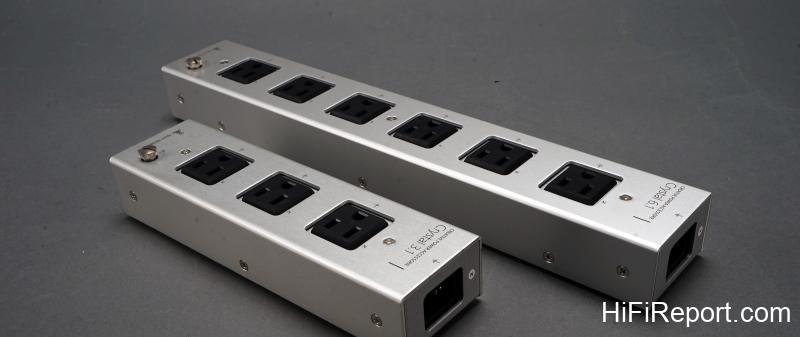
Visually, the Crystal series power strips exhibit a more refined and premium texture compared to other Kojo power strips. According to the manufacturer, this series is an evolution of the Force Bar series, which was highly popular among Japanese audiophiles due to its excellent cost-effectiveness and flexibility. Compared to its predecessor, the Crystal series not only changes the exterior from the previous black tone to silver but also features a redesigned shell with a more streamlined form.
The silver finish of the Crystal series power strips is achieved because Kojo specifically selected silver-white anodized aluminum to accentuate the casing. Notably, both the Crystal 3.1 and 6.1 feature the company’s exclusive “MIS (Mechanical Isolation System)” technology. Inherited from the Force Bar series, this technology designs the power strip chassis with a three-layer structure: Top (outer casing), Bottom (base layer), and Sub (inner layer).
Besides the outer casing, both the base layer and inner layer of the Crystal series power strips also adopt a silver-toned design. Furthermore, the corners of the base layer are specially crafted with rounded edges, presenting a very stylish and modern look overall.
The MIS technology employed by Kojo for the Crystal series power strips is quite distinctive. This technology allows the inner layer to remain in an independent, suspended state, effectively preventing the power signal from being interfered with by unnecessary vibrations. Observing the internal design of the 3.1 and 6.1, one can see special titanium alloy pads placed at the junction of the outer casing and the inner layer.
According to the official description, this design significantly reduces the attenuation of extremely low frequencies. Additionally, the inner layer utilizes the company’s unique patented M2052 vibration-damping alloy. This alloy, crafted from a blend of 73% manganese, 20% copper, 5% platinum, and 2% iron, possesses high vibration-damping properties not found in traditional alloy materials, effectively reducing resonance.
Thanks to the MIS technology, the components of the Crystal 3.1 and 6.1 maintain appropriate distances from each other. This is evident when using the outlets – plugging and unplugging feels effortless. Moreover, once a plug is inserted, it does not contact the outer casing, ensuring that interference to the power signal from extraneous vibrations is minimized.
To enhance the stability of the Crystal series power strips, Kojo specifically changed the outer casing material from the previously commonly used steel alloy to aluminum alloy, while the base layer material was changed from aluminum alloy to steel alloy. This modification also increases the mass of the power strip; for instance, the 3.1’s weight increased from 550 grams to 665 grams, and the 6.1’s from 907 grams to 1080 grams, undoubtedly boosting stability significantly.
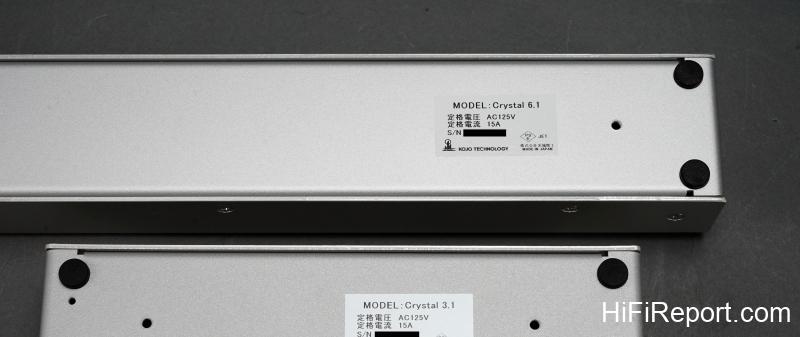
Furthermore, observing the bottom of the Crystal 3.1 and 6.1 reveals the presence of vibration-damping pads from the renowned Japanese brand TAOC. The thickness of the base layer has also been increased from the previous 1.6mm to 2.0mm, which substantially reduces the impact of ground vibrations on the power signal.
The base layers of both power strips also feature ventilation holes specially crafted by Kojo using a unique mold, which effectively regulates operating temperature and maintains stability during use.
Internal Construction and Wiring
The internal wiring of the Crystal 3.1 and 6.1 power strips also exhibits thoughtful design. Kojo specifically replaced the previous 4N oxygen-free copper conductors with tinned conductors measuring 1.6mm in diameter. According to the manufacturer, using this conductor significantly reduces interference to the signal caused by the skin effect. Additionally, for optimal transmission efficiency, the manufacturer used the shortest path for wiring.
Close inspection reveals no breaks in the conductors within the power strip; they run straight from the power input, connecting each output terminal in series. This method ensures that the signal is transmitted in its most complete form. Naturally, the solder used was also specifically selected by the manufacturer.
Model Differences and Connectivity
Speaking of which, since the design and materials of the Crystal 3.1 and 6.1 power strips are the same, what differentiates them? The biggest difference lies in the number of outlets provided. Both power strips feature internationally compliant outlets. The 3.1 offers three 3-prong outlets and one 2-prong outlet, while the 6.1 provides six 3-prong outlets and one 2-prong outlet.
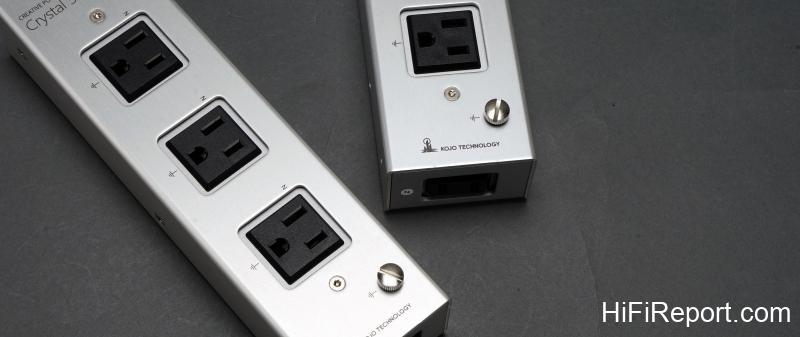
Users can choose according to their needs, pairing them with equipment like CD players, digital sources, preamplifiers, or power amplifiers. Of course, if it’s inconvenient to run a dedicated ground wire at home or if you wish to further enhance sound quality, they also offer additional grounding terminals.
Sonic Performance and Listening Impressions
In practical use, upon first handling either the Crystal 3.1 or 6.1, I was slightly taken aback. The reason being their substantial weight, which felt disproportionate to their size. Just holding them conveys a strong sense of stability, naturally raising expectations for their performance. I connected these power strips to my home audio system and my usual headphone system, listening using CDs and high-resolution streaming sources.
I found a very noticeable improvement across both system types, particularly in the three-dimensional sense of the soundstage, which became more pronounced.
Perhaps due to the enhanced stability provided by the Crystal series power strips, listening revealed that in addition to cleaner sound edges, the forms of instruments and objects were more focused and cohesive. However, instead of positioning themselves closer to the listener, they expanded outwards. This resulted in a more vivid sonic picture, with improved longitudinal depth and lateral spaciousness of the soundstage.
For example, when listening to classical recordings like Karl Münchinger’s “The Baroque Legacy” or “Mussorgsky: Pictures at an Exhibition,” I could hear the ethereal violin strings, the rich and steady double bass strings, the clear yet full brass wind instruments, and the resonant, weighty bass drum, each distributed across the soundstage with distinct, three-dimensional forms.
It must be said that after switching to the Crystal 3.1 or 6.1 power strips, the treble extension also improved, adopting a slightly sweet character. The subtle brightness was very pleasant to listen to. This characteristic was particularly enjoyable when listening to piano albums, such as Vikingur Olafsson’s “Mozart: Piano Sonata.”
I could hear the pearl-like clarity of the individual keystrokes, and as the musician played, the keys exhibited a very distinct sense of movement, making the overall soundscape rich and natural. Similarly, listening to “Rachmaninov: Complete Works For Piano,” even when inner and outer voices were played simultaneously, I could still discern very focused details for each instrument.
The changes brought to system sound quality by the Crystal 3.1 or 6.1 power strips were audible across other music genres as well. For instance, listening to jazz albums like “Christian aTunde Adjuah” or “The Complete Birth Of The Cool,” I could hear the piano, saxophone, trumpet, double bass, and drums each placed distinctly within the soundstage. And as mentioned before, the forms of these instruments were very focused, possessing a very natural texture.
Especially with the slight addition of sweetness to the high frequencies, the piano keys and brass sounds had finer decay and nuances. Combined with the solid and steady double bass and drum sounds, they presented a more lively stage presence, drawing the listener in effortlessly.
Listening to popular music, the singer’s voice was positioned slightly further back in the soundstage, but the vocal shape was more focused, and details were clearer. For example, on Japanese singer-songwriter Kenji Ozawa’s album “Inu wa Hoeru ga Caravan wa Susumu,” I could hear the lead singer’s deep, magnetic male voice, and subtle vocal techniques, whether breathing or vibrato, were rendered with greater refinement.
Since the main vocal image was slightly set back, instruments like piano, guitar, drums, and electric bass also presented clearer details. Listening to female vocals, such as on the Taiwanese indie band Shallow Levée’s album “Wedding Pathway,” I could hear the lead singer’s gentle and elegant vocal details, also presented with a more natural and authentic timbre, which was very captivating and appealing.
The impact of the Crystal 3.1 or 6.1 power strips on sound quality is evident across various music genres. Beyond classical, jazz, and pop mentioned earlier, even rock and electronic music exhibited significant changes. For instance, listening to Japanese band Cody・Lee ()’s album “Seikatsu no News” or CreepHyp’s album “Yoru ni Shigamitsuite, Asa de Tokashite,” I could hear the vocalist, electric guitar strumming, electric bass, and drums all maintaining a certain distance from each other.
When each instrument was playing rapidly, I could perceive the distinct forms of different instruments. Combined with the outwardly expanding electric mist effect from synthesizers, it presented a more realistic live experience.
It’s worth noting that after switching to the Crystal 3.1 or 6.1 power strips, system stability felt significantly improved. For example, I could turn the volume down compared to before while still achieving a similar sound pressure level, allowing for finer adjustments. Overall, these two power strips can noticeably enhance system sound quality.
Convenience, Value, and Final Thoughts
Considering convenience, the Crystal series inherits the slim and compact form factor of the Force Bar series, making them ideal for tucking away in the gap of a TV cabinet or a corner of a listening room. Furthermore, Kojo’s attention to detail is highly commendable; even the smaller 3.1 model includes a grounding terminal. If it’s inconvenient to run an additional ground wire at home or in the listening space, you can connect a ground box to further stabilize the power signal.
The Crystal 3.1 or 6.1 power strips offer genuine build quality, an accessible price point, and the ultimate assurance of “Made In Japan” quality, making them an excellent choice for both newcomers and seasoned audiophiles looking to upgrade their power quality.
Specifications
* Type: Power Distribution Block
* Output Outlets: 3-prong × 6, 2-prong × 1 (for 6.1) / 3-prong × 3, 2-prong × 1 (for 3.1)
* Input Connector: 3-prong
* Grounding Function: Yes
* Conductor Material: Tinned Conductor
* Rated Voltage: 125V
* Dimensions (W.H.D): 59×37×363mm (6.1) / 59×37×213mm (3.1)
* Weight: Approx. 1080g (6.1) / 665g (3.1)