
Lampizator Atlantic 3 TRP DAC Review
It’s not my first encounter with a Lampizator DAC, but it’s the first time I’ve been tasked with reviewing one. All I can say is, returning a piece of Lampizator gear requires a certain withdrawal period; it is, indeed, addictive.
I use such strong language, words that might trigger content warnings after review, because Lampizator is truly captivating. I don’t believe everyone will embrace Lampizator; some dislike vacuum tubes, others find their DACs too large, some might want more features, and others still prefer machines with a more modern, sleek aesthetic.
No piece of equipment is guaranteed to become a bestseller just because a reviewer writes about it. We, as audio reviewers, seek both to discover prodigious talent () and to find a kindred spirit (); we are both the talent scout () and the musician (). My writing about Lampizator isn’t intended to convince anyone; it’s simply to leave a written record, a memory, of my time listening to music with it. Consider me merely a musician playing my lute ().
The unit sent for review this time is Lampizator’s advanced-level DAC – the Atlantic 3 TRP DAC. Lampizator’s lineup starts with the entry-level Amber 5, followed by the Baltic 4, and then comes the Atlantic 3 TRP. Moving further up the range, you find the Big 7 MK3, Golden Gate 3, Poseidon, Pacific 2, and the flagship Horizon. Counting it out, the Atlantic 3 TRP sits as the sixth model in their family of eight DACs. With a starting price of €8,000 (approximately $8,640 USD), it can only be considered an “entry-level advanced” model within the Lampizator family.
Tube Rolling Paradise
The birth of the Atlantic DAC has a rather romantic origin. Five years ago, Lukasz Fikus, the founder and chief designer of Lampizator, developed a new DAC. While brainstorming names, he had a sudden flash of inspiration, recalling his recent voyage across the Atlantic Ocean. Inspired by that unforgettable experience, he named the new machine the Atlantic.
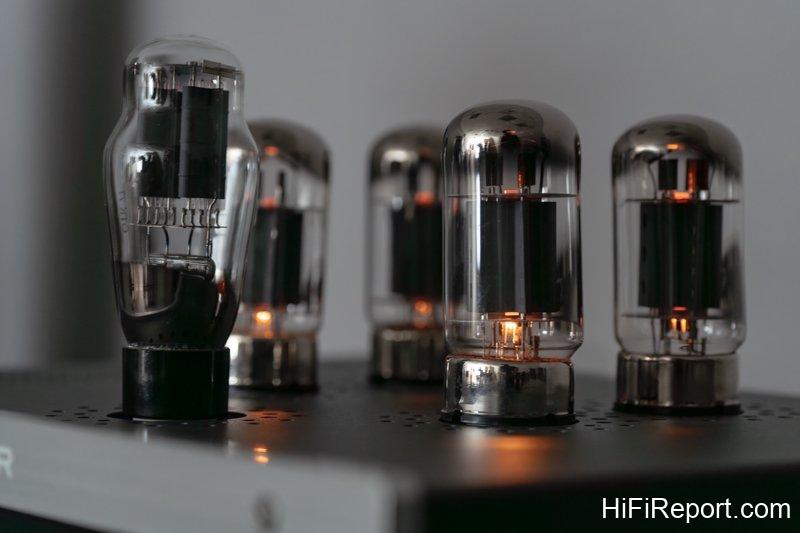
In early 2019, he redesigned the Atlantic DAC’s circuitry, adopting an octal pin base. This allowed compatibility with both tetrodes and pentodes. Furthermore, by adding a 6.3V heating voltage, the Atlantic DAC, which previously didn’t allow for easy tube swapping, was transformed. It could now freely accommodate up to 10 different types of vacuum tubes, adding significant enjoyment for listening and experimentation.
Thus, Lukasz gave it a new name – “TRP,” which stands for “Tube Rollers Paradise.” This name signifies that users can freely swap tubes, finding themselves in listening heaven. What’s even more exciting for Lampizator is that they experimented with about 20 different vacuum tubes and found that while the sonic character varied with each combination, not a single one sounded bad.
Other DACs are fixed in their configuration once purchased; at most, you might play with digital filters. But with Lampizator’s tube amplification, you gain the added fun of tube rolling. In many tube amplifiers, tube swapping is limited to the same tube type. For example, if an amplifier uses KT88/6550 as power tubes, you can use tubes from JJ, EH, or Genalex, but you must stick to KT88/6550. You can’t swap in other tube types because their operating biases are different. However, some modern tube amplifier designs now allow for free tube swapping. The machine automatically detects and adjusts the bias, letting users switch from KT88 to tubes like KT66, KT90, or KT120.
High-Output Power Tubes for Effortless Dynamics
The Lampizator Atlantic 3 TRP follows this approach. While Lampizator’s more entry-level Amber 5 and Baltic 4 still utilize small-signal tubes, the Atlantic 3 TRP steps up by adopting tubes more commonly used for power amplification in its output stage.
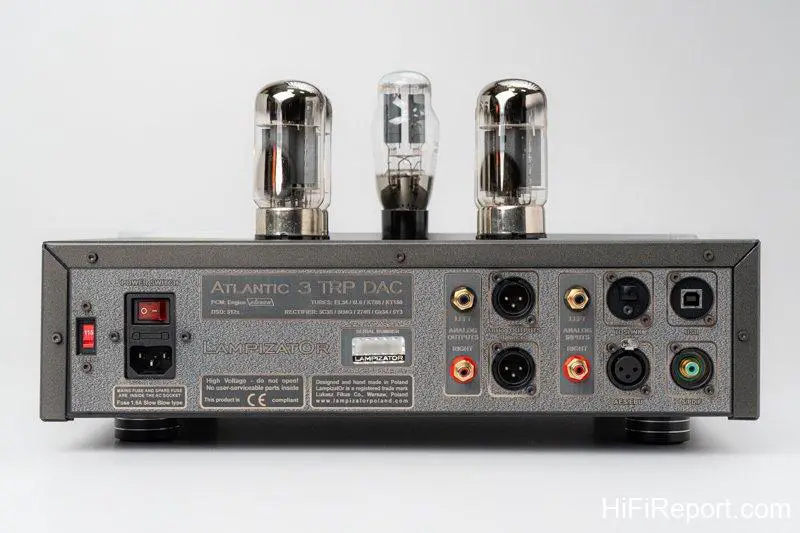
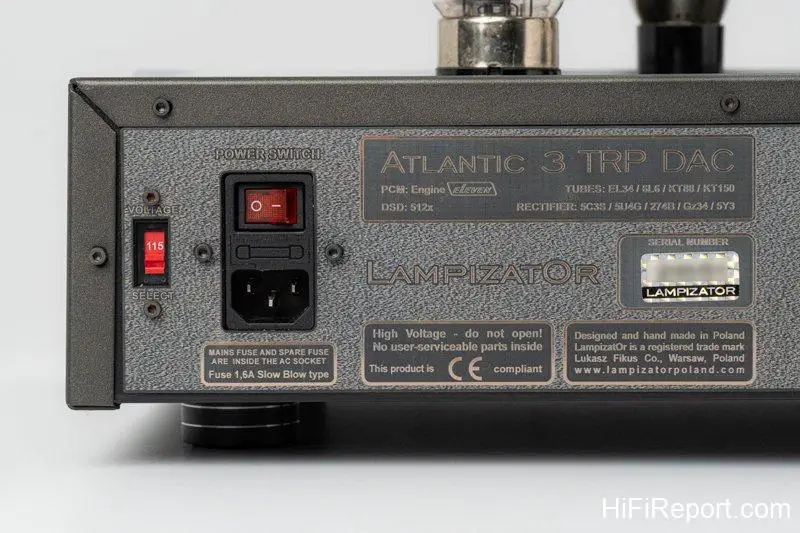
The manufacturer’s manual explicitly states that it can handle everything from low-output tubes like the EL84 to high-output behemoths like the KT170. The manual lists compatible tubes as follows: EL34, KT66, KT88, KT90, KT120, KT77, KT150, KT170, 6L6, 6V6, 6550, 6CA7, 5881. Essentially, any octal base tube with eight pins can be used.
Users don’t need to make any other settings; the Lampizator DAC automatically adjusts the bias. Different vacuum tubes have different bias settings, naturally resulting in distinct sonic characteristics. This allows the Atlantic 3 TRP to exhibit a multitude of sonic personalities. One machine, multiple joys – if this isn’t paradise, where is?
Built to Last
Speaking of vacuum tubes, many people raise concerns: Do tubes degrade? Is the cost of ownership high? First, it’s important to clarify that it’s not just vacuum tubes that age; all components do, including transistors. Lampizator states that the DAC’s circuit boards, transformers, oil-paper capacitors, wiring, terminals, and sockets are theoretically indestructible and should last a lifetime. Only four specially selected electrolytic capacitors have a lifespan of approximately 25-30 years, which is still a very long time, making aging practically a non-issue. Only the vacuum tubes, while not necessarily failing, are recommended by the manufacturer to be replaced after 10 years to maintain the best sonic performance.
Optional Volume Control
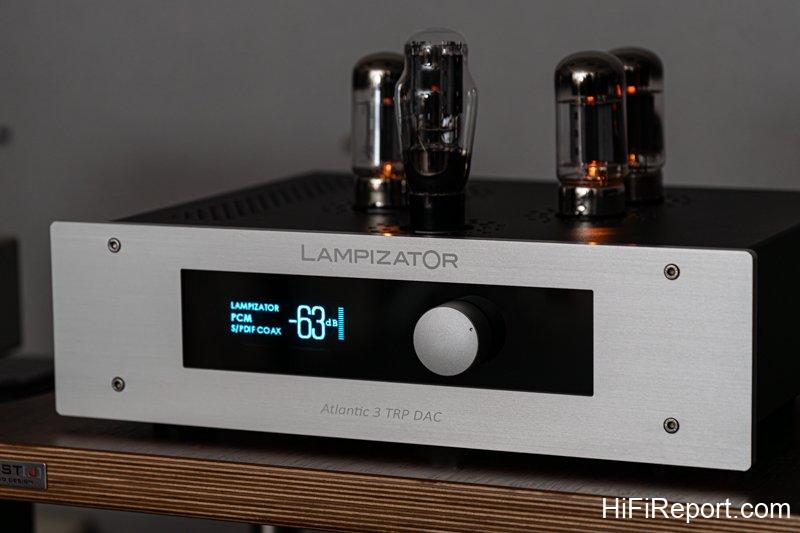
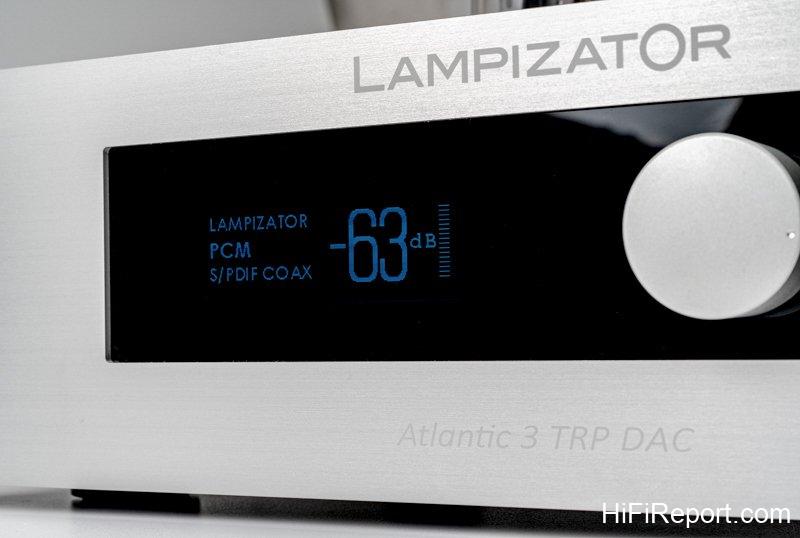
Lampizator offers four different versions of the Atlantic 3 TRP based on whether it’s single-ended or balanced and whether it includes built-in volume control: single-ended without volume, balanced without volume, single-ended with volume, and balanced with volume. The manufacturer states that the volume control module used in the Atlantic 3 TRP is a resistor-ladder type, switched by relays and controlled by a microprocessor. It offers 63 steps in 1dB increments.
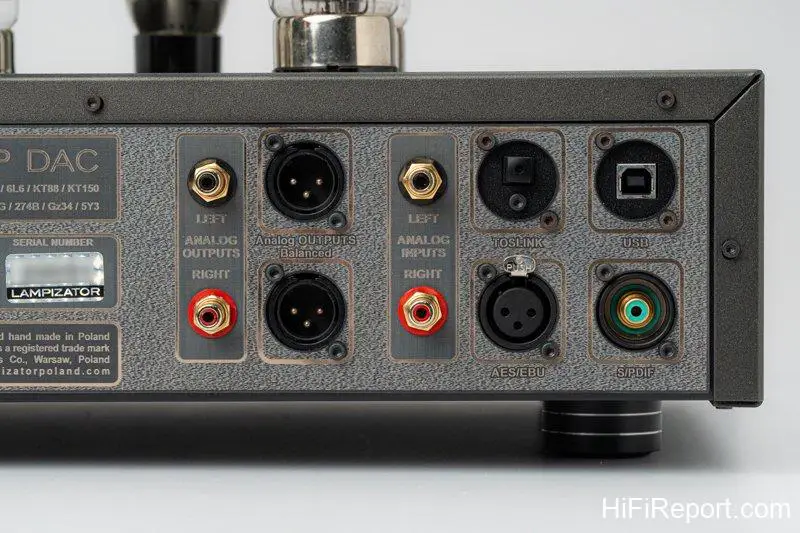
The single knob on the front panel directly controls the volume when rotated. Pressing it for three seconds switches it to input selection; rotating it then cycles through the different digital inputs: USB, Coaxial, Optical, AES/EBU, plus one analog input. Therefore, the Atlantic 3 TRP DAC equipped with volume control can also function as a preamplifier. The manual specifically recommends that users with volume control versions can let the Lampizator DAC replace their preamplifier for the most direct and cleanest sound.
If the amplifier is a separate pre/power or an integrated amplifier, users can choose to use the DAC’s volume control in conjunction with the amplifier’s volume control, adjusting them for their preferred sound. Alternatively, the Atlantic 3 TRP’s volume control can be set to 0dB attenuation, at which point the DAC’s volume control is completely bypassed. If you purchase the version without volume control, you don’t have this consideration. However, buying the version with volume control offers greater application flexibility.
Introducing Engine Eleven
The latest generation of Lampizator DACs all incorporate the new Engine Eleven technology. What is it? I first heard the term Engine Eleven from Lampizator’s owner, Lukasz Fikus, at the 2023 TAA audio show. I initially thought it was some kind of digital algorithm or perhaps involved an FPGA chip. He explained that it was actually the result of his optimization work on DAC circuitry during the Covid pandemic years of 2020-2021.
Engine Eleven was first used in the new flagship Horizon DAC and has since been applied to the entire series of DAC products, marking a generational update for the entire line. So, what exactly did Engine Eleven optimize? The manufacturer hasn’t provided detailed explanations, only listing general improvements such as: more refined power supply, stricter isolation and grounding for signals and clocks, replacement of previous voltage-based DACs with current-based designs, software management of digital-to-analog conversion settings, zero digital input delay, independent digital receiver chips for each digital input, completely silent switching, and direct coupling from the chip to the tube amplification stage using silver wire, completely free of capacitors or resistors.
What benefits do these design choices bring? The manufacturer claims that Engine Eleven comprehensively improves sonic performance. They liken it to the time when all guitar amplifiers had volume knobs that went from 0 to 10, and Marshall introduced amplifiers that went to 11, indicating that Marshall amps could play louder. By naming it Engine Eleven, Lampizator is declaring to the world that their products “go to Eleven,” meaning they are better than before and better than others. If it’s truly this good, can users who previously purchased Lampizator DACs send their units back for an upgrade? The answer is yes. The manufacturer promises that all older DAC models can be upgraded, though upgrade prices vary for each model. Interested users should inquire directly.
Lively, Fast, and Natural Sound
As I mentioned at the beginning of the article, Lampizator DACs are addictive – at least, they are for me. During its stay in the HiFiReport listening room, I consistently included the Atlantic 3 TRP DAC as one of my reference components. Its sound is vivid, its response speed is fast, and it’s agile and lively. The tone is natural, the texture smooth, and the frequency balance is even, without significant bias. The sound, rich with moisture, makes the music feel beautifully hydrated and lovely to listen to.
It provides abundant information, with details that are plentiful and clear, yet entirely free from harshness. The Atlantic 3 TRP’s sound is exceptionally transparent, the image is clear, and it possesses excellent perspective. The layout and layering of the stage and soundstage unfold naturally, utterly free from obscurity. These sonic characteristics strike me right where it matters.
In the company’s listening room, I paired it with a Lumin U2 digital streaming transport and a YBA CDT 450 CD transport (streaming via USB, CD via AES/EBU). The amplification consisted of a Linear Acoustic LA V5 preamplifier and LA 200 power amplifier, driving Wilson Audio Alexia 2 loudspeakers. In this setup, the Atlantic 3 TRP DAC could fully showcase its capabilities, unfazed even by music with large scale and dynamic swings.
Unflinchingly Beautiful
I want to start with Beethoven’s Fourth Piano Concerto. The version I played was a recording of the Rotterdam Philharmonic Orchestra conducted by Lahav Shani. At the very beginning of the first movement, Beethoven unusually begins with the piano introducing the first theme directly, imbuing it with a meditative quality. The subsequent development unfolds in a fantastical style.
Listening to those contemplative and gentle notes, the graceful arpeggios, and the brilliant rapid passages, the piano tone rendered by the Lampizator was simply exquisite. It retained a beautiful, pearl-like roundness while still revealing the impact of the piano keys. Its unhurried speed was also admirable. Texture, impact, speed—the same music, the same source, but switch to a different DAC, and that subtle flavor is just missing. The Atlantic 3 TRP’s piano tone was simply rounder, more three-dimensional, the notes more elastic, and the force and speed of the keystrokes distinctly more vibrant.
I admit, these differences are very subtle. Furthermore, our editorial reference DAC is the Merging NADAC, which has a professional recording studio background, so there should be no issues with it. However, as soon as the Lampizator Atlantic 3 TRP was swapped in, the piano’s resonance immediately became captivating. That elusive charm is hard to describe; I only knew that once it was in place, I didn’t want to switch back.
Not only was the piano resonance mesmerizing, but the strings also received an “upgrade.” The Atlantic 3 TRP made the texture and quality of the string section emerge more vividly. Despite being a digital CD, listening to the beauty of the strings felt like it had the richness of analog. One could describe it as bow sound, but it was more than just individual strokes; it was the sound of an entire section bowing, weaving and crafting the sound. That texture felt like it had warp and weft, with depth and tactile presence.
I was also captivated by the soundstage it presented. This soundstage unfolded so naturally, with both width and depth opening up. Each section, the solo piano, and the woodwind instruments occupied their respective positions within the sonic image, with clear positioning, well-defined forms, and an orderly distribution of layers. This is indeed one of the great charms of Lampizator’s tube DACs – individual elements are more three-dimensional, the collective image is more expansive, the layers are more distinct, and the soundstage is more transparent.
Poetic and Refined
Beethoven’s Fourth Piano Concerto follows a path of exquisite elegance. The Lampizator Atlantic 3 TRP excelled at rendering this refinement; the sound possessed true class. What if the piece is a bit wilder? Listening to Martha Argerich’s performance of Shostakovich’s First Piano Concerto from the 2006 Lugano Music Festival. To be precise, this is a “Concerto for Piano, Trumpet, and String Orchestra,” feeling more like a double concerto.
The piece begins after a prologue filled with mocking sarcasm. Argerich’s playing, full of energy and vitality, delivers arpeggios that are crisp and glittering, while the forcefully struck high notes pierce like swift arrows. The heavily pressed left-hand chords make the piano strings vibrate with deep bass tones. These details, this information, constitute the picture of the performance. The trumpet in the piece sometimes adopts a warm tone, at other times becoming spirited and leaping. Its golden-hued notes echo the piano.
Does the Lampizator Atlantic 3 TRP then sound unrefined? Of course not, quite the opposite. Its resolution of sound isn’t merely dissecting it; it imbues the “threads” with the requisite luster, resilience, and warmth. By comparison, the piano, strings, and trumpet from the NADAC sound straightforward, clear, and defined, like resolute and well-trained soldiers. The Atlantic 3 TRP’s sound, on the other hand, appears elegant, refined, and full of variation, more like a sensitive poet with a soaring imagination.
Vivid and Lifelike
Listening to chamber music with smaller ensembles, the texture and tone of the instruments are more easily highlighted; this is where “less is more” in the musical experience. Listening to Yo-Yo Ma and Kathryn Stott’s collaboration on the album “Songs of Comfort & Hope,” one can truly feel the Atlantic 3 TRP’s sense of aliveness, which is quite uncommon among products in its class.
Take the American folk song “Shenandoah” as an example. This piece, arranged, sounds elegant, gentle, and contemplative. The piece begins with the piano playing single notes, while the cello pizzicato provides hints of the theme. Subsequently, the piano responds with chords, and the cello resumes bowing. The melody’s lines and contours become clear. I love the detailed, vivid, and lifelike sound that the Atlantic 3 TRP delivers. Through its decoding, it seems more information within the music is unearthed, allowing for a greater appreciation of the sound’s texture.

“Goin’ Home,” arranged from the second movement of Dvořák’s Ninth Symphony, features Yo-Yo Ma’s cello singing with a rich, almost nasal timbre. Yo-Yo Ma’s cello playing always possesses great lyricism; his phrasing and the softness of his tone always make his playing sound remarkably like singing. The Lampizator 3 TRP not only conveys the deep, nasal quality that identifies it as a cello but also, through its vivid and three-dimensional reproduction, gives the cello tone a captivating stance and expression.
This is interesting. The Atlantic 3 TRP uses high-output power tubes in its amplification stage, yet its sound is not at all rough or sluggish. Instead, it is delicate, refined, beautifully lustrous, and full of expression. Whether reproducing Beethoven’s Fourth Piano Concerto or chamber music as heard here, it reveals a fine and pure character.
Analog Soul, Digital Precision
Given that the Atlantic 3 TRP DAC is vivid, agile, and fast, it naturally excels at reproducing vocals. (Or perhaps I should say: the vocal performance is, of course, excellent.) Let’s take “Blue Coast Collection—The E.S.E. Sessions” album as an example. Blue Coast Collection recordings feature natural tone, transparent texture, and lean towards a fresh sound. With Lampizator’s tube amplification, the character of this music becomes even more vibrant.
Taking “Looking for a Home” as an example, the guitar tone is clear and crisp, the sliding sounds possessing a certain free-spirited elegance. The subtle variations in the guitar’s tone are delicate and minute. With the Atlantic 3 TRP’s decoding, there’s more information, greater clarity, and the wealth of information it unearths maintains a high degree of analog quality rather than a strong digital feel. Keith Greeninger’s voice has a slight huskiness, revealing a touch of weariness, like a wanderer longing for home.
The female voice in “Slow Day” is Jane Selkye; her voice is sweet and sounds very pleasant and lovely accompanied by the guitar. This track adds bass, giving the lower frequencies more weight and stability. The Atlantic 3 TRP’s bass extension is natural and rich in detail. Its characteristic isn’t a thick and heavy sound but rather a natural and clear one. Listening through the Linear Acoustic pre/power and Alexia 2 system, the Atlantic 3 TRP’s bass sounds entirely complete, and because it possesses such excellent resolution, this kind of bass is, in my opinion, even more to my liking.
Bringing the Concert Hall Home
On Hugh Masekela’s “Hope” album, Masekela’s vocal line is clear, its texture distinct. The Atlantic 3 TRP’s vibrant vocal reproduction is truly exceptional. The Atlantic 3 TRP illuminates the entire stage with a brightness akin to daylight, positioning each instrument/musician clearly and distinctly. It provides a clear and deep soundstage, not a cramped, shallow one, but one filled with the atmosphere of a live performance.
Whether it’s the trumpet or the flugelhorn, the brass instruments possess a vivid metallic texture. Listening to this brass alone, it fits neither the traditional warm, hazy image we have of tube sound nor the cold, rational digital reproduction. Lampizator’s tube amplification imparts elements of vitality to the music, making it sound more alive. The drum kit establishes the rhythm throughout almost the entire piece. I kept trying to decide whether to use “crisp” or “incisive” to describe the drumming. The drum and cymbal sounds are bright and fast, clean and sharp without lingering, with strong impact and strike sensation.
Although these are popular tunes, compared to the Blue Coast recording, the pieces on “Hope” sound much more energetic, with a larger ensemble and naturally richer sonic effects. The result is greater musical expression and a wider scope for performance. The Lampizator Atlantic 3 TRP is not at all intimidated by reproducing these rich musical elements. Perhaps with the NADAC, I might hear a sound that is more stable and solid, but only with the Lampizator do I get this vibrant sound, like freshly caught live shrimp.
Direct to Amp: Maximum Vibrancy
I paired it with Linear Acoustic’s pre/power setup, which offered the choice of whether or not to use the preamplifier. Compared directly, it is indeed true, as Lampizator states, that when the Atlantic 3 TRP feeds directly into the LA 200 power amplifier without the preamplifier, the sense of liveliness is outstanding. The sonic characteristics I mentioned earlier, including speed, impact, and brightness, are particularly distinct. The more direct sound makes the details, texture, and nuances of the sound clearer.

Adding the LA V5 preamplifier results in a thicker, fuller sound, with the bass gaining more authority. The soundstage depth retreats slightly, and the sound sources become more concrete and three-dimensional. However, the transparency is not as good as when going direct to the power amp, and the sense of aliveness is slightly diminished. Frankly, this isn’t about which is better or worse; it’s a matter of style and taste. Moreover, if you buy the version without volume control, you don’t have this “trouble.”
The V8 Engine Experience
As I said earlier, people who choose a Lampizator DAC typically have discerning tastes. With such a large chassis and such a rustic appearance, devoid of intricate decorations or technologically flashy controls, Lampizator DACs are made for those who seek musical emotion. The Atlantic 3 TRP is no different. The manufacturer says that once you’ve truly heard the Atlantic 3 TRP, it’s like driving a car with a V8 engine – you simply can’t go back.
Specifications
* Type: Vacuum Tube DAC
* Vacuum Tubes Used: KT88 x4 (or EL34, 6L6, KT150), Rectifier Tube: 5U4G (or 274B / 5C3S / 5Y3 / Gz34)
* Analog Input: RCA x1
* Digital Inputs: S/PDIF RCA x1, AES/EBU x1, Toslink x1, USB type B x1
* Analog Outputs: RCA x1, XLR x1 (Balanced Version)
* Maximum Supported Sample Rate (USB): PCM 768kHz, DSD 512