
LUMIN M1 Hi-Res Streaming Review
The trend of all-in-one audio components has quietly permeated the high-end audio realm. Lumin, a brand renowned for its high-fidelity network streaming music players, has embraced this movement with the introduction of the M1. This integrated unit is designed to be the centerpiece of a modern digital audio system, handling every aspect of music playback, from file reception and digital-to-analog conversion to signal amplification.
Audiophiles need only add a NAS (Network Attached Storage) device and their preferred loudspeakers to unlock a world of high-quality music reproduction with remarkable ease.
In stark contrast to the often complex and component-heavy traditional audiophile setups, the concept of the all-in-one system, while not new, is now making significant inroads into the high-end sector. Previously confined to more mainstream audio solutions, we’re now witnessing a surge in high-end manufacturers embracing integrated designs.
These new breed of all-in-one units cleverly consolidate the functions typically found in separate preamp, DAC, and amplifier components into a single chassis. By applying high-end design principles, utilizing premium materials, and incorporating the convenience of network streaming, these systems aim to deliver both exceptional audio performance and user-friendly operation.

Exceptional Value Proposition
Despite being positioned as an entry-level model within Lumin’s product range, the M1 benefits significantly from the successes of its predecessors. It cleverly incorporates key strengths from higher-tier models, streamlining the design to maximize performance per dollar. This approach allows audiophiles to access exceptional features and sonic quality at a more accessible price point.
Lumin dedicated 18 months to the development of the M1, aiming to achieve a remarkable balance of affordability and performance, ultimately delivering a musical experience that rivals more expensive, separates-based systems. Despite its comprehensive functionality, the M1 maintains a surprisingly compact footprint, barely exceeding the dimensions of an A4 sheet of paper.
This truly all-in-one player boasts a sleek, low-profile chassis, a minimalist aluminum front panel, and clearly defined gold-plated speaker binding posts.
Intuitive App Control
The Lumin M1 presents a remarkably uncluttered front panel. To the left, a power switch is located, while the right side features a volume control knob. At first glance, these controls might suggest a traditional integrated amplifier. However, seasoned Lumin users and those familiar with network streaming will immediately recognize the key to its operation: the dedicated Lumin app. Lumin’s in-house developed control app is exceptionally well-refined and feature-rich.
Its development was initiated early in Lumin’s history, running in parallel with their hardware design, making app-based control a core design principle from the outset. [Link to LUMIN APP iOS version] [Link to LUMIN APP Android version]
Streamlined Connectivity
Examining the rear panel of the Lumin M1 reveals its intended operational philosophy. On the left, you’ll find the AC power inlet with a master power switch and a grounding post, followed by high-quality speaker binding posts that accommodate both banana plugs and spade connectors. To the right are the essential Ethernet port and a USB port. Noticeably absent are traditional analog or digital inputs and outputs.
This design choice underscores the M1’s all-in-one nature; it’s designed to be a self-contained system, minimizing external connections and maximizing simplicity. Input options are exclusively Ethernet and USB. The Ethernet port facilitates connection to your home network router, providing access to music files stored on a NAS or computer. This network connection is also crucial for app control. Therefore, a home network is a prerequisite for utilizing the M1’s full streaming capabilities.
While Ethernet is the primary input, the M1 also offers a USB port for direct connection to external hard drives, supporting both USB flash drives and USB HDDs (formatted as Single-partition FAT32, NTFS, and EXT2/3). Setting up and using the Lumin M1 is remarkably straightforward, as evidenced by the concise, single-page quick start guide that clearly outlines the necessary steps.
Extensive Format Support and Robust Amplification
Given the Lumin M1’s focus on high-fidelity digital music reproduction, it naturally boasts comprehensive support for a wide array of audio file formats and resolutions. It handles PCM files up to an impressive 384kHz/32-bit and DSD up to DSD128 (5.6MHz/1-bit). Supported music formats include: DSF (DSD), DIFF (DSD), DoP (DSD), FLAC, Apple Lossless (ALAC), WAV, AIFF, MP3, and AAC (in M4A container).
The integrated Class D amplifier section delivers a substantial 100 watts per channel into 4 ohms and 60 watts per channel into 8 ohms. It’s crucial not to underestimate the M1 as merely a compact or secondary system. Its all-digital processing and robust 60 watts per channel output are more than capable of filling medium-sized listening rooms with rich, dynamic sound.
Multi-Room Capability and Ecosystem Integration
The app-centric design of Lumin products facilitates seamless multi-room audio setups when incorporating multiple Lumin devices throughout your home. The Lumin app is available for both iOS and Android platforms. While the M1 is highly versatile, its operation is intentionally simplified compared to Lumin’s higher-end models, primarily by omitting upsampling and digital filter selection options. The M1 offers integrated access to internet radio, Tidal Hi-Fi, and Qobuz streaming services.
Users simply need to log in with their existing accounts for these providers to enjoy direct streaming through the M1. Within the app, users can customize playback preferences and navigate their music library. The app intelligently scans the local network, identifying other storage devices, including NAS units and computers, allowing you to browse and select music files stored on these devices.
It’s worth noting Lumin’s dedicated L1 music server, a 2TB UPnP hard drive specifically designed to store and serve music files to Lumin network players. Think of it as a purpose-built external music library for the Lumin ecosystem. The L1 will naturally appear within the M1’s music library, along with any other Lumin devices with storage capabilities on the network. This interconnectedness enables a home-wide music sharing network.
Even though the M1 itself lacks internal storage, connecting an external USB hard drive allows its music library to be accessible by other Lumin players on the network. For our testing, we utilized a NAS running MinimServer UPnP software, which is officially recommended by Lumin for optimal performance.
Internal Design and Key Components
**Specifications**
* **File Format Support:** DSF (DSD), DIFF (DSD), DoP (DSD), FLAC, Apple Lossless (ALAC), WAV, AIFF, MP3, AAC (in M4A container)
* **PCM Sample Rates:** 8kHz – 384kHz, 16 – 32-bit, Stereo
* **DSD Sample Rates:** DSD64 2.8MHz, DSD128 5.6MHz, 1-bit, Stereo
* **Digital Output:** USB
* **Analog Output:** Speaker Binding Posts
* **Amplifier Power:** 100W per channel into 4 Ohms, 60W per channel into 8 Ohms (Class D)
* **Input:** Ethernet, USB
* **Control:** Lumin App (iOS and Android)
* **Streaming Services:** Tidal, Qobuz, Internet Radio
* **Other Features:** Multi-room capability
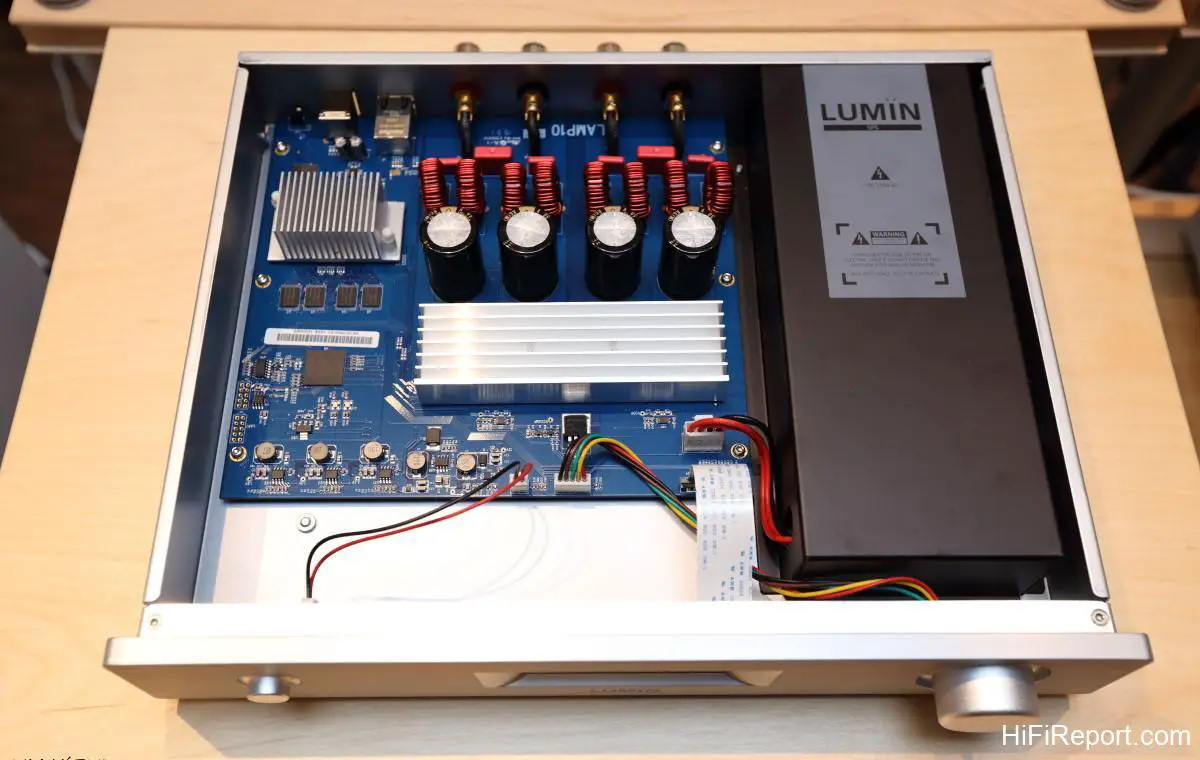
Internally, the M1’s compact chassis is intelligently organized, housing the power supply, digital circuitry, amplifier section, and analog outputs. Removing eight screws from the bottom panel grants access to the neatly arranged internal components. The chassis base prominently displays the Lumin logo, model name, and serial number barcode. Upon opening the unit, a substantial power supply section immediately catches the eye, occupying approximately one-third of the internal space.
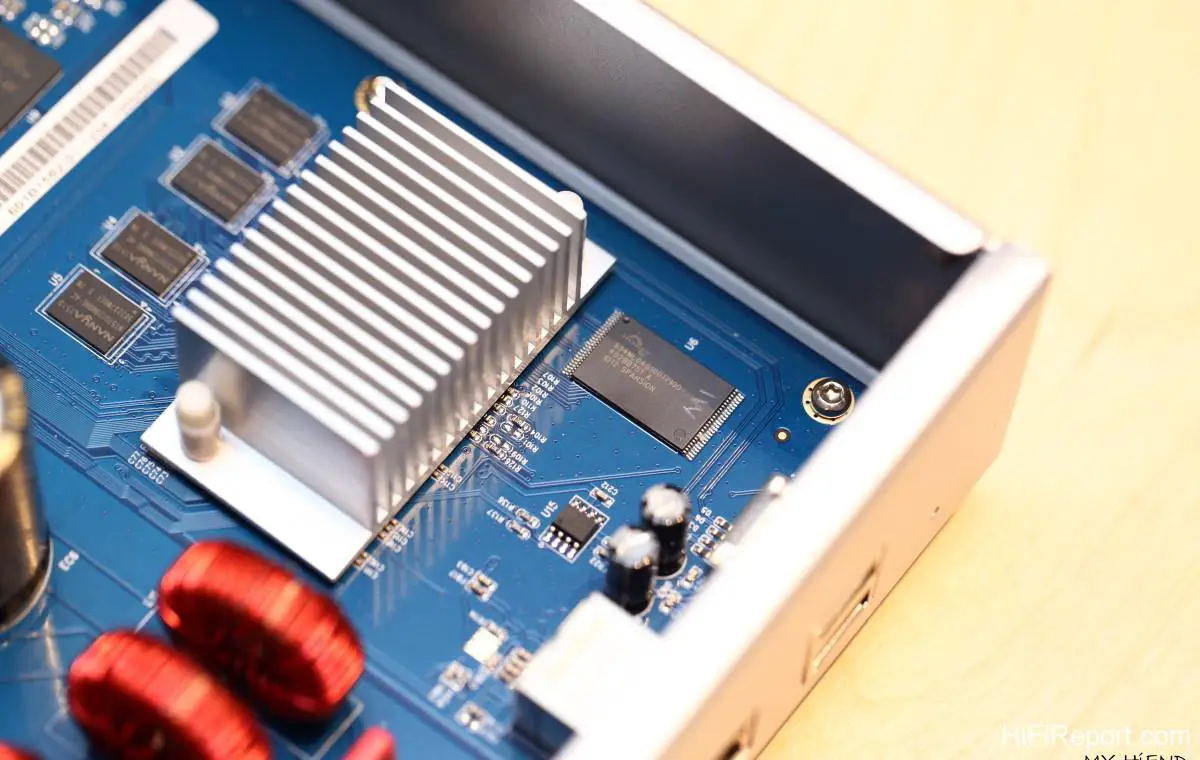
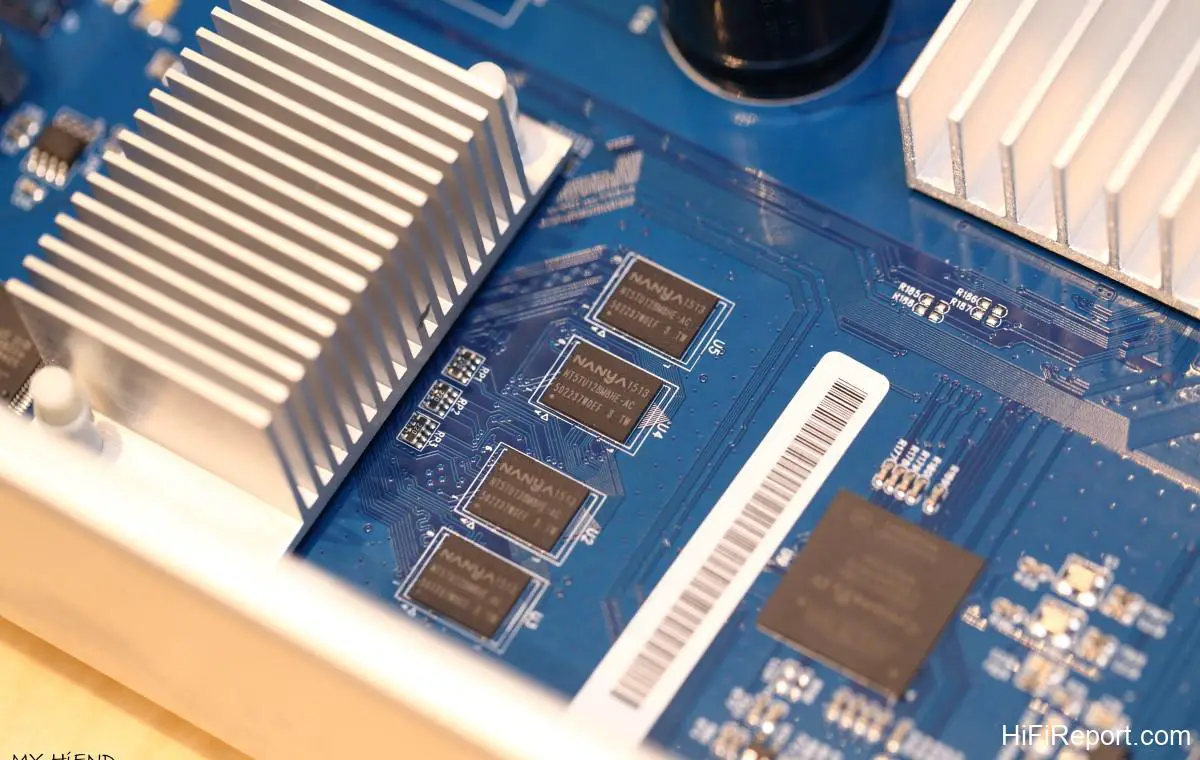
It’s enclosed in a metal shield for isolation, with a small opening for the power cable. The digital circuitry enters from the rear left, encompassing the Ethernet and USB ports. The signal path then leads to the speaker binding posts via two symmetrical outputs located on the right side of the circuit board, passing through two heatsinks along the way. Component close-ups reveal key parts: The memory semiconductor chip is identified as a Spansion device.
Spansion, known for flash memory solutions, is a company formed from AMD and Fujitsu. Four Nanya Technology DRAM chips are also visible. The FPGA chip is an Altera Cyclone 4, manufactured in the USA. The Lumin M1 employs Texas Instruments’ TAS5558 digital processing chip and TAS5624A Class D MOSFET amplifier chip for its core amplification.