
Luna Cables Gris AC Power Cable Review
Have you heard of Luna Cables? The name itself immediately tells you they specialize in cables.
Luna Cables hails from Quebec, Canada, the French-speaking province. This Francophone heritage is reflected in their product names, which are also in French.
Luna Cables offers five series, ranging from entry-level upwards: Gris (Grey), Orange, Mauve, Rouge (Red), and Noir (Black).
Let’s set aside the brand’s history for now. Unless you’ve interviewed founders Danny Labrecque or Erik Fortier, the information available is primarily from their official website. Lin Zhiyu has already provided a detailed account in his review of the Rouge XLR signal cables, so those interested can refer to that.
Key Features: Tinned Copper, Waxed Cotton, Handmade
Luna Cables boasts three core characteristics that apply across their entire product range.
Firstly, they exclusively use tinned copper conductors in their cables.
Secondly, all cables are sheathed in waxed cotton fabric.
Thirdly, every cable is meticulously handcrafted in-house.
Let’s delve into each of these features in detail.
The Allure of Tinned Copper
Most high-end audio cable manufacturers strive for conductor purity. For copper cables, they often emphasize “N-purity oxygen-free copper” or highlight special processes that result in longer copper crystal structures and fewer impurities, such as LC-OFC long-crystal copper, OCC single-crystal copper, or Furutech’s Triple C technology.
Alternatively, some brands promote the use of silver, which has a higher conductivity than copper, also emphasizing its purity.
Other approaches include silver-plated copper, silver-clad copper, or even precious metal alloys.
However, the sonic character of a cable is never solely determined by the conductor material. Specifications like transmission speed, capacitance, impedance, and inductance are merely references.
Manufacturers can adhere to their scientifically grounded cable designs, but ultimately, consumers don’t buy based on numbers and specifications alone.
The true value lies in the level of enjoyment the cable brings, which can only be verified through personal listening and experience.
In contrast to manufacturers obsessed with conductor material and purity, Luna Cables uniquely adopts tinned copper wire.
The company hasn’t explicitly stated why they use tinned copper conductors. They only mention that founder Danny Labrecque was captivated by the sound of “vintage cables,” which led him to establish Luna Cables and create his own.
Interestingly, many of these early “vintage cables,” predating the “High End audio” era and even “High Fidelity,” were not originally designed for audio applications. They were primarily used in telecommunications, where the focus was on durability rather than sonic nuance.
Yet, with the passage of time, these once-utilitarian cables have become highly sought-after by contemporary audiophiles.
Luna Cables isn’t alone in using tinned copper. Swedish brand Supra also employs tinned copper conductors, as does Danish manufacturer Duelund in their cable lines.
Luna Cables’ design philosophy leans towards a vintage aesthetic, particularly in their non-power cables. They utilize LCNV (Luna Cables Neo-Vintage) technology, combining tinned copper with paper and waxed cotton, effectively recreating the essence of classic Western Electric cables.
Unique Gris Power Cable Design
Did you notice my earlier qualification? “Non-power cables.”
While LCNV technology is used in their signal and speaker cables, the power cables, like the Gris AC Power we are reviewing, employ a different design tailored for their specific function.
Let’s return to the main subject and examine the construction of the Gris AC Power cable.
It’s worth noting that Luna Cables’ Gris series also includes a Gris DC Cable. Hence, they specify “Gris AC Power” rather than simply “Gris Power.”
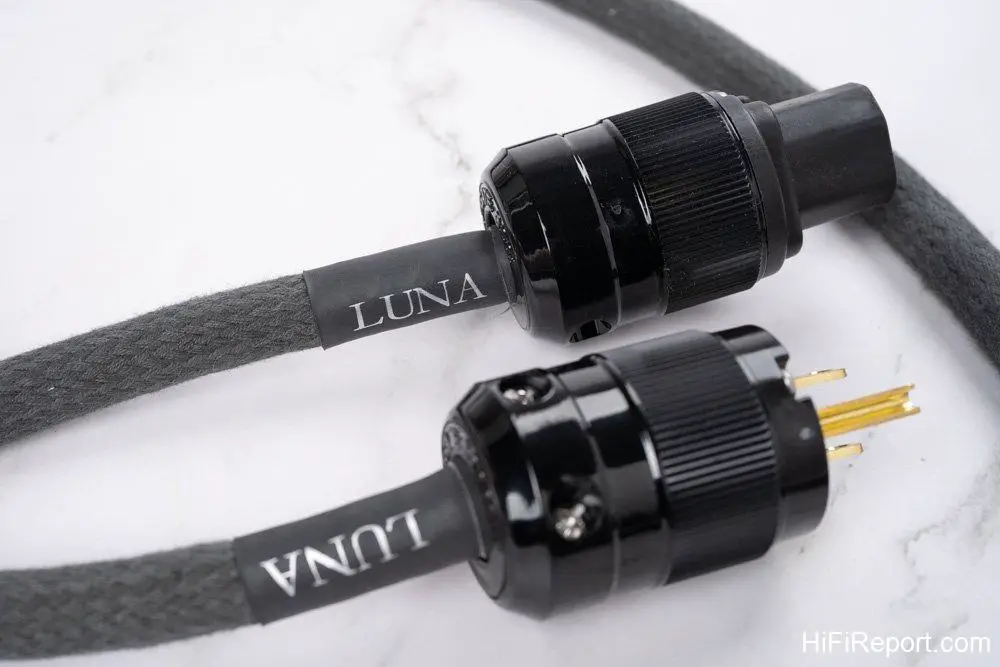
The Gris AC Power uses three 16 AWG tinned copper conductors, surrounded by a rubber dielectric material designed to absorb micro-vibrations and control overall cable resonance, thereby reducing electromagnetic interference.
Outside the rubber layer, there’s another layer of paper dielectric.
This is followed by a braided shield, also made of tinned copper, to further isolate external electromagnetic noise. An outer layer of rubber provides insulation.
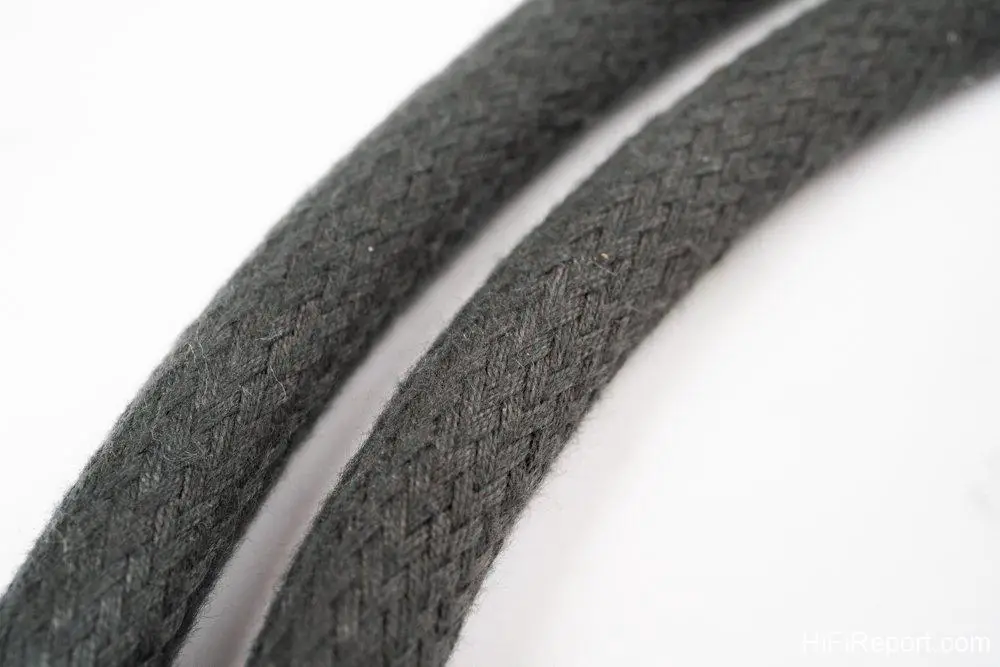
Most uniquely, the outermost layer of the Gris AC Power is an unbleached, hand-dyed grey cotton sleeve. This acts as a damping material for cable resonance. The hand-dyed fabric is not only natural in material but also in texture, a hallmark of all Luna Cables products.
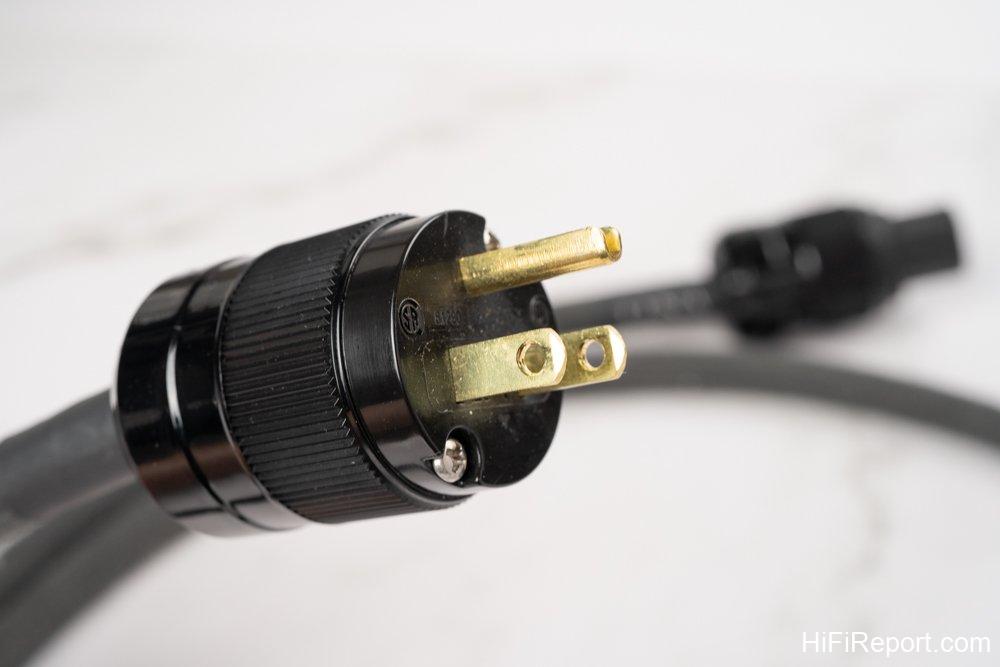
For the power plugs, Luna Cables uses Wattgate connectors. Both the male and female plug components undergo cryogenic treatment to relieve internal stress in the metal.
Ideal for Lower Power Components
From the official website, it appears that Luna Cables currently offers power cables in only three of their five series: Gris, Orange, and Mauve. The wire gauges are 16AWG, 14AWG, and 12AWG respectively. Until higher-tier power cables are introduced, consumers should choose based on their equipment’s power consumption.
The 16AWG Gris AC Power is recommended for source components, preamplifiers, or low-wattage integrated amplifiers.
Unadorned Naturalness
I used the Gris AC Power with both an Audiobyte Black Dragon DAC and a Lavardin IS Reference integrated amplifier at home. The sonic characteristics remained consistent across both setups.
The Gris AC Power presents a remarkably natural sound. Compared to other cables, it seems many others, despite claiming “naturalness,” apply a degree of sonic coloration. The Gris AC Power, in contrast, delivers a truly unadorned sound.
It brings a clear, defined, and solid soundstage. Despite its modest 16AWG gauge, which might seem “un-audiophile” on paper, the sound completely defies expectations.
The sound is remarkably grounded, lacking any sense of lightness or weakness.
Its timbre and texture are unembellished, direct, and transparent. Those accustomed to other cables might initially find it unusual. However, with extended listening, you begin to appreciate the unveiled truthfulness and its inherent intimacy.
Solid Imaging, Clear Expression, High Separation, Strong Live Atmosphere
Listening to vocal albums revealed much about the Gris AC Power’s strengths.
Its midrange prowess is immediately apparent. It’s warm, but not with an overtly colored warmth. Instead, it’s a natural, soothing warmth. Within this warmth, you can discern a wealth of musical detail without any hint of harshness.
The level of resolution is honest and genuine, allowing you to hear everything without feeling artificial.
This renders vocals fluid and natural.
For instance, listening to Sara Bareilles’ “Brave Enough: Live at the Variety Playhouse” album, the Gris AC Power delineated clear and precise outlines, with solid and focused imaging. Musical expression was vivid, and a healthy fullness imbued Sara Bareilles’ vocals with greater and more profound emotional impact.
When the vocals soared dynamically, the Gris AC Power remained composed, providing ample headroom for musical dynamics to unfold.
On this album, the Gris AC Power also showcased its spatial rendering capabilities.
To my ears, it didn’t dramatically widen the soundstage, but by giving each sound source a more concrete image, it enhanced the sense of separation between instruments. This enriched the spatial and stage information.
Its straightforward nature also accentuated the live concert atmosphere by faithfully reproducing the audience’s cheers and applause.
Warm, Rounded Piano with Rich Detail
On Oscar Peterson Trio’s “We Get Request” album, the Gris AC Power’s full-bodied sound allowed this exceptionally skilled and tightly-knit trio to fully display their talents.
The plucked notes of the double bass were full and elastic, with delightfully bouncy and rounded sonic particles – particularly enjoyable in “Corcovado.”
The piano’s rounded texture was also commendable.
This jazz album, recorded in the early 1960s, is steeped in the characteristics and charm of that era. The piano tone carried a warm hue and a moist texture, with a subtle sheen that was incredibly comfortable and pleasing to listen to.
Drummer Ed Thigpen’s performance here is truly exemplary, never stealing the spotlight. He consistently deferred to Oscar Peterson, yet his drumming was almost ceaseless. The subtle details of his playing were clearly and distinctly conveyed by the Gris AC Power.
Rocking Out is a Blast
I didn’t underestimate the Gris AC Power simply because it’s Luna Cables’ entry-level power cable. However, I found myself enjoying its performance with rock music even more than with classical. It delivered an impactful and emotionally rich experience.
Yes, you read that right. This seemingly unassuming “grey robe wizard,” though clad in a deep grey sleeve, surprised me much like Gandalf.
It amplified the accusatory tone in Guns N’ Roses’ “Civil War.”
The full and substantial electric guitars provided ample musical tension, and the drum beats were clear and powerful.
“Don’t Cry,” the power ballad classic, gradually builds from a slow verse, intensifying in emotional depth as it progresses. Slash’s soulful and unrestrained guitar solo in the song’s midsection, though brief, is the highlight of the track.
The Gris AC Power endowed the electric guitar tone with considerable midrange thickness. Compared to my usual Swisscables Reference power cable, it was as if Slash had switched to a different guitar amplifier.
Moving onto “November Rain,” the Gris AC Power’s power and solidity released even richer musical emotion. Whether it was the drums, guitars, or Axl Rose’s vocals, it reinforced the musical fabric while amplifying the emotional tension.
Listen to Slash’s brilliant solo towards the song’s end, interwoven with rhythm and vocals. It further reveals the song’s powerful, lyrical essence.
Candid and Direct Honesty
Finally, I must clarify something about the Gris AC Power, lest you think it unsuitable for classical music.
The Gris AC Power’s sound is neutral, natural, direct, and uncolored. It can even be described as simple and unadorned.
Such a sound, emphasizing sonic purity and fidelity, is certainly not unsuitable for classical music. However, I previously mentioned preferring its performance with non-classical genres. This is because when listening to classical music, I often expect a refined and delicate expression, which isn’t the Gris AC Power’s primary strength.
It’s like comparing different styles of speech. Classical music, in my view, is like meticulously crafted language, carefully chosen words to present an elegant and polished aura.
Others, however, don’t dwell on word choice, aiming for the most direct, precise, and unvarnished expression. They speak plainly and honestly, never mincing words.
The Gris AC Power is similarly candid and direct, without pretense or affectation.
Capturing the Grandeur of Concertos
In actual listening, I can confidently tell you (as plainly as the Gris AC Power would) that its open and smooth sound resonates deeply when playing large-scale orchestral music.
The benefits become even more pronounced at higher volumes (especially when used with source components).
For example, listening to Alice Sara Ott’s performance of Tchaikovsky’s Piano Concerto No. 1, the powerful opening chords blossom after the orchestra’s spirited introduction.
The majestic orchestral theme expresses emotions far beyond mere romantic love.
The piano is resonant and steady, its tone solid and assertive. While it may lack a certain captivating sheen and brilliance, the musical texture is undeniably substantial.
The Gris AC Power presents this concerto in a way that feels more inherently Tchaikovsky, and less about Alice Sara Ott’s interpretation.
Simple Appearance, Honest Sound
The Gris AC Power cable’s simple, even understated appearance directly reflects the essence of its sound.
Unlike some cables that create an immediately impressive first impression, the Gris AC Power’s charm unfolds gradually with patient listening.
Its naturalness, openness, and subtle warmth and fullness make music incredibly approachable.
This approach is rare among cables in its price range.
For someone who values music deeply, the listening pleasure provided by the Gris AC Power is enduring, lasting, and constant.
Specifications
* Type: AC Power Cable
* Conductor: Tinned Copper
* Gauge: 16AWG
* Sheathing: Waxed Cotton Sleeve
Reference Equipment
* Sources: Silent Angel Z1, Telos EMP, Audiobyte Black Dragon DAC
* Amplifiers: Lavardin IS Reference, Audiomat Adagio
* Speakers: JMR Abscisse Jubile
* Cables: Telos QAC power cable, Swisscables Reference power cable, Esprit Structura power cable, Real Cable Cheverny RCA signal cable, Chu Pei Le Fang Cherry Peacock USB cable
* Accessories: Telos GNR Mini Active Grounding Noise Reducer, NuPrime Pure AC-4 Power Conditioner