
Marantz Cinema 50 Review
If you’ve been keeping an eye on the home theatre market, you’ve likely noticed how much more effort Japanese AV receiver manufacturers have been putting in over the past few years. Beyond simply packing in all the latest theatre specifications, each brand’s sound tuning has become more distinct, leading to significant leaps in AV receiver sound quality and finally breaking away from the past “toothpaste squeezing” product strategy.
However, regardless of how much the technology in AV receivers improves, the exterior design often seems to be the same old story, rarely offering much surprise to enthusiasts.
Furthermore, as home theatre systems have moved from dedicated audio rooms into living spaces in recent years, “appearance” has become even more crucial. I’ve had many home visits where, no matter how top-tier the theatre system in the living room was, the AV receiver’s plain black box always looked out of place next to stylish speakers and displays.
This year, Japanese AV receiver giant Marantz has completely refreshed its product lineup, introducing the Cinema series of AV receivers. Not only do these units deliver superior sound quality, but they also break with traditional design norms. By shedding the cold, utilitarian look of theatre equipment, their beautiful designs have truly impressed enthusiasts. The Cinema series comprises four AV receivers.
Introducing the Cinema 50
We’ve previously covered the entry-level Cinema 70s and Cinema 60, and this article focuses on the sub-flagship Cinema 50. It boasts the same stylish exterior, stronger channel support, and more power. Most importantly, in addition to built-in Audyssey MultEQ XT automatic room correction, it can also be upgraded with powerful Dirac Live functionality via a firmware update (purchased separately), further catering to the needs of advanced theatre enthusiasts.
Exterior Aesthetics
The Cinema 50’s exterior design is largely the same as the Cinema 60 we reviewed last month. The front panel features the Cinema series’ unique double-layer structure, with Marantz’s signature circular display in the center and gunmetal grey rhombus pattern accents on either side. The only difference is that the Cinema 50 hides its buttons behind a metal cover plate, which can be easily slid open when needed, resulting in a cleaner visual aesthetic.
Rear Panel and Connectivity
Turning to the rear panel, the Cinema 50 offers a more comprehensive 9.4 channel output, allowing for 5.1.4 or 7.1.2 Dolby Atmos theatre configurations. It also supports standard audio formats like Dolby Atmos and DTS:X.
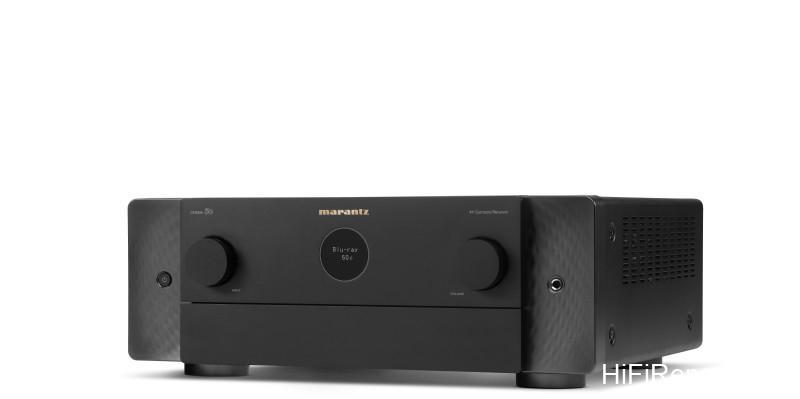
Even if you can’t install overhead speakers at home, you can still choose this unit, as it features both DTS Virtual:X and Dolby Atmos Height Virtualization technologies to enhance the sense of audio dimensionality. This also ensures seamless integration if you decide to upgrade your channel count in the future. There’s also a Zone 2 speaker terminal set, allowing you to connect and listen to another pair of speakers.
Advanced Channel Configuration & Flexibility
Compared to the lower-tier Cinema 60, the Cinema 50 allows the overhead sound configuration to transition from a “line” to a complete “plane,” resulting in more comprehensive soundstage height and vertical audio movement when rendering Dolby audio.
Furthermore, the Cinema 50 boasts 11 channels of decoding capability, which means it has full pre-out outputs. If you have a higher-end multi-channel power amplifier, you can engage the Pre-Out Only mode, bypassing the internal amplification and using the unit purely as an AV preamp processor. And what’s the “.4” in the specifications?

Don’t be surprised; Marantz has equipped its mid-to-high-end models with four subwoofer outputs to accommodate the increasingly popular multi-subwoofer configurations in recent years.
If your space is large enough, you can increase the number of subwoofers. Doing so can reduce the burden on individual subwoofer amplifiers, thereby improving low-frequency quality. The Cinema 50 also provides 6 spare RCA audio inputs for connecting sources like CD players, gaming consoles, etc. If you want to listen to vinyl, the unit includes a Phono input, meaning it has a built-in MM phono stage allowing direct connection of a turntable.
Video Capabilities
In terms of video, it supports 6 inputs and 3 outputs for HDMI. Six inputs and one output group comply with the HDMI 2.1 standard, supporting 4K/120p and 8K/60Hz video pass-through, as well as video formats like Dolby Vision, HDR 10+, and Dynamic HDR. It also includes gaming-related features such as VRR (Variable Refresh Rate), ALLM (Auto Low Latency Mode), and QFT (Quick Frame Transport), reducing ghosting and distortion during gaming and capturing the most perfect details.
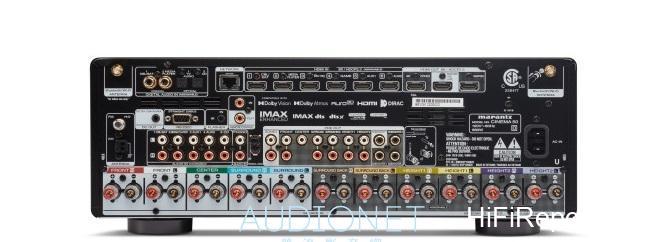
Of course, the output terminals also feature eARC (Enhanced Audio Return Channel), allowing you to use your home theatre system instead of TV speakers to fully unleash the audio quality of streaming platforms.
Network and Streaming
The Cinema 50 supports both wired network and Wi-Fi connectivity, allowing access to a wide range of streaming music services. This includes playing music files stored on PCs and NAS devices within the local network via UPnP. Using the proprietary HEOS App, you can also directly listen to mainstream streaming music platforms like Spotify and TIDAL.
If you’re an Apple user, it also features the familiar AirPlay 2 functionality, allowing you to mirror audio from your mobile device for playback on the unit. The streaming decoder supports high-resolution files up to PCM 24bit/192kHz and DSD128, which is more than sufficient for current streaming music services.
Internal Design and Components
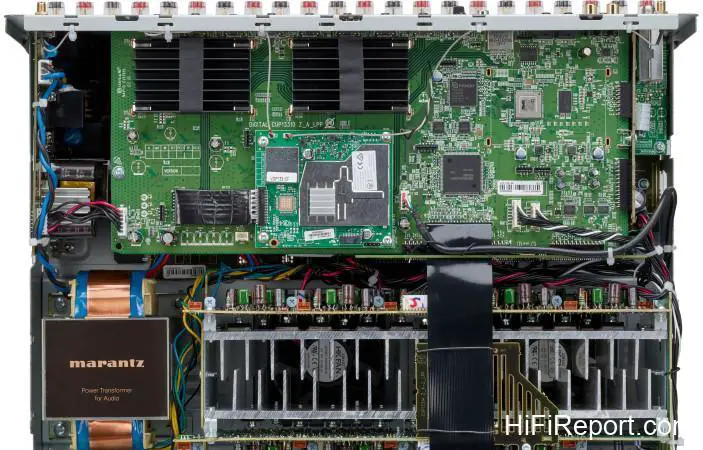
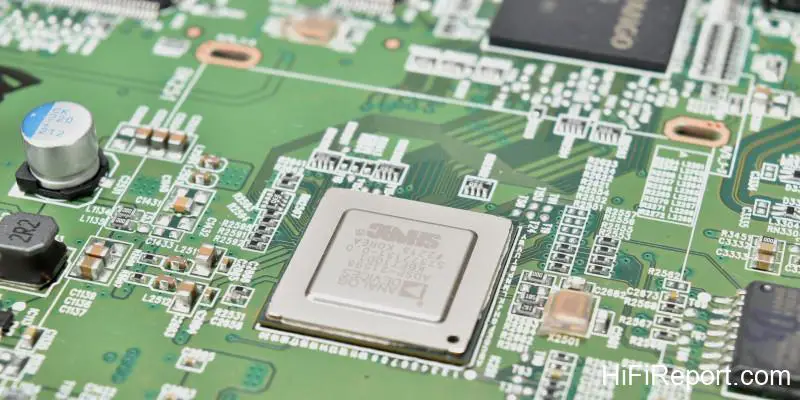
Opening the chassis reveals that the Cinema 50’s circuit design is significantly more complex than that of the Cinema 60. The unit employs a multi-layered circuit architecture. First, after receiving the digital signal, it passes through a 1GHz “Dual-SHARC+” DSP chip. This chip handles digital audio processing, Audyssey MultEQ XT automatic room correction, and the future upgradeable Dirac Live function.
Next, the digital-to-analog decoding circuit is placed vertically inside, connected to the pre-amplification circuit. This arrangement saves space and shortens the signal path.
Unlike typical AV receivers that use two 8-channel chips to distribute 11 channels of decoding, this unit takes a more audiophile approach. It uses 8 x 32-bit dual-channel TI PCM5102A DAC chips, paired with a buffer amplification circuit composed of 8 OP Amps (JRC NJM8080). This significantly improves the signal-to-noise ratio, making movie soundtracks clearer and more transparent.

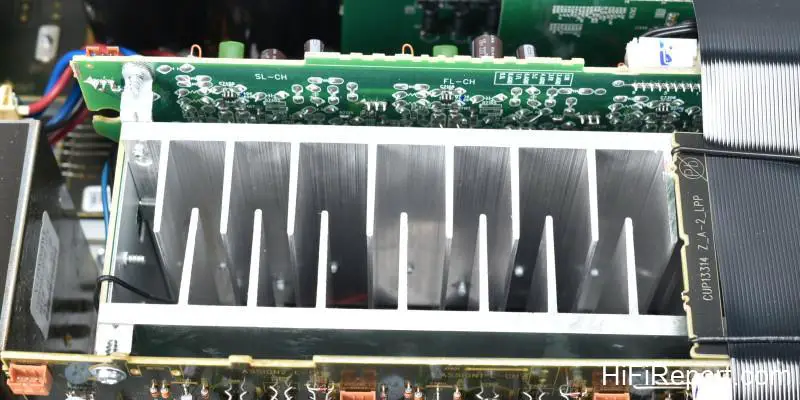
Finally, the Cinema 50’s power amplifier circuits are cleverly designed. Two circuit boards are mounted back-to-back, with a large heat sink in the center. Two fans at the bottom concentrate cooling for optimal heat dissipation. It features 6 pairs of discrete power transistors forming a Class A/B amplifier circuit, providing 110 watts per channel into 8 ohms and a robust 150 watts into 4 ohms (two channels driven). Both channel support and driving capability are superior to the Cinema 60.
Test Setup
For testing, we used the internal Pioneer Excellence series multi-channel speakers, with Monitor Audio in-ceiling speakers for the overhead channels. To showcase the Cinema 50’s subwoofer prowess, we specifically connected two SVS 15-inch subwoofers to create a 5.2.4 channel system. Last month, I reviewed the entry-level Cinema 60, and its refined, transparent sound quality was still fresh in my mind. This made me even more curious about what improvements this higher-end Cinema 50 would offer.
To my surprise, the actual listening experience was once again incredibly impressive!
Listening Impressions: General & Music
The most significant improvements in this unit are the increased sound density and the stillness of the audio background. For an AV receiver, this represents a fundamental upgrade in quality because a quiet background and richer details create a more vivid and lifelike presentation, whether for music or movies.
To fully showcase the unit’s audio capabilities, I first used a Magnetar UDP900 Blu-ray player as the source, playing the “John Williams in Vienna” live performance BD. Firstly, the Cinema 50’s soundstage is incredibly expansive, and the sense of space isn’t limited to horizontal expansion; you can distinctly hear height. The murmurs and conversations of the audience on each floor of the Vienna Musikverein Golden Hall are clearly discernible in terms of direction and distance.
Playing the second track, “Hedwig’s Theme,” the opening celesta sounds exceptionally transparent against a pitch-black background. The violin lines are full-bodied, and the hall ambience is full of luster. Every bow stroke conveys a clear, palpable sense of air. Even during the intense, high-register passages, the sound remains sweet and non-fatiguing.

Precise localization is also a strong point of the Cinema 50. Instruments have excellent separation, and the performance details of each section in the accompanying orchestra are very distinct. The low-frequency quality of this unit is superb. There’s no excessive peak energy masking details; whether it’s the deep string vibrations of the double bass or the elastic response of the timpani, everything is clearly articulated.
When encountering passages with massed strings, the sound is controlled and agile, completely free from any muddiness.
Listening Impressions: Movies
Next, I switched to using the unit’s eARC function, playing streaming content from a Sony A80J 4K OLED TV, replicating the most common user scenario. The Cinema 50’s neutral, precise, and analytical style is undoubtedly better suited for movie soundtracks than the Cinema 60. As expected, when I played the Netflix film “Extraction 2,” the unit delivered a reference-class interpretation of the train escape sequence! Several moments stood out.
Firstly, you can clearly feel the unit’s meticulous rendering of environmental sounds. As the protagonist moves in and out of the train, from the engulfing roar of the wind outside the carriage to the vacuum-like silence inside, you perceive subtle transitions in the soundstage. In one scene, during close-quarters combat at the carriage door, the protagonist narrowly avoids an oncoming tunnel wall. Here, you feel the solid wall whizzing past your side, sending shivers down your spine!
As the train enters the confined space of the tunnel, you feel the soundstage instantly shrink; that immersive sense of oppression is truly realistic.
With the four overhead channels working together, the Cinema 50 is even better at fully showcasing the three-dimensional audio advantage of Dolby Atmos. For instance, when the train overturns and flies off the tracks, following the perspective from inside the carriage with the protagonists, the listener is spun 360 degrees as the carriage rolls to the right. Scattered objects circle widely around you before crashing down.
From this, you notice the very distinct movement of audio objects and the seamless transitions between channels, resulting in such natural and impactful surround sound. Finally, this unit supports four subwoofer outputs, and initially, I worried about excessive bass when connecting the two giant SVS subwoofers we have. However, it completely exceeded my expectations.
After applying Audyssey MultEQ XT automatic room correction, the unit didn’t produce uncontrolled or boomy energy; instead, it delivered low frequencies with remarkable elasticity and lingering texture. In the film’s gun battle scenes, bullets whizzing back and forth are sharp and impactful.
During various explosions and bombardments, the instantaneous impact is quick and fierce, and even after the powerful dynamics, you can still hear the deep rumble of flames, showcasing the advantage of dual subwoofers to its fullest.
Conclusion
Compared to previous Marantz AV receiver models in the same class, this Cinema 50 not only shows a significant improvement in sound transparency and precision but also boasts a completely revitalized exterior, making it a true home theatre luxury item. If you’re navigating the sea of AV receivers and looking for one that perfectly balances specifications, sound quality, and design, I believe the Cinema 50 will not disappoint!
Specifications
* Design: 9.4 Channel AV Receiver
* Output Power: 110 watts per channel (8ohm), 150 watts per channel (4ohm)
* Supported Dolby Technologies: Dolby TrueHD, Dolby Atmos, Dolby Atmos Height Virtualization, Dolby Atmos Music, Dolby Surround
* Supported DTS Technologies: DTS HD Master, DTS:X, DTS Neural:X, DTS Virtual:X
* Supported Hi-Res Audio Files: 24bit/192kHz (FLAC, WAV, ALAC), DSD (2.8MHz/5.6MHz)
* Inputs/Outputs: HDMI Terminals 6 In / 3 Out (supports eARC), RCA Analog Audio Inputs x5, RCA Phono Input x1, Optical Audio Inputs x2, Digital Coaxial Audio Inputs x2, 11.4 Channel Pre-Outs x1, Speaker Terminals x11, 6.3mm Headphone Jack x1, USB Type-A x1, FM/AM Antenna x1, RJ45 x1, Remote Control In/Out x1
* Dimensions (W.H.D): 441 x 236 x 403mm
* Weight: 10.8 kg

- Sound Master tuned: Hand-tuned at Marantz’s legendary Shirakawa facility in Japan, CINEMA 50 delivers the warm, enveloping, picture-perfect sound that defines The Most Musical Sound
- Timeless design: Symmetrical, elegantly proportioned, and built with premium materials, CINEMA 50 is as refined in appearance as it is in performance
- Immersive audio: Dolby Atmos, DTS:X, IMAX Enhanced, and Auro-3D place you at the center of a three-dimensional sound experience that brings every scene to life
- Uncompromising power: With 9.4 channels and 110 W per channel, CINEMA 50 delivers the commanding dynamics and subtle nuance of a world-class home theater
- Effortless connectivity: Six 8K-compatible HDMI inputs plus analog, digital, and phono connections welcome virtually any source into your entertainment universe