
Marantz SR7012 Review
Introducing the SR7012, currently the highest-tier active surround sound receiver that Marantz offers in Taiwan. For several years now, any Marantz AVR with a “7” in its model number has signified their flagship product, and significantly, their flagship models have historically been more affordable than their competitors’. Looking purely at the specifications, the SR7012’s relatively lower price point is understandable.
Channel Configuration and Expandability
While many current top-tier models boast integrated 11-channel amplification for 11.2-channel systems, the SR7012 features built-in 9-channel amplification for a 9.2-channel setup. If your planned multi-channel system is designed for 5.1.4 or 7.1.2 channel speaker configurations, the SR7012 is an excellent fit.
Furthermore, its built-in surround decoding preamplifier circuit can handle up to 11.2 channels, meaning you can expand the system to 7.1.4 or even 7.2.4 channels simply by adding a two-channel power amplifier.
Aesthetic Design and External Features
For years, Marantz’s high-end surround sound receivers have maintained a consistent aesthetic, adhering to the “M-1 Design.” This design features a central panel crafted from aluminum alloy, flanked by curved sections made from FRP (Fiber-Reinforced Polymer). This combination of different materials with distinct resonant properties helps disperse resonant energy and effectively suppress vibration.
The SR7012 retains this elegant design, yet it incorporates new specifications and features that are more advanced than most current surround sound receivers on the market.
The unit’s HDMI input and output interfaces not only support 4K/60p video transmission but also feature a planned firmware update that will upgrade its Audio Return Channel to “eARC.” I anticipate that starting in January of this year, major first-tier television manufacturers will upgrade the HDMI inputs on their 2018 model 4K TVs to support eARC.
This will allow Dolby Atmos multi-channel audio (from certain content) to be sent back from the TV to the eARC-compatible SR7012, enabling users to enjoy genuine (not upmixed) three-dimensional sound when watching such online videos.
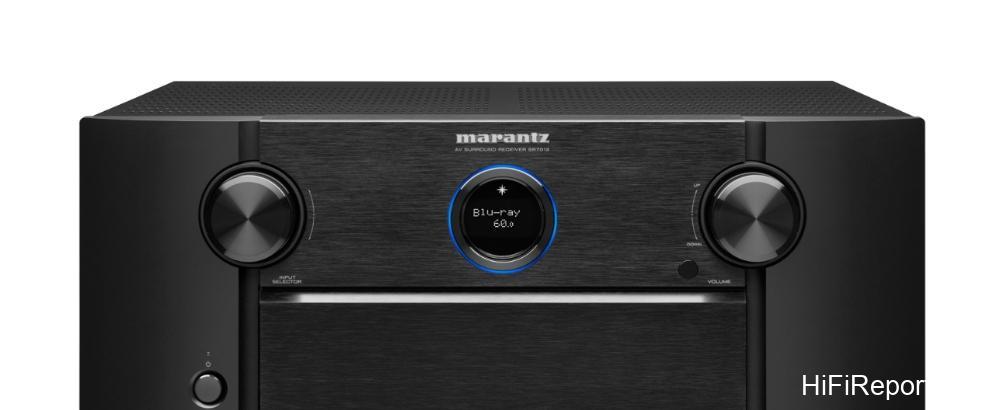
Another advanced feature is support for Amazon’s Alexa voice control, allowing you to operate the unit “by voice.” Unfortunately, the Alexa voice assistant does not currently support Chinese; it only understands and speaks English and Japanese. However, should Alexa ever learn Chinese, SR7012 owners could simply purchase an Amazon Echo device to enable this function, transforming the SR7012 into a “smart surround sound receiver.”
Audio Decoding and Network Capabilities
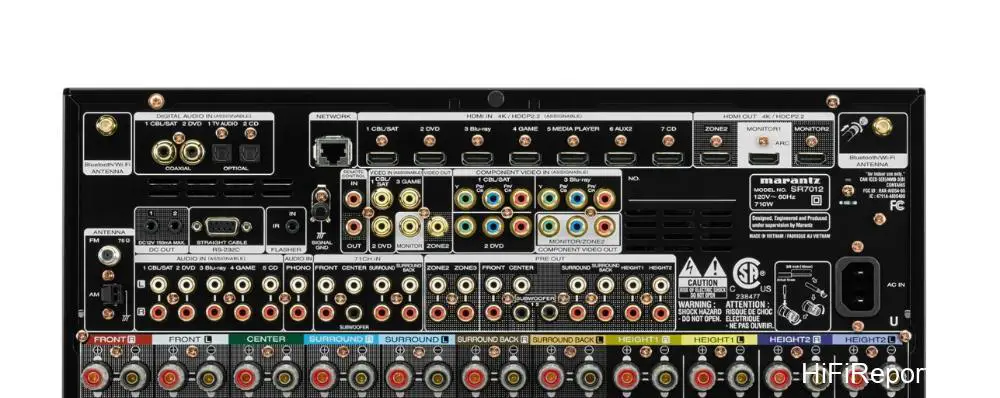
Beyond these advanced features, the SR7012 offers comprehensive multi-dimensional audio decoding capabilities, supporting not only DTS:X and Dolby Atmos but also incorporating Auro-3D decoding.
The unit features built-in Wi-Fi and Bluetooth. When connected to the internet, it can access tunein internet radio and Spotify, and it includes HEOS multi-room music streaming functionality. Via the network, it supports playback of music files from NAS drives, PCs, and mobile devices, including WMA, MP3, WAV, MPEG-4 AAC, FLAC, Apple Lossless, and DSD formats. Users can also connect a USB storage device to play music files stored on it.
The supported file types for USB storage playback are the same as those for network streaming. For multi-bit formats, the highest resolution supported is 192kHz/24bit, while DSD is compatible with DSF and DFF formats, supporting up to DSD128 (5.6MHz sampling).
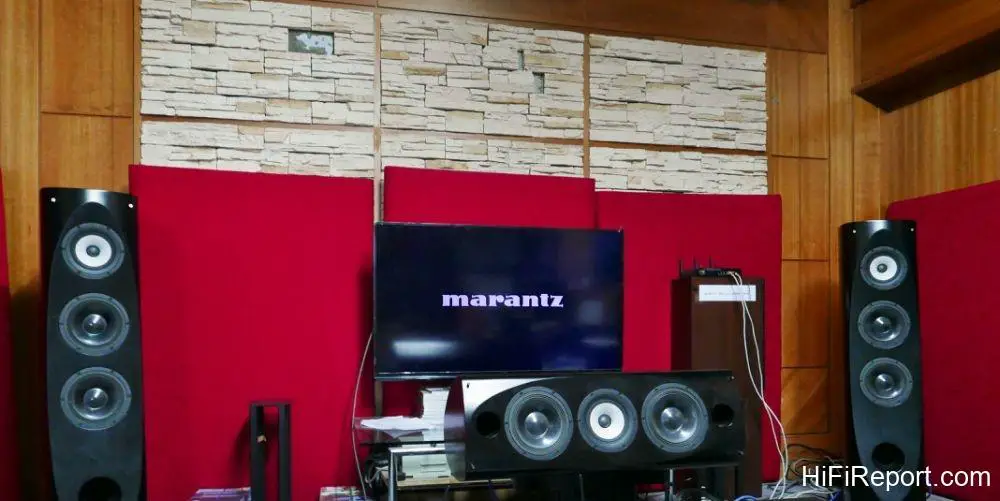
Although the official manual states that the unit supports USB devices formatted with FAT16/FAT32, my testing revealed that NTFS-formatted USB hard drives are also supported. When playing music files from a USB storage device this way, you can directly select tracks using the remote control (without needing to use a tablet or smartphone app), making it convenient even without a network connection at home.
The on-screen display (including album title, track title, and artist name) fully supports Chinese and Japanese characters without distortion.
Engineering Philosophy for Sound Quality
Marantz rarely elaborates on the design concepts behind their surround sound receivers, but enthusiasts know that this veteran audio company, with over 60 years of Hi-Fi manufacturing history, places a high priority on sound quality, especially musical performance. They possess both “soft skills” (years of accumulated tuning experience) and “hard skills” (original circuit designs and implementations).
Particularly during the development process of new products, engineers meticulously measure the strength of electromagnetic interference (EMI) and radio frequency interference (RFI) in various parts of the unit using instruments. This data informs the circuit layout and shielding design, with the goal of minimizing interference. Therefore, beyond circuit structure and tuning, “quietness” is undoubtedly one of the key factors contributing to the excellent sound quality of Marantz audio equipment.
Internal Architecture and Key Components
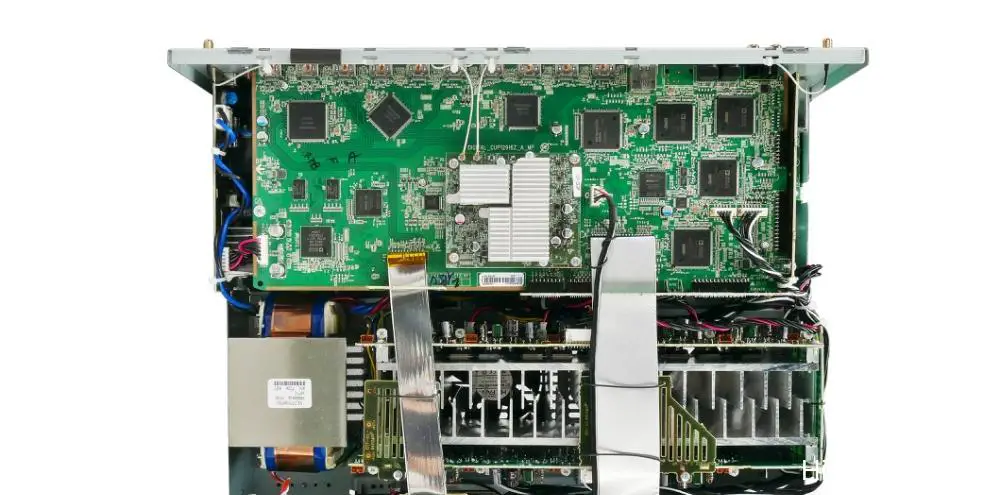
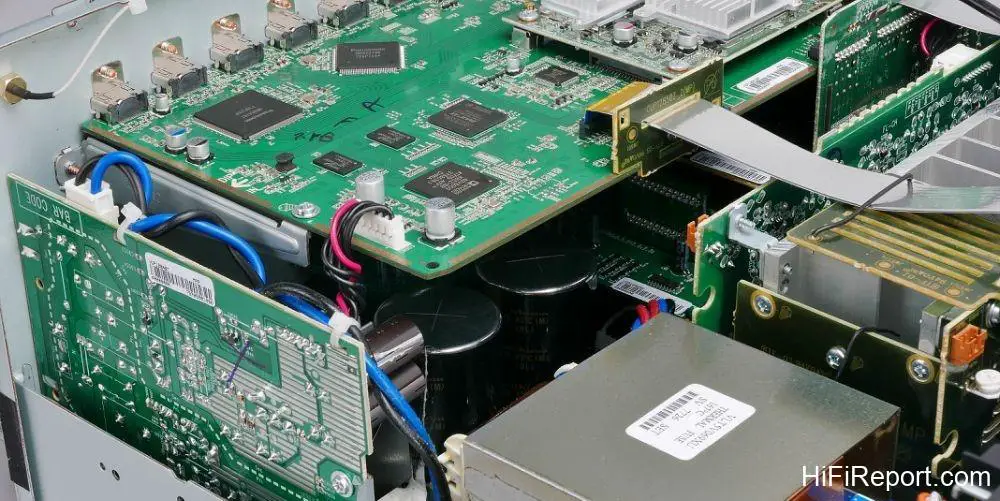
The internal circuit layout of the SR7012 is similar to most surround sound receivers, with the surround decoding preamplifier section located at the rear and the 9-channel power amplifier circuits positioned at the front. The main digital board is situated at the top of the preamplifier section. The HEOS wireless module, specifically designed for music streaming, is placed in the center of the main digital circuit board.
For multi-channel audio processing, the unit is equipped with four Analog Devices SHARC DSP chips, the ADSP21487. These chips provide powerful processing performance for multi-channel decoding and handle the highest level of Audyssey high-precision equalization, MultEQ XT32.

Typically, mid-range and lower-priced models house all DAC chips for every channel on the main digital board. High-end models, however, separate the digital-to-analog conversion circuitry used for the “main zone” onto a dedicated circuit board to reduce noise interference. The SR7012 follows this practice, but the installation location of the DAC board is different. Most high-end products mount this board horizontally below the main digital board.
The SR7012, in contrast, mounts the digital-to-analog conversion board vertically. Its upper end connects to the main digital board, and the lower end connects to the preamplifier audio circuit board, which handles source selection, volume control, and high-level amplification. This design effectively allows the digital-to-analog conversion board to “double as” a signal connection between circuit boards, shortening the signal transmission path.
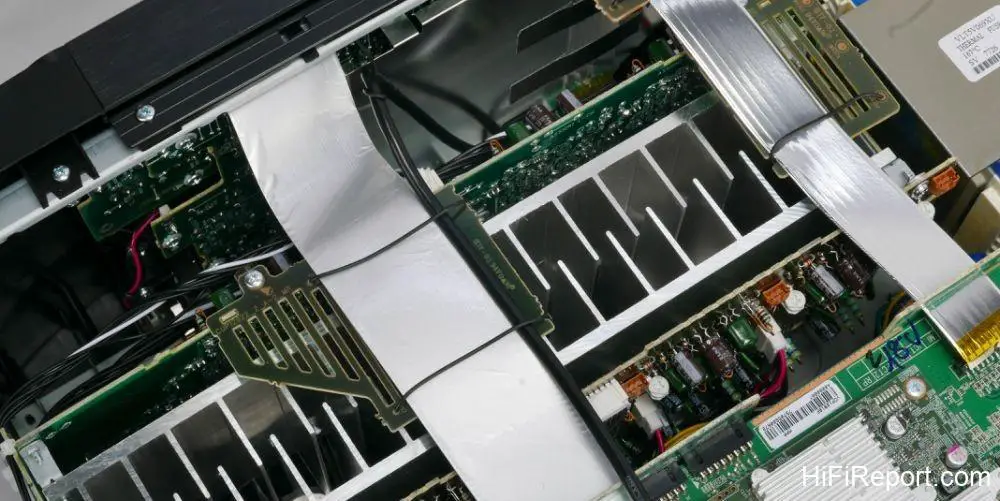
It also increases the distance between the small-signal circuits after the DAC and the main digital board, further reducing induced noise. In the digital-to-analog conversion section, the unit employs two AKM AK4458VN 32-bit 8-channel DAC chips, providing 13 channels, which is more than the 11.2 channels (.2 channels independent) required.
In the preamplifier section, the unit utilizes Marantz’s proprietary HDAM (High Dynamic Amplifier Module). This module is a transistor-based amplifier circuit composed of discrete SMD components. Its slew rate is approximately 10 times faster than typical audio operational amplifiers. Employing current negative feedback, it exhibits wide bandwidth characteristics, resulting in excellent high-frequency extension.
It’s clear that Marantz intends these design elements to give the unit an advantage in terms of “high-resolution performance.” In the power amplifier section, each channel’s output stage uses a pair of Darlington transistors (2SB1647/2SD2560) with a current output capability of 15 amperes in a push-pull configuration.
Listening Impressions: Music Performance
I began by testing with two-channel music files. First, I compared the Stereo mode (using 2.1 channel speakers) with the Pure Direct mode (using only the left and right Pioneer S-1EX floorstanding speakers). During this process, I could hear that the unit’s automatic subwoofer volume adjustment was moderate and appropriate, unlike many surround receivers that tend to excessively boost subwoofer levels. Therefore, listening to music in 2.1 channels felt well-balanced.
In Pure Direct mode, without assistance from the subwoofer for low-frequency reproduction, the unit drove the full frequency range through the Pioneer S-1EX speakers with a stable and full bass response. The high frequencies were brilliant, and the midrange was warm and finely textured. The natural flow and excellent musicality made it sound unlike a typical surround sound receiver; instead, it resembled a high-quality Hi-Fi amplifier.
While the SR7012 has strong speaker driving capability, it possesses a characteristic that most audio enthusiasts will notice: its background quietness surpasses that of many higher-priced models. When listening to music at comfortable or even lower volumes, the music still emerges gently and clearly. It is highly sensitive to the nuances of piano key pressure and the rich timbre variations produced by the touch of a violin bow on the strings.
The sound is clear, transparent, and lively, allowing you to distinctly hear the hall ambiance and subtle details within the recording space. There’s no need to push the volume; you can enjoy dynamic, clear music even at low listening levels. When playing Hi-Res music files with it, you can even more fully appreciate the realistic and beautiful timbre of instruments and voices.
Listening Impressions: Movie Performance
In terms of movie sound performance, the SR7012 undeniably delivers flagship-level performance. When playing action films with powerful output from the multi-channel speakers, it maintains excellent control and stability. It presents sound images clearly and precisely in three-dimensional space, with distinct positioning and movement from far to near and in all directions. Even the texture of the background score remains completely uncompromised.
I believe the SR7012 exhibits three main characteristics in its movie sound performance. First is a “clear visual sense.” The soundstage is transparent, wide, and deep, allowing me to easily “listen and discern location” and clearly hear the flight path of objects in the air, as well as “how close they are to me.” Passing sound effects are incredibly realistic. Second is its ability to resolve subtle sounds, especially when playing movies I am very familiar with.
Not only do you feel surrounded by subtle sounds throughout the space, but you can also clearly identify “what that sound is.”
The third and arguably most important characteristic is that it doesn’t need high volume to deliver dramatic movie sound. I personally find this crucial because installing a multi-channel system at home often requires considering whether you might disturb neighbors. It’s unlikely that you can “” (wildly showcase movie sound effects) with the high sound pressure levels that reviewers might use.
The SR7012’s exceptional quality lies in its ability to maintain full-frequency balance (remember to enable Dynamic EQ) when playing at neighbor-friendly, “gentle” volumes. Moreover, the details, texture, liveliness, and positioning and movement of sound images are almost identical to when played at high volume.
Conclusion and Recommendation
The SR7012 is currently the most affordable flagship-grade surround sound receiver. It offers broader compatibility with new formats and is packed with features. Its music performance is superior, and its unique ability to fully showcase movie sound and musical charm at volumes acceptable in residential areas is truly special. Based on its actual performance and price, I have decided to give it our highest recommendation.
Technical Specifications
* Type: 9.2 Channel Surround Receiver
* Power Amplifier Channel Count: 9 channels
* Processing Channel Count: 11.2 channels
* Power Output (per channel): 125 Watts (8 ohms)
* Maximum Mono Output Power: 235 Watts (6 ohms)
* Signal-to-Noise Ratio: 100 dB
* Frequency Response: 10Hz – 100kHz (+1,-3dB)
* Distortion: 0.005% (20Hz – 20kHz)
* HDMI Terminals: 8 In / 3 Out
* Composite Video Terminals: 4 In / 2 Out
* 3RCA Component Terminals: 3 In / 1 Out
* Two-Channel Audio Inputs: ×6
* Network Terminal: 1 set
* USB Terminal: 1 set
* Digital Audio Inputs: Optical ×2, Coaxial ×2
* 7.1 Channel Analog Input Terminal: 1 set
* Headphone Output Terminal: 1 set
* 13.2 Channel Preamplifier Signal Output Terminal: 1 set (maximum 11.2 channels simultaneous output in the main zone)
* 11 Channel Speaker Terminals (maximum 9 channels simultaneous output)
* Wi-Fi/Bluetooth Antenna Terminals: ×2
* FM/AM Antenna Terminals: 1 set each
* Dimensions (W×H×D): 440×185×411mm
* Weight: 14.2 kg