
Marten Mingus Septet Floorstanding Loudspeaker Review
Swedish high-end speaker manufacturer Marten was founded in 1998 and has been in operation for 25 years.
To commemorate their 25th anniversary, Marten unveiled the stunning new Mingus Septet loudspeaker at the 2023 Munich High End Show.
At the time, the sonic performance of the Mingus Septet deeply impressed visitors at the Marten exhibit. It’s said that Marten received over a dozen orders for the Mingus Septet directly at the show.
Due to the order backlog, it took some time for us to receive the Mingus Septet for review. Its official public debut was also at the December audio show.
Marten’s current product lineup consists of four series, ranging from high-end to entry-level: Coltrane, Mingus, Parker, and Oscar, each named after legendary jazz musicians John Coltrane, Charles Mingus, Charlie Parker, and Oscar Peterson, respectively.
Among these, the Mingus model has the longest history.
In 1998, Marten’s first product was named Mingus, a 2-way floorstanding speaker.
This model has remained in Marten’s catalog ever since.
In 2016, Marten launched the Mingus Quintet, using a quintet name, moving away from numerical designations and beginning a new chapter of “ensemble” naming conventions for Marten.
Subsequent series like Oscar and Parker continued to follow this naming logic.
Septet Aims for Orchestra-Level Performance
The Mingus Septet is positioned just below the Mingus Orchestra, the flagship of the Mingus series. However, Marten has even greater ambitions for it.
They aim for the Mingus Septet to achieve power and performance comparable to the Mingus Orchestra, but in a smaller cabinet size and with a more relaxed listening experience for the user.
“Based on many similarities with the Mingus Orchestra, it can deliver top-level playback performance without compromise.” In what aspects? Full frequency range, deep bass, and wide dynamic range.
These claims are prominently featured on Marten’s official website page for the Mingus Septet.
Pure Diamond Tweeter with Exceptional Stiffness-to-Weight Ratio
How is this achieved? The Mingus Septet, like the Mingus Orchestra, employs a four-way design.
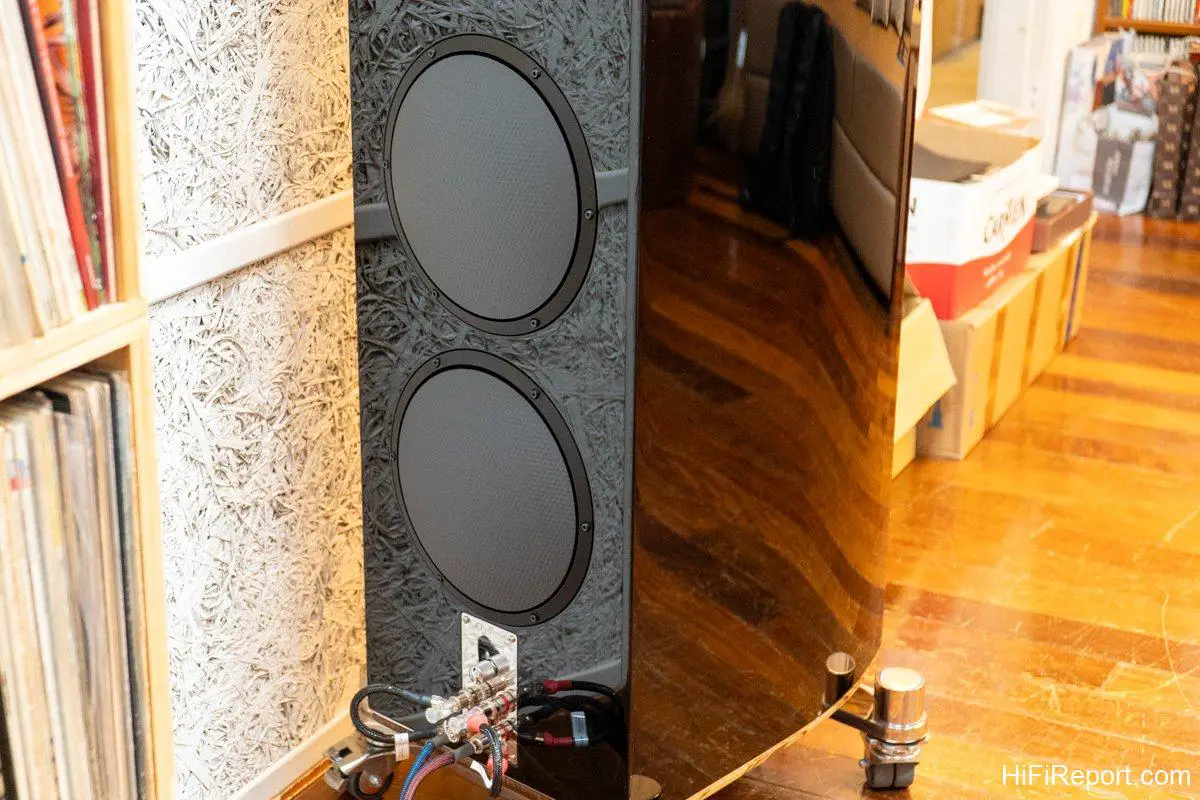
The “Septet,” meaning seven instruments, in the Mingus Septet refers to its seven drivers. Five drivers are front-firing, and two passive bass radiators are located at the rear, totaling seven units.
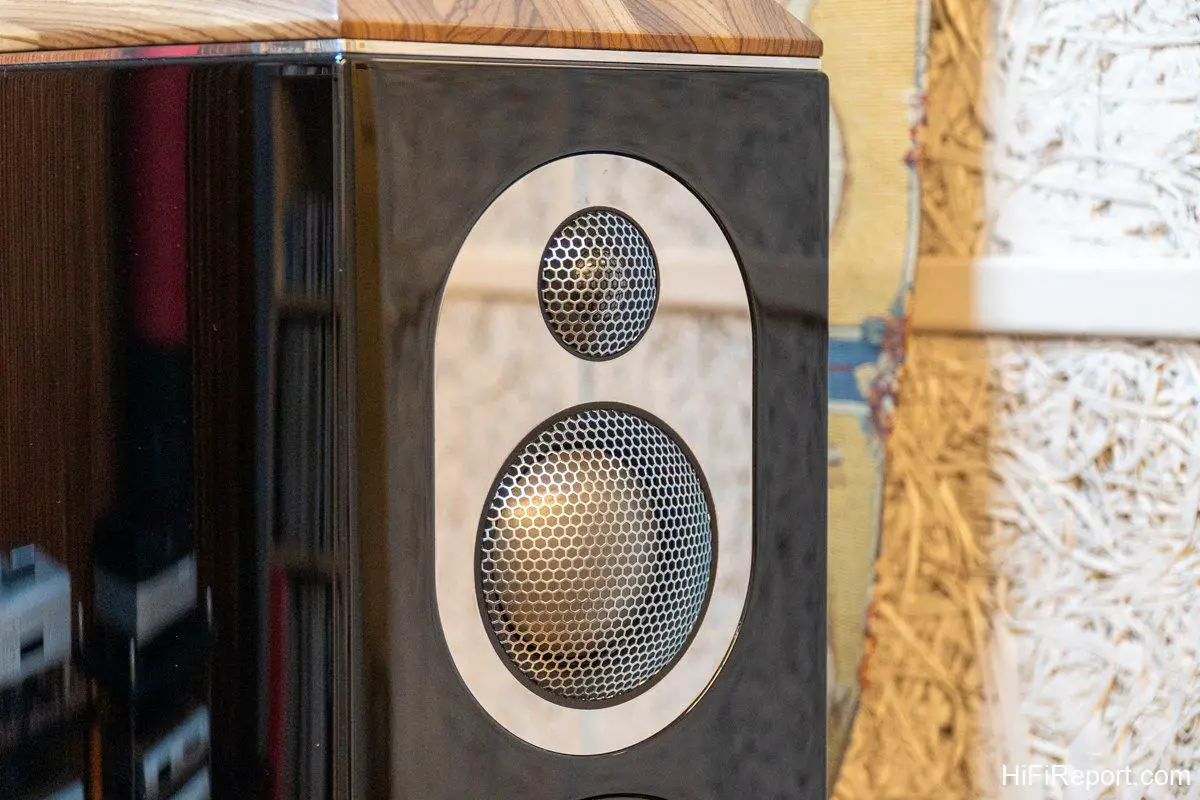
At the very top is a 1-inch pure diamond tweeter, responsible for frequencies above 6kHz, extending up to 40kHz.
The manufacturer states that this diamond diaphragm possesses an exceptional stiffness-to-weight ratio, requiring minimal current for drive while operating with agility, precision, and extremely low distortion.
Diamond itself has high heat dissipation efficiency, quickly dispersing heat generated by the voice coil’s movement. This prevents overheating and damage to the voice coil, even during high-volume operation.
Marten’s First Beryllium Mid-High Driver
The most distinctive feature of the Mingus Septet is its use of a 3-inch beryllium diaphragm mid-high driver.
In the past, Marten often used ceramic drivers in this position. The Mingus Septet is the first Marten speaker to utilize a beryllium mid-range driver.
What are the advantages of beryllium diaphragms? Firstly, they are very light, even lighter than ceramic, with a density one-third that of aluminum. Secondly, they are very rigid, harder than steel, making them less prone to unwanted resonances.
Based on these two characteristics—beryllium being both light and rigid—combined with excellent damping properties, beryllium diaphragms can reproduce a wide frequency response, especially clear and precise high-frequency information without distortion.
Furthermore, beryllium itself is a good conductor of heat and highly corrosion-resistant.
Therefore, it not only helps with voice coil heat dissipation but is also durable.
Marten has long desired to use beryllium diaphragms, and it finally came to fruition with the Mingus Septet.
This beryllium mid-high driver covers the crucial 800Hz to 6kHz range.
New Ceramic Mid-Woofer with Lower Distortion
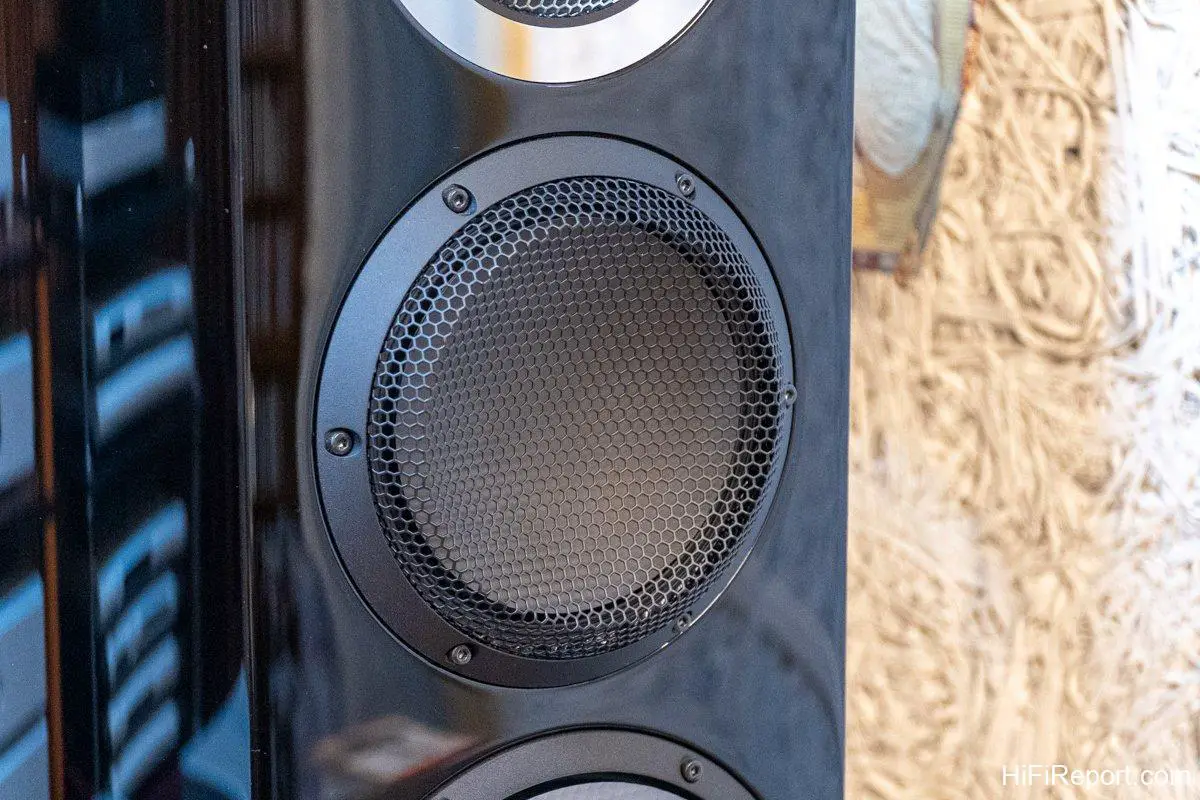
The 200Hz to 800Hz range, the lower midrange, is handled by a 7-inch ceramic mid-woofer.
Using ceramic drivers has always been a forte of Marten.
The ceramic mid-woofer used here employs a new manufacturing process, increasing the diaphragm’s internal damping, which helps to further reduce driver distortion and produce a cleaner sound.
Dual 8-inch Sandwich Cone Woofers with Dual 10-inch Passive Radiators
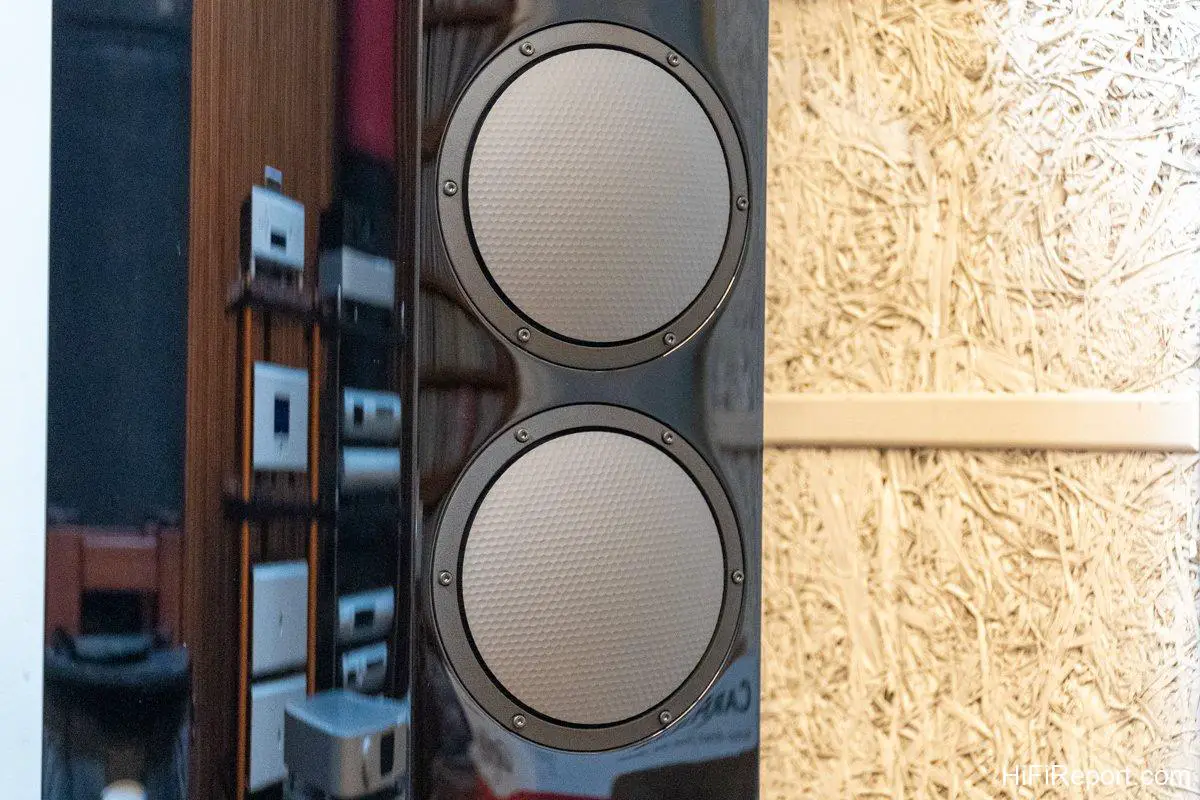
The two 8-inch convex cone woofers below feature a sandwich diaphragm of aluminum alloy and honeycomb structure, paired with a concealed surround design. They offer long excursion, high linearity, and extremely low distortion.
These two woofers cover the 45Hz to 200Hz range. Behind them are two passive radiators of the same structure but larger 10-inch size, used to enhance bass frequencies below 45Hz, reaching down to a remarkable 23Hz.
Considering this bass depth and the speaker’s cabinet volume, the Mingus Septet is truly impressive.
Crossover Components of the Highest Quality, Statement Internal Wiring Version Only
The coordination between drivers relies on the crossover.
It not only defines the operating range of each driver but also aligns their time phases to ensure temporal coherence.
When setting time alignment between speaker drivers, Marten doesn’t adhere to a fixed approach. Some of their speakers have a sloped-back design, while others are vertical without any backward tilt; the Mingus Septet falls into the latter category.
The crossover construction utilizes top-tier components. The manufacturer lists copper foil air-core inductors, silver-copper capacitors, custom-specified resistors, and Jorma Design internal speaker wiring.
It’s worth noting that while the Mingus Septet has a standard version and an upgraded version using Statement speaker cables, Soundray, the distributor, considering its sonic performance and price difference, decided to only import the Statement version, saving users the need for future upgrades.
Time Phase Coherent Design, Adjustable Bass Level
Ensuring time phase coherence among drivers is a key focus in the crossover design. Marten employs first-order crossovers, known for minimizing phase distortion.
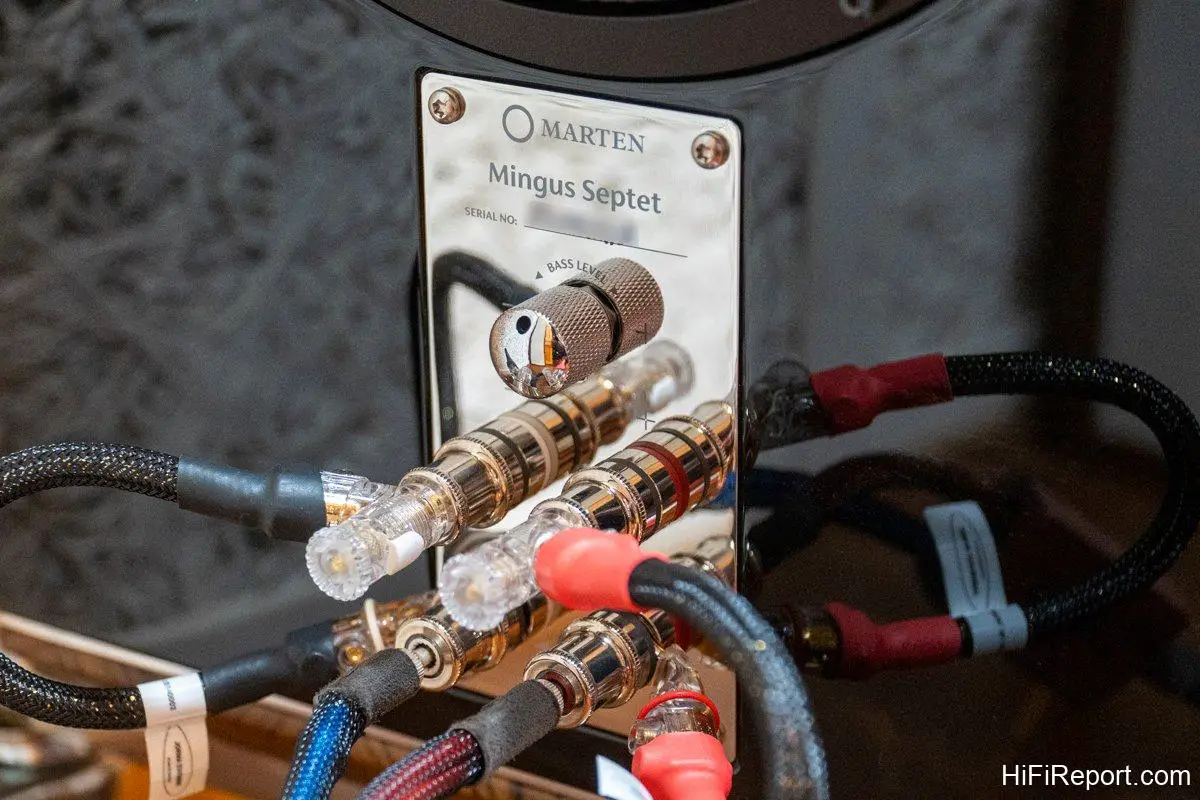
Additionally, on the rear speaker terminal panel, there’s a bass level adjustment knob, with 1dB increments, allowing for +/- 2dB fine-tuning of the bass.
This gives the Mingus Septet greater adaptability to rooms with different acoustic characteristics. Users can also adjust according to their sound preferences, making it a practical and appealing feature.
Black Piano Lacquer Cabinet with Structural Reinforcement and Solid Wood Accents, Substance and Style
Beyond drivers and crossovers, the third essential element of speaker performance is the cabinet. Without a speaker cabinet, even the best drivers are futile (how many families can tolerate large baffles in their homes?).
Marten designs speaker cabinets with two goals: to provide optimal acoustic support and to achieve exquisite and beautiful aesthetics, offering both substance and style.
Let’s first discuss substance.
The Mingus Septet’s cabinet is made of specially selected, high-rigidity medium-density fiberboard (MDF). The thickness varies depending on location, with 25mm thickness in areas with less vibration and 40mm thickness where higher damping is needed.
The cabinet sides are curved, giving the Mingus Septet a front-narrow, rear-wide profile, reducing parallel surfaces and minimizing internal standing waves.
For structural reinforcement, internal bracing is incorporated to enhance cabinet rigidity and resonance damping.
Stability is increased by extended stainless steel outriggers at the base.
Marten speaker feet are unique. They collaborated with Canadian isolation material manufacturer IsoAcoustics to develop Marten-exclusive feet.
IsoAcoustics’ isolation materials have been scientifically proven effective through experiments at the National Research Council Canada.
This scientific validation has propelled them to prominence in the isolation market, with more and more audio manufacturers seeking their expertise in designing isolation solutions.
Marten can be considered visionary, having partnered with IsoAcoustics early on, making them a pioneer in the home high-end audio realm.
Now, let’s talk about style.
Marten speakers have always been renowned for their exquisite craftsmanship. For the Mingus Septet, priced over 100,000 Euros, the aesthetics are naturally refined.
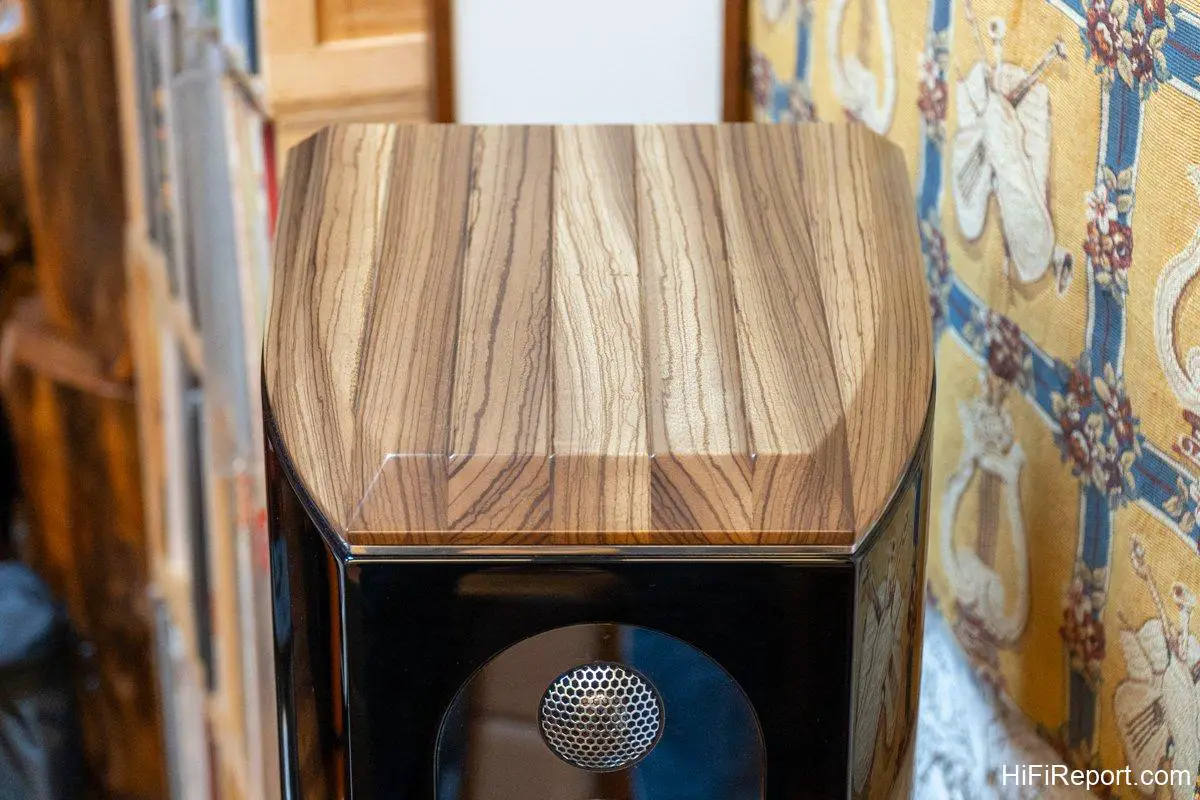
The main cabinet body is finished in black piano lacquer, a mirror-like gloss achieved through seven layers of lacquer, each layer hand-polished, representing authentic and meticulous piano lacquer craftsmanship.
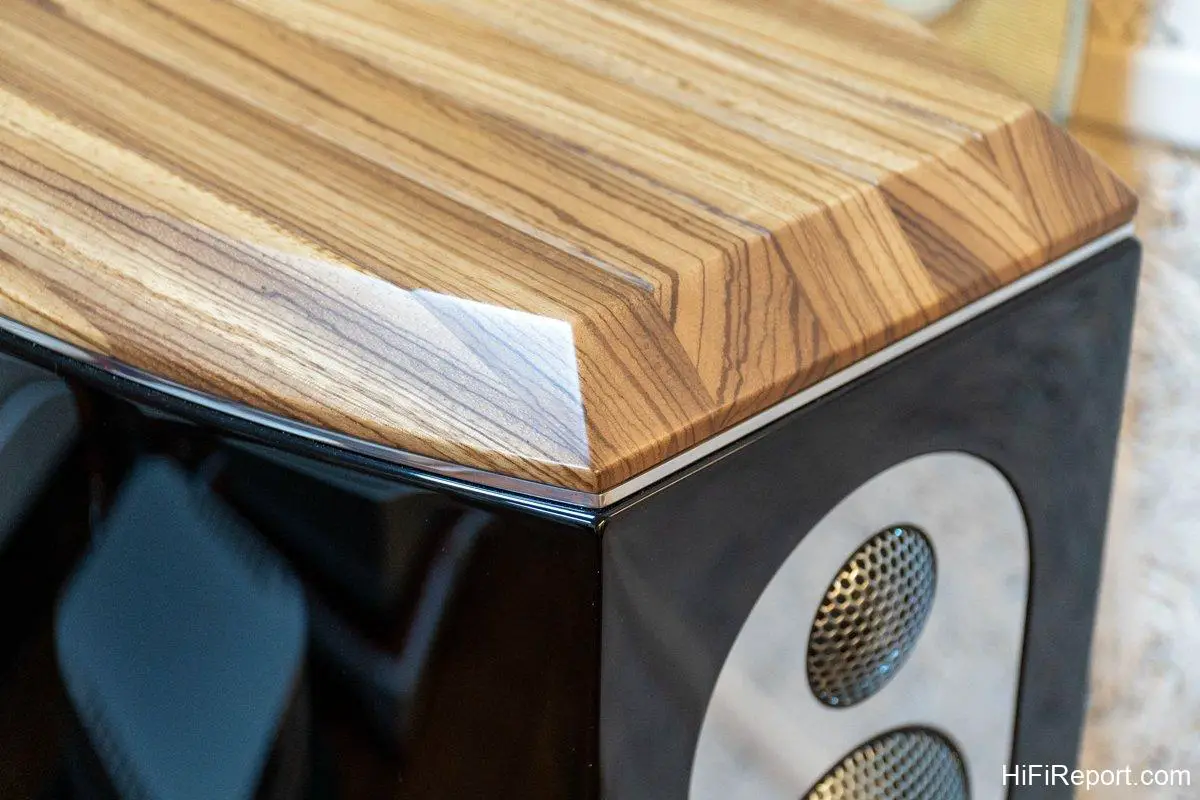
The top and bottom of the speaker feature thick solid wood accents, seamlessly integrated with the main cabinet and accented by a metal trim piece.
This accent panel is available in seven options: Zebrawood, Oak, Black, Dark Grey, Gold, Red, and Purple.
Users can choose the most suitable color to match their home decor, showcasing their personal style.
Furthermore, these two accent panels are thick enough to provide considerable resonance damping to the cabinet.
Additionally, the cabinet features multiple metal accents, including around the mid-high drivers, the nameplate below the front baffle, and the speaker terminal panel trim, all with mirror-polished finish that is truly admirable.
Overall, the Mingus Septet’s cabinet delivers both substance and style in abundance.
Near-Field Listening Magic, MSB Discrete DAC: A Surprising Pairing
I initially thought Mr. Chang would arrange for me to audition the Mingus Septet at a dealership.
Even though the Mingus Septet doesn’t look particularly large, its sound energy is substantial, requiring ample space to unfold.
Soundray’s listening room is roughly the size of a typical home living room, about 4 to 5 pings (approx. 140-175 sq ft). Would auditioning the Mingus Septet here be too small? Since I was already there, I decided to see what setup Soundray had prepared.
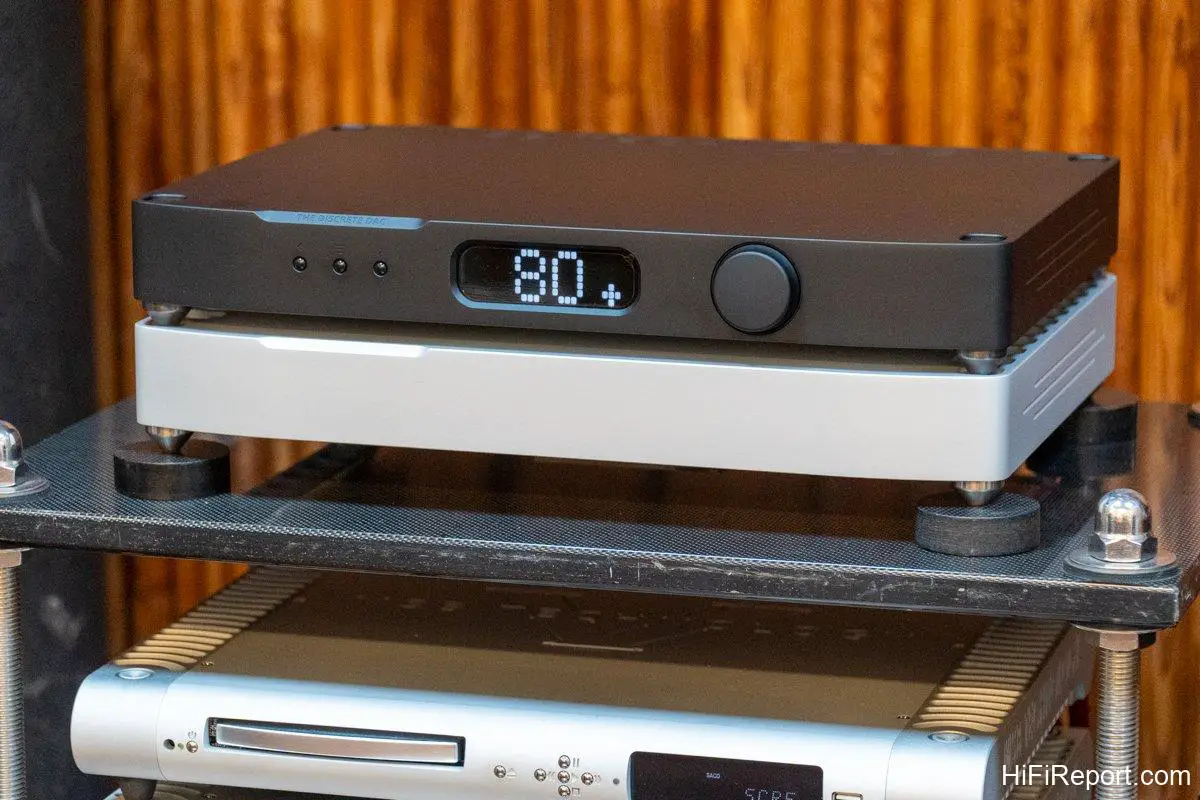
Unexpectedly, the system pairing was also surprising. I had anticipated that for the Mingus series, they would likely use the MSB Reference DAC. However, this time they opted for the Discrete DAC with the Premier Digital Director as the source and preamplifier.
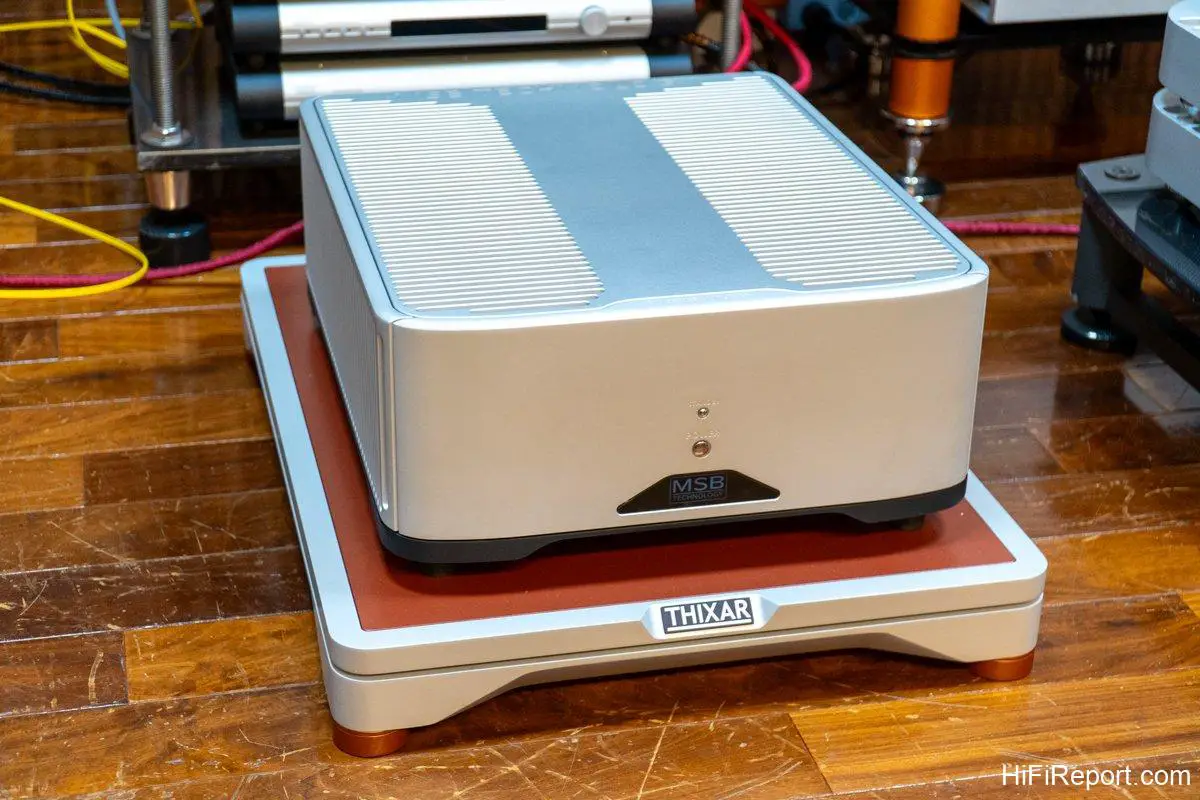
Bo Yun informed me that the MSB Reference DAC used for demonstration had recently encountered some issues. They initially considered canceling my visit, but then tried using the Discrete DAC paired with the Premier Digital Director running Roon streaming, powered by the MSB S202 stereo power amplifier. To their surprise, the sound was quite good, so they proceeded with the plan.
This shows how capable the MSB’s “entry-level” Discrete DAC truly is, handling even “above-its-class” pairings with ease.
Last year at the Munich High End Show was my first encounter with the Mingus Septet. I was seated on the side, and also busy taking photos, so my listening wasn’t ideal.
At the December audio show, we met again, but I was similarly occupied with interviews and couldn’t listen properly.
This visit to Soundray was specifically for auditioning, finally allowing me to fully appreciate it.
Soundray’s listening room is much smaller, with sound-absorbing treatment on the walls and ceiling. With near-field placement, my listening position was even closer to the speakers than the distance between the left and right channels. Toe-in was used to achieve focus.
While I couldn’t experience the Mingus Septet’s grand scale like in the Munich show, this near-field listening allowed me to better appreciate its sonic texture.
Although the speakers were almost against the side walls, they were about 2.5 meters away from the back wall, allowing the soundstage depth to unfold.
Placing speakers in such a limited space is a skill Mr. Chang has honed over decades.
Equipment is inanimate, space is inanimate, but people are adaptable, and techniques are flexible.
The Color, the Layering, the Weight – Simply Brilliant
Listening to Myung-Whun Chung conducting the Orchestre de l’Opéra Bastille in Saint-Saëns’ Symphony No. 3, the opening of the first movement, with its dreamy interplay of strings and woodwinds, was beautifully delicate and nimble, like ethereal music.
When the lower strings emerged, the Mingus Septet effortlessly delivered elastic and spacious low frequencies.
I dared not increase the volume too much. Although bass traps were installed, in this limited space, pushing the volume would cause the bass to overwhelm the room.
Restraint was necessary. I resisted the urge to turn up the volume. The Discrete DAC’s volume at 87 was, in my opinion, the limit for this piece in this listening environment. Any louder, and the overwhelming bass would mask other information, disrupting the overall balance.
The Adagio section in the latter half of the first movement, as rendered by the Mingus Septet, was unbelievably beautiful.
The organ’s bass was deep and resonant, reaching profound depths, almost ethereal, like enveloping air or swirling mist.
The Mingus Septet’s ability to depict sonic texture is exceptional. The string sound was both supple and delicate, with a beautiful sheen, like the sunburst finish on a watch dial, shimmering and shifting with the light, imbued with vibrant life.
Sometimes, it’s not necessary to play at high volumes. In near-field listening like this, one can discern more musical information, appreciate the inherent refinement of the sound.
In the second movement’s Allegro moderato, the complex orchestration was clear and layered, with distinct individual instruments.
The woodwinds, taking turns to shine, each had clear texture and timbre, with precise localization and well-defined images.
The music unfolded layer by layer, revealing all the secrets within the kaleidoscope.
The latter part of the movement was solemn and magnificent. The organ entered with a powerful presence. I longed to turn up the volume, but it wasn’t feasible at the moment. At the current volume, the bass was already slightly boomy.
I suddenly remembered the bass adjustment knob on the Mingus Septet’s rear panel. I turned the bass down two notches towards the “-” direction. Indeed, the bass instantly became cleaner.
The bass remained full but also revealed layers of detail.
And so, I let Myung-Whun Chung and the Orchestre de l’Opéra Bastille play through the entire movement.
The color, the layering, the weight – simply brilliant.
Astonishing Density, Healthy Thickness, Full Dynamics, Vividly Recreating Live Performance
A single piece, Saint-Saëns’ Organ Symphony, already clearly demonstrated many of the Mingus Septet’s strengths.
Switching to a simpler piano and violin duet showcased different aspects of its excellence.
Take “Tango, Song and Dance” by Anne-Sophie Mutter and Andre Previn, for example. The violin and piano tones were focused, dense, and solid.
Played through the Mingus Septet, the sonic density of the violin and piano was truly impressive.
It’s not just about “thickness,” but also “density,” like fabric. You can distinguish between thick and thin fabrics, and also the thread count.
Applying this to sound description, the former is “thickness,” the latter is “density.”
The Mingus Septet’s sonic density is top-tier. At this point, I finally grasped how remarkable the Accuton beryllium midrange driver is.
High density, yet with a balanced and appropriate thickness, gives the sound considerable agility. It doesn’t become sluggish or overly thick, nor does it become hollow and insubstantial in pursuit of liveliness.
This sonic thickness is very healthy, making the music sound very real.
On another note, Marten speakers often employ drivers with high-rigidity diaphragm materials, yet the sound is not hard. Instead, it offers an extremely high degree of realism.
The higher the Marten speaker model, the more pronounced this characteristic becomes.
Regarding realism, I want to add another point.
Healthy sonic thickness alone isn’t enough to achieve realism; other conditions are necessary.
The Mingus Septet can accurately reproduce the inherent timbre of instruments. I could perceive bright luster and color, observe sharp lines and clear shapes, and sense the layers of light and shadow and three-dimensionality.
This experience is akin to watching a high-brightness, high-resolution OLED TV or laser projector, which faithfully restores the texture, color, layering, and lines of the video. The Mingus Septet, in the realm of sound, recreates a live performance.
Furthermore, dynamic performance is crucial.
Even in a simple duet, there’s a wealth of emotion in the music. Musicians create emotional fluctuations and musical tension through changes in tempo and intensity.
We wouldn’t say music from a built-in phone speaker sounds real because it lacks dynamics and bandwidth.
However, when a sound system can deliver a full frequency response and completely reproduce the dynamics of music, it’s not far from reality.
Listening to the violin’s passionate expressions, the piano’s grounded weight, the dialogue between the duet, and the emotions they convey in different movements, titles, and tempos.
These elements combined inevitably lead to truth, goodness, and beauty.
Transparent and Balanced Sound
Listening to Schubert’s Trout Quintet, performed by Renaud Capuçon and a group of French musicians, I reached the same conclusions and discovered even more.
In this piano quintet, Schubert replaced a violin with a double bass, broadening the music’s frequency range. The richness and fullness of the bass added to the music’s weight.
At this point, the Mingus Septet had already attenuated the bass by 2dB. Yet, in Soundray’s listening room, the fullness and weight of the double bass didn’t sound “discounted” at all.
This Virgin recording is actually very balanced and transparent. My listening experience on many systems is that transparency is audible, but balance is not always guaranteed.
On bookshelf speakers or systems lacking bass, the double bass, lacking thickness and weight, fails to build a complete musical architecture.
Without a foundation, a house cannot be built firmly. Without bending the knees, how can one jump high? The transparent nature of this album also highlighted the Mingus Septet’s excellence in layering and transparency.
I’ve mentioned its full bass and emphasized the weight of its musical notes more than once. However, its balance lies in the fact that these qualities do not hinder its ability to present a transparent, see-through soundstage.
The quintet instrumentation is not large, but it enriches the sonic colors and musical arrangement considerably.
Listening to the instruments taking turns, each representing its own essence, constructing a story-filled scene, and narrating a scene-filled story.
Superb Piano Reproduction, Revealing So Much
The piano’s sound production mechanism is complex. Keys activate hammers, striking strings to vibrate and produce sound. Additionally, pedals mechanically alter the timbre.
As the king of instruments, piano recordings are a major test for audio systems.
Ordinary Hi-Fi systems can, of course, play piano music, but piano recordings reproduced through high-end audio systems are simply different.
The Mingus Septet, though not particularly large, at most categorized as a mid-sized floorstanding speaker, possesses a sense of scale that exceeds expectations.
The manufacturer claims they aim for the Mingus Septet to approach the level of the Mingus Orchestra. I believe this is not just marketing hype, but a serious statement.
Take Ivo Pogorelich’s performance of Mussorgsky’s “Pictures at an Exhibition,” for example. Pogorelich sculpts the timbre, imbuing this work, which uses sound to depict paintings, with philosophical depth.
The “Promenade” sections reveal full piano tones. Whether powerful playing in the mid-high range or chordal textures in the low register, the piano sound is weighty.
As for “The Old Castle,” a personal favorite, there are countless details. The realism of the piano tone and the imagery of the performance are all clearly conveyed.
Listening to Pogorelich create rich timbres through touch and dynamic control is truly magical! In “Bydło” (Cattle), the low-frequency chords, combined with the melodic chords, sing a sorrowful and mournful duet, yearning for freedom yet powerless to break free.
Listening to “Catacombs (Sepulcrum romanum)” a variation of “Promenade,” the heavy low-frequency chords in the left hand contrast sharply with the incessant sixteenth notes in the right hand, creating layers of tonal color through tempo and dynamics.
“The Hut on Hen’s Legs (Baba Yaga)” is full of powerful fortissimo playing, paired with dazzling right-hand arpeggios – truly magical! Not only is the music magical, but Pogorelich’s performance is also magical, and the Mingus Septet’s reproduction is even more miraculous.
Transitioning from this piece to “The Great Gate of Kiev,” Pogorelich first leads the ending of “Baba Yaga” to an intense and glorious climax. After a brief pause, the magnificent image of the Kiev Gate emerges.
That magnificent gate is not merely material, but also carries an unseen historical legacy. Pogorelich changes his tone and timbre in this piece, like standing at the gate telling a story.
How much have you heard in this piece? How much have you heard in Pogorelich’s “Pictures at an Exhibition”? You should listen to it through the Mingus Septet.
Playing Jazz, Lively and Fresh
Jazz is a must-listen genre for Marten speakers.
Owner Leif Oloffson himself is a jazz enthusiast, which is why he names his speakers after jazz masters.
Charles Mingus’ 1959 album “Mingus Ah Um” is a post-bop masterpiece. “Better Git It in Your Soul” has a simple, memorable, and easily understood melody running throughout. The drum set performance is a highlight, the full and weighty bass is also a key player, and the improvisational shouts add further interest to the piece.
“Goodbye Pork Pie Hat,” already a standard, features warm and mellow saxophone, with astonishingly rapid short note playing technique in the middle section.
As for “Jelly Roll,” a playful interpretation of Jelly Roll Morton’s musical style.
Listening to the saxophone and drums in this track, the 1959 analog recording sounds surprisingly vibrant.
In “Fables of Faubus,” the bass is weighty and deep, the saxophone mellow and warm. This is Mingus’ famous political satire. The later addition of alto saxophone and trombone fully reveals the satirical intent of this piece.
Despite the recording’s age, the reproduced music is so lively and fresh. It’s no exaggeration to say Marten speakers are born for jazz.
Hearing the Briskness of Bebop Piano, and Modern Precision
Ahmad Jamal’s 1992 live performance in Paris, in the track “The Tube,” features a continuous bass line, steady drum rhythms, and piano melodies bursting with passion.
Then, a bass solo takes over, with the piano engaging in a fitting dialogue, before reclaiming the musical conversation.
This brilliant exchange of solos prompts applause from the live audience.
The medley performance is equally captivating. The piano enters with a bright and lighthearted presence. Ahmad Jamal, deeply influenced by the bebop era, is himself a master who inherited the bebop spirit. However, he also incorporates many modern jazz cool-style elements into his music. Between warmth and coolness, he creates a more solid and profound musical style.
This medley solo, reproduced by the Mingus Septet, is nothing short of brilliant.
The bright piano timbre, the solid yet nimble notes, are all beautiful, all deserving of praise for this truly remarkable mid-high frequency performance.
As for Duke Ellington’s famous “Caravan,” reinterpreted by Ahmad Jamal, it becomes even more vibrant and colorful. Not only are the piano timbres richer and more vivid, but the lively rhythmic support of the drums and bass further enhances the inherently energetic piece, making it sound radiant and bursting with vitality.
Meticulously Reproducing Vocal Characteristics, Every Detail Noticeable
Does it handle rock? Yes! Pop? Yes! The “A Star Is Born” soundtrack proves it.
Bradley Cooper’s concert opening in the movie, “Black Eyes,” features heavy electric bass, solid and weighty drums, and electric guitar with colorful and bright sounds. Bradley Cooper’s somewhat (cāngsāng – vicissitudes of life, weathered) vocals, filled with magnetism, call out, “Everybody’s waiting for you…”
The expansive sense of space is largely recreated within this small room, conveying the live atmosphere.
Lady Gaga’s rendition of “La Vie en rose” is not only powerful but even piercing. The Mingus Septet, in reproducing vocals, can meticulously capture vocal characteristics, with clear and defined image outlines, and every detail noticeable.
In “Out of Time,” the drumstick strikes are crisp and solid, full of realism.
Combined with electric guitar and electric bass, and later the addition of the bass drum, along with live audience noise, both the music itself and the added sound effects provide a lively live atmosphere.
The song unfolds in “Alibi.” The drums are truly memorable – heavy, weighty, full, and impactful, as if determined to knock down every listener, fierce and relentless.
“Shallow” features acoustic guitar and vocals with a touch of delay, perfectly capturing the live concert feel.
The Mingus Septet allows you to appreciate not only the beauty in the music but also perceive the truth in the recording.
In “Before I Cry,” the electronic drums are even heavier and fuller than real drums. However, I want to emphasize Lady Gaga’s vocals even more – a voice full of power and healthy thickness.
As for “I’ll Never Love Again,” the focused, full vocals make Lady Gaga’s voice as clear and prominent as if illuminated by a spotlight and then focused by a camera lens.
Here, too, are heavy drums, this time beating not just the rhythm of the song, but Ally’s inner heart.
Just as the chorus reaches its climax, strings join in, thickening and enriching the accompaniment. Emotions reach their peak. Subsequently, the music and scene shift to when Jack was still alive.
The expansive musical scene instantly shrinks to a central point. The terminally ill Jack sings a new song, while Ally beside him is heartbroken yet content – heartbroken for her lover’s terminal illness, yet content with their profound love.
Becoming a New Reference Point in Listening Memory
Listening to this point, I was both satisfied and melancholic.
The sound was simply brilliant.
Due to space limitations, I couldn’t fully experience the Mingus Septet’s full potential. However, this near-field listening experience in a small room will become a new reference point in my memory.
The Mingus Septet’s sonic performance is truly comprehensive. Whether it’s timbre, sonic texture, density, dynamics, layering, or soundstage presentation, it achieves extremely high standards.
I later told Mr. Chang that this was the most expensive Marten speaker I had ever heard in Soundray’s listening room. The texture of this mid-high range was something I had never experienced here before.
This entire afternoon of listening was deeply satisfying.
Why melancholic? Firstly, I had to leave. Secondly, the Mingus Septet was beyond my reach. This afternoon will be our only encounter. How could I not feel melancholic?
Specifications
* Type: 4-way 7-driver bass-reflex floorstanding loudspeaker
* Drivers (front): 4 x 8-inch aluminum sandwich cone woofers, 1 x 7-inch ceramic mid-woofer, 1 x 3-inch beryllium diaphragm mid-high driver, 1 x 1-inch diamond tweeter
* Drivers (rear): 2 x 10-inch aluminum sandwich cone passive radiators
* Frequency Response: 23 Hz ~ 40 kHz (+/-2dB)
* Sensitivity: 88dB/1m/2.83V
* Impedance: 4 ohms (minimum 2.7 ohms)
* Crossover Frequencies: First order, 200Hz, 800Hz, 6000 Hz
* Terminals: WBT Nextgen Bi-wire
* Internal Wiring: Jorma Design (Sales version internal wiring is Jorma Design Statement)
* Dimensions: 335 x 1260 x 460 mm (WxHxD)
* Weight: 95 kg