
McIntosh XRT 1.1K Review
In July 2018, in issue 358 of Audio Art magazine, I reviewed the McIntosh XRT 2.1K loudspeakers. To my surprise, the McIntosh XRT 1.1K speakers were delivered to my home just a few months later, by the end of 2018. McIntosh certainly releases new speakers quickly, and their local distributor is just as swift in importing and sending them out for review.
McIntosh Speaker Design Philosophy
If you’ve ever delved into the design lineage of the XRT 1.1K, you’ll realize that McIntosh’s speaker design philosophy is vastly different from the norm. Most speaker manufacturers might believe fewer drivers are better, ideally a full-range single driver. However, McIntosh established its multi-driver design thinking very early on, using perhaps even over 70 drivers in a single speaker. While most speaker companies design point-source speakers, McIntosh is renowned for its line-source designs.
Traditional speakers often use paper, PP, ceramic, or metal diaphragms, but McIntosh speakers have recently favored metal and carbon fiber diaphragms. Midrange drivers typically range from 4 to 8 inches, but McIntosh employs 2-inch or 2.5-inch units. Furthermore, most speakers are two-way or three-way designs, whereas McIntosh frequently utilizes four-way or even five-way configurations.
With so many distinctive characteristics, could McIntosh be designing speakers this way merely for showmanship? Absolutely not! McIntosh has its own anechoic chamber at their factory and officially launched speaker products back in the 1970s. It’s just that for many years, most people focused on their amplifiers, overlooking the excellence of their speaker designs.
Appearance and Physical Features
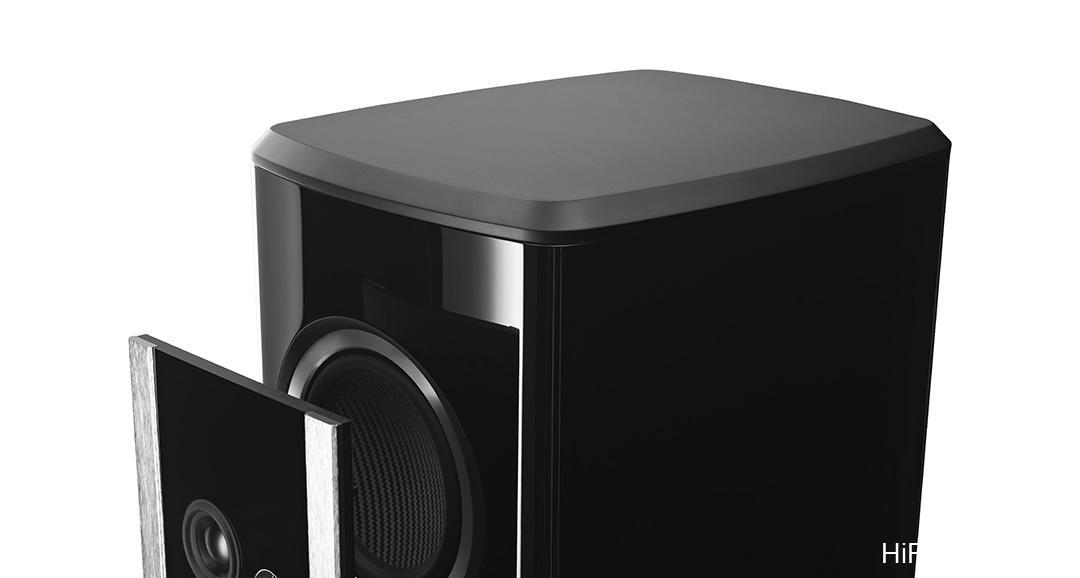
When I wrote about the XRT 2.1K previously, I analyzed McIntosh’s speaker design philosophy. Now, let’s revisit the advantages of McIntosh’s speaker design with the XRT 1.1K. The XRT 1.1K inherits its appearance from the XRT 2.1K, featuring an Italian design with a tall, slender cabinet finished in premium seven-layer piano lacquer and metal trim, creating a visually elegant effect.
Unlike the XRT 2.1K, where the mid-bass drivers are located in the middle section and angled sharply inwards, the XRT 1.1K’s mid-bass drivers project forward like the bass drivers.
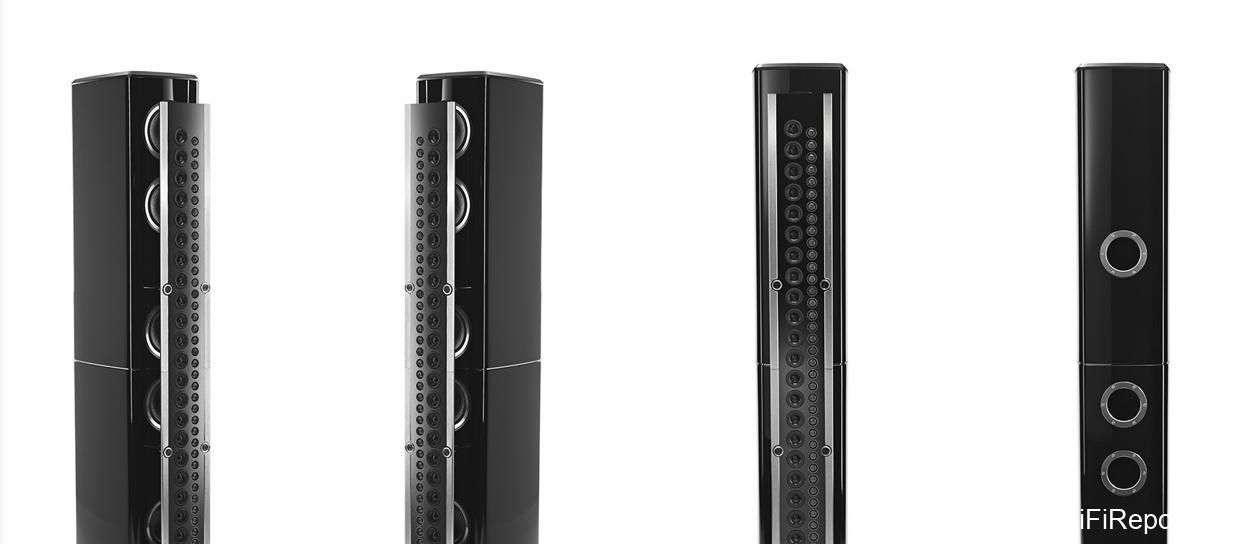
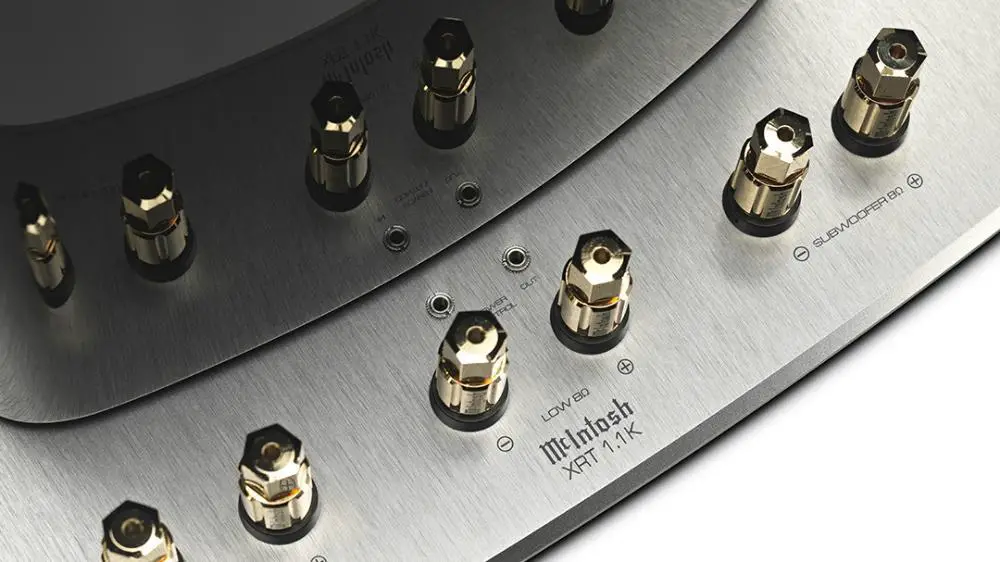
On the rear panel, you’ll find three reflex ports: one at the top for the mid-bass drivers and two below for the bass drivers. Given the XRT 1.1K’s tall and narrow cabinet, a large base is essential for stability. The XRT 1.1K is equipped with three sets of speaker terminals for tri-wiring, a feature less common than the typical bi-wire design, marking another distinction of the XRT 1.1K.
Completely Different from the Previous Generation 1K
The predecessor to the XRT 1.1K was the XRT 1K. So, what exactly does that “.1” signify compared to the 1K? Aesthetically, the XRT 1.1K adopts the design of the XRT 2.1K, resulting in a significantly more beautiful overall visual impression. In terms of driver count and usage, the 1K used 28 ¾-inch titanium dome tweeters, 44 2-inch titanium dome midrange drivers, and 2 10-inch bass drivers.
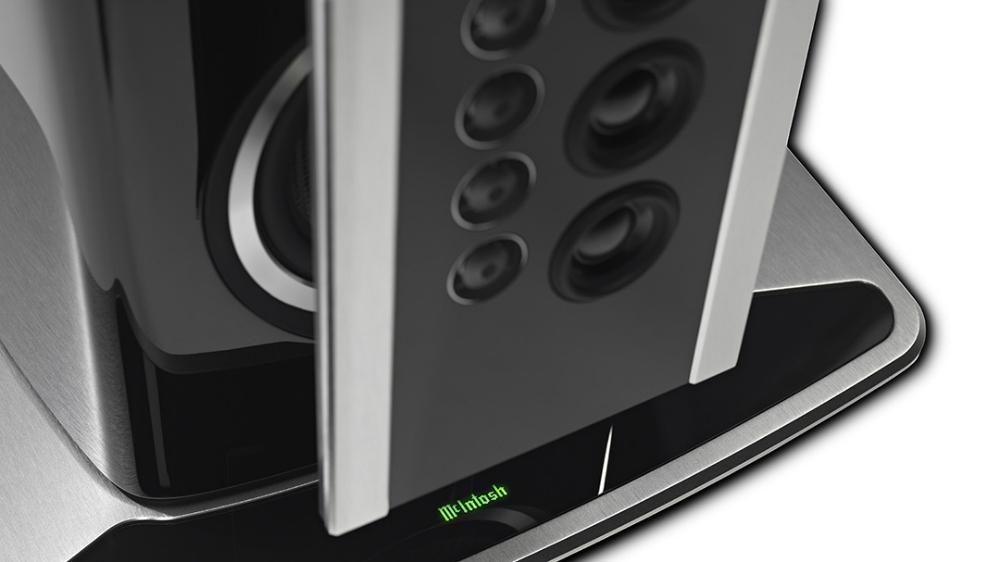
The XRT 1.1K, however, employs 40 ¾-inch aluminum-magnesium alloy dome tweeters, 24 2.5-inch aluminum-magnesium alloy dome midrange drivers, 2 6.5-inch carbon fiber sandwich cone mid-bass drivers, and 4 6.5-inch carbon fiber cone bass drivers. Looking at the crossover points, the 1K crossed over at 250Hz and 2kHz, while the XRT 1.1K crosses over at 150Hz, 400Hz, and 2kHz. Both speakers boast a frequency response of 16Hz-45kHz, while the XRT 2.1K extends down to 12Hz-45kHz.
While the number of drivers in the XRT 1.1K and 1K is quite similar, the most significant difference lies in a complete overhaul of the design philosophy. The 1K utilized a single, continuous cabinet concept. Although the XRT 1.1K also appears as a single cabinet, it’s internally divided into two sections. All drivers in the 1K were mounted on a single plane, with the two bass drivers positioned at the bottom, following a traditional arrangement.
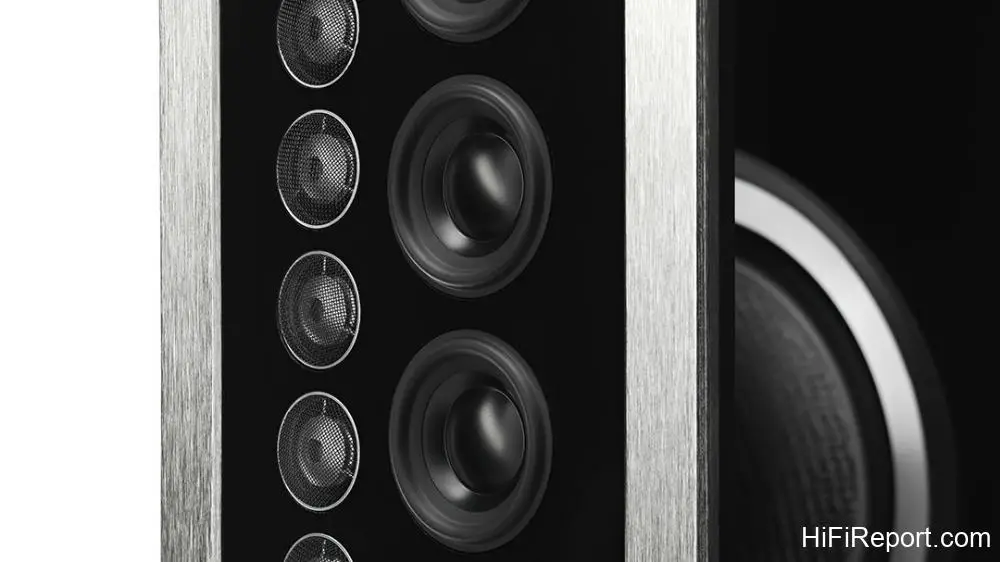
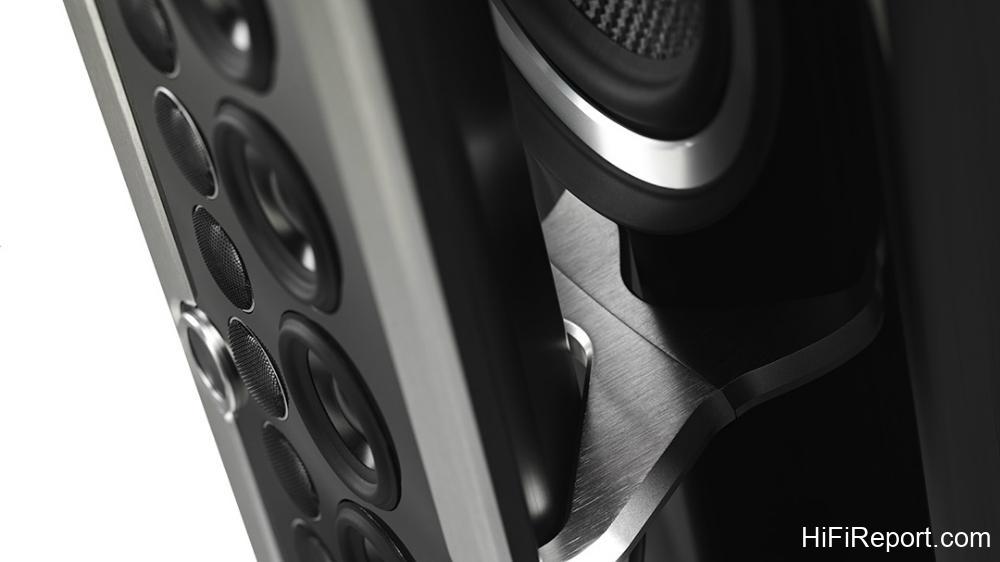
The XRT 1.1K, conversely, mounts its six identically sized mid-bass and bass drivers vertically along the cabinet from top to bottom. The tweeters and midrange drivers are mounted on a separate panel, and this high/midrange column is then attached to the front of the bass column, effectively creating a unique form of four-piece speaker design.
However, the XRT 1.1K’s four-piece speaker design is arguably more rational than traditional four-piece systems. In traditional designs, the high/midrange column and the bass column are separate cabinets placed apart. Even if positioned close together, they remain separate entities. What’s the problem with separating into two columns? Phase issues. Imagine two flashlights held parallel, shining light onto a wall. What do you see? Two distinct circles of light.
With the XRT 1.1K, the high/midrange column is fixed in front of the bass column. This is akin to two flashlights positioned one in front of the other, shining light onto a wall – you’d see only one circle of light. This is one of the ingenious aspects of the XRT 1.1K’s design.
The Advantages of Many Drivers in a Vertical Array
Why does the XRT 1.1K use so many drivers? And why are they arranged vertically from top to bottom? As I mentioned when reviewing the XRT 2.1K, using multiple drivers has the advantage of distributing the input power, reducing diaphragm excursion. Both of these factors help to lower driver distortion. The vertical, linear arrangement creates a line source. A traditional point source emits spherical wavefronts, while a line source emits cylindrical wavefronts.
Spherical waves have a wide vertical and horizontal dispersion angle, which also results in excessive ceiling and floor reflections. Cylindrical waves, conversely, restrict vertical dispersion, significantly reducing reflections from the ceiling and floor.
Furthermore, a line source offers another benefit: for every doubling of distance between the speaker and the listening position, the sound pressure level only decreases by 3dB, whereas a traditional point source decays by 6dB. In large spaces, a line source can save amplifier output power, and the volume doesn’t drop off too dramatically when listening from a distance.
Frankly, among McIntosh’s speaker designs, I consider the use of 24 2.5-inch drivers as the midrange array to be a stroke of genius. Why do I say this? Line source design wasn’t invented by McIntosh, and many other speakers use a similar approach. Using multiple ¾-inch or 1-inch tweeters in an array is also seen in other speakers. The practice of using multiple small-diameter bass drivers is far from unique.
What is relatively rare (though not unprecedented) is using so many 2.5-inch drivers for the midrange.
The Brilliance of the 2.5-inch Midrange Array
What are the benefits of using multiple 2.5-inch drivers for a midrange array? Because the diaphragm size is small, they are exceptionally agile in their movement. This makes the sound particularly nimble and lively, meaning even the most minute sonic details are clearly rendered. The sound feels very vibrant, clean, and fast-reacting. It’s transparent, never dull, sluggish, or indistinct.
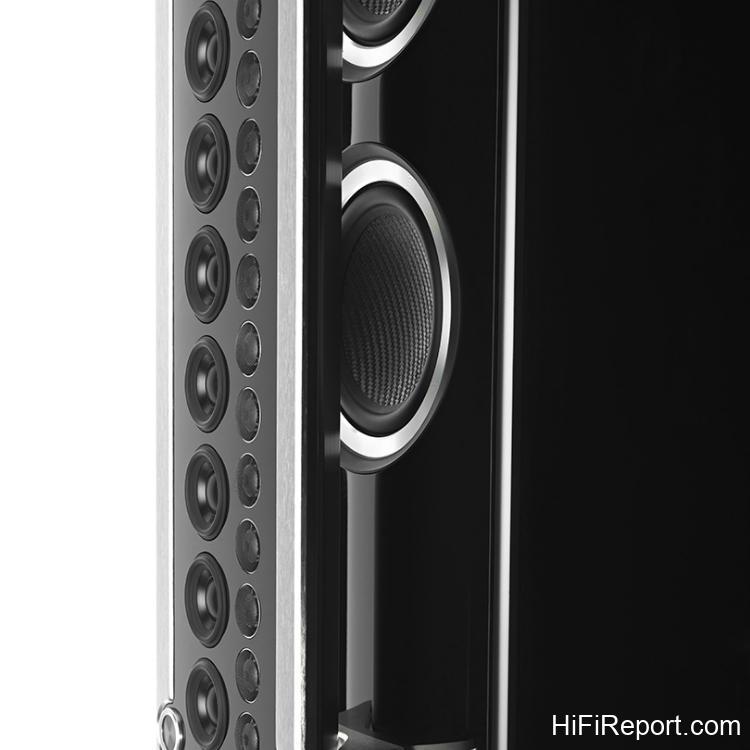
It’s important to note that the frequency range covered by the XRT 1.1K’s 2.5-inch midrange drivers is 400Hz-2kHz. This band encompasses the fundamental frequencies of most musical instruments and is, in fact, the most critical frequency range.
In this crucial frequency band, the sound of instruments is rendered with such agility, liveliness, clarity, and bursting detail – could the midband, instruments, and vocals possibly sound anything but real and beautiful? Perhaps, influenced by traditional midrange driver sizes, you might wonder how these 2.5-inch drivers could possibly produce a sufficiently thick, full, and expansive midrange. If you have the opportunity to listen to the XRT 1.1K, you’ll realize your concerns are unfounded.
In fact, the voice coil of the XRT 1.1K’s 2.5-inch midrange driver astonishingly measures 1 inch in diameter. This means that while the driver size is small, if you scale it up proportionally, you’ll be surprised at how large the voice coil is – no wonder it’s capable of producing a full-bodied midrange.
Initial Listening Impressions
If you assume that because the XRT 1.1K’s midrange drivers are only 2.5 inches, vocals and piano will sound thin and sharp, you are completely mistaken. If you assume that the XRT 1.1K’s six 6.5-inch mid-bass and bass drivers are blocked by the front tweeter and midrange arrays and won’t produce bass, that is also completely incorrect. Listening to the XRT 1.1K, I must admit, my level of (emotional impact/satisfaction) surpassed my experience with the XRT 2.1K.
I’m not entirely sure why, but this time, pairing them with the McIntosh C1100 preamplifier and MC1.25KW monoblock power amplifiers truly felt like the XRT 1.1K reaching its state of Nirvana.
My listening space for the XRT 1.1K was my large, open-plan area. This large space is over 17 meters long at its longest point and about 15 meters at its shortest, over 7 meters wide at its widest and about 6 meters at its narrowest. With ceiling and floor treatments, the lowest height is around 2.4 meters and the highest around 2.8 meters. This time, the distributor sent the two-piece McIntosh C1100 tube preamplifier. The power amplifiers were the same MC 1.25KW monoblocks used previously.
For digital sources, I used the emmLabs TSDX SE transport with the DAC 2SE DAC as one setup, and the same transport with a Weiss DAC 502 as the other. When I reviewed the XRT 2.1K, the digital source was an Esoteric K-03-Xs.
System Matching and Room Considerations
Which digital source to use? I compared them for a while and ultimately decided on the full emmLabs setup. Why? Because the XRT 1.1K’s sound signature is incredibly clear and transparent, with exceptionally high resolution. Pairing it with the Weiss would accentuate these characteristics even further, as the Weiss DAC 502 itself is highly resolving with a more delicate sound, and its mid and low-frequency quantity isn’t particularly abundant.
The emmLabs, on the other hand, offers a more relaxed sound with richer mid and low frequencies, not a thin character. The full emmLabs digital source complemented the XRT 1.1K, providing a balancing effect, whereas the Weiss would have emphasized the same sonic direction.
Beyond equipment matching, I must also advise that listening in a small space would be like hobbling the XRT 1.1K; it truly needs a large room to fully demonstrate its capabilities. Also, avoid acoustically hard rooms. A hard room will multiply the XRT 1.1K’s already clear high frequencies, causing the sound to lose balance with the mid and low frequencies. In such a space, it might sound overly aggressive. Furthermore, pay attention to cable matching.
For instance, when listening to the XRT 1.1K, I switched to Vanthor speaker cables, which are known for their fuller mid and low frequencies.
Sound: Clarity and Resolution
First, I must say that the XRT 1.1K creates a sense of complete clarity from the very first note. It’s like the morning mist being chased away by sunlight, filling the air with transparency. The resolution is astonishingly high; every tiny sound within the soundstage is crystal clear, impossible not to hear. Describing this level of clarity as “seeing every hair follicle” isn’t enough.
When I listened to Jody Chiang’s “Half Drunk, Half Awake,” the clarity was like monitoring in the recording studio. The artificial reverb used by the recording engineer during mixing was so evident. It felt like planing an old piece of wood to reveal the fresh grain underneath. What was most remarkable was the resolution of the bass.
Whether it was produced by electronic instruments, kick drums, or electric bass, the definition and distinctness of those low frequencies made it feel as though my hearing had improved severalfold overnight.
Sound: Piano and Cello
Next, I must mention the XRT 1.1K’s particularly distinct rendition of the piano’s lower register. When I listened to the Chen siblings’ cello and piano album, “Violonchelo del Fuego” (Audite 97.736), although the piano played an accompanying role, it was impossible not to hear it. The way the lower keys gently descended was mesmerizing. It created an image of the bass strings vibrating and allowed one to discern the myriad overtones produced by their vibration.
Not only did a gentle touch on the low keys elicit clear overtones, but the crystalline quality of the high keys was like fingers lightly brushing them, producing a cascade of resonant sounds. The middle keys were full-bodied and energetic, brimming with power and a strong sense of presence.
Regarding the cello, I heard a very clean, nasal hum, and a remarkably agile sound, not a dull or ponderous cello sound. The cello sound produced by the XRT 1.1K was neither hard nor coarse; rather, it possessed a soft, warm quality. This cello sound, like the piano, was utterly captivating.
Sound: Double Bass and Organ
After listening to the cello and piano duo, I immediately sought out Gary Karr’s “Audiophile Selections.” This album primarily features double bass, piano, and organ. I was mainly interested in hearing the double bass performance, but the XRT 1.1K also revealed a delicate yet powerful side of the piano and organ. Let’s start with the double bass: the XRT 1.1K reproduced a very clean double bass, not a thick, muddy sound.
The clarity was such that it felt like I could visually perceive the thick strings vibrating. Furthermore, the double bass was not at all coarse or hard; it possessed rich resonance and a strong woody character.
And the piano? Frankly, the piano’s scale is captured quite grandly on this CD; it’s a “super-realistic” recording. However, the XRT 1.1K made it utterly thrilling to listen to. It felt as though my ears were placed directly on the piano’s soundboard, amplifying every detail of the string vibrations. This meticulous level of detail was like suddenly being able to see PM2.5 particles with the naked eye. And the organ?
Similarly, I didn’t hear a thick, muddy mass of sound but rather distinct textures, allowing me to differentiate between different frequencies and pipes. This is another testament to the XRT 1.1K’s high resolution and transparency. Moreover, as the bass descended, the sense of a focused column of air moving downwards was also fresh and exciting, as if I could discern different textures within the low frequencies.
It’s like distinguishing different cuts of beef by their unique textures and flavors.
Listening to the organ was my first encounter with the XRT 1.1K’s bass – incredibly focused, powerful, and exceptionally elastic. This power felt very stable, not weak or diffuse. This bass characteristic was further confirmed when listening to the first and third tracks of Sanpuy’s self-titled album. The drum sounds within were like taut water balloons bouncing out, one after another.
The crossover point for the XRT 1.1K’s four bass drivers is set at 150Hz, a frequency range that encompasses most drum sounds. entrusting this frequency band to the four 6.5-inch bass drivers results in not only fast transient response but also no lingering decay and ample energy. I recall Gryphon stating that bass drivers are best kept under 8 inches, as performance starts to slow down beyond that size. The XRT 1.1K goes even further, reducing the bass driver size to 6.5 inches.
I believe this size wasn’t chosen arbitrarily but was determined after extensive testing.
Sound: Vast Soundstage and Dynamics
Next, I must highlight another outstanding aspect of the XRT 1.1K: its enormous soundstage, encompassing both width and depth. Listening to Eivor’s “Live” album genuinely startled me. Why? Because the soundstage was so vast, the electronic bass was so clear, the drum sounds were so impactful, the piano was so distinct, and the vocals were so real. All of this, I assure you, was more impactful than a live concert. In fact, this *is* a live concert recording.
Why would I say it’s more impactful than a live concert? Firstly, the XRT 1.1K can play very loud without distortion. Secondly, you don’t hear such crystal-clear, high-resolution sound at a live venue. Thirdly, the low-frequency energy produced by the XRT 1.1K is jaw-droppingly powerful, yet also incredibly clear, not muddy.
Listening to the second track, featuring only guitar, bass rhythm, and a cappella vocals, the XRT 1.1K displayed unparalleled transparency. This ethereal transparency painted the soundstage with incredible “realism.” Frankly, the realism we perceive is crafted by the recording engineer, but upon listening, we instinctively feel it’s a true live performance – that’s the skill of the engineer, and also the brilliance of the XRT 1.1K.
After listening through the entire Eivor “Live” album, it felt like attending an audio class I’d never experienced before. The soundstage presented by the XRT 1.1K was boundless, the vocals were bright, sweet, and impactful, the clarity of various instruments was astounding, and the realism of instrumental textures was breathtaking. The clear, highly resolving, and abundant low-frequency performance is rarely heard in other speakers.
When all these elements come together, the resulting listening experience is truly impactful.
Sound: Intimacy and Detail
The XRT 1.1K isn’t just capable of reproducing immense soundstages and impactful sound; its ability to render subtlety and delicacy is also remarkable. When I listened to the Dorian album “A Treasury of Favorite Violin Encores,” the XRT 1.1K surprised me once again. This time, I wasn’t astonished by the intense bass impact or the colossal soundstage, but by an incredibly nuanced, delicate, and agile violin. What do I mean by agile?
It means the speaker diaphragms seem capable of reproducing even the most minute vibrations, as light as a cicada’s wing. Applied to the violin, this capability means that even the faintest sounds from the instrument are clearly rendered by the XRT 1.1K. With such clear detail, coupled with softness and delicacy, the sheer beauty of the violin sound is difficult to describe in words.
I suspect that for some listeners, the violin and piano on this CD might sound dull, sluggish, or even dark. However, through the XRT 1.1K, they sounded clear, soft, tender, sweet, and moist – this is what amazed me. Not only the violin, but the piano was also very clean, and even the low keys conveyed a clean sense of rich string vibration.
Sound: Performance at Low Volumes
The XRT 1.1K can play at high volumes without audible distortion, but it can also sing very softly while maintaining exceptionally clear resolution. When I listened to Haydn’s Piano Trios (Harmonia Mundi Trio Wanderer), I deliberately lowered the volume to a level that wouldn’t disturb neighbors late at night.
At this low volume, the XRT 1.1K clearly delineated the sounds of the piano, violin, and cello as distinct lines floating in the air; the instrument sounds did not become blurred despite the low volume. Even listening quietly, the timbre and tone of the violin, piano, and cello were beautiful. The cello, in particular, had just the right amount of nasal richness, woody texture, and humming quality. The violin was not at all shrill, and the piano had a sense of ease.
Why can the XRT 1.1K remain so clear at low volumes? This is related to its line source design. This design causes the sound pressure level to decay more slowly after the sound waves are emitted. So, don’t worry that buying a large speaker like the XRT 1.1K means you can only listen loudly. When you want to listen to music late at night, turn the volume down, and you can still enjoy incredibly clear sound.
Sound: Driver Integration
Speaking of which, perhaps you worry that the XRT 1.1K’s high/midrange column might obstruct the mid-bass and bass drivers behind it. You needn’t worry. When listening to the aforementioned Haydn Piano Trios, I deliberately stood in front of the XRT 1.1K and listened. I genuinely couldn’t tell whether the cello sound was coming from the six bass drivers at the back or the entire row of midrange drivers at the front.
My point is: the XRT 1.1K positions the tweeter and midrange drivers at the front and the bass drivers at the back. The bass sound is not only unobstructed but also integrates seamlessly with the high and midrange sounds at the front. This design sounds more cohesive and unified than a vertical arrangement of high, mid, and low drivers.
Sound: Vocals and Jazz
How does the XRT 1.1K perform with vocals, acoustic double bass, and jazz drums? Listening to Anne Bisson’s “Four Seasons in Jazz Live at Bernie’s” was deeply moving. Anne Bisson’s voice was incredibly real and beautiful, not bloated, yet possessing the required warmth and clarity. Her piano notes were crystalline, with palpable key action, and the sound was rich in luster and sweet.
The drum kit was crisp where it needed to be; the cymbals had a sense of physical weight when struck; the kick drum had a full, tight thud; and the bass notes were not overly large, staying in their rightful place at the back without overwhelming the front. The plucked bass had a tight, slightly hard quality, very real and springy, making it sound very much like a live performance. This CD is actually a direct-to-vinyl analog recording, so there are no breaks during the recording.
In many places, you can hear subtle ambient noises like turning sheet music, which again highlights the XRT 1.1K’s excellent detail reproduction capabilities.
Sound: Test Tracks
It’s time to pull out our own “Beyond Peaks 200 Strikes” test disc to evaluate the XRT 1.1K. This time, I started with the Decca disc. The first and second tracks, Shostakovich’s Jazz Suite, were incredibly vivid, and the realism of the instruments, especially the brass, was exceptional.
Listening to the third track, Giuliani’s Guitar Concerto, the texture of fingers and nails contacting the nylon strings of the classical guitar was so real that I could even feel the elasticity of the vibrating strings. The plucked notes were like a string of pearls, warm and beautiful to listen to. The accompanying orchestra was incredibly detailed and also displayed a fine, thread-like texture, like the grain of Hinoki cypress.
Listening to the fourth track, by Nikolai Myaskovsky (1881-1950), the delicate and enchanting violin sound returned.
The fifth track, Fauré’s “Requiem,” showcased a wide and deep soundstage with the solemn choir. The sixth track, “Russian Delights,” fully demonstrated the XRT 1.1K’s wide dynamic contrast between soft and loud passages. Clarity at low volumes and freedom from distortion at high volumes are hallmarks of the XRT 1.1K. The drum sounds, growing from soft to loud, were all distinct, elastic, and powerful.
From the changing intensity of the drum sounds, I also felt that the XRT 1.1K indeed surpasses ordinary speakers significantly in its handling of dynamic contrast.
The seventh track, “Romeo and Juliet,” naturally tests the low frequencies. They must not be muddy, but also sufficiently substantial and powerful. Again, the XRT 1.1K’s bass displayed its characteristics of being elastic, focused, and highly resolving, and the impact was significant – utterly thrilling to listen to.
The final track, “The Planets Suite,” was where the XRT 1.1K demonstrated its incredibly strong resolution and its tolerance for volume ranging from the softest to the loudest – in other words, its massive dynamic contrast. When played on typical audio systems, this piece can easily become noisy and lack clarity in layers, failing to convey Karajan’s conducting mastery.
Listening to this recording with the XRT 1.1K, one can truly appreciate the subtlety of Karajan’s conducting and the wide dynamic range. This piece is genuinely not something ordinary speakers can handle. The XRT 1.1K is one of the best performers I have heard to date on this track, excelling in clarity, layering, depth, instrumental texture, clear articulation at low volumes, and intense impact at high volumes.
Sound: Jazz Divas
After experiencing impactful music, it was time for something gentler. I chose the second disc of the Audio Art 30th Anniversary commemorative album, “Adagio for Jazz Divas,” released late last year. I produced this set of albums and have listened to them countless times, yet the XRT 1.1K still amazed me. I was astonished by how well it reproduced the vocals, by how soft the bass could be, and by the relaxed sound of the piano.
On track ten, “Estate,” the bass was so soft and elastic it was simply mesmerizing. The XRT 1.1K’s bass performance isn’t just powerful and elastic like a fully inflated water balloon; it can also be soft and subtly vibrating like a water bed, making you want to lie down and never get up. On track two, “Say It Isn’t So,” the plucked texture of the acoustic double bass was incredibly real, the bass sound tight and slightly hard, and the changes in pitch were exceptionally clear.
And on the third track, the relaxed, breathy sound of the saxophone was utterly captivating, like basking in the warm winter sun – utterly comfortable. Here, the acoustic double bass was equally realistic, as if listening to a live performance from close proximity. On track four, “The Girl From Ipanema,” both the male and female vocals were sung with such a low, gentle tone, yet the XRT 1.1K was able to render these low, soft voices with incredible clarity.
Conclusion
Although the McIntosh XRT 1.1K is smaller in size than the XRT 2.1K I reviewed previously, and the bass drivers are smaller and fewer in number, my emotional impact and satisfaction this time were no less than, and perhaps even surpassed, my previous experience with the XRT 2.1K. What factor contributed to this greater sense of fulfillment while listening to the XRT 1.1K? The room was the same, the power amplifiers were the same; only the preamplifier and digital source were different.
In the past, audiophiles who loved McIntosh amplifiers might have been forced to choose speakers from other brands because they weren’t aware of McIntosh’s outstanding speakers, thus losing the aesthetic beauty of a complete McIntosh system. Now, you no longer have to compromise. As long as your listening space is not acoustically hard, the XRT 1.1K will undoubtedly make you feel you wish you had met it sooner.
It is the final piece of the puzzle that completes the overall beauty of a McIntosh system.
Specifications
* Digital Source: emmLabs TSDX SE / DAC 2SE / Weiss DAC 502
* Amplification: McIntosh C1100 + MC 1.25KW
*Plophia Culture celebrated the 30th anniversary of Audio Art magazine by releasing their first jazz CD, “Adagio for Jazz Divas.” The song selection was purely based on musical enjoyment, with no intention of being an audio test disc. However, many of the excellent recording qualities within are still captivating for audiophiles and worth collecting. (5386203, Plophia Culture)*
Key Highlights
* Each speaker utilizes 70 drivers, a globally unique feature.
* The bass drivers are separate from the high and midrange arrays and directly attached to the front, forming an integrated four-piece speaker design.
* Line source design results in less sound pressure decay with distance.
* Vast soundstage, incredibly agile, high resolution and transparency, excellent performance at both low and high volumes.