
Stenheim Alumine Two.Five Floorstanding Speaker Review
My initial encounter with the captivating charm of Stenheim speakers occurred at HiFiReport Audio’s former location on Beian Road in Dazhi. On that occasion, I listened to the Stenheim Alumine Five. Prior to this, I was entirely unfamiliar with the brand, having only caught glimpses of them at audio shows. However, that listening session left a profound impression.
Not long after, HiFiReport Audio relocated from Dazhi to Zhongcheng Road in Tianmu. Why the move? To accommodate Stenheim’s larger, higher-end Reference series speakers, including the flagship Reference Statement, which necessitated a sufficiently spacious environment. My first listening experience at the new HiFiReport location was with the smallest model, the Stenheim Alumine Two.
During that session, Mr. Yang, the owner, had the Alumine Two placed on its dedicated bass pillars, designed by Stenheim at the time to bolster the Alumine Two’s low-frequency performance. Together, these were known as the Alumine 3 Way. The specific Alumine Two I listened to only comprised the upper section, without the bass pillars.
What would the sound be like with the Alumine 3 Way setup? I never had the chance to hear it, as the Alumine 3 Way was discontinued. However, Stenheim clearly recognized the gap between the Alumine Two and the Alumine Three needed filling. After years of development, the Alumine Two.Five was finally unveiled in 2023.
At the Munich High End show, the Alumine Two.Five, a compact floorstander standing less than a meter tall, demonstrated the ability to fill the entire exhibition room with energy. The sound was full-bodied, powerful, and open; it was truly hard to believe without experiencing it firsthand. Now, let’s delve into discussing this “little floorstander.”
For ease of writing and reading, I will henceforth use Arabic numerals to represent the English numerals in the model name, referring to it consistently as the Alumine 2.5. This convention will also apply when discussing other speakers in the Stenheim Alumine series.
Minimalist Design, Exquisite Craftsmanship
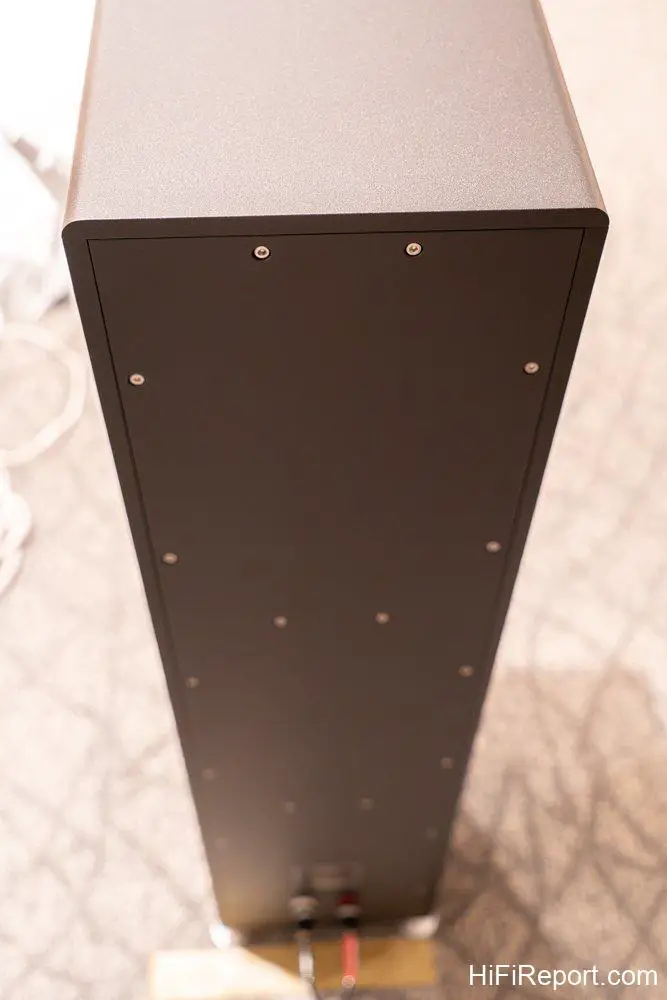
Stenheim is renowned for its aluminum cabinets, and their speakers have never featured extravagant or flashy embellishments. They are simply rectilinear, with clean, sharp lines. While wooden cabinets rely on adhesives for assembly, aluminum cabinets are secured with screws.
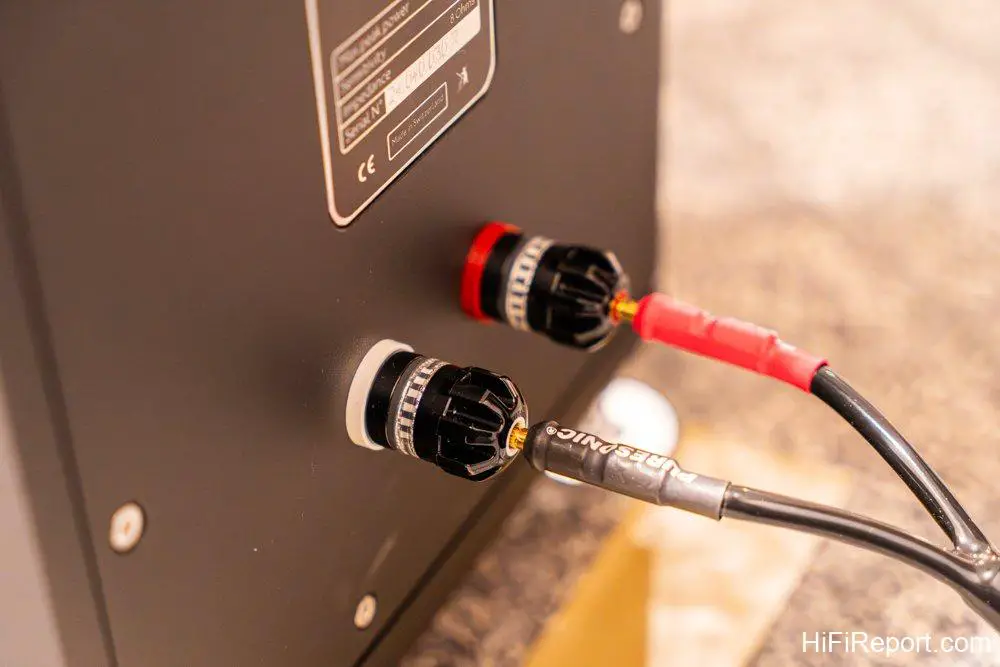
Since Stenheim’s speaker cabinets are fastened with screws, where are they? You won’t find them on the front, sides, or top. The answer: some are internal, while others are located on the rear panel. Hiding the screws as much as possible is key to achieving the speaker’s premium aesthetic.
The speaker’s finish is also understated. Stenheim speaker surfaces are typically sandblasted, resulting in a uniform paint finish free of imperfections. The Alumine 2.5 I listened to this time was black, so judging the paint quality precisely might be challenging. However, the Alumine 5 and Alumine 2 I previously heard were silver (which the manufacturer calls light grey), and the surface treatment was excellent.
Furthermore, the aluminum panel edges are beveled, and even areas without rounded treatment feel smooth to the touch, not sharp. Upon closer inspection of the aluminum panel joints, the entire seam width remains consistent, indicating a high level of metalworking precision (or exceptionally stringent quality control). High-end audio earns its designation through unwavering attention to such details.
Larger Cabinet Volume Than Typical Wooden Boxes
Beyond aesthetics, speakers must sound good. Stenheim’s aluminum cabinets aren’t just for looks; they serve a valid acoustic purpose. Why choose aluminum? Because the material itself boasts high rigidity and sufficient mechanical strength, making it easier to control vibrations compared to wood. Some manufacturers tout that musical instruments are made of wood, therefore speakers should be too. However, the principles of sound production in musical instruments and speakers differ fundamentally and cannot be directly compared.
Musical instruments seek more beautiful resonance, while speaker cabinets aim for the opposite: as little vibration as possible. The cabinet should not resonate along with the drivers. This is precisely why Stenheim utilizes aluminum instead of wood for their cabinets.
Furthermore, there are numerous aluminum alloy formulations, with different compositions resulting in varying degrees of rigidity and density. Many believe aerospace-grade aluminum is the best, but it’s not necessarily ideal for speaker manufacturing. Stenheim tested various aluminum alloy formulas for their vibration parameters, employing computer simulations and extensive listening tests before selecting their specific alloy formula.
Once the material is chosen, a robust structure must be designed to enhance overall mechanical performance and minimize cabinet vibration interference. The speaker cabinet isn’t solely made of aluminum; specific internal areas are lined with damping materials to suppress vibrations. This approach solves the cabinet resonance problem and offers another advantage.
Compared to the MDF panels commonly used in wooden cabinets, which are often 18mm or thicker, aluminum panels are significantly thinner. This allows the Alumine 2.5, relative to a wooden speaker of the same external volume, to have a larger internal cabinet space, facilitating better low-frequency reproduction.
2-Way, 3-Driver Configuration with Offset Design
In terms of drivers, the Alumine 2.5 adopts a 3-driver, 2-way architecture. This might seem odd given the model name is Two.Five – why not 2.5 ways? Perhaps they would respond, “The Alumine 5 isn’t a 5-way speaker either!” Fair point.
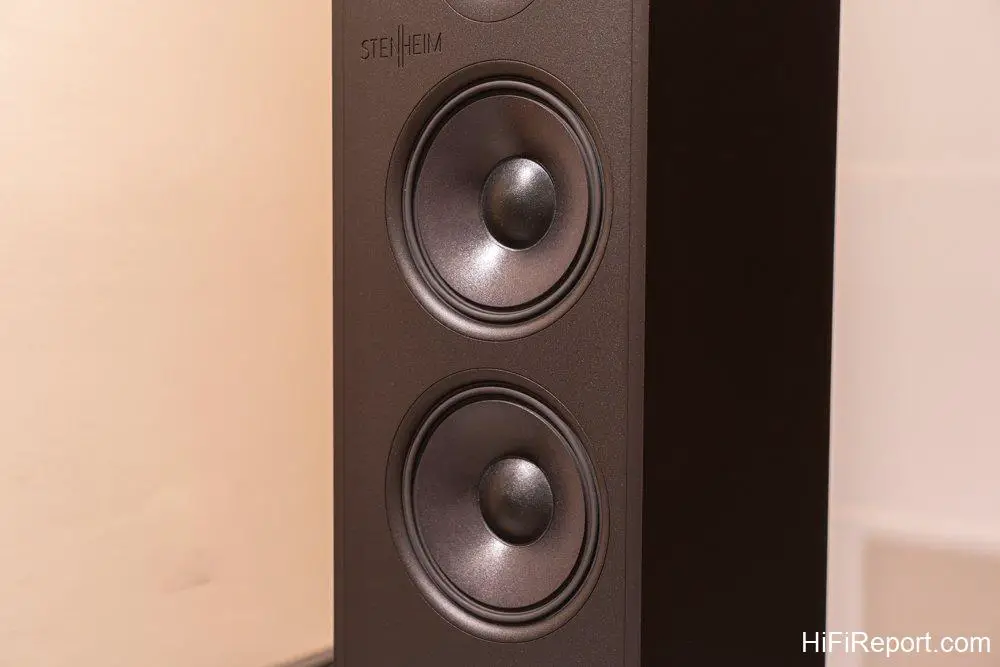
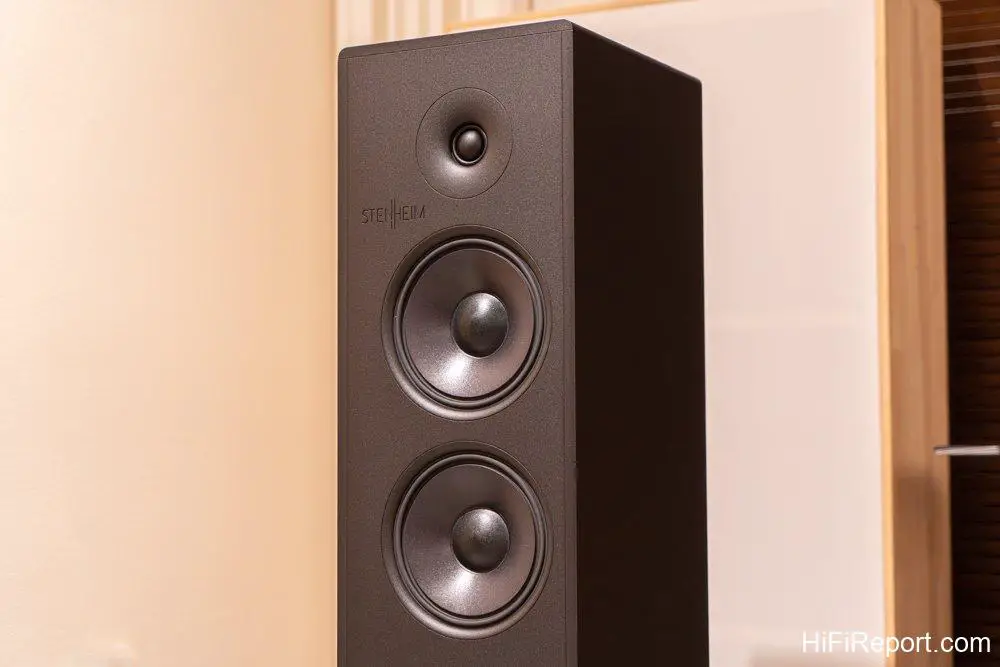
The Alumine 2.5 employs a 1-inch Scan-Speak soft-dome tweeter with a shallow waveguide around its opening to control dispersion and enhance efficiency. Below it are two 6.5-inch paper cone woofers custom-made by the French driver manufacturer PHL, featuring a W-shaped pleated surround (or double-layer surround). Stenheim’s principles for driver selection are high efficiency, fast response speed, and excellent linearity to produce a natural sound.
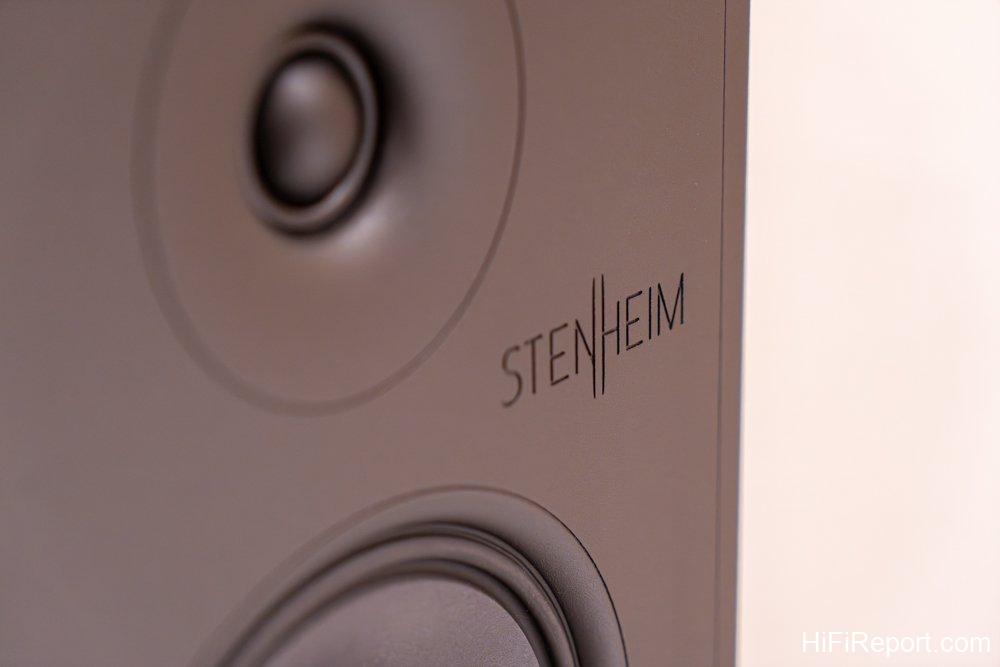
The driver layout is slightly offset from the center, a common practice for Stenheim. Typically, speakers have drivers centered on the baffle, making the speaker symmetrical and thus interchangeable between left and right channels. With an offset design, usually only the tweeter is offset, while other drivers remain centered. Mr. Yang from HiFiReport explained that Stenheim speakers utilize an offset design, meaning they are handed (left/right specific). When setting them up, the offset side is always placed towards the inside, with the “Stenheim” logo engraved on the front baffle facing outwards.
High 93dB Sensitivity for Easy Driving
The Alumine 2.5 utilizes a second-order crossover network, generously populated with high-quality components like M-Cap capacitors. Although the manufacturer doesn’t provide a diagram, Mr. Yang showed me a photo of the Alumine 2’s crossover on his phone, stating, “The Alumine 2.5’s crossover is even more complex than this.” Indeed, the Alumine 2.5 adds an extra driver compared to the Alumine 2. The manufacturer states that the addition of this single driver significantly increased the difficulty of the crossover design, requiring precise phase alignment while maintaining Stenheim’s hallmark high efficiency.
In modern speakers, achieving 89dB or 90dB sensitivity is often sufficient for a manufacturer to confidently claim their speakers are highly efficient and easy to drive. These figures typically appear on floorstanding speakers; smaller speakers with smaller drivers and cabinets usually have lower sensitivity. However, Stenheim speakers consistently boast high efficiency. Taking the Alumine series as an example, the smallest model, the Alumine 2, is roughly the size of a standard bookshelf speaker yet has a sensitivity of 93dB. The flagship Alumine 5 floorstander has a sensitivity of 94dB. What about the Alumine 2.5? Its sensitivity is also 93dB.
Stenheim aims for the Alumine 2.5 to be very amplifier-friendly, capable of being driven well by as little as 10W, and sounding excellent even with tube amplifiers. Stenheim speakers all feature bass-reflex designs, and the Alumine 2.5 is no exception. Like its smaller sibling, the Alumine 2, it has a circular port located on the front baffle. This simplifies speaker placement for the user, eliminating concerns about distance to the rear wall.
Manufacturer Recommends Spacing Speakers 3+ Meters Apart
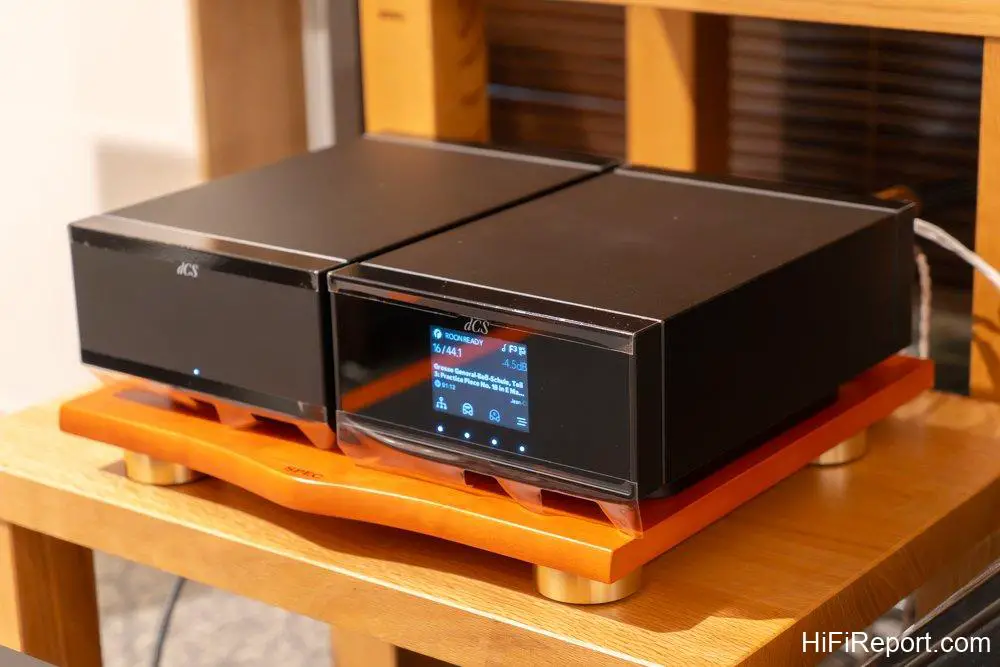
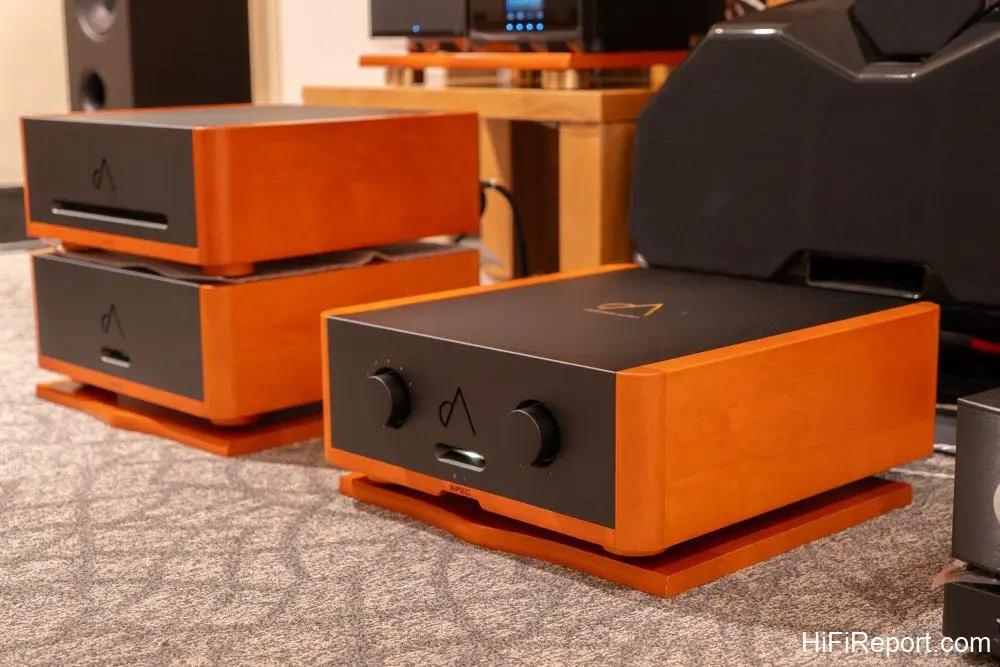
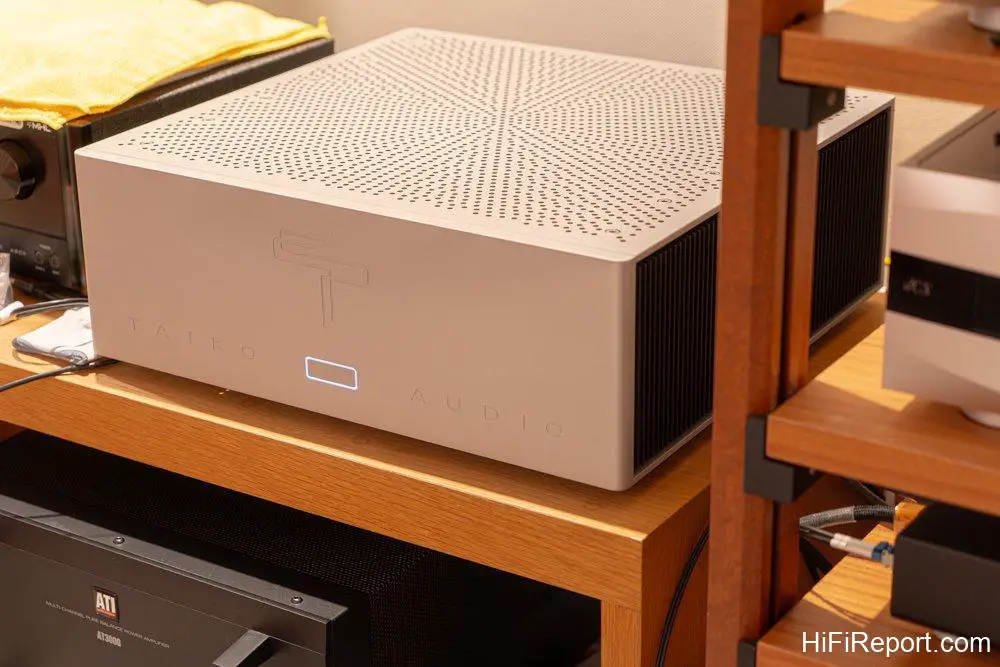
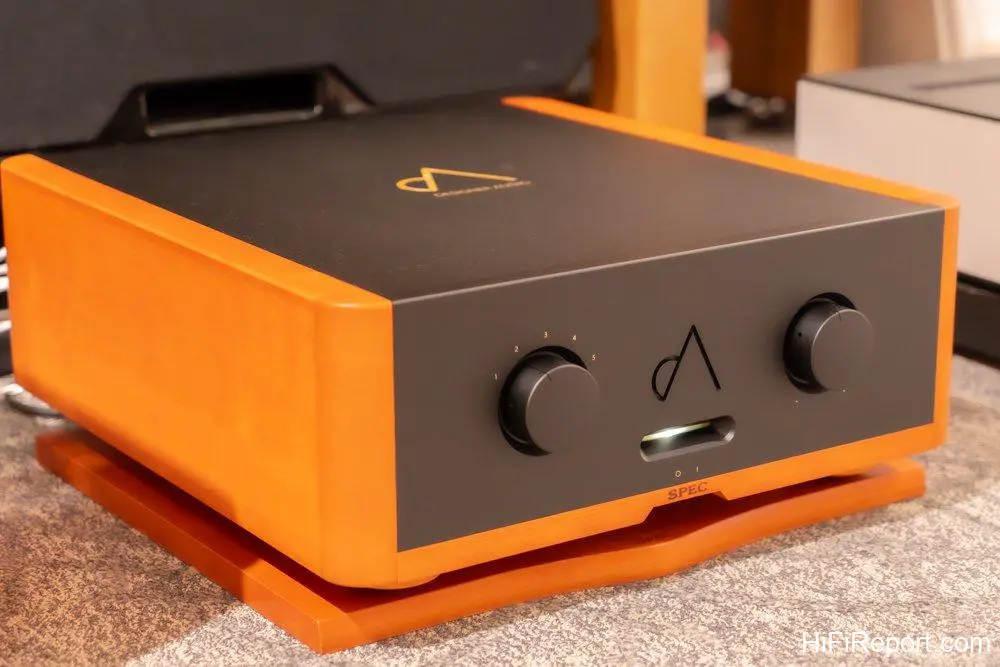
The listening session took place in HiFiReport’s second-floor listening room. Mr. Zhang from HiFiReport paired the Stenheim Alumine 2.5 with the latest flagship integrated amplifier from Spec (which his company, Boeing Sound Technology, distributes), the RSA-EX1000. The source comprised a dCS Lina Network DAC streamer with an external Master Clock, and the Roon Server was a Taiko Audio Extreme music server.
Mr. Zhang placed the Alumine 2.5 speakers quite far apart, almost adhering to the manufacturer’s minimum recommended half-meter distance from the side walls, with a spacing of roughly 3.2 meters between them. Don’t be fooled by the Alumine 2.5’s small size; the manufacturer recommends users spread the speakers at least 2.5 meters apart, and ideally 3-4 meters if possible. Of course, these are the manufacturer’s suggestions. In practice, in a room with less space, placement will require user discretion. The important thing is to achieve solid imaging and deep bass. Can such small speakers, placed so far apart, achieve this?
Solid Drums, Elastic Bass Erase All Doubt
Listening to Kyrie Kristmanson’s album “Pagan Love,” Kristmanson’s vocal line was clear, with details like articulation and enunciation rendered distinctly. The image was focused and solid, and the sound texture was direct and natural. The Alumine 2.5 certainly excels at portraying vocals.
The bass plucks in “Talk” had excellent texture, combining elasticity with power. This bass line didn’t merely reside in the low frequencies; it had its own rising and falling melody. Several of the lower bass notes were indeed sufficiently deep, while the higher notes, in addition to being elastic, carried a touch of crispness. As for the finger snaps in “Song X,” they sounded clean and remarkably lifelike, and the drum sound was full and weighty, with tangible impact. These two tracks alone were enough to dispel any lingering doubts I had.
Clean, Tight, Fast, and Articulate Bass
While listening to Kristmanson’s “Talk,” I thought of Diana Krall’s cover of “All or Nothing at All,” which opens with a deep, full-bodied bass pluck. This bass line is well-recorded and yields good bass quantity on many systems. However, is it truly deep bass, or merely a forced, hollow semblance of low frequencies? Bookshelf speakers or small floorstanders, if designed to maximize bass quantity to give an impression of richness, can often end up sounding like a “boom box.” Some may enjoy that fat, heavy, thick, loose “booming bass.”
However, the Alumine 2 and Alumine 2.5 are different. Their bass descends naturally; it goes as deep as it can and then stops, with no artificial, exaggerated “fake bass” trying to punch above its weight. Listening to the bass in this song and the aforementioned “Talk” reveals that Stenheim has a fastidious approach to low frequencies.
Excellent Dynamics and Atmosphere Turn the Living Room into a Concert Venue
Stenheim speakers also typically possess a lively quality. Beyond clearly reproducing the texture of vocals or instruments, they have a knack for naturally rendering all sorts of details. Listening to Stenheim speakers always makes the music feel particularly vivid and real. Are you thinking that by saying this, I’m implying the speakers are biased towards the mid-high frequencies and sound thin? No, no, don’t jump to conclusions. What I mean is precisely what I’ve written: Stenheim speakers exhibit a natural, clear texture, with rich and realistic details.
I even believe the Alumine 2.5 and Alumine 2 are speakers with considerable monitoring characteristics and capabilities—they can directly, uncolored, and unvarnished reproduce almost all the information in a recording. Take the live album “Belafonte: At Carnegie Hall” as an example. Harry Belafonte’s voice is warm and rich, full of power, and his spontaneous performance on stage generates a lively atmosphere in the hall. How well was this live atmosphere reproduced?
The widely spaced Stenheim Alumine 2.5s, combined with their excellent dispersion, created a vast soundstage. Despite being small floorstanders with drivers that aren’t exceptionally large, the Alumine 2.5’s sound possesses Stenheim’s characteristic effortlessness. This recording was rendered with a palpable sense of being there. Every detail was laid bare: Belafonte’s movements on stage, his singing expressions and inflections, the positioning of the accompanying instruments, the audience interactions, the reverberation captured during recording and mixing, and so forth.
For example, the opening track, “Darlin’ Cora,” features the roar of audience applause, the accompaniment of guitar and drums, and Belafonte’s powerful, spirited, and stirring performance. Or in “Cotton Fields,” the richness of the accompanying instruments builds layer upon layer, and Belafonte’s singing power gradually intensifies. Combined with skillful phrasing, legato, elastic tempo, and improvisational variations, the song exhibits a naturally progressive sense of dynamism.
In the pigeon song, “Cu Cu Ru Cu Cu Paloma,” the musicians join in with harmonies, creating a layered, echo-like texture. The whistling mimicking bird sounds is particularly charming; hearing this lively whistling, one simply has to admire Stenheim’s first-class ability to reproduce lifelike sound. As for “Matilda,” it’s a quintessential example of his stage improvisation charisma. Belafonte first leads the stage musicians in a singalong, then encourages the entire audience to join in. This scene of stage and audience merging was recreated in HiFiReport’s second-floor listening room, as I and the two owners (from HiFiReport) listened together, transported back to the Carnegie Hall stage 65 years ago.
Capable Piano Reproduction, Solid and Weighty Tone
Although the Alumine 2.5 is small, it handles piano reproduction with commendable capability. While it may not match the scale, authority, and weight of the larger Alumine 5 or even the Reference Ultime Two, without direct comparison (perhaps comparison is the thief of joy?), it is entirely sufficient to allow me to appreciate the multifaceted beauty of piano performance.
Consider Danilo Rea’s album “Lirico,” where he transforms famous operatic passages into jazz-infused piano pieces. Even with just a single piano, he manages to express a wide range of emotional tension. In the aria “Mon cœur s’ouvre à ta voix” from Saint-Saëns’ opera “Samson et Dalila,” the left hand reaches down to the lowest octaves to play heavy chords, while the right hand plays a flowing melodic line moving upwards. The layers of different voices are clearly distinct. The Alumine 2.5 doesn’t apply a soft-focus or colored brushstroke to the mid-high frequencies like some speakers that make the treble sound sweeter and more pleasing. The Alumine 2.5’s piano tone is direct, natural, and free from artificial embellishment. What others might consider beautiful coloring, it deems insincere.
Towards the end of the piece, there is a section of oscillating low chords and tremolos. The arrival of deep, heavy, rich low frequencies is something rarely heard from a speaker the size of the Alumine 2.5, which manages to be both deep and sufficiently clear. Considering Mr. Zhang’s placement with over 3 meters of spacing, the fact that it can still deliver such solid, focused, and weighty piano tone speaks volumes about the Alumine 2.5’s capability.
Concertos Impress with Piano and Orchestra Power and Presence
Open-sounding and energetic, the Alumine 2.5 is also excellent with large-scale orchestral music. Listening to Alice Sara Ott playing Tchaikovsky’s Piano Concerto No. 1, the first movement opens with the four-note motto led by the brass. Accompanied by the piano’s powerful and decisive chords, the strings introduce the first theme. The piano then takes over the main melody, expressing an even richer range of emotions. At one point, the piano notes descend deeply, followed by a rapid ascending arpeggio. Just this opening section alone, both the piano and the orchestra, were impressive in their sheer power.
The Alumine 2.5 presented the piano tone with focused solidity and clear articulation – that’s one thing, but the brilliant timbre, with a touch of liquid quality within its dazzling sheen, was truly beautiful. I’ve heard Stenheim speakers several times: the Alumine Two, Alumine Five, and even the flagship Reference Ultime Two. Regardless of size, Stenheim speakers always possess an extraordinary innate beauty, appearing delicate and refined. Scale is one matter; larger speakers naturally have greater scale. But their larger speakers can render a noble texture, and the smaller ones also exhibit this quality. Larger speakers can display grand power, and the smaller ones are not far behind.
Dissecting Voices Like a Watchmaker, Leading You into the Music’s Depths
Listening to Valery Gergiev conducting the Mariinsky Theatre Orchestra in Tchaikovsky’s “Romeo and Juliet Fantasy Overture,” whether the music is deeply introspective or passionately soaring, the Alumine 2.5 consistently conveyed the appropriate mood and emotional impact. This fantasy overture was a work Tchaikovsky mulled over for a long time, demonstrating his ability to tell a story through music, a composer known for his melodies. After the Father Laurence theme, it moves into the theme of the family feud; the former is distant and mysterious, the latter is impassioned and emotional.
The Alumine 2.5 acts like a watchmaker, dissecting the various voices within the music, cleaning and oiling them before reassembling. The musical layers are clear. Even during busy orchestral passages, the clarity and definition remain, while maintaining the smooth texture and refined beauty of the musical notes. In the love theme section for Romeo and Juliet, the delicate strings shimmer and sparkle – a tangled embrace in the clouds above, beneath a starry rainbow bridge. Whether it’s plucked strings or a gentle timpani tap, no matter how subtle the sound, if it was captured in the recording, the Alumine 2.5 articulated it precisely. This compels me to praise its excellent monitoring capability.
Good Monitoring Capability, Gives You What You Give It, Reveals System Changes
Because of its excellent monitoring capability, it can clearly reveal differences in the upstream equipment. All the listening impressions mentioned previously were obtained with the Spec RSA-EX1000 pairing. Although the Spec is a solid-state amplifier, and Class D at that, its sound possesses the sweet, fresh, liquid, lively, and dynamic qualities of a single-ended triode tube amplifier, while offering much greater power, making it even more adept at driving speakers.
Switching to a different amplifier immediately changed the sound. Removing the RSA-EX1000 and substituting the Mola Mola Kula integrated amplifier elevated transparency and resolution to a new level. Mola Mola’s owner, Bruno Putzeys, is a master of Class D amplification; brands and models associated with Class D like UcD, Hypex, NCore, Purifi, are all linked to him. While both Mola Mola and Spec are Class D, we can broadly consider the former technical-oriented and the latter tuning-oriented, resulting in vastly different flavors of Class D amplification. The moment the Alumine 2.5 was connected to the Kula, the sound instantly became refined, incredibly transparent, incredibly fast and clear, and details were too numerous to count. The Alumine 2.5’s monitoring character was evident here; whatever you feed it, that’s what it produces. No matter how complex the details or how fast the transients, it handles them without hesitation.
Small But Capable, Price Justified
Have you ever heard Stenheim speakers? You should. And the Alumine 2.5 can be an excellent starting point. If you have heard them, you will understand what I mean by clean and transparent. You will understand why I keep praising its lively sound and excellent atmosphere. And you will know why I say it can create a large soundstage disproportionate to its size, and has the capability to reproduce the scale and weight of a grand piano.
Perhaps it’s small, and perhaps it looks understated. If you spent the same amount of money on speakers from other brands, you might find larger, more imposing ones. However, if you listen, you will realize that Stenheim speakers are truly remarkable—small but capable, and the price is entirely justified.
Specifications
* Type: 3-driver, 2-way bass-reflex speaker
* Drivers: 1 x 1-inch tweeter; 2 x 6.5-inch woofers
* Sensitivity: 93dB
* Impedance: 8 ohms
* Power Handling: 125W RMS (250W peak)
* Minimum Recommended Amplifier Power: 10W
* Dimensions: 945 x 230 x 275 mm (HxWxD)
* Weight: 45kg