
Monitor Audio Hyphn Review
Let me emphasize from the outset: the Hyphn’s design is not merely an exercise in attention-grabbing or eccentricity. Instead, it adheres strictly to the maxim “Form Follows Function,” coined by the renowned American architect Louis Sullivan (1856–1924), known as the father of skyscrapers and a leader of the Chicago School.
Taking this further, the Hyphn’s design truly embodies the words of another famous American architect, Frank Lloyd Wright (1867-1959), designer of Fallingwater: “Form follows function—that has been misunderstood. Form and function should be one, joined in a spiritual union.” This phrase was Wright’s elaboration on his mentor Sullivan’s dictum and has become a crucial benchmark in architecture and design ever since.
Why do I begin by quoting “Form and function should be one”? Because the Hyphn’s external design is utterly spectacular, and it’s the part I’m most eager to discuss first. It fully embodies the essence of that very phrase.
Design Philosophy and Cabinet
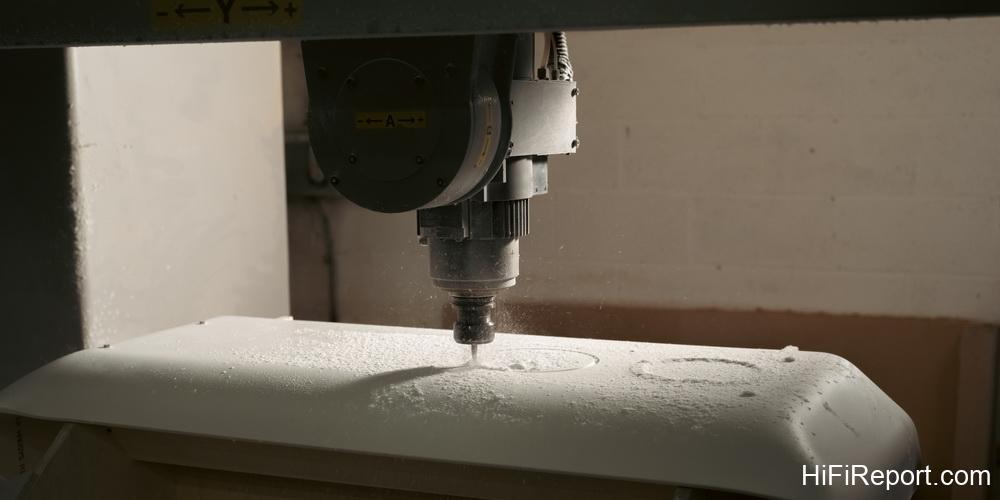
Let’s start with the cabinet material and shape. As we know, rectangular cabinets inevitably suffer from internal standing waves and are prone to cabinet resonance. Therefore, right from the start, Monitor Audio abandoned traditional rectangular enclosures for the Hyphn, opting instead for a beautifully organic form. Given this organic shape, using materials like MDF or metal wasn’t feasible; the cabinet had to be molded. The designers chose a material similar to DuPont’s Corian solid surface.
This material is called “artificial stone” because it is hard yet possesses damping properties, resulting in extremely low resonance. So why haven’t we seen artificial stone used for speaker cabinets before? Because the cost is exceptionally high.
Now, consider the shape. The designers divided each speaker into two halves, and each half features an organic form with no straight lines or right angles. There are only small, paired parallel wall surfaces. This is not only visually appealing, but the shape also serves a functional purpose. This form resembles a butterfly with outstretched wings, which is why I’ve affectionately nicknamed it “The Butterfly.”
You might ask, why split a single cabinet into two halves? This is the origin of the model name, “Hyphn.” A hyphen is the short dash we use in English to connect words or parts of words. If you look closely, you’ll see that the two halves of the Hyphn are connected by four sturdy, substantial metal bars, much like an English hyphen. Why connect the two cabinet halves with four thick metal bars?
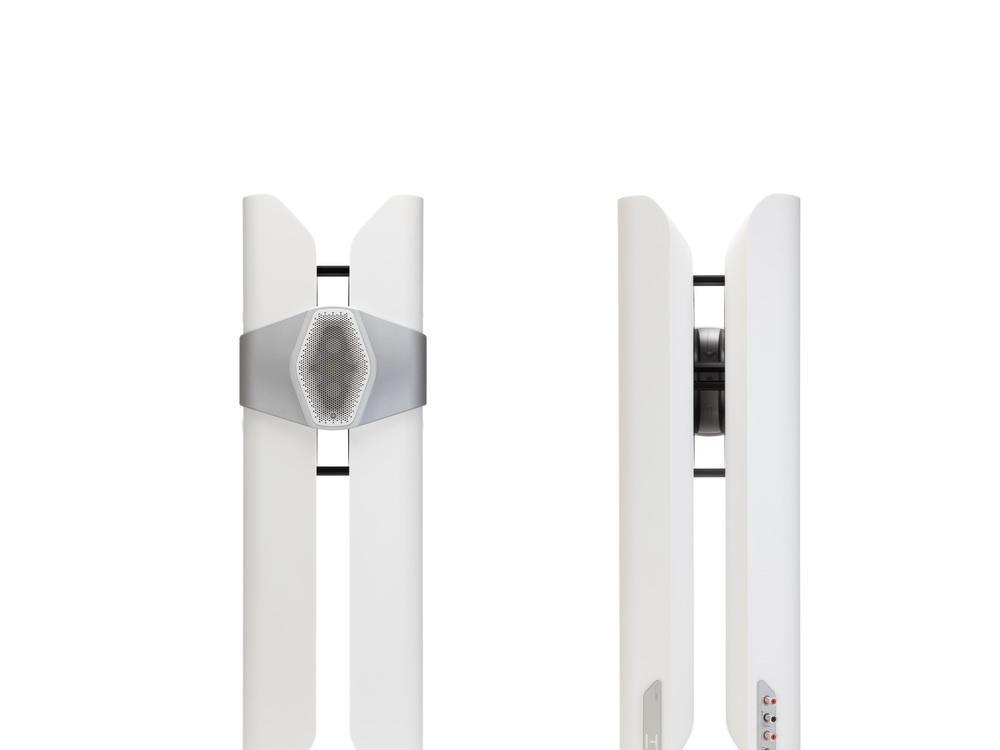
It’s not arbitrary; those four metal bars are the connecting structure for two pairs of opposing 8-inch woofers. Like twins, the Hyphn has four 8-inch woofers per channel. Four 8-inch flat-diaphragm woofers per speaker roughly equate to the effective radiating area of a single cone woofer of what size? Approximately a 16-inch woofer.
Opposing Woofers
Why arrange the woofers in opposing pairs? Because when two woofers are placed face-to-face and operate “in phase” (both moving inward or both moving outward simultaneously), the vibrations generated by the two drivers effectively cancel each other out. Consequently, the vibration transmitted from the woofers to the cabinet is virtually zero. So, even with four 8-inch woofers per channel pounding away forcefully, the Hyphn’s cabinet remains utterly motionless.
This is the reason the designers divided the cabinet into two halves – it’s for functional performance, not just aesthetics. Imagine a single cabinet equipped with a 16-inch woofer; solving the issues of such a large driver’s diaphragm inertia, excursion, and resulting vibrations would be exceedingly difficult.
By dividing the task among four 8-inch drivers arranged in opposing pairs, not only is ample low-frequency volume achieved, but the aforementioned problems are also almost entirely resolved. This is truly brilliant design!
Beyond creating the low-frequency vibration cancellation effect, dividing the cabinet into two halves allows sound waves to pass through the space between the halves, preventing a large volume from blocking the waves. This likely also helps in creating the soundstage, which is another benefit. The Hyphn employs a bass-reflex design, with the ports cleverly hidden and firing downwards to avoid disrupting the overall aesthetic.
Each of the Hyphn’s two halves houses woofers, and thus each half also has a downward-firing bass port. The port exits are also organically shaped with smooth curves.
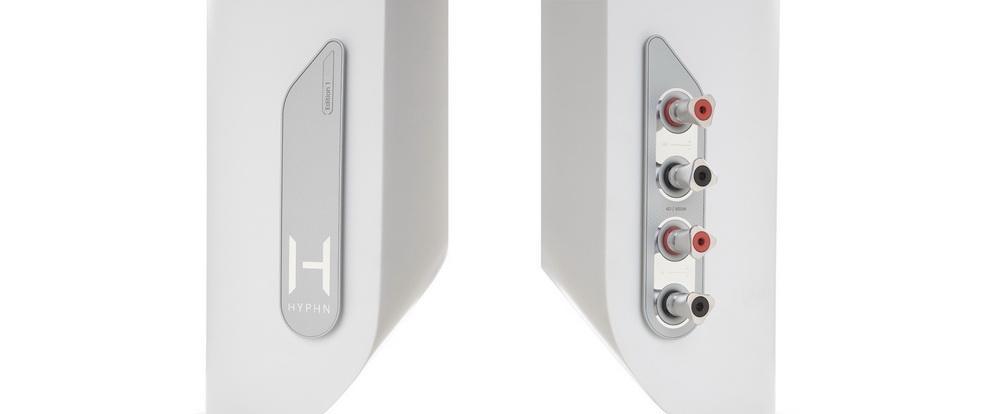
Driver Arrangement: The M-Array
Having discussed the outstanding cabinet material, appearance, and functionality, let’s move on to the arrangement and configuration of the drivers. The core acoustical design principle behind the Hyphn is to have all drivers form a “large point source” or a “quasi-coaxial” large sound source. This approach aims to achieve optimal soundstage focus and imaging capabilities.
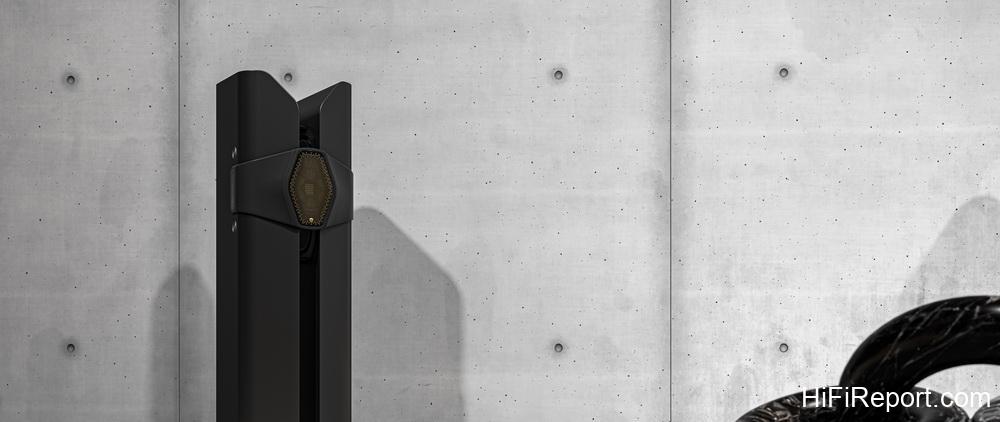
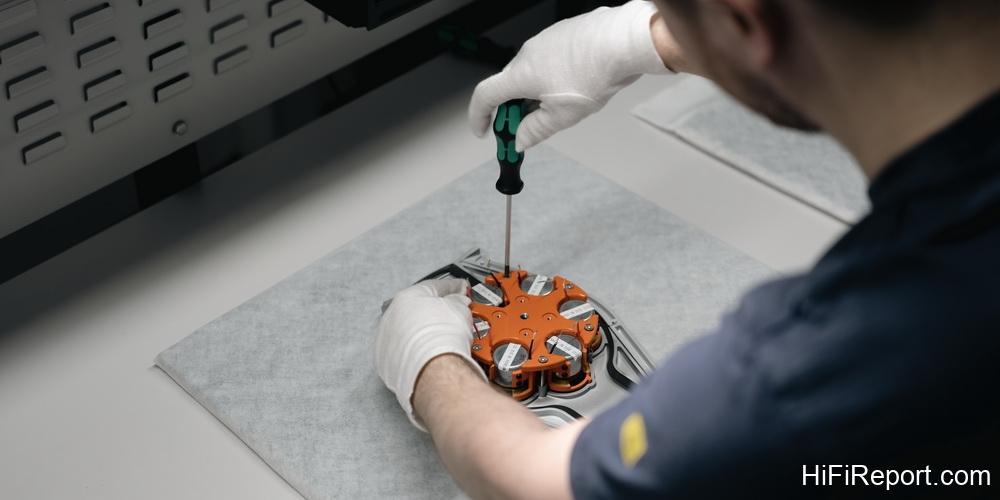
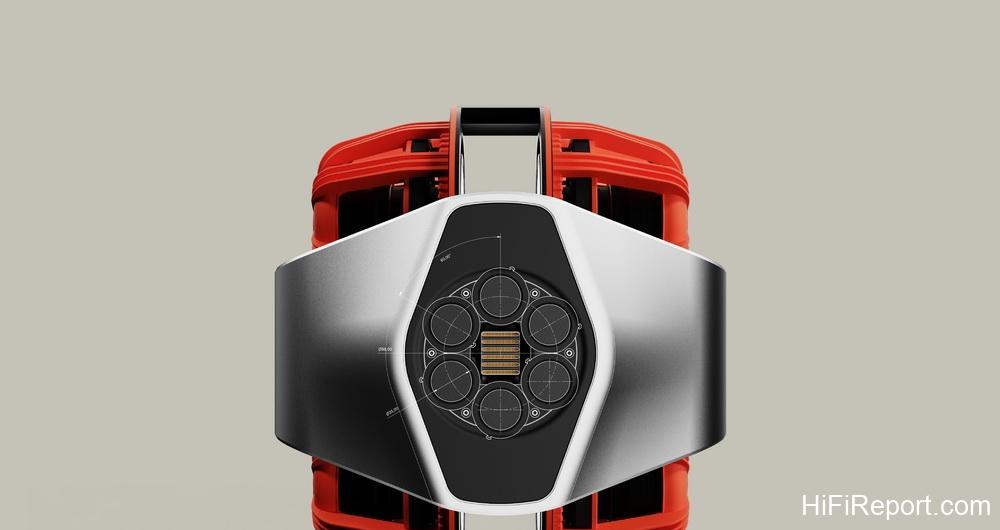
However, to meet the requirements of a large point source or large coaxial design, the traditional top-to-bottom arrangement of tweeter, midrange, and woofer cannot be used. Therefore, the midrange was first designed as a cluster of six 2-inch small midrange drivers surrounding the AMT tweeter, forming a coaxial concept. Furthermore, have you noticed how close the four woofers are to the tweeter and midranges?
This is a deliberate design choice to enclose the high-frequency and midrange drivers, creating a large coaxial concept around the outer edge, rather than placing them conventionally at the bottom of the cabinet. Monitor Audio calls this driver arrangement the M-Array. In fact, this M-Array tweeter and midrange unit is housed in its own separate enclosure, decoupled from the woofer cabinets.
This ensures that any vibration from the woofer cabinets will not affect the high-frequency and midrange drivers.
Driver Technology and Design
At this point, the cabinet is complete, and the driver arrangement is finalized. The next step was to design the tweeter, midrange, and woofer drivers from scratch. Fortunately, Monitor Audio already had experience manufacturing AMT tweeters, so creating the AMT tweeter used in the Hyphn wasn’t overly difficult. It features a diaphragm made with Micro Pleated Diaphragm (MPD III) technology.
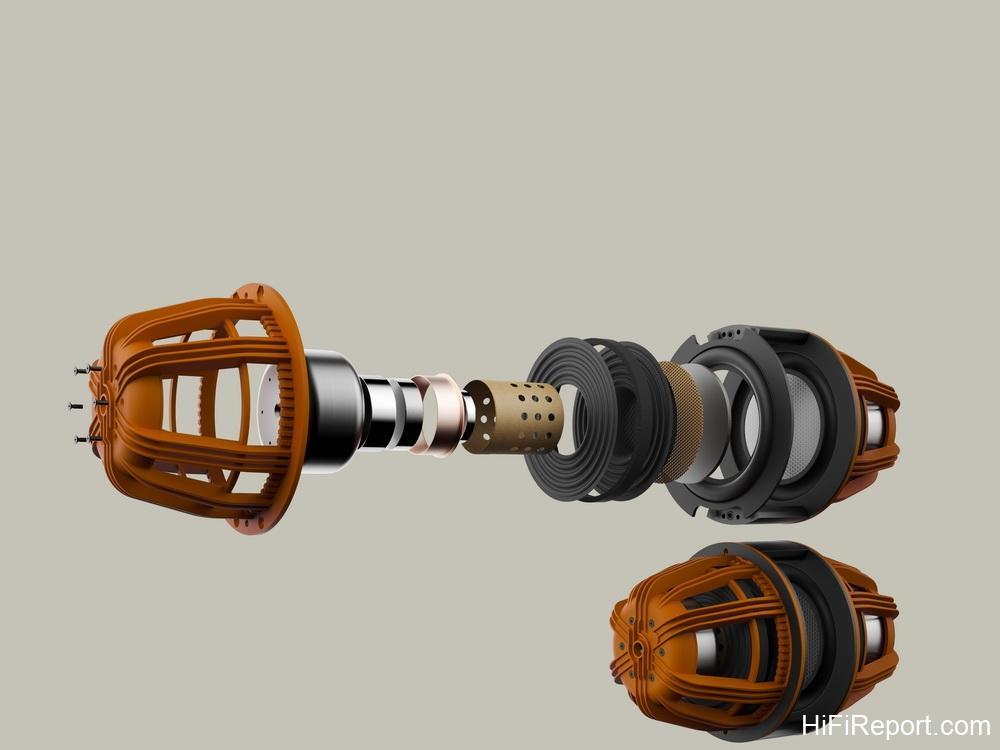
For the midrange drivers, calculations determined that six 2-inch flat-panel drivers were needed, using Monitor Audio’s proprietary RDT III diaphragm material. The 8-inch woofers are also flat-panel types. In other words, the tweeter, midrange, and woofer drivers are not cone-shaped.
Just how large is the total surface area of six 2-inch midrange drivers? The formula for the area of a circle is Pi multiplied by the radius squared. The radius of a 2-inch midrange driver is 1 inch, and 1 inch squared is still 1 inch. So, the area of a 2-inch diameter circle is approximately 3.1416 square inches. The total area of six 2-inch diameter midrange drivers is roughly 18.8496 square inches. Now, what about the diaphragm area of a single 6-inch midrange driver?
Ignoring the slight difference between cone area and circle area for a moment, a 3-inch radius squared multiplied by 3.1416 gives us approximately 28.2744 square inches, significantly larger than the total area of the Hyphn’s six small 2-inch disc-like midrange drivers.
In reality, the total area of the Hyphn’s six 2-inch midrange drivers is only roughly equivalent to the diaphragm area of a single 5-inch midrange driver. However, they can handle very high power and produce very strong sound pressure levels, something a typical 5-inch midrange driver simply couldn’t achieve. This demonstrates just how impressive the performance of Monitor Audio’s 2-inch small disc-like midrange drivers is. You might ask: why not design them as six 3-inch midrange drivers?
I believe Monitor Audio’s engineers likely considered this but perhaps found that the effect was not as good as with the 2-inch drivers, leading them to abandon that path. After all, making 2-inch or 3-inch midrange drivers involves similar technology and manufacturing processes. If 3-inch drivers performed better than 2-inch, there would be no reason not to use them.
AMT Tweeter
Next, let’s discuss the Hyphn’s drivers: the Micro Pleated Diaphragm (MPD III) and RDT III. Starting with the MPD III. The radiating element of this AMT tweeter is a very thin and light pleated diaphragm with very fine folds. When unfolded, its surface area is approximately 8 times that of a typical 1-inch soft dome tweeter. This results in strong sound wave energy and a frequency response extending beyond 60kHz. Conventional AMT tweeters usually extend to around 40kHz.
This AMT tweeter is designed as a rectangle rather than a circle to maintain identical horizontal and vertical dispersion characteristics, which helps create a better soundstage.
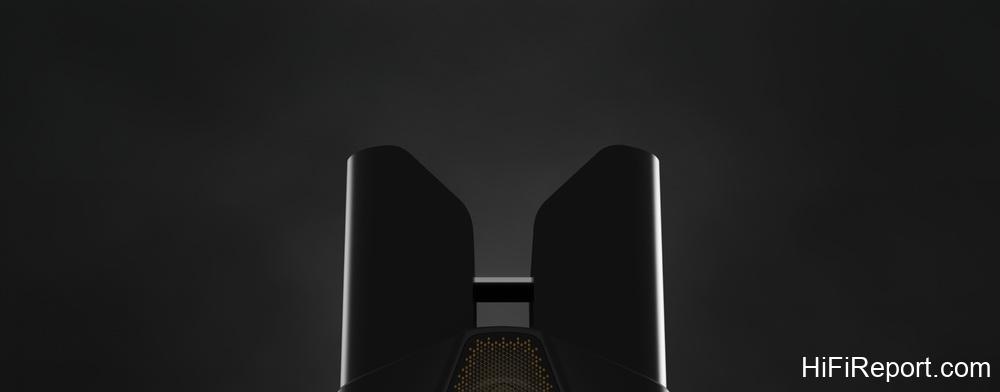
Monitor Audio noted that the volume of the space behind the AMT tweeter’s accordion-like folds also impacts the retrieval of fine details, so they specifically optimized this rear volume. Finally, a waveguide is placed in front of the AMT tweeter. This waveguide controls the high-frequency dispersion, ensuring better air impedance matching during sound radiation, thereby increasing sensitivity and enhancing soundstage performance.
Honeycomb Diaphragm
Now, let’s talk about Rigid Diaphragm Technology III (RDT III). This technology is used to create diaphragms for the midrange and bass drivers using a structure that is exceptionally light and strong, like a honeycomb. The surface layer of the diaphragm is made of C-CAM aluminum alloy, the bottom layer consists of two layers of carbon fiber, and the middle layer is a Nomex honeycomb structure.
Combined with a dual-surround suspension and a powerful magnetic system, the surround has also been optimized to reduce the possibility of surround breakage. Most RDT III midrange and bass drivers are cone-shaped, but the Hyphn’s midrange and bass drivers are flat. Why were they designed as flat drivers? Are flat drivers better than cones? The manufacturer’s explanation isn’t provided.
As for the orange framework visible on the drivers (only found on the Platinum series and Hyphn), it’s made of cast iron coated with orange-red paint. It’s heavy, sturdy, and vibration-resistant. The driver frameworks on the Gold series, Silver series, etc., are also made of cast iron but coated in grey.
Listening Setup
The listening environment for the Hyphn was my large open-plan space at home. The sources I used included the Weiss DAC502 ch4, as well as the emmLabs TSDX SE CD transport and DAC 2 SE DAC. The amplifiers paired with them were my Spectral DMC 30 SS preamp, Pass X350.5 (350W), Linear Acoustic 150.2 III SE (150W), two Classe Delta monoblocks (250W each), and the Burmester 218 (165W).
Each of these power amplifier setups had its strengths when driving the Hyphn, but the best match was the Burmester 077 preamp + 218 power amp. If using just the 218 power amp alone, the performance wasn’t quite as good.
Why is that? Because the Hyphn pairs well with amplifiers that have a somewhat more opulent high-frequency presentation, and, of course, sufficient output power is essential. While using the Weiss DAC 502 4ch. directly into the 218 to drive the Hyphn already delivered enough high-frequency sheen and sweetness to write a review, I felt it wasn’t as good as when the 077 was included. In fact, not all speakers sound better with a preamp.
For example, when listening to the B&W 801 D4, driving them solely with the 218, I found it more suitable than adding the 077 preamp. With the 077, the high frequencies sounded overly opulent.
Needs High-Power Amplifier
Furthermore, I strongly recommend driving the Hyphn with a high-power amplifier. Are Monitor Audio speakers easy to drive? Looking at the specifications, most are 4 Ohms with 88dB sensitivity (2.83V), or close to it. This is equivalent to an 8 Ohm speaker with 85dB sensitivity. Compared to a speaker with 90dB/8 Ohm sensitivity, Monitor Audio speakers are certainly harder to drive.
However, ease of driving cannot be judged solely by sensitivity; the impedance and phase curves must also be considered. If these curves show large fluctuations, it also indicates that the speaker is difficult to drive. Monitor Audio’s specifications do not provide these curves, so judgment must be made by listening. During the TAA Audio Exhibition in August, the Hyphn was driven by Orpheus Heritage Ultimate monoblock amplifiers (2,000W/4 Ohms) at the venue.
Since the Hyphn is a 4 Ohm speaker, it was being driven by a solid 2,000W power amplifier. No wonder it wasn’t fazed by any explosive music! I believe its maximum sound pressure level rating of 129dB is not an exaggeration.
Do you know what a sound pressure level of 129dB means? It’s roughly equivalent to the noise of a jet aircraft taking off, the maximum volume at a rock concert, hearing a gunshot at close range, or the sound of a pneumatic drill. Of course, we won’t listen to music at such extreme levels, but this 129dB SPL does reveal the Hyphn’s “extraordinary capability.”
Monitor Audio speakers are known for their robustness, and the Hyphn is no exception. Having witnessed its prowess at the audio exhibition, I started by testing it with some fairly explosive music. It didn’t falter one bit with Telarc’s recording of Tchaikovsky’s “1812 Overture.” Track 13, “Ode to Ludwig,” from Telarc’s “Beethoven or Bust,” was also incredibly impactful.
When listening to The Hu’s heavy metal rock track “Songs of Women” (the version featuring Lzzy Hale of Halestorm), I wasn’t afraid to turn the volume up high. To be honest, the time I spent listening to the Hyphn at high volume at home was short because I was worried about neighbor complaints. The Hyphn truly can be pushed to very high volumes without revealing any distortion.
Low Frequency Performance
The Hyphn’s low-frequency extension is exceptionally strong. I tested it with the Saint-Saëns “Symphony No. 3 (Organ)” conducted by Myung-Whun Chung. I felt the ethereal organ low frequencies, seemingly coming from nowhere, transmitting vibrations through my skin. When listening to Malia and Boris Blank’s album “Convergence,” the lowest frequencies crept in like a very deep organ, while some powerful bass notes felt like large water balloons oscillating towards me.
The Hyphn’s specifications list the in-room frequency response as 18Hz-60kHz at -6dB, and the bass reflex port’s tuning frequency as 25Hz. Based on the low-frequency performance I heard, I believe the Hyphn can indeed reproduce 25Hz audibly.
Not only does the Hyphn exhibit excellent low-frequency extension, but the range from low bass to mid-bass is also incredibly full, taut, and controlled. When listening to many pop songs, I could fully appreciate the punchiness of the bass. In Mayumi Itsuwa’s “Koibito yo” (My Lover), the thud of the kick drum was very solid. Listening to Alanis Morissette’s “You Oughta Know,” the kick drum and bass truly pounded out.
On Dido’s “Don’t Believe in Love,” the impact of the kick drum, bass, and other instruments creating the mid-bass energy was full, fast, and bouncy. Listening to Koji Tamaki’s “Yasou” from the album “Present,” the bass extended very low, and the kick drum had a quick, solid decay. Together, they created a captivating sonic effect.
Midrange Performance
The Hyphn’s midrange is dense, focused, and the outlines of instruments and vocals are clear without being aggressive. I find piano excellent for testing the midrange. On one hand, its wide range covers the entire midrange and beyond; on the other, it allows you to hear subtle string vibrations, rich harmonics, the touch on the keys, and a sense of physical presence. Using Beatrice Berrut’s piano solo arrangement of the second movement of Mahler’s Symphony No.
5, the Hyphn reproduced a very realistic, resonant sound. The notes had shape and body, not just diffuse sound. The sweetness and sheen of the piano notes were also ample.
Even more captivating were the rich harmonics. The Hyphn’s crossover points are set at 350Hz and 3.7kHz. In other words, the six 2-inch midrange drivers are responsible for this wide frequency range from 350Hz to 3.7kHz. This explains why the designers chose 2-inch rather than 3-inch midranges, as the frequency range of the 2-inch drivers could naturally extend above 3.7kHz to seamlessly connect with the MPD III AMT tweeter.
The frequency range above 3.7kHz is primarily where the harmonics of instruments reside, affecting aspects like moisture, sweetness, sheen, and timbre. Don’t believe it? Try temporarily disconnecting the wires to the tweeter and listen to what the music sounds like without it.
The Hyphn’s midrange and high frequencies are somewhat reserved, not forward-sounding. This gives piano and cello a rich, woody tone. It’s difficult to explain “woody tone” to non-audiophiles, but it’s essentially the warm sound inherent in acoustic instruments that one learns to appreciate with more listening experience. For example, when listening to Till Fellner’s performance of Beethoven’s Piano Concerto No.
5 (conducted by Nagano with the Orchestre symphonique de Montréal), I fully felt the warm, woody tone in the Hyphn’s midrange. This woody quality extended to the string section and brass as well. The string section with that slight rustle was truly captivating.
The Hyphn’s reproduction of the violin is reserved; it doesn’t become shrill. There’s a sense that the higher the pitch, the more reserved it becomes. I believe this is closely related to the six 2-inch midrange drivers, as the frequency range most commonly heard in violin performances is primarily between 500Hz and 2,000Hz, which falls within the midrange drivers’ domain.
As for the MPD III AMT tweeter, claimed to extend up to 60kHz, without it, the violin would sound muffled, dark, lacking sheen, sweetness, and color, like a photograph without light and shadow. In fact, when you put your ear close to the tweeter, you only hear a very faint violin sound; most of it is a hissing noise. But when this hiss is combined with the sound from the midrange drivers, it transforms into the captivating timbre and quality of the violin.
Not Harsh Even at High Volume
For example, when listening to Christoph Koncz’s performance of Mozart’s Violin Concerto No. 5 (accompanied by Les Musiciens Du Louvre), turning the volume up high doesn’t result in sharpness or harshness. The violin maintains a sweet, luminous sound. Listening to Henryk Szeryng’s performance of Paganini’s Violin Concerto No. 1 (conducted by Gibson with the London Symphony Orchestra), the violin also felt “silky” (using a Taiwanese Hokkien term), not coarse or harsh in the slightest.
The Hyphn’s cello reproduction doesn’t sound bloated but refined and focused. However, the texture of the bowing, the resonance of the instrument’s body, and the nasal ‘humming’ quality are all excellent, especially the clear (vibrato/tremor) in the trailing notes. For instance, listening to Emmanuelle Bertrand and Pascal Amoyel’s album of Brahms’ “Sonatas & Liebeslieder,” the Hyphn tightly focused the cello’s sound, preventing it from blurring, and revealed a wealth of cello details.
And when the piano played in the lower registers, the sense of the keys being struck with a relaxed yet tangible impact was truly superb.
Clear Bass Resolution
The Hyphn possesses very high resolution, but it’s not the kind of resolution that feels aggressive. Instead, it manifests naturally and subtly. For example, when listening to the title track from Anette Askvik’s album “Liberty,” I found that the Hyphn resolved the low-frequency range exceptionally clearly, allowing me to hear more bass details. Furthermore, I heard more subtle sounds in the mid-high and high-frequency ranges within the soundstage.
Some people might find the low frequencies in this song too muddy, but have you considered whether the recording engineer would actually produce such muddy bass? That’s a problem with your own audio system! Some people might feel that the soundstage in this piece isn’t open or deep enough, and the sense of space isn’t good. But do you really think the recording engineer was incompetent?
If you have the chance to listen to this track loudly on the Hyphn, you’ll realize you’ve been hearing it incorrectly all along.
Immense Scale and Impact
The Hyphn performs equally brilliantly with heavy metal rock and orchestral music, but in both cases, driving them with a high-power amplifier is essential to truly enjoy the experience. The sheer scale and impact of the sound waves are something smaller speakers cannot reproduce, and it’s also something you wouldn’t expect from a speaker of the Hyphn’s size.
In other words, the Hyphn is an “extraordinary” speaker; it can produce immense sound pressure levels far exceeding what its physical size would suggest.
Transformed
The Monitor Audio Hyphn is undoubtedly a pair of speakers with exceptional design, exquisite manufacturing, and superb performance. Calling them “extraordinary” is no exaggeration. Their external design perfectly serves all the speaker’s requirements, their drivers are specially crafted, and their sound performance is versatile, handling both delicate and powerful music with aplomb.
Frankly, I’m still a little surprised that these are Monitor Audio speakers, because it truly feels like a complete “transformation”!
Specifications
* Product Type: Three-way, 11-driver, bass-reflex floorstanding speaker
* Introduced: 2023
* Drivers: 1 x AMT tweeter, 6 x 2-inch midrange, 4 x 8-inch woofers
* Frequency Response: 18Hz-60kHz (-6dB)
* Sensitivity: 86dB
* Nominal Impedance: 4 Ohms
* Maximum SPL: 129dB
* Crossover Points: 350Hz, 3.7kHz
* Recommended Amplifier Power: 200W to 1,600W
* Weight: 106 kg (each)
* Dimensions (WHD): 502 x 1,392 x 520 mm
Focus and Recommendations
* The Hyphn’s design embodies “Form Follows Function,” featuring a unique split cabinet and opposing woofers.
* High and midrange drivers form a large point source.
* Capable of producing 129dB SPL.
* Excels with all types of music.