
Moon 891/861 Review
Moon is a Canadian audio manufacturer based in Quebec. I had the opportunity to visit Moon twice, in 2010 and 2013. Their factory spans over 41,000 square feet. For a high-end audio company, Moon’s facility is genuinely large. Beyond its size, their level of self-sufficiency is remarkably high; almost everything they can manufacture themselves is completed in-house.
They acquired CNC machinery for metalwork and later invested in component insertion machines, even fabricating their own circuit boards. Apart from purchasing bare PCBs and external components, nearly everything is handled within their own factory.
Why does Moon handle so much in-house? Because their production volume is substantial enough that manufacturing themselves is more cost-effective than outsourcing. They boast 102 dealers in North America and distribution in 46 countries worldwide, with European offices and a distribution center. The company currently employs 62 staff members.
Moon’s Journey
Established in 1980 by audio engineer Victor Sima, the company was initially named Sima and located in St. Hubert, Quebec. In 1990, it was renamed Simaudio Ltd. Jean Poulin acquired the factory from Victor Sima in 1994. By 1997, due to a confusing mix of product brands (starting with Telarc, then Celeste, followed by Sima and Sim Audio), the decision was made to unify the brand under Moon, with Simaudio Ltd. as the company name. From then on, Moon became the sole product brand.
In 1998, Moon products expanded into the UK and Russia. The following year, Moon introduced the Eclipse CD player, the world’s first CD player with 24/96 digital inputs. 2005 saw the launch of the Evolution Class products, featuring significant upgrades in both aesthetics and sonic performance. In 2006, the company acquired its first CNC equipment. My 2010 visit was to their old factory; they moved to the new facility in 2011.
In 2012, they unveiled the Moon Intelligent Network Device (MiND), their first network streamer.
My second visit was in 2013. Shortly after, Jean Poulin sold the company to Costa Koulisakis (Sales) and Thierry Dufour (Engineering), who were already key figures, joined by Louis Lemire. These three became the new owners. Costa initially served as CEO, with Thierry now holding the position.
Introducing the North Collection
Moon kept pace with the times, launching the ACE All-in-One product in 2016. In 2017, they acquired PCB insertion machines, enabling in-house circuit board production. The company received the Quebec SME Award in 2018. That same year, they introduced their flagship 888 power amplifier, designed with 37 years of accumulated experience and representing their peak achievement. 2019 brought MiND2, the second generation of their streaming platform.
Also in 2019, they released the 390, a groundbreaking preamp combining preamplifier, DAC, streamer, phono stage, and headphone amplifier – a truly landmark product for Moon.
For their 40th anniversary in 2020, they launched commemorative models, including the 680D streaming DAC/preamp and the 600iV2 integrated amplifier, featuring a special rose gold finish. In 2022, they ventured into loudspeakers with the Voice 22, a two-way bookshelf design. Their latest significant launch, in 2023, is the North Collection, divided into three tiers: 600, 700, and 800.
The North Collection was five years in development. Why “North Collection”? Because Canada is in the northern hemisphere, Moon’s company is located in northern Canada, and a compass needle always points north. North signifies guidance and direction, holding special meaning for Moon.
According to Moon’s Technical Director, Dominique Poupart, market research indicated that audiophiles increasingly prefer fewer boxes. A system with separate phono stage, preamplifier, DAC, and streamer involves four components. Integrating these functions into a single chassis was seen as highly desirable, leading to the North Collection.
The North Collection comprises three tiers: the entry-level 600 series with the 641 integrated amplifier and 681 streaming DAC/player; the intermediate 700 series featuring the 791 streaming DAC/preamp and 761 stereo power amplifier; and the flagship 800 series, home to the 891 streaming DAC/preamp and 861 stereo power amplifier.
Moon 891 Streaming DAC/Preamplifier
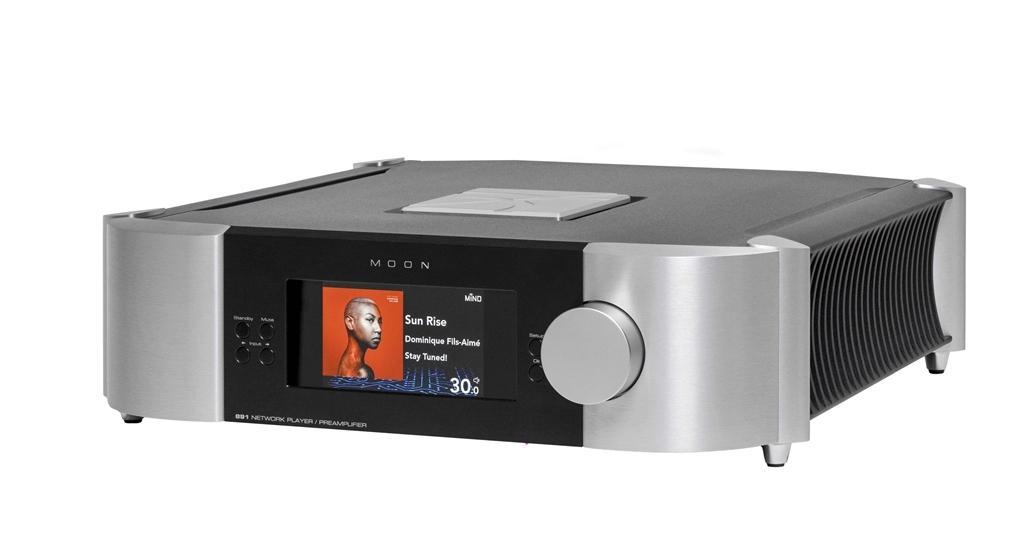
The 891 is a comprehensive preamplifier combining streaming, DAC, preamplification, and phono stage functions, similar in concept to the 791 I previously reviewed. However, everything within the 891 has been significantly upgraded. Aesthetically, the 891 is essentially a larger version of the 791. It features a central 5-inch display, a large control knob on the right, and gracefully curved panels on either side that are both visually appealing and serve to protect the chassis.
Large, inwardly curved heatsinks flank the sides. While the 891 doesn’t run particularly hot, these heatsinks contribute to both aesthetics and chassis rigidity. The front, side, and top panels are constructed from thick metal plates, and the chassis is supported by substantial metal feet at each corner, resulting in a build quality akin to a fortress.
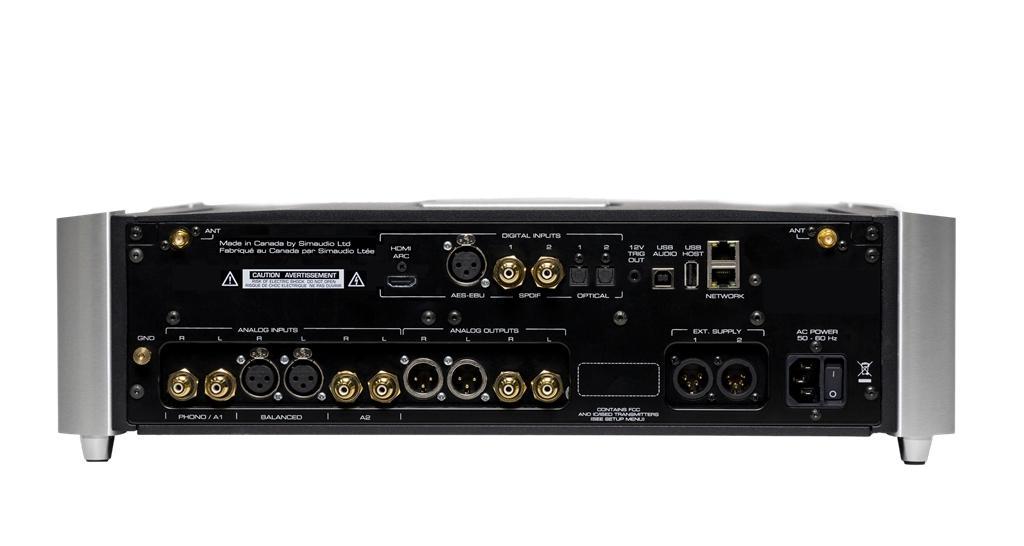
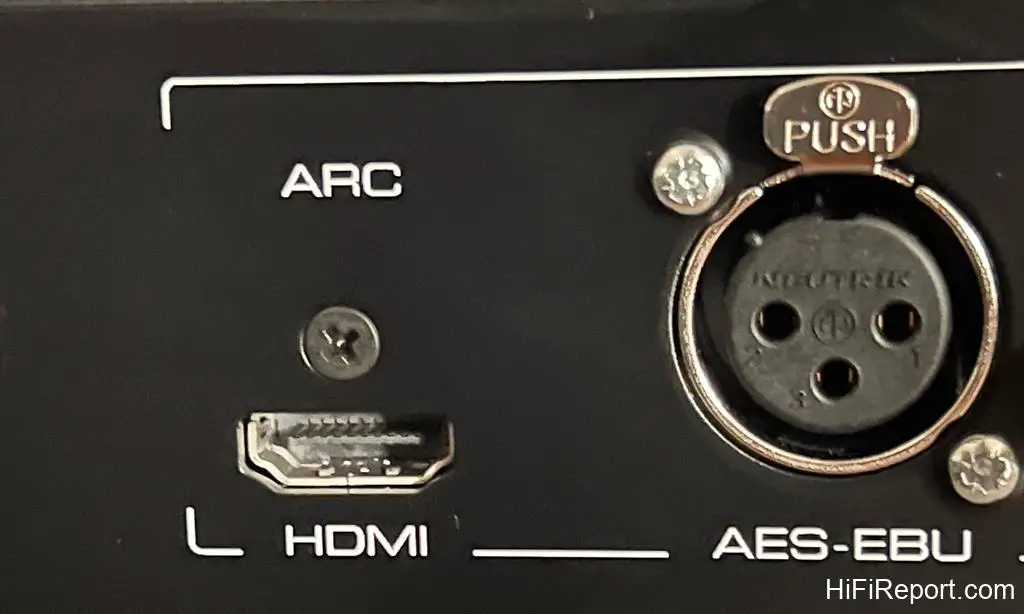
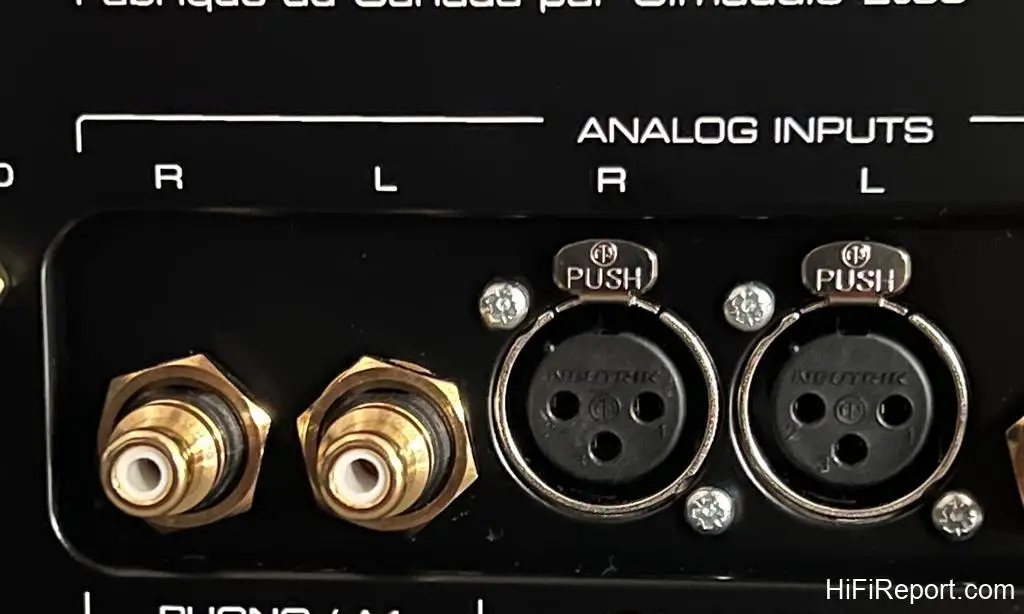
To the left of the display are buttons for Standby, Mute, and Input selection. To the right are Setup and OK buttons, used in conjunction with the volume knob for menu navigation and settings. The rear panel is well-equipped: six digital inputs (AES/EBU, two RCA coaxial, two optical, USB DAC), one ARC input (HDMI), three analog inputs (Phono, RCA, XLR), and two analog outputs (XLR, RCA).
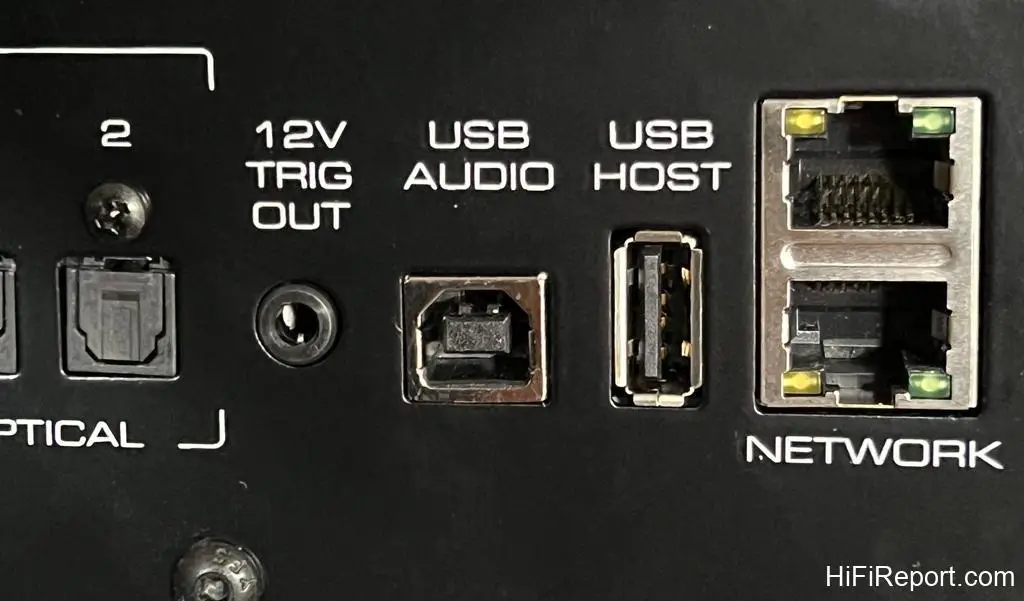
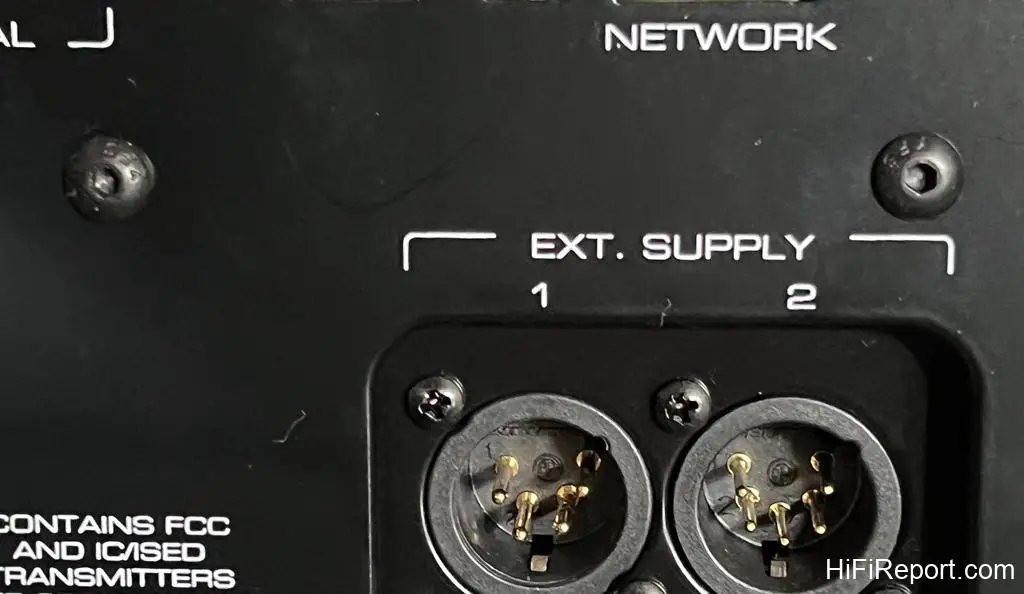
The analog outputs can be configured for variable or fixed output via the menu; fixed output is useful for connecting external headphone amplifiers or other sources. Additional connectors include 12V triggers, USB Host (for local playback from a hard drive), a Wi-Fi antenna terminal, two Ethernet ports (one for Moon Link), and an EXT. Supply XLR terminal for connecting an external Moon power supply.
The Setup menu offers 13 adjustable items, each with detailed settings. I won’t go into specifics here; users can find detailed instructions in the 891’s manual. It’s worth noting that the 891 includes an excellent MM/MC phono stage – it’s far more than just functional. Adjustable settings include gain (40dB/54dB/60dB/66dB), capacitance (0/100/470pF), and load impedance (10/100/1k/47kΩ).
You can also select between RIAA EQ and IEC EQ (which filters out very low-frequency noise), making it as versatile as a standalone phono preamp. Don’t let this capability go unused.
Furthermore, the MiND 2 platform is compatible with Roon, Tidal Connect, Spotify Connect, and AirPlay. It can directly stream from Tidal, Spotify, and Apple Music, a convenient feature often missing from other network players. Remember to download the MiND App when using the 891.
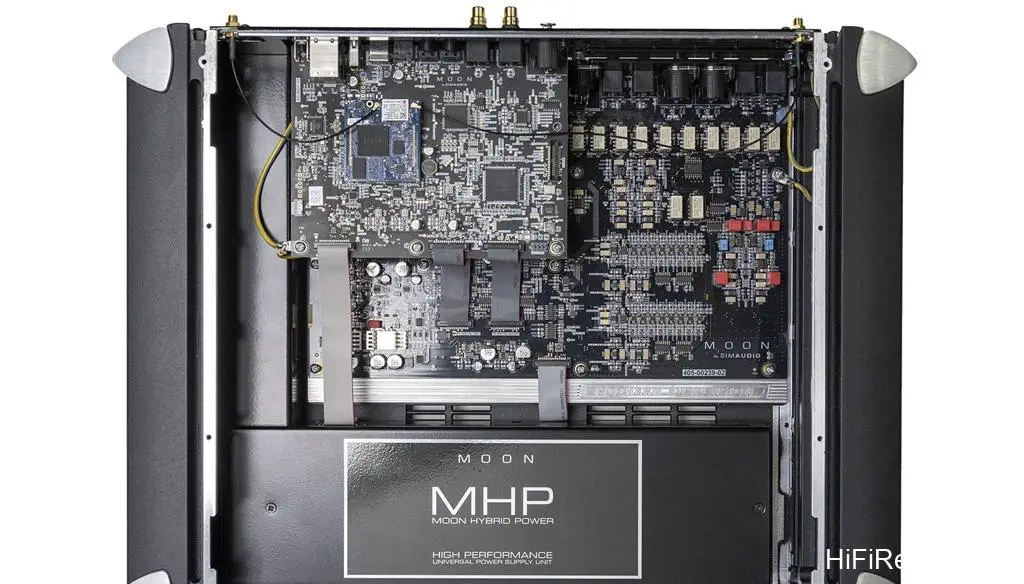
Lifting the top cover reveals the 891’s internal layout, similar to the 791. The front section houses the sealed MHP (Moon Hybrid Power) supply, followed by a large main circuit board and a digital board stacked above it, containing the MiND2 streaming module and DAC. The Moon Hybrid Power (MHP) supply is designed to meet two key objectives: first, to create a more efficient power supply with a lower carbon footprint; second, to achieve better sound quality than traditional power supplies.
MHP is a high-quality mixed design combining switch-mode and linear power supply technologies, developed over years of Moon’s experience. The input stage can handle a wide voltage range, eliminating the need for manual voltage selection (no need to choose between 110V or 220V). The output section is closer to a linear design, offering extremely low noise and highly precise regulation.
The 891 utilizes Moon’s top-tier MDE-3 DAC technology. Volume control is handled by the M-Ray2 system. Internal construction and isolation techniques employ MDB technology. The streaming capability integrates Moon’s previously separate MiND playback mechanism directly into the unit.
MDE3 DAC is Moon’s flagship digital engine, used in the top-of-the-line 891. To effectively tackle jitter, incoming digital signals are processed by a proprietary Field-Programmable Gate Array (FPGA) design, coupled with a femto-second (10^-15 second) precision clock. This reduces timing errors beyond the range of human hearing.
The MDE3 uses one ESS 9038 Pro chip per channel. Each DAC chip is meticulously selected and measured to ensure precise matching. The MDE3 also automatically reconfigures itself to adapt to different digital signal formats (PCM, MQA, DSD), ensuring optimal playback for various digital standards without requiring manual selection or adjustment.
The 891’s volume control system is their second-tier system (the top-tier M-Ray is used in the flagship 850P preamp) – M-Ray2. This electronic gain control system was designed by the Moon Engineering team and is very similar to the M-Ray volume control used in the 850P reference analog preamplifier. “Ray” stands for “Array,” indicating the circuit’s use of an R-2R array composed of 0.1% precision thin-film resistors and switching transistors.
When the user rotates the volume knob on the front panel, it activates an optical encoder connected to the internal R2R array, which changes the volume. In the default mode, there are 140 steps, configurable from 0 to 20 in 1dB increments and from 20 to 80 in 0.5dB increments. In fine mode, there are a total of 640 volume steps, with 0-20 in 1dB increments and 20-80 in 0.1dB increments.
The M-Ray2 volume control system offers channel level accuracy better than 0.1dB and lower crosstalk than any potentiometer, producing precise, well-defined 3D sound images. Among their extensive product lineup, only the 891 utilizes the M-Ray2 system.
Moon 861 Stereo Power Amplifier
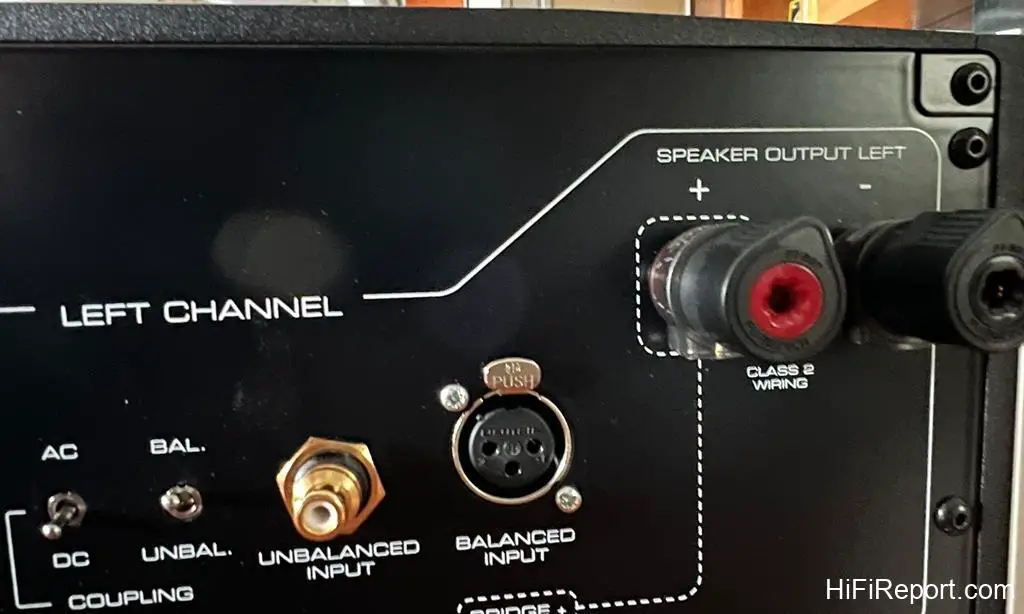
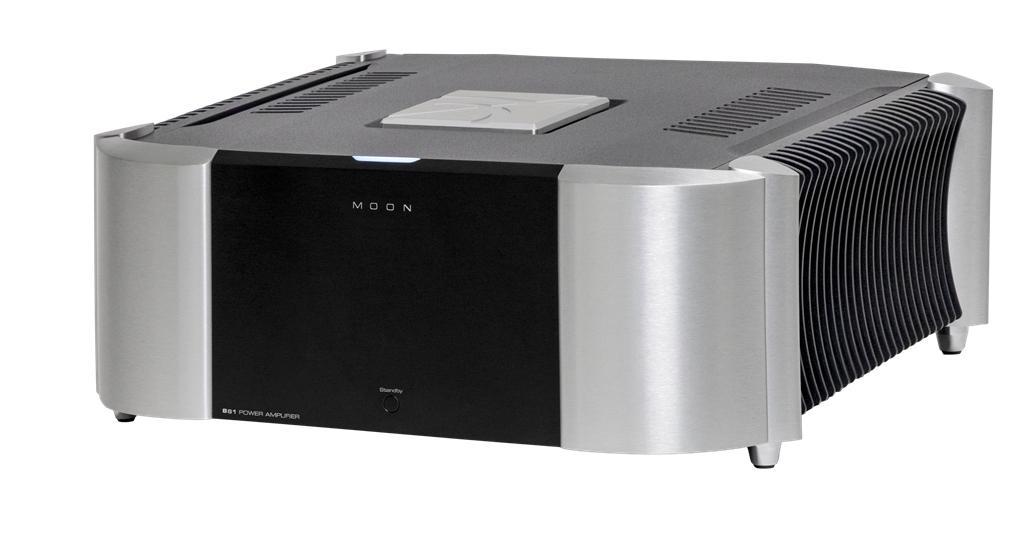
Now let’s look at the 861 stereo power amplifier. Its appearance is also similar to the 891, though without a display screen on the front panel. It features only a Standby button and a small indicator light at the top center showing different internal states. The chassis has large, inwardly curved heatsinks on both sides, and ventilation slots on the top panel. A large logo dominates the center. Like the 891, the top cover is free of visible screws, lending a premium feel.
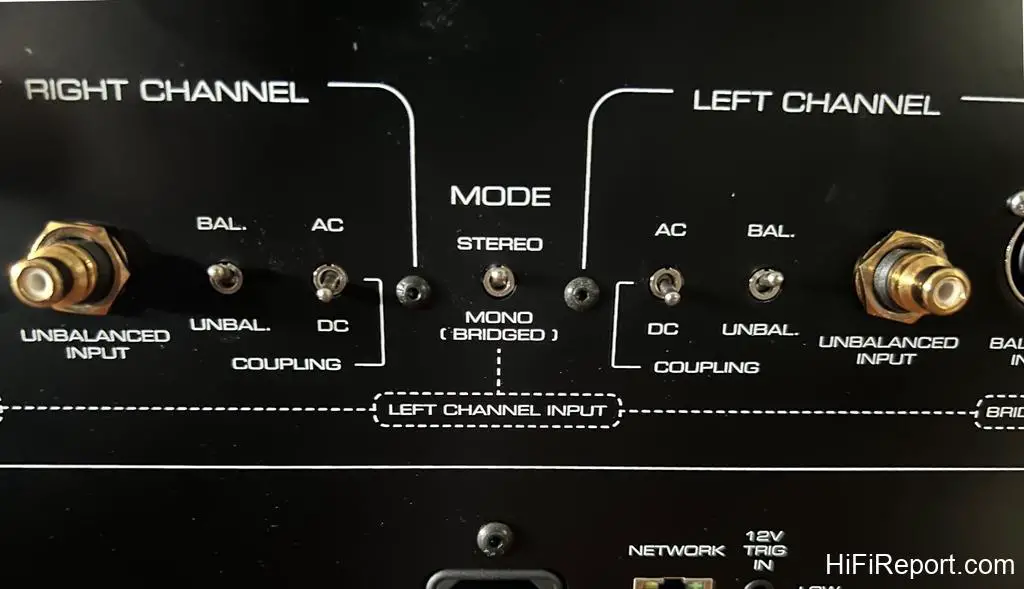
The rear panel houses one pair each of XLR and RCA inputs, and one set of speaker terminals per channel. Additionally, there are small toggle switches for Balanced/Unbalanced input selection, AC/DC mode, and Stereo/Mono operation. In stereo mode, the output power is 300 watts per channel into 8 ohms and 600 watts into 4 ohms. In mono mode, it delivers 800 watts into 8 ohms, making it truly “invincible.”
The 861 weighs 58 kg with packaging; without the box, it’s still over 40 kg, requiring two people to lift – it’s undoubtedly “sturdy and imposing.”
The indicator light on the front panel signifies different states: flashing yellow indicates a DC input, alternating orange and green flashing means a fuse is blown, flashing orange signals voltage protection activation, flashing red means the temperature is too high, and flashing purple indicates a firmware upgrade failure. The normal display is blue.
Let’s explain the AC/DC switch. This feature is used to block external DC voltage input. If your preamplifier is older or the indicator light frequently shows a DC input, switch to the AC position. This blocks external DC, protecting the power amplifier.
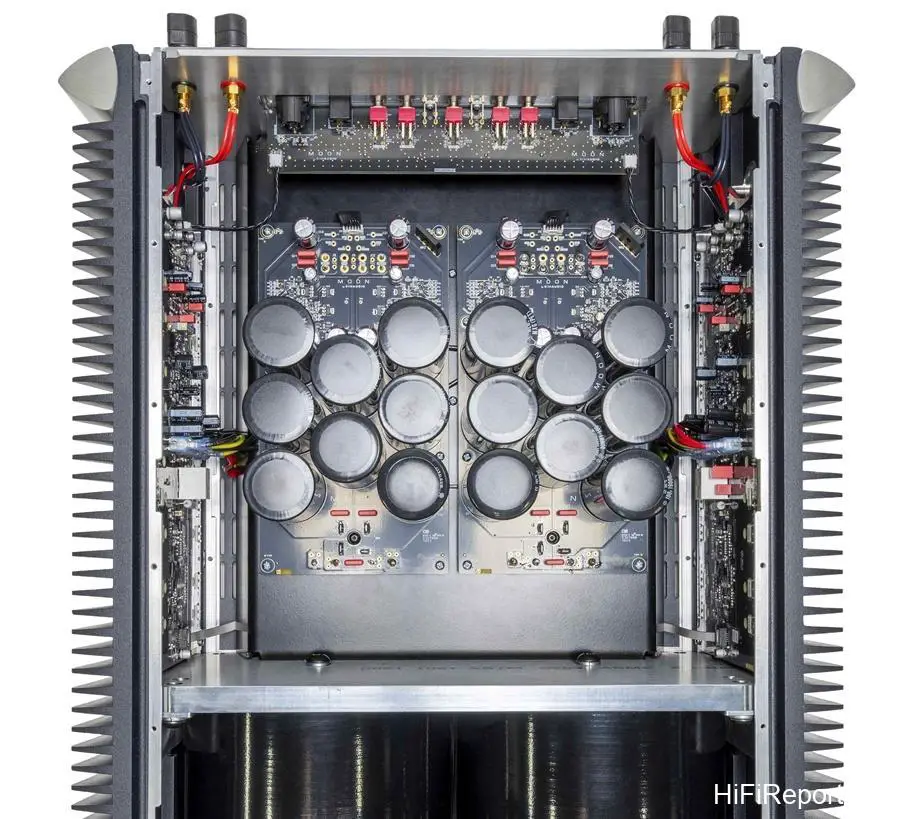
Removing the top cover reveals two massive 1,500VA toroidal transformers standing vertically at the front. Behind them are eight large filter capacitors per channel, totaling 228,000 uF of capacitance. The power output stage circuit boards are mounted vertically on either side, directly coupled to the heatsinks.
The 861’s amplification circuitry employs Moon’s long-developed MDCA circuit. MDCA (Moon Distortion Cancelling Amplifier) is an amplification circuit refined over Moon’s forty-plus years of experience, designed to reduce distortion and coloration caused by the amplification process. How is distortion canceled? A distortion sensing circuit compares the input and output signals in real-time, sending a correction signal to the output stage.
While seemingly similar to negative feedback, it achieves even lower distortion than traditional negative feedback circuits. This circuit design is utilized in the 641, 761, and 861 amplifiers.
The power transistors used inside the 861 (and indeed all Moon amplifiers) are custom-made bipolar power transistors commissioned by Moon from their partner, Motorola. These transistors offer tighter tolerances compared to other bipolar types. Moon’s bipolar power transistors boast wider bandwidth, lower distortion, and unprecedented linearity. Their superior DC gain (HFE) ensures the amplifier maintains optimal sound performance at any output level.
The chassis structure of the 891 and 861 incorporates Moon’s MDB (Moon Damping Base) mechanical isolation method. This new mechanical damping system uses a gel-like material to isolate and suspend the circuit boards from the chassis base plate. This reduces microphonic effects and improves isothermal heat dissipation. Microphonic effects from subtle vibrations on the circuit boards can degrade sound resolution and detail retrieval.
Applying MDB results in more natural sound, higher resolution, and richer detail. Additionally, the thick aluminum chassis provides higher moment of inertia and lower vibration.
Listening Impressions
I auditioned the 891/861 in my large open-plan listening space, pairing them with AER Momentum and DynamiKKs! Monitor 10.15 loudspeakers. Both pairs have sensitivities around 95dB, classifying them as high-sensitivity speakers, which theoretically don’t require hundreds of watts to drive. However, I’ve found over the years that driving high-sensitivity speakers with high-power amplifiers positively benefits the mid-range and low-frequency performance, enhancing overall sound quality.
So, if you use high-sensitivity speakers, don’t limit yourself to low-power amplifiers; quality high-power amplifiers can also be excellent.
After multiple comparisons, both speaker pairs matched well, but I ultimately chose the DynamiKKs! Monitor 10.15. The reason is that the AERs sounded finer and softer, while the DynamiKKs! projected a more heroic presence. Instruments had full, cohesive forms and large sizes, making for a highly satisfying listen, especially with a prominent mid-range that brought the music closer to the listener. Since the 861 outputs 300 watts per channel, I chose the DynamiKKs to fully utilize its power.
Typically, when an amplifier has high power output, some might worry if it’s just brute force, lacking musical vitality – sounding stiff, not refined, just muscular. Let me assure you, when the 891/861 was paired with the AERs, the sound was refined, soft, highly resolving, with excellent front-to-back layering of the soundstage, and ample musical liveliness.
This demonstrates that the 891/861 can reveal the distinct sonic characteristics of different speakers rather than imposing its own signature, indicating that the 891/861 is fundamentally quite neutral.
The 891/861 presents sound with full lines, high density, and instruments/voices that are substantial but never diffuse. Transient response is lightning fast, and the driving power is truly astonishing. Listening to “In Dictum” from Wallis Bird’s “Retrospective Sessions,” even with just vocals and steel-string guitar, the solid coherence and rapid transients were striking.
The speed and firmness of the guitar strumming and the clear, full, beautiful, and detailed texture of the singer’s voice were impressive. Listening to “I Remember You” from “Kenny Rogers With David Foster,” his voice was utterly captivating, very prominent but without any sense of pressure, making it sound authentically “real.” The accompanying orchestral strings were incredibly soft, bringing a feeling of comfortable relaxation, like a summer breeze passing through an old house hallway.
With Diana Krall’s “Quiet Nights,” the string section was smooth as silk, and her soft, dreamlike voice constantly flowed forward. The soundstage was wide, and every accompanying instrument within it appeared with exquisite clarity. This combination of vast musical scale and refined detail highlights the advantages of the 861’s high power.
Listening to “Sister Rosetta Goes Before Us” from Robert Plant and Alison Krauss’s “Raising Sand,” the 861 displayed superb driving force and control. This album is a notorious test track; most systems render the low frequencies muddy or the high frequencies sharp, making it hard to understand its five Grammy awards (and nominations) in 2009.
In “Sister Rosetta Goes Before Us,” the bass line is very heavy. If the driving power is insufficient, control is poor, or the listening space has severe mid-bass peaks, the low frequencies become muddy, obscuring other subtle musical details. Furthermore, the violin within is delicate and sweet, as is Alison Krauss’s voice. Systems with sharp high frequencies will distort the violin and her voice, making them unpleasant.
The 891/861 performed exceptionally here. Both Alison Krauss’s sweet voice and the violin’s smooth sound were beautifully rendered, showcasing their inherent quality. Control over the entire low end was excellent, heavy but not indistinct, with cohesive and dense form. The ability to reproduce this song so well demonstrates that the 891/861’s capability surpasses that of many amplifiers.
Next, I listened to Sara Bareilles singing “Goodbye Yellow Brick Road” (live version). The piano had strong impact, and her voice was full of energy, penetrating, and sweet. This song fully revealed the 861’s power and beauty, vividly presenting the fiery atmosphere of a live concert. Then, I switched to Sandy Lam’s “For Those Who Waited the Longest.” Here, the 891/861 shifted to a soft, delicate sonic character, a strong contrast to Sara Bareilles’ bright, powerful delivery.
This confirms the 891/861’s versatility, capable of both grace and power, softness and strength.
Moving on to Nelson Freire playing Beethoven’s Piano Concerto No. 5. The piano notes were very solid, with first-class realism, but the form wasn’t excessively large. There was plenty of woody texture, warm and rich. This characteristic of the piano recording was completely different from “Goodbye Yellow Brick Road,” belonging firmly to the classical music aesthetic.
The accompanying orchestra had clear layering, and the scale of the music and the piano’s form were well-balanced, resulting in an overall harmonious sound.
Listening to Pierre Goy perform Ravel’s “Berceuse sur le nom de Fauré” (a tribute to Fauré) for violin and piano, the violin’s tone and timbre were simply beautiful! The accompanying piano also sounded very realistic. Such beautiful tonal quality and realistic instrument texture once again declared the 891/861’s excellence in sound quality and fidelity.
With Maxim Vengerov’s “Encores,” the violin’s brilliant, sweet, tight, smooth, and lustrous tone was utterly captivating. The accompanying piano also sounded excellent. This piece highlighted the beauty in tonal quality and timbre of this preamp-power amp duo, as well as the realism of the instrument’s texture.
Listening to Isabelle Faust and Alexander Melnikov perform Beethoven’s Violin Sonata No. 9, in fast passages, both the violin and piano exhibited incredible transient response. The variations in dynamics from both instruments were very clear, making the music sound incredibly fiery. This is also representative of the 891/861’s sonic character.
Hearing Abels’ “Global Warming” from the Sphinx Virtuosi album “Songs For Our Times,” the string section was incredibly beautiful. The violin’s soft bounce also revealed the 891/861’s character – a very lively and real feeling of violin performance.
When listening to Pepe Romero play the anonymous “Farrucas” Flamenco piece, the guitar’s size and proportion were correct, not exaggeratedly large. The powerful but not overblown sound of the foot stomps behind were impressive, especially the full presentation of the nylon string guitar’s beauty. The rapid strumming of the guitar, the powerful foot stomps, and the crisp sound of the castanets all showcased the rapid, clean, and precise transient response of this preamp/power amp.
The instrument decay and sense of space were very clear.
Listening to Fazil Say playing Mozart’s “Fantasia in D Minor, K. 397,” the piano notes were full, the bass keys had strong impact, harmonics were incredibly rich, and the woody character was still retained, preventing the piano sound from becoming metallic. I then listened to Christoph Dange (cello) and Stefan Preyer (double bass) perform Rossini’s “Duetto Per Violoncello e Contrabasso,” the famous duo for cello and double bass.
The relaxed string vibration of the double bass and the texture of plucking and bowing were fantastic. Conversely, the cello sound here wasn’t as beautiful as I desired; there was an excessive amount of spatial reverb, making the cello less crisp. This is likely a characteristic of the recording itself.
When I listened to Sergei Stadler perform Sibelius’s Violin Concerto (conducted by Peter Lilye with the Moscow RTV Symphony Orchestra), the various effects of the violin sound were simply captivating for any audiophile, and the powerful surge of the orchestra once again attested to the 861’s boundless driving force.
The Moon 891 streaming DAC/preamplifier is Moon’s multifunctional source component, capable of accommodating various digital sources, vinyl systems, or other inputs. The 861 stereo power amplifier is both invincible and versatile, capable of both grace and power, softness and strength. When these two products are paired, they become virtually unstoppable, capable of meeting the diverse needs of audiophiles.
If you are planning for the long term, this system should be able to complement your continuously upgraded loudspeakers without needing to replace the core components. Furthermore, Moon offers a 10-year warranty, a confident and assertive commitment from the factory.
Specifications
Moon 891
* Product Type: Streaming player, DAC, Phono stage, Preamplifier All-in-One
* Launch Year: 2023
* Streaming Support: Roon, Tidal Connect, Spotify Connect, AirPlay
* Decoding Support: PCM: 44.1kHz-384kHz/16-32bit, DSD: DSD64-256
* Digital Inputs: Ethernet LAN×2, USB type B x1, Optical×2, Coaxial×2, AES/EBU×1, HDMI ARC×1
* Analog Outputs: RCA×1, XLR ×1
* Total Harmonic Distortion: 0.0004%
* Weight: 19 kg
* Dimensions (WHD): 481 x 102 x 449 mm
Moon 861
* Product Type: Two-channel Solid-state Power Amplifier
* Launch Year: 2023
* Output Power: 300 watts per channel (8Ω), 600 watts (4Ω), 800 watts (8Ω, mono mode)
* Total Harmonic Distortion: 0.001% (@ 200W)
* Damping Factor: 900
* Weight: 57 kg
* Dimensions (WHD): 481 x 210 x 609 mm
Highlights
* Comprehensive features meet various source requirements.
* High power output can drive challenging speakers.
* Backed by a 10-year warranty.
* Sound is versatile, capable of both strength and delicacy.