
NAD M66 Review
NAD’s flagship “Masters Series” is home to some of their most iconic components. Previously, the M33 integrated amplifier made waves, combining Dirac Live room correction with the “King of Class D,” Purifi Eigentakt amplification. This was a formidable pairing of two cutting-edge technologies, offering robust 200-watt-per-channel power with ultra-low distortion, enhanced by comprehensive room correction. Frankly, the M33 could outperform many separate preamplifier/power amplifier combinations.
So, where could NAD go next? Their answer was a new separates system: the M23 power amplifier, already released, featuring NAD’s special version of the Purifi Eigentakt module and a potent power supply, followed by the much-anticipated M66 streaming preamplifier.
Streaming Features and Connectivity
Functionally, the M66 is equipped with Wi-Fi and Bluetooth, and features BluOS multi-room streaming. It can connect to your network to play music files shared from a PC running the BluOS app as a server, or from a NAS. Users can also connect a USB hard drive filled with music folders to the rear USB port, turning it into the M66’s local music library.
With the recent BluOS 4.2 update, the M66 can now even act as a server itself, sharing the music files on the connected USB drive with other BluOS-enabled audio equipment in different rooms.
Beyond playing your own music files, BluOS provides the M66 with an incredibly rich suite of streaming capabilities. NAD is one of the very few brands that supports KKbox and also one of the few that supports Tidal Connect (making Tidal operation much more convenient). The M66 is MQA-capable, and you can even stream the high-quality MQA-encoded Radio Paradise station for free.
This allows users to directly compare the sound quality differences between MQA (Hi-Res) and CD-level playback of the same musical content.
Streaming is undeniably important, but for many modern music enthusiasts, YouTube videos combining audio and video are a significant, often the most frequently used, primary source of music content. I believe many users have also noticed that starting this year, an increasing number of music videos (including classical music) are becoming available in 4K (2160p). The NAD M66 is equipped with an HDMI eARC port.
By connecting it to an HDMI input on your smart TV that supports ARC, the M66 can receive digital audio output from the TV, allowing your audio system to completely replace the TV’s built-in speakers. This capability ensures users can fully enjoy YouTube music videos and experience stronger sonic energy and impact when watching Netflix or Disney+ streaming movies through their hi-fi system.
Architecture and Design Philosophy
Let me explain the hardware structure and applied technologies of the NAD M66. I must say, in my nearly thirty years of analyzing audio circuits, this is the most unique, advanced, and thoughtfully designed preamplifier structure I’ve seen. It features optimized signal paths and processing flows for both digital and analog sources.
The M66 isn’t like most products that simply add some components after a streaming player’s DAC circuit to give them partial preamplifier functions (mainly just volume control). I can clearly see that the designers treated the streaming preamplifier and analog preamplifier sections of the M66 as “independent entities” during design, and then integrated them.
The Analog Signal Path
Starting with the analog preamplifier section, the M66’s phono stage supports both MM/MC cartridges. The phono circuit and other analog inputs (Line in) undergo buffer amplification before source switching. Following this, the unit employs a flagship-grade volume control chip, the MUSE72323. This chip digitally “controls” the switching of internal resistor arrays to adjust the level of the input audio signal, thus providing “analog volume control.”
The MUSE72323 is also one of the highest-performance, quietest volume control chips available today, with output noise as low as 0.63µVrms (less than one-millionth of a volt). At the final stage of the M66’s analog preamplifier circuit are the source switching, buffered preamplifier output, and headphone amplifier circuits.
Because the unit has a complete analog preamplifier circuit, it can allow each analog input signal to follow an “Analog Direct” path, functioning just like any “pure analog” preamplifier, handling only phono equalization, source selection, volume control, and amplification, without any A/D or D/A conversion between digital and analog domains.
Advanced Room Correction: Dirac Live
News of NAD’s plan to launch the M66 surfaced in May of this year, and at the time, enthusiasts were surprised not only by the inclusion of Dirac Live but also by its ability to connect up to four subwoofers! When NAD Product Manager Cas Oostvogel visited Taiwan previously, he mentioned that the M66 would not only feature Dirac Live Full Bandwidth (20Hz to 20kHz full-range correction) but also Dirac Live Bass Control Multi Subwoofer.
This advanced feature optimizes and calibrates the low-frequency response and phase alignment between the main speakers and up to four subwoofers. After calibration, it ensures a very flat and balanced frequency response not just at the “sweet spot” but across all listening positions in the area. Cas also hinted that in the future, M66 users might have the option to pay for a Dirac Live ART upgrade.
Regardless, the NAD M66 comes standard with Bass Control Multi Subwoofer, a feature positioned above the “Full Bandwidth” version of Dirac Live. In the realm of two-channel audio products, this represents the highest level of Dirac technology currently equipped.
Digital Audio Processing
Implementing Dirac Live room correction necessitates digital audio processing. The M66 also debuts NAD’s DDH (Dynamic Digital Headroom) technology. In the process of digitally processing native low-sample-rate audio to a higher sample rate, DDH is able to insert calculated new samples between two adjacent samples of the native audio.
This results in a signal that more closely approximates the linear state of analog audio, effectively eliminating inter-sample clipping distortion present in native digital audio. To put it more simply, DDH’s effect is to significantly improve the linearity characteristics when playing CD-level digital audio on this unit, making it sound closer to Hi-Res.
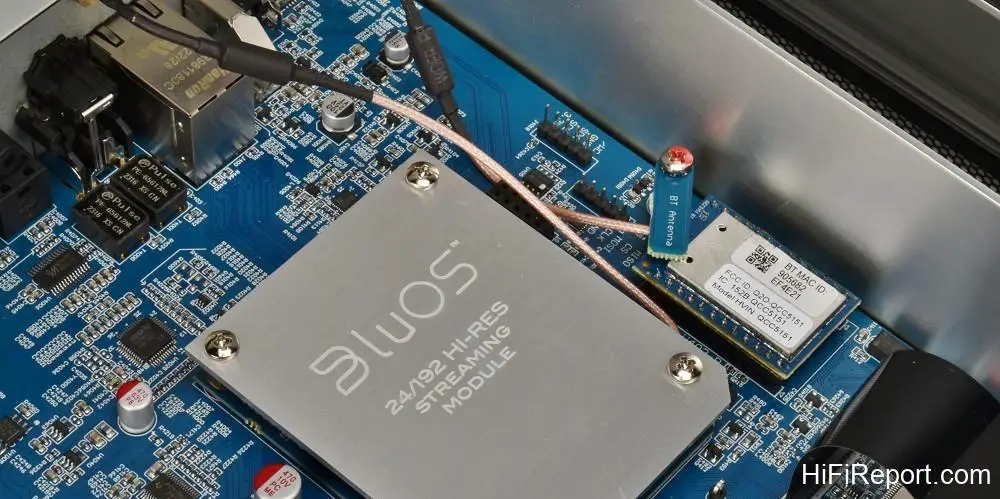
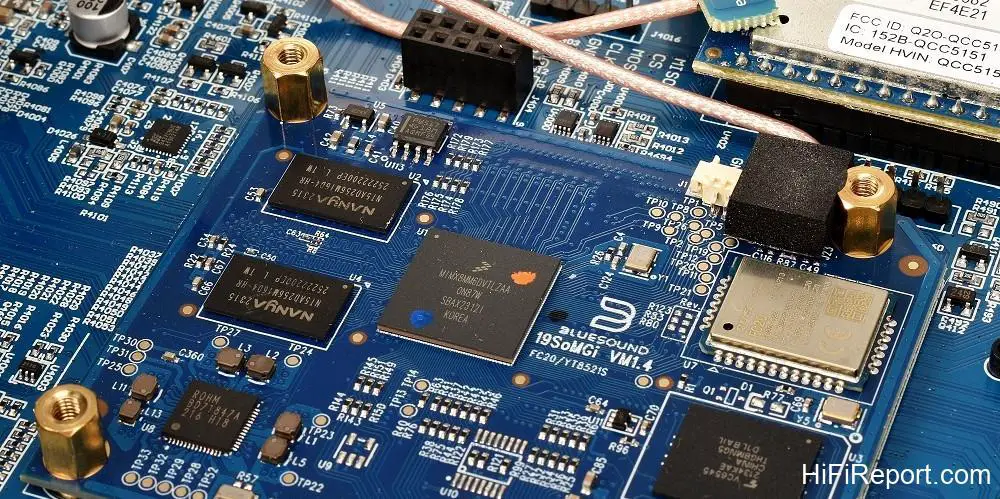
The M66 is equipped with NAD’s custom BluOS 192kHz/24bit Hi-Res streaming module. The “engine” responsible for digital audio processing in this module is the NXP i.MX 8M Mini MIMX8MM6DVTLZAA, a 4-core 1.8GHz ARM Cortex-A53 CPU.
Since the NAD M66 needs to process significantly fewer channels than a multi-channel surround processor, based on the chip’s processing power (the manufacturer hasn’t specified), I speculate that the digital audio processing precision, particularly for Dirac Live, is likely carried out at 32 bits.
Dirac Live Application Across Sources
Many enthusiasts have experienced the effects of Dirac Live processing, which primarily works to significantly optimize frequency response and transient response. As it’s a “digital” room correction, it naturally offers the greatest benefit to digital inputs and streaming. However, frequency and transient response issues are problems caused by the room and speakers, not just the source.
Since Dirac Live is available, it shouldn’t only optimize digital sources; it should also be applicable to analog inputs. So, for analog sources, including turntables passing through the phono stage and buffer amplification circuits, users who adhere to the belief that “analog should remain analog” and insist on a pure analog path can choose the option I mentioned earlier within the “analog preamplifier circuit.”

*However*, NAD also provides a second path for analog inputs on the M66: using one of the highest-performance ADC chips currently available, the ESS ES9822PRO, it converts the analog signal into digital, which is then sent to the BluOS streaming module for digital audio processing. This means the M66 can perform Dirac Live correction and bass management for *all* analog and digital sources.
With bass management available, users can define the crossover points between the left and right main speakers and the subwoofers (digital crossover). Furthermore, the four subwoofer outputs are individually independent for setup and correction (they are not simply a 1-into-4 parallel output).
Detailed DAC Implementation
The DAC circuit in the M66 is truly meticulous, surprisingly so. I already knew it employed the king of current DAC chip performance (ultra-low distortion, highest dynamic range), the ESS ES9038PRO. But I was very interested in *how* the M66 uses this DAC chip. The ES9038PRO is an “8-channel” DAC chip. Since it has 8 channels, and the left/right channels plus four independent subwoofer outputs total only 6 channels, theoretically, one ES9038PRO could handle everything.
However, prioritizing sound quality, the M66 divides the digital-to-analog conversion circuit into “main channel” and “secondary channel” groups. A single ES9038PRO is solely responsible for the left and right channel DACs. It operates in stereo mode (stacking eight channels as 4+4 to be used as two channels), achieving a dynamic range of up to 137dB (A-weighted), a significant 5dB higher than its 8-channel mode (132dB).
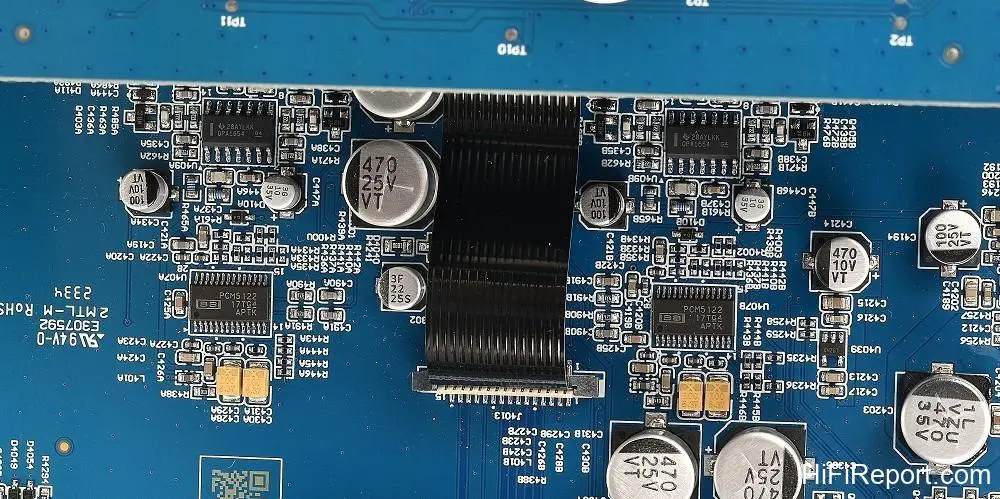
The second DAC circuit is equipped with two TI PCM5122 chips (32bit two-channel DACs), specifically for the digital-to-analog conversion of the four independent subwoofer channels. These are followed by a high-level amplification circuit with a +15dB gain, directly outputting to the subwoofer jacks on the rear panel.
Optimized Signal Routing
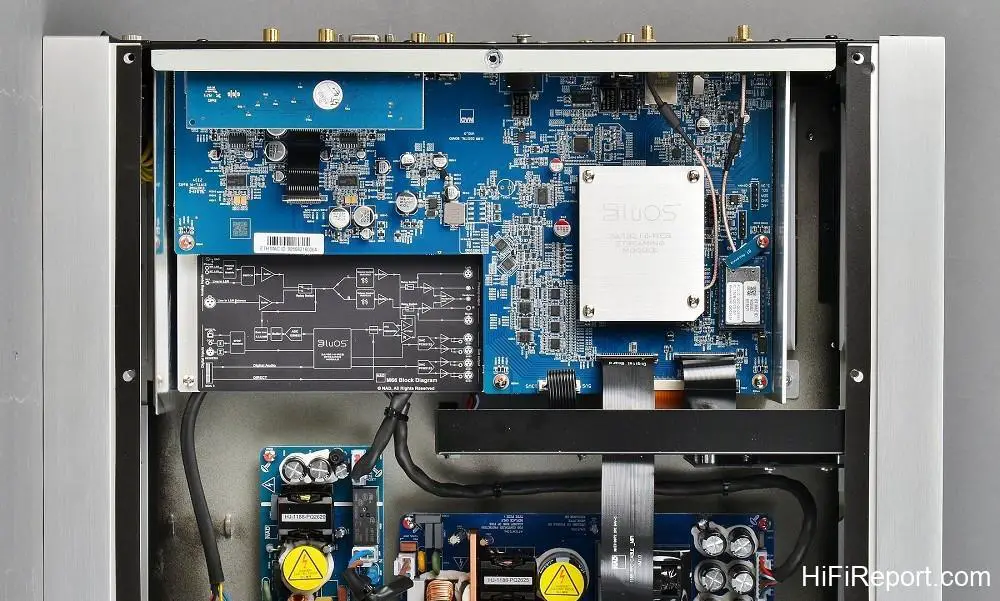
Before my actual listening tests, I observed a detail that showed the designers’ strong desire for the M66 to exhibit a pure, neutral sound characteristic: The M66’s audio signal passes through the analog volume control chip *only* when using analog inputs AND following the pure analog path.
If the user is listening to streaming, digital sources, or using Dirac Live with analog inputs, the left and right channel audio signals after digital-to-analog conversion “bypass” the analog volume control chip and go directly to the left and right output stage buffer amplification circuits (or the headphone amp). In other words, whenever the digital path is utilized, digital audio processing is combined with digital volume control.
Since volume control is already handled digitally, there’s no need for the audio signal output from the DAC circuit to pass through the resistor array and amplification circuit within the analog volume control chip. This further maintains the low distortion, low noise, and low coloration characteristics of the DAC circuit. The fact that the circuit designers “thought this meticulously” truly impressed me. This approach effectively optimizes the audio paths for both analog and digital sources.
Physical Design and Noise Isolation
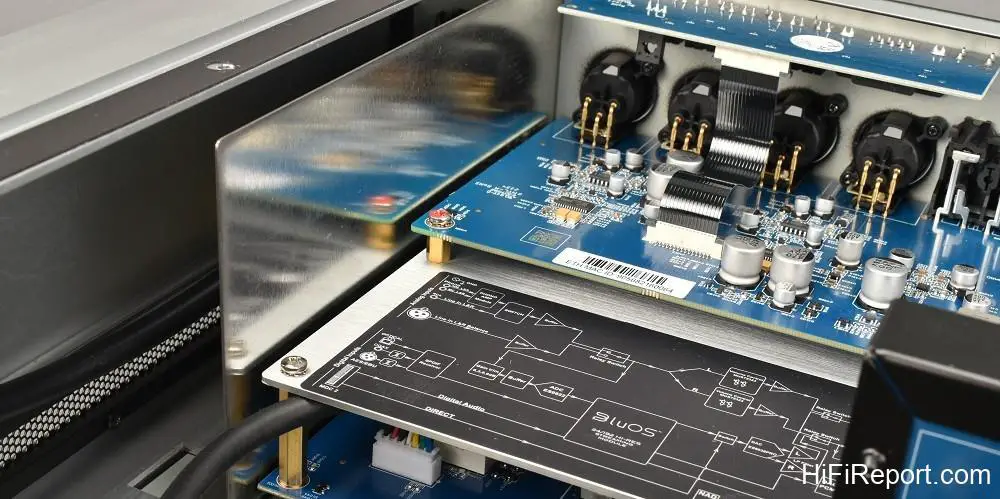
Furthermore, the M66 employs a digital and analog separation design: all digital interfaces, digital audio processing, and the secondary channel (4 subwoofer outputs) DAC circuits are located on the upper circuit board; the left and right channel DAC circuits, phono stage, analog volume control, preamplifier, and headphone amplifier circuits are on the lower circuit board.
A metal plate is placed between the upper and lower boards to shield the lower audio circuits from electromagnetic noise generated by the upper digital circuits. These are all measures taken as part of the “low noise” design consideration.
Dirac Live Calibration and Tuning
Before the actual listening test, I completed the Dirac Live calibration procedure. For beginners, simply follow the steps, complete the tests, choose one of two preset target curve types, calculate the filters, and send them to the M66. The M66 has 5 slots where you can save and name different Dirac Live calibrations. Here, I want to share a concept with users: Any product utilizing advanced DRC (Digital Room Correction) is not limited to just “correction.”
Some brands separate “correction” and “tuning” into two different features, allowing users to further adjust equalization after DRC correction. Products using Dirac Live often don’t have separate equalization adjustment options, but you *can* tune the sound using the “Custom Target Curve” feature within the Dirac Live application.
Many users lack this concept. After using DRC, if they are dissatisfied with the sound, they dismiss it entirely. This isn’t actually a problem with the DRC technology itself. The fundamental function of each technology is to make the system’s frequency response more accurate. However, subjective listening preferences have no right or wrong.
Having grown accustomed to the sound affected by bass room modes from youth, it can be difficult to immediately accept the result when prominent bass modes are flattened (making the bass feel “thin”).
I completely understand users being dissatisfied with the bass quantity after DRC calibration, but please, please don’t give up on using DRC! With the Dirac Live used in the M66, after completing the basic calibration and saving it, you can go to the “Filter Design” section in the Dirac Live application and manually drag the target curve to adjust the sound.
If you feel the initial calibration’s bass is too thin, you can slightly raise the target curve around 100Hz to, say, 3dB, and below 60Hz, before the main speakers’ natural low-frequency roll-off, raise it to around 4dB. After making adjustments, go to “Export Filters” and save the adjusted result to an unused “empty slot” on the M66. This completes one set of tuning.
Afterwards, you can actually listen and compare: this custom target curve setting sounds “fuller” in the bass compared to the original automatic calibration. It also effectively eliminates the specific frequency booming caused by bass modes before Dirac correction. You can experiment with how much you want to “thicken” the extreme bass, bass, and mid-bass, and how much you want to soften the treble. You can save each adjustment on your computer, offering a lot of fun with this tuning method!
As for the natural roll-off at the upper treble end (above 15kHz), I don’t recommend trying to flatten it using a custom target curve. This is due to considerations of microphone accuracy and testing methods, and compensating for upper treble roll-off increases the load on the tweeter, adding distortion and potentially making the treble sound harsh.
Dirac Live Benefits Illustrated
Dirac Live can not only correct frequency response but also improve transient response. (Referring to the included comparative graphs before and after correction.)
Listening Impressions: Dirac Off
For this review, I paired the M66 with the matching M23 power amplifier, using ELAC VELA BS 404 speakers. Those in the know will recognize I chose speakers with an Air Motion Transformer tweeter specifically to evaluate treble quality. In the first phase, I listened with Dirac Live Off. I can only say that if speaker placement is good, the sound of the M66 paired with the M23 is truly captivating. I had previously tested the M23 (with other components), and it’s a very neutral amplifier.
Listening to the M66 with the M23 this time, I confirmed they are a synergistic match. The M66’s sound is also neutral, extremely clear and transparent. It reveals its high-resolution characteristic through “high-purity sound” that is free of impurities and coloration. The mids and highs are refined and natural, while the bass is sharp and fast. The M66’s neutrality doesn’t mean a lack of flavor; it means it faithfully reproduces the flavor inherent in the music software itself.
For instance, The Beatles – Get Back Rooftop Concert fully captured the analog sound and era feel of the 1960s.
Listening Impressions: Dirac On
This time, I deliberately placed the ELAC VELA BS 404 speakers close to the front wall, simulating a typical home living room setup. After performing the Dirac Live frequency response test, I could see that these bookshelf speakers’ low frequency extends robustly down to about 33Hz, almost reaching the level of medium-sized floorstanding speakers.
However, simultaneously, due to being too close to the wall and the effect of room modes (not an issue with the speakers themselves), the bass quantity in the 40Hz to 90Hz range was excessive, with peaks exceeding 10dB at both 50Hz and 70Hz. I know many users enjoy the sound of excessive bass. While preferences are subjective, I believe it’s best to first correct and then tune.
With Dirac Live enabled on the M66, the resonance peaks were effectively flattened, and dips in the frequency range were filled (and as I mentioned earlier, savvy users can tune the sound themselves once they master Dirac Live). At this point, because the bass response accuracy improved, and flattening the resonance peaks also reduced output in those frequencies, lowering distortion and effort, I could clearly hear that the bass and extreme bass were faster and had higher resolution.
Optimizing the frequency response symmetry of the two channels also made the soundstage clearer and more stable.
Dirac’s Impact on Sound Texture
What top enthusiasts care about most is the impact DRC has on sound quality. Here, I am talking purely about “texture” and not about changes in quantity like “a little less treble, a little more bass.” I’ll be blunt: most DRC systems cause me to notice a degradation in sound quality (compared to Off or Pure Direct mode). However, when I switched back and forth between Dirac ON/OFF on the M66, the texture displayed during violin performance was very similar.
Without direct switching comparison, playing the same musical passage, it would be difficult to distinguish the difference in “texture” (the main audible difference is the change in frequency response before and after correction). This indicates that the Dirac Live processing performed by the M66 is virtually “lossless in terms of sound quality.” This is truly the capability of a flagship-grade product!
Conclusion and Recommendation
The M66’s neutral character combined with Dirac Live room correction results in outstanding realism during actual listening. The sound is free of impurities, providing a strong sense of being present at the performance even at low volumes. What’s even more remarkable is that playing standard resolution music files (e.g., 44.1kHz/16bit) results in a level of sonic refinement very close to Hi-Res.
Even the audio quality from playing YouTube music videos (compressed format) sounds better than playing CDs on many audio systems. The M66 is not just what NAD calls “the world’s most advanced amplifier”; it also utilizes the most advanced room correction technology available today. More importantly, it is capable of demonstrating impressive sound quality and sonic accuracy in all modes – streaming, playing Hi-Res and CD-level music files, watching online videos, etc.
I believe it is one of the most comprehensive high-end preamplifiers currently available and deserves our highest recommendation.
Specifications
* Type: 2.4-channel Streaming Preamplifier
* Key Technologies: BluOS, Dirac Live Bass Control Multi Subwoofer, DDH (Dynamic Digital Headroom)
* Inputs: HDMI eARC, Phono (MM/MC), Line (RCA), Digital (Coaxial, Optical), USB-A (front & rear), Ethernet, Wi-Fi, Bluetooth
* Outputs: Balanced (XLR), Unbalanced (RCA), Headphone, 4 x Subwoofer (RCA), Trigger, IR out
* DAC: ESS ES9038PRO (2x, Stereo Mode for L/R), TI PCM5122 (2x, for 4 Subs)
* ADC: ESS ES9822PRO
* Volume Control: MUSE72323 (Analog)
* Dirac Live: Full Bandwidth + Bass Control Multi Subwoofer (Standard)
* Dimensions (W x H x D): 435 x 101 x 396 mm
* Weight: 9.7 kg