
NAD T 778 AV Receiver Review
Many friends have asked me: with everyone watching online streaming videos and YouTube these days, and fewer and fewer people watching Blu-ray discs, is it still necessary to spend money on an AV receiver and set up a multi-channel home theater? Indeed, there is now so much online video and audio content of varying quality, with new content emerging every day, it’s endless. Does anyone still watch Blu-rays? However, I believe that as we spend more and more time watching and listening to online video and audio, shouldn’t we be upgrading the playback quality to make the viewing and listening experience more exciting, comfortable, convenient, and enjoyable? At this point, an AV receiver that can handle various playback methods, has diverse functions, and provides high-quality audio and video effects may be even more suitable for modern families. For example, the NAD flagship AV receiver T 778, which I auditioned at HiFiReport, is a fitting choice. In particular, it features NAD’s unique MDC modular design, which allows the receiver to stay up-to-date with the latest audio and video specifications and maintain strong compatibility simply by replacing modules, ensuring it never becomes outdated and can better meet the demands of rapidly changing playback requirements.
BluOS Makes This Receiver Smart
Among the numerous AV receiver brands on the market, NAD is currently a major sales force at HiFiReport. Compared to Japanese brands, NAD’s AV receiver model selection is not extensive, mainly consisting of the mid-range T 758 V3i and the high-end T 778, with no entry-level models. What reasons have led HiFiReport to favor NAD? Ms. Lan from HiFiReport told me that it’s primarily due to four key reasons: the BluOS streaming music platform, Dirac Live room correction technology, MDC modular design, and excellent sound performance. These features allow NAD to not only meet the listening needs of every family member, easily integrate into a whole-house multi-room playback system controlled by a smartphone, but also continuously evolve with the times, serving in the home for a long time.
BluOS is a streaming playback and control system developed by the Canadian Lenbrook Group, NAD’s parent company. It is widely used in NAD and Bluesound products under the Lenbrook umbrella. This means that many NAD products, including the protagonist of this review, the T 778 AV receiver, are network-enabled and ready to stream once connected to the internet.
One of the biggest features of BluOS is its support for an exceptionally wide range of streaming platforms, likely the most among similar systems currently available. Services like Spotify, Tidal, Qobuz, KKbox, Tunein, Deezer, Napster, Amazon Music, and more – if you can name a streaming service, BluOS probably supports it. Many of these are high-resolution music services, and the T 778 also features MQA decoding, allowing you to enjoy high-quality streaming music at any time.
If you have your own music files stored on a NAS or music server, the T 778 can also access and play them.
Furthermore, BluOS is compatible with multiple control systems, including Roon, AirPlay 2, Amazon Alexa, Google Assistant, and professional automation systems like Control4, RTI, and Crestron, offering great flexibility in application.
Don’t worry if these features seem overwhelming and potentially unused. If you can use them, HiFiReport, with their expertise in home planning, will configure the functions according to your needs, allowing you to easily listen to music with a few taps on your phone – isn’t that convenient?

High-Efficiency, High-Quality Class D Amplification
BluOS is a user-centric application software that is completely free to use with BluOS-enabled hardware.
Software can be continuously upgraded or have new features added through version updates. What about hardware? The T 778 uses MDC modular design to “stay young,” unlike Japanese AV receivers that need to release new models every couple of years to avoid becoming outdated.
The T 778 has two MDC slots on the left side of the rear panel, capable of accepting two MDC module cards.
The T 778 comes pre-installed with one module card, which provides HDMI output/input interfaces, an RJ45 network interface, and a USB A port.
The T 778’s HDMI features 5 inputs and 2 outputs. The audio section currently supports Dolby Atmos, DTS:X, and DTS HD Master Audio, with ARC functionality for TVs. The video section supports 4K HDR, which is already quite sufficient. In the future, when 8K becomes more prevalent, NAD will release an 8K-compatible module card, allowing users to watch 8K by simply swapping the card, without needing to replace the entire receiver.
The USB A port is for installing a USB hub, which can accommodate a wireless network card and Bluetooth receiver, enabling Wi-Fi and Bluetooth functionality for the T 778.
As for analog audio and digital audio (optical and RCA coaxial) input terminals, the T 778 has them readily available in the center of the rear panel, without requiring a module card. Notably, it also includes a set of MM phono inputs! (Image/taken from NAD official website) In terms of power amplification, the T 778 is equipped with Hypex UcD Class D amplifier modules, providing 9 channels of output. When all channels are driven simultaneously, each channel can deliver a maximum power of 85 watts, with a damping factor as high as 300. It can support up to 5.2.4 or 7.2.2 channel configurations. By adding a stereo power amplifier, it can achieve 7.2.4 channel output, totaling 11 channels, demonstrating impressive performance.
In fact, most of NAD’s current high-end models adopt Class D amplification. For example, the newly launched M33 streaming integrated amplifier uses the latest Purifi Eigentakt power modules, delivering outstanding sound performance and making the M33 frequently out of stock and highly sought after. Bruno Putzeys, the founder of Purifi, was also the inventor of Philips UcD Class D amplifier modules. Later, Hypex recruited him to design the Hypex Ncore amplifier modules, which have attracted many high-end models. This clearly demonstrates that the Hypex UcD module is not ordinary!
Flagship Aesthetics with High-Quality Design
For a home theater to sound its best, room correction functionality is essential.
Most people’s home environments are not “golden spaces” suitable for audio playback. Moreover, many people may not even be able to distinguish accurate sound, let alone tune for good sound. At this point, a good room correction system can solve many problems for you, allowing you to achieve more with less effort, just like Dirac Live, which is incorporated in the T 778.
Although the Dirac Live provided with the T 778 is the free standard version, only allowing users to manually adjust the “target curve” frequency range below 500 Hz, in my experience, this effect is already sufficient. This is because the mid-low frequency range is the most influential and difficult to handle in a room. By addressing the mid and low frequencies, significant improvements can be achieved. If you desire full-range manual correction, you can simply purchase the paid version for $99 USD.
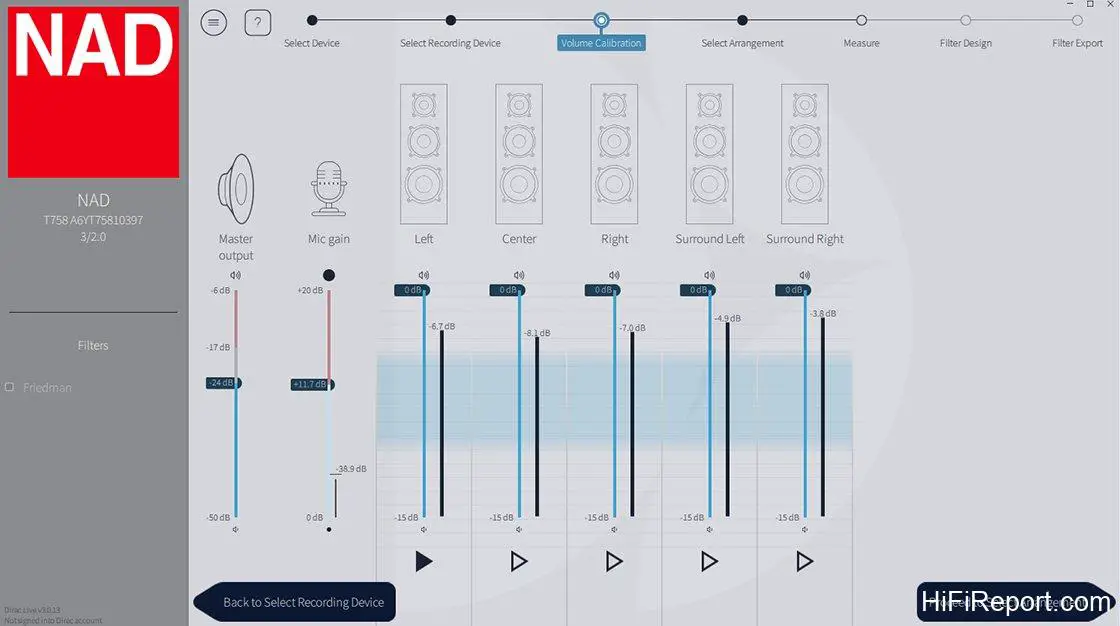
To perform Dirac Live testing, the included USB microphone is required for measurements. In the past, it had to be operated through a computer, but now it can be done by downloading the Dirac Live app on a smartphone or tablet, which is much more convenient.

I have already detailed the operation methods and steps of Dirac Live in my previous review of the NAD T 758 V3i AV receiver. Interested readers can refer to that review, and I won’t go into detail here again.
Of course, the appearance of the T 778 is also worth mentioning.
Unlike traditional AV receivers that place all buttons and knobs on the front panel for easy access and operation of all functions, making them look very technological, since the advent of “touch screens,” buttons and knobs have become outdated designs. Fewer buttons are better, just like the iPhone.
Similarly, the T 778 only retains a power button, a knob, and a full-color touch screen on the front panel, along with a few convenient input jacks. That’s it. This results in a very stylish, minimalist, understated, and sophisticated appearance, befitting a high-end model.
In fact, the same design elements are also used in other high-end NAD products, such as the compact M10 streaming amplifier and the newly launched M33 flagship integrated amplifier, both setting the best example of minimalist design.
Long-Term, High-Volume Listening Without Strain
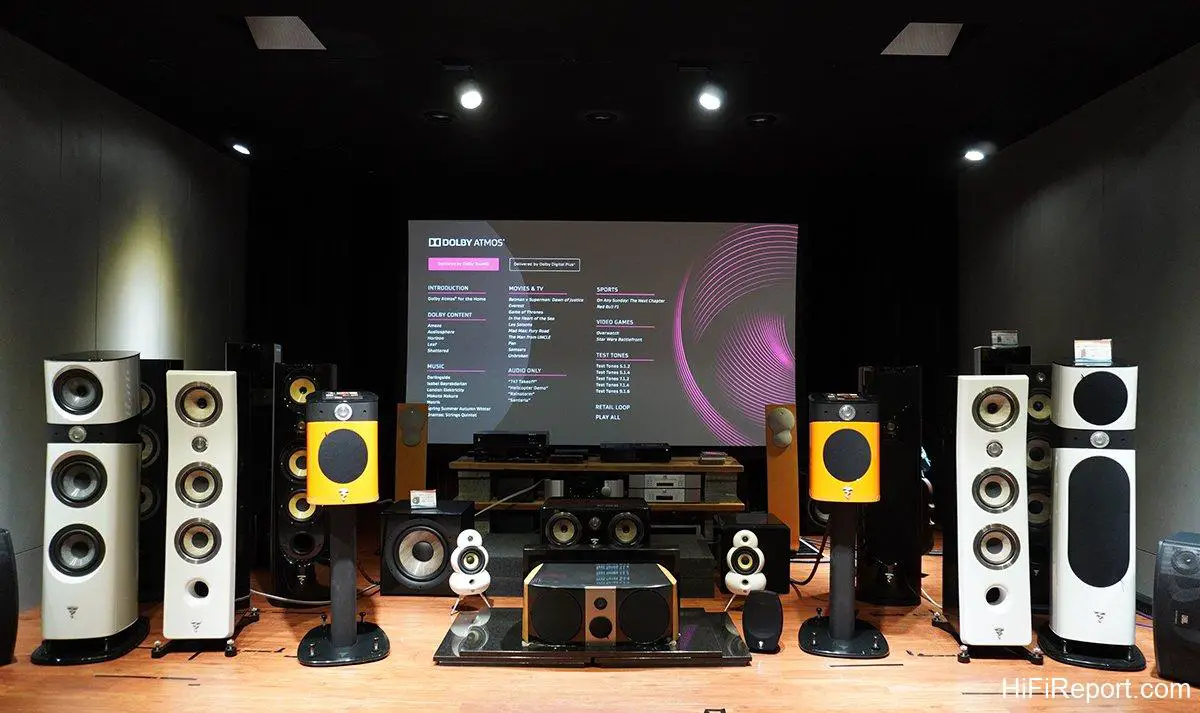
The audition was conducted in HiFiReport’s third-floor listening room. To fully unleash the performance of the T 778, the speakers paired were also top-notch, a complete Focal system including a pair of Kanta No.3s as main speakers, a Kanta Center for the center channel, two 300IW6 in-wall speakers for surround channels, and two Aria SR 900 surround speakers for rear surrounds.
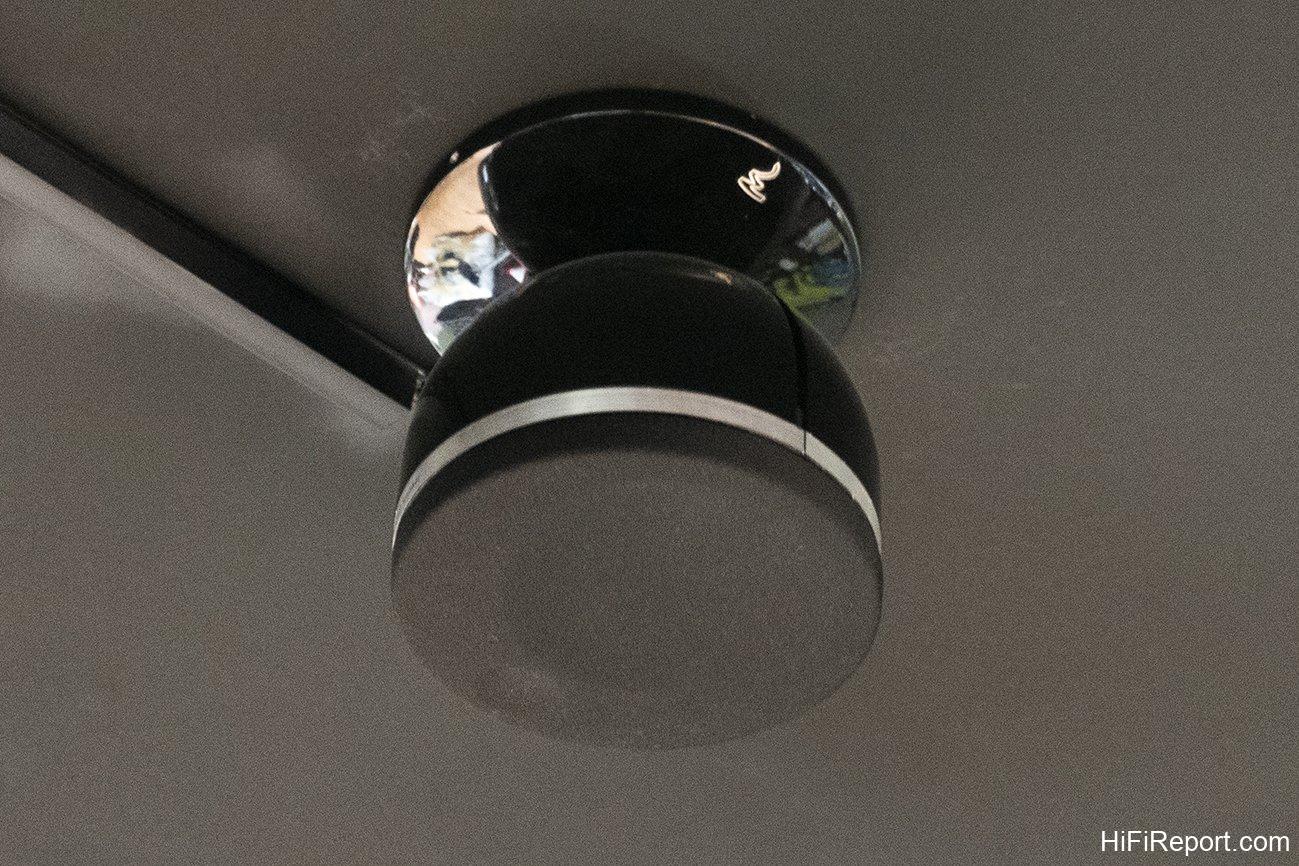
For the height channels, there were four Focal Dome Flax spherical speakers. Their tilt angle is adjustable, making it easy to aim them at the listening position for more precise projection.
It’s worth noting that the mid-bass drivers of all the above speakers use Focal’s unique flax fiber sandwich cones. The consistent material helps maintain tonal consistency and performance.
The extreme low frequencies were handled by two active subwoofers of different sizes.
Ms. Lan from HiFiReport configured the listening room to the T 778’s maximum capacity of 7.2.4 channels, a total of 11 channels. This means that two of the four height channels had to be driven by an external amplifier. However, in pursuit of sonic consistency, Ms. Lan directly used an Onkyo multi-channel power amplifier to drive all four height channel speakers.
What kind of performance does a full set of Focal mid-to-high-end speakers paired with the NAD flagship AV receiver deliver? Ms. Lan casually played a few movie clips. After listening, my first impression was that the entire system possessed a powerful sense of energy, a grand scale, a warm tonality, a clear and clean soundstage, and excellent resolution. I could listen at high volumes, allowing me to hear rich sound effects details and sonic variations, yet without any sense of strain.
This was slightly different from my previous experience listening to the T 758 V3i. The T 758 V3i was more fresh and clean, with a distinct skeletal structure, brisk and sharp, leaning towards analytical. But the T 778 had a richer and more gorgeous color, softer texture, better thickness, and greater harmonic coherence, making it more suitable for long-term, high-volume listening.
Balancing Ethereal Brightness and Rich Stability
Taking the “Audiosphere” clip from the Dolby Atmos demo disc as an example, the scene features a disc-like object with a light orb that continuously jumps to the beat of the music. Wherever it lands, it lights up and produces a musical note. The outer ring sounds are biased towards high frequencies, while the inner ring sounds are biased towards mid-frequencies, showcasing Dolby Atmos’s ability to depict directionality, distance, and the scale of sound objects.
In the past, when I listened to this clip, most systems could clearly present the positions of the sound effects, occurring around me in a lively and colorful manner. However, the sounds were mostly bright and the sound objects were relatively small and light, lacking in solidity.
The T 778 is different.
When reproducing the sounds of the outer ring, it also possesses an ethereal and bright luster, with agile and leaping sounds, showcasing a deep and expansive soundstage. However, the inner ring sounds have better solidity and weight, with a warm and soft texture and rich and stable sound objects, making them sound more rhythmic.
The same feeling also appeared in the “Makoto Nakura” clip from the Dolby Atmos demo disc.
Makoto Nakura is a Japanese marimba player. In the video, he plays Bach’s famous “Chaconne” from Partita No. 2 for Violin Solo in a church-like setting, demonstrating Dolby Atmos’s ability to interpret spatial ambiance.
Through the playback of the T 778, the resonance produced by the marimba through its tubes became richer, making the sound more dense and sustained. It not only sounded warmer and more (rùnzé – rich and mellow), but also rounder, fuller, and with better solidity.
In the past, when I listened to this piece, most systems emphasized the openness of the space and high-frequency penetration, which was quite exciting, but not very listenable and lacked charm, easily becoming monotonous. However, the T 778 emphasizes the mid-frequency presence, detail, and layering more, which I think is a commendable tuning direction.
Sufficient thickness in the sound definitely makes vocals more enjoyable. After listening to the marimba “Chaconne,” I immediately skipped to the “Spring Summer Autumn Winter” section of the demo disc. The scene is set in a pub in Korea with a live jazz band performance. The Spring Summer Autumn Winter fusion jazz band is performing on stage, with saxophone, keyboard, drums, and more taking turns for solos. But I think the most exciting part is the three female singers’ chorus.
Through the playback of the T 778, not only did the unrestrained singing style appear more explosive, but it was also controlled with ease, and the contrast between loud and soft was more pronounced. The lively atmosphere was even more vivid, suddenly giving me a feeling of being there live, which was truly exhilarating.
Excellent Enjoyment for Both Music and Movies
Ample energy, rich detail, solid mid-range, soft tonality, and a high-frequency range without harshness – these combine to create a powerful yet pressure-free and immersive movie atmosphere.
For example, in the “Everest” clip from the Dolby Atmos demo disc, the fierce storm blows, and the sounds of ice and snow impacts are everywhere, filling the listening space. Interspersed are sudden gusts of wind, thunder, and lightning, transforming into waves of rumbling low, mid-low, and mid-frequencies. In such a complex soundscape, the T 778 appropriately delivers these sounds, each sound being real, clear, and distinct. It’s evident that the T 778 is not just about thick sound; its handling of detail and energy is also well-organized and effortless.
Finally, I asked Ms. Lan to play a few music tracks. I wanted to test the T 778’s ability to play two-channel pure music. After all, the Hypex UcD Class D amplifier modules in the T 778 were originally used in NAD’s two-channel integrated amplifiers, with the purpose of listening to music.
At this point, Ms. Lan picked up her iPhone and swiped. The BluOS app immediately brought up the Tidal music service. High-resolution music flowed out. As expected, it was a charming, pleasing, comfortable sound that did not lack cleanliness, naturalness, and resolution. The charming, pleasing, and comfortable aspects mainly came from the Focal Kanta No.3 speakers, while the cleanliness, naturalness, and resolution were the inherent qualities of the T 778. With the full cooperation of both, whether listening to music or watching movies, it was an excellent enjoyment.
Buy It and Forget About Upgrading
Good sound must be built on a good analog amplification foundation. The T 778 is backed by NAD’s many years of amplifier technology development and is equipped with excellent Hypex UcD modules, combining efficiency and sound quality. The sound is trustworthy.
The specifications of AV receivers must keep pace with the times and continuously evolve. The T 778 adopts a clever MDC modular design, allowing module replacement to support new specifications and prevent obsolescence.
Good functionality relies on user-friendly software. The T 778 is equipped with the advanced and powerful BluOS system, making operation convenient and allowing you to handle everything with one hand.
Of course, you also need a quality dealer to handle all the planning, installation, and setup hassles for you, and that is HiFiReport.
If you only want to buy one AV receiver from now on, the T 778 should be your top choice.
Specifications
* Type: 9.1 Channel AV Receiver
* Power Output: 85 Watts × 9
* THD: < 0.08% * Frequency Response: 20 Hz – 20 kHz (+0.3 / – 0.8 dB) * Damping Factor: > 300
* Signal-to-Noise Ratio: > 100 dB
* HDMI: Supports 4K Ultra HD Pass-through, CEC/eARC
* Multi-channel Format Support: Dolby Atmos, DTS HD Master Audio
* Music Streaming: Via Ethernet or Wi-Fi
* BluOS System Compatible
* Room Correction: Dirac Live System
* Dimensions: 435 × 140 × 430 mm (Width × Height × Depth)
* Weight: 12.1 kg