
Nordost Purple Flare Figure-8 Power Cable Review
Audiophiles know that Nordost is a benchmark brand among American hi-fi cable manufacturers. In 2021, they even launched the flagship Odin Gold series cables, featuring top-tier materials and intricate craftsmanship that would make any audio enthusiast salivate. However, Nordost’s reputation isn’t solely built on materials or build quality; it stems from their unique know-how in cable design, understanding the true essence of cable construction.
This expertise allows them to develop upgrade cables that deliver a truly “perceptible” improvement to the user.
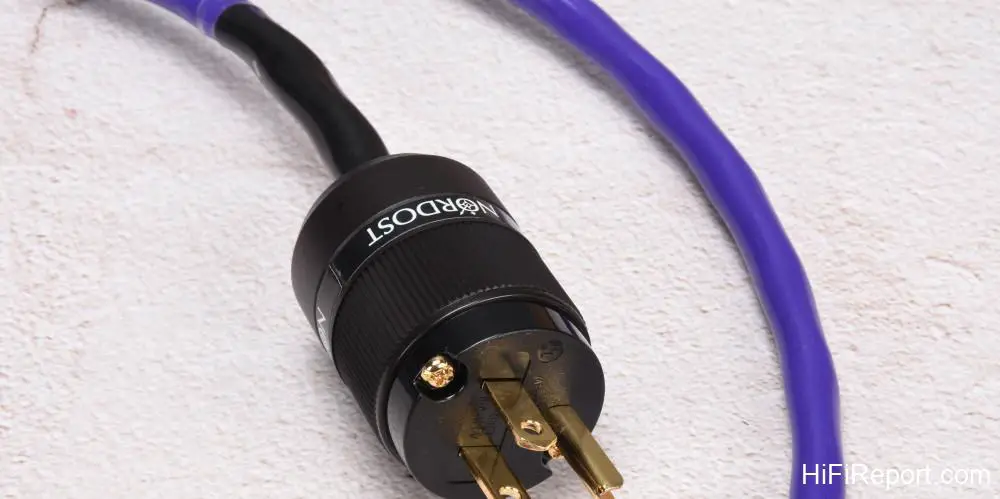
But Nordost doesn’t just cater to the high-end market; they also offer corresponding products for the entry-level segment. The Purple Flare power cable reviewed here is one such entry-level offering from Nordost. It comes equipped with a figure-8 connector, allowing it to upgrade various audio-visual components that utilize this type of plug.
Truth be told, there’s quite a substantial number of such components. For example, many modern soundbars, flat-panel TVs, mid-to-low-range 4K players, small-sized DACs, and other devices frequently employ this type of plug. Perhaps your main system is top-tier and doesn’t require such a cable. However, if you’re setting up a second system in a bedroom or another space, you might encounter equipment with this type of connector.
And sometimes, this particular component happens to be critical to the overall performance, such as a 4K Blu-ray player, which acts as the source for all audio and video signals. In such cases, it’s certainly worth pairing it with a quality power cable.
Technical Design and Construction
Despite being Nordost’s most entry-level cable, the Purple Flare maintains the brand’s consistent commitment to solid materials. Internally, it features two strands of 65-core stranded OFC (Oxygen-Free Copper) as conductors, boasting a purity of 6N, with each strand measuring 16AWG. Nordost even provides conductivity specifications for the Purple Flare: a DC resistance of only 4.4 ohms per 1,000 feet and a propagation speed of 81%.
Finding a figure-8 power cable on the market with such premium specifications is virtually impossible.
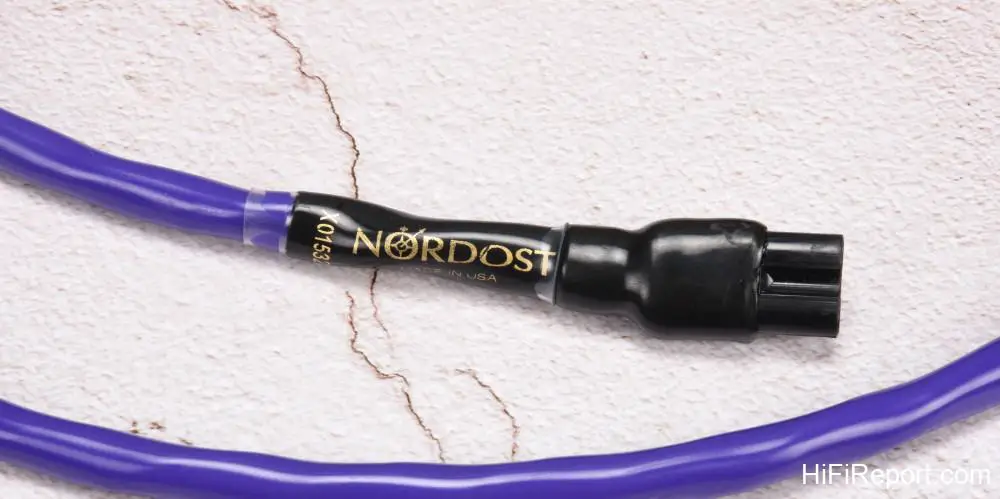
The Purple Flare also incorporates Nordost’s proprietary cable construction techniques, primarily comprising two key elements: Micro Mono-Filament technology and Mechanically Tuned Lay.
First, let’s discuss Micro Mono-Filament technology. Simply put, it involves precisely wrapping a fine strand of FEP (Fluorinated Ethylene Propylene, a type of Teflon) spirally around the conductor before encasing it in another layer of Teflon for insulation. The purpose of this is to create an air dielectric layer, as air has the lowest dielectric constant.
Combined with the low dielectric constant of Teflon, this configuration significantly minimizes the influence of the insulation layer and material on signal transmission.
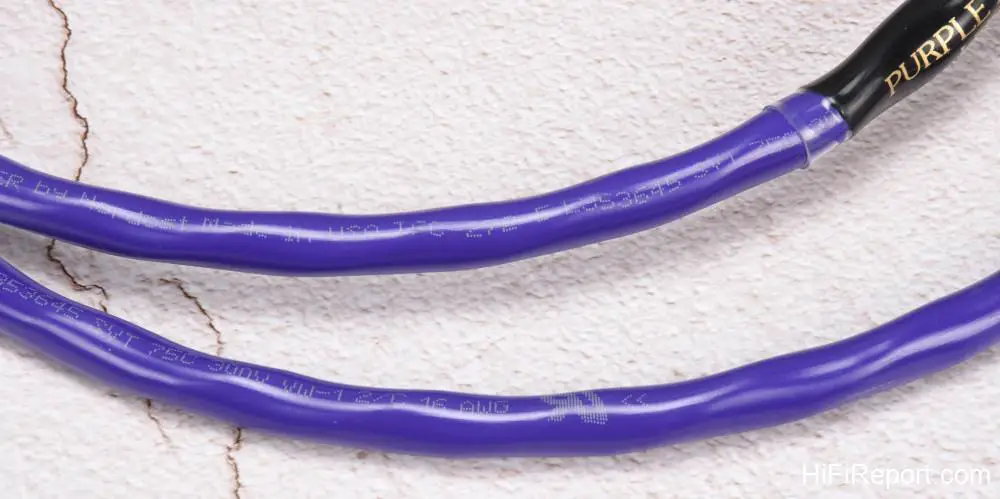
As for Mechanically Tuned Lay, it involves mechanically adjusting the cable’s structure during manufacturing to precisely control the spacing and relative positions of the conductors. This process optimizes the Purple Flare’s conduction characteristics.
Testing Setup and Methodology
For this review, I used a Sony 4K Blu-ray player as the source, connected to a Marantz SR7015 surround receiver, paired with Sonus Faber Lumina series speakers, Monitor Audio height channels, and an M&K Sound X10 subwoofer, forming a 5.1.4 home theater system. I used the Purple Flare on the 4K Blu-ray player, comparing it to the power cable included with the product (commonly referred to as the “stock cable”).
In a home theater system, the player is the source of all audio and video signals, so altering the power supply at this point should, in theory, impact both picture and sound.
Sonic Performance Evaluation
The results were far beyond my expectations. Let’s start with the sound. I played the “Amaze” segment from a Dolby test disc. Upon switching to the Purple Flare, the initial sound of flowing water immediately changed. It became more natural and concrete. Then, as various sounds from the forest appeared, they created a more expansive soundstage with a greater sense of space.
All the sound effects within the scene became more solid and palpable, and the separation between different effects also increased significantly. Finally, the thunder and rain sounded more layered with varying intensities, the rain more detailed, and the overall soundscape became much more refined.
Playing movie soundtracks also yielded noticeable differences. For example, I played the 4K BD of “Zack Snyder’s Justice League.” In the scene where Batman attacks the old nuclear power plant in the Flying Fox, I immediately noticed a change in the background music after connecting the Purple Flare. It became more ethereal and grander. Furthermore, the sound of the Flying Fox’s engines was elevated to a different class, sounding more powerful and substantial.
The overall level of detail in the sound effects improved as well. When the Parademons flew around, chasing the Batmobile, I could hear intricate, precisely located sound effects moving within the listening room. It felt as if more subtle details were emerging from the background, making the sound appear more elaborate and rich.
I also tried music playback. I played the “John Williams in Vienna” 4K BD concert (with Dolby Atmos sound). Before the performance began, the audience applause and coughing sounds were noticeably different – more prominent and natural. I perceived a much clearer sense of the concert hall’s space. When Anne-Sophie Mutter played the violin, the instrument’s tone was clearer and more delicate. The same bowing and string friction revealed more details.
When the string section entered, their ensemble playing sounded more weighty, with energy that was focused and cohesive. Switching back to the stock cable, the violin sounded soft, and the string ensemble playing felt loose – the difference was substantial.
Visual Performance Evaluation
Furthermore, the Purple Flare doesn’t just impact the sound; its effect on the image is equally significant. I played a 4K image demonstration file created by a TV manufacturer, viewed on a Sony flagship 65-inch A90J OLED television. The content featured close-ups of various fruits, vegetables, and food.
I found that when connected to the Purple Flare, the overall sense of “vivid sharpness” was different. This might sound a bit abstract, so to be more specific, I noticed an improvement in the sharpness of fine details. At the same viewing distance, the fruits and vegetables exhibited clearer details and more refined outlines. Consequently, this enhanced the dimensionality and tangibility of the objects in the image.
Beyond details, the colors were also different. With the original stock cable, the colors appeared somewhat flat and slightly pale. After switching to the Purple Flare, the colors looked more vibrant with higher saturation and seemed to have more weight and depth. This simultaneous improvement in resolution, dimensionality, and color saturation contributed to that feeling of “vivid sharpness.” “Vivid” implies vitality – the food looked fresher.
“Sharp” refers to a clearer, more defined visual appearance.
Let’s take another example: an extreme sports segment featuring skiing in the high mountains (4K HDR). This scene poses a challenge for displays as it requires rendering surface textures of the snow and the contours of the mountains against a predominantly white background. After connecting the Purple Flare, the image clearly became sharper, mountain ridges were clearer, and the subtle textures of snow drifts on the ground stood out, better revealing fine details.
The gradual color transitions in the snowy mountain background were smoother, and the overall image became three-dimensional and natural. Switching back to the stock cable, the picture’s tone felt softer, and the image lacked dynamism.
Moreover, while watching this segment, my ears naturally detected that the sound effects had also changed entirely. When the Purple Flare was connected, the fast guitar strumming sound in the rock-like background music became brighter and more layered. The drum accompaniment in the background music also became more cohesive and solid.
Playing movie soundtracks yielded similar results. For example, when playing the 4K BD of “No Time to Die,” the Purple Flare made details appear clearer, and the textures of fine details became more palpable. When sports cars appeared in the film, they felt more three-dimensional. Because the details and outlines of nearby objects improved, when the camera captured distant scenes, the sense of depth throughout the picture felt stronger.
In terms of color, there was a tendency towards more weight and richness. This change significantly helped in rendering the warm-toned quality of the film, making the colors feel denser and more film-like.
Conclusion: Significant Impact and Value
The magnitude of the difference introduced by this Purple Flare was beyond my expectations. It naturally made me wonder: why can the Purple Flare, Nordost’s most entry-level power cable, make such a significant difference? My own speculation is that equipment typically using figure-8 cables is often more budget-friendly. The power cables provided with such equipment are likely prioritized for cost-saving, designed simply to work.
Naturally, they cannot cater to the audio and video quality we seek, and much of the potential performance of these components is effectively “lost” by these inexpensive cables. By using the Purple Flare, not only is a reasonable level of performance restored, but because it incorporates Nordost’s cable-making know-how, we experience a very noticeable improvement in both audio and video quality.
From this perspective, equipment using figure-8 cables actually *needs* an upgrade cable even more, doesn’t it? Especially if, like the 4K Blu-ray player in this review, it is the source of all audio and video signals. The return on investment from the Purple Flare made it feel well worth the cost. Highly recommended!
Specifications
* Design: Figure-8 Power Cable
* Insulation Material: FEP Teflon
* Structure: Micro Mono-Filament, Mechanically Tuned Lay
* Conductors: 4 × 16 AWG
* DC Resistance: 4.4 Ohms / 1,000 feet
* Propagation Speed: 81%