
Nordost QK1 Review
Nordost, an American manufacturer, is renowned for producing high-end audio cables and power conditioning equipment. Their signature flat cable design is instantly recognizable and has earned them a distinguished reputation in the audiophile community. Power conditioning represents another area of Nordost’s expertise. Here, we introduce the QK1 AC Enhancer from their QRT series of power products, a device designed to restore the purity of your AC power.
QRT Power Series
The QRT series encompasses Nordost’s comprehensive range of power treatment solutions, including filters, power distribution blocks, AC enhancers, grounding wires, and grounding boxes. All these products are designed to mitigate the adverse effects of compromised household electricity on the ultimate sound quality of your audio system.
By addressing issues such as grounding, eliminating radio-frequency interference (RFI), and correcting timing discrepancies, the QRT series aims to bring your AC power closer to a state of pristine, unadulterated quality.
The QK1 AC Enhancer, or “Tuner,” is compact in size, with its main body measuring approximately 8 centimeters in height. The packaging clearly displays the QRT series logo along with the QK1 model designation.
Passive Current Enhancement
The QK1 is named an AC Enhancer for good reason: it is engineered to enhance the quality of AC power supplied to your audio equipment, resulting in a more engaging and refined musical experience. As a passive device, the QK1 consumes no power itself. Instead, it employs LRC – load resonating coil – technology to create an electronic field that safeguards the AC current. This technology can be implemented in both video and audio circuits.
Internally, the QK1’s LRC benefits from Nordost’s acclaimed Micro Mono-Filament technology. This proprietary technique, utilized across many Nordost cables, effectively prevents signal transmission delays and distortions, ensuring the AC current remains as close to its ideal, lossless state as possible.
The top of the QK1 proudly displays “Nordost,” indicating that all their products are manufactured in the United States.
Simple and Easy Use
Using the QK1 is incredibly straightforward, requiring no complex adjustments. Simply plug the QK1 into any available socket within the power circuit serving your audio equipment. As long as it’s in the same electrical loop, it will exert its beneficial effects. The QK1’s main body is constructed from carbon fiber, and its gold-plated plug is available in both US and EU standards. It is compatible with voltages ranging from 110V to 240V and can be used with plug adapters if necessary.
The manufacturer provides a 2-year warranty for peace of mind.
While a single QK1 provides noticeable improvements, Nordost emphasizes the cumulative effect of their QRT power products. The more QK1 units you use, the greater the enhancement. Furthermore, different components within the QRT series, such as grounding boxes, power strips, and multiple QK1 or QV2 units, can be used in combination to achieve even more significant results.
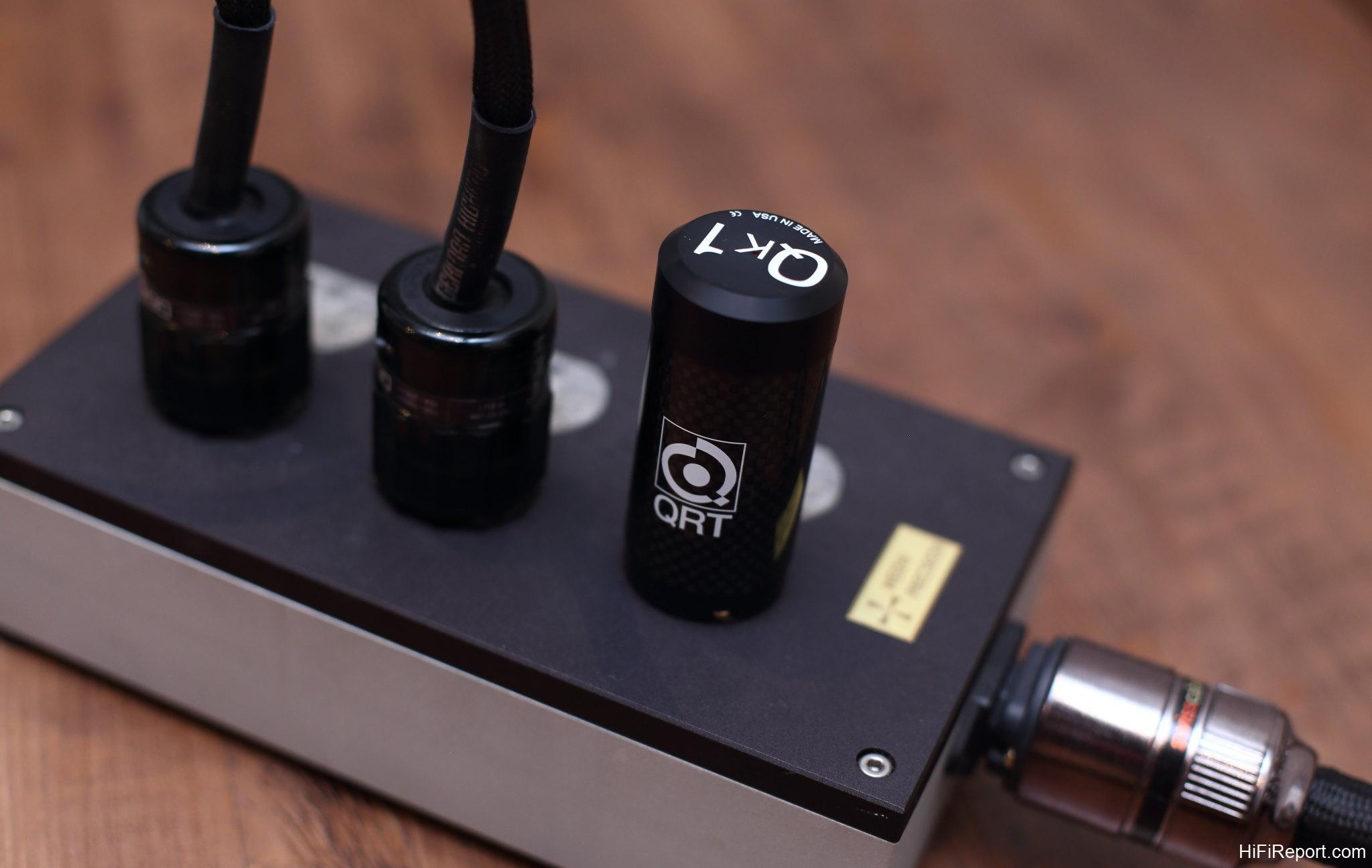
As illustrated in the photo, when using a two-socket power strip, one socket is used for the component’s power cable, and the other is occupied by the QK1.
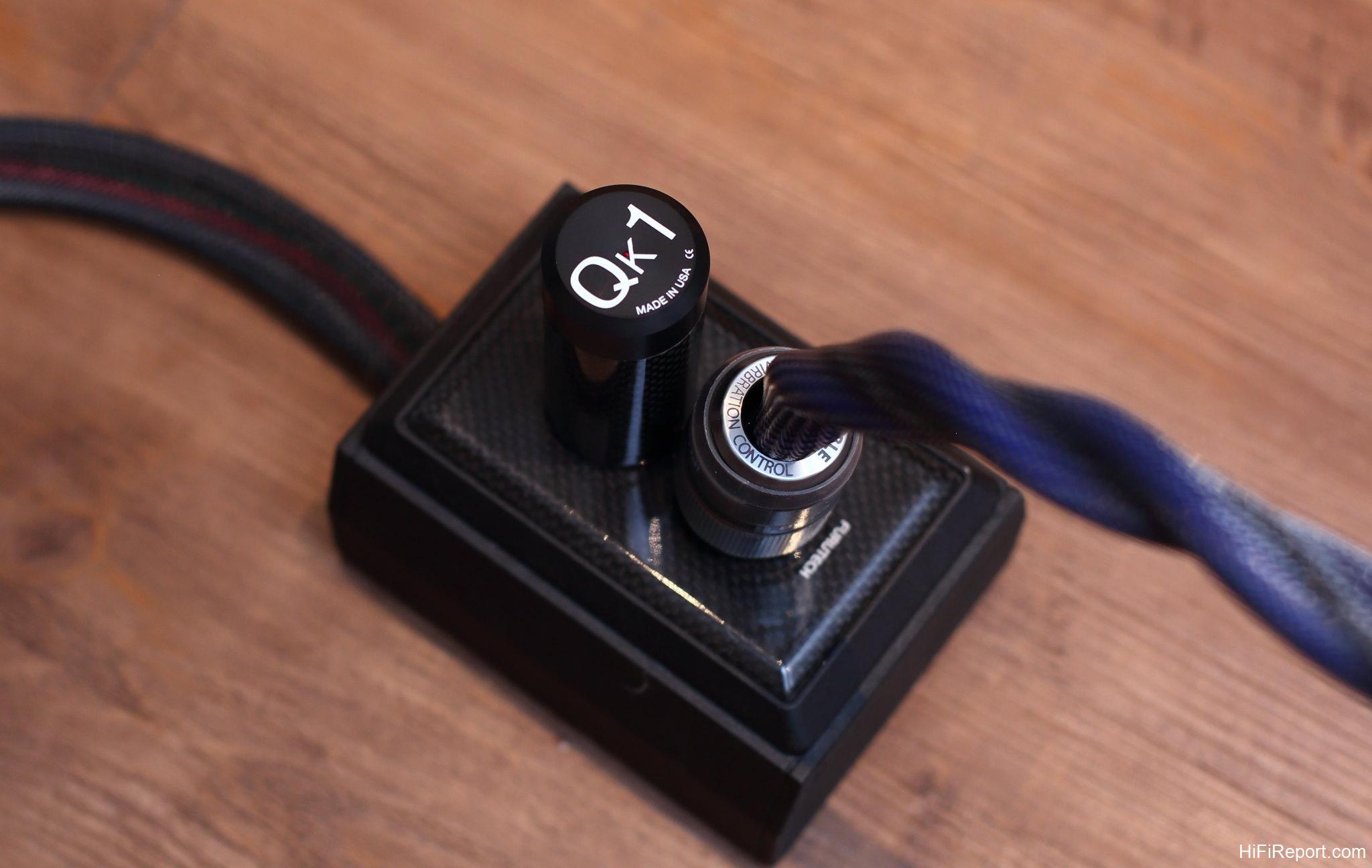
Similarly, with a six-socket power strip, after connecting all your components, any remaining empty sockets can be filled with QK1 units. Ideally, if you have enough QK1s, you can populate all the vacant sockets for maximum effect.
Reduced Harshness
For the initial listening test, Tracy Lau’s album <Maiden’s Prayer> was selected. A short passage was auditioned without the QK1, and then the same passage was repeated with the QK1 inserted. Given the QK1’s ease of use and the fact that equipment doesn’t need to be powered down for insertion, repeated A/B comparisons were easily conducted. In the first track, “Maiden’s Prayer,” the piano notes at the beginning sounded more natural with the QK1 in place.
In comparison, without the QK1, the sound, while clear and bright, exhibited a slight harshness. The QK1 effectively mitigated this edginess. Vocals also displayed improved focus and a touch more weight, addressing a slight looseness in the overall musical presentation observed without the QK1.
Cohesive Sound Image
Next, Chie Ayado’s was played. The opening of track 1, “New York State Of Mind,” immediately revealed the difference the QK1 makes with Ayado’s unaccompanied opening vocal. Without the QK1, the vocal image seemed to have a slight halo or fuzziness around it, diffusing into the space. However, with the QK1 in place, this dissipation vanished, and the vocal line became purer and more defined. The improvement was even more pronounced in track 2, “Sunny.”
When the saxophone and drums enter together at the beginning, the cymbal strikes and their decay sounded as if they had a ghost image without the QK1, similar to ghosting on a television screen. With the QK1, the drum strikes and saxophone notes were significantly more focused.
Improved Cohesion
Moving on to the Eagles’ , tracks 5 “Tequila Sunrise” and 6 “Hotel California” were chosen. In both songs, the vocals and instrument images were noticeably more cohesive and focused with the QK1. The overall sound became cleaner and clearer, particularly evident in the guitar’s plucked notes. The audience whistles at the beginning and end of “Tequila Sunrise” were more prominent and the applause sounded more natural.
In “Hotel California,” the opening guitar arpeggios were more distinct and defined. While the bass drum’s weight didn’t increase, it became tighter and more solid.
Expanded Soundstage
For the final piece, Gil Shaham’s performance of “The Butterfly Lovers Violin Concerto / Tchaikovsky” was selected. The opening of the first movement features very subtle sounds: distant, low drums on the right and five plucked single notes followed by a gentle flute melody on the left. With the QK1 in place, the flute melody was distinctly clearer, and the nuances of the musical phrasing were easier to perceive.
While the expansion of the soundstage wasn’t dramatically obvious, it seemed to extend more freely and less constrained with the QK1. In the second movement, the solo violin sounded smoother and more lustrous. The violin’s body resonance and the subtle shifts in bowing technique and speed were rendered with enhanced clarity and precision.
Worthy Upgrade
Nordost offers a wide array of power conditioning products, and the QK1 stands out as a convenient and relatively affordable option. Even using just one QK1, the positive sonic changes are readily apparent and appreciable. As the manufacturer suggests, using multiple units could yield additive benefits, potentially leading to remarkable improvements.
Considering the cost relative to the performance gains, the Nordost QK1 AC Enhancer is undoubtedly a worthwhile investment for audio enthusiasts seeking to optimize their system’s sound.
Specifications
* Passive electronic field generation
* Enhances musicality and improves tonal balance
* Increases image clarity, including resolution, depth, and focus
* Reduces background noise
* LRC utilizes patented Micro Mono-Filament technology
* Mechanically tuned carbon fiber construction