
Obit Audio Isolation Footers Review
In my previous review, I explored the effects of Obit Audio isolation footers on bookshelf speakers. I tested them with three different pairs of speakers, experimented with various combinations of footer sizes, and placements. My conclusion was definitive: using them is better than not, and they enhance the sound without altering the system’s inherent sonic character – a truly benign upgrade.
This time, I’ve expanded my investigation significantly. I’ve not only applied Obit Audio footers to floor-standing speakers but also extended their use to amplifiers, DACs, and source components, encompassing six critical areas in total. What were the results? Read on to find out.
Unique Technology
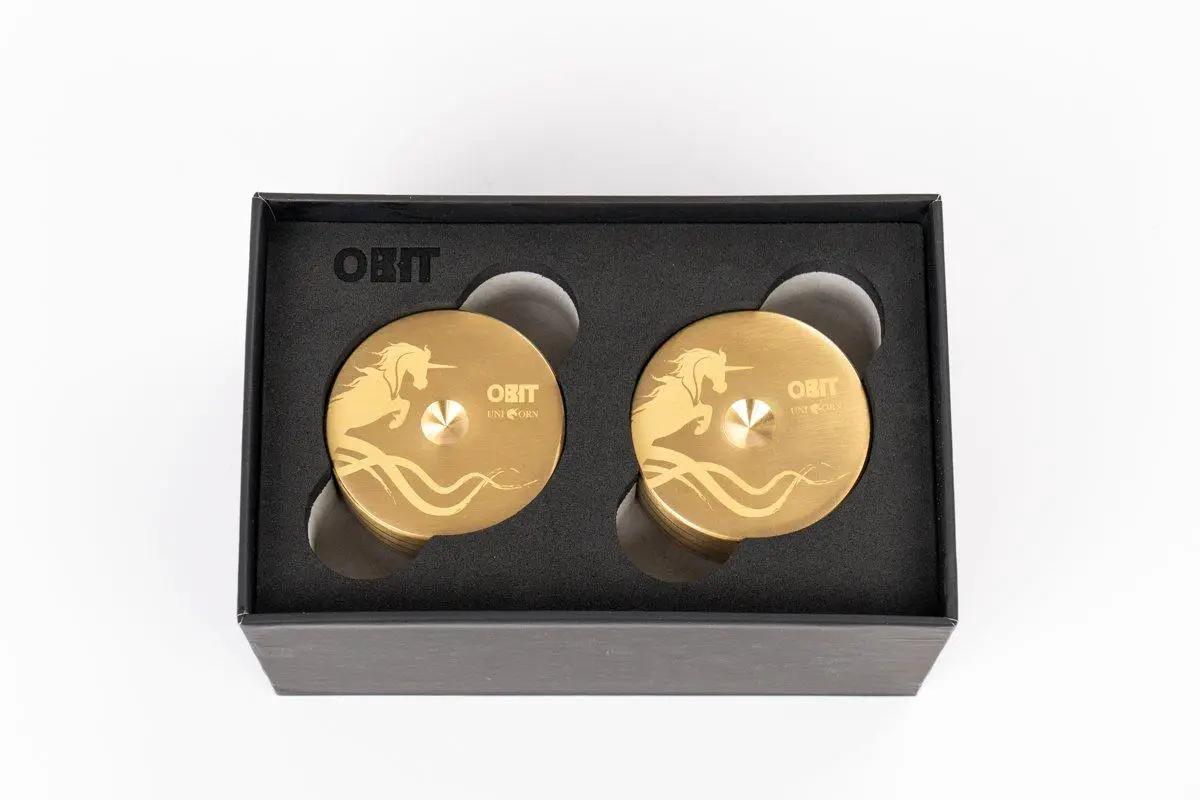
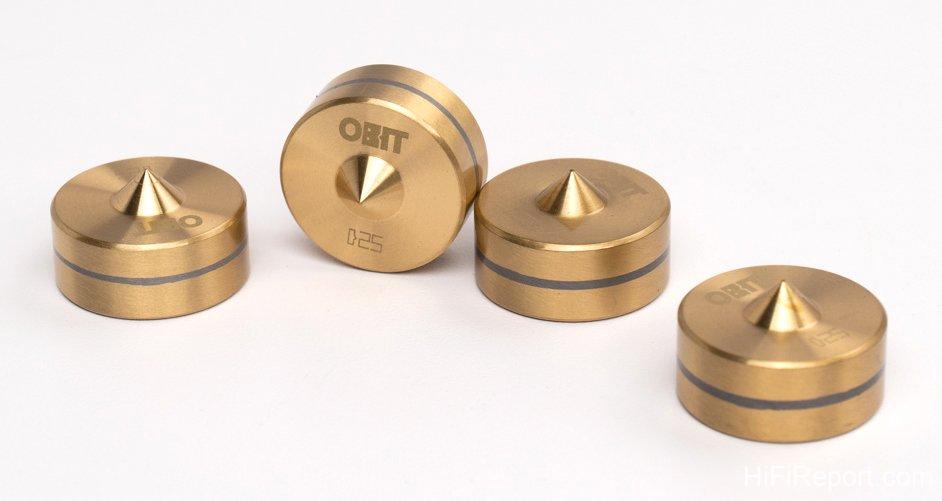
The principle behind Obit footers is elegantly simple. They utilize a fusion of two different alloys, one softer and one harder, creating a single footer with multi-frequency resonance characteristics. By placing these footers under audio equipment, they subtly modify and manage vibrations, steering the sonic performance in a positive direction.
While the concept is straightforward, the execution is far from easy. Countless variables, including the number of metal layers, their thickness, diameter, and alloy composition, need to be precisely calibrated. Designer Mr. Chen Rui-Ren achieved the optimal balance through meticulous calculations, prototyping, and countless hours of critical listening.

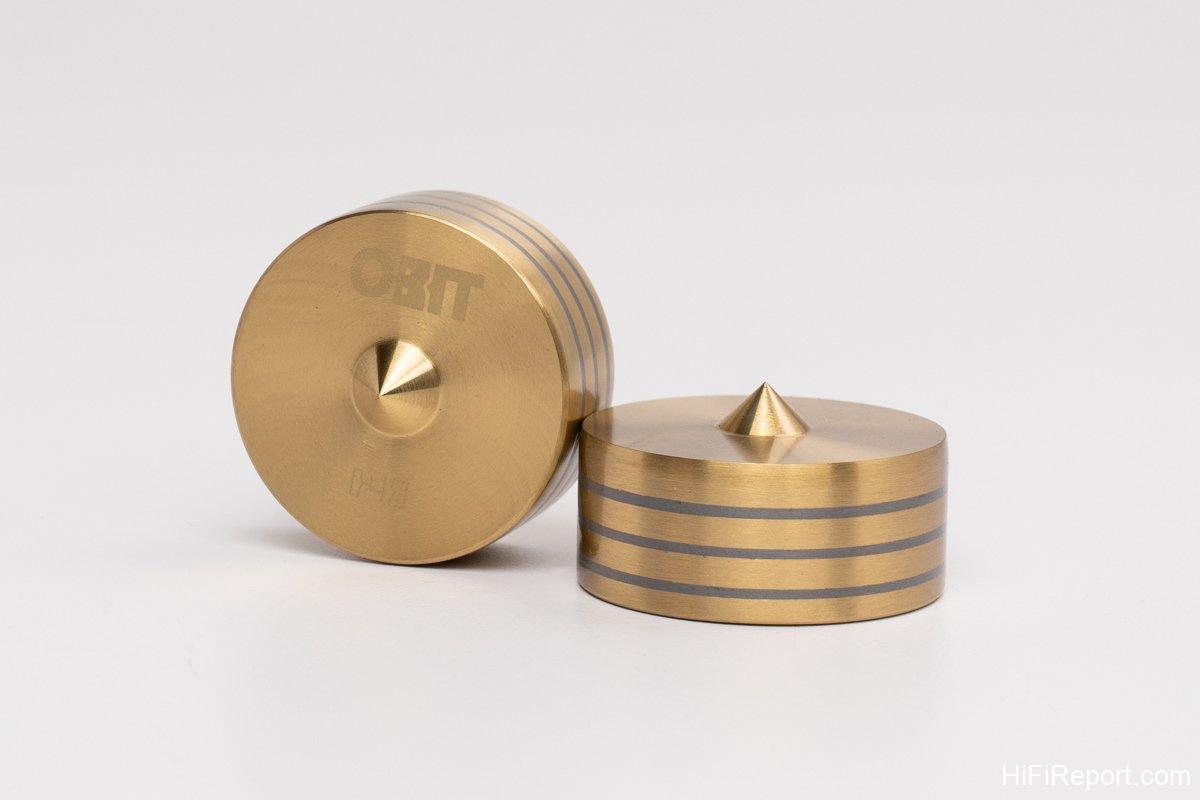
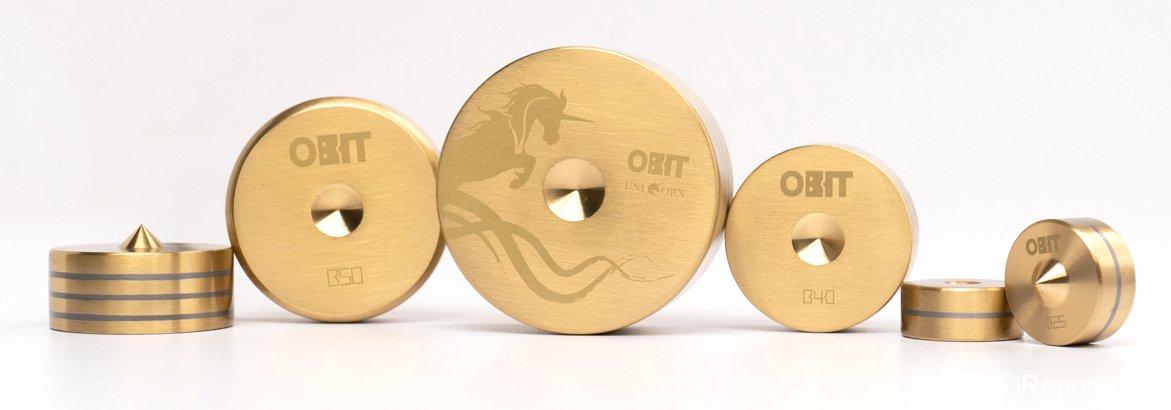
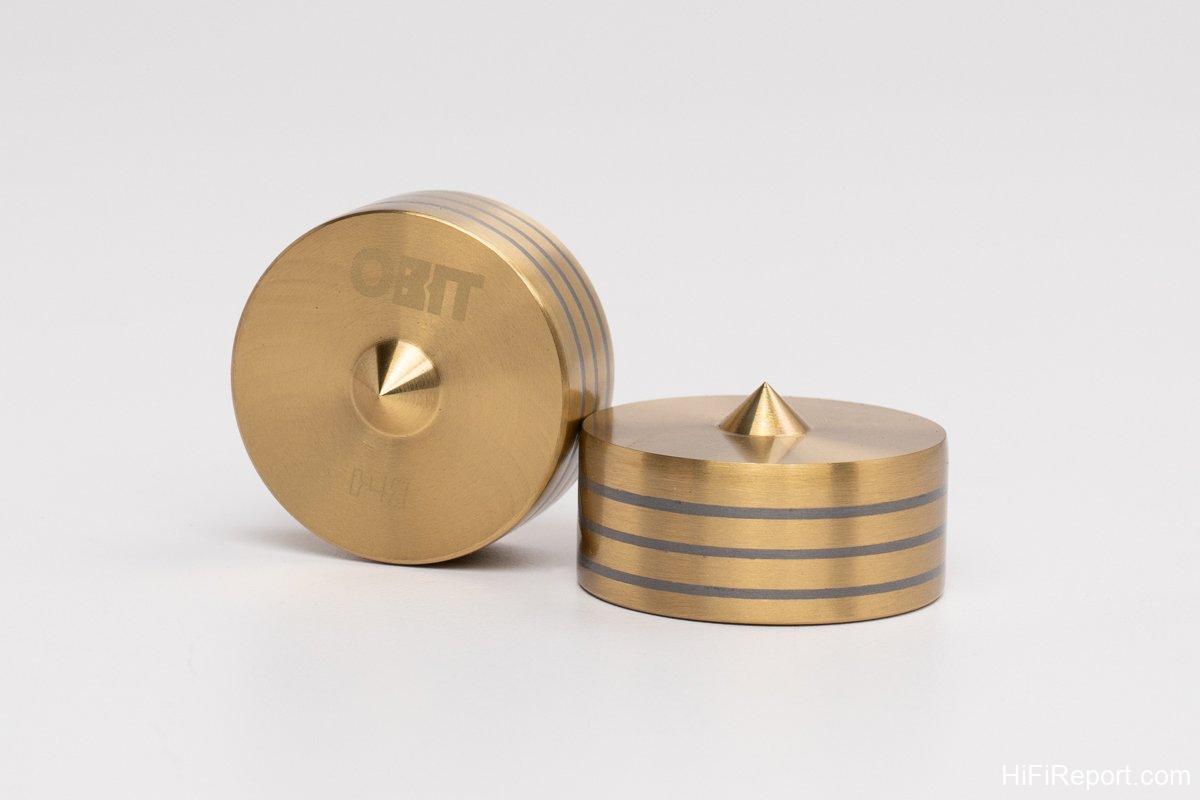
The Obit footer range might seem extensive with various models and sizes, but the system is actually quite simple. It revolves around two basic types: concave cones (B series) and pointed cones (I series), each in different diameters.
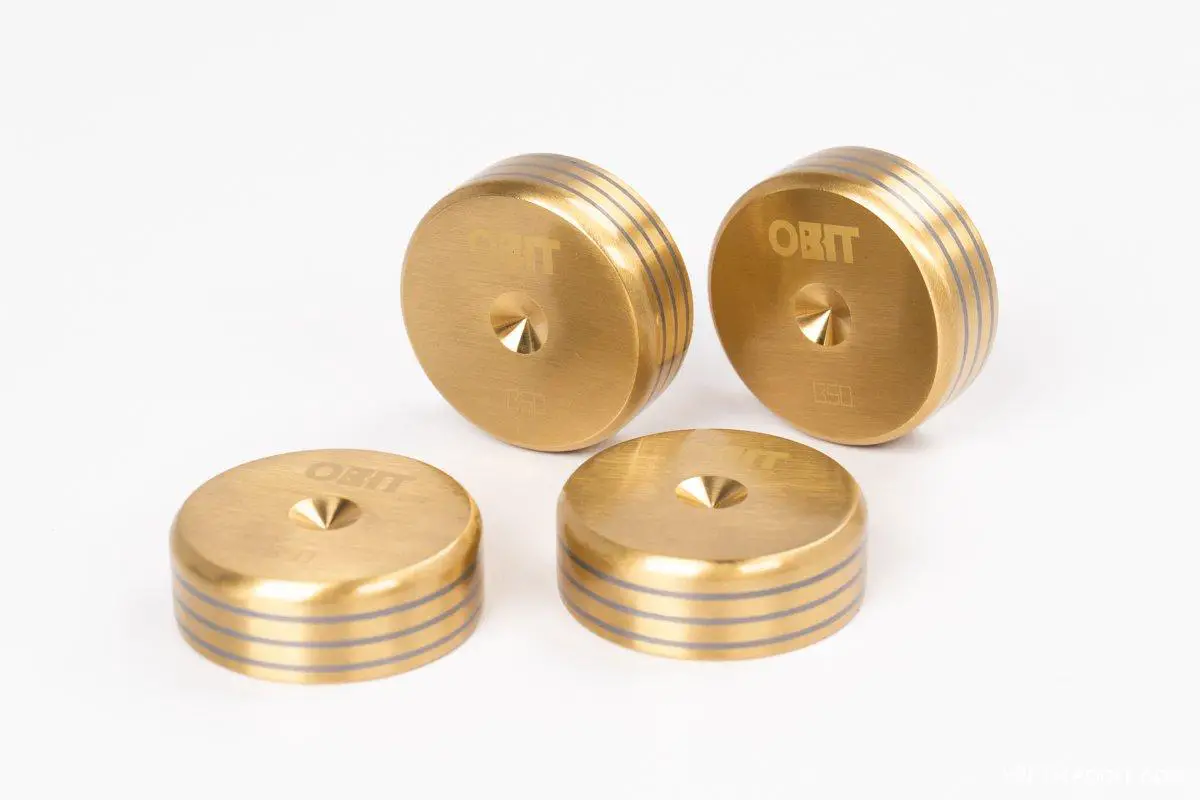
The ‘I’ series represents pointed cones, featuring a convex center. The ‘B’ series are concave cones, with a central recess designed to accommodate pointed cones. ‘I’ and ‘B’ series footers can be used independently or in combination.
The numbers following the letters denote the diameter in millimeters. For example, B40 is a concave cone with a 40mm diameter, and I50 is a pointed cone with a 50mm diameter.
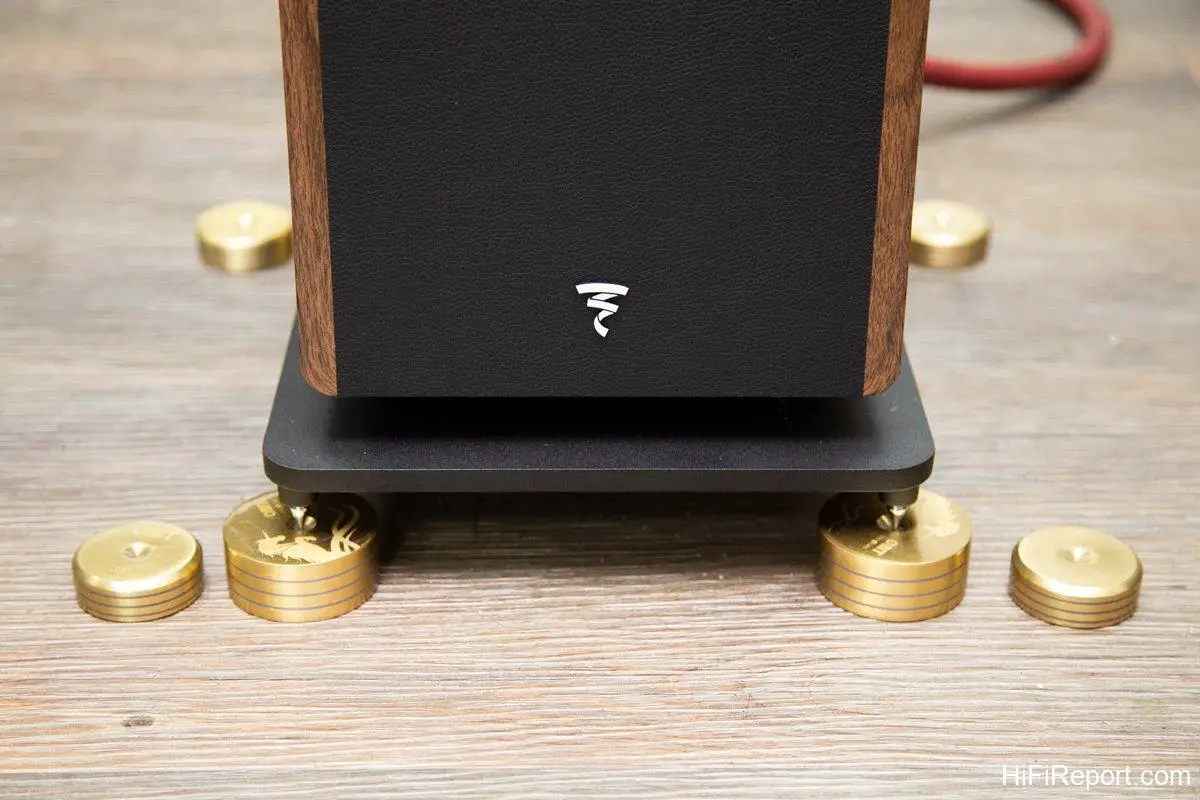
For floor-standing speakers, manufacturers typically include spikes that can be attached to the base or stands, allowing the speaker to couple with the floor through these spikes. In such cases, you can use B series concave cones, placing them under the speaker’s existing spikes.
For further refinement, you can replace the original spikes with I series pointed cones. I series cones have threaded holes on their back, allowing them to be screwed directly into the speaker base using appropriate screws. These I series cones can then be placed atop B series concave cones.
Which size should you choose? Mr. Chen recommends that for speakers, larger Obit footers are generally better. He suggested I start my listening tests with the B50. Therefore, the first phase of my evaluation began with the B50.
Stage One: Floor-standing Speakers
Let me first detail the system used for this evaluation. It comprised an Intel NUC i3 running Roon Core, a Telos EMP streaming player, a North Star Design USB DAC32, a Linear Acoustic LAV-60 MKII integrated amplifier, Focal Vestia No.2 floor-standing speakers, and a Linn LP-12 Klimax turntable.
The Focal Vestia No.2 speakers come with spikes but no spike shoes. I borrowed a set of spike shoes from Wilson Audio Alexia 2 speakers. These Alexia 2 shoes are made of pure aluminum, a neutral and simple material, making them suitable as reference spike shoes.
The first stage of listening involved comparing the Vestia No.2 speakers placed on B50 footers versus the reference spike shoes.
The music selection was track 6, “Talk To Me,” from the “Uncompressed World Vol. III” test disc. This is an R&B-flavored ballad with a relatively simple arrangement including drums, electric bass, guitar, strings, and synthesizers.
Listening first with the reference spike shoes and then switching to the B50s, the difference was immediately striking. Even someone with untrained ears would notice it, especially in the intro with the kick drum and bass. With the reference spike shoes, the sound was denser, thicker, even a bit muddy. Instruments and vocals had a substantial presence, sounding quite full, but the outlines and definition weren’t as clear. Even with the simple arrangement, instrument separation felt somewhat constrained, and the overall transparency was lacking, hindering soundstage depth and layering.
Switching to the B50s brought an immediate sense of airiness and clarity. High and low-frequency extension became more defined and effortless. The soundstage expanded vertically and horizontally, revealing a more structured and layered presentation. Instrument images became more focused and precise, shrinking slightly in size, and the low-end became tighter and more controlled. The soundstage transformed from a somewhat pyramid-shaped presentation to a more balanced, columnar form.
The most significant difference was in the bass. It was previously muddier and heavier, but with the B50s, the kick drum and electric bass became more articulate and prominent, with clearer outlines. This made the music feel lighter and more agile, less sluggish.
To be clear, the reference spike shoes didn’t sound bad, but the B50s were undeniably superior.
Another example was track 8, “Now And Forever,” also a ballad. The B50s noticeably improved the transparency of the opening piano, making the attack and decay of each note more distinct and the high-frequency airiness more pronounced. There was also a sense of increased calmness and stability. The B50s seemed to purify both the background and the overall sonic texture.
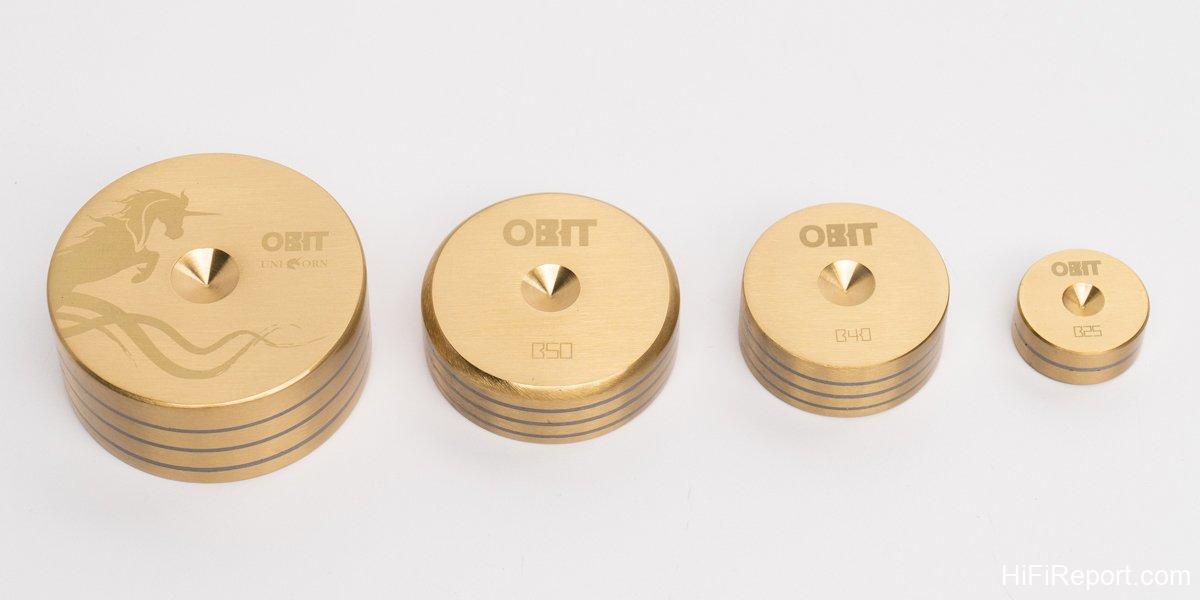
Next, I replaced the B50s with larger B60s to see what further improvements might be possible. Even though the diameter difference is only 1cm (though the thickness is more significantly different), the sonic impact was still substantial.
The B60s made an immediate impression. Using the same track 8, “Now And Forever,” in addition to the improved airiness, the density and focus of the piano notes were enhanced. The overall timbre didn’t change significantly, but the quality improved, becoming cleaner and purer. Reverberation and decay were richer and more defined, resulting in a clearer depiction of the acoustic space. Right from the piano intro, the sense of calmness was even more pronounced, and the instrument images became even more compact and well-defined.
When the drums and bass entered – wow! It was impressive. The shape, tone, and detail of the low frequencies became even clearer. In this track, the bass and kick drum fall on the same beat, and now it was easier to distinguish the distinct timbral characteristics of each instrument.
Furthermore, the B60s enhanced the vocal presence, making dynamic variations more apparent and the vibrato at the end of phrases more sustained. This resulted in richer emotional expression and greater musical tension.
At the loudest passages, the B60s sounded more relaxed and less strained than the B50s, allowing me to listen at higher volumes without fatigue.
Additionally, the B60s seemed to reduce the perceived bass level. This was due to the bass becoming more focused and controlled, tightening the lower frequencies and shaping the soundstage into a more ideal columnar form.
After listening with the B60s, I had no desire to revert to the B50s.
The difference between the B60 and B50 was no less significant than the improvement the B50s offered over standard footers. In this context, opting directly for B60s instead of starting with B50s and upgrading later seems like a worthwhile investment.
Stage Two: Amplifier
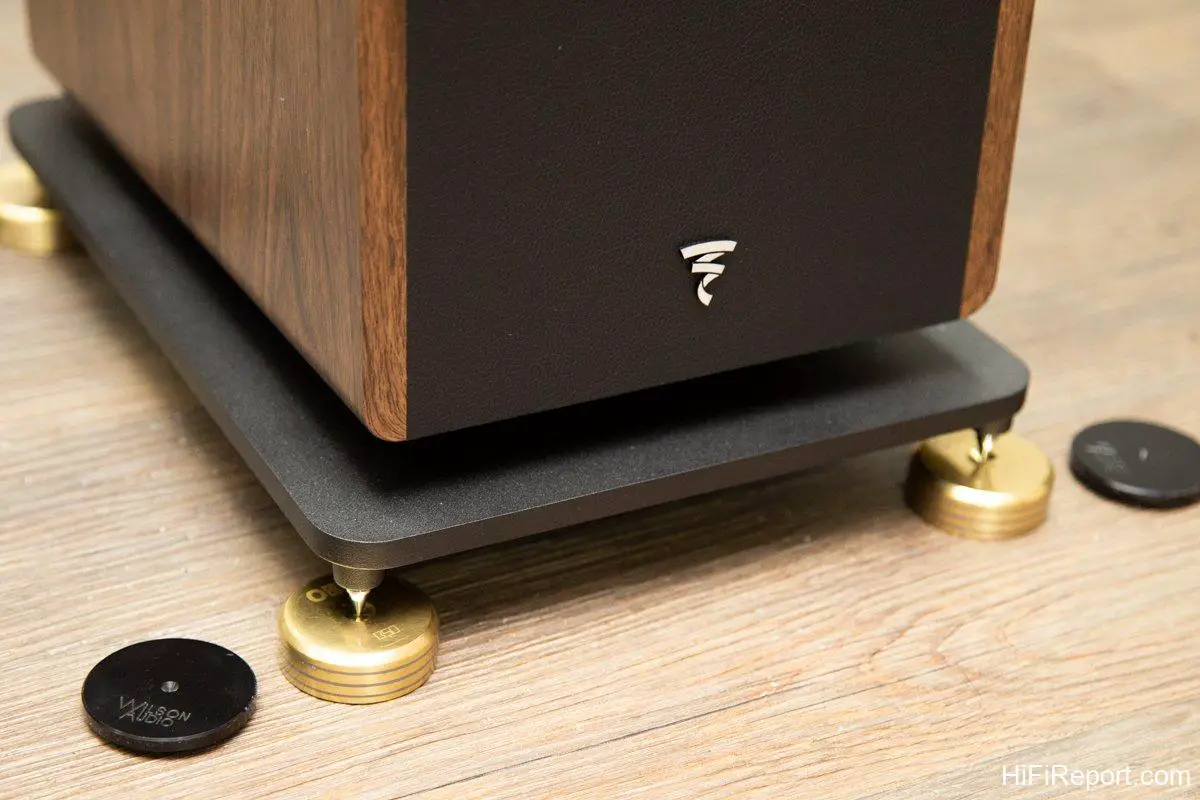
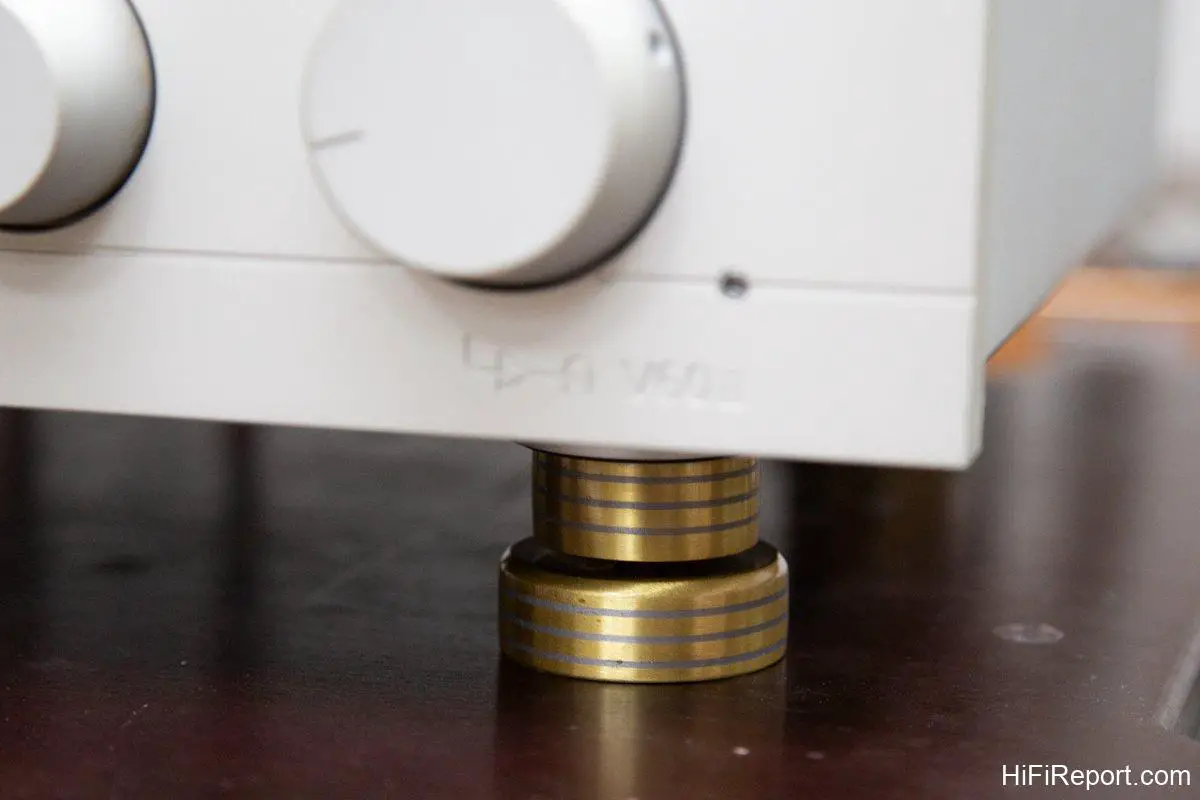
Leaving the B60s under the Vestia No.2 floor-standing speakers, I shifted my focus to the Linear Acoustic LAV-60 MKII integrated amplifier. I used four sets of I25 pointed cones paired with B40 concave cones, placing them under the amplifier’s original rubber feet. The amplifier was placed on a Tiglon audio rack. I directly compared the sound with and without the Obit footers.
Listening again to tracks 6 and 8 from “Uncompressed World Vol. III,” the sound with the I25 + B40 footers was immediately captivating. There was a sense of greater openness, and the balance between different instruments became more distinct, improving separation. The volume seemed to increase slightly, and dynamic contrasts became more pronounced. The timbre gained moisture and brilliance, becoming more beautiful and refined. The system felt like it had suddenly been elevated to a higher level.
Upon closer listening, the bass focus and clarity might not have improved dramatically with the I25 + B40, but the sound was undeniably more pleasing. They seemed to inject a dose of musicality, making the sound more enjoyable and comfortable, perhaps even smoother.
Without the I25 + B40, the sound was drier, more realistic and direct, still very good.
With the footers, the violin at the beginning of track 6 became brighter and more liquid, and the drum impact was stronger, suggesting more efficient energy transfer. In track 8, the vocalist’s performance became more expressive and emotionally engaging. This improvement is hard to describe in words, but simply put, it was clearly more enjoyable.
Furthermore, the perceived bass quantity increased slightly compared to without the footers, but without disrupting the overall balance, making the sound more appealing.
It seemed that the I25 + B40 footers acted as a fine-tuning component for the amplifier.
Stage Three: Turntable
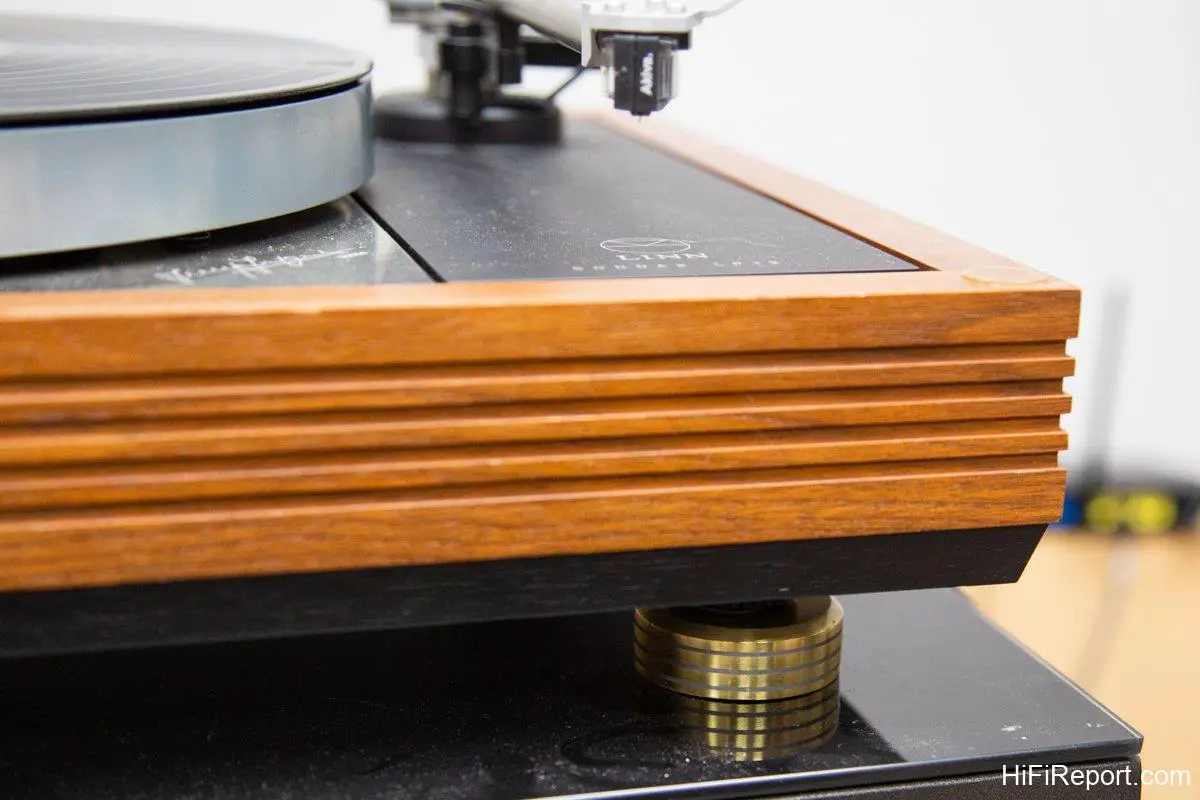
If Obit footers worked well for the amplifier, what about a turntable? I prepared four sets of I25 + B40 for the Linn LP-12 Klimax turntable, intending to place them under its four rubber feet. However, I discovered that the LP-12 Klimax’s feet are somewhat mobile, making it unstable to use I25 + B40 directly. Therefore, I only used B40 concave cones.
Playing track 2, “Joey,” from Dave’s True Story’s self-titled album, the LP-12 Klimax with B40 footers showed improved separation between instruments and vocals. The frequency balance became clearer and more organized, and the high-frequency timbre gained moisture, enhancing airiness. Vocal focus and definition also improved.
In essence, the improvements with Obit footers on the LP-12 Klimax were similar to those on the LAV-60 MKII amplifier, but the magnitude of improvement was less pronounced, possibly due to only using B40 cones.
Stage Four: Blu-ray Player
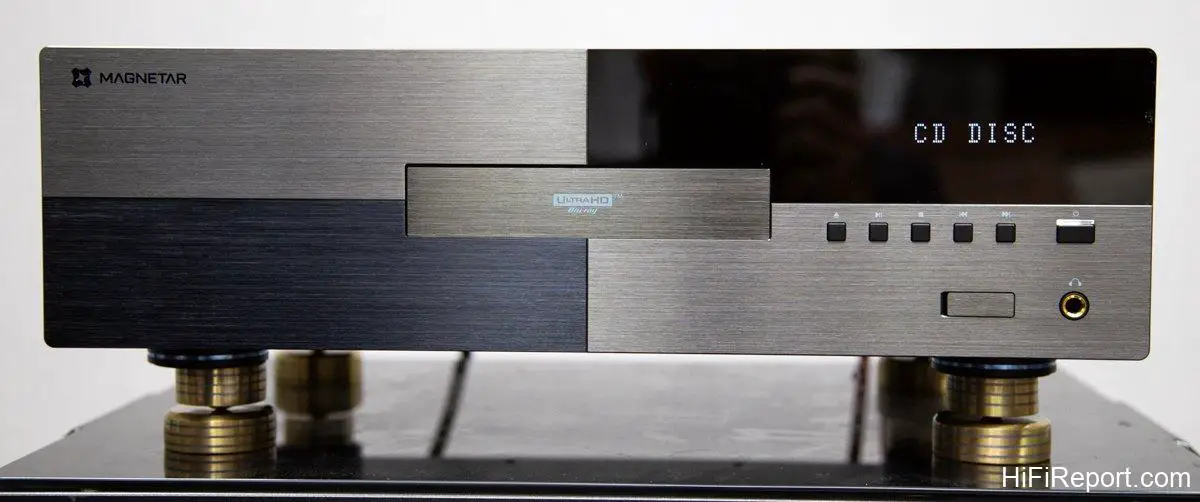
During the Obit footer testing, the Magnetar UDP900 Blu-ray player was also available, so I included it in the test lineup. I placed four sets of I40 + B50 footers under the UDP900’s four feet.
Note that I used I40 + B50, a larger size than the I25 + B40 used for the amplifier! Playing the “Uncompressed World Vol. III” test CD again, the improvement was significant. It was clear that using the I + B combination brought about more noticeable effects.
The sound felt like it had been unleashed. The entire sonic presentation opened up, with both soundstage and energy expanding, as if I had upgraded to a more powerful and better-sounding amplifier, or as if the entire system had jumped up a class. The musical picture became instantly more vivid.
Is it really that dramatic? Yes, it is.
Without the I40 + B50 footers, the sound was more restrained, contained, even a bit constricted. With them, it immediately became more unrestrained and vibrant. For R&B tracks like track 6 “Talk To Me,” this was exactly the intended feel.
For track 8, “Now And Forever,” the sound without the footers was not bad, but the musical vitality and emotional impact were less engaging. The soundstage seemed confined to the center, like a ball, lacking openness. The ease and naturalness of high and low-frequency extension were also reduced. The vocalist sounded like they were singing to someone nearby, merely conveying the melody.
With the footers, the vocals became more expressive and emotive, and the singer’s emotions came through. The musical flow became smoother and more linear, with clearer separation across the frequency spectrum. The structure became more defined, and the ease and naturalness of extension at both ends of the spectrum improved. The mid and low-frequency fullness also increased, making the sound richer and more complete.
Stage Five: Amplifier Upgraded to I40 + B50
Having previously placed I25 + B40 under the LAV-60 MKII amplifier and achieving excellent results with I40 + B50 under the UDP900 Blu-ray player, I decided to upgrade the LAV-60 MKII to I40 + B50 to see if further improvements could be realized.
Obit provided a generous quantity of footers for testing, allowing me to upgrade the amplifier without removing the footers already in use.
What were the changes in sound? Was bigger truly better? The improvements were consistent in direction and equally significant. Transparency, tonal purity, soundstage imaging and structure, separation, layering, dynamics, and musical vitality all benefited positively. However, upon closer comparison, I found that the I40 + B50 combination sounded more solid and grounded, with a slightly weightier presentation. The I25 + B40, on the other hand, was more delicate, agile, and revealed micro-dynamics more readily.
I don’t believe either combination is definitively superior; rather, it depends on user preference and equipment characteristics. However, using them is undoubtedly better than not using them at all.
Stage Six: DAC
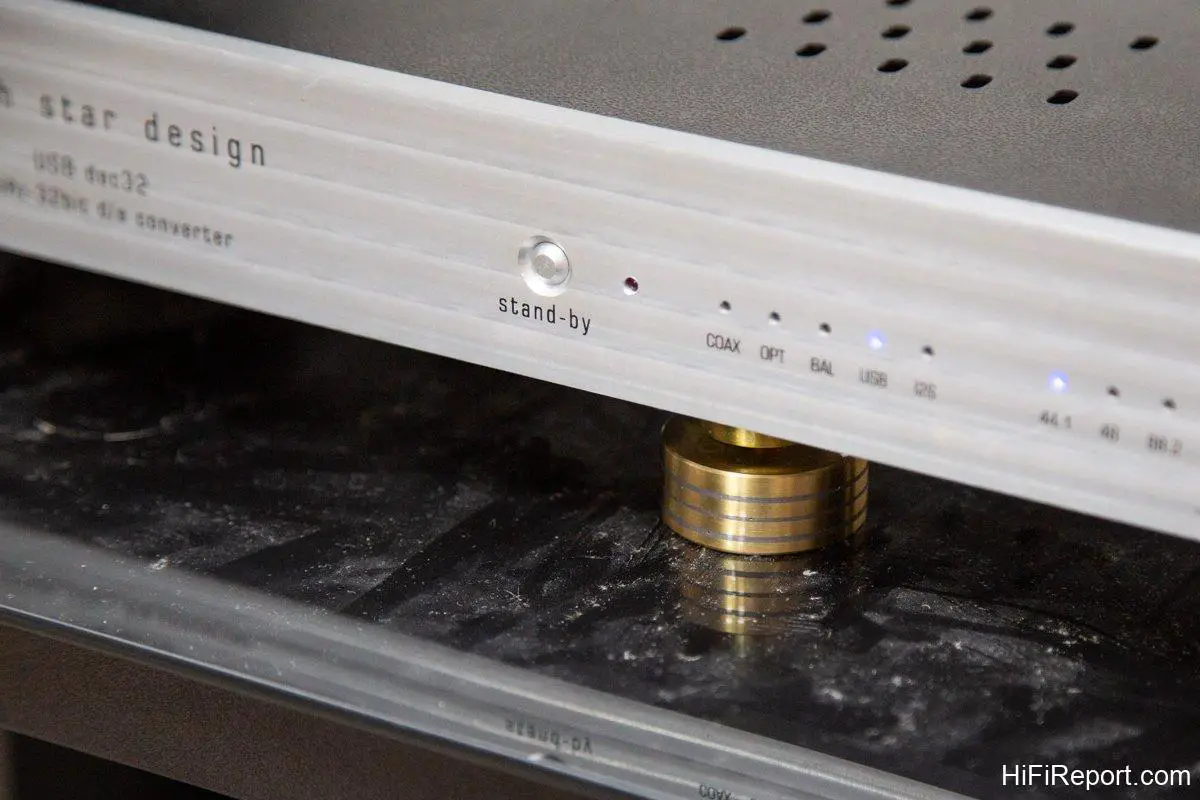
Finally, I placed Obit footers under the North Star Design USB DAC32, using I25 + B40. I only used three sets because the DAC32’s feet are pointed, making it unstable to place directly on I25 + B40. So, I placed three sets of I25 + B40 directly under the chassis, one at the front and two at the rear, which provided excellent stability.
Comparing the sound with and without footers, the improvement was immediately apparent. The sound became even better, with more detail, or rather, details became more easily discernible, enhancing the overall completeness of the sound. Subtle nuances were also more clearly rendered. The smoothness of sonic lines improved, dynamic gradations became more linear, and the layers became richer. High-volume passages were handled more effortlessly, with more defined impact yet sounding relaxed. Low frequencies extended deeper, and both high and low-frequency extension improved. Tonally, there was a subtle coloration, adding a touch of warmth and sweetness, enriching the listening experience.
Again, Obit footers had no negative effects on the DAC. Using them was definitely better than not.
Whether used with speakers or components, large or small, the direction of improvement was consistent.
Positive System Enhancement
Through a series of tests, including previous bookshelf speaker evaluations, I can confidently conclude that Obit footers, whether used with speakers, amplifiers, DACs, digital sources, or turntables, consistently deliver positive system enhancements. They improve the sound in a beneficial direction, without introducing any unwanted artifacts or side effects.
There are a few guidelines for using Obit footers.
Firstly, for speakers, generally, larger speakers benefit more from larger Obit footers (usually B series), yielding better results.
Secondly, for components, it’s recommended to use I + B combinations, pointed cones with concave cones. While this is more costly, the effect is more pronounced and better demonstrates their value. As for size, larger isn’t always necessarily better. Experimenting with different size combinations to find your preferred sonic character is key.
Why this difference? Obit footers were initially developed to address speaker vibrations. Speaker vibrations encompass a wide range of frequencies, and larger Obit footers are more effective at managing complex vibrations. However, component vibrations are often simpler, typically concentrated in a specific frequency range, and different components vibrate differently. Therefore, experimentation is needed to find the appropriate footer combination to target that specific frequency, achieving your desired sound.
Highlight Equipment Potential
Considering their price, Obit footers might not be considered inexpensive. However, I believe the improvements they offer outweigh their cost, making them a worthwhile investment. In other words, their value for money (C/P ratio) is high.
If you own high-quality speakers and components, Obit footers are even more essential to unlock their full potential. They effectively address complex vibration issues, providing an immediate and noticeable system upgrade, allowing your equipment to perform at its best.
Specifications
* **Obit Audio Type:** Composite Metal Isolation Footers
* **Dimensions:**
* B25: 25 mm (width), 11 mm (height)
* B40: 40 mm (width), 17 mm (height)
* B50: 50 mm (width), 17 mm (height)
* **Recommended Load Capacity:**
* B25 / B40: Up to 20 kg
* B50: 20~100 kg