
Steinmusic Super Naturals Signature Review
“Could you *please* not assign me to write about audio footers?” I asked Chief Editor Lin Chih-Yu during our weekly editorial meeting when the schedule for reviewing equipment came up. The reason? He wanted me to write about Steinmusic’s Super Naturals Signature footers.
“Sorry, it’s Madison Audio who specifically requested it.”
No reply. I silently accepted the Steinmusic Super Naturals Signature. In this industry, debts must be repaid.
Three Sets of Super Naturals Signature for Review
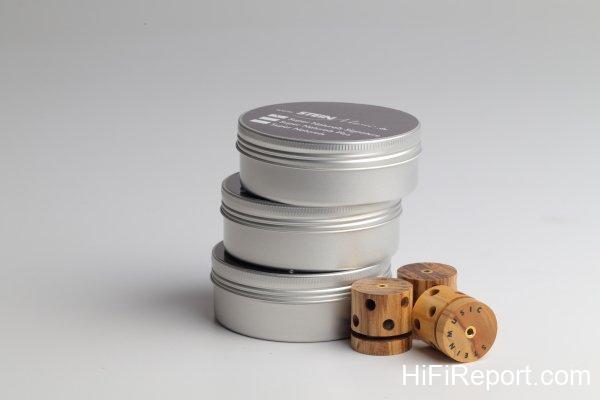
Madison Audio sent over three sets of Super Naturals Signature at once, making it convenient for me to experiment with various equipment. Two sets were of the same size and height, while the third set was taller, but all were Super Naturals Signature models.

The different height settings are designed to accommodate various equipment configurations. Some devices have taller stock feet and require taller Super Naturals Signature footers to match.
Each set of Super Naturals Signature contains three footers, adhering to the audiophile principle of three-point support for vibration isolation. However, according to the manufacturer’s information, individual footers can be purchased separately to create sets of four if desired.
How are they used? Simply place the wooden Super Naturals Signature under the equipment, replacing the original feet, right? It seems straightforward. Heh heh, if you thought so, you would be making the same mistake I did. I initially placed the Super Naturals Signature casually, without much thought, and the results were…unclear. I had to sheepishly return to the A4-sized instruction manual to learn how to “correctly use” the Super Naturals Signature.
Effectiveness Proven by Listening
If you believe that audio footers are solely for vibration isolation, that manufacturers use various materials that all sound roughly the same – wood sounds like wood, metal sounds like metal – and that reasonable pricing is the key, dismissing expensive footers as “snake oil” from brands trying to scam audiophiles, then you might as well stop reading now. No matter how good I say the Super Naturals Signature is, you won’t believe me, so there’s no need to waste your time.
Truthfully, I felt some resistance when Super Naturals Signature was assigned to me in the editorial meeting. After the product photos were taken and the elegant little metal box was placed on my desk, I opened it a few times, but still hesitated to try them. I feared not being able to hear any difference or articulate any rationale. I procrastinated for a week or two, just looking at them without listening. But duty calls. I finally took out one set of Super Naturals Signature and placed them under the Lindemann Musicbook Source, two at the front and one at the back, paired with the Lindemann Musicbook Power amplifier, driving Wilson Audio Alexia 2 loudspeakers.
Wood, Metal, Ceramic, and Tuning Lacquer
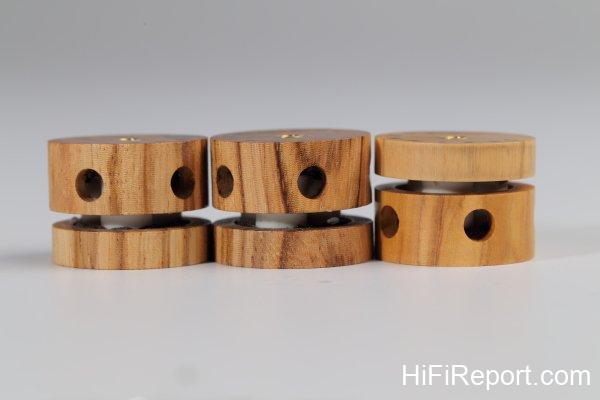
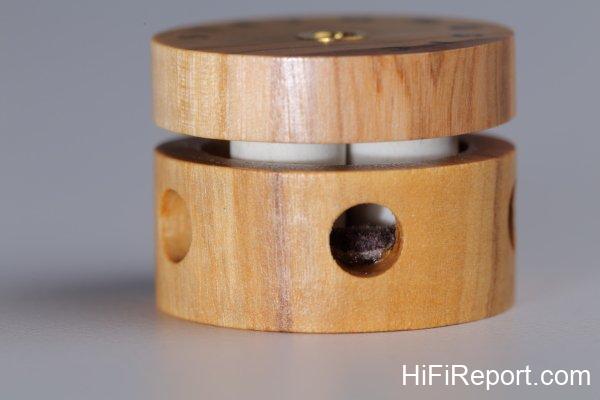
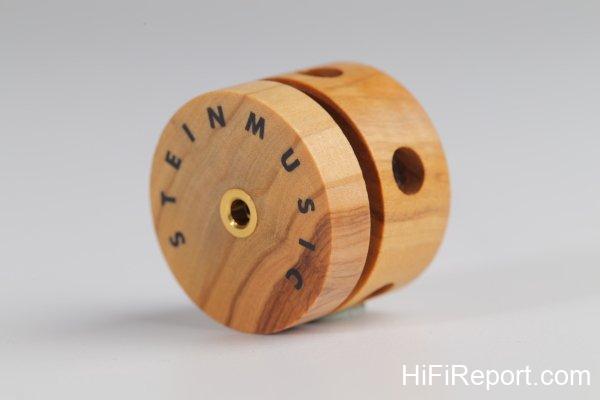
Why Lindemann for pairing? Because the Musicbook Source is small and lightweight, and even the Musicbook Power amplifier is light. Using them with Super Naturals Signature made my life easier; moving the components around was effortless. But when I took them out to use, I was puzzled about how to orient them. They appeared to be composed of a thick piece of wood and a thin piece of wood. The thicker wood surface had holes, and looking through the holes, I could see white granular material inside. One footer had a metal tube in the center, while the others didn’t. Moreover, the lighter-colored one was thicker on the bottom and thinner on top, while the two darker-colored footers were the opposite, thicker on top and thinner on the bottom. Should the thicker side face up? Or the thinner side? What was the correct orientation? I obediently pulled out the instruction manual for a proper read. The two darker Super Naturals Signature footers are made of African Zebrawood, while the lighter one is crafted from Italian Olivewood. The white material inside is a special ceramic compound, further enhanced with Steinmusic’s proprietary formula, emphasizing “quantum physics” level tuning technology. The surfaces are coated with a special tuning lacquer, and the manufacturing process involves 130 steps, all to create the Super Naturals Signature’s remarkably natural sound.
Metal Ring Face Upwards
These descriptions might sound like marketing hype, going in one ear and out the other. Let’s skip that for now and go straight to the usage instructions.
Indeed, the metal ring is key – it must face upwards when placed; otherwise, you’re using them incorrectly.
Using three Super Naturals Signature footers achieves three-point vibration isolation. If your equipment is heavy and weight distribution is uneven, like a power amplifier, where the transformer at the back is usually the heaviest part and the front is relatively lighter, you should place the lighter-colored Olivewood footer under the heaviest side. Then, distribute the two African Zebrawood footers to balance the remaining weight evenly.
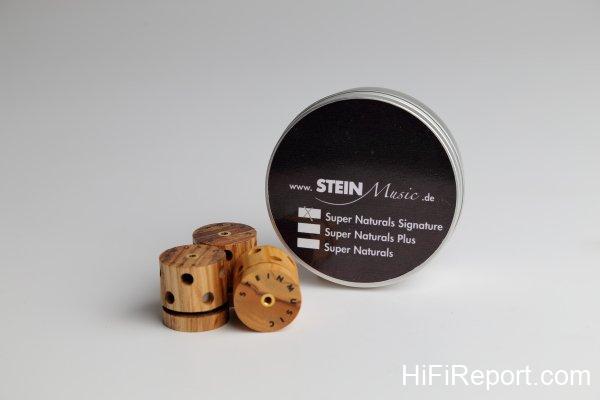
Understood. I made sure all three Super Naturals Signature footers had the metal rings facing upwards, ensuring I wouldn’t misplace them.
The Musicbook Source isn’t heavy, and its weight distribution is reasonably balanced. I positioned the lighter Olivewood footer at the front and the two African Zebrawood footers at the back, one in each rear corner, employing a three-point configuration. I decided to listen with just one set first.
Intriguing. It’s been a while since I encountered such an interesting audio footer like the Super Naturals Signature.

Composite Material Audio Footers Make Sense
Audio footer materials are generally either soft or hard, with composite materials combining both. Super Naturals Signature utilizes composite material design. It incorporates wood, a relatively soft material, and uses two types of wood with differing densities. The central metal ring is a hard material, and the internal special ceramic beads are also hard.
I’ve experimented with many audio footers – metal, wood, carbon fiber, cylindrical, conical. Each type has its own tuning capability, and none is absolutely superior. However, through experience, I believe composite material footers are better and more comprehensive than those made from a single material.
Why are composite footers more comprehensive? Because footers address resonance. Soft materials provide damping, while hard materials isolate vibration. Both approaches have merit but also drawbacks.
Soft materials provide damping to reduce resonance, but they can also diminish musical vitality, making the sound darker and less lively. Hard materials isolate resonance but can trap it within the equipment, lacking an outlet for dissipation, resulting in a sound that is tight and unnatural. Steinmusic outlines the pros and cons of soft and hard materials in the small A4 manual. Their solution is to combine both, and the Super Naturals Signature’s purpose is to eliminate unwanted equipment resonance, channeling it to the ground while preventing resonance from the audio rack from feeding back into the equipment, preserving the music’s natural expression.
Unfathomable 130 Complex Manufacturing Steps
I’ve gained a basic understanding of Super Naturals Signature, but Steinmusic’s claims of “quantum physics” level technology and 130 processing steps remain incomprehensible. That’s their proprietary knowledge. My serious reading of the A4 manual only started after placing the first set of Super Naturals Signature under the Musicbook Source. The musical expression noticeably became more natural, comfortable, and engaging, prompting me to meticulously reread the one-and-a-half A4 pages.
However, I must admit, Steinmusic’s quantum physics, special processes, tuning lacquer… I still don’t understand any of it. But I do know the musical expression has become more natural. Super Naturals Signature is genuinely effective.
Natural and Lively Musical Expression
Before placing the Super Naturals Signature, I had already listened to several tracks for comparison. The last piece was Bartoli’s “Live in Italy,” specifically Handel’s “Lascia La Spina,” recorded in one of Italy’s oldest theaters during a live concert. The mezzo-soprano Bartoli, accompanied by an early music ensemble, already sounded captivating through the Alexia 2s even before the Super Naturals Signature. However, after adding the footers, the musical background became quieter. The relatively softer sounds of the period instruments floated ethereally in the air, and the subtle dynamic shifts, from soft to loud, became more vivid. Bartoli’s rich vocal nuances and the details of her breathing between phrases became richer. The emotional impact of listening to a live concert intensified.
Strange? Not improved bass? Not enhanced treble? Not thicker midrange? None of these. It’s the naturalness of the sonic expression, the smoother breathing, and the more gentle and fluid musical lines. It’s the kind of change that easily draws you into focused listening.
I can’t pinpoint which frequency range Super Naturals Signature altered in the existing sound. I can only say the sonic edges became smoother, the listening experience more comfortable, and even at higher volumes, there was no sense of strain. Instead, it felt like moving closer to the front rows of a concert hall. Musical details increased, and the dynamic range of vocals and instruments widened. Moreover, with Super Naturals Signature, the overall musical expression became more natural, making the listening experience closer to a live concert.
Effortlessly Increase the Volume
Making musical expression livelier and more natural is the most fascinating aspect of Super Naturals Signature. Let’s take the “Friday Night in San Francisco” live concert recording by the three guitar masters as an example. The Alexia 2s already present a remarkably precise soundstage. The image and timbre of the three guitars are also very realistic. However, simply by adding Super Naturals Signature under the Musicbook Source, I could increase the volume further. The soundstage depth and height expanded, and the guitar images moved slightly forward, with richer performance details. The sense of live guitars playing right in front of you became even more engaging and enjoyable.
If one set of Super Naturals Signature is this interesting, I quickly brought out the other two sets. The smaller ones went under the North Star Design CD transport, and the larger set went under the Musicbook Power amplifier, wondering if more would be even better.
More is Better, But Diminishing Returns
I listened to Bartoli’s “Live in Italy” again, Handel’s “Lascia La Spina.” The naturally vivid musical expression and the lively vocal nuances, compared to using only one set of Super Naturals Signature, seemed slightly better. I still enjoyed listening, Bartoli’s subtle breathing changes and vocal inflections were natural, but the effect of using all three sets seemed only marginally better than using just one set.
Alas, this is the “law of diminishing returns” for audio footers. One set of Super Naturals Signature immediately makes the sound more natural. Some sonic roughness is smoothed out, the soundstage width and height expand, and the overall listening experience becomes more relaxed. Just placing one set under the Musicbook Source noticeably made the musical expression more natural, but adding two more sets, while improving things further, didn’t produce the same “wow, how interesting!” change as the first set.
Most Effective on Source Components
Over two months, three sets of Super Naturals Signature accompanied my listening sessions. During this time, I used them with all the equipment I reviewed, especially source components. Whether it was a CD transport, streamer, or turntable, Super Naturals Signature consistently delivered excellent results.
Of course, without direct comparison, the difference might not be immediately apparent. But with Super Naturals Signature, music gains a touch of spaciousness, a hint of naturalness, musical lines become more fluid, and expressions become more vivid and lively.
Even as I write this review, I still don’t understand Steinmusic’s “quantum physics” level processing and 130 special steps. What exactly is in the black box? But the Super Naturals Signature, made from a blend of wood, metal, ceramic, and special tuning lacquer, effectively makes musical expression more natural. It’s truly worth a try. But before auditioning, please calm yourself and listen attentively. Without quiet focus, you might miss the joy of experiencing Super Naturals Signature.