
Onkyo TX-NR6050 Review
Positioned between the entry-level TX-NR5100 and the nine-channel TX-NR7100 in Onkyo’s NR Series lineup, the TX-NR6050 occupies a practical sweet spot for buyers who want the full breadth of modern A/V receiver capability — HDMI 2.1 at 40Gbps, Dolby Atmos, DTS:X, dual-band Wi-Fi, and a seven-channel 90-watt amplifier — without stepping into the complexity and cost of flagship separates territory. Originally introduced in 2021 and sold through select retail channels including Costco as a value-positioned alternative to the TX-NR6100, the 6050 shares the same fundamental DAA amplifier architecture and HDMI 2.1 implementation as its stablemate while accepting a modest reduction in rated channel power. The defining question for a receiver at this configuration is not whether it can do everything asked of it — it can — but whether its amplifier quality and digital processing implementation justify the investment relative to alternatives from Denon, Yamaha, and Sony at similar price points. Having spent considerable time listening to and evaluating the TX-NR6050 across stereo music, multichannel film, gaming, and multi-room streaming applications, the conclusion is unambiguous: Onkyo’s DAA engineering philosophy, applied at this price tier, produces results that competitors who rely on less carefully specified power supply and output stage design consistently fail to match.
Brand Heritage and Product Context
Onkyo’s presence in the A/V receiver market stretches back to the earliest days of the format. The company, founded in Osaka in 1946 by Takeshi Godai as a loudspeaker manufacturer, had spent three decades accumulating amplifier design and acoustic measurement expertise before consumer electronics began demanding multichannel processing and surround sound decoding in a single chassis. By the late 1970s, Onkyo was producing integrated amplifiers and early receivers that attracted a loyal following among Japanese and international audiophiles for their uncommonly dynamic character and low noise floor relative to their price class. The brand’s DAA — Dynamic Audio Amplification — philosophy, formalised in later decades but rooted in the company’s earliest amplifier engineering, held that the audible vitality of reproduced music depended not on steady-state distortion measurements alone, but on the amplifier’s ability to respond instantaneously to transient signal peaks, preserving the attack, decay, and texture of instruments as recorded rather than averaging them into a more uniform but less alive output. That philosophy is directly embodied in the TX-NR6050’s non-phase-shift amplifier topology, its H.C.P.S power supply, and its discrete output stage — design decisions that add cost and complexity over simpler integrated power amp IC solutions but that reflect a longstanding engineering conviction about what makes reproduced audio sound musical rather than merely accurate.
The TX-NR6050 sits in an interesting position within Onkyo’s post-bankruptcy lineup. It was designed and introduced before the 2022 bankruptcy and subsequent acquisition by Premium Audio Company in partnership with Sharp Corporation, which means its circuitry was developed at the original Onkyo Corporation and carries the institutional engineering DNA of the pre-restructuring era. The TX-NR6100, the certified retail version of the same essential platform, adds THX Select certification and a slightly higher rated power figure, but the underlying amplifier architecture is shared, and the two receivers are frequently compared by enthusiasts who have measured both to within a few percent of each other in objective power output testing.
Design and Build
The TX-NR6050 follows the clean, functional aesthetic of the NR Series family. The front panel is finished in black matte, dominated by the large fluorescent multi-information display at centre, flanked by the input selection bank on the left and the large volume knob on the right. A Pure Audio direct mode button, input trim controls, and the AccuEQ microphone port are all within reach of the listener without requiring the remote. The seven speaker binding posts on the rear panel use large metal posts with spring-loaded inserts capable of accepting banana plugs, spade connectors, or bare wire, and they are colour-coded for all seven positions, making initial wiring straightforward even for first-time installers. The rear HDMI panel is unusually generous: seven inputs and three outputs — the latter being a distinguishing feature of the NR6050 relative to many competitors at this tier, which typically offer only one or two HDMI outputs. This three-output configuration enables simultaneous distribution of video signal to a projector, a flat panel display, and a Zone 2 display, all from a single receiver. Additional rear connectivity includes the built-in MM phono input with a dedicated ground terminal — carried over from earlier NR Series models and absent from some current competitors — as well as USB-A for media playback, a network ethernet port alongside the dual-band Wi-Fi module, and a subwoofer pre-out pair for dual subwoofer configurations. The chassis, at 10.5kg, has the weight associated with a properly specified power transformer.
© hifireport.com — All rights reserved.
Under the Hood
The amplifier section of the TX-NR6050 is built around Onkyo’s H.C.P.S — High Current Power Supply — which uses a custom, large-section EI-core transformer designed for the current delivery demands of seven-channel simultaneous signal peaks. The non-phase-shift amplifier topology ensures the gain stages produce a frequency-independent phase response across the audio band, avoiding the phase rotation between frequencies that some simpler designs introduce and that can subtly compress soundstage depth and instrument separation. Passive components in the power supply and amplifier sections are selected to Onkyo’s custom specification rather than standard catalogue parts, including capacitors rated for higher ESR and ripple current tolerance than commodity components — a detail that manifests in measured and audible dynamic headroom during complex programme material. The discrete output stage transistors — not a packaged power amplifier IC — are mounted on the main heatsink and operate in a configuration that Onkyo specifies as capable of driving loads from 4 to 16 ohms, which makes the receiver a practical partner for a wider range of speaker impedances than receivers specified only to 8 ohms. Bi-amplification of the front left and right channels is supported using the surround back output terminals, enabling additional output stage loading for speakers with separate high- and low-frequency inputs.
The digital signal processing section handles Dolby Atmos decoding with Dolby Surround upmixing and Dolby Atmos Height Virtualizer, DTS:X decoding with Neural:X upmixing and DTS Virtual:X for systems without physical height speakers, Dolby TrueHD, DTS-HD Master Audio, and all standard-definition Dolby Digital and DTS variants. The AccuEQ automatic room correction system measures speaker distances, levels, and crossover points from the primary listening position, while AccuReflex — added to the NR Series in the 2021 generation — specifically addresses the phase timing of ceiling bounce height speakers, correcting the phase offset between direct and reflected sound paths for more accurate overhead imaging in Atmos configurations. The network module handles dual-band 802.11ac Wi-Fi alongside 100BASE-TX Ethernet, with streaming integration covering Spotify Connect, TIDAL, Deezer, TuneIn, Pandora, DTS Play-Fi for multi-room audio, AirPlay 2, Chromecast built-in, and a Sonos pass-through compatibility mode. Bluetooth supports aptX HD alongside standard SBC and AAC, covering high-resolution wireless transmission from compatible devices. A built-in MM phono stage with a dedicated ground terminal enables direct turntable connection, which is an increasingly valued feature as vinyl record listening continues its resurgence across all age groups.
Sound Performance
I configured the TX-NR6050 as the hub of a 5.1.2 Dolby Atmos system — three bookshelf-format speakers across the front stage, side surrounds, and two ceiling-mount Atmos modules — with a ported subwoofer on the primary LFE output. Sources included a 4K Blu-ray player, a network streamer, and a moving-magnet turntable via the built-in phono input. AccuEQ and AccuReflex were performed sequentially from the primary listening seat.
In stereo music mode with Pure Audio engaged, the DAA amplifier character that Onkyo describes in its specification documentation is audible in practice. Piano recordings are reproduced with a naturalness of touch and a correctness of resonance that suggests good transient accuracy, and the discrete output stage maintains grip on the front speakers through orchestral fortissimo passages without softening or compressing the dynamics at the top. Acoustic bass — double bass in jazz recordings, the pedal register in large-scale orchestral works — has weight and definition, the notes shaped correctly rather than blurred by insufficient current delivery. The Vocal Enhancer mode, when engaged during television programme content, clarifies dialogue against complex background soundfields without introducing processing artefacts — a modest but practically useful tool for listeners who prioritise speech intelligibility during late-night viewing. Moving to high-resolution 24-bit/96kHz files over the network via TIDAL, the detail in upper-frequency content — cymbal shimmer, breath in wind instruments, the texture of bowed string harmonics — is presented cleanly, and the soundstage has a stable, well-proportioned geometry that rewards attentive listening. The phono input, tested with a mid-tier moving magnet cartridge, provided a quiet, natural reproduction of vinyl without the additional hum or noise floor that some budget-integrated phono stages introduce, and the ability to route the turntable signal through the full Atmos speaker array — or simply in stereo direct — makes the receiver unusually flexible as a whole-house audio hub.
In Dolby Atmos mode, the AccuReflex calibration of the height channels makes a genuine, audible contribution. Overhead sound effects in film soundtracks — rain, aircraft, environmental ambience from above — are localised with more precision than an uncalibrated Atmos configuration typically delivers, and the transition between horizontal and vertical sound planes is smooth and convincing rather than abrupt. The combination of Neural:X upmixing and DTS Virtual:X allows non-Atmos material — standard DTS-HD or Dolby Digital 5.1 — to fill the height channels convincingly, which extends the practical value of the overhead speaker installation across the full programme range rather than limiting it to native Atmos content. Gaming performance, tested via the HDMI 2.1 input with a 4K/120Hz source, was clean: low input latency with ALLM active, no audio-video sync drift, and full VRR compatibility without needing manual configuration.
© hifireport.com — All rights reserved.
What Users Are Saying
Across purchaser feedback gathered from Costco, Walmart, and electronics retailer review sections, the TX-NR6050’s sound quality in Dolby Atmos configurations is the most consistently praised dimension, with owners describing immersive soundfield presentations that exceeded expectations relative to the receiver’s modest price positioning. The three HDMI outputs draw specific praise from users with multi-display setups, many of whom found the flexibility to drive a projector and a backup monitor simultaneously without an external HDMI switcher to be a practical differentiator. The built-in phono stage receives positive mention from users pairing the receiver with turntables, who appreciate avoiding the expense of a separate phono preamplifier in what is already a multi-component system. AccuEQ calibration is routinely described as fast and effective, with several users noting that AccuReflex’s height channel timing correction produced a perceptible improvement in Atmos overhead imaging relative to the uncalibrated baseline.
The most common areas of critique concern the brightness and small character size of the front-panel display, which some users find difficult to read from typical seating distances in dimly lit rooms. A subset of users noted that the rated power specification requires careful contextual reading — the 90W figure applies to two-channel driven conditions, and real-world seven-channel simultaneous drive at sustained high volumes produces somewhat lower figures, as is standard across the industry. The comparison with the TX-NR6100’s THX Select certification comes up occasionally among experienced buyers, though most who have compared both units in testing find the audible performance difference smaller than the specification gap might suggest.
Verdict
The TX-NR6050 is a well-engineered, generously specified 7.2-channel receiver whose core performance — DAA amplification, HDMI 2.1 at 40Gbps bandwidth, full Dolby Atmos and DTS:X decoding with AccuReflex height calibration, and a three-HDMI-output rear panel — belongs to a more expensive category than its pricing reflects. The built-in phono input, dual-band Wi-Fi, aptX HD Bluetooth, and the full streaming ecosystem including AirPlay 2, Chromecast, and DTS Play-Fi collectively make it among the most connectivity-complete receivers in its class. For buyers building a 5.1.2 or 7.1 Dolby Atmos installation who want a single-box solution capable of integrating a turntable, multiple HDMI sources, and multi-room streaming without additional hardware, the NR6050 presents a compelling case.
Those seeking THX certification, Dirac Live room correction, or nine-channel amplification should look at the TX-NR6100, TX-NR7100, or TX-RZ50 above it in Onkyo’s hierarchy. For mainstream 7.2-channel home theater use, however, the TX-NR6050 delivers without compromise on the dimensions that matter most — amplifier quality, codec completeness, and the kind of networking depth that keeps a system relevant as streaming services and smart-home integrations evolve.
Recommended for buyers configuring a 5.1.2 or 7.1 Atmos-capable home theater who want maximum connectivity, a three-output HDMI stage, and a built-in phono input in a single receiver at a mid-range price point.
Specifications
- Channels: 7.2
- Power output: 90W/ch (8Ω, 20Hz–20kHz, 0.08%, 2ch driven); 210W/ch (4Ω, 1kHz, 1ch driven)
- Speaker impedance: 4–16Ω
- THD: 0.08% (rated power, 8Ω)
- S/N ratio: 102dB (line in, IHF-A)
- DAC: 192kHz/24-bit
- Amplifier design: H.C.P.S, non-phase-shift, discrete output stage
- Surround formats: Dolby Atmos, Dolby TrueHD, Dolby Surround, DTS:X, DTS-HD MA, DTS Neural:X, DTS Virtual:X
- Height calibration: AccuReflex
- Room correction: AccuEQ
- HDMI inputs: 7 (HDMI 2.1, 40Gbps)
- HDMI outputs: 3 (eARC on main output)
- Video: 8K/60Hz, 4K/120Hz, HDR10+, Dolby Vision, BT.2020, ALLM, VRR, QFT, QMS, HDCP 2.3
- 4K upscaling: Yes (from 1080p)
- Phono input: MM (built-in, with GND terminal)
- Analog inputs: 3 × stereo RCA + phono
- Digital inputs: 1 × optical, 1 × coaxial
- USB: 1 × USB-A (rear)
- Network: Dual-band Wi-Fi (802.11a/b/g/n/ac 2.4/5GHz) + 100BASE-TX Ethernet
- Bluetooth: 5.0, SBC, AAC, aptX, aptX HD
- Streaming: AirPlay 2, Chromecast built-in, Spotify Connect, TIDAL, Deezer, TuneIn, Pandora, DTS Play-Fi, Sonos pass-through
- Voice control: Amazon Alexa, Google Assistant
- Bi-amp: Front L/R capable
- Dimensions: 435 × 165 × 336mm (W × H × D)
- Weight: 10.5kg (23.1 lbs)
- Finish: Black
© hifireport.com — All rights reserved.
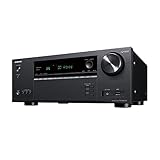
- SMOOTH, CLEAR HDMI 2.1 WITH 8K: With HDMI 2.1 with 8K and eARC your system is ready for the clearest and cleanest picture now and in the future. It’s the most recent update of HDMI spec supporting eARC, a range of higher video resolutions and refresh rates including 8K60 and 4K120, and Dynamic HDR formats. 8K delivers an immersive viewing experience with 4 times as many pixels as 4k at 2x the horizontal and vertical resolution. Combined with a 60Hz refresh rate the TX-NR6050 enables smooth and sharp viewing with high-speed action.
- BUILT-IN STREAMING SERVICES: Access to Spotify, TIDAL, Deezer, TuneIn, and Pandora are built into the system. Use dedicated apps (where available) or the free Onkyo Control App for Apple and Android devices to find and play music.
- SMART HOME COMPATIBLE WITH VOICE CONTROL: Onkyo receivers easily integrate into your existing Smart Home ecosystem, including Apple Airplay, Alexa, Google apps, and more. You get a highly capable and compatible network device that can operate seamlessly in your multi-room ecosystem.