
Onkyo TX-NR6050 Review
The AV receiver market occupies a peculiar position in consumer electronics: it is at once the most technically dense product category in mainstream home audio and, increasingly, the one most exposed to the relentless churn of codec updates, HDMI revisions, and streaming ecosystem politics. Manufacturers who thrive here must balance deep amplifier engineering heritage against the constant pressure of feature compliance, and few have walked that line longer than Onkyo. The TX-NR6050 arrived in 2021 as the company’s mid-tier 7.2-channel network receiver — a machine built explicitly around HDMI 2.1 bandwidth and the gaming performance requirements of the current console generation, while maintaining the full streaming and surround processing stack that the home theater market now demands as a baseline. It is, in the language of product management, a specification-forward machine. Whether the engineering beneath those specifications holds up to scrutiny is a more interesting question.
Brand Heritage & Product Context
Takeshi Godai founded the Osaka Denki Onkyo Company in September 1946, beginning in the ruins of postwar Japan with a crystal phono cartridge and the conviction that Japanese-made audio components could meet the highest standard of acoustic fidelity. The company’s name — a contraction of “onkyo,” meaning sound resonance or sound harmony in Japanese — was not chosen for marketing reasons but as a technical declaration: every product would embody precision before aesthetics, function before form, and engineering discipline over romantic tuning. The Integra amplifier series, introduced in 1969, gave that philosophy its commercial expression, and by the early 1970s Onkyo had established European and North American distribution arms. In 1993 the company became the first consumer electronics brand to earn THX certification for an AV receiver, a milestone that positioned Onkyo as the reference brand for large-scale home cinema amplification across the genre’s defining decade. The company went through a period of structural difficulty in the 2010s, eventually entering bankruptcy proceedings in 2022, but the brand was acquired by a joint venture between Sharp Corporation and Voxx International and subsequently relaunched — most visibly at CES 2025 with the Icon series of audiophile-grade stereo amplifiers, representing an explicit return to the high-fidelity roots that made the Integra name famous. Throughout these transitions, the NR-series AV receivers have continued to represent the working center of Onkyo’s output.
The TX-NR6050 sits directly below the THX-certified TX-NR6100 in the current lineup, sharing virtually identical amplifier and power supply architecture — both units weigh 21.7 lbs and draw 635W at rated output — with the primary distinction being the absence of THX certification on the NR6050. It occupies the mid-range tier of Onkyo’s NR lineup, above the 5-channel TX-NR5100 and below the 9.2-channel TX-NR7100, and was positioned at launch as a value-oriented option for listeners who required full HDMI 2.1 bandwidth and 7.2-channel processing but could live without the THX badge. The NR6050 effectively replaced the TX-NR696 as the brand’s primary entry point for HDMI 2.1 capable surround — a meaningful generational upgrade given the legacy model’s HDMI 2.0 ceiling.
Design and Build
The TX-NR6050 presents itself with the understated, somewhat industrial gravity that has characterized Onkyo’s chassis aesthetics since the 1970s. The front panel is finished in matte black with a gently brushed aluminum fascia, dominated by a large centrally positioned volume knob and a segment dot-matrix display that reads out input source, decoding mode, and volume level in a legible amber. A recessed flip-down panel below the main controls conceals front-panel inputs — a 3.5mm stereo mini jack and a USB-A port for flash drive playback — alongside direct input selection buttons. The overall lines are clean rather than dramatic; this is a component that communicates seriousness through proportion rather than through decorative gesture. At 17 1/8 inches wide, 6 13/16 inches tall, and nearly 15 inches deep, the NR6050 is a full-depth receiver that requires genuine shelf space. At 21.7 lbs, it is heavy enough to feel substantial without being genuinely unwieldy. Ventilation slots run across the top panel and both sides, accommodating what is a measurably warm-running unit under extended high-volume operation — the chassis temperature rises noticeably during demanding sessions, something that warrants attention in closed entertainment cabinets with limited airflow.
The rear panel is dense with connectivity in the way that only a fully specified AV receiver can be: seven HDMI inputs total, three of which (inputs 1 through 3, plus the Main Out and Sub/Zone 2 Out) carry full HDMI 2.1 capability at 40Gbps bandwidth, while inputs 4 through 6 operate at HDMI 2.0 spec. Eight multiway speaker binding posts accommodate the full 7.2-channel complement with reasonable spacing, and a dedicated Zone 2 HDMI output supports simultaneous independent video to a second display. Analog inputs include a moving-magnet phono stage — a feature that remains practically useful and is often omitted at competing price points — along with four RCA line inputs and a balanced XLR multichannel input set. A pair of subwoofer preouts flank the speaker terminals, and Zone 2/Zone B line outputs provide preamp-level analog signals for secondary amplification. The setup microphone input for AccuEQ room calibration sits on the rear panel alongside ethernet, IR, RS-232C, and 12V trigger terminals. The remote control is a full-size, button-rich affair that covers all receiver functions; those who prefer iOS and Android control can use the Onkyo Control app, which replicates the remote’s functionality over the local network with a cleaner visual interface.
© hifireport.com — All rights reserved.
Under the Hood
Onkyo describes the TX-NR6050’s amplifier topology under the banner of Dynamic Audio Amplification — a philosophy the company articulates as the pursuit of transient accuracy over the static test-bench metrics that dominate specification sheets. The operative argument is that music’s emotional content lives in attack and decay events: the leading edge of a piano keystroke, the breath before a sung phrase, the moment a kick drum displaces air. Achieving accurate reproduction of these transient structures requires an amplifier with sufficient current delivery to respond instantaneously to signal demands, rather than simply one with a high steady-state power figure. The practical implementation involves high-current output stages, wide power supply bandwidth, and grounding and shielding treatments intended to reduce noise intrusion into the signal path. Onkyo published meaningful revisions to the HDMI board topology, DAC section, and power-amp ground plane layout for the 2021 NR-series generation, addressing noise-floor issues that had affected earlier generations. The result is an amplifier rated at 90W per channel into 8 ohms with all channels driven (20 Hz to 20 kHz, 0.08% THD, FTC methodology), climbing to 210W dynamic power into 4 ohms on the front channels — figures that distinguish the NR6050 from comparably priced receivers that present impressive per-channel ratings measured in more favorable single-channel conditions.
The signal processing chain is anchored by Dolby Atmos and DTS:X decoding, with support for 5.2.2 configurations combining conventional surround channels with two height channels. Atmos Height Virtualization and DTS Virtual:X extend the three-dimensional sound field to systems without physical height speakers, with acceptable rather than convincing results under demanding material. The AccuEQ room calibration system uses the supplied measurement microphone to assess speaker distance, size, and level balance, with a dedicated subwoofer EQ routine that tunes the bass channel independently of the main speaker array. AccuReflex is a phase-matching algorithm specific to Atmos-enabled upward-firing speakers, addressing the time-alignment issues that arise when front-height content is derived from reflected energy rather than direct radiation — a technically sound approach that benefits from the wider room correction tools found in competing Audyssey MultEQ XT32 implementations, which perform a more comprehensive multipoint measurement. The streaming architecture supports dual-band 802.11ac Wi-Fi, Bluetooth 5.0 with bidirectional capability — SBC and AAC in receive mode, SBC, aptX, and aptX HD in transmit mode for wireless headphone output — alongside Chromecast built-in, AirPlay 2, Spotify Connect, TIDAL, Deezer, TuneIn, and Pandora direct integration. The Works with Sonos certification adds the receiver to the Sonos app ecosystem via a connected Sonos Port, enabling multi-room zone management alongside the NR6050’s own Zone 2 hardware output.
Sound Performance
I ran the TX-NR6050 through an extended evaluation anchored by a 5.2.2 Atmos configuration: a pair of Klipsch RP-8000F II floorstanders at the front, RP-600M bookshelves for surrounds, a pair of RP-500SA Atmos-enabled elevation modules, and an SVS SB-3000 subwoofer. Source material came from a Sony UBP-X800M2 4K Blu-ray player via HDMI, a Sony PlayStation 5 via one of the three full-bandwidth HDMI 2.1 inputs, and network streaming through AirPlay 2 from Apple Music lossless files. Speaker cables were Audioquest Rocket 11 bi-wire throughout; the receiver’s front left and right channels were fed via the balanced XLR inputs from a Marantz AV8805A for comparative preamp evaluation during a secondary session, though the primary listening was conducted entirely through the NR6050’s own analog and digital input stages.
The first and most immediate impression is of amplifier authority. The TX-NR6050 drives the RP-8000Fs with a firm, controlled grip that speaks to genuine current delivery rather than paper power ratings — bass lines have definition and snap rather than the softened, slightly loose quality that can appear when a receiver’s output stage is being stressed. Orchestral film scores reproduce with genuine scale: when a full brass and percussion section enters at full fortissimo, the receiver neither compresses the dynamic peak nor allows the front stage to smear spatially. Dialogue intelligibility through the center channel is excellent, maintaining a stable, forward-projected presence even as the surround field sweeps complex effects around it. The high-frequency extension on acoustic content — pizzicato strings, the sharp transient of a brushed cymbal, the initial consonants of sung syllables — is clean and precise without edge, suggesting a well-managed digital filter implementation ahead of the DAC stage. Tonally, the NR6050 errs neither toward warmth nor toward analytical coolness; it presents a flat, largely neutral character that reproduces the character of the source material rather than imposing one of its own.
Gaming performance through the PS5 is a legitimate differentiator. The HDMI 2.1 implementation handles 4K/120Hz HDR signals from the console without the handshake instability and Dolby Atmos signal dropout issues that have been documented in certain competing receivers. VRR and ALLM engage automatically when the source requests them, reducing input latency in a measurable and perceptible way during fast-paced titles. The transition between game audio and Atmos upmixed game soundtracks is handled cleanly, without the mode-switching interruptions or audio blackouts that can disrupt extended gaming sessions. Streaming quality via AirPlay 2 and native TIDAL integration is indistinguishable from optical disc sources at equivalent resolution levels, pointing to a competent clock and jitter-rejection architecture in the DAC input stage. The phono input, while modest in specification at 3.5mV / 47k-ohm MM loading, handles a Rega Planar 2 with Ortofon 2M Red cartridge with a surprisingly quiet noise floor and useful gain structure for those who want to integrate a turntable into a home theater context without a separate phono stage.
AccuEQ’s calibration results are reliable at the macro level — speaker distances and level matching are measured accurately and the subwoofer crossover integration is handled sensibly — but the room correction curve it generates can be overly aggressive in the upper midrange, applying a dip in the 2-4 kHz region that, in rooms with moderate acoustic treatment, does more harm to presence-range detail than the room acoustic justifies. A manual override of the AccuEQ curves, retaining the distance and level settings while releasing the tonal EQ, often produces a more transparent result. This is a known characteristic of AccuEQ that has been widely noted in enthusiast forums, and it represents the primary performance gap between the NR6050 and similarly priced receivers equipped with Audyssey MultEQ XT32 or Dirac Live, both of which deploy more sophisticated measurement and correction algorithms.
© hifireport.com — All rights reserved.
What Users Are Saying
Among buyers who have lived with the TX-NR6050 over extended periods, the HDMI 2.1 implementation quality has generated the most consistently positive feedback, specifically in the context of Xbox Series X and PlayStation 5 use — owners frequently describe the receiver’s handling of 4K/120Hz signals with Dolby Atmos as reliable and drama-free in a way that comparable receivers from competing brands were not at their respective launch firmware states. The setup experience draws mixed but ultimately favorable accounts: experienced AV enthusiasts praise the logical menu structure and the quality of the manual documentation, while users coming from older or simpler equipment note that a first-time setup involving AccuEQ calibration and HDMI routing can take a full afternoon. Klipsch speaker owners in particular report a well-documented synergy, reflecting the formal Klipsch Optimized Mode integration that Onkyo has built into the firmware — a feature that automatically applies the correct crossover and driver values for specific Klipsch Reference and Reference Premiere models, removing a historically fiddly step from the setup process. Forum discussion on Audioholics and AVS Forum consistently echoes the sentiment that the NR6050 delivers more amplifier and connectivity at its price point than any direct competitor introduced the same year, with the AccuEQ room correction identified as the single most frequently recommended area for improvement.
Verdict
The TX-NR6050 is a genuinely impressive mid-range AV receiver that earns its position through amplifier substance, connectivity completeness, and gaming-oriented HDMI 2.1 execution. The Dynamic Audio Amplification implementation delivers audible results — this is a receiver that sounds more composed and controlled under dynamic musical and cinematic content than the specification sheet alone would predict, and it reveals its character most clearly when driven hard through a demanding speaker load. The HDMI ecosystem handling is among the more reliable implementations at this tier, with the full bandwidth required for current console gaming and a streaming architecture deep enough to handle most household media workflows without additional hardware. The phono input and bidirectional Bluetooth transmit capability represent practical differentiators that competitors at the same price point do not always match.
The qualifications are real but contained. AccuEQ’s room correction is functional rather than sophisticated, and listeners with acoustically live rooms or unusual speaker placements will benefit from supplementing it with manual parametric EQ or considering the competing models that ship with Audyssey MultEQ XT32 or Dirac Live. The chassis runs warm, and the depth of the unit requires genuine planning within a home theater rack. Neither of these is a disqualifying concern, but both are worth knowing in advance.
For listeners building or upgrading a 5.1 to 7.2-channel home theater — particularly those integrating current-generation gaming consoles, streaming services, and a vinyl source under a single-receiver topology — the TX-NR6050 makes a clear and confident case. The Denon AVR-S960H and Yamaha RX-V6A represent the primary head-to-head alternatives at this price point, with the Denon offering Audyssey and the Yamaha offering YPAO with parametric EQ; neither matches the NR6050’s full HDMI 2.1 bandwidth on three inputs simultaneously, which remains a practical hardware advantage for multi-console gaming households. For the intended use case, this is a recommendation without significant reservation.
Specifications
- Channels: 7.2
- Power Output (rated, FTC): 90 W/ch (8 Ω, 20 Hz–20 kHz, 0.08% THD, 2-ch driven)
- Dynamic Power: 240 W (3 Ω, front) / 210 W (4 Ω, front) / 120 W (8 Ω, front)
- THD+N: 0.08% (20 Hz–20 kHz, half power)
- Signal-to-Noise Ratio: 106 dB (Line, IHF-A) / 80 dB (Phono MM, IHF-A)
- Frequency Response: 10 Hz–100 kHz (+1 dB / -3 dB, Direct/Pure Audio)
- Input Sensitivity / Impedance: 200 mV rms / 47 kΩ (Line); 3.5 mV rms / 47 kΩ (Phono MM)
- Speaker Impedance: 4–16 Ω
- Tone Controls: Bass ±10 dB @ 20 Hz; Treble ±10 dB @ 20 kHz
- Subwoofer Pre-Out Level: 1 V rms / 470 Ω
- HDMI Inputs: 7 total (inputs 1–3: HDMI 2.1, 40 Gbps, 8K/60, 4K/120; inputs 4–6: HDMI 2.0, 4K/60)
- HDMI Outputs: 3 (Main Out + Sub/Zone 2 Out + Sub Out: all HDMI 2.1 capable)
- HDMI Features: eARC, VRR, ALLM, QFT, DSC, QMS
- Video Pass-Through: 8K/60Hz, 4K/120Hz, HDR10, HLG, Dolby Vision
- Audio Decoding: Dolby Atmos (5.2.2 max), DTS:X, Dolby Atmos Height Virtualization, DTS Virtual:X, Neural:X
- Room Calibration: AccuEQ with dedicated subwoofer EQ; AccuReflex phase-matching for Atmos-enabled speakers
- Wi-Fi: 802.11ac, dual-band 2.4 GHz / 5 GHz
- Bluetooth: 5.0 bidirectional — RX: SBC/AAC; TX: SBC/aptX/aptX HD
- Network Streaming: AirPlay 2, Chromecast built-in, DTS Play-Fi, Spotify Connect, Amazon Music HD, TIDAL, Deezer, Pandora, TuneIn
- Smart Home: Works with Sonos Certified, Google Assistant (external device), Amazon Alexa (external device)
- Phono Input: MM (3.5 mV / 47 kΩ)
- Zone 2: HDMI video + audio; Zone 2/B line out (analog RCA)
- FM Tuner: 87.5–107.9 MHz (40 station presets)
- AM Tuner: 530–1,710 kHz
- Power Consumption (operating / idle / standby): 635 W / 65 W / 0.1 W
- Dimensions (W × H × D): 435 × 173.5 × 379.5 mm (17 1/8″ × 6 13/16″ × 14 15/16″)
- Weight: 9.8 kg (21.7 lbs)
- Included Accessories: Remote control (RC-972R), AAA batteries, indoor FM antenna, AM loop antenna, AccuEQ setup microphone, power cord, Quick Start Guide
© hifireport.com — All rights reserved.
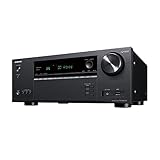
- SMOOTH, CLEAR HDMI 2.1 WITH 8K: With HDMI 2.1 with 8K and eARC your system is ready for the clearest and cleanest picture now and in the future. It’s the most recent update of HDMI spec supporting eARC, a range of higher video resolutions and refresh rates including 8K60 and 4K120, and Dynamic HDR formats. 8K delivers an immersive viewing experience with 4 times as many pixels as 4k at 2x the horizontal and vertical resolution. Combined with a 60Hz refresh rate the TX-NR6050 enables smooth and sharp viewing with high-speed action.
- BUILT-IN STREAMING SERVICES: Access to Spotify, TIDAL, Deezer, TuneIn, and Pandora are built into the system. Use dedicated apps (where available) or the free Onkyo Control App for Apple and Android devices to find and play music.
- SMART HOME COMPATIBLE WITH VOICE CONTROL: Onkyo receivers easily integrate into your existing Smart Home ecosystem, including Apple Airplay, Alexa, Google apps, and more. You get a highly capable and compatible network device that can operate seamlessly in your multi-room ecosystem.