
Piega Coax 511 Floor-Standing Speaker Review
Piega, originating from Switzerland, has long been a symbol of premium loudspeakers.
Their headquarters is situated along Lake Zurich, where they witness the lake’s ever-changing scenery through different weather conditions and seasons. This setting seems more fitting for an artist’s studio than an audio company’s headquarters.
This is exactly how Piega sees it. They treat their speakers as works of art, drawing inspiration from the natural landscape to stimulate creativity and ideas, allowing their products to stay closer to the essence of art.
Piega’s Two Signatures: Ribbon Drivers and Aluminum Alloy Cabinet
In 1986, Kurt Scheuch and Leo Greiner founded Piega. Kurt was the technical expert responsible for speaker development, while Leo managed the company’s finances and operations.
Today, after 30 years, both founders are still active, and the company has become more vibrant with the addition of the next generation.
Piega’s design philosophy has always avoided flashiness and eccentric designs. The consistent curved back profile in their recent products has practically become Piega’s trademark.
They are known for two signature features: ribbon drivers and aluminum alloy cabinets.
Hand-Crafted Ribbon Coaxial Drivers
While most speakers using ribbon drivers typically limit them to tweeters, Piega takes a different approach.
What makes them different? They not only use ribbon tweeters but also implement ribbon drivers for the midrange.
A ribbon diaphragm is a thin aluminum metal foil. Metal materials have low internal resistance, and during rapid vibration of the diaphragm, they can produce ringing phenomena, resulting in what we hear as “metallic” sound.
Even with small ribbon tweeters, which vibrate quickly, distortion from ringing is inevitable. Therefore, manufacturers who use ribbon tweeters work hard to overcome this issue.
If it’s already challenging to perfect small ribbon tweeters, imagine the complexity of creating ribbon midrange drivers. How Piega overcomes these distortion issues remains their trade secret.
Currently, they are the only company capable of producing such ribbon midrange drivers, and they’ve even managed to create a coaxial design combining both tweeter and midrange.
The greatest advantage of coaxial drivers is phase coherence. The sound emission points of both tweeter and midrange drivers are on the same axis, achieving phase alignment.
Human ears are even more sensitive to time differences than frequency response, making time and phase coherence between tweeter and midrange a crucial consideration for all speaker manufacturers.
To address this, coaxial speakers were born, placing tweeter and midrange sound sources on the same axis, which is exactly what Piega does.
Piega emphasizes that their coaxial drivers undergo precise X, Y, and Z axis measurements, ensuring the three-axis center points of tweeter and midrange drivers perfectly overlap.
As the manufacturer states: “This is true point source design.”
High Manufacturing Complexity Showcasing Ultimate Craftsmanship
While common coaxial drivers use dynamic drivers, Piega employs ribbon drivers in a coaxial configuration, making the manufacturing process particularly challenging. Currently, only one or two employees at the Piega factory can precisely manufacture these ribbon drivers.
The company’s website features a video where Mario Ballabio, currently responsible for manufacturing coaxial ribbon drivers at Piega, demonstrates and explains the process.
He starts with a custom aluminum ribbon membrane, only 0.02mm thick.
He then sprays adhesive on the back of the membrane and carefully applies the thin film coil, requiring both precision in placement and appropriate pressure to ensure proper adhesion.
Next comes the soldering points. He first applies small conductive membrane patches at the soldering points, then adds solder and attaches the lead wires.
This procedure is equally challenging, requiring enough pressure to secure the components while avoiding excessive force that could damage the underlying coil.
Ballabio knows exactly how to balance this force.
In fact, before soldering and wire attachment, he must first use a hair dryer to dry the entire membrane.
Due to the previous application of adhesive, the membrane remains slightly damp. If not dried at this stage, visible spots would later appear on the coil layer.
Soldering and wire connection also require considerable skill. Ballabio explains that the soldering work is challenging because there’s no room for correction – each soldering point has only one chance, and any mistake means starting over.
Moreover, throughout the soldering process, his fingers must not touch the coil, or fingerprints would remain.
But the challenges don’t end there.
The next procedure is equally unforgiving.
He must place the entire ribbon membrane on an embossing machine. Through embossing, small granular patterns are pressed into the membrane to enhance its rigidity.
However, angle and pressure are crucial – damaging the coil, misaligning the pattern, pressing too lightly or too heavily would all ruin the piece.
After embossing, he carefully inspects the membrane under magnification to ensure the coil and soldering points remain intact before proceeding to the next step.
With membrane processing complete, frame assembly follows.
This stage also allows no mistakes – one error means saying goodbye to the membrane that took half a day to prepare.
Before bonding the cut neodymium magnet frames, Ballabio carefully hand-polishes them to prevent rough edges from damaging the membrane.
He first secures the completed ribbon membrane to a fixing plate, then precisely bonds the neodymium magnet frame to the membrane’s back, followed by adding a heavy cover plate for secure fixation.
This is followed by a 48-hour natural drying process.
After 48 hours, the front magnet frame is bonded, surrounding the ribbon membrane with powerful magnets on both sides.
Piega’s design aims to keep the magnetic field as flat as possible, ensuring magnetic forces act precisely at the membrane, maximizing the strong magnets’ effect.
Finally, the outer frame is secured, and the unit moves to installation.
Complex? Piega’s self-manufactured coaxial mid-tweeter truly represents the pinnacle of Hi-End audio craftsmanship.
Aluminum Alloy Cabinet – Making Small Speakers Sound Big
The aluminum alloy cabinet is another Piega speaker trademark.
Why aluminum? Because aluminum’s high hardness and rigidity allow for thinner cabinet walls while maintaining structural integrity, enabling small speakers to produce big speaker sound.
However, Piega’s aluminum alloy cabinets are not easy to manufacture. According to the manufacturer, only three factories worldwide can produce cabinets to Piega’s specifications.
Regardless of material, speaker cabinets are hollow, and tapping on them produces resonant “dong dong dong” sounds that affect speaker performance. Speaker manufacturers must find ways to overcome this issue.
Ribbon Coaxial Mid-Tweeter Paired with UHQD Aluminum Diaphragm Woofers
The Coax 511 we’re reviewing belongs to Piega’s Coax series, which sits just below their flagship Master series.
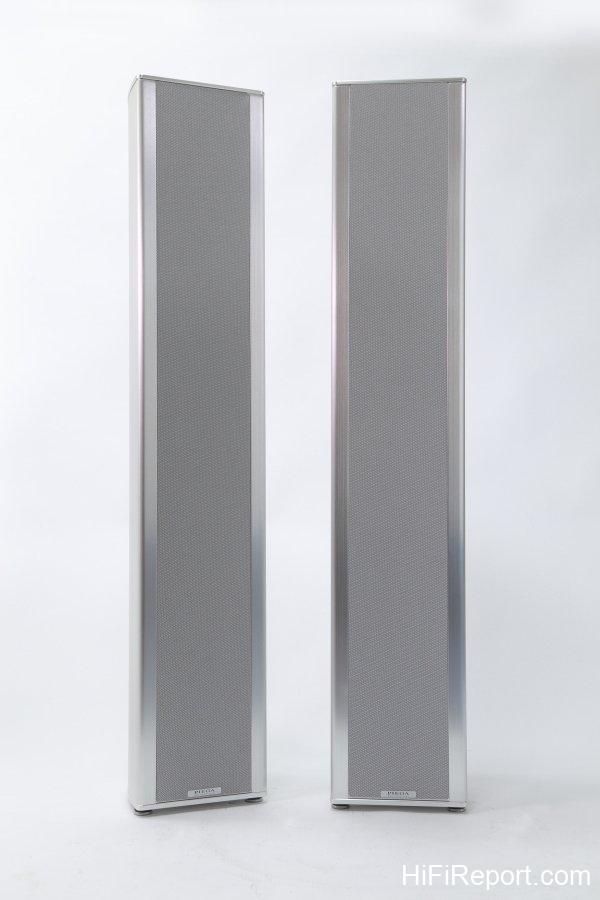
The Coax series consists of four speaker models: two floor-standing speakers (Coax 711 and Coax 511), one bookshelf speaker (Coax 311), and a center channel speaker (Coax Center 111).
The Coax 511 is smaller than the Coax 711, and due to its smaller driver size, the speaker appears more compact and slender.
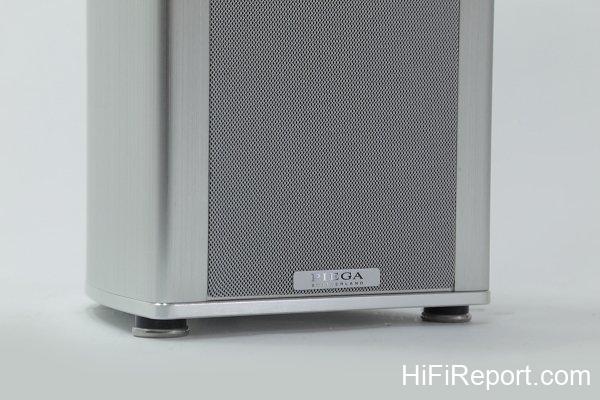
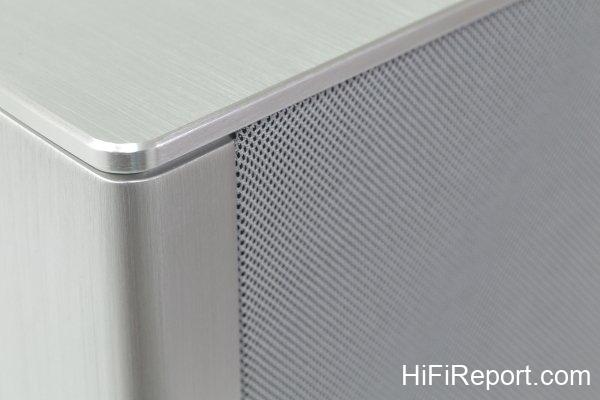
The Coax 511’s front baffle features a metal grille that covers almost the entire front panel from top to bottom. This grille cannot be removed, so we cannot directly view or photograph the drivers used in the Coax 511.
Fortunately, the manufacturer provides images, so we’ll rely on those for our discussion.
As its name suggests, the Coax 511 uses Piega’s ribbon coaxial driver, which is why the series is called Coax.
The Coax 511 employs the C111 ribbon coaxial driver, the same unit used in the Coax 311 bookshelf speaker and Coax Center 111 center channel speaker.
Through this coaxial driver design, they achieve the ideal of point-source sound reproduction.
Below the coaxial driver are four 160mm UHQD woofers. Of these four UHQD woofers, only two are actively driven while the other two function as passive radiators.
The UHQD driver is Piega’s newly developed unit, featuring an aluminum alloy diaphragm that’s extremely rigid but coated with a damping layer on its surface.
The voice coil former is made of titanium alloy, known for its high hardness. More importantly, titanium is non-magnetic, preventing interference with the voice coil’s magnetic effects and enabling more precise driver movement.
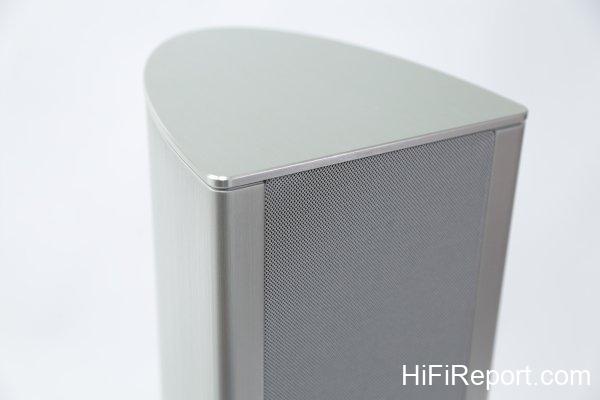
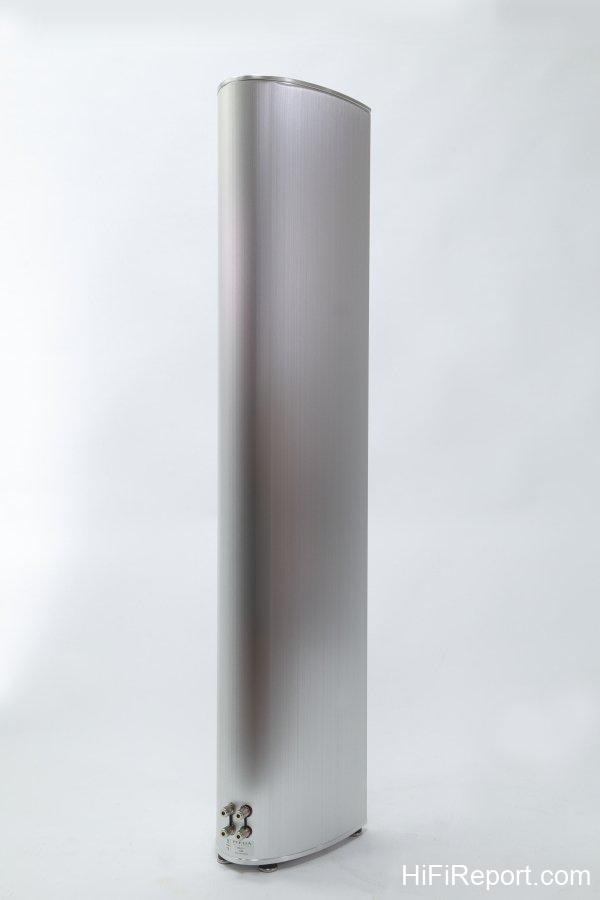
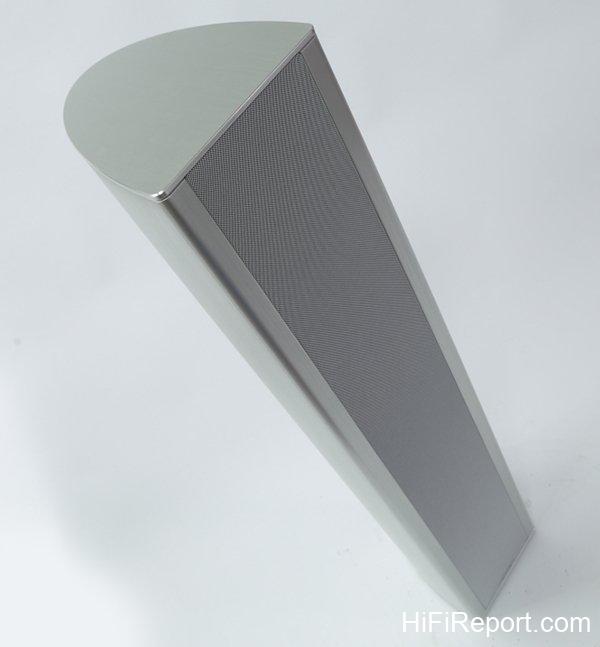
The entire cabinet is formed from curved aluminum alloy, with a teardrop-shaped curved back that helps reduce internal standing waves.
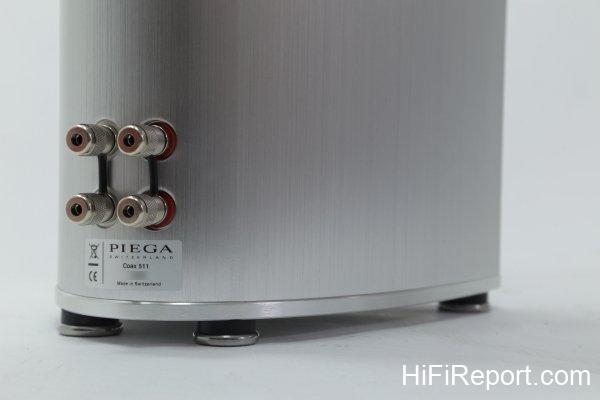
The speaker features two sets of terminals for separate high and low-frequency connections. The terminals appear to be rhodium-plated and are custom-made for Piega, laser-engraved with the Piega logo.
While appearing understated at first glance, closer inspection reveals refined craftsmanship throughout.
The review unit came in natural aluminum finish, but the manufacturer also offers black anodized and gloss white finishes, allowing customers to choose according to their interior décor.
Small Speakers with Big Sound, Rich Detail, and Natural Tonality
Listening tests were conducted in the HiFiReport listening room, using three different amplifiers: the McIntosh MA8900, Linear Acoustic LAV-60 II, and Oriole OSA-88-1BV tube amplifier.
These three integrated amplifiers consist of a 200W solid-state, a 100W solid-state, and a 40W tube amplifier.
The Coax 511 demonstrated the unique characteristics of each amplifier while maintaining its own sonic beauty across all pairings.
My overall impression starts with the Coax 511’s grand presentation.
Both image size and soundstage are large – these are speakers with “big sound.”
I’m not referring to volume here, but rather to sonic imaging and soundstaging.
The Coax 511 appears tall and slim in HiFiReport’s roughly 660-square-feet listening room, looking quite petite, especially when placed next to the Dynaudio Contour 60.
However, its sound is anything but small.
The second impressive aspect is the bass performance, with both quantity and extension exceeding my expectations.
The bass sounds relaxed, providing excellent foundation when playing orchestral music, creating a particularly stable musical structure.
The third outstanding feature is precise imaging, which relates to its coaxial driver design.
Before listening, I anticipated excellent positioning and clear imaging from the Coax 511, as this has been my consistent experience with point-source design speakers.
Indeed, the Coax 511 delivered exactly that.
Fourth is the tonal quality. Despite using metal ribbon coaxial drivers, the Coax 511 avoids any metallic coloration, sounding quite natural. The mid and high frequencies exhibit excellent quality, combining both brilliance and smoothness, with a slight hint of wetness that makes the sound very pleasant. Even with abundant detail, high volume listening remains non-fatiguing.
Finally, I experimented with various speaker positions and found that the Coax 511 easily “disappears” – not literally, but the sound doesn’t obviously emanate from two distinct speaker locations. The soundstage distribution feels natural, and even with speakers placed more than 2.5 meters apart without toe-in, sitting slightly behind the apex of an equilateral triangle, the central image remains solid and convincing.
Wide Soundstage with Clear Layering
Listening to the Berlin Philharmonic conducted by Karajan performing Wagner’s “Die Meistersinger von Nürnberg” Prelude, the Coax 511 presents a vast concert hall stage, both wide and deep, with clear instrument separation.
The prelude opens with impressive grandeur, the entire orchestra powerfully presenting the Meistersinger motif in tutti, creating a magnificent and majestic effect.
As the motif develops, the music interweaves upward, emotions intensify, and the strings shine with brilliant luster.
On other systems, when I’ve increased volume to achieve greater dynamic effect, violins could become harsh and slightly hard-edged.
With the Coax 511, I hear no such tension. Instead, the music’s intertwined passion continues to surge, becoming even more moving.
The middle section features a march-like counterpoint, gradually building in density, followed by another climax with brass, woodwinds, and strings. The rich emotional content of the music is beautifully portrayed as the Coax 511 opens up the soundstage, constructing an even more three-dimensional musical presentation.
Finally, the Meistersinger motif returns, bringing the piece to a magnificent conclusion.
In the ending, where the orchestra maintains its forte, with percussion adding brilliance, you can hear the metallic strike of cymbals in the background, their delicate reverberations floating through the air, while the triangle penetrates through the orchestra’s multiple layers with bright, clear resonance. The Coax 511’s coaxial driver enables precise instrument positioning, while the ribbon drivers make these percussion instruments particularly distinct.
A brilliant performance – and I’m not referring to Karajan, but to Piega.
From Micro to Massive – Dynamic Range
When listening to Günter Wand conducting the NDR Symphony Orchestra performing Beethoven’s Fifth Symphony, this is a live recording from Hamburg in 1992.
Switching from EMI to RCA, the two record companies have distinctly different recording styles. Although this album was recorded in Germany, it notably displays RCA’s characteristic rich and full sound.
The first movement is filled with intense conflicts, with the fate motif revealed at the beginning permeating throughout the piece.
Despite Wand’s scholarly appearance and refined demeanor, his conducting of the Fate Symphony shows a pace no less urgent than Kleiber’s, clearly expressing Beethoven’s restlessness and anxiety.
Through the Coax 511, the string instruments display excellent density while maintaining a distinct tactile quality, creating a very special listening experience.
I suspect this is due to the aluminum ribbon coaxial driver’s superior resolution, which reveals even the most subtle textural details.
Relaxed Sound Quality with Clear Positioning
At the beginning of the third movement, the low strings present the main theme, followed by the familiar fate motif. Wand conducts the NDR Orchestra with giant-like steps forward. The richness of the low strings is astounding, seemingly impossible to emerge from a speaker of this size. The music flows between low and high string instruments, moving in fugal form while displaying playful variety.
The music then becomes calm, and after a period of undercurrent development, gradually accumulates robust energy, building tension before seamlessly entering the fourth movement.
The orchestra erupts from the mysterious depths, soaring skyward. The Coax 511 handles the dynamics of this journey from darkness to light with exceptional precision. In quiet passages, it whispers with restless agitation, and during powerful outbursts, it generously releases all its energy. The magnificent sound and dramatic musical fluctuations seem to pose no challenge for it.
Moving on to chamber music, let’s experience how it handles the delicate atmosphere of small ensemble performances.
Listening to German rising cellist Valentin Radutiu performing cello sonatas by Lalo, Ravel, and Magnard, Hanssler’s recording takes a full and warm approach, particularly succeeding in presenting the cello’s sound.
Through the Coax 511, one can hear the rich and substantial cello sound, built upon a solid foundation of abundant information.
The cello’s body resonance is rich, like a baritone singing.
In quiet moments, it’s like a poet’s song or a lover’s whisper, full of romantic sentiment.
When the music becomes joyful and animated, it displays elegant dance movements, dancing with the piano.
The piano notes are round and lustrous, with a slightly soft and mellow texture, not particularly rigid or firm.
Drums with Impact, Authentic Instrument Textures
The Coax 511’s low-frequency performance is outstanding. When the cello and piano reach the lower registers, they present a rich and deep sound, intoxicating like aged whiskey.
The Coax 511’s “big sound” is equally evident when listening to chamber music, with the cello’s form appearing even larger than through the Dynaudio Contour 60. The Contour 60 sounds more concentrated and solid, while the Coax 511 sounds more relaxed and spacious.
When listening to gypsy violinist Roby Lakatos and his ensemble’s live recording in Budapest, the first track “Bird in the Morning” begins with Lakatos’ flowing, smooth singing tone, with the accompanying instruments providing subtle support without stealing the spotlight.
After the approximately two-minute introduction, the piece transitions into its climax, with Lakatos gradually increasing the tempo as the music builds to its peak.
The Coax 511 presents this piece with more refinement than other speakers.
Lakatos’ performance is always energetic, like an exploding supernova, often feeling overly intense and stimulating, necessitating volume reduction. However, with the Coax 511, there isn’t such strong tension. While Lakatos’ virtuosic performance remains hot and spicy, the Coax 511 presents it in a vibrant yet non-aggressive manner.
The latter half of the piece features a wild arrangement with extended violin passages and the addition of the Cimbalom (Hungarian dulcimer), a string instrument played by striking the strings with hammers, producing resonant and agile sounds.
The piano then enters with a full jazz flavor, balancing Lakatos’ passion.
The bass provides unwavering rhythmic support throughout, allowing the three instruments to present rich yet clear layers in their intricate interplay.
The Coax 511’s low-frequency performance makes the bass particularly springy here, and the Cimbalom’s colorful tones are hard to ignore.
I also notice that throughout the musical progression, the sound imaging remains clear. Though the presentation is relaxed, the form and positioning never become ambiguous.
Indeed, coaxial is truly coaxial.
Vocals with Depth and Detail, Displaying Liveliness
Its vocal reproduction also has a special charm.
The Coax 511’s coaxial structure enables it to present clear positioning. The aluminum ribbon coaxial driver’s excellent detail reproduction provides abundant information without being excessive. When listening to vocals, sounds like lip movements, breath sounds, and swallowing are audible yet not intrusive, maintaining a natural presentation. Combined with its spacious sound and large physical presence, vocals become particularly enchanting.
Listening to “Cucurrucucú Paloma” from the “Talk to Her” soundtrack, Caetano Veloso sings with complete ease – it’s a love song, yet delivered with such comfort.
The articulation in the singing, the floating variations during sustained notes, the breathy attacks at the beginning of phrases, the rolled ‘r’s in Portuguese pronunciation – all these details are clear, yet presented very naturally, as effortlessly as Veloso’s singing itself.
As for Cassandra Wilson’s voice in the “Rendezvous” album, her rich, deep female vocals are reproduced with a slightly larger image than usual, but the contours remain excellent without becoming unclear.
The details in Cassandra’s singing are rich, with all the nuances in her vocal technique clearly presented.
When vocals have depth, detail, physicality, and clear contours, and when the spatial relationship between accompanying instruments and the singer is well-defined, that’s when liveliness emerges.
Not Just Refined, But Cultivated
The Piega Coax 511 stayed in the HiFiReport listening room for nearly three months, with both myself and colleagues testing it with various equipment.
When I asked Hung-Chun Tung about his impressions after listening, he broadly stated, “This is a very refined sound.”
Indeed, defining sonic refinement is difficult to articulate clearly, but when you hear it, you understand it.
I completely agree with Tung’s assessment that the Coax 511 is refined – his evaluation isn’t vague but rather hits the mark precisely.
However, I would add to Tung’s observation that the Coax 511 isn’t just refined, but truly cultivated.
In the Yong Ye chapter of the Analects, it is written: “When substance exceeds refinement, we get roughness; when refinement exceeds substance, we get pretentiousness. Only when refinement and substance are properly balanced do we have a superior person.”
Confucius’s words apply not just to writing but to character as well.
The Piega Coax 511 gives me exactly this impression – it has an elegant, sophisticated appearance yet produces sound that is composed and expansive, capable of exploring the finest details while also expressing grand magnificence.
This truly embodies the concept of “refinement and substance in perfect balance.”
Technical Specifications
- Model: Piega Coax 511
- Type: 3-way floor-standing speaker
- Drivers: 1 x C111 coaxial ribbon mid/high driver; 2 x 160mm UHQD; 2 x 160mm UHQD passive
- Terminals: Bi-Wiring / PIEGA Multi Connectors
- Recommended amplifier power: 20 – 250 Watts
- Sensitivity: 90 dB/W/m
- Impedance: 4 ohms
- Frequency response: 32 Hz – 50 kHz
- Dimensions: 1150 x 220 x 250 mm (H x W x D)
- Weight: 32 kg