
Porsche Design PDS50 Bluetooth Speaker Review
When you see Porsche Design, many might assume it’s a fashion sub-brand spun off by Porsche Cars to capitalize on brand value, aiming to sell luxurious lifestyle products to Porsche car enthusiasts. However, the reality is a bit more nuanced.
Company Founded by the Creator of the 911
Porsche Design was established in 1972 by Ferdinand Alexander Porsche, a member of the Porsche family and the very person who designed the iconic 911.
From 1962 to 1972, Ferdinand headed the design department at Porsche, contributing to numerous significant models, including the legendary 911.
However, starting in 1970, Porsche transitioned from a family business to a publicly traded company. Porsche family members gradually withdrew from company operations. Under new regulations, Ferdinand could no longer continue as chief car designer. Consequently, in 1972, he founded Porsche Design, extending his passion for design into lifestyle and fashion products.
Initially, Porsche Design’s biggest support came from Porsche Cars. The car manufacturer needed suitable gifts for long-serving employees and placed orders with Porsche Design for watches, guaranteeing an annual purchase of 20 pieces.
Over time, Porsche Design expanded its product range beyond watches to include eyewear, pipes, pens, knives, and more. Today, Porsche Design’s product line is highly diversified, encompassing even this very stylish PDS50 Bluetooth speaker.
All-Aluminum Construction
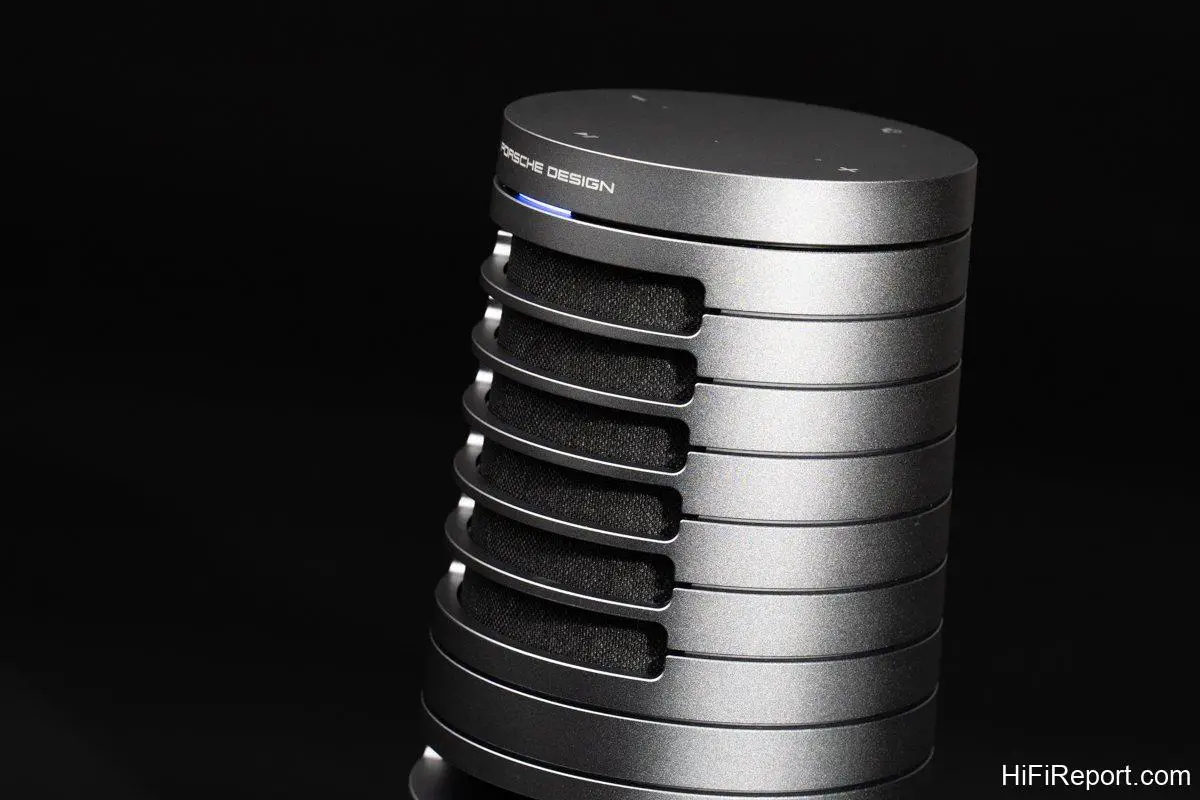
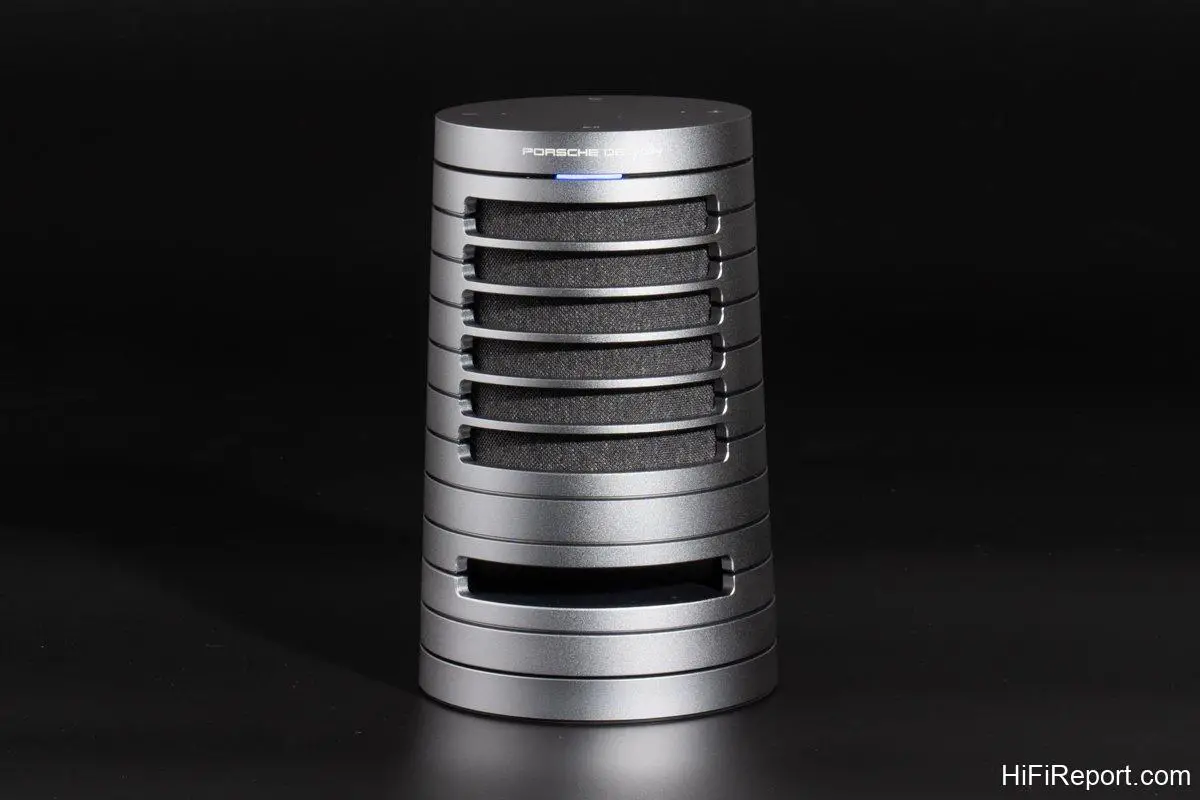
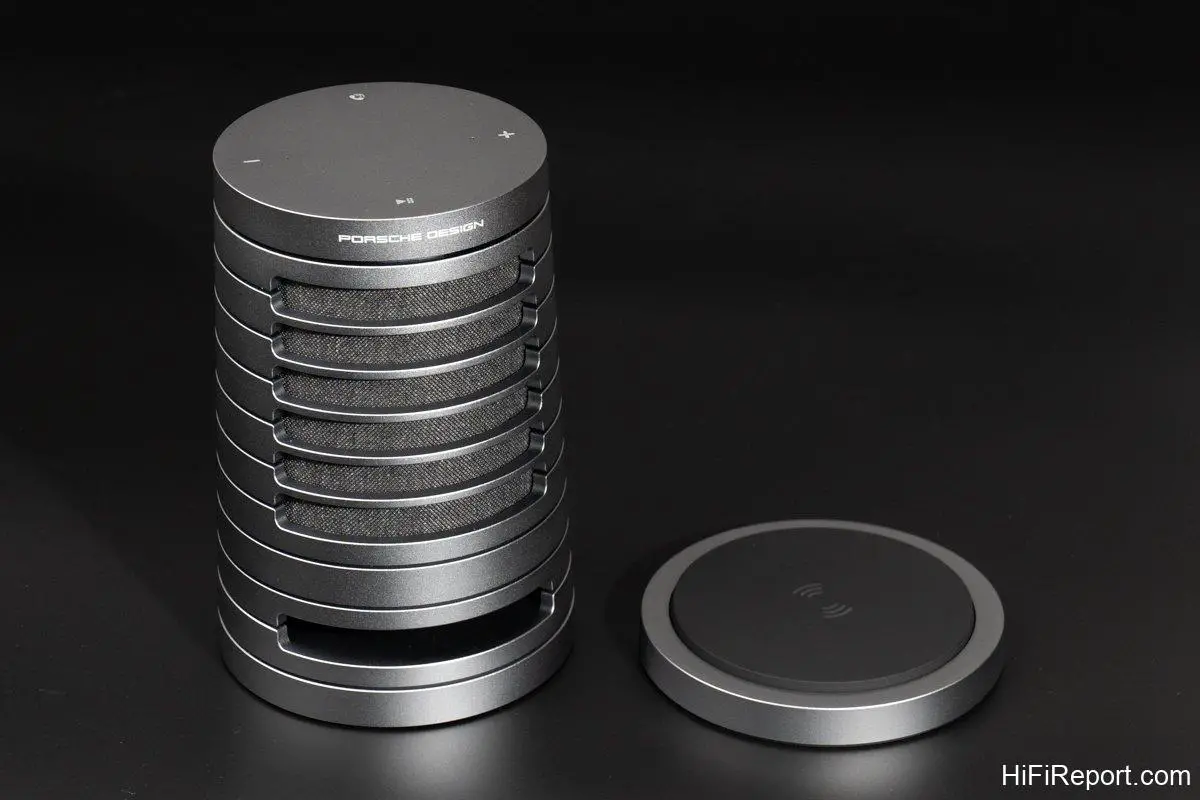
The PDS50 exudes a strong metallic aesthetic, not only due to its masculine form but also because it is constructed entirely from solid aluminum alloy. Coupled with a cool titanium-grey sheen, it projects a very avant-garde impression.
The PDS50 appears to be composed of stacked metal discs. The bottommost layer is actually a wireless charging pad, also made of aluminum alloy with the same coating as the speaker body. As a result, when the PDS50 is placed on it, the charging pad is completely indistinguishable as a separate accessory.
When you want to take the PDS50 elsewhere for listening, simply pick it up.
Returning it to the charging base after use makes recharging completely hassle-free, eliminating the need for frequent cable plugging.
Another key feature of the PDS50 is its two-way configuration with a back-firing bass radiator design.
It incorporates a 1-inch tweeter, positioned at the top of the enclosure, firing forwards.
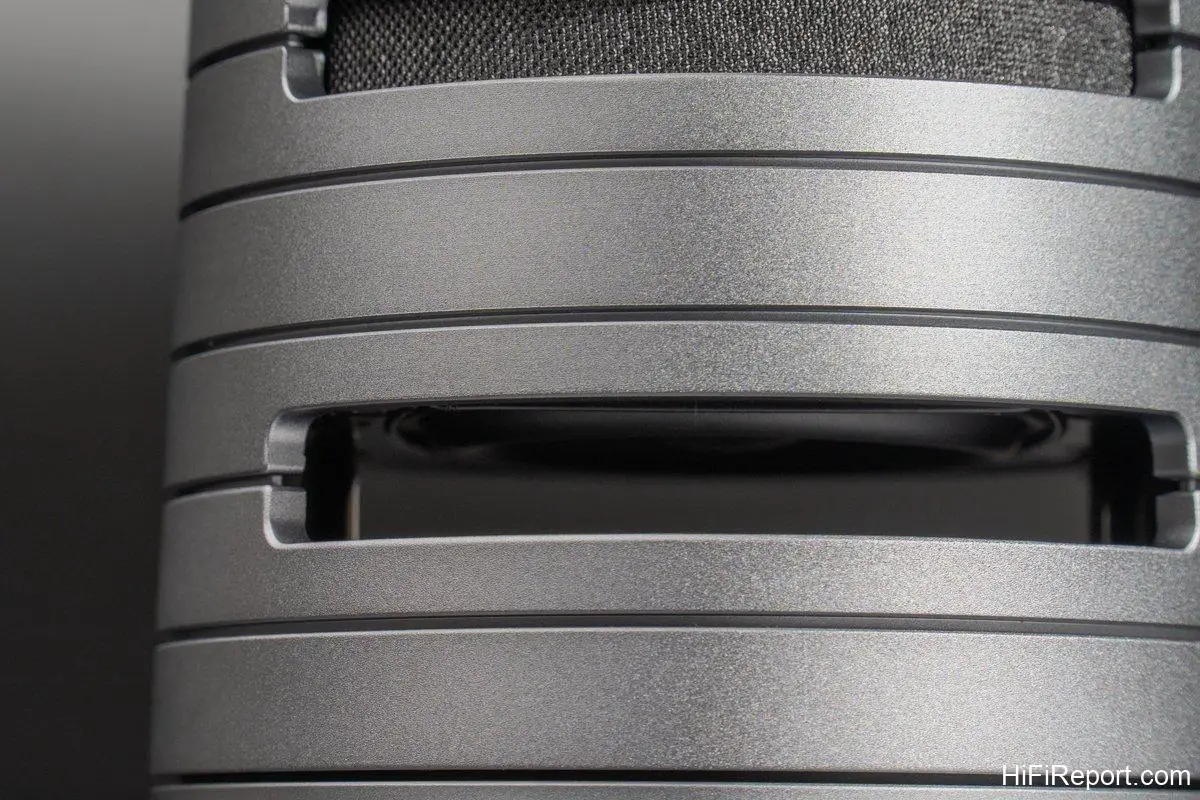
A 3-inch mid-bass driver is mounted in the lower part of the enclosure, firing downwards, and its sound disperses outwards through the gap beneath.
Furthermore, the PDS50 is equipped with two oval passive radiators, located internally on both sides, radiating to the left and right to enhance bass performance.
Stereo Pairing Capability
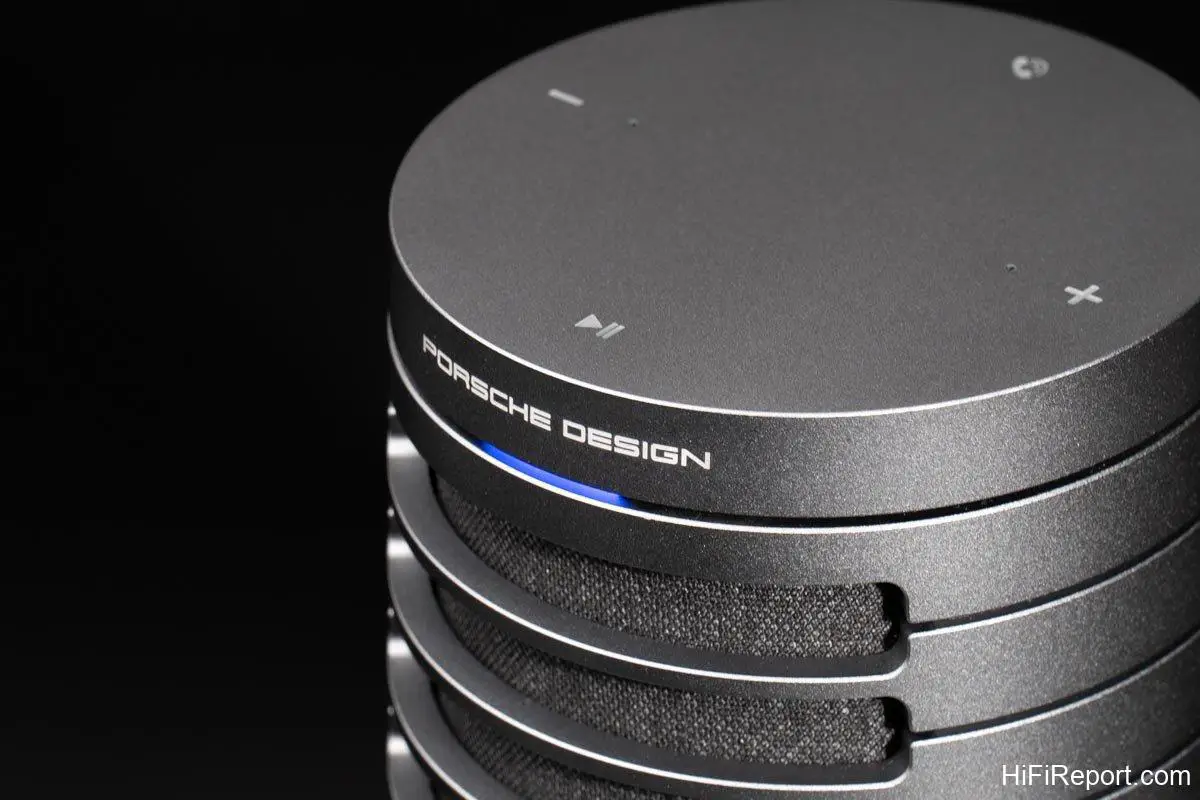
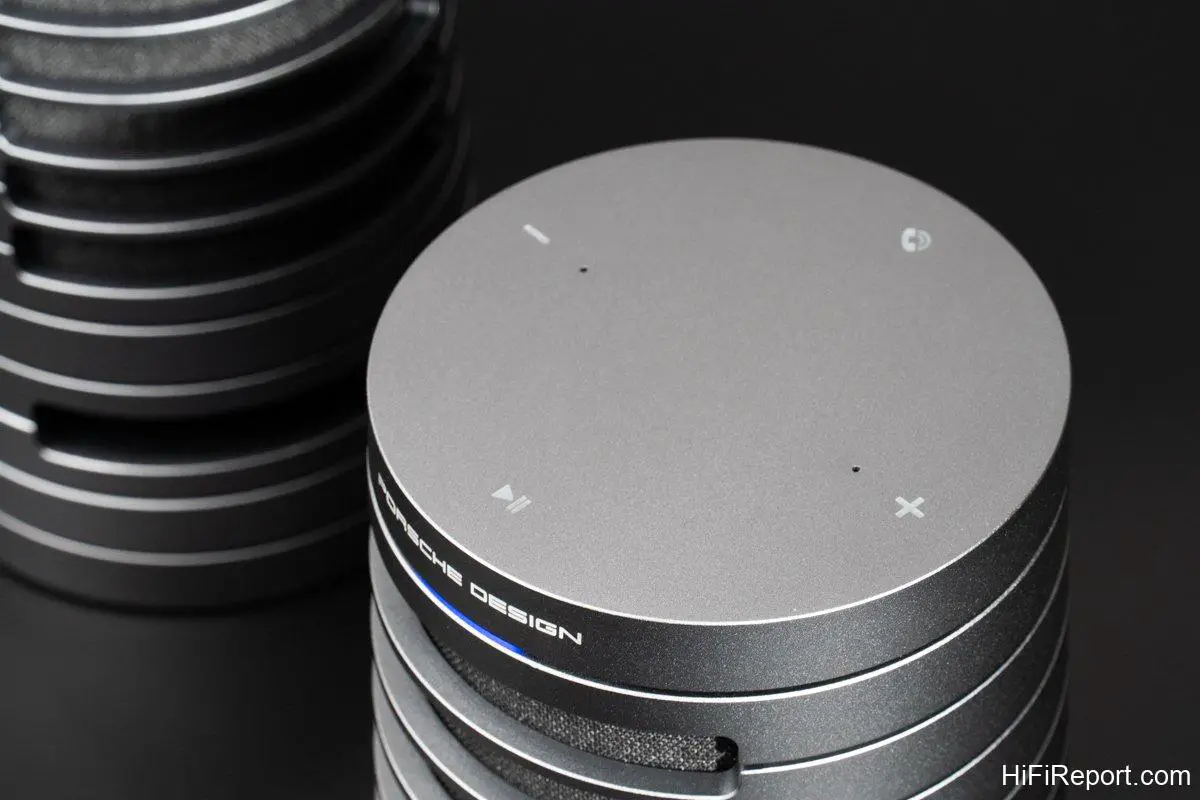
The PDS50’s controls are located on the top panel and utilize a touch-sensitive design. “+” and “-” symbols adjust volume, while “▶||” and a phone icon control play/pause and call answering.
Although these touch controls are integrated into the aluminum top panel, the symbol positions have embedded acrylic, allowing them to sense finger presses. A gentle touch is all it takes for control, and operation remains highly responsive.
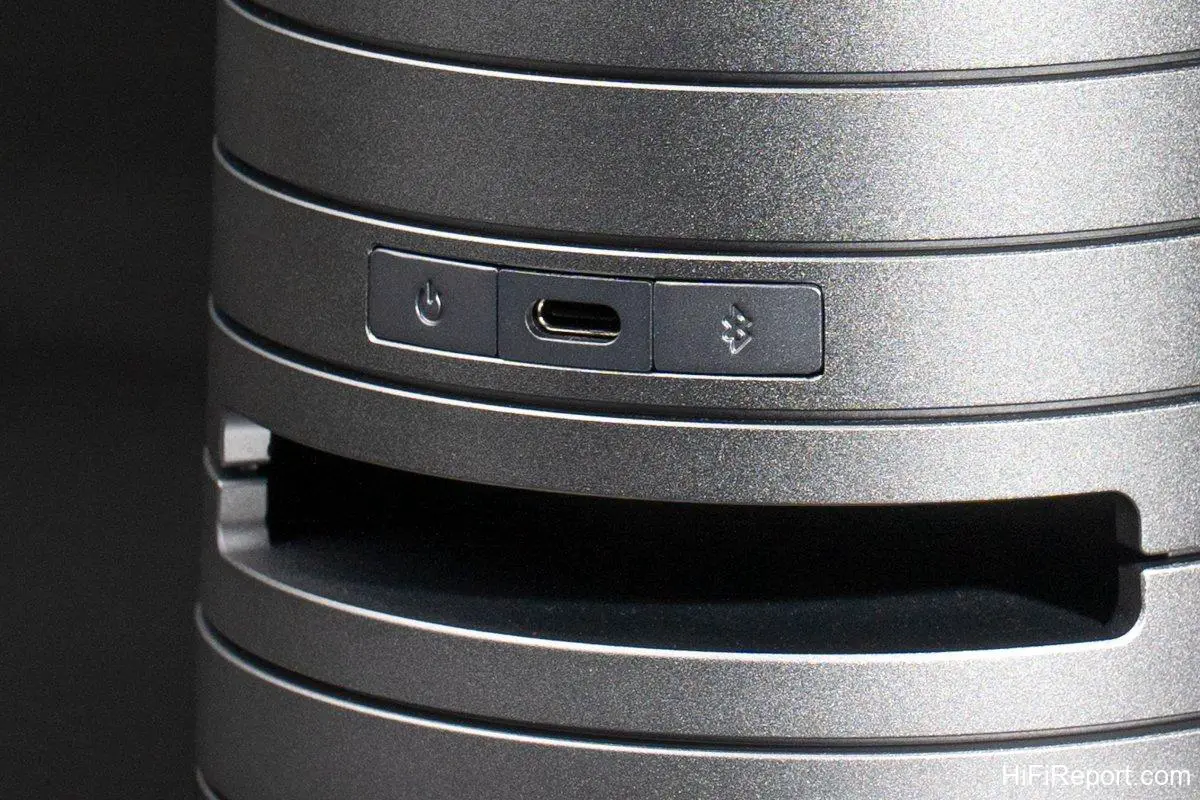
The power and Bluetooth pairing buttons are located at the rear.
To conserve power, the PDS50 automatically shuts down after 10 minutes of inactivity. Upon shutdown, the PDS50 announces “Power Off” via voice prompt. To power it back on, simply press the power button briefly.
What is the Bluetooth pairing button for? It facilitates pairing two PDS50 speakers to create a stereo setup.
The operation is straightforward and doesn’t require an app. Simply double-press the Bluetooth pairing button on each PDS50. They will automatically initiate pairing. Once paired, both speakers emit a confirmation tone, and the LED indicator on the front of each speaker will display different colors: blue for the left channel and white for the right channel. Ensure correct placement.
Besides wireless charging, the PDS50 can also be charged via the USB Type-C port on the rear. Charging from empty to full takes 5 hours, providing approximately 20 hours of playtime when fully charged.
Additionally, the PDS50 boasts an IPX4 waterproof rating, protecting against splashes, such as light rain during outdoor use or poolside spray, further broadening the PDS50’s versatility.
Commendable Sound Performance
In terms of sound performance, the PDS50 is certainly commendable, ranking among the top tier in its class.
Thanks to its all-aluminum enclosure and rounded construction, the speaker cabinet is exceptionally rigid, virtually eliminating resonance. Consequently, its sound is clean, clear, and tight, devoid of muddiness or boominess. It maintains composure even at high volumes, a stark contrast to Bluetooth speakers with typical plastic enclosures.
Furthermore, the PDS50’s bass is well-controlled, avoiding artificially boosted or thickened frequencies, resulting in a more refreshing sound.
Take, for instance, track 1, “Another Day of Sun,” from the “La La Land” soundtrack. The scene depicts a massive traffic jam on a freeway where commuters, out of impatience, get out of their cars and start dancing in a large-scale musical number. The music is vibrant with ample bass. Typically, on most Bluetooth speakers, this track would sound “muddy” or exhibit bloated mid-bass due to excessive cabinet vibration, which in turn vibrates the surface it’s placed on, causing boominess and muddiness. In contrast, the PDS50’s aluminum enclosure minimizes vibration, and table resonance is also low. As a result, the bass not only possesses ample quantity but also well-defined form and impactful punch, rendering the song dynamic, powerful, and lively without being “muddled.”
Another example is Sting’s “Fields Of Gold” from the “Ten Summoner’s Tales” album. The electric bass not only has sufficient presence but also clear lines. Sting’s vocals are rendered with distinct and prominent form, clean texture, and appropriate thickness, leaping out from the accompaniment, delivering a refreshing and relaxed listening experience.
I rarely encounter such a sensation from Bluetooth speakers of this size. The PDS50 may well be the first.
Design Expertise Makes a Difference
Another excellent attribute of the PDS50 is its high-frequency extension, which is well-extended and possesses a pleasing smoothness. It also seamlessly integrates with the mid and low frequencies, accurately reproducing the timbre of many instruments, such as the nuances of vocals, the sheen of strings and piano, the delicate shimmer of cymbals, and the crisp texture of guitar plucking. This enlivens the sound and enriches the listening experience.
In comparison, most other Bluetooth speakers fall short in this aspect, sounding either duller or somewhat sharp and dry.
In terms of price, the PDS50 is indeed slightly higher than comparable-sized products. However, it offers a stylish design from a renowned name, exquisite craftsmanship and quality, thoughtful engineering, and sound performance that surpasses its class. Furthermore, its wireless charging capability eliminates the need for frequent cable connections.
Design expertise truly makes a difference. Porsche Design is indeed remarkable!
Specifications
* Type: Bluetooth Speaker
* Drivers: 1-inch tweeter × 1, 3-inch mid-bass driver × 1, passive radiators × 2
* Enclosure Material: Aluminum alloy
* Charging: USB Type-C, Wireless charging
* Waterproof Rating: IPX4
* Dimensions: 180 × 122 × 122 mm
* Weight: 1.55 kg