Sennheiser AMBEO Soundbar Mini Review
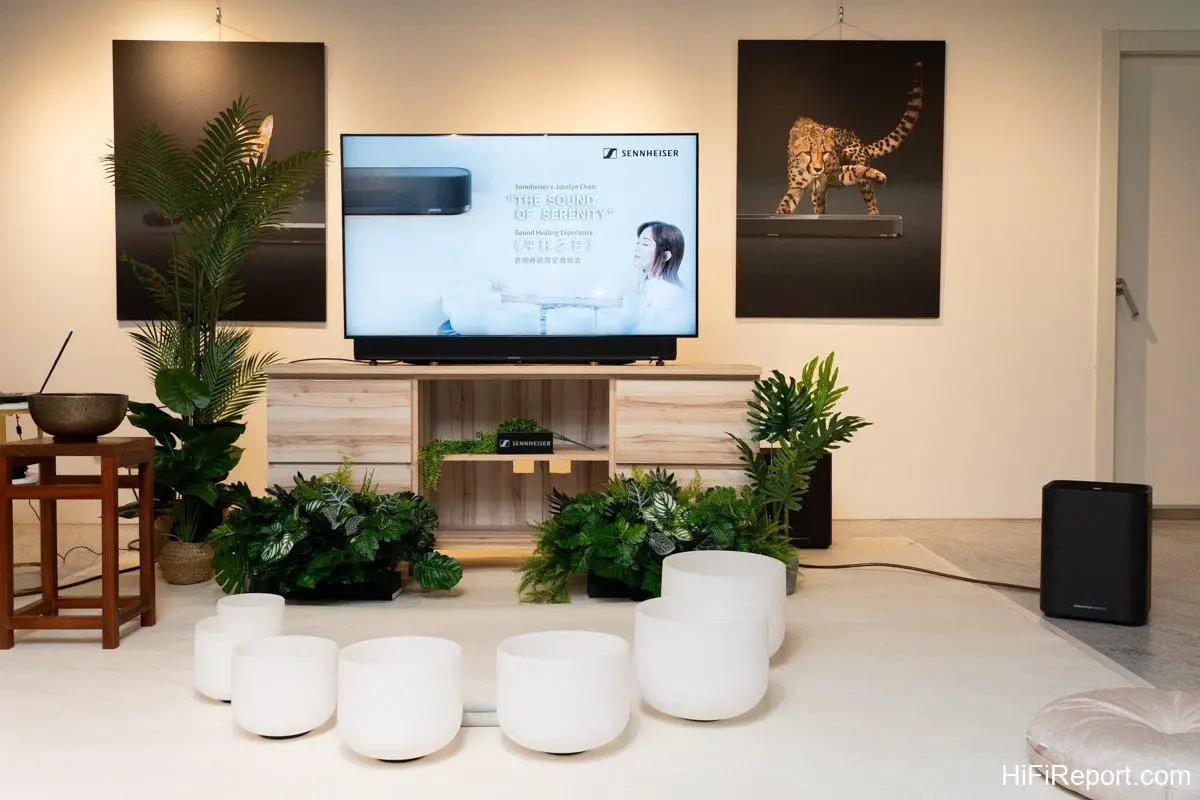
In early October last year, Sennheiser hosted a launch event for their AMBEO Soundbar Mini, a single-unit speaker. The event showcased their latest product and incorporated an audio healing experience, personally demonstrated by Hong Kong singer-songwriter and sound therapist Jocelyn Chan (Jocelyn).
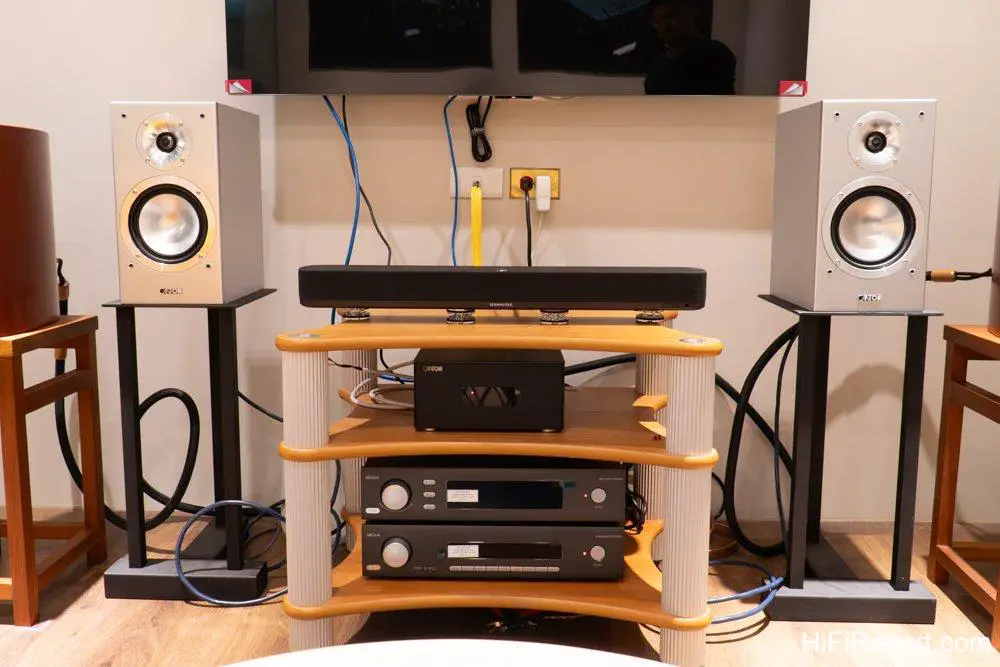
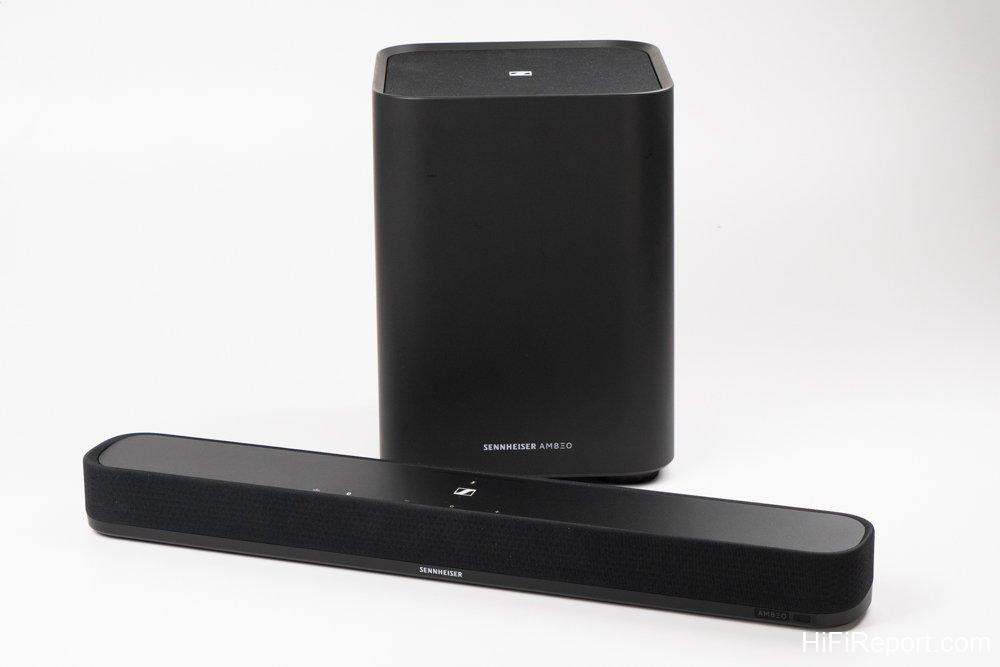
During the event, the organizers set up an AMBEO Soundbar Mini + AMBEO Sub combination in a small listening room at the back. Despite the speaker’s diminutive size in photos, the surround sound effect was remarkably pronounced during the on-site audition! The large number of attendees at the event made it impossible to fully savor the experience, leaving a feeling of wanting more. Thanks to the assistance of Sennheiser’s distributor, World Wide Audio, we revisited Rich Music Hi-Fi () on Xinyi Road in Taipei City, where store manager Mr. Lee Yung-Ta () personally welcomed us and meticulously introduced the key features of the AMBEO Soundbar Mini.
Compact Size, Powerful Audio: Six Drivers Inside
Sennheiser’s AMBEO Soundbar series includes three models: the flagship AMBEO Soundbar Max, the mid-range AMBEO Soundbar Plus, and the latest and smallest, the AMBEO Soundbar Mini (hereafter referred to as “Mini”), which we are reviewing at Rich Music Hi-Fi.
The manufacturer claims the Mini is less than half the size of the Plus. Its dimensions are 70 x 10 x 6.5cm, and it weighs a mere 3.3kg, making it easily portable with one hand.
*Image showing AMBEO Soundbar Plus above and AMBEO Soundbar Mini below, illustrating the size difference.*
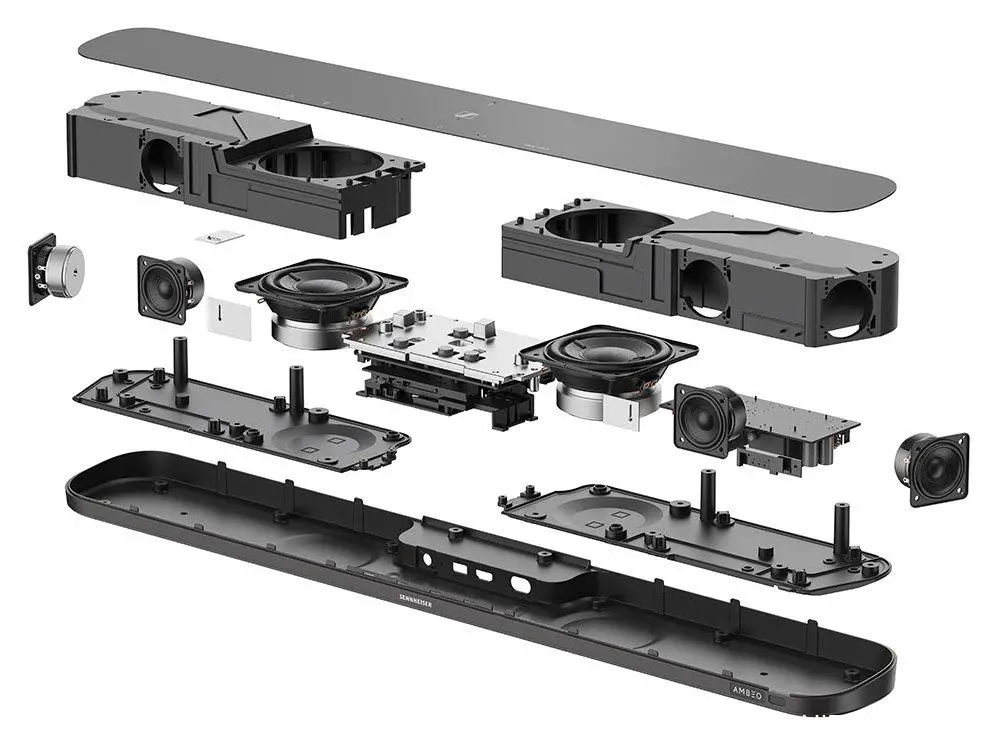
The Mini houses six drivers: four 1.6-inch full-range drivers and two 4-inch woofers. Each driver is powered by an independent Class-D amplifier module, delivering a total output power of 250W and a frequency response of 43Hz~20kHz.
Utilizing Sennheiser’s proprietary AMBEO technology, this single soundbar is capable of virtualizing a 7.1.4 channel home theater system.
Built-in smart system calibration, coupled with four microphones, uses spatial acoustic reflection to create seven virtual surround speakers and four virtual overhead speakers around your listening position. It supports 3D surround sound formats including Dolby Atmos, DTS:X, MPEG-H, and 360 Reality Audio.
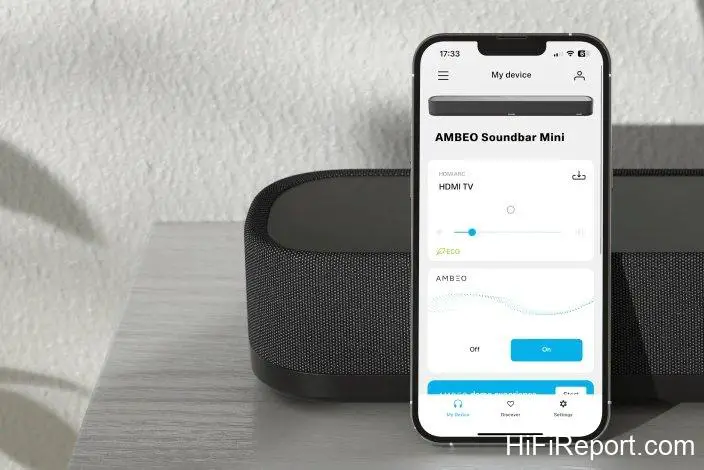
For those who desire further customization beyond the automatic system calibration, the “Smart Control” app allows for fine-tuning the sound to personal preferences.
*(Image source: Sennheiser)*
Wireless Connectivity: Bluetooth 5.0 and Wi-Fi
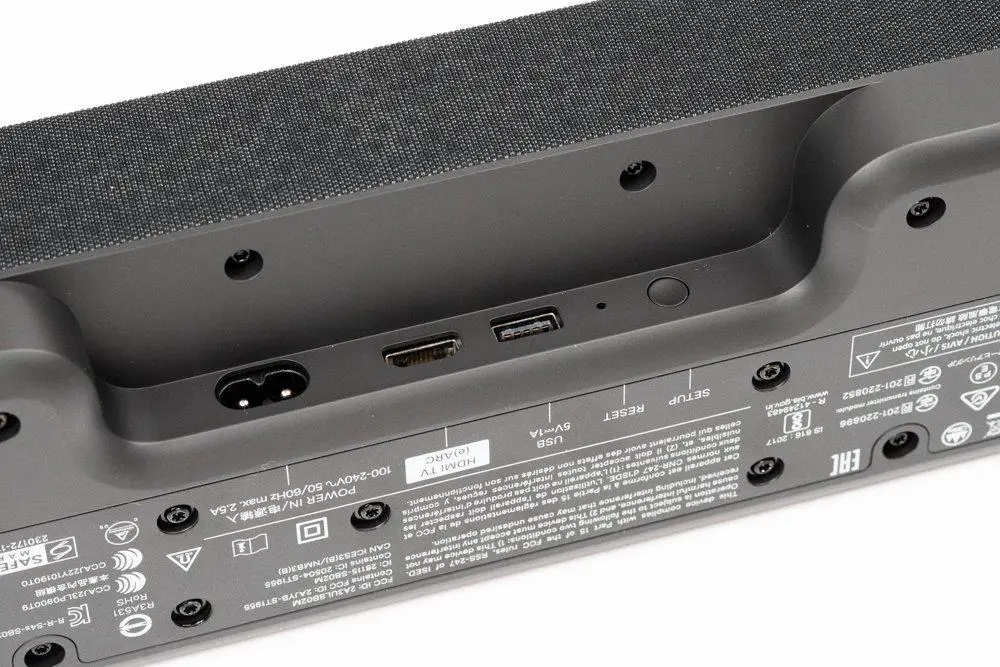
The input/output connections are straightforward, featuring only one HDMI 2.1 (eARC) port and a USB Type-A port (for service/updates). Other input/output options are not provided.
However, the Mini offers wireless connectivity via Bluetooth 5.0 and Wi-Fi, supporting Apple AirPlay 2, Spotify Connect, Tidal Connect, Chromecast Built-in, and Alexa built-in.
Ideal for Smaller Spaces
With the basic specifications covered, I asked store manager Lee about choosing between the three AMBEO Soundbar models. He explained that the Mini’s compact size makes it more suitable for TVs under 55 inches and for smaller spaces like bedrooms or studios.
For listening spaces of 8-10 pings (approximately 280-350 sq ft) or larger, he recommends upgrading to the Plus model.
The primary reason is that the Mini lacks dedicated upward-firing drivers for overhead sound, relying instead on algorithmic simulation. While effective in smaller rooms, the Plus, with its dedicated drivers, is better suited for medium to large spaces to create a convincing height effect.
For the ultimate performance, the larger drivers of the Max model offer superior sound pressure, depth, and solidity across the board.
Enhanced Bass with Dedicated Subwoofer
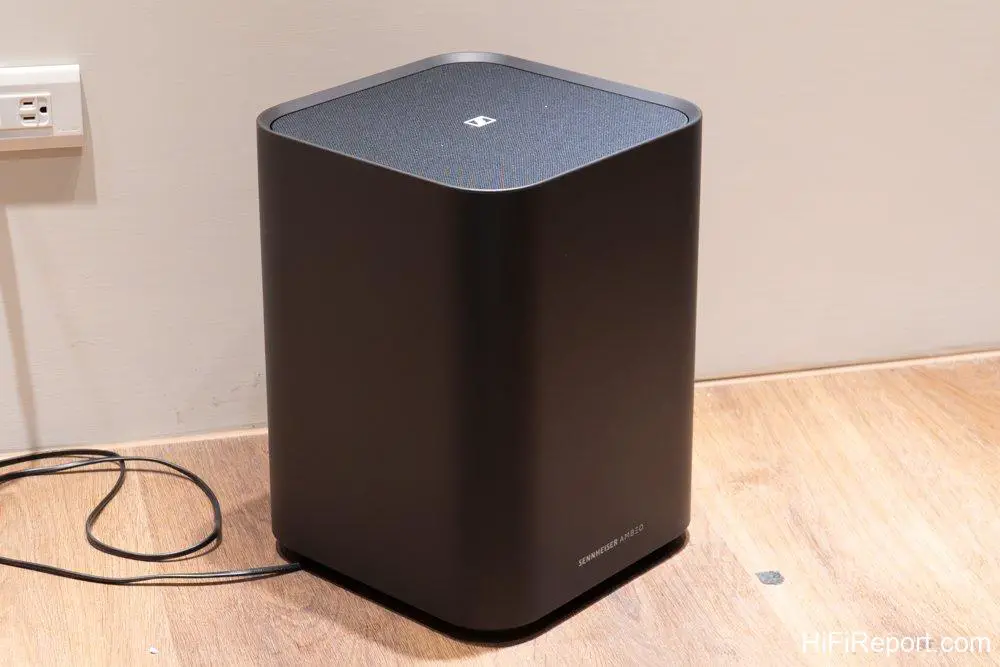
In addition to the Soundbar, there is a dedicated AMBEO Sub wireless active subwoofer. Is it a necessary addition? Mr. Lee suggested that for smaller spaces, the subwoofer might not be essential, and the soundbar alone could suffice. However, for those seeking a more expansive low-frequency spatial presence, adding a subwoofer is recommended. Most customers who auditioned the system in the store could discern the difference with and without the subwoofer.
He emphasized that, in his view, the purpose of the subwoofer is not just to create “thump-thump” bass effects, but to enhance the overall spatiality of the soundstage.
I followed up by asking what he meant by “spatiality.” Mr. Lee explained that in a war movie scenario, without a subwoofer, the soundstage would primarily be perceived in front of the listener. However, with a subwoofer, there is a sense of sound enveloping the entire space.
Furthermore, both the Mini and Plus can wirelessly connect with up to four subwoofers, and the “Smart Control” App allows for adjusting the dB level of each subwoofer individually.
He cautioned against overdoing the bass adjustment, as excessive bass can negatively impact the mid and high frequencies, leading to a loss of detail clarity. Proper adjustment is crucial to achieve seamless frequency integration, and the optimal settings will vary depending on the unique acoustics of each user’s listening environment.
Simple Setup and Installation
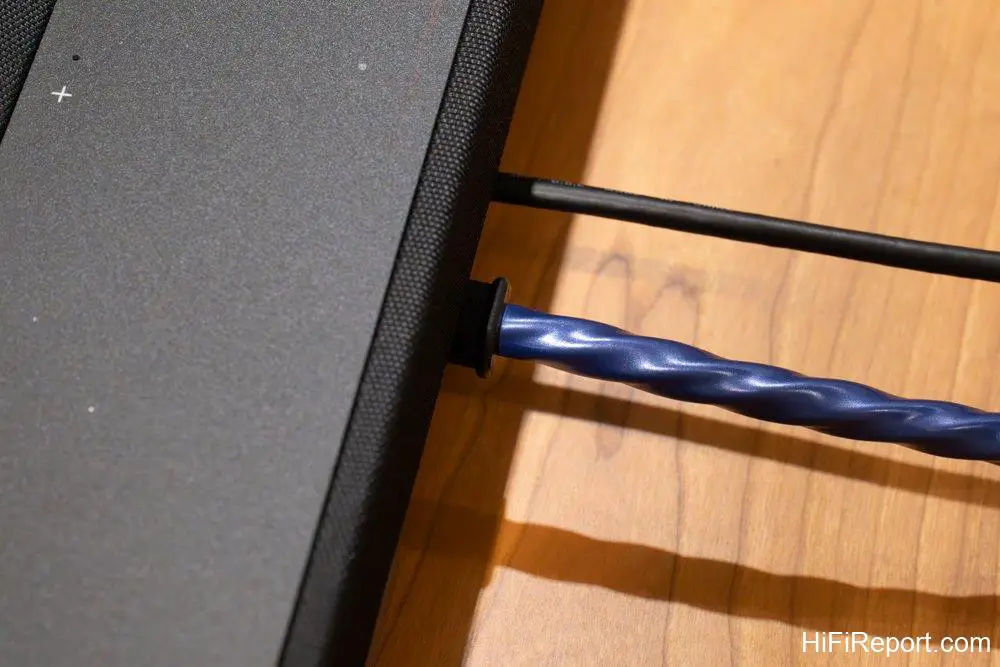
Installation and setup are straightforward. For the Soundbar, simply connect the power and HDMI cables, position it, and activate the calibration function. The speaker will automatically detect the acoustic characteristics of the environment.
For those who are particularly meticulous about soundstage, further adjustments can be made through the sound field settings within the app to fine-tune the spatial presentation. If an AMBEO Sub (or multiple) is added, the APP allows for seamless integration of all components, Mr. Lee explained.
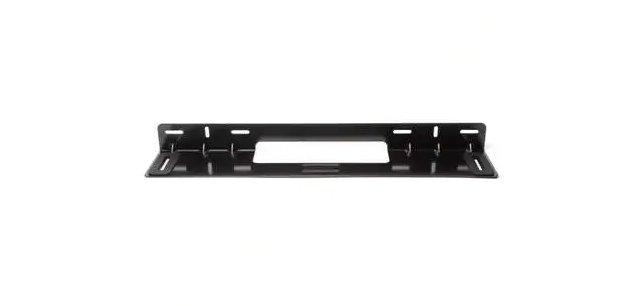
Mr. Lee highlighted that, based on his installation experience, the Mini is well-suited for wall mounting. Using the official Sennheiser wall mount, it doesn’t protrude excessively and looks aesthetically pleasing.
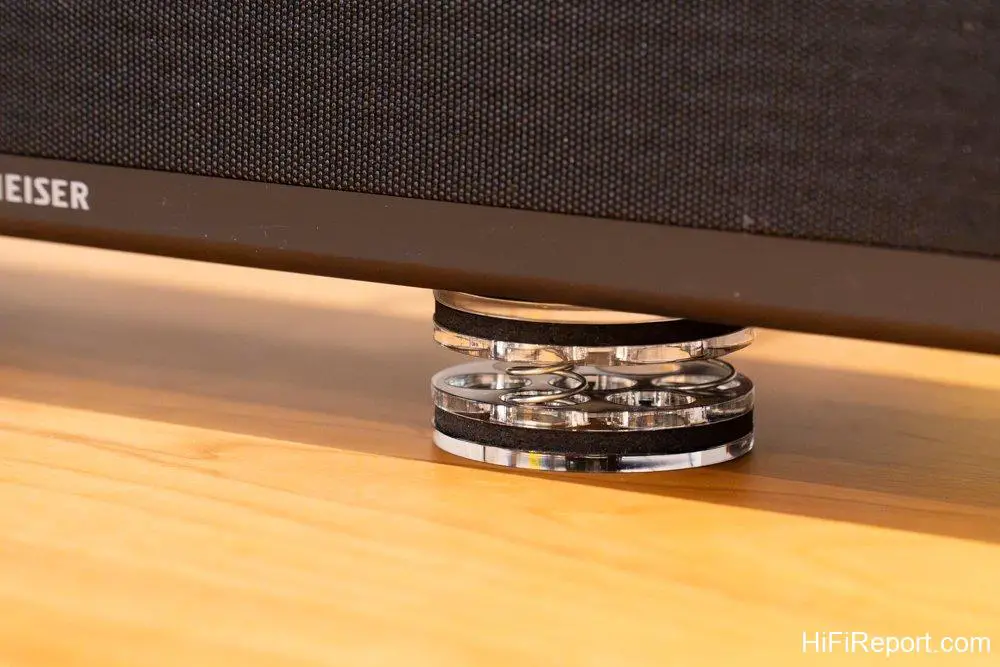
Alternatively, for placement on a TV cabinet, optional foot pads can be used. Rich Music Hi-Fi also carries its own brand of these, and customers can consult with Mr. Lee for recommendations.
*Image showing simple connection setup.*
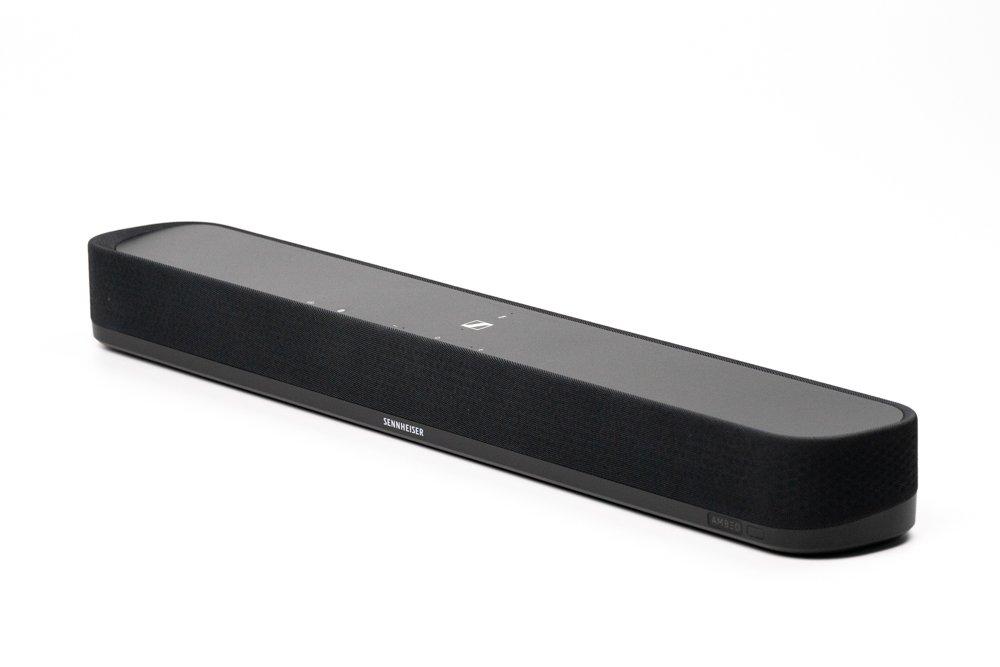
*Image source: Sennheiser official wall mount.*
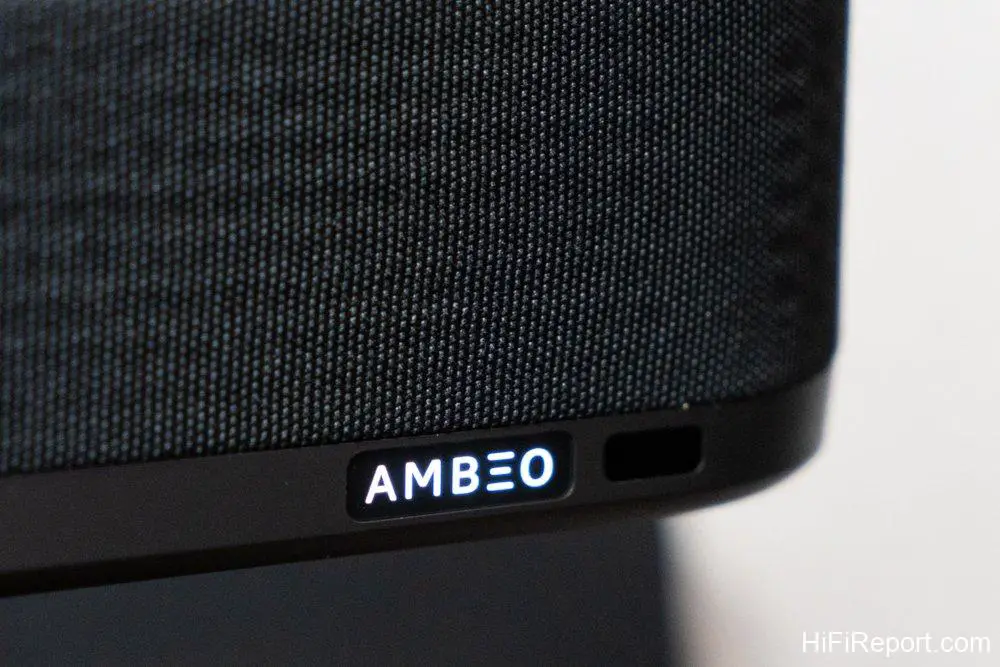
Finally, Mr. Lee added that AMBEO technology relies on algorithms. He pointed out a light indicator on the bottom right of the unit, which is often overlooked. When the light is off, AMBEO is deactivated, and the soundstage will sound constricted.
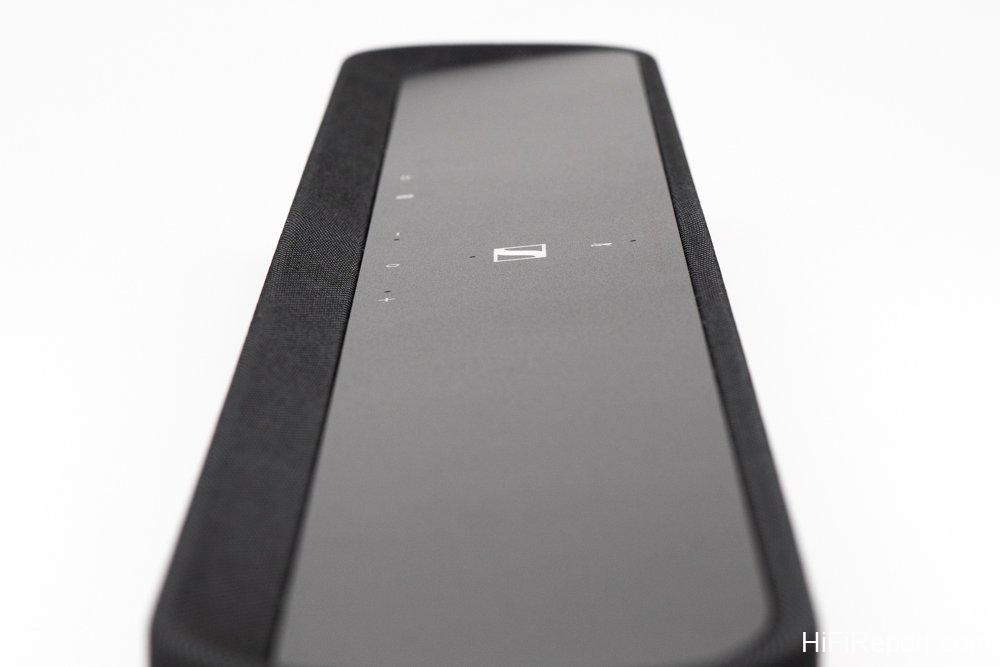
When activated (light on), especially when listening to music, the sense of surround sound expands dramatically. Some listeners may find this unnatural for music listening, depending on personal preference. The default setting is AMBEO on (light illuminated). If preferred, it can be turned off via the app or remote control.
Regarding sound quality, Mr. Lee confidently stated that compared to other brands, the Mini offers superior layering and separation, preventing the soundstage from becoming congested.
He elaborated that traditional soundbars often create the perception that sound emanates solely from the front. In contrast, the Mini excels at creating a sense of spaciousness, allowing listeners to perceive sound directionality from above and to the sides, largely thanks to the sophisticated algorithms.
Clear Vocals, Slightly Leaner Tonality
The audition took place in Rich Music Hi-Fi’s small listening room in the basement, approximately 2-3 pings (70-105 sq ft), simulating a typical small room or apartment listening environment.
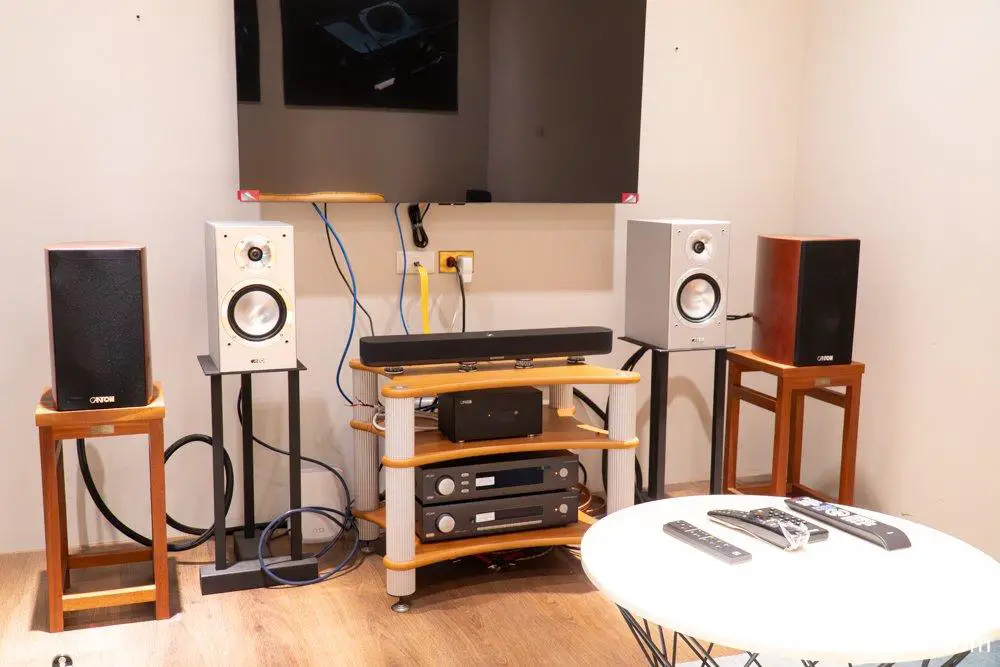
In terms of vocal performance, the Mini exhibits ample clarity, though with a slightly leaner quality. The transient response is excellent. For instance, listening to Celine Dion’s “A New Day Has Come” and Susan Wong’s “Desperado” on the Mini, the vocals were clean, focused, and detailed with good image size, but lacked some fullness in body.
Upon adding the AMBEO Sub, as suggested by Mr. Lee, vocal richness improved, and the overall musical density also increased noticeably.
Next, I experimented by activating AMBEO. The soundstage expanded further, but the sound became somewhat “hollow” for music listening.
Therefore, for music listening, I personally recommend deactivating AMBEO, which provides a more conventional two-channel stereo-like experience.
Immersive Movie Soundscapes
However, the experience shifted dramatically when switching to movie soundtracks. For example, track 8, “Wonder Woman’s Wrath,” from the “Wonder Woman” soundtrack, showcased a completely different sense of scale and impact with AMBEO engaged. The low frequencies even generated a palpable rumble that could be felt in my pant legs.
At this point, Mr. Lee shared his personal tuning tip: placing a plush toy on top of the subwoofer. After repeated A/B comparisons, he found that the low frequencies became cleaner, with reduced muddiness, and the rhythmic definition became clearer.
Finally, playing “My Enemy” from “The Amazing Spider-Man 2” soundtrack, the Mini rendered clear vocal details, creating a sense of whispered dialogue directly in front. In the latter half of the track, the sound localization was remarkably distinct, making it hard to believe that the immersive surround sound and impactful presence were generated solely by a Mini + Sub combination.
Clearly, for movies or movie soundtracks, AMBEO is essential for a truly immersive experience!
Creating Immersive Surround Sound in Small Spaces
If you are familiar with the Sennheiser brand, the AMBEO Soundbar series is likely no stranger, having been actively showcased at various exhibitions and events to allow consumers to experience its surround sound capabilities firsthand.
The latest Mini model, significantly reduced in size from the original 126.5cm to 70cm, is even more suitable for smaller listening spaces. Without requiring multiple speakers, it helps users create a virtual surround sound experience with impressive audio clarity. It’s not just for movies; music enjoyment is also excellent! While the suggested retail price of NTD 32,990 (approximately USD $1030 based on a 32 NTD to 1 USD exchange rate) isn’t inexpensive, it is certainly more accessible than its larger siblings. Ultimately, to determine if it’s a worthwhile investment, a visit to a Hi-Fi store for a personal audition is highly recommended!
Specifications
* Drivers: 6 Class-D speaker drivers (including 4×1.6″ (40mm) full-range drivers / 2x 4″ woofers)
* Frequency Response: 43Hz – 20 Khz (-3dB)
* HDMI TV (eARC) Output: 1x HDMI eARC (HDMI 2.1)
* USB: 1 x USB socket (Type A), For power supply of accessories: 5 V, 1 A;
* WiFi: IEEE 802.11 a/b/g/n/ac/ax
* Bluetooth Version: 5.0
* Bluetooth Transmission Frequency: 2,400 MHz to 2,483.5 MHz
* Bluetooth Maximum Power: 100 mW (max)
* Total Audio Power: 250W (RMS)
* Dimensions (with feet): approx. 70 x 10 x 6.5 cm
* Dimensions (without feet): approx. 70 x 10 x 6.5 cm
* Weight: approx. 3.3 kg