
Sharkwire Genesis Fuse Review
Fuses, these tiny components, are found in every piece of electrical audio equipment. Decades ago, when I first started listening to Hi-Fi, it was already popular within the audio community to swap out fuses, and naturally, I tried it myself. After all, a fuse only costs a few dollars, so trying dozens wouldn’t significantly impact my living expenses.
Experiences with Audio Fuses
At the time, I went to electrical supply stores to buy different fuses, and there were also a few types labeled as “audio-grade” being sold within the community.
To be honest, after trying so many fuses, the improvement in sound performance was always only marginal, or perhaps it was just a “difference” rather than a definite improvement. Because of that, I never felt compelled to write about it. If changing a fuse had the same instantaneous, noticeable effect as changing cables, I would have been enthusiastically writing about fuses long ago.
The Breakthrough: Sharkwire Vulcan
It wasn’t until a few years ago when Sharkwire released the Vulcan fuse. This was the first time I encountered a fuse with such a significant effect. After swapping them in, the improvement in audio performance was clearly audible. Excited, I immediately wrote about it. However, even I thought, who would buy such a tiny fuse costing 12,000 NTD (approximately 375 USD)? Unless you’re like us – particularly passionate audiophiles who can keenly perceive improvements in sound quality.
But upon reflection, if you replaced one fuse in your source, preamp, and power amp, the total cost would be 36,000 NTD (approximately 1125 USD). This expenditure is equivalent to buying a moderately priced cable. Audiophiles replace various cables without hesitation, so if spending only 36,000 NTD can yield a better improvement than changing cables, why not change the fuses? That was my thinking.
Introducing Genesis: A Shocking Price Jump
This year, Sharkwire introduced their new generation of fuses, Genesis, and the price point dramatically increased to 68,000 NTD (approximately 2125 USD). When I saw that, I gasped, thinking, “Has Sharkwire gone mad?” Selling a single fuse for such a high price? How was this price even determined? Surely, only a tiny fraction of audiophiles would buy such a product? I thought the market would decide the fate of the Genesis fuse.
Last month, an editor from “Audio Art” magazine visited a user in Shenkeng whose system had been upgraded with the Genesis fuses. According to the editor’s report, the user was extremely satisfied with the improvement brought by the Genesis fuses. This piqued my curiosity. I was already using four Vulcan fuses in my four ATC SCM 100 ASL active speakers. I wanted to see how much more improvement the new Genesis fuses could bring.
The Listening Experience: An Astonishing Transformation
Through a colleague, I contacted Mr. Jiang from Mulu Audio, the Taiwanese distributor for Sharkwire, and quickly four Genesis fuses were delivered to the magazine office. I immediately took them home, removed the four original Vulcan fuses, and installed the four Genesis fuses. Following my usual listening habit, I let the entire system play for two hours (as background music) before I began serious listening.
When I started listening intently, I found that all the music sounded better than before. This level of improvement was absolutely not influenced by my mood or the weather; rather, the instrument sounds were more beautiful, the music’s inherent harmonies were more exquisite, and aspects like soundstage, sense of space, transparency, resolution, layering, etc., were all elevated.
Simply put, after replacing the fuses with Genesis, it was as if I had upgraded to higher-end, more expensive audio equipment. The overall sound performance improved by several levels, and this result utterly astonished me.
Frankly, my home audio system was already tuned to a very balanced state, and all types of music sounded great on it. To achieve an even better sound, I believed that only upgrading to higher-tier audio components could accomplish it. Unexpectedly, replacing the fuses with Genesis resulted in a degree of improvement far exceeding that of swapping out a specific cable.
Detailed Improvements Across Genres
Moreover, it wasn’t just an improvement in a particular area like treble, midrange, or bass quantity, resolution, or layering; it was an overall enhancement. This was beyond my imagination.
For instance, when listening to Vivaldi’s Violin Concertos on the Naïve label (Julien Chauvin, violin, Le Concert De Laloge orchestra), the music entered my ears, and my mind suddenly opened up, as if I had inhaled a large amount of fresh air, instantly refreshed. It was also like biting into a particularly sweet and crisp pear, bringing immense satisfaction. The listening experience was truly transformative, fundamentally different.
Listening next to Ponchielli’s “Dance of the Hours” (from the opera *La Gioconda*) performed by the Philadelphia Orchestra, my brain was again struck powerfully – another fundamentally transformative listening experience. Simply put, the overall captivating nature of the music was elevated to another level. I cannot quantify the improvement, but the degree of enhancement was certainly one that brought me pleasure.
In fact, my system was already in an excellent state, and I never anticipated such a significant improvement after installing the Genesis fuses.
The Nature of the Improvement: Overall Musical Balance
Please note, I emphasize again that this transformative change was not merely the typical perception of altered treble, midrange, or bass quantity, or a slight increase in sheen, or the cello sounding a bit more beautiful, and so on. It was an overall elevation.
This overall elevation meant that all instruments sounded more beautiful in terms of timbre, the playing texture was more realistic, the orchestral harmonies were more exquisite, the layering of inner voices was more clearly articulated, and most importantly, the overall musical balance reached another, higher level.
Listening again to Gershwin’s “An American in Paris” performed by Leonard Bernstein conducting the New York Philharmonic (1967 recording), I was once again deeply impressed. The expansive orchestral sound that greeted me, whether it was the sense of liveliness, impact, or transient response, was significantly stronger than before. The entire orchestra, both in width and depth, expanded considerably, and the sense of musical scale became larger.
Having listened to large orchestral works, I moved on to chamber music. Listening to Haydn’s Piano Trio No. 37 performed by the Beaux Arts Trio, wow! The music was truly beautiful! The timbres of the violin, cello, and piano were all elevated, the beauty of the harmony was globally enhanced, and the violin, cello, and piano also sounded more realistic. This is truly an improvement in overall musical balance!
Listening to Schubert’s Piano Quintet, Op. 114 (Trout Quintet) performed by the Beaux Arts Trio, the same transformative listening experience was replicated. When I listened to the second movement, the beauty of the piano quintet was beyond description. Not only were the harmonies of the three string instruments captivating, but the overall harmony when the piano joined was moving in the extreme.
This kind of improvement in musical balance greatly increased the power of the music to stir emotions. That this was achieved by changing fuses was a revolutionary experience I had never encountered before.
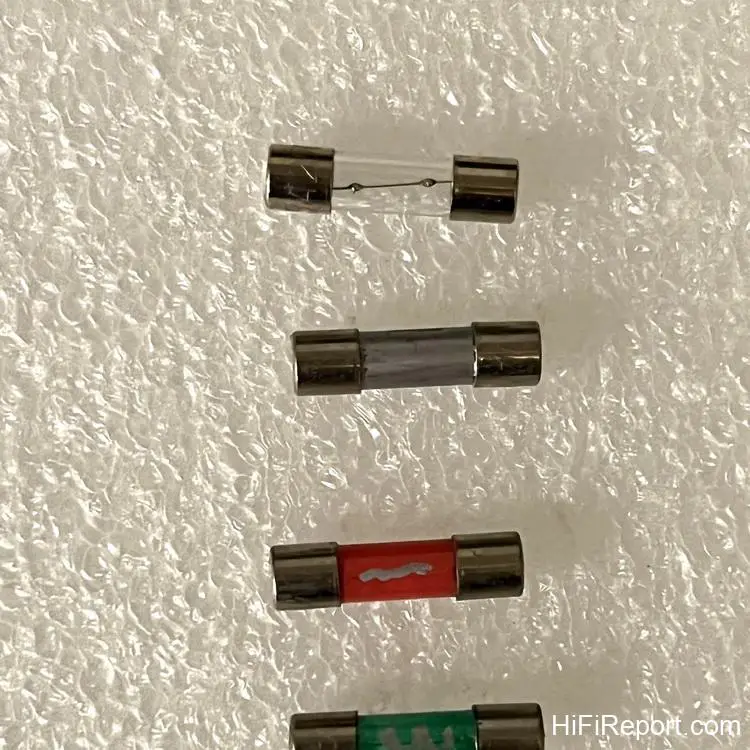
Genesis vs. Vulcan: A Revolutionary Leap
Perhaps I should state more precisely that previously, when I replaced fuses with Sharkwire’s Vulcan, their ability to enhance audio performance was already superior to any fuses I had used before. However, the Sharkwire Genesis fuses I have now installed demonstrate a significantly greater magnitude of improvement than the Vulcan fuses. This is why I say, “This is something I had never encountered before.”
Having organized my initial excitement, I must calmly state that this is a comprehensive elevation in grandeur and the sheer pleasure of listening to music. In comparison, improvements in specific areas of the treble, midrange, or bass, or certain enhancements in resolution or transparency, seem almost trivial changes.
Evaluating the Genesis Fuse
However, I must also say that Sharkwire Genesis fuses cannot transform a system that fundamentally sounds poor into one that sounds good.
If an audio system sounds poor, there are likely many underlying issues, and a single fuse cannot perform such a miracle. But, the Sharkwire Genesis fuse can turn an audio system that is on the borderline between good and not-so-good into one that sounds good, because its overall enhancement capability is sufficient.
As for audio systems that already sound excellent, replacing the fuses with Sharkwire Genesis will make you feel that the beauty of the music has reached a higher level, allowing you to enjoy the pleasure of listening to music every single minute.
So, how do you test if the Sharkwire Genesis fuse is effective? I suggest you find some recordings that you usually feel are missing something, not quite satisfying to listen to. Take them out one by one and listen, and see if you suddenly feel these recordings have become enjoyable. When listening, relax and focus on the overall beauty of the music. Don’t fixate on how the treble, midrange, or bass have changed. Simply use your ears to feel the enhancement in musical beauty.
Under the Hood: Genesis Materials and Technology
How can a tiny fuse have such a significant enhancement capability? According to the information provided by Mr. Jiang from Mulu Audio, Sharkwire was founded in the UK as early as 1971, making it a historical cable manufacturer. The fuses were researched and manufactured in Japan by their R&D team. They not only develop fuses for home audio but also for automotive and other applications. The R&D team focused on the metal caps at both ends of the fuse, the fuse tube, and the conductor inside.
This is how they developed the Vulcan and Genesis fuses. From the outside, the most obvious difference between the Vulcan and Genesis fuses and standard ones is that the exposed length of their fuse tubes is shorter, while the length of the metal caps at both ends is longer than standard fuses. Other differences are in the materials. Could the length of the metal caps also affect sound performance?
According to the official information, both Vulcan and Genesis use the same crimping method, TAC, and the internal conductor is pure silver. The differences lie in the plating method of the metal caps and the material of the fuse tube. Vulcan uses DSAPT20K for plating, while Genesis uses DSAPT20K+SICLT. Vulcan’s fuse tube is made of Magic Wood, while Genesis uses Tastu Stone. What is SICLT? Sharkwire Ion-Conducting Layer Technology. What is Tastu Stone?
It’s a material discovered by the R&D team member, Mr. Tastu, hence the name Tastu Stone. According to official data, Tastu Stone not only possesses characteristics similar to Magic Wood, such as high heat resistance, non-conductivity, elasticity, and non-breakage, but also boasts excellent processability.
The precisely crafted cylindrical tube meets the standard of true roundness and perfectly fits with the metal caps at both ends, creating a state inside the fuse that is close to low-oxygen and high-sealed, making it more resistant to extreme weather changes and allowing the music to reach its ultimate potential.
Packaging and Pricing Philosophy
Besides the fuses themselves, the packaging of Genesis is also different from Vulcan. Vulcan is packaged in a blunt-nosed bullet-shaped metal tube, while Genesis comes in a clear acrylic cube with one corner missing. Why is one corner deliberately missing? If you place the missing corner on a flat surface, you’ll find the entire acrylic cube can stand stably at a certain angle. If you remove the lid and similarly place the missing corner on the surface, the cube cannot stand upright at all.
Could this packaging design be suggesting that without the Genesis fuse, the audio system cannot achieve optimal musical balance?
Frankly, the information provided by the manufacturer should be taken with a grain of salt. Marketing language is necessary when selling a product. What’s important is to use your ears to evaluate the product and only spend money if you can hear a tangible improvement. What I find somewhat perplexing is that the Vulcan sold for 12,000 NTD (approx. 375 USD), which was already quite shocking. The Genesis, however, instantly jumped to 68,000 NTD (approx.
2125 USD) per fuse, a price that will absolutely leave people speechless. What is the basis for the Genesis’s pricing? Is it perhaps priced based on the magnitude of sound improvement it brings? Or is it intentionally testing the limits of audiophiles’ wallets? As for why fuses improve sound performance, I don’t know. There are many unresolved mysteries in this world, so let the experts research them.
But I can confirm that the improvement brought by the Genesis fuse is greater than replacing a cable.
Market Value and Final Thoughts
If the Sharkwire Genesis fuse sells well, it would truly be the most profitable product in audio history. It’s small in size, easy to transport, requires almost no after-sales service – it’s practically like selling diamonds. However, how much the distributor makes is not something I can influence; it can only be said to be their good fortune to have developed such a good product.
A diamond, when you get down to it, is just a transparent crystal of carbon, but by cleverly controlling the supply, it has become an accessory women covet. No one denies that diamonds are expensive, yet enthusiasts flock to them. The Sharkwire Genesis fuse, when you get down to it, is just a tiny fuse, but it can enhance the overall performance capability of an audio system. A tiny fuse selling for 68,000 NTD (approx. 2125 USD) is undoubtedly expensive.
As for whether audiophiles will flock to it, that’s for the market to decide!
Specifications
* Crimping Method: TAC
* Internal Conductor: Pure Silver
* Metal Cap Plating (Vulcan): DSAPT20K
* Metal Cap Plating (Genesis): DSAPT20K+SICLT (Sharkwire Ion-Conducting Layer Technology)
* Fuse Tube Material (Vulcan): Magic Wood
* Fuse Tube Material (Genesis): Tastu Stone