
STAX SR-X9000 Review
In the 1950s, STAX began manufacturing condenser microphones, condenser phono cartridges, tonearms (from 1952-1981), and oscilloscopes. Later, Naotake Hayashi developed an interest in electrostatic loudspeakers, producing the first electrostatic tweeter unit in 1954. In 1959, STAX created their first pair of electrostatic headphones, which were exhibited at the Tokyo Audio Fair that year.
These headphones were officially launched in 1960 as the world’s first electrostatic headphones, the SR-1, and were uniquely named “Earspeakers,” a term still used today. At that time, the SRD-1 and SRD-2 headphone amplifiers were also introduced to accompany them.
Over the years, founder Naotake Hayashi and his son Takeshi Hayashi worked tirelessly to manage the company. The father remained involved in product research and development at the company well into his eighties.
STAX has produced power amplifiers (five models in total across 1966, 1968, 1974, and 1976), DACs (one each in 1989 and 1990), tonearms (12 models, the first being the uniquely curved LA-24), cartridges (two electrostatic models, not including early capacitor types, discontinued in 1977), CD players (one each in 1986 and 1988), and even floor-standing electrostatic speakers (first introduced in 1964, then again in 1976 after a 12-year gap, followed by various models, with the last pair introduced in 1992, totaling 14 models).
Ultimately, however, they focused their main business on electrostatic headphones and amplifiers. Detailed historical product lines are thoroughly documented on the official STAX website, in truly “Japanese style.”
Looking at their diverse product range, the period between 1968 and 1970 stands out as STAX’s golden age. During these two years, they launched many new products, accumulating nearly 40 different items, including pure Class A amplifiers and carbon fiber tonearms. Their product line essentially covered all types of equipment used by audiophiles at the time. Despite years of diligent work, by 1995, STAX faced financial difficulties and temporarily ceased operations.
A new company was formed the following year to continue operations, still led by the Hayashi father and son.
Perhaps you might wonder how STAX headphones, being so expensive, could face financial troubles. It’s important to remember that headphone sales were very small back then, and few audiophiles bought headphones. Headphones only became popular in the last decade or so, driven by young people using portable audio players. Furthermore, the electrostatic headphones produced by STAX were not affordable for the typical young headphone user.
As a result, STAX eventually couldn’t overcome financial difficulties by December 2011 and was fully acquired by the Chinese company Edifier. However, despite the change in ownership, STAX remains committed to production in Saitama Prefecture, Japan. The current president is Yoshimoto Nakata. Being acquired by a larger company has paradoxically allowed STAX the capacity to update equipment and manufacture even better products.
Current STAX Lineup
Currently, the flagship of STAX electrostatic headphones is the SR-X9000, followed by the SR-009S, SR-009, and SR-007 MK2, all featuring a round ear cup design. Below these are the SR-L700 MK2, SR-L500 MK2, and SR-L300, which use a square ear cup design. Finally, STAX also offers an in-ear electrostatic headphone, the SR-003 MK2.
Amplifier Requirements and Options
Since electrostatic headphones require voltage to operate, they must be used with dedicated headphone amplifiers and cannot be driven by standard headphone amps. To meet this need, STAX offers 11 models of headphone amplifiers for users to choose from. The top-tier option is, of course, the SRM-T8000 (introduced in 2017), which features a hybrid design with tubes in the input stage and solid-state in the output stage. Next are the SRM-700T (tube amplifier) and SRM-700S (solid-state amplifier).
I won’t list the models further down the range. All amplifiers, except for the most affordable SRM-D50 and SRM-D10 which can connect only one pair of headphones, can connect two pairs simultaneously.
Connectivity and Cable Options
One common annoyance audiophiles encounter when listening to headphones from their listening sweet spot is that the connecting cable is often not long enough. No problem, STAX has thought of that too. You can purchase extension cables offered by STAX.
There are four types available: two models using 6N silver-plated wire, the 5-meter long SRE-950S and the 2.5-meter long SRE-925S; and two models using PCOCC (Single Crystal Oxygen-Free Copper) wire, the 5-meter long SRE-750 and the 2.5-meter long SRE-725.
SR-X9000 Positioning and Availability
The predecessor to the SR-X9000 is the SR-009S, launched in 2018 to celebrate the company’s 80th anniversary. The SR-X9000 was released in 2021. While the SR-X9000 is the flagship, it can be used with various STAX amplifiers; there’s no strict requirement to pair it with the flagship SRM-T8000. However, given the price of the SR-X9000, which is around $6,700, users will likely also purchase the SRM-T8000, which has a price difference of about $330 from the headphone itself.
Therefore, to enjoy this top-tier electrostatic headphone system, you should be prepared to spend around $13,500.
However, don’t assume you can just buy the SR-X9000 just because you have the money. Due to the need for very precise manual craftsmanship and the low yield rate of the ultra-thin diaphragm, only about 20-30 pairs of headphones can be produced each month. Taiwan is allocated only one pair per month. Even if you have the money, you’ll need to wait patiently in line.
It is said that the local distributor still owes customers over a dozen pairs, so those wanting to buy the SR-X9000 will likely have to wait for at least a year or more!
Design Details and Technology
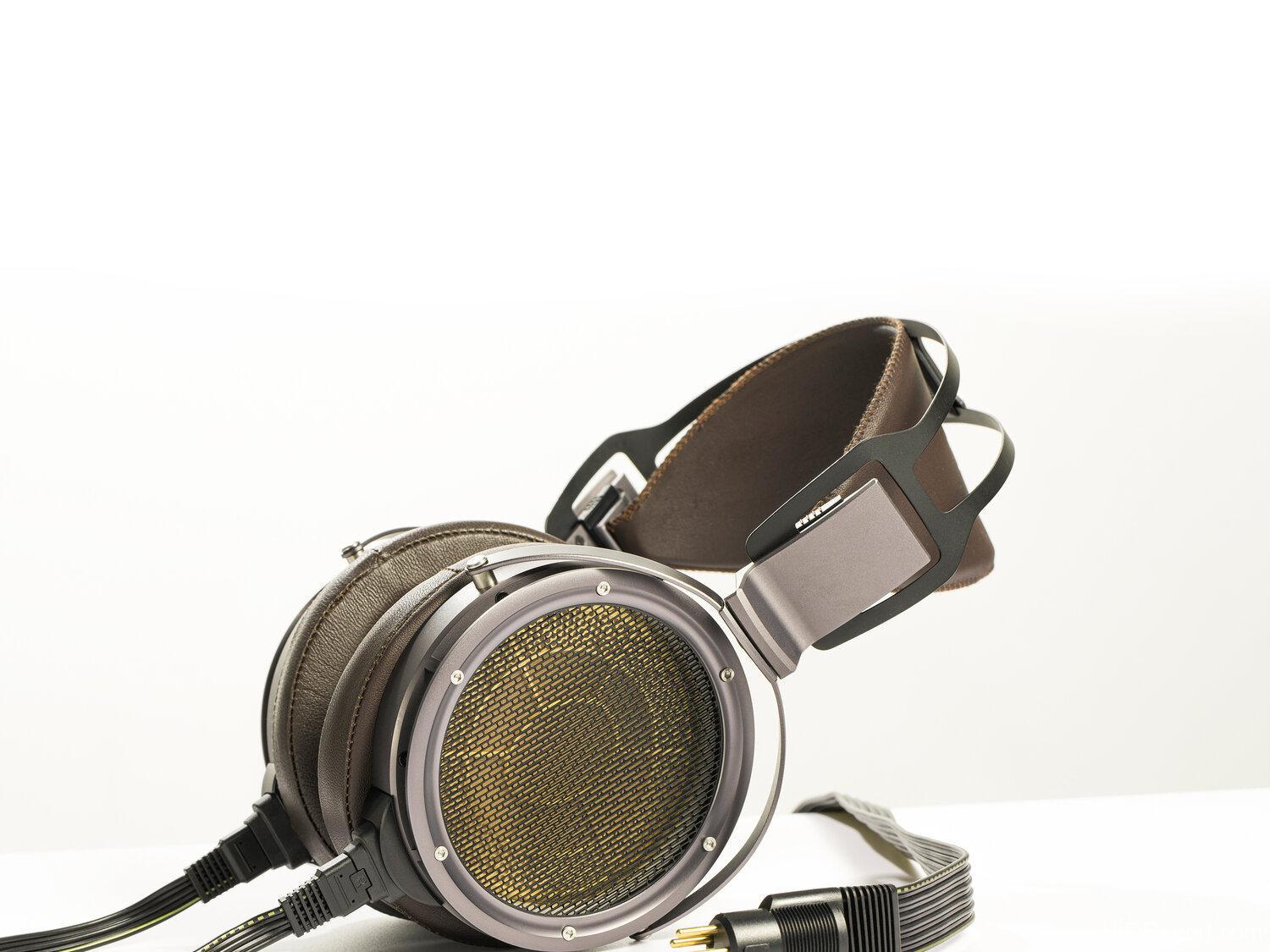
At first glance, the appearance of the SR-X9000 seems identical to its predecessor. Upon closer inspection, you’ll notice that the electrode shape is different. The SR-009S electrodes look like a pie sliced into six pieces, while the SR-X9000 electrodes feature three concentric circles with radial lines. Additionally, the bottom of the SR-009S headband frame has “STAX” printed on it, whereas the SR-X9000 has nothing.
Furthermore, the protective grille on the SR-009S is tightly integrated with the ear cup and has a cross-weave mesh. The protective grille of the SR-X9000 is open and not connected to the ear cup, mounted at an angle with an H-shaped mesh pattern.
What’s the advantage of mounting it at an angle? I suspect it prevents sound waves that don’t pass through the mesh from reflecting back onto the diaphragm. Because the SR-X9000’s protective mesh is very fine, allowing sound waves emitted by the diaphragm to fully transmit into the ear and also outwards, it can be described as an “extremely open” open-back headphone.
The SR-X9000 is very light and comfortable to wear. The ear pads appear to be covered in leather, but in fact, only the small circle that makes contact with the ear is genuine lambskin; the rest is artificial leather. The headband is also made of artificial leather. Why make this distinction? Would using lambskin throughout add significantly to the cost? Or perhaps lambskin and artificial leather each have their own advantages?
So, how do electrostatic headphones (and speakers) produce sound? The basic structure consists of three thin elements in a sandwich configuration. The central element is a high polymer film less than 2 microns (two-millionths of a meter) thick (the first-generation diaphragm was about 5 microns thick), which is thinner than ordinary paper. This thin diaphragm is suspended between two perforated electrodes.
A fixed positive voltage is applied to the diaphragm, while the two electrodes are connected to the music signal (which can be considered an alternating voltage), changing their positive and negative voltages according to the signal. When the front electrode has a negative voltage, the diaphragm is pulled forward; when the rear electrode has a negative voltage, the diaphragm is pulled backward. The diaphragm moves back and forth in this manner, driving the air to produce music.
STAX’s first electrostatic headphones had a sensitivity of 95dB/100V rms, an impedance of 130k ohms at 10kHz, a frequency response of 20Hz-20kHz, and required a 150VDC bias voltage. By 1979, the SR-Lambda electrostatic headphones had a diaphragm thickness reduced to 3 microns, an expanded frequency response of 8Hz-35kHz, a sensitivity of 102dB/100V, and a maximum SPL of up to 109dB.
By the previous generation, the SR-009S, the frequency response reached 5Hz-42kHz, impedance was 145k ohms, sensitivity was 101dB, bias voltage was 580VDC, and weight without the cable was 441 grams.
And the SR-X9000? Diaphragm thickness is less than 2 microns, frequency response is 5Hz-42kHz, impedance is 145k ohms, sensitivity is 100dB, bias voltage is 580VDC, and weight without the cable is 432 grams. Hmm? The specifications look almost identical! The SR-X9000 is even slightly heavier. Oh, the SR-X9000 comes with one 2.5-meter and one 1.5-meter cable, so you can use whichever you need.
If you want to listen to the SR-X9000 from your listening sweet spot, you’ll need to purchase the aforementioned extension cables separately.
Perhaps you’re wondering, since the specifications are almost identical, why release the SR-X9000? The main reason is the improved driver structure. The most crucial part of electrostatic headphones is the driver structure. The SR-X9000’s diaphragm electrode structure was updated to a Multi-Layer Elect-Rods (MLER) design when the SR-009 was launched in 2011.
This was further refined to the second generation with the SR-009S in 2018, at which point the electrode plates were gold-plated, resulting in the golden color we see now.
The SR-X9000 utilizes the third generation of MLER. While the driver structure still consists of one diaphragm layer and two electrode layers, the third generation MLER uses a four-layer structure to strengthen the entire driver assembly. Including the outer support structure, there are a total of seven layers. This increased layering in the driver structure makes it slightly heavier but significantly stronger and more resistant to vibration. How are these four layers bonded together?
Are they screwed in? That would be too crude. STAX uses a vacuum low-temperature thermal compression bonding method (thermocompression bonding) to firmly adhere these four layers together.
In addition to the third-generation MLER, the diaphragm area of the SR-X9000 is also 20% larger than its predecessor. Although the sensitivity is unchanged, I believe the maximum SPL should be improved (the manufacturer doesn’t provide this specification), and the sound performance should naturally be better.
Amplifier and Connectivity
The main focus of this review is the SR-X9000, but a brief introduction to the accompanying SRM-T8000 amplifier is necessary to provide a complete picture. The SRM-T8000 is a hybrid design with tubes in the input stage and solid-state in the output. It uses two 6922 dual triode tubes on an independent circuit board, separate from other circuitry. The power output stage employs Toshiba transistors. Being a Class A design, the chassis includes substantial heatsinks.
Inside the chassis, there’s a large toroidal transformer and sophisticated filtering and voltage regulation circuitry, providing separate power to the tube circuitry and the transistor output stage.
The front panel of the SRM-T8000 features two headphone jacks, a volume control (inner and outer rings allow separate adjustment for left and right channels), an input selector (Line 1-4), and a Level Control. This Level Control essentially acts as a switch for Mute, Internal, and External (Bypass) modes. Internal means the volume is controlled by the amplifier.
External bypasses the internal volume control, allowing an external preamplifier to handle volume control, thus avoiding the signal passing through two volume controls.
On the rear panel, you’ll find two sets of RCA inputs (Line 1, Line 2), and one set of XLR inputs (Line 3). Line 4 is blocked off with a metal plate, reserved for potential future input expansion. Next to Line 1, there’s also a set of parallel RCA outputs. This output allows the music signal fed into the SRM-T8000 to be sent to another amplifier.
For listening with the SR-X9000, I did not use a separate preamplifier. Instead, the music signal went directly from the Weiss DAC 502 to the SRM-T8000’s XLR input. Since the DAC 502 itself has volume control, I simply set the Level Control on the SRM-T8000 to Bypass. Music sources included CD and streaming, with an emmLabs TSDX SE CD transport used for CDs.
Listening Impressions: Dynamics and Bass
I know that for audiophiles, the biggest question about electrostatic headphones isn’t about micro-details, but whether they can deliver impactful dynamics, or “explode,” to use a common term. Because traditional electrostatic loudspeakers are generally perceived as less capable of strong dynamics, there’s often a concern about whether electrostatic headphones can do it. Let me assure you right now: relax! The SR-X9000 can handle impactful dynamics with any music.
When listening to “Cosmic Hippo,” the SR-X9000’s bass quantity was not only sufficient but also deep, full-bodied, and elastic. Remember, the SR-X9000’s frequency response goes down to 5Hz – what ultra-low frequencies could it possibly fail to reproduce? When listening to Carolin No’s “Crystal Ball,” the bass felt like large water balloons being thrown around, or rather, those bass air masses seemed to spring out.
Listening to Malia & Boris Blank’s album “Convergence,” every track is a bass challenge. Whether it’s quantity, impact, or digging deep, the SR-X9000 dissected it all with effortless ease. Listening to the film scores for Shigeru Umebayashi’s “2046” and “House of Flying Daggers,” even at high volumes, the SR-X9000 showed no fear; the only fear was that my own ears couldn’t handle it.
Listening to “End of the War” from Umebayashi’s “Curse of the Golden Flower,” the bass was deep, full, and plentiful. Listening to Kari Bremnes’ “Gate Ved Gate,” the full-bodied, ample bass and powerful vocals were rendered without any compromise.
Even when I listened to Shostakovich’s “Symphony No. 4” conducted by Myung-Whun Chung with the Philadelphia Orchestra, the SR-X9000 completely held its ground against the astonishing energy that swept through like a hurricane. Listening to Sibelius’ “Symphony No. 1” conducted by Bernstein with the Vienna Philharmonic, the raging brass and timpani did not cause the SR-X9000 to distort.
After subjecting it to this kind of musical abuse, I can confidently say that the SR-X9000 is absolutely not the “electrostatic loudspeaker” you might imagine, but rather an electrostatic headphone as powerful as dynamic driver headphones. Of course, STAX itself considers their products “Earspeakers”!
Clarity, Detail, and Timbre
We’ve covered the powerful, impactful, ultra-low, and elastic bass. Now, let’s enjoy the SR-X9000’s transparency, clarity, micro-details, lightning-fast transient response, and its inherently beautiful tone and timbre reproduction. Frankly, whenever I think of the SR-X9000’s transient response, the image of a dragonfly’s transparent wings beating rapidly comes to mind. The SR-X9000’s transient response is like that: it’s fast, but it doesn’t feel rushed, aggressive, or irritating.

Ultimately, it’s a natural speed; the SR-X9000 is as fast as the instruments’ response demands.
Regarding the reproduction of tone and timbre, I listened to many recordings of voices, violins, cellos, pianos, string quartets, piano trios, sextets, octets, etc. The SR-X9000’s reproduction of strings and piano timbre is exceptionally beautiful, fully capturing the delicate beauty of acoustic instruments.
If your home audio system makes chamber music sound sharp, piercing, noisy, cold, or hard, I guarantee that after hearing the SR-X9000’s performance in this regard, you’ll want to discard your speakers because the difference is simply too vast!
In terms of vocals, if you’ve always thought Cai Qin’s voice was deep and massive, or Leonard Cohen’s presence was overwhelmingly huge, listening through the SR-X9000 will immediately change your preconceived notions. The human voice comes from the vocal cords in the throat, not from a bass instrument. The SR-X9000 will ruthlessly show you what a realistic human voice should sound like.
Speaking of timbre, we know that the total harmonic distortion of most loudspeakers is very high, so high that most speaker manufacturers don’t dare list this specification. Harmonics are important factors in forming the timbre of instruments and voices. High harmonic distortion is equivalent to altering the original timbre of voices and instruments. Frankly, this is unavoidable; drivers have harmonic distortion, and enclosures also have harmonic distortion.
When mixed, the harmonic distortion becomes even greater. What’s interesting is that most audiophiles don’t consider loudspeaker harmonic distortion a significant issue; in fact, they often revel in the belief that their speakers have a lot of “character.”
However, once you compare the timbre of the same piece of music played through the SR-X9000 and through speakers, you’ll suddenly realize that the sound you’ve been hearing every day is “heavily made up,” while the sound produced by the SR-X9000 is truly “naturally beautiful.”
Why do I dare say that the sound produced by the SR-X9000 is “naturally beautiful”? Because the harmonic distortion caused by the ultra-thin diaphragm should be much lower than that of typical loudspeaker drivers. Furthermore, the SR-X9000 has no speaker enclosure; it merely finds a way to suspend the diaphragm and let it sing. Thus, it can exhibit lower harmonic distortion than typical loudspeakers.
In other words, if you listen to music with the SR-X9000, you can truly experience how beautiful the sound of a violin originally is, and how captivating a person’s voice can be.
Transparency and The ‘Addiction’ Factor
Does the SR-X9000 reveal many details? An astonishing amount! Consider this: the headphones are right against your ears, free from external noise interference. Naturally, you’re going to hear far more micro-details than with speakers. Coupled with the SR-X9000’s electrostatic diaphragm, which has virtually zero mass and low inertia, what details could it possibly fail to reproduce?
Indeed, no matter what music you listen to, you’ll feel like there are too many details to keep up with; details you could never hear through speakers will pour out like a spring.
The sound of the SR-X9000 is extremely transparent and clear. Consequently, the quality of your source is paramount. If your source quality isn’t good enough, it will be like dropping a few grains of sand into distilled water – you’ll see them clearly. Only with a truly excellent source will the SR-X9000’s high degree of transparency and clarity make you feel like you’re listening to heavenly music.
When listening with the STAX SR-X9000 electrostatic headphones, there’s no burden on your head, and the ear pads are soft, making it comfortable to wear even for extended listening sessions. Furthermore, through the SR-X9000, you’ll find yourself wondering how the music has become so beautiful, so enchanting? The only thing you need to worry about is that you might become “addicted” and find “there’s no going back.”
After listening to the SR-X9000 for just one day, you’ll be puzzled why the speakers you were perfectly happy with before suddenly sound bad. Are you sick? Has the weather changed? Has your audio system been tampered with? Has a neighbor poisoned your power supply? None of the above. This is just you succumbing to the SR-X9000’s “poison” – there’s no going back!
Specifications
* **Type:** Electrostatic Headphones
* **Launch Year:** 2021
* **Frequency Response:** 5Hz-42kHz
* **Impedance:** 145k ohms
* **Sensitivity:** 100dB
* **Bias Voltage:** 580VDC
* **Weight (without cable):** 432 grams