
Electrostatic Appeal Review
Why Stax? Because in that era, headphones weren’t the phenomenon they are today, and headphone brands weren’t the explosive multitude we see now. Stax was, quite simply, *the* name for electrostatic headphones. Astonishingly, what was true then remains true in today’s booming headphone market. Apart from the stratospheric, wallet-obliterating Sennheiser “HE 1” (a spiritual successor to the original Orpheus), Stax is still the undisputed champion of the electrostatic domain.
And even now, every time I encounter a pair of Stax headphones, it feels like meeting a long-lost love; my heart races, and I’m utterly captivated. Even reviewing the most accessible SR-L300 + SRM-D10 combination fills me with that familiar flutter of romantic longing.
No, this time feels different. When I reviewed the higher-end Stax SR-L700 paired with the SRM-006tS tube amplifier previously, my heart didn’t pound quite like this. Perhaps it’s the more approachable price point of the SR-L300 combination, or maybe the compact SRM-D10 is just a better fit for my small office desk than the classic Stax full-sized amplifiers. A sudden thought bloomed in my mind: “You know, you could actually *own* this!”
It hit me then – yes, I’m no longer that impecunious student. Maybe this time, I truly can bring that teenage dream home.
Rest assured, I haven’t let affection cloud my judgment. Whenever I write about electrostatic headphones, I always feel compelled to rationally explain their principles and advantages, and this instance is no exception.
How They Work
The fundamental structure of an electrostatic diaphragm consists of a membrane, thinner than cling film, incredibly lightweight, sandwiched between two conductive plates. This membrane is charged by a power supply. The actual music signal is applied to the two conductive plates, but not before it’s boosted to a high voltage via a transformer. As music plays, the signal rapidly switches between the two plates, creating a fluctuating electric field.

This field attracts and repels the charged membrane, causing it to vibrate back and forth, thus moving the air and producing the sound we hear.
This design offers two primary advantages. First, the diaphragm is exceptionally light and isn’t burdened by a voice coil like dynamic drivers, allowing for unparalleled transient response speed. The job of a speaker or headphone driver is to convert the energy of the music signal entirely into the energy of air vibration. The lower the energy loss during this conversion, the higher the efficiency, ensuring the music’s energy is transmitted to the air with minimal compromise.
How can a diaphragm achieve perfect coupling with the air for maximum energy transfer efficiency? Theoretically, the most efficient transfer of mechanical energy occurs between objects of similar density and mass. Therefore, the most ideal diaphragm material for moving air should be “air” itself. Among all speaker diaphragm materials, which one comes closest to “air”? The answer is the lightest and thinnest of all, the virtually massless electrostatic diaphragm.
Second, any dynamic driver diaphragm, during intense piston-like movement, is inevitably prone to breakup distortion due to deformation – even those made from extremely rigid materials like diamond, ceramic, or pure beryllium. Conversely, the electrostatic diaphragm, thin as a cicada’s wing, while large in area, is completely controlled by the conductive plates across its entire surface.
This ensures the entire diaphragm moves uniformly, minimizing problems related to diaphragm deformation and phase distortion.

At this juncture, I must reiterate a passage from “The Loudspeaker Handbook” regarding driver diaphragms: “To reproduce a 20kHz music signal, the diaphragm must instantaneously accelerate from rest, stop just as quickly, then accelerate in the opposite direction. This entire process must be completed within one forty-thousandth of a second!
A diaphragm that is too heavy will inevitably be unable to perform such instantaneous acceleration, stopping, and re-acceleration due to inertia, thus limiting high-frequency extension and detail reproduction.” Which diaphragm can approach this level of performance? The answer, again, is the electrostatic diaphragm.
Naturally, no driver or speaker is perfect. The Achilles’ heel of electrostatic speakers lies in the necessity for a very large diaphragm area to reproduce sufficient bass. Even then, electrostatic speakers often struggle to match the visceral bass impact and density characteristic of dynamic speakers. Furthermore, electrostatic diaphragms are susceptible to collecting dust, and their tension can relax over time.
Gradually, the initially ethereal and transparent sound signature might become slightly veiled. In humid environments, dust on the diaphragm can even lead to arcing, potentially damaging the diaphragm. While theoretically perfect, electrostatic speakers have raised concerns regarding durability.
Is there a solution? Yes, electrostatic headphones, with their drastically reduced diaphragm area, represent the optimal application of electrostatic technology. With a smaller diaphragm, loosening tension is less of an issue, and isolating the diaphragm from dust becomes easier. Tightly covering the ears, the electrostatic diaphragm minimizes bass energy loss transmitted to the eardrum, largely mitigating the bass deficiency often associated with electrostatic speakers.

Sonic Purity
Listening to Li Yundi’s “The Campanella” from his album “Liszt: Piano Recital,” a track I frequently use to test audio systems, I was captivated by the opening high-pitched staccato notes. I’ve heard millionaire-dollar systems render this passage with breathtaking artistry, but I must honestly say, even the most extraordinary conventional system cannot replicate the absolute transparency and crystalline clarity of the STAX SR-L300.
It’s only after experiencing electrostatic headphones that you truly grasp the concept of transient response speed without any hint of sluggishness. This holds true for delicate pianissimo passages and even more so for explosive fortissimo bursts. Some say the human ear possesses uncanny sensitivity to transients and phase, and they are absolutely correct.
But you won’t know the full extent of your auditory perception’s ability to discern subtle sonic variations until you’ve listened to Stax electrostatic headphones.
Moving on to the final nocturne on Jan Lisiecki’s “Chopin: Works For Piano & Orchestra” album, I adore this young pianist’s interpretation. His touch is incredibly gentle, and his command of tempo rubato is flawless. Through the SR-L300, the piano touch becomes even more transparent and ethereal, yet it retains a natural, warm texture, never sounding pale or thin.
I began to notice that with every track I listened to on the SR-L300, I uncovered numerous details I hadn’t perceived before. This wasn’t just about audiophile characteristics; it included the subtlest shifts in key pressure, the most minute tempo transitions, and the nuanced flow of musical thought and emotion.

Take, for instance, Argerich playing Chopin’s “Preludes,” a recording I know intimately. Previously, I had only focused on the Piano Queen’s famously uninhibited and spontaneous style. Listening with the SR-L300, I discovered how lyrical Argerich’s playing can be, and how sweet her tone. In that moment, I felt as if Argerich had secretly sent me a love letter. That sudden, overwhelming sense of revelation is simply ineffable. After listening, my admiration for Argerich deepened further.
I suddenly realized that perhaps I wasn’t just falling in love with the SR-L300 itself, but with every piece of music and every musician it brought to life.
Portable Powerhouse
The SRM-D10 is another intriguing product. Its compact size and built-in battery seem designed for portable listening. However, upon using it, I discovered it gets remarkably hot, like a miniature furnace, suggesting a pure Class A amplification design. The solid aluminum alloy casing is clearly intended for heat dissipation. An amp that runs this hot is difficult to simply toss in a bag and use on the go.
In fact, the open-back design of Stax headphones isn’t ideal for noisy streets (external noise bleeds in, affecting the sound) or public spaces like cafes (the music leaks out, disturbing others). The compact SRM-D10 is actually intended for quiet indoor listening, allowing you to settle down and immerse yourself in the music. While the battery life isn’t marathon-like, it’s sufficient for several hours of listening.
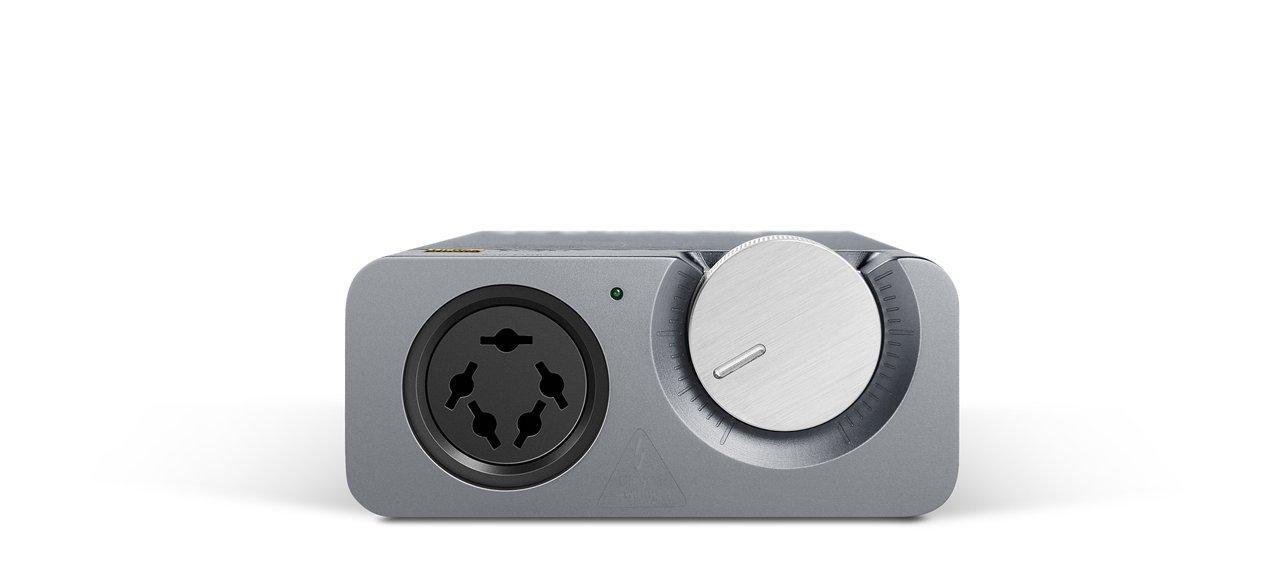
The SRM-D10 includes a built-in DAC. I couldn’t find the chip model, but I know it supports DSD128 playback. That’s less important, however. What truly delighted me about the SRM-D10 was its exceptional sound performance. Not only is the sound quality transparent and pure, but the density also seems even better than other Stax gear I recall hearing. Despite being an entry-level unit, it fully unlocks the unique strengths of Stax electrostatic headphones.
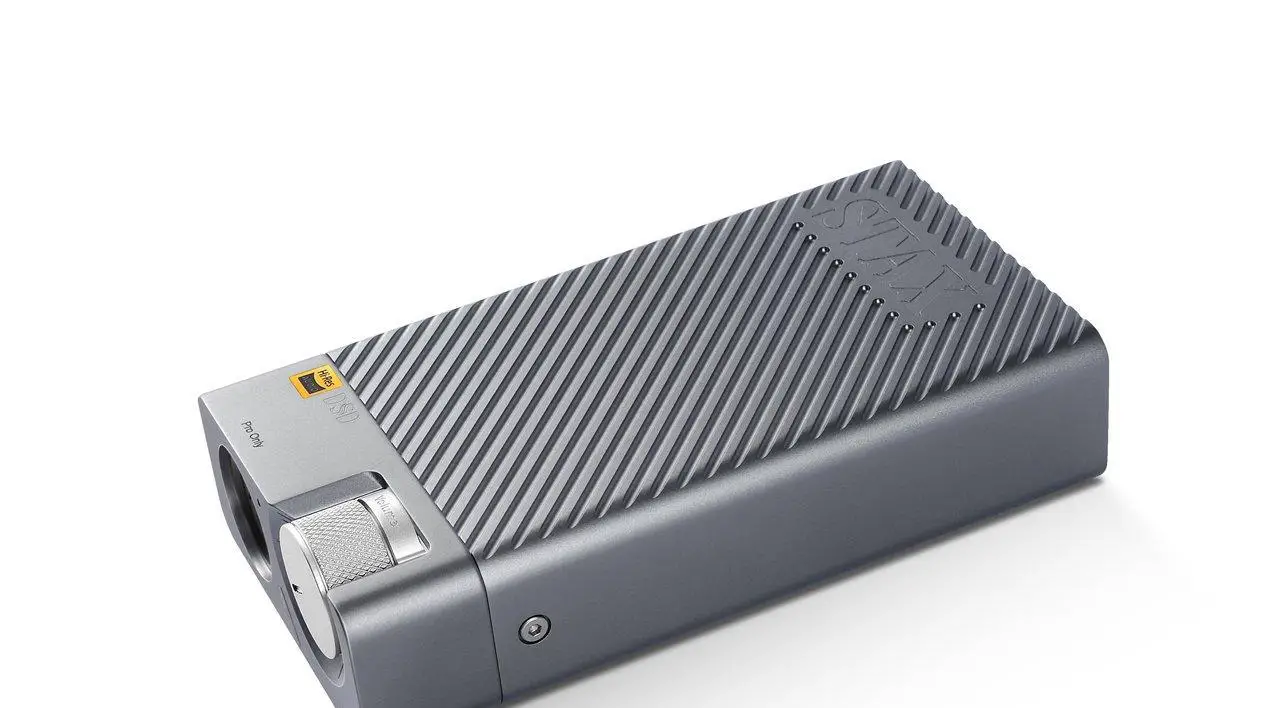
If there’s a weakness in this combination, it’s still in the bass. Listening to heavy electronic dance music might feel slightly underwhelming, but tackling the lightning-fast drumming of heavy metal yields immensely satisfying results. For large-scale orchestral works, the clarity, rich layering, expansiveness, and effortless presentation are simply unmatched by other dynamic headphones.
Please do not misunderstand me. I am absolutely not recommending this combination solely because of its accessible price (though I won’t deny that’s a significant factor). It’s because the sound of the SR-L300 + SRM-D10 truly made me fall in love. That old magazine wasn’t wrong; every characteristic of electrostatic headphones was fully realized in this pairing! Even at the most affordable entry level, Stax remains Stax.
The unique sonic character of electrostatic headphones is simply irreplaceable!
Further Listening Impressions
Having previously listened to several Stax electrostatic headphones, I’ve always been impressed by their transparent and elegant sound quality. The music sounds utterly clean, lean, and refined – a truly classic presentation. However, listening to Stax’s most accessible SR-L300 this time revealed a sound with notable warmth and (a sense of pleasant savoriness). Playing Edouard Ferlet’s rendition of “Think Bach,” the piano strokes possessed a wonderfully sweet, woody texture.
The soundstage felt spacious, and the low-frequency notes triggered surprisingly ample bass compared to my expectations, creating a listening experience with a controlled upper register and comfortably extended lower end. This tonal balance is quite appealing. Switching to Sade’s “By Your Side,” the headphones presented a softer impact characteristic. The bass in popular music felt springy and full, not constrained.
Vocals were rendered with appropriate proportion, and while the soundstage felt slightly smaller, it fostered a sense of intimacy. Overall, it still retains the lively and sensitive sonic energy of electrostatic headphones but with a greater sense of musical richness.
This Stax headphone and amplifier combination arguably leans towards a “portable” concept, though the open-back design means it’s not truly suited for “on-the-go” use in noisy environments. Nevertheless, it significantly enhances the usability freedom of Stax electrostatic headphones compared to the past. So, how does this streamlined electrostatic system actually sound? Incredibly, it sounds remarkably good!
It maintains the anticipated level of supreme detail and possesses excellent elasticity and layered detail in the bass frequencies. I played “Youth Collection II: Flower Butterfly” by Korean singer Bolbbalgan4. Ahn Ji-young’s voice is naturally sweet, but through this system, her vocals reached an utterly captivating level, becoming more enchanting with every listen – a quality incredibly difficult to reproduce on typical headphone systems.
In the slightly more pop-oriented arrangements, the bass pulses were as relaxed as they might sound on a two-channel system. The soundstage expanded remarkably wide, creating a sense of openness without pressure, while still retaining the intimacy and abundant, direct musical detail inherent to headphones. In short, it’s more than sufficient for lightweight desktop use!
In the vast world of headphone tuning, this Stax combination reminds one that “the source is the best tuning.” The hallmark of this Stax pairing is nothing less than pure sound and a jet-black background, capable of revealing the minutiae of a performance and immersing the listener in a soundscape as close to the original recording as possible.
Listening to Mutter play “Across the Stars,” her effortless, flowing bowing produced a violin tone that was delicate yet beautiful, completely devoid of any harshness – a quality rarely heard even on many high-end two-channel systems. Piano music is particularly moving with this Stax combination. Listening to Joe Hisaishi play “Castle in the Sky,” the simple piano solo became infinitely rich.
Not only could I appreciate the intricate arrangement of the score, but I could even discern the subtle differences in pressure with each keystroke. This ability to resolve tiny details is so profound that one can easily distinguish between recordings from different eras; it’s practically a monitoring tool. What’s magical is that this feels like the purest, most dust-free performance I’ve ever heard from Stax headphones. Could it be the benefit of the D-10 being battery-powered?
Specs
STAX SR-L300
* Elliptical electrostatic diaphragm, open-back design
* Frequency Response: 7-41kHz
* Sensitivity: 101dB (100V RMS/1kHz)
* Bias Voltage: DC 580V
* Weight: 448g (including cable)
STAX SRM-D10
* 5-pin PRO bias headphone output terminal
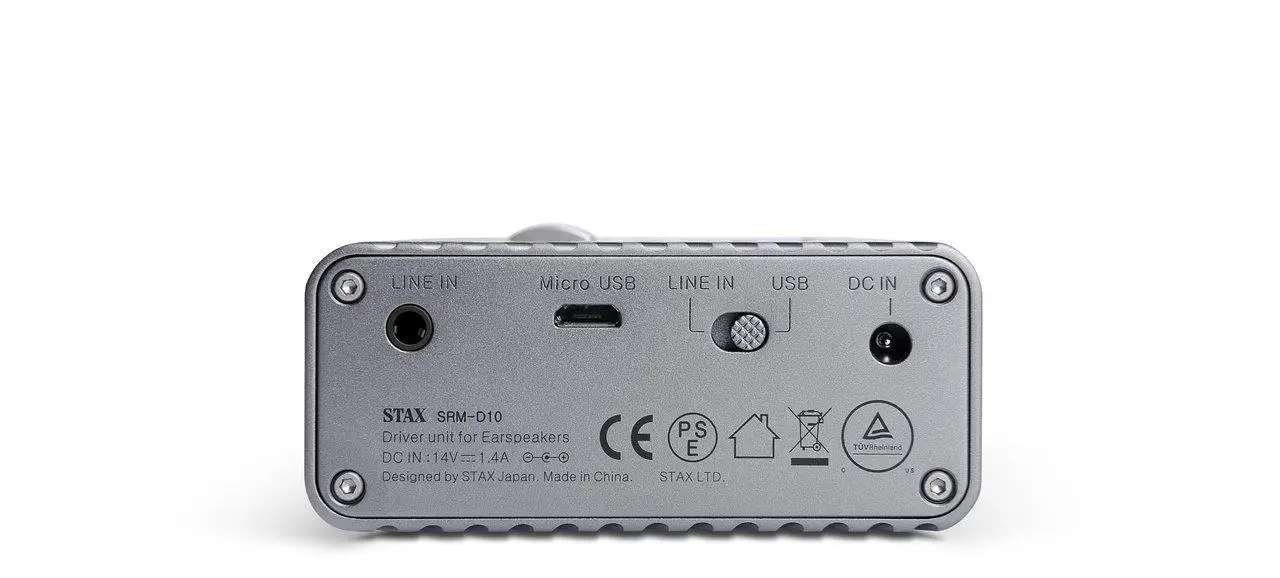
* MicroUSB digital input
* 3.5mm analog input
* Frequency Response: 20Hz-40KHz (+0dB, -3dB)
* Total Harmonic Distortion: Less than 0.025% (1KHz-10KHz)
* Maximum Output Voltage: 200V RMS (100Hz-10KHz)
* Static Bias Voltage: DC 580V
* Power Voltage: DC 14V
* Battery Life: 4.5 hours (analog input) / 3.5 hours (digital input)
* Power Consumption: 6.4W (USB input), 5W (analog input)
* Dimensions: 75×32×141mm
* Weight: 450g