
Stenheim Reference Ultime 2 Review
It’s often said that it’s easy to draw the skin of a tiger but hard to draw its bones. The same principle applies to audio. Producing sound is not difficult, but achieving naturalness, transparency, fluidity, and detail is a real challenge.
This time, I visited Resound Audio in Tianmu to audition the Swiss Stenheim Reference Ultime 2. Its unassuming sonic performance effortlessly reveals the natural and rich expressions within the music.
Swiss Craftsmanship & Prestige
Stenheim, a Swiss brand, might be relatively unfamiliar to many, but for audiophiles, it is undoubtedly a Hi-End gem. The mere phrase “Swiss handcrafted” speaks volumes about its prestige. The Reference series, in particular, represents Stenheim’s flagship line at the pinnacle of Hi-End audio, and its high price tag is a given.
The Reference series was first introduced in 2014, and currently includes four models. The top-of-the-line flagship is the four-piece Reference Statement, followed by the Reference Ultime 5, which shares the same main speaker but has smaller bass columns. Then there’s the Reference Ultime 3, which reverts to a traditional two-piece design without bass columns. The latest release, the Reference Ultime 2, which is the focus of this review, is a slightly smaller, high-end speaker.

Why are speakers getting smaller? It’s quite logical. Living spaces in cities are often not large, making it difficult to accommodate massive speakers. While buyers who can afford the Reference Statement might not have space constraints, its high price limits its market. Therefore, the Reference Ultime 3 and Reference Ultime 2 return to a two-piece design, reducing the speaker’s footprint, making them more suitable for home placement. This is also reflected in the price, appealing to a broader consumer base. However, these are still Hi-End Swiss luxury speakers, and the entry threshold remains considerably high.
Consistent Design Language
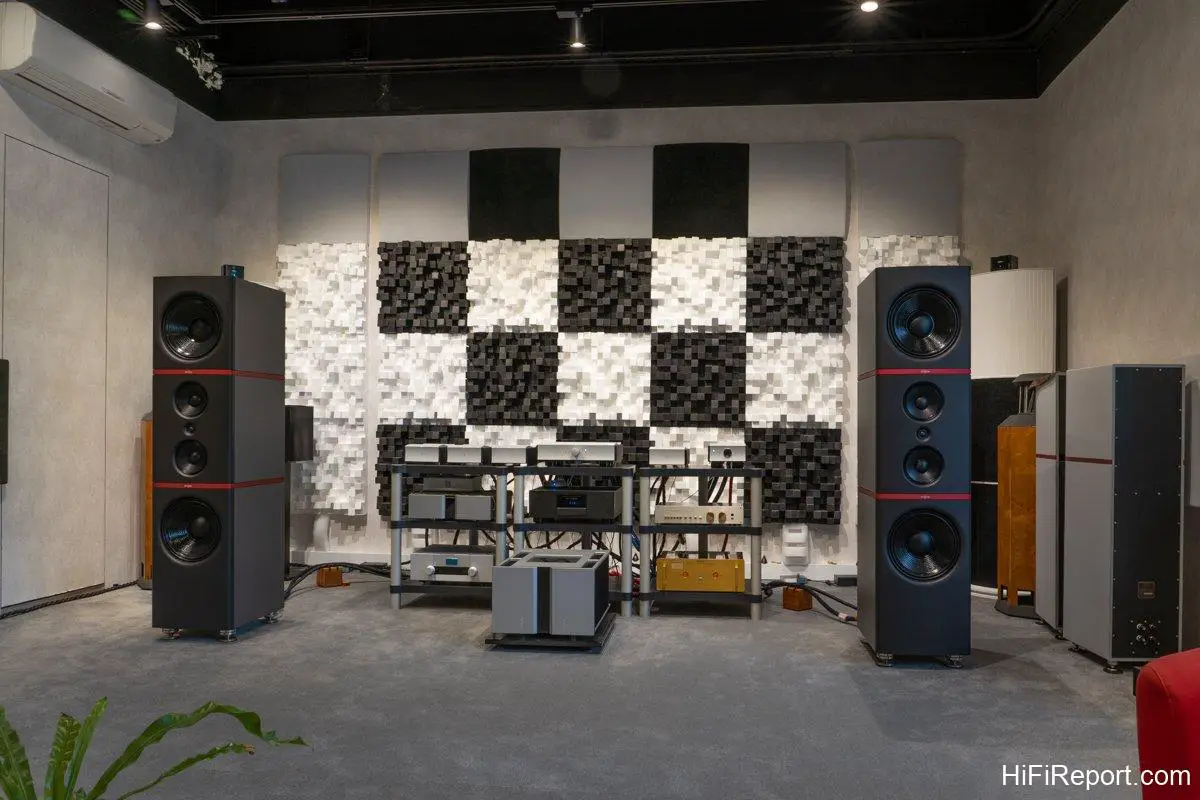
When I arrived at Resound Audio in Tianmu and first saw the Reference Ultime 2, I initially thought it was a revised version of the Ultime 3, as they look so similar. Upon closer inspection, I noticed the speaker height was slightly shorter, and the position of the metal trim was slightly different. It’s unmistakably a Reference series speaker, with a completely consistent industrial design language. The only differences are the cabinet dimensions and the number of drivers. Models above Reference Ultime 3 feature an additional ribbon super tweeter next to the central tweeter, while the Reference Ultime 2 returns to a standard three-way design. The D’Appolito point source driver configuration, however, is a common design element across the Reference series.
Wait, the differences don’t stop there. Looking at the back of the Reference Ultime 2, I noticed two fewer bass drivers. The Reference Ultime 3 has a total of 8 drivers, while the Reference Ultime 2 is simplified to 5 drivers.
Furthermore, the Reference Ultime 3 uses an external crossover, while the Reference Ultime 2 integrates the crossover inside the speaker cabinet. These changes make the Reference Ultime 2 occupy even less floor space and easier to place at home. Moreover, the Room Control feature for adjusting the balance of high, mid, and low frequencies is still retained, although the adjustment steps are slightly reduced to a three-stage setting.
Three Pillars of Stenheim Design
Regarding Stenheim’s speaker design philosophy, principal Jean-Pascal Panchard once explained at a product launch event during an audio show that Stenheim has three key technical characteristics, and they are dedicated to making these three things the best they can be, to the extreme.
What are these three things? Aluminum alloy speaker cabinets, extremely high-efficiency dynamic drivers, and precise high-order crossovers.
With these three core principles, Stenheim has successfully navigated its first decade in the market and is now moving forward into its second decade.
Aluminum Cabinet & Driver Tech
Stenheim is not alone in using aluminum alloy for speaker cabinets. Swiss brands Goldmund and Piega adopted aluminum cabinets earlier, and American brand Magico is also a proponent of aluminum enclosures. They believe that aluminum alloy offers superior rigidity and low resonance, outperforming MDF in terms of physical properties. With proper internal damping, it is possible to create the best speaker cabinets.
The rationale is clear to everyone, but why are there so few brands using aluminum alloy cabinets? The reason is simple: they are difficult to manufacture, requiring very high precision, which leads to high costs. Look at the Reference Ultime 2 speaker cabinet; the aluminum alloy panels are large, requiring large CNC machines. Even slight deviations in machining precision can prevent the cabinet from being assembled. Coupled with low production volumes, it’s hard to reduce manufacturing costs, leading to high speaker prices. If sales are not as expected, it’s difficult for a brand to survive. However, Stenheim has weathered its first decade, proving its market viability.
Regarding driver technology, Stenheim insists on using ultra-high-efficiency drivers, aiming to make dynamic drivers achieve efficiency almost comparable to horn speakers. This is to reproduce the most complete details and dynamics of music, imbuing it with rich realism. Therefore, the drivers used by Stenheim are custom-made and not available off-the-shelf. Stenheim hasn’t disclosed who manufactures the drivers for the Reference Ultime 2, but clues from the Alumine series suggest it might be Seas, Scan-Speak, or Audio Technology. As for crossover design, Stenheim favors high-order crossovers. There are actually two schools of thought among speaker designers: one advocates for low-order crossovers, ideally first-order, with minimal passive components and lower phase distortion; the other argues for high-order crossovers, which provide steeper crossover slopes and tighter integration at the crossover points. Both approaches have their proponents, and technically, each has its advantages and disadvantages. However, Stenheim belongs to the high-order crossover camp.
Complex Internal Cabinet Structure
From the outside, the Reference Ultime 2 adopts a clean and elegant aesthetic. The cabinet is rectangular, with a rounded front baffle, and shallow horn flares around the drivers. However, the internal speaker cabinet structure is extremely complex, divided into a total of six independent enclosures. The tweeter and two midrange drivers each have their own sealed enclosures, the crossover has another separate enclosure, and the two woofers share another independent enclosure. The bass reflex ports are located at the back of the speaker, with long, narrow openings at the top and bottom.
Furthermore, the crossover is installed in an airtight, independent chamber to minimize the negative effects of vibration. The Reference Ultime 2 may appear to have simple lines, but its internal cabinet structure is surprisingly complex.

Despite its seemingly substantial size, the Reference Ultime 2 boasts a high efficiency of 95 dB and a high power handling capacity of 400 watts, with a peak power handling of 800 watts. Thanks to its 95 dB efficiency, Stenheim emphasizes that it requires as little as 30 watts of power. However, efficiency is just a simple calculation of electrical energy conversion to sound energy. The dB value only tells us about loudness, not sound quality. The actual results can only be determined through practical pairings. Each time I go out to listen to equipment, I gain experience from real-world scenarios and learn the art of audio system matching.
Mola Mola Amplification Synergy
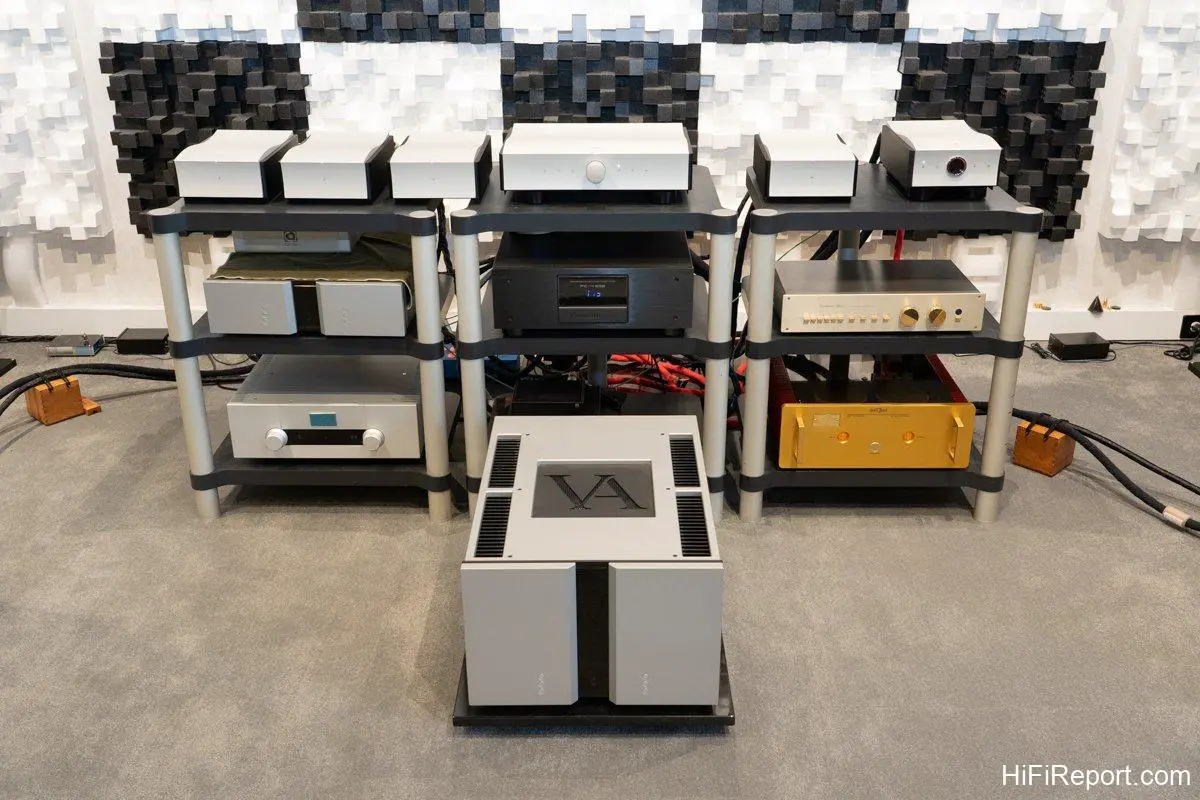
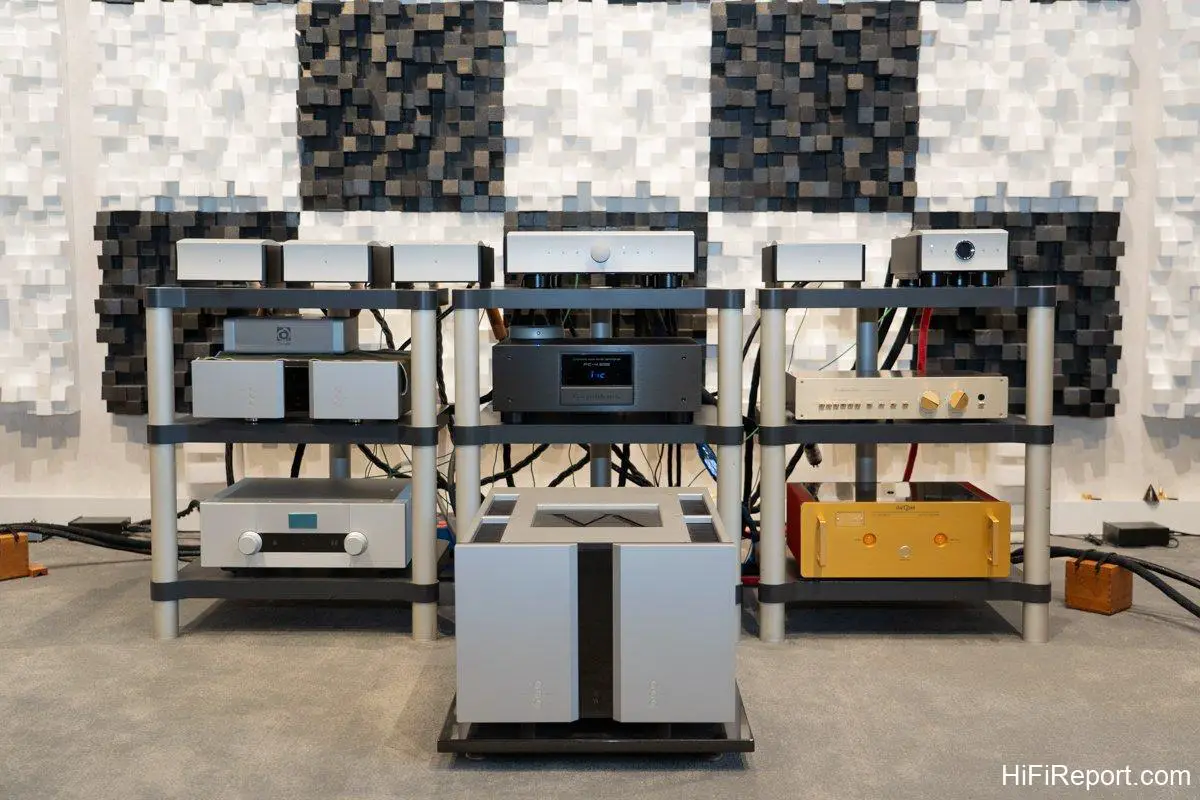
I previously auditioned the Reference Ultime 3 at Resound Audio in Tianmu. In the same space, the system setup for the Reference Ultime 2 was completely different. For the Ultime 3, the source was an Orpheus Absolute SACD player, and the amplification was a Danish Vitus Audio SL-103 preamp and SS-103 power amp. This time, for the Reference Ultime 2, it was an all-Mola Mola system: the Tambuqui streaming DAC as the source, the Makua preamp, and a whopping four monoblock Kaluga power amps, separately driving the mid-high frequencies and the low frequencies, each delivering 400 watts per channel, totaling 1,600 watts to drive the Reference Ultime 2.
The cabling was a mix of Brandt Audio and Way Cable, both brands distributed by Resound Audio. The digital source was powered through a GigaWatt PC-4 power conditioner, while the preamp and power amps were directly connected to an ART power isolator.

As you can see from the Mola Mola equipment setup, there was no CD source. All the CDs I brought were useless. We were going to listen to cloud-based digital streaming music. So, Mr. Yang handed me an iPad and asked me to select music from Tidal. It seems that convenient and user-friendly digital music subscription services have become mainstream. CDs are probably only listened to by us old-school folks. Even audio stores are showcasing systems without CD players, which gives you an idea of the demand in the consumer market.
Impressive Bass Performance
Starting with Chris Jones’ “Roadhouse & Automobile” as a quick test, the crisp acoustic guitar, paired with blues harmonica, presented a refreshing and breezy country folk atmosphere. I remarked to Mr. Yang of Resound Audio that the sound with Mola Mola was very different from Vitus Audio. The Mola Mola setup had a more transparent and expansive soundstage, while Vitus Audio had higher sonic density and weight. Both systems performed excellently musically, but their sonic directions were different.
I tried pushing the volume up. Although the Reference Ultime 2 is slightly smaller in size, its mid-bass energy doesn’t lose out to the larger Reference Ultime 3 at all. At least in Resound Audio’s listening room, the mid-bass energy of the Reference Ultime 2 could reach a level comparable to the higher-end model. If I were to nitpick, the larger Reference Ultime 3 might have slightly better deep bass extension and a more relaxed feel than the Reference Ultime 2. For those who are truly fastidious, they would have to spend more to pursue the Reference Ultime 3.

Excellent Low-Level Performance
Perhaps due to the speaker’s high efficiency, or maybe the control of the four Mola Mola Kaluga power amps delivering a total of 1,600 watts, the Reference Ultime 2 exhibits excellent linearity. I’m not talking about how powerful and grand it sounds at high volumes. Instead, it’s about its musical performance at low volumes. Some speakers sound impressive at high volumes but become timid and constricted at low volumes, with the image proportions shrinking drastically. In reality, we spend most of our time enjoying music at moderate volumes, only occasionally cranking it up for a thrill. Therefore, the Reference Ultime 2’s excellent linearity means it performs well at both high and low volumes. It can play loudly without strain and maintain proper image proportions and musical details at low volumes—truly versatile for all listening levels.
Take Tsai Chin, a familiar artist to audiophiles. Listening to “Moonlight Serenade” from her album “Encounter,” as I turned up the volume on the Makua preamp, Tsai Chin’s vocal image grew larger, and the overall musical density and richness also increased. Her voice was vibrant and lifelike. However, when I turned the volume down to a level where you could comfortably converse while listening, Tsai Chin’s image size shrank, but the proportions remained correct, and musical details were still present. Even the frog croaking sounds at the very end of the track, though faint, were still discernible. This is the advantage of high-efficiency speakers. At high volumes, the music is lively and dynamic, with clear and full images. But at low volumes, while the musical scale reduces, not too many musical details are sacrificed. Speakers like this are more suitable for home listening. After all, most of the time, we are enjoying music casually, not trying to blow the roof off with every record.
Searching the Tidal library, I found the familiar Eva Cassidy “Live At Blues Alley” recording. Listening to the opening track “Cheek to Cheek,” the emcee’s voice came from the back of the stage, introducing Eva Cassidy, followed by continuous applause from the audience. The Reference Ultime 2 clearly presented a wide stage space. The transparent sonic character might be related to the all-Mola Mola system, but this transparency didn’t detract from the mid-bass richness. The transients of the jazz drums and electric bass were lively and energetic, and Eva Cassidy’s voice was sweet and bright, filling out the spacious stage presence.
The Reference Ultime 2 has the ease of large speakers. It performs effortlessly at high volumes without strain, and at low volumes, it is transparent and gentle, without sounding compressed or congested.
Piano and Orchestra Reproduction
Listening to folk, pop, and jazz with the Reference Ultime 2 is like “a piece of cake.” Switching to classical music is where the speaker’s ability to reproduce musical emotion is truly tested.
Listening to Brendel’s piano solo and Rattle conducting the Berlin Philharmonic in Beethoven’s Piano Concerto No. 5 “Emperor,” the first movement opens with a powerful orchestra tutti, followed by a virtuosic piano cadenza. Beethoven broke the traditional concerto structure of starting with a slow movement and then moving to an allegro. “Emperor” begins with a majestic and grand atmosphere, making the allegro theme even more heroic and powerful, breaking with classical tradition and heralding a new romantic era.

Brendel has recorded the complete Beethoven piano concertos three times, and I listened to the 1999 third recording, with Rattle, a young and energetic conductor at the time. The Reference Ultime 2 reproduced the grand opening, bringing out the expansive presence of the Berlin Philharmonic. The piano solo was clear and focused, with full-bodied notes, firmly placed on the stage. This is mature-period Brendel, with a freer tempo, in contrast to the Berlin Philharmonic’s precision. During the orchestra tutti sections, the Reference Ultime 2 beautifully presented the interplay between the strings and brass sections. The warm brass emerged from the back of the soundstage, and the woodwinds and strings responded to each other with distinct layers. When the piano solo sections began, the orchestra followed the pianist’s free tempo seamlessly, like flowing water. I quickly became engrossed in the music, forgetting I was there to review speakers. Isn’t the purpose of a high-quality audio system to allow us to focus on the music?
Listening to Beethoven’s Piano Concerto No. 5 “Emperor” on the Reference Ultime 2, where did the sound effects stand out? Sorry, my attention was completely on the music. When the exposition theme unfolded, Rattle’s Berlin Philharmonic was dignified and solemn, while Brendel’s piano solo had a freer tempo, as if the piano was leading the orchestra. Moving into the development section, the piano’s sparkling high notes had woodwind responses hidden beneath. When the woodwinds took over the theme, the piano provided a bass foundation. The Reference Ultime 2 presented beautiful instrumental layering and tonal textures. The dynamic variations of the piano were clear, especially during the transition from the development section back to the recapitulation, the piano’s ornate solo was truly fluid. Listening to Beethoven like this is a real pleasure.
Copland Orchestral Power
Oops, my focus was entirely on the music. No, I need to get back to “listening to the audio equipment.” Let’s put on something powerful. Listening to RR’s “Copland: Fanfare for the Common Man,” the opening timpani strikes showed the Reference Ultime 2’s impressive power delivery. The weight was substantial, the dynamic contrasts distinct, and the soundstage spacious and deep. The brass section’s timbre was bright, emerging from the depth of the soundstage, gradually increasing in intensity. The Reference Ultime 2 responded to the crescendo with increasingly immense musical energy. The high, mid, and low registers of the brass section blended beautifully. In response to the timpani strikes, with the support of the four Mola Mola Kaluga power amps, I wasn’t afraid to crank up the volume. In the finale, the brass’s soaring sound and the timpani’s powerful response, the Reference Ultime 2 didn’t falter but upheld the majestic grandeur.

Listening to “Fanfare for the Common Man,” the Reference Ultime 2 demonstrated substantial musical energy. However, I was even more impressed by its wide and transparent soundstage, which created a natural sense of stage space. With a sufficiently open soundstage, instrumental sections don’t sound congested, and the musical layering improves. Because of this expansive soundstage, the Reference Ultime 2’s bass sounded relaxed and natural. Its unassuming sonic performance brought out the rich musicality of “Fanfare for the Common Man.”
Listening to opera with the Reference Ultime 2 was also very enjoyable. Listening to Sutherland and Pavarotti’s “La Traviata,” Pavarotti’s “Un di Felice” in the first act, eloquently expresses his feelings for the heroine, which is also the love theme of “La Traviata.” The Reference Ultime 2 reproduced Pavarotti’s robust, full-bodied voice. The heroine responded dismissively, with Sutherland singing coquettishly and rich coloratura variations. Here was a deeply affectionate male lead, but the heroine said they should just be friends. The emotions hidden in the singing were captivatingly revealed by the Reference Ultime 2.
Visit Resound Audio for a Listen
Is spending just an afternoon with the Reference Ultime 2 enough? Of course not, but it was sufficient for me to sketch out the sonic personality of the Reference Ultime 2. It is smooth, warm, and comfortable, effortlessly conveying the joy of music listening. The fluid musical lines and expansive soundstage present a natural musical expression. These are speakers that make you want to keep listening to music, immersing yourself in the notes. This newly arrived Reference Ultime 2 is currently being run-in at Resound Audio. You might as well take a trip and experience the excellence of Stenheim speakers for yourself.
Specifications
* Stenheim Reference Ultime 2
* Type: 3-way 5-driver bass reflex floorstanding speaker
* Drivers: 25mm soft dome tweeter x 1; 6.5-inch midrange x 2; 12-inch woofer x 2 (D’Appolito configuration)
* Frequency Response: 25 Hz – 35 kHz
* Sensitivity: 95 dB
* Impedance: 4 ohms
* Maximum Power Handling: 400 W (continuous); 800 W (peak)
* Recommended Amplifier Power: > 30 W
* Dimensions: 1535 x 368 x 505 mm (H x W x D)
* Weight: 231 kg