
Swisscables Diamond XLR Interconnect Review
This marks my second encounter with Swisscables. My first experience was with their Evolution and Reference interconnects. Unexpectedly, my second foray into their world brings me directly to their top-tier Diamond XLR interconnects, offering an even more exhilarating listening experience. The Diamond interconnects exemplify the noble, natural, and effortlessly relaxed sonic character of Swisscables, showcasing it to its fullest extent.
Unlisted Diamond Series
If you were to browse the Swisscables official website, you would only find three series of cables listed, ranging from entry-level to advanced: Evolution, Reference, and Reference Plus. The Diamond series is conspicuously absent. However, during the 2018 TAA Hi-End Audio Exhibition, Barbara Suter, the Export Manager of Swisscables, mentioned in a product presentation that the complete product lineup officially consisted only of Evolution, Reference, and Reference Plus, with the Diamond series initially limited to power cables, with plans for future additions. Therefore, the Diamond XLR interconnects I have in hand are indeed a brand-new product.
Consistent Design Philosophy
Despite offering four tiers of audio cables, Swisscables maintains a consistent design philosophy throughout their product range. Looking back at my previous reviews, as well as those from my colleagues at HiFiReport, I noticed a striking similarity in our descriptions. This isn’t due to lazy editors plagiarizing each other, but rather because Swisscables’ core message and design principles remain constant. There’s not much room for audio reviewers to invent new interpretations from the same fundamental concepts. Even though the design principles of the Diamond series align with other Swisscables offerings, a dedicated review is still warranted. Their cables are characterized by five key features:

* Utilization of top-tier metal conductors, with a commitment to 100% Swiss manufacturing.
* Exclusive use of UPOCC single-core conductors.
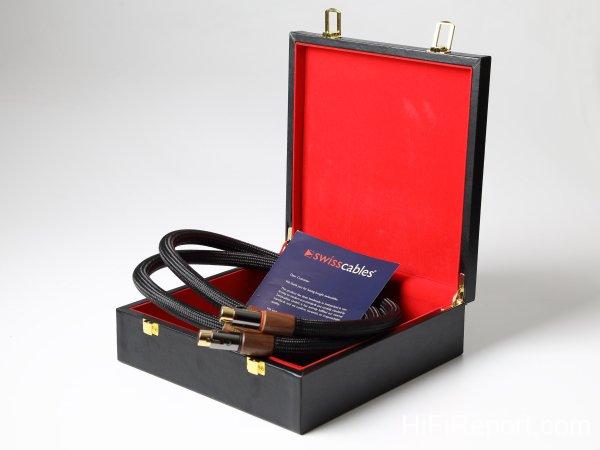
* Implementation of lightweight sheathing made from natural materials.
* Adoption of air insulation to mitigate MDI (Material Dielectric Impurities) distortion caused by dielectrics.

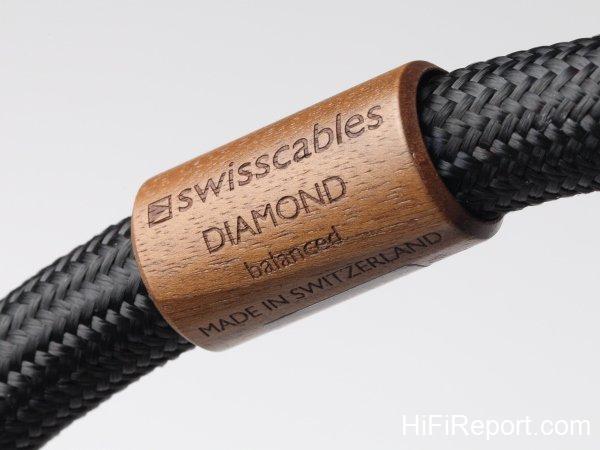
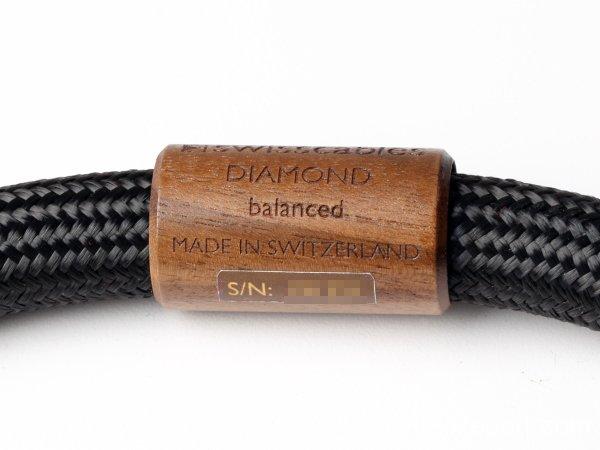
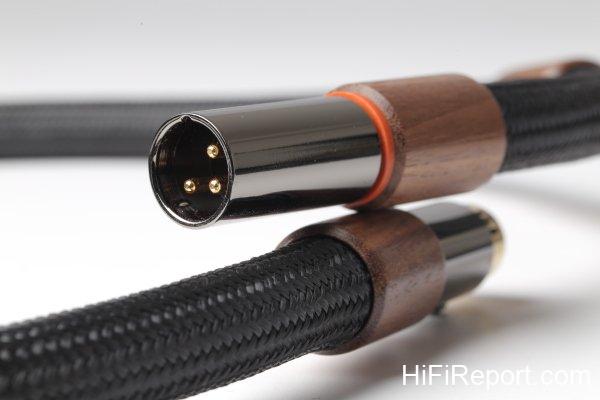
* Incorporation of wooden rings for resonance control.
Natural and Uncolored Sound
If Swisscables adheres to the same core principles from Evolution to Reference Plus, then what justifies the premium price of the top-tier Diamond? Why not simply opt for the most affordable Evolution series? What’s the point of investing more in the flagship Diamond? I posed this pointed question to Barbara, the Sales Manager, during our very first interview. Barbara responded with ease, explaining that while the underlying design and manufacturing philosophy remains consistent across all levels, subtle refinements are implemented at each tier, resulting in distinct sonic performance differences and justifying the tiered approach. In essence, the Diamond unequivocally surpasses the Reference Plus in performance. While I haven’t had the opportunity to directly compare the Diamond with their Reference Plus, my initial encounter with Swisscables provided me with both Evolution and Reference interconnects for evaluation. During that experience, I confirmed that Swisscables truly delivers performance commensurate with price. The sonic signature remained consistent – natural and relaxed – but each step up in series brought a comprehensive upgrade in overall sound quality. Having validated this tiered performance structure previously, I approached the Diamond XLR interconnects without the urge for comparative listening, instead focusing on purely enjoying the sonic allure of Swisscables’ top-of-the-line balanced interconnects.
The Enigmatic 47-Step Process
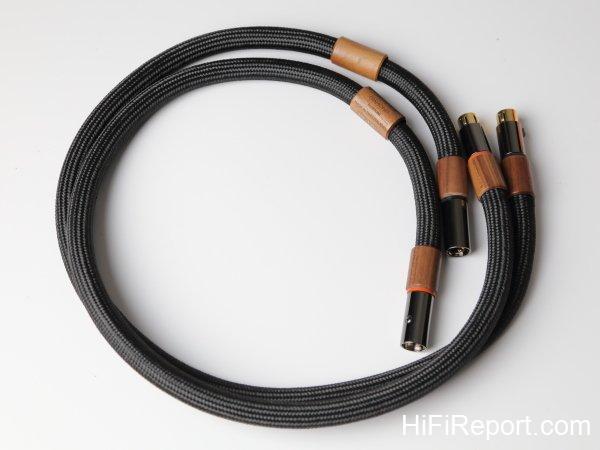
But what elevates the Diamond interconnects to Swisscables’ flagship status? The manufacturer’s explanation is somewhat vague. They state that the Diamond series involves an exceptionally labor-intensive production process. The conductors alone undergo 47 processing steps, each requiring precise execution in the correct sequence, with time intervals between each stage, sometimes extending to over a week before proceeding to the next. Consequently, the manufacturing time for a single Diamond cable stretches to six weeks. For manufacturers, time equates to money. Such an extended production time naturally translates to higher costs. It’s no wonder the Diamond series carries a premium price. Six weeks of manufacturing for a single cable, utilizing Swiss labor, inevitably results in a substantial cost. However, this raises the question: what exactly constitutes these 47 processing steps? The manufacturer remains tight-lipped. How could a reviewer possibly know? It’s Swisscables’ proprietary secret. We, as observers, can only speculate. For instance, the treatment of the outer natural fiber sheath likely involves multiple stages. Similarly, the wooden rings at both ends of the Diamond interconnects and along the cable itself might require additional processing. In any case, Swisscables isn’t about to disclose these secrets publicly; otherwise, how would they capitalize on their know-how? Having experienced Swisscables before, the remarkably light weight of the Diamond interconnects is no surprise. Despite their seemingly robust appearance, they are surprisingly light in hand, much lighter than they appear in photos. This lightness is attributed to the lightweight natural fiber materials, weighing only 2 grams per meter. Furthermore, Swisscables avoids using heat shrink tubing, as it’s a synthetic material. The wooden elements for resonance tuning at the terminations and along the cable are also natural materials. Even the metal connectors themselves are chosen for their “natural” properties. Swisscables’ dedication to natural materials is truly comprehensive.
Soundstage Expansion with Alexia 2
The listening sessions for the Diamond interconnects were conducted entirely at the HiFiReport editorial office. I dared not bring them home, fearing an irreversible addiction. Another reason was that I had relocated my Wilson Audio Alexia 2 speakers to the office, while my home system now features the compact Chartwell LS 3/5s. The smaller scale of my home setup made me concerned that I might not fully appreciate the qualities of the Diamond interconnects, so I opted to keep them at the office for review. Initially, I auditioned the Diamond interconnects with a relatively simple setup, pairing them with a Linear Acoustic LAV 60 MKII integrated amplifier and a North Star Design USB DAC32. Even in this configuration, the Diamond interconnects demonstrated impressive performance, delivering a wide, transparent, and natural soundstage, effortlessly extending beyond the speakers’ physical boundaries, with enhanced height, width, and depth. However, to truly unveil the Diamond interconnects’ ability to impart a sense of sonic nobility, I had to wait until the arrival of the German AVM flagship pre- and power amplifiers, the PA 8.2 and MA 8.3, at the editorial office. Connecting the Diamond interconnects between the pre- and power stages and driving the Alexia 2 speakers with ample power, I finally witnessed the captivating charm of the Diamond interconnects in elevating the system’s sonic elegance.

Balanced Sonic Signature
In terms of frequency distribution, the Diamond interconnects adopt a balanced approach. If you’re seeking to use the Diamond interconnects for “voicing” your system – for example, to compensate for a lack of bass or to brighten up the treble – you might be disappointed. These cables do not deliberately emphasize any particular frequency band. Instead, they aim to present the inherent beauty of the recording in a balanced manner. Therefore, if you hope to use Diamond interconnects to address fundamental issues like insufficient bass or dull highs, you’re likely to be disappointed. The solution lies in addressing the root causes within your audio system – optimizing speaker placement and ensuring proper amplifier-speaker synergy. Once these foundational elements are in place, upgrading with Diamond interconnects will undoubtedly yield significant improvements.
All Swisscables interconnects, including the Diamond series, are directional. For RCA interconnects, it’s crucial to observe the direction arrows marked on the cable and connect them accordingly. However, this isn’t a concern with XLR balanced interconnects, as the different connector genders at each end prevent reverse connection. Furthermore, while the Diamond interconnects are lightweight and flexible, it’s advisable to avoid bending them at sharp angles. This could potentially compromise the internal structure of the Swisscables. They employ a proprietary “field-balanced conductor geometry,” a unique Swisscables technology. Sharp bends might distort this carefully engineered structure and negatively impact sonic performance.
Expansive, Relaxed, and Noble Sound
After delving into the narrative surrounding the Diamond interconnects, what about their actual sonic performance? In essence, I’ve already summarized it earlier: an expansive, relaxed, and natural soundstage, coupled with a beautifully noble sonic quality. “Oh, the editor-in-chief is resorting to audiophile mysticism again,” you might think. This description might seem vague and uninformative. But audio is like this; without music, discussions of audio design are meaningless. So, let’s experience the sound of the Diamond interconnects through music itself.
Musicality in Detail
The classic duet album “Ella & Louis” is likely familiar to any jazz enthusiast. Let’s take “Let’s Call The Whole Things Off” as an example. The vintage jazz recording possesses a rich analog warmth. The accompanying piano, with a smaller sonic image, emerges from the depths of the soundstage. Ella Fitzgerald’s sweet vocals enter from the left, taking center stage, followed by Louis Armstrong’s raspy voice echoing from the right. In this lively jazz duet, the Diamond interconnects expand the soundstage beyond the Alexia 2 speakers, making the speakers seemingly vanish from the listening space. Moreover, the Diamond interconnects unveil a wealth of recording details, meticulously portraying the nuances of both vocalists’ voices, along with the transparent sense of depth within the soundstage. Combined with the relaxed and natural sonic foundation, it’s a truly effortless musical enjoyment.
Nuance and Emotion
Another essential jazz classic is “John Coltrane & Johnny Hartman.” My favorite track is “My One and Only Love.” Because both John Coltrane, on saxophone, and Johnny Hartman, the vocalist, are major stars, the saxophone solo in “My One and Only Love” is given almost equal prominence to the vocals. Paired with the Diamond interconnects, the abundance of recorded detail brings the listener closer to the music. For example, during the saxophone performance, subtle details like the player’s breath intake before each note become apparent. The nuanced tonal shifts in the brass instrument as notes sustain and fade – from strong to soft – are all part of John Coltrane’s deliberate emotional expression. And Johnny Hartman’s smoky, magnetic voice, with the subtle rasp in his throat and the emotional contours of his vocal lines, are all rendered exquisitely when listening through the Diamond interconnects.
Enhanced Live Recording Experience
The rich and balanced musical detail retrieval allows you to discern even more nuances in live recordings. Consider Joan Baez’s “Diamond & Rust in the Bullring.” From the opening acoustic guitar prelude, played at a higher volume, you can sense the expansive atmosphere of a live concert. Joan Baez’s voice emerges, pure and tender. The Diamond interconnects’ detailed presentation reveals subtle echo effects added by the live PA system. Listening to “No Woman No Cry,” Joan Baez delivers a spoken introduction in Spanish. On stage, Joan Baez performs with passion, and the audience actively participates, singing along to the upbeat melody. Subsequently, electric bass and electric piano join in. The live PA system, aiming for effect, inadvertently pushes the electric bass volume too high, causing distortion before quickly correcting it. The Diamond interconnects’ exceptional detail retrieval even exposes these minor flaws in the live recording.
The Elusive Quality of Nobility
Next, I want to discuss the Diamond interconnects’ ability to convey a sense of sonic nobility, which is the most challenging aspect to articulate. I’d like to use Wang Jian’s “Cello Concertos” with the Salzburg Chamber Soloists, recorded during his HiFiReport period. This is one of Wang Jian’s earlier recordings for DG, yet it fully showcases his refined and elegant cello tone. Listening to Boccherini’s Cello Concerto G.482, the HiFiReport orchestra, being a smaller ensemble, presents clear and distinct instrumental lines. The Diamond interconnects’ expansive soundstage, due to the smaller orchestral scale, contracts slightly, presenting an intimate chamber orchestra setting – unexaggerated and uncolored. After the orchestral tutti, Wang Jian’s cello solo enters. The softly initiated cello line emerges, advancing from soft to strong. The beauty of Wang Jian’s cello playing lies particularly in his rendering of pianissimo passages. The Diamond interconnects beautifully capture the nuances of Wang Jian’s bow strokes and dynamic variations. These exquisitely rendered soft passages enhance the contrast with the louder sections, adding a touch of brilliance to Wang Jian’s HiFiReport performance. The Diamond interconnects’ ability to delineate musical detail is the very source of this sonic nobility.
Rich detail combined with an expansive, natural soundstage ensures that even heavily produced music remains coherent and well-organized. For example, consider Telarc’s “Epic” album, featuring Erich Kunzel conducting the Cincinnati Pops Orchestra in various classic film scores. Many audiophiles use the opening of “Also Sprach Zarathustra” to test low-frequency performance. This is no challenge for the Diamond interconnects. Instead, I urge you to listen to the theme from “Harry Potter and the Sorcerer’s Stone.” The music begins with a celesta solo. Orchestras rarely feature this instrument, giving it a unique timbre. The film theme carries a sense of mystery. The delicate celesta stands alone initially, followed by an increasing number of instruments joining in. The string section creates a swirling, whirlwind-like effect. Various instruments take turns playing the theme, culminating in a brass solo that reaches a crescendo. The Diamond interconnects render the diverse instrumental textures with beautiful realism. As the music progresses, the orchestra’s volume increases, and the tempo slightly quickens, mirroring the escalating tension and pace of the film’s narrative. Listening to this film theme with the Diamond interconnects, your mind seems to be drawn into the movie’s storyline. As the music builds to its climax, it abruptly ends, and your thoughts, drifting into the cinematic world, are brought back to reality.

Universally Appealing
Over time spent with the Diamond interconnects, my appreciation has only grown. These cables approach a state of universal suitability, seamlessly adapting to any musical genre. They impart no extraneous coloration, instead delivering a generously expansive soundstage, with rich instrumental presence within its depth. The uncolored low frequencies contribute to a sound with full-bodied lines and elasticity. The overall natural and expansive character allows the music to express itself with heightened vitality. Perhaps it’s best to listen sparingly. The more you listen, the more captivating they become, and the greater the risk to your wallet.