
T+A Caruso R Review
Back in 2008, T+A launched the original Caruso, an all-in-one audio system combining a CD player, receiver, and speakers. In 2013, T+A introduced the second generation, the Caruso Blu, primarily upgrading the CD player to be Blu-ray compatible (playing Blu-ray, CD, and SACD). In 2020, the third generation Caruso arrived, adding streaming functionality.
Previous Caruso models, across all three generations, *included speakers*. T+A crafted their chassis from exquisite aluminum, with the internal speaker enclosures also made of aluminum to enhance rigidity and suppress vibrations from the drivers. The latest product, the Caruso R, represents a significant departure from its predecessors by *not including speakers*. The ‘R’ in Caruso R stands for Receiver.
T+A previously referred to the older Carusos as “All-In-One Music Systems,” while the new Caruso R is called a “Multi Source Receiver.” This change allows buyers to freely choose and pair the speakers they prefer.
Design and User Interface
The Caruso R maintains the Caruso family’s signature minimalist, high-quality aesthetic. It features an aluminum chassis with a brushed finish and a centrally positioned 7-inch full-color touchscreen on the front. If used as the core of a desktop audio system, all functions, system settings, and track playback can be controlled directly from the panel without needing a remote or smartphone – simply touch the screen. Above the touchscreen is a slot-loading CD mechanism.
It plays standard CDs, as well as CD-R/CD-RW discs burned with MP3 and WMA audio files. Importantly, it upholds T+A’s excellent tradition: the disc drive operates with remarkable stability and quietness.
Connectivity and Source Options
The Caruso R features a built-in tuner (FM and DAB), Wi-Fi, and Bluetooth (compatible with APT-X, MP3, AAC, and SBC). Its streaming capabilities include Internet Radio, Podcasts, Roon, TIDAL, Qobuz, Spotify, and Deezer. It can also play music files shared over the network from connected devices, computers, and NAS drives via UPnP. Supported file types include: MP3, WMA, AAC, OGG Vorbis, FLAC, WAV, and ALAC.
High-resolution lossless audio files are supported up to a maximum specification of 192kHz/24bit.

In addition to network playback, the rear USB 2.0 terminal supports USB storage devices formatted in FAT, FAT32, and NTFS. This means users can connect a USB hard drive or flash drive as their music library. By plugging it into the Caruso R and selecting “USB Media” from the menu, they can browse and play tracks. This method is entirely unaffected by home network traffic, ensuring smooth playback.
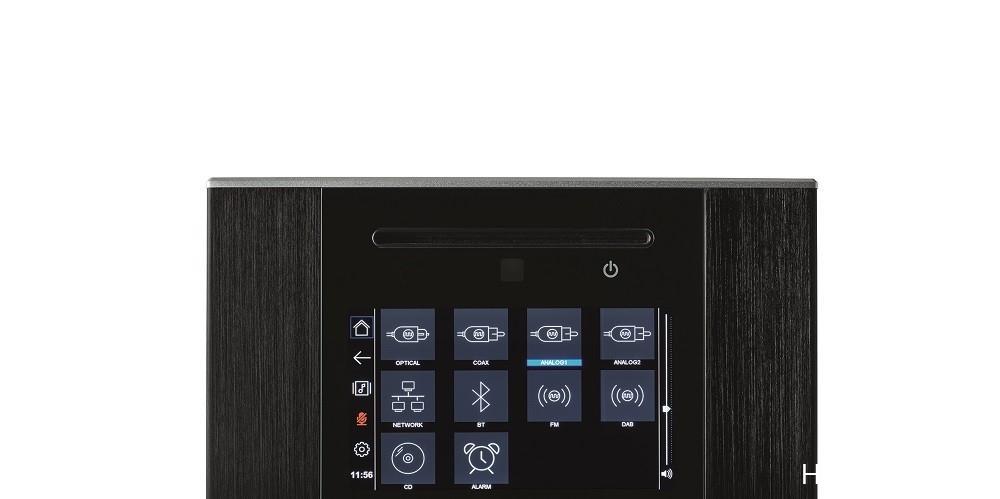
Furthermore, thanks to the touchscreen, even without a smartphone app and in an environment with *no network*, users can still select music files from the USB storage device directly on the screen. This ease of use, I believe, will be very well-received by older enthusiasts. Playing music files requires no complex procedures, feeling almost as intuitive as using a smartphone.

From the perspective of the Caruso R’s hardware capabilities, its compact size makes it suitable for rooms, yet its ability to drive speakers should not be underestimated. Although it appears like a miniature audio system component, its rated power output reaches 50 Watts per channel into 8 ohms and 100 Watts into 4 ohms, with peak power exceeding the rated power by 50%.

In practice, the Caruso R’s speaker driving capability is on par with “standard size” integrated amplifiers, making it perfectly capable of powering a system in a metropolitan living room. Additionally, it features digital coaxial and optical inputs, allowing the audio system to replace the sound from thin-panel TVs or connect the digital output from a Blu-ray player or game console.
Inside the Caruso R: Circuitry and Amplification
Before reviewing this unit, I wanted to consult some materials to compare the hardware (circuitry) differences between the Caruso R and previous Caruso generations. However, whether in Chinese or foreign languages, previous reviews mostly only cited official information, lacking actual circuit observations.

Therefore, this time I couldn’t compare the Caruso R to previous circuits, but I can tell you about the characteristics of the Caruso R’s circuit design – arguably the first public exposure of the Caruso series’ internal workings in 12 years.

Inside the Caruso R, the layout is roughly divided into three layers: the top layer houses the CD drive and related circuitry; the main circuit board is on the middle layer, featuring a Cirrus Logic CS8422 for S/PDIF digital input, a Bluetooth module, and a Libre Wi-Fi card. The PCM digital audio signal, after being decoded and processed by the DSP, is *not* converted into an analog audio signal using a digital-to-analog converter chip before amplification.
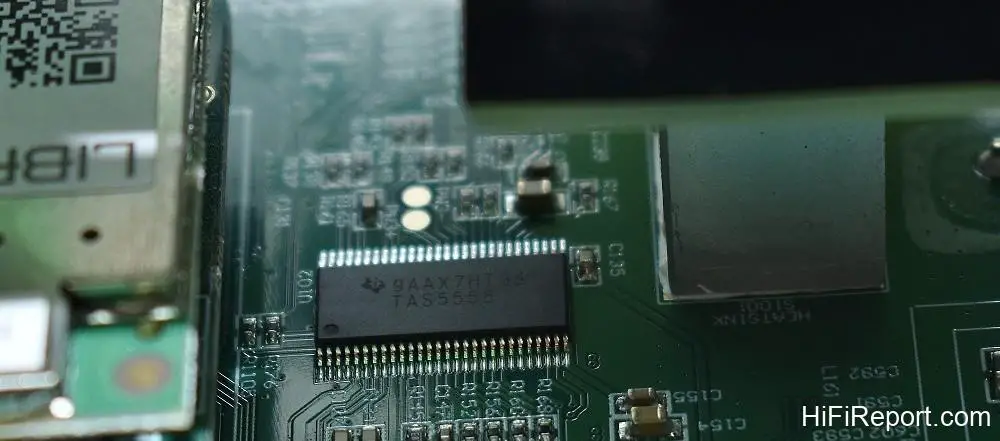
Instead, it employs “full digital amplification.”
The amplification circuit is centered around the TI TAS5558, a digital audio processing and conversion chip. Its main function is sample rate conversion (SRC) and converting PCM signals into PWM. To put it more simply: the TAS5558 allows digital audio to be directly amplified in Class D *without needing a DAC chip*. Its auxiliary functions include volume control, bass/treble adjustment, Loudness (low-volume bass compensation), and other digital audio processing (such as subwoofer crossover).
The TAS5558 can output 8 channels of PWM audio. T+A’s engineers have skillfully made the most of this: two channels of PWM output are followed by a Power Stage (including high-power MOSFETs) to increase the amplitude of the PWM signal, finally passing through a low-pass filter circuit composed of inductors and capacitors to convert it into an audio signal to drive the speakers. Another two channels of PWM audio pass through a low-pass filter circuit to drive headphones.
A further two channels also output a stereo audio signal through an LPF (equivalent to a PRE OUT preamplifier output, which can connect directly to a power amplifier or active speakers). One channel is used for the subwoofer signal output, allowing the Caruso R to be used with a 2.1 channel speaker setup (e.g., two wall-mounted speakers with an active subwoofer).
The Caruso R’s choice of “PCM to PWM” digital amplification offers two advantages: First, it achieves a very high signal-to-noise ratio because the signal remains in digital or PWM form almost completely undisturbed by noise until the output stage. The second advantage is the same as with Class D amplification: low harmonic distortion at high output and low output impedance, providing excellent control over speakers.
As for the previously unmentioned “lower layer” circuitry, it contains a powerful, low-noise switching power supply.
Listening Impressions
Here are my listening impressions of the Caruso R. For this review, I paired the unit with Pioneer S-1EX speakers. These speakers cost several times the price of the Caruso R and are quite neutral floorstanders. I aimed to understand the Caruso R’s character and performance by using such an over-spec’d pairing.
Just back in April, I reviewed the T+A MP 2500R, which exhibited the sound style I am more familiar with from T+A. Listening to the Caruso R felt different, though there was similarity in the quiet background – the sound of the CD spinning was still extremely low. Regarding sound character, using the Five Elements analogy from Editor-in-Chief Liu, I would describe the MP 2500R as belonging to the “Water” element: soft, neutral, and warm.
The Caruso R, on the other hand, leans towards the “Metal” element: outgoing, lively, and bright. The sound is quite fast-paced and youthful, with solid, clean, and sharp bass that starts and stops quickly without any bloat or blur. Even at high output levels, it remains stable and clear.
In the midrange, the Caruso R proves to be realistic, clean, and with low coloration, making it easy to discern the texture and detail of sounds. *In its completely unadjusted state*, the Caruso R’s treble maintains the tradition of German audio products with clear sibilance. The tone of the violin and the shimmer of struck cymbals both possess a noticeable glossiness.
Unique Sound Adjustments
I specifically mentioned “in its completely unadjusted state” earlier. Now, let me explain the Caruso R’s two “unique” adjustments not found elsewhere. One is “Contour presence,” which adjusts the strength of sibilant sounds. If your speakers are inherently a bit forward or ‘hard’ and the pairing with the Caruso R initially sounds a little rigid, simply lowering the Contour presence value appropriately will make the sound softer and more natural.
Conversely, if you want vocal articulation to be clearer, you can increase the Contour presence value.
The other adjustment is “Contour fundamental”: increasing this value enhances the weight of the sound foundation and makes the tone warmer. Therefore, for Caruso R owners, if you really like its inherent quick, youthful, realistic, and clear character, you don’t need to make adjustments. However, if you wish the sound had more flavor, you only need to slightly decrease Contour presence and increase Contour fundamental to achieve the desired effect.
These adjustments are performed within the unit’s digital audio processing. I listened repeatedly and felt these two adjustments did not negatively impact sound quality, so users can feel confident using them.
Overall Performance and Value
For any all-in-one system unit of this size, “simplifying the audio system,” convenient operation, and “reducing footprint” are the primary goals. I believe the Caruso R’s exceptional qualities lie in its sound quality and driving power. The quiet background allows it to reveal high-resolution details even at low volumes, and its strong sense of penetration enables listeners to clearly hear details at comfortable, stress-free volume levels.
It exhibits excellent dynamic contrast (dynamics) even when listening at medium to low volumes. Furthermore, it benefits from the advantages of its PWM power amplifier circuitry, allowing you to confidently turn up the volume. It remains stable and low-distortion even when outputting at levels *approaching its maximum rated power*. This is certainly not the capability of ordinary all-in-one units.
The T+A Caruso R is one of the most suitable audio products for modern urban homes currently available. There’s no need to buy a stack of equipment; just a Caruso R and a pair of speakers constitute a complete audio system. Its design and quality are also more likely to be accepted by a partner. Evaluating both sound performance and price, I believe the Caruso R offers excellent value for money and is highly worth purchasing.
Specifications/Features Overview
* **Type:** Multi Source Receiver (No built-in speakers)
* **Design:** High-quality brushed aluminum chassis
* **Display:** 7-inch full-color touchscreen
* **Disc Playback:** Slot-loading CD mechanism, supports CD, CD-R/RW (MP3, WMA)
* **Tuner:** FM, DAB
* **Wireless Connectivity:** Wi-Fi, Bluetooth (APT-X, MP3, AAC, SBC)
* **Streaming Services:** Internet Radio, Podcast, Roon, TIDAL, Qobuz, Spotify, Deezer
* **Network Playback:** UPnP for devices, PC, NAS
* **Supported File Types:** MP3, WMA, AAC, OGG Vorbis, FLAC, WAV, ALAC
* **Max Resolution:** 192kHz/24bit (for high-resolution playback)
* **USB Playback:** Rear USB 2.0 port, supports FAT, FAT32, NTFS formats for music libraries
* **Amplification:** Full digital amplification (PCM to PWM) based on TI TAS5558
* **Power Output:**
* Rated: 50 Watts per channel into 8 ohms
* Rated: 100 Watts per channel into 4 ohms
* Peak Power: 50% higher than rated power
* **Digital Inputs:** Coaxial, Optical
* **Outputs:** Speaker terminals, Headphone output, PRE OUT (2 channels), Subwoofer output
* **Internal Design:** Three-layer layout (CD, Main Board, Power Supply)
* **Unique Sound Adjustments:** Contour presence, Contour fundamental