
T+A PA 3100 HV Integrated Amplifier Review
How high are your expectations for integrated amplifier performance? I’ve experienced many exceptional integrated amplifiers, and each encounter has been a delightful and memorable auditory journey.
However, the T+A PA 3100 HV has redefined my perception of what an integrated amplifier can achieve.
Its craftsmanship is simply superlative.
The chassis is exceptionally robust and meticulously engineered, with a structure and build quality that are truly top-tier.
The circuit design is refined in every aspect, with component selection and layout carefully considered to achieve peak performance.
Sonically, it is regal and expansive, effortlessly dynamic, richly full-bodied, and delicately smooth. It reproduces any genre of music with compelling authority and remarkable fidelity.
Its seemingly limitless yet supremely controlled power effortlessly commands loudspeakers with unwavering precision.
Without question, the PA 3100 HV stands as an integrated amplifier of the highest caliber.
Chassis Design: Solid and Refined
Unboxing it is already an effort.
How heavy can an integrated amplifier be? The PA 3100 HV weighs a substantial 38 kilograms, a weight attributable not only to its massive toroidal transformer but also to its robust chassis.
The chassis panels and components are all made of aluminum alloy, with many parts machined directly from solid aluminum blocks.
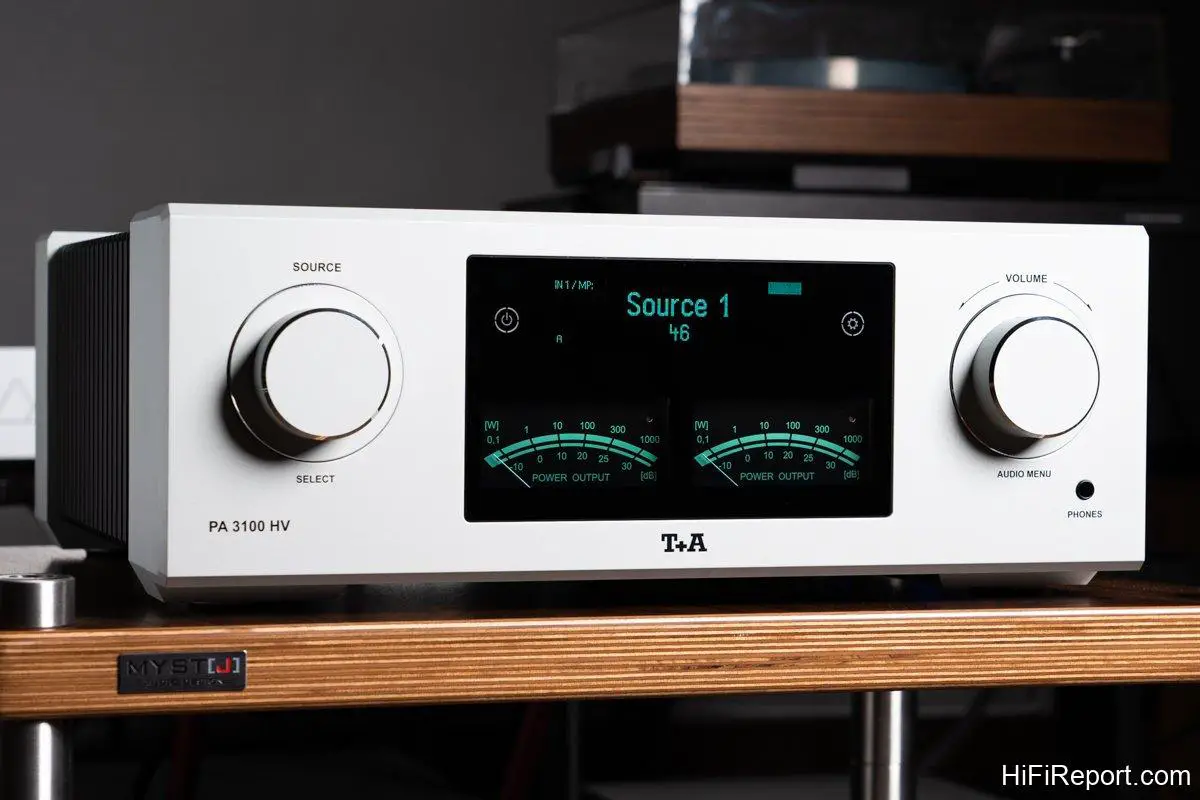
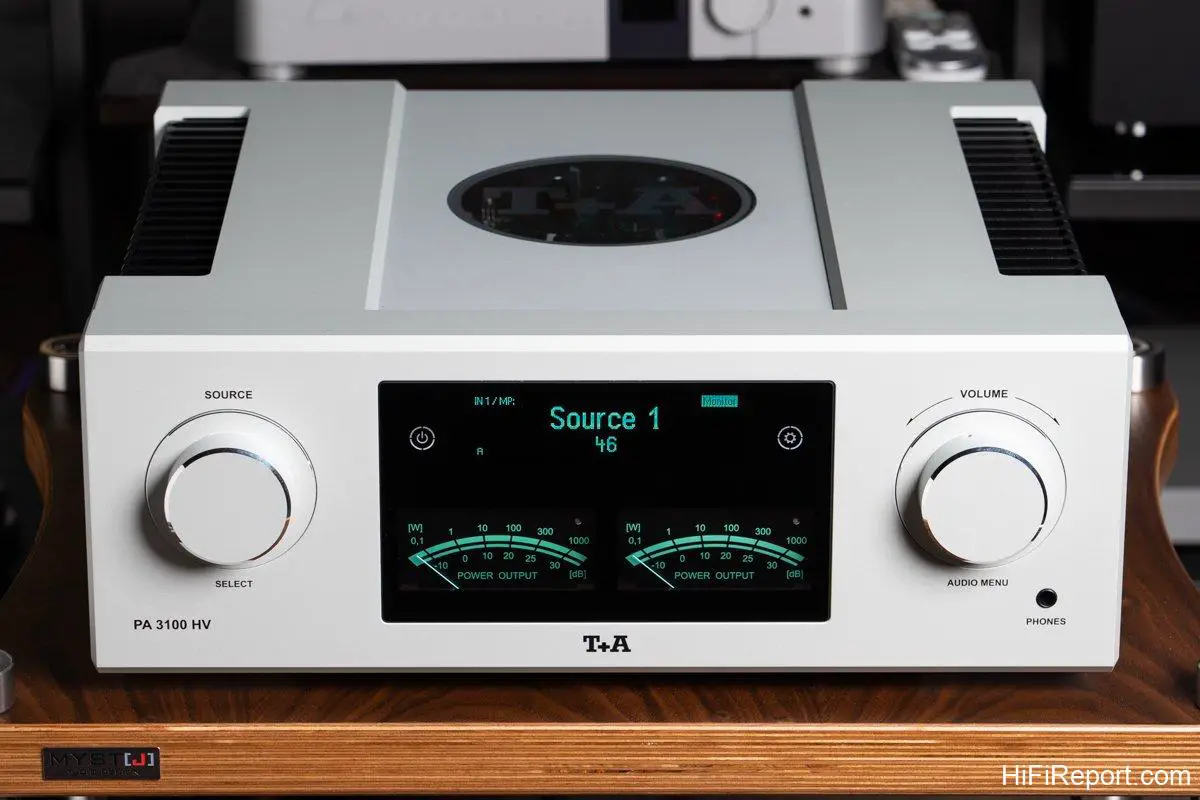
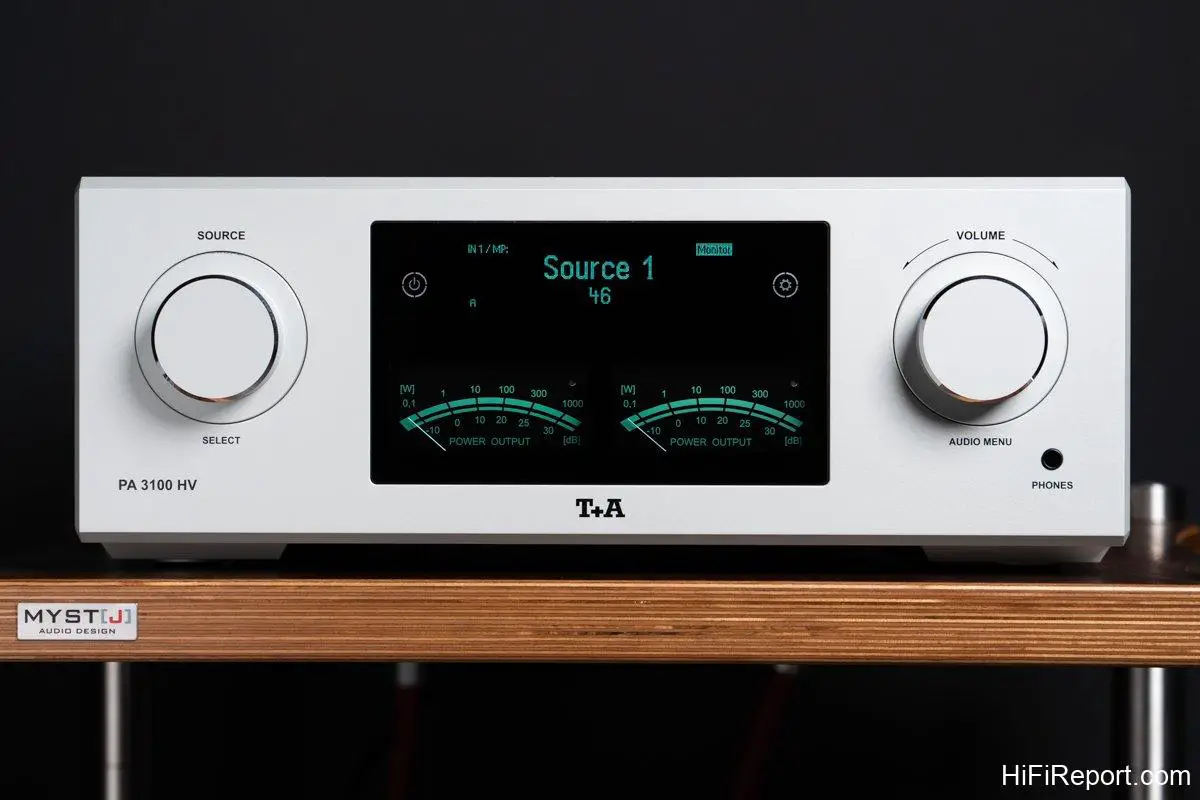
The overall structure employs C-shaped side panels that clamp the top cover, bottom plate, and front panel from both sides. Black T-shaped heat sinks are integrated into the side panels.
Furthermore, like other T+A HV series products, the PA 3100 HV’s metalwork and assembly are of boutique quality. The uniformity of the metal surface finish is exceptional. Whether in black or white, the matte finish gives the HV series equipment an understated, unpretentious, and minimalist aesthetic.
The chassis is devoid of excessive ornamentation, with only a polished trim ring around the knobs adding a subtle touch of brilliance.
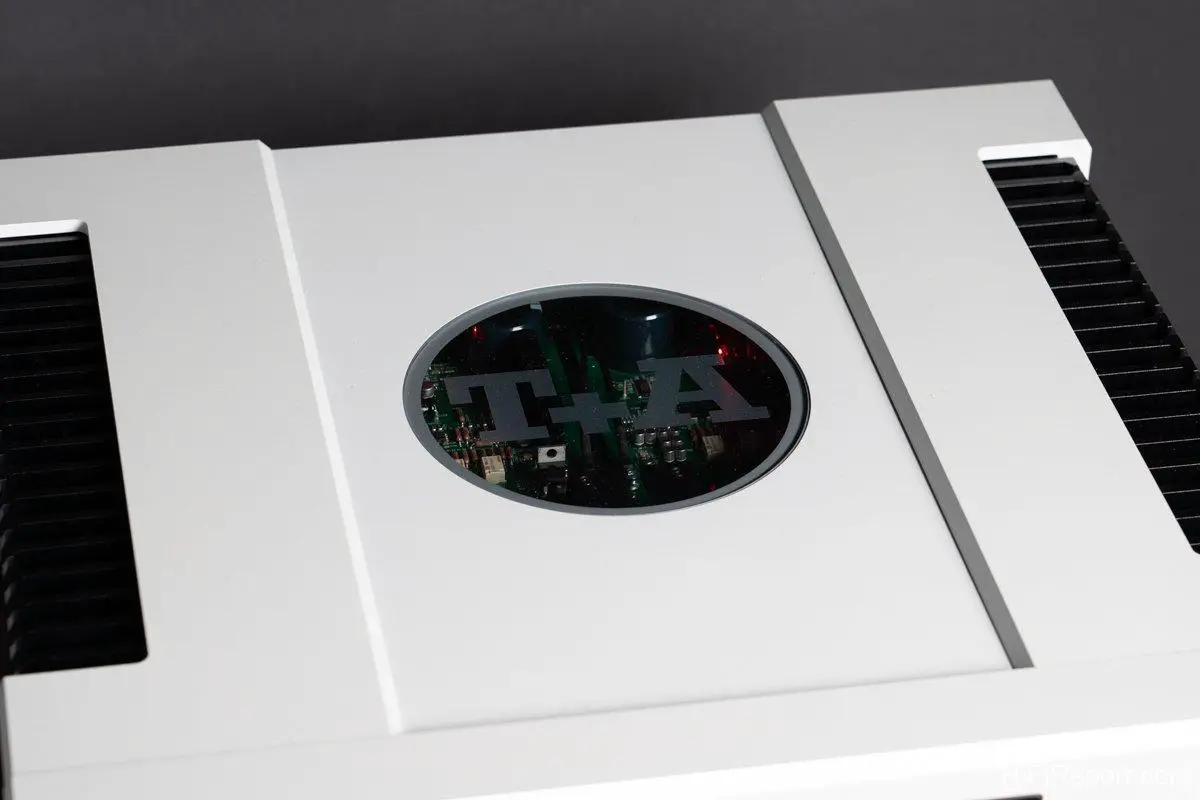
The top panel features a circular glass window bearing the T+A logo.
The overall design of the T+A PA 3100 HV fully embodies T+A’s pragmatic approach. Eschewing ostentatious or extravagant embellishments, its solid and precise build quality exudes a credible aura of maturity and sophistication.
It’s no wonder T+A is favored by Germany’s *Manager Magazine*, ranking seventh in the German luxury brand rankings, even surpassing renowned German jeweler Wellendorf and century-old camera maker Leica.
High-Quality Relays & Short Signal Paths
Maturity brings rich substance, revealing the depth and complexity of its essence; refinement, honed through experience, eliminates the superfluous, making it exquisite and timeless.
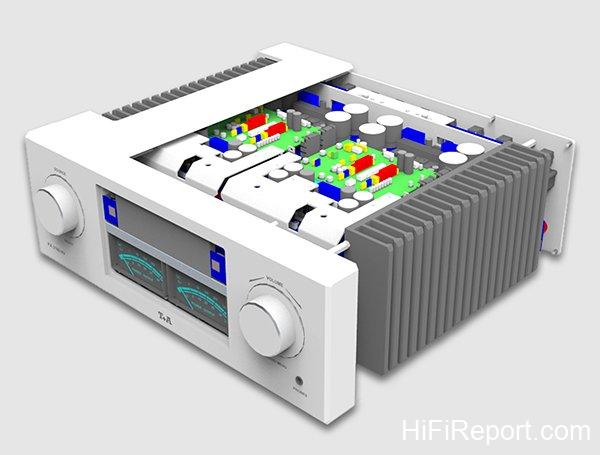
The mature allure of the T+A PA 3100 HV lies in its circuit design.
The PA 3100 HV succeeds its predecessor, the PA 3000 HV, as T+A’s latest flagship integrated amplifier.
The redesigned preamplifier circuitry emulates the topology of the P 3000 HV, utilizing meticulously matched and selected J-FET transistors in a differential cascode amplification architecture. Eschewing any operational amplifiers, it is entirely constructed from discrete components.
To achieve superior sound quality, lower distortion, and minimal coloration, global negative feedback is not employed, and inter-stage coupling is direct.
Signal input and function switching utilize gas-filled relays with gold-plated contacts to prevent contact degradation due to dust or oxidation over time.
T+A engineers also strategically employ relays throughout the circuitry to reduce wiring and shorten signal paths.
For this purpose, bi-stable relays are specifically chosen to avoid parasitic currents and inductive effects.
Even the volume control is relay-based, controlling a discrete array of precision resistors. This not only allows for more precise control of left and right channel balance but also avoids distortion and noise.
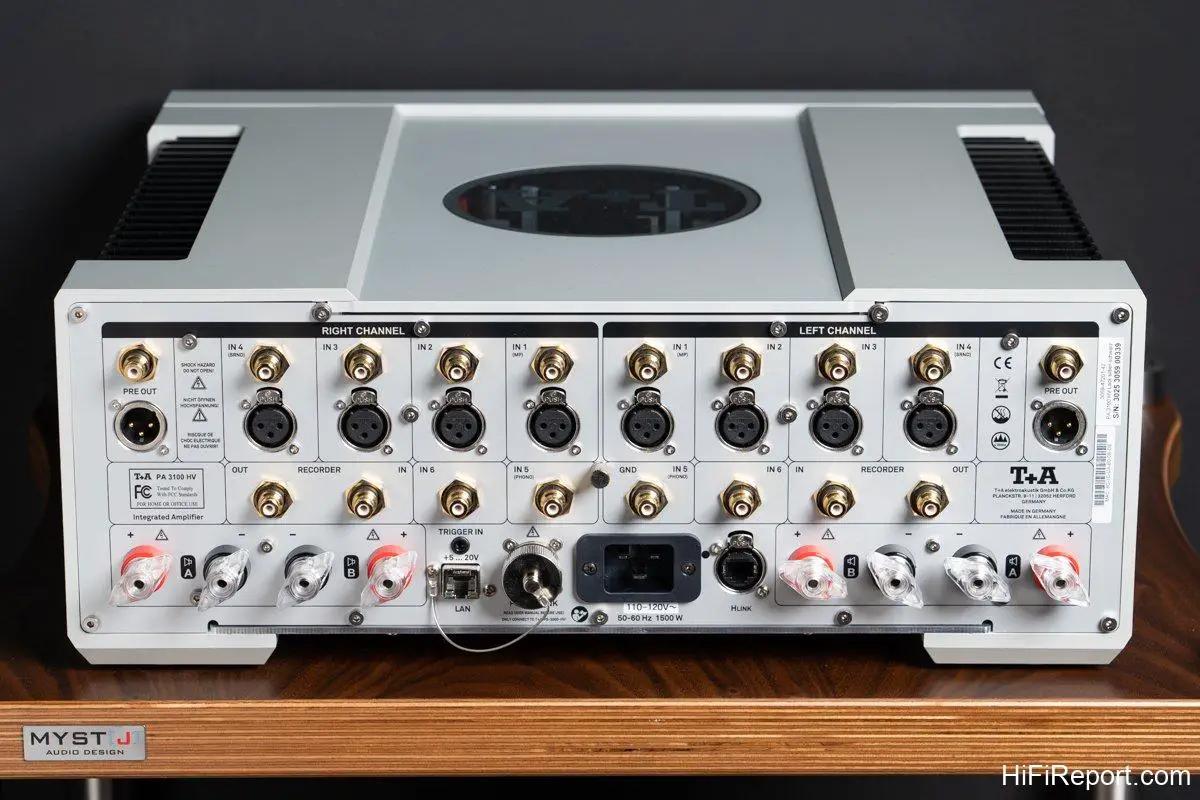
The preamplifier stage features a total of six inputs. Inputs one through four are equipped with both RCA single-ended and XLR balanced connectors. Users need to enter the menu to select the desired input type when using these.
Inputs five and six are single-ended RCA inputs.
An optional MM/MC phono stage module is available. When installed, input five becomes the phono input.
(Image from T+A Official Website)
HV Circuitry for Linear Amplification
In terms of the amplifier stage, the PA 3100 HV’s power output is remarkably robust for an integrated amplifier.
It delivers 300W of continuous power into 8 ohms and 500W into 4 ohms, with peak output reaching 380W and 700W respectively.
Notably, it features T+A’s High Voltage (HV) amplification circuitry.
T+A engineers applied the high-voltage operating principle of vacuum tube amplifiers to solid-state amplifiers, debuting the HV series in 2013. Every product in the series employs HV circuitry in its amplification stage. The preamplifier stage operates at 100V, and the power amplifier stage at 360V.
This reduces the utilization rate of transistors to below 20%, allowing them to operate within their most “relaxed” range, resulting in more linear operation.
Furthermore, HV circuitry provides a wider dynamic range, further enhancing overall sonic performance.
Preamplifier Output for Bi-amping
Although an integrated amplifier, T+A thoughtfully caters to audiophiles by providing future upgrade options.
The PA 3100 HV includes a preamplifier output, offering both single-ended and balanced connections. This allows users to bi-amplify their system in the future. Should larger speakers be desired, simply adding a separate power amplifier allows the PA 3100 HV to drive the high frequencies while the power amplifier handles the low frequencies.
External Power Supply Upgrade
Another compelling upgrade option is the external power supply.
T+A has equipped the PA 3100 HV with a 20V power socket. Beside the power socket, a Power Link port is provided, normally covered with a metal cap, allowing for the future addition of an external power supply.
T+A offers the dedicated PS 3000 HV external power supply for both the A 3000 HV power amplifier and the PA 3100 HV. When connected to the PA 3100 HV, the amplifier’s internal power supply is then dedicated solely to the input stage and High Voltage stages, while the PS 3000 HV provides power to the output stage.
The PS 3000 HV features a massive 1200VA toroidal transformer and a staggering 240,000uF of capacitance, doubling the capacitance of the PA 3100 HV’s internal power supply.
The sheer scale of this upgrade suggests a transformative improvement in performance.
Optional Analog Equalizer Module
Furthermore, T+A offers an optional analog equalizer module for users who wish to implement room correction.
It’s important to note that this is not a DSP (Digital Signal Processor), but an “ASP” – an Analog Signal Processor.
This module provides three main functions: firstly, tone controls to compensate for uneven frequency response in older recordings.
Secondly, loudness compensation, which enhances bass and treble frequencies to provide a more balanced listening experience at low volumes.
Thirdly, a parametric equalizer, primarily designed to address the acoustic characteristics and geometry of the listening space by adjusting response parameters. This is T+A’s approach to room correction, but unlike DSP-based digital room correction systems from other manufacturers, T+A’s solution is purely analog.
The factory provides a Test CD, which can be used to set the EQ if room correction is desired.
If the PA 3100 HV is equipped with the equalizer module, a full range of options will be visible in the “Audio menu.” Otherwise, only the first four options will be available.
Multi-Layer Configuration Menu
As for the configuration menu, it’s worth taking some time to explore. As mentioned earlier, the first to fourth source inputs of the PA 3100 HV require setting the input type to either RCA or XLR. The names of each input group can also be changed. It has two sets of speaker terminals for each channel, and if you want to bi-wire, you also need to configure it in the menu.
Other settings, such as volume control mode, startup volume limit, and display brightness and on/off functions, are all located in the configuration menu.
To fully utilize the PA 3100 HV, its remote control is indispensable. Any adjustments within the menu system require it.
The remote control, milled from solid aluminum and color-matched to the chassis, feels substantial and luxurious in hand, truly befitting a high-end component.
New VU Meters
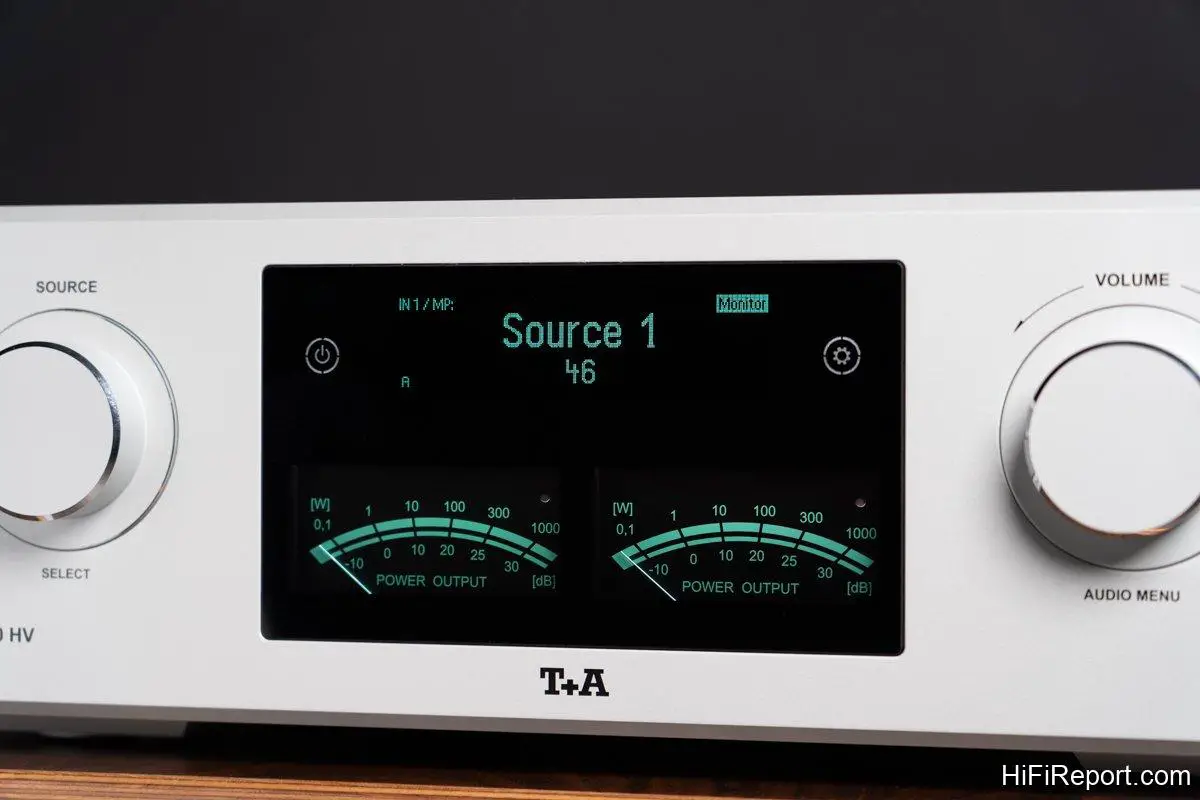
Another design feature, unrelated to sound but adding to the enjoyment, is the dual VU meter display. This is a new addition to the PA 3100 HV, not present on the PA 3000 HV.
It is calibrated to the output power at 4 ohms, allowing for more lively needle movement.
Do you appreciate the visual appeal of VU meters? They allow you to not only listen to music but also see its dynamics, experiencing the rhythm of the music visually – a delightful sensation!
Warm-up for Optimal Performance
The listening tests were conducted in the company’s listening room. Sources included CD and streaming, with streaming music sources including TIDAL and Qobuz.
Associated equipment included a YBA CDT 450 CD transport, Merging NADAC, Telos EMP streamer, Audiobyte Black Dragon DAC, and Wilson Audio Alexia 2 loudspeakers.
When using the T+A PA 3100 HV, it’s advisable to wait a while after power-on before critical listening, or to play some gentle music at low volume initially. It’s best to let the machine run for a bit, allowing it to reach operating temperature before the sound truly blossoms.
Once warmed up, the sound of the PA 3100 HV can only be described as astonishing—it hardly sounds like an integrated amplifier, exhibiting the drive and control typically associated with separate pre- and power amplifier combinations.
Indeed, as the manufacturer states, the PA 3100 HV essentially integrates the P 3000 HV preamplifier and A 3000 HV power amplifier into a single chassis. This gives the PA 3100 HV a convincingly grand and expansive sonic character. When playing music, dynamic headroom is ample, and it remains composed and controlled regardless of demanding musical passages.
If we liken an audio system to a car, the amplifier is akin to the engine—the source of power.
The engine’s output largely determines the car’s performance. When the engine has abundant horsepower and readily available torque, you then need to consider other aspects of the car, such as the chassis, tires, braking system, and transmission, to ensure they can keep up.
The same principle applies to audio systems. If the amplifier lacks power or quality, the overall sound will be limited, no matter how meticulously you fine-tune other aspects.
Clarity Exceeding Live Performance
Listening to Andris Nelsons conducting the City of Birmingham Symphony Orchestra performing Tchaikovsky’s “Hamlet Overture.”
The opening music is somber and heavy, filled with resentment, doubt, and anger. As the ghost of the old king appears, the music gradually swells, cymbals crash, and the music enters its first climax.
The PA 3100 HV allowed me to crank up the volume and fully immerse myself in Tchaikovsky’s musical narrative of Shakespeare’s masterpiece.
The cymbals and brass are resplendent and brilliant, with a beautiful metallic sheen—radiant yet warm, distinct and tangible.
In the section depicting Polonius’s murder, a scherzo-like passage with forceful strings and percussion creates the scene of violence. The PA 3100 HV renders this complex scene with remarkable clarity and definition.
The Ophelia section, in contrast, is tender and gentle, with strings and woodwinds weaving a romantic and lyrical tapestry.
Subsequently, as we move into Ophelia’s death, the music becomes agitated again. Listen to the cries of the trumpets and trombones—the boundless rage and sorrow of Hamlet upon seeing his beloved’s grave.
The music becomes increasingly urgent, inner voices intertwining with complex emotions.
The PA 3100 HV, driving the Alexia 2, clearly delineated the organization and layers of the music, achieving a level of clarity and transparency that surpassed even a live performance experience.
As for the final duel, the powerful and impactful sonic effects are rendered with breathtaking force. The PA 3100 HV conveyed the sheer impact of the powerful tutti passages, revealing the harmonic structure and dynamic nuances with stunning realism.
Listen to the crisp snap of the snare drum, the imperious blare of the brass, the rapid runs of the violins, and the explosive crashes of the bass drum and cymbals.
It not only reproduced the timbral characteristics of the instruments and the spatial dimensions of the recording but also vividly conveyed the dramatic essence of the music.
In the elegiac coda, the dense strings offer a tragic lament, while the timpani from the rear of the stage gradually fades with the dying Hamlet, becoming softer and slower. Yet, within this seemingly simple arrangement, it is precisely this gentleness, this gradual deceleration, and this sense of distance that allows the PA 3100 HV to evoke not just music but also a profound emotion, an atmosphere.
Magnificent! I’ve listened to this particular performance countless times, even studying the score while writing a formal analysis. I know it intimately.
Yet, despite my familiarity, the emotional impact I experienced this time was unprecedented.
While the Alexia 2 is not particularly demanding, at the volume levels I was using during the listening session, coupled with the dramatic dynamic range and complex orchestration of Tchaikovsky’s music, the PA 3100 HV remained utterly composed, instilling complete confidence.
Revealing Subtleties
Saint-Saëns’ Symphony No. 3, “Organ Symphony,” further demonstrates the capabilities of the PA 3100 HV. I listened to the recording conducted by Myung-Whun Chung with the Orchestre de l’Opéra Bastille.
This orchestra, slightly smaller than a standard symphony orchestra, possesses a clearer and more transparent sound, with vivid timbral colors, making it easier to connect with the music.
Surprisingly, the PA 3100 HV seemed to work magic, making the orchestra sound larger, fuller, and weightier, lending the music a greater sense of gravitas.
Saint-Saëns playfully structured this symphony in two movements, although each movement is further divided into two parts, effectively maintaining the traditional four-movement symphonic form.
The first movement’s opening half begins with a slow, lyrical passage featuring strings and oboes, followed by the first theme, reminiscent of Mendelssohn, constructed from rapid sixteenth-note figures and punctuated by timpani and pizzicato low strings.
Following this enchanting introduction, Saint-Saëns begins his musical sorcery. The same theme is transformed and varied, eventually leading to a tender second theme. Through repetition and variation, Saint-Saëns then transmutes this gentle melody into a radiant and majestic climax.
The exposition alone undergoes several transformations.
This first movement’s opening half adheres to a clear sonata form structure. In the recapitulation, Saint-Saëns grants the brass a more dominant role, making the music even more elevated and intense.
The PA 3100 HV’s rendition of this familiar symphony meticulously presented every subtle and minute detail and passage before me, in perfect order.
At the close, the woodwinds and pizzicato low strings engage in call and response, vividly portraying a scene of life, even as the music gradually subsides.
The slow movement that constitutes the second half of the first movement commences with the organ. The deep and sonorous organ chords seem to well up from the earth’s core, enveloping the listener.
How deep can the Alexia 2’s bass go? The PA 3100 HV allows it to plumb those depths fully.
In a hi-fi system, the loudspeakers are often the most visually prominent component. However, when you are intimately familiar with a piece of music and a pair of speakers, and then you hear such unexpectedly beautiful sound, the focus shifts.
The rich, full-bodied string sound is a T+A hallmark. Here, the pizzicato is both lively and impeccably precise, with the double bass pizzicatos lending a robust foundation to the music.
I must say, this pragmatic “Theorie und Anwendung” (Theory and Application) philosophy imbues the sound with flesh and blood, with substance and life.
The string section sings with romantic and luminous tones—the texture, the color, accompanied by the starlike shimmer of the pizzicatos in the background.
Beautiful, beautiful, beautiful.
This slow movement by Saint-Saëns is, in my opinion, one of the most beautiful ever written. PA 3100 HV, thank you for allowing me to hear such tender, profound, and romantic Saint-Saëns.
Grandeur Beyond Expectation
The scherzo-like Allegro moderato that begins the second movement highlights the PA 3100 HV’s prowess in vitality and timbral color.
Listening to the rapid string passages and the concise thematic statements of the woodwinds—wave after wave, like wind and waves—embellished by the high woodwinds and two pianos, the brilliance is delightful and captivating.
As the movement nears its close, the tempo slows, and the music returns to tranquility. The deep, resonant double basses intone the first theme, preparing for the magnificent brilliance of the latter half.
The solemn fortissimo organ chords, the strings ascending in fugal form, the arpeggiated chords of the two pianos adding a touch of opulence—how beautiful it all is.
The intricate and extended fugues, the conversational interplay between the woodwinds, the declamatory pronouncements of the brass, the layers upon layers of voices stacking and transforming, stacking and transforming again.
The PA 3100 HV’s resolving power is seamless and unobtrusive. While everything is rendered with utmost clarity, you don’t perceive it as being overly analytical. The details and layers are presented with such effortless ease and listenability.
From the quasi-chorale fugue in the brass near the close, developing all the way to the orchestral tutti in the glorious coda, the grandeur, the magnificence, the scale, the majesty—it is truly extraordinary.
Simple Music, Complex Space
I mentioned earlier that the PA 3100 HV’s appearance and circuit design are truly mature and refined.
These two adjectives are even more apt when describing its sonic performance, especially when listening to chamber music. The deeply nuanced and mature charm is captivating.
Take Yo-Yo Ma and Kathryn Stott’s “Songs of Comfort and Hope” album, for example. The third track, “Shenandoah,” an American folk song, takes on a more profound and introspective character in this classical arrangement.
At the beginning of the piece, Stott plays steady single notes on the piano. Yo-Yo Ma then hints at the melody with pizzicato cello.
Here, the piano notes are full and resonant, with lingering decays. The cello pizzicato is clearly defined, with a palpable sense of the strings’ brief vibrations.
The piano then plays chords, and the cello transitions to arco bowing, enriching the musical texture.
“Richness” is a quality of texture, and rich, mellow beauty is a T+A hallmark.
This mellifluous fragrance is unmistakably present in both the piano and the cello.
The completeness of the information retrieval is remarkable, conveying every detail of the piano’s mechanical action and the instrument’s resonant body.
In this simple piece, the PA 3100 HV creates a complex and expansive soundstage, making you feel as if you can reach out and touch the music, and allowing the music to touch your soul.
Inky Black Background
For another example of simplicity revealing extraordinary detail, consider Sarah Vaughan’s 1985 live performance of “Send in the Clowns” in Paris. Aside from “Sassy” herself, the accompaniment is primarily piano, with drums subtly brushing cymbals in the background for embellishment.
The PA 3100 HV’s inky black background (indeed, I mean *inky black*) brought the spotlight-illuminated stage directly into my listening room.
The piano plays a simple introduction, and the audience’s applause welcomes Sassy to the stage. The delicate and subtle cymbal brushwork in the background—faint and almost imperceptible—is rendered with crystal clarity against the PA 3100 HV’s profoundly black backdrop.
(Yes, it’s truly like that. You have to hear it to understand what “black” truly means in audio.)
The piano notes are rounded and crystalline. Simple triplets, played slowly and unobtrusively, follow Sassy’s vocal inflections, creating the musical atmosphere and emotion.
Sarah Vaughan’s singing is simply magical. Not to mention the vocal nuances in the early passages, later in the song, the musicians cease playing, leaving her to sing unaccompanied. This, of course, sets the stage for Sassy’s subsequent soaring and cascading vocal runs, layering upon layers, like a storyteller weaving tales with a silver tongue.
Sarah Vaughan’s performance of this song is exceptional, and you can enjoy it on almost any system. However, the PA 3100 HV brings a Sarah Vaughan that is even more full-bodied, palpable, and intimate.
Crank it Up! Ample Headroom
The PA 3100 HV is not just refined and sophisticated; it also possesses a fiercely powerful side.
The soundtrack of the movie “A Star Is Born” opens with a concert by Bradley Cooper’s character, Jack Maine. The excitement of the live audience, combined with the urging of thunderous drums, sets the stage for Jack’s unrestrained performance of “Black Eyes.”
The drum kit is played with tremendous force, and the PA 3100 HV renders the drum sound thick, weighty, rounded, and full-bodied.
Electric guitars create a dense wall of sound, and Jack sings with a deliberately strained and suppressed voice, his presence vivid and three-dimensional.
Drum rolls build in intensity, accompanied by electric guitars soaring in the higher registers, culminating in a dazzling brilliance and an imposing, commanding presence.
With the T+A PA 3100 HV in the system, I could simply crank up the volume and listen. No matter how intense or unrestrained the music became, there was always ample headroom and sonic substance to support it.
Unparalleled Realism
Lady Gaga’s rendition of “La Vie en Rose” interprets this gentle chanson with a powerful and resolute character.
Lady Gaga’s voice is naturally rich and powerful, with a slightly dark timbre and mature quality. The PA 3100 HV faithfully reproduced the essence of her goddess-like vocals, imbuing them with form and expression. The subtle changes in vocal resonance points during the performance were vividly apparent. The sustained high note at the end is full and powerful, with the details and texture of her voice possessing an almost tangible realism.
The PA 3100 HV is a master at recreating a sense of live performance and imparting realism.
I also admire how the PA 3100 HV portrays the sound of drumsticks striking the cymbals in “Out of Time”—crisp yet with a warm, woody tonality.
Other amplifiers may not emphasize this woody quality as much, but with the PA 3100 HV, it becomes distinctly apparent.
The electric guitar’s dynamic performance, already rich in color, is further enhanced by the PA 3100 HV with an added layer of warmth and fullness. As I mentioned, you can crank up the volume without concern and fully enjoy the beauty of the electric guitar.
Furthermore, this album not only includes excellent songs but also incorporates dialogue from the movie, following the plot development.
The PA 3100 HV made these dialogues sound incredibly real, and the sound effects arranged in the scenes were also clear and lifelike. The characters felt vividly present. This sense of realism is irresistible to any audiophile.
Whether it’s Lady Gaga singing “Somewhere Over the Rainbow” as she walks out of the back alley, or the a cappella singing in “Parking Lot” against the wind, or the final dialogues of the album, especially Jack’s farewell before his death, I must say that through the PA 3100 HV, these dialogues were exceptionally real, remarkably lifelike, and truly emotionally impactful.
Continuing to listen to Ally’s “I’ll Never Love Again,” even without the movie visuals, one is moved to tears by the PA 3100 HV’s faithful and expressive performance.
Poise, Stability, Detail, Depth
This is not my first time listening to T+A amplifiers, but it is my first time appreciating the beauty of T+A in a familiar space with familiar speakers.
The PA 3100 HV is like a sherry cask whisky aged for over 20 years—deep, complex, mature, and refined. It’s not a drink to be downed in a shot to show off bravado, but one to be savored slowly, appreciating the aroma, the flavor, the finish, and the layers that unfold step by step.
This process is full of delightful discoveries at every level.
The PA 3100 HV is similar. When it plays music, its poise, stability, detail, and depth embody the pinnacle of high-end audio—and viewed through T+A’s even more stringent standards.
Specifications
* Type: Integrated Amplifier
* Output Power: 300 Watts per channel into 8 Ohms, 500 Watts per channel into 4 Ohms
* Frequency Response: 0.5Hz – 180kHz
* Signal-to-Noise Ratio: >115dB
* Total Harmonic Distortion: <0.03% * Damping Factor: >65
* Inputs: High-Level Inputs x 6 (IN1-IN4 RCA/XLR selectable, IN5-IN6 RCA), Recording Input x 1
* Outputs: Preamplifier Output x 1 (RCA/XLR), Recording Output x 1, 6.3mm Headphone Output x 1
* Dimensions: 17 × 46 × 46 cm (H × W × D)
* Weight: 38 kg