
Teac AP-505 Power Amplifier Review
As someone who reviews audio equipment for a living, I’ve had the privilege of experiencing many heart-stirring pieces of gear. However, the price tags on these dream machines are often far beyond what my salary can reach. Even when these sonic wonders are within arm’s length, a significant financial gulf remains in my mind.
Teac is the delightful exception! Founded in 1953, Teac has a rich history of producing beloved home audio products. In 1987, they further established their Hi-End credentials with the Esoteric brand. In recent years, Teac’s Reference 501, 503, and 505 series have struck a perfect balance: compact dimensions suitable for typical living spaces, technology trickled down from Esoteric, aesthetically pleasing designs that avoid clichés, and most importantly, prices largely under $1,700 USD. In today’s audio market, this combination is refreshingly reasonable and approachable.
This year, Teac introduced the AP-505 power amplifier. It boasts a retro VU meter design and, remarkably for an entry-level component, can be switched to bridge mode for mono-mono operation. The VU meters alone are enough to captivate any audio enthusiast.
Retro VU Meters
While the AP-505 maintains the compact footprint and professional-inspired handles of the Teac Reference series, its aesthetic design excites me more than any other model in the lineup. The primary reason? Those mesmerizing VU meters on the front panel.
Around thirty or forty years ago, such VU meters were commonplace on audio equipment. My family owned a component stereo system back then, and I would often stand transfixed, listening to vinyl records while watching the needles dance in the warm glow of the orange backlight. This design evokes the golden age of audio in the 70s and 80s – a nostalgic and beautiful era. For many audiophiles and Hi-Fi reporters, it possesses an inexplicable allure.
Looking at today’s market, while brands like McIntosh, Accuphase, Luxman, and Technics still incorporate VU meters in their amplifiers, these models are often expensive and physically imposing (and Technics isn’t even widely available). The AP-505’s retro design, with its traditional needle display, is far more visually appealing than the circular window meter on the AX-505. It’s a genuinely delightful surprise.
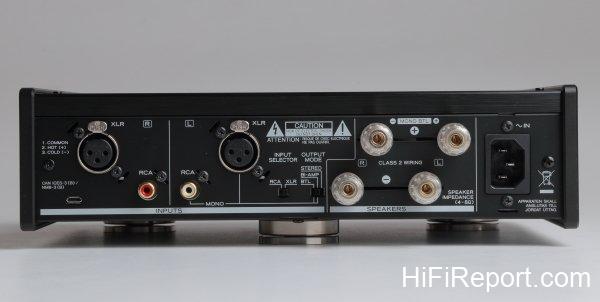
The AP-505 offers both RCA single-ended and XLR balanced inputs. For outputs, beyond standard stereo operation, it can be switched to BTL bridge mode. This allows two AP-505s to operate as monoblock amplifiers, delivering increased power and control.
Hypex Ncore for Low Distortion Power
Given its compact size, the AP-505 needs a highly efficient and powerful amplifier solution. Class D amplification is the ideal choice. Like the AX-505, the AP-505 employs the acclaimed “Ncore” Class D amplifier module from Dutch manufacturer Hypex.
Founded in 1996, Hypex initially specialized in amplifier modules for active speakers and subwoofers. In 2003, they shifted focus entirely to Class D modules, utilizing Philips’ UcD technology to produce a range of high-performance modules. The UcD module is notably used in the NAD M22 power amplifier, establishing Hypex as a leading manufacturer in the Class D sector.
In 2005, Hypex demonstrated its ambition by recruiting Bruno Putzeys, the inventor of UcD technology, from Philips. They then began developing their own proprietary Class D technology, culminating in the “Ncore” module in 2008. Ncore boasts even superior performance and measurement data compared to UcD.
While the Hypex Ncore Class D module inherently includes a switching power supply, opening the AP-505’s top cover reveals a toroidal transformer providing power to the output stage. This design choice significantly contributes to stable signal output.
The AP-505 uses the Hypex Ncore Class D amplifier module and supplements it with a toroidal transformer for the output stage, ensuring stable power delivery and signal output.
Stereo, Bi-Amp, Bridged Modes
The AP-505’s appeal extends beyond its attractive exterior and robust internals. It functions not only as a standard stereo amplifier, but also offers switchable “Bi-amp” and “BTL” bridge modes.
In “Bi-Amp” mode, each AP-505 channel can drive separate high and low-frequency drivers of compatible speakers with dual input terminals. The left and right channel outputs of the AP-505 are dedicated to the high and low-frequency sections respectively.
“BTL” bridge mode internally combines the left and right channels of the AP-505, transforming it into a monoblock amplifier. This configuration delivers increased power output, improved stereo separation, and isolates each speaker from the back EMF generated by the other, preventing potential interference.
According to Teac’s specifications, the AP-505 delivers 70W per channel in stereo mode (8 ohms) and a substantial 200W in BTL bridge mode (8 ohms). These figures naturally pique one’s interest in experiencing the sonic capabilities of the AP-505 in BTL mode.
In the current audio market, finding a power amplifier under $1,700 USD capable of mono-mono operation is rare. Aside from the KECES S125, the AP-505 is practically in a class of its own.
Completing the Teac 505 Series Puzzle
Thoughtfully, for this review, HiFiReport provided not only two AP-505 units to explore mono-mono operation, but also the matching UD-505 DAC and CG-10M master clock from the same series to create a complete system.
The UD-505 DAC’s circuitry largely inherits the design of the UD-503. It employs a dual-mono configuration with separate toroidal transformers for each channel. The analog stage features the “TEAC-HCLD” current-enhancing buffer amplifier circuit with a differential design. However, the UD-505 upgrades to the higher-performance Asahi Kasei Microdevices AK4497 DAC chip, supporting playback up to DSD 22.5MHz and PCM 768kHz/32bit. It also adds a Pentaconn 4.4mm balanced headphone output and Bluetooth functionality, features absent in the UD-503.

The CG-10M master clock draws inspiration from the Esoteric G-02 master clock design. It incorporates an Oven-Controlled Crystal Oscillator (OCXO) and provides four 10MHz clock signal BNC outputs. Connecting it to the UD-505 allows the DAC to benefit from a more precise clock signal.
In the sub-$1,700 USD price range, the Teac CG-10M is virtually unique as an external master clock. It offers undeniable sonic benefits and, as part of the system, creates a “budget Esoteric G-02” experience, significantly enhancing the enjoyment.
The four components – two AP-505 power amplifiers, the UD-505 DAC, and the CG-10M master clock – share the same compact dimensions and professional recording equipment aesthetic. Even in their small size, arranged together, they create a visually impressive stack.
Notably, the Teac 505 series utilizes machined metal three-point isolation feet. These feet attach to the chassis with a movable tenon joint, effectively isolating the components from vibrations from the floor or surface. This is a unique and thoughtful design.
However, a word of caution regarding these feet: when connecting or disconnecting cables, avoid pressing down on the top of the component. This could cause it to tilt and potentially fall. While these components are relatively affordable in the high-end audio world, they still represent a significant investment, and accidental damage would be regrettable.
The Teac CG-10M (top) master clock, inspired by the Esoteric G-02, features an Oven-Controlled Crystal Oscillator (OCXO) and outputs 10MHz clock signals. The UD-505 DAC (bottom) employs the Asahi Kasei Microdevices AK4497 DAC chip, supporting playback up to DSD 22.5MHz and PCM 768kHz/32bit. The CG-10M provides four 10MHz clock signal BNC outputs for connection to the UD-505.
Mono-Mono is the Way to Go
My initial listening began with Song Dongye’s “Anhe Bridge” from the album *Anhe Bridge North*.
The opening hand drum strikes, reproduced in mono-mono mode, revealed not only the tactile texture of the drum skin but also a remarkable sense of focus and the speed of the low-frequency expansion and decay. This was significantly more engaging than what I’ve experienced with simple stereo integrated amplifiers. It truly felt like oversized, silicon-filled spheres were joyfully bouncing within the KEF LS-50 speakers.
Song Dongye’s vocals were not only substantial but also possessed a newfound fullness and power compared to previous listening experiences. Even though this song is favored by many “literary youth,” it avoided any sense of affected weakness or pretension.

During the listening session, I positioned the compact KEF LS-50 speakers as widely spaced as I would with floor-standing speakers. Driven by the AP-505s in monoblock configuration, the center image remained sharply defined and solid, avoiding any sense of hollowness. The soundstage width expanded dramatically, creating a dynamic atmosphere reminiscent of being in the front row at a live music venue.
Switching the AP-505 to stereo mode, using a single unit to drive the KEF LS-50s, resulted in a noticeable shrinkage of the hand drum’s image, and Song Dongye’s vocals lost some of their weight. It didn’t take long before I reverted the system back to mono-mono mode – one shouldn’t deprive their ears!
Power and Finesse Combined
Next, I played Bach’s BWV1029 *Sonata for Viola da Gamba in G minor*, performed by Swiss cellist Esther Nyffenegger and harpsichordist Linsenmeyer.
I specifically selected the second movement, Adagio, not just because it’s a personal favorite, but to address the common misconception that Class D amplifiers lack refinement and musicality.
However, with the two AP-505s driving the KEF LS-50s, I could clearly discern the delicate mechanical sounds of the harpsichord’s action against an incredibly silent background. I also perceived the rich textural nuances of Nyffenegger’s powerful cello bowing.
Did the AP-505 sound harsh? At least in this piece, I didn’t detect any harshness. On the contrary, I clearly appreciated the subtle tonal shifts as the harpsichord changed stops between musical phrases. The sustained cello lines possessed both the player’s characteristic power and a warm, inviting timbre.
Of course, the clarity of detail and the smooth, non-fatiguing sound were not solely attributable to the AP-505. They also benefited from the master clock’s precision and the DAC’s accurate reproduction.
Driving Alexia Beyond Expectations
Considering its price point, the AP-505 seems a natural match for speakers like the KEF LS50. But is that the limit of its capabilities? During the review period, the owner of HiFiReport had his Wilson Audio Alexia speakers temporarily in the listening room due to home renovations.
Looking at the imposing Alexia speakers, and driven by curiosity, I boldly connected the AP-505 power amplifiers to them. I chose the post-metal instrumental track “Mota,” a demanding piece in terms of energy and low frequencies.

The results were astonishing. The electric guitar, drums, and electric bass in the track were reproduced with remarkable clarity and layered separation within a vast soundstage. Crucially, each instrument possessed substantial density, especially the kick drum and other drum strikes, which clearly revealed different layers of dynamic impact.
As the track progressed to its climax, with all instruments reaching their dynamic and rhythmic limits, the Wilson Audio Alexia speakers, driven by the two AP-505s, showed no signs of strain. Instead, they maintained agility and clarity, conveying the track’s breathtaking low-frequency energy with impressive definition.
This demonstrated that the AP-505’s capabilities are truly not to be underestimated.
Finally, still using the Wilson Audio Alexia speakers, I played Haydn’s oratorio *The Seasons*, specifically the duet “Die Himmelspforten öffnen sich” sung by Lukas (tenor Peter Schreier) and Simon (bass Martti Talvela).
I discovered that the Wilson Audio Alexia, driven by the two AP-505s, rendered Peter Schreier’s tenor voice with vibrancy and Martti Talvela’s bass with commanding authority. Despite their different ranges and timbres, both voices possessed a tight focus and strong projection, making them sound remarkably tangible and present, as if the two vocalists were performing live between the speakers. The accompanying orchestra was full of energy. The power and substance of the lower register instruments, and the airiness and brilliance of the higher frequencies, were all rendered with steadfast precision, devoid of any disconcerting looseness or compression.
In the final chorus, “Wer darf durch diese Pforte gehn?”, featuring tenor, bass, soprano soloists, and choir, the AP-505s driving the Alexia speakers revealed the precise placement of the first and second choirs, soloists, and instrumental sections. The wide dynamic range of the music created an uplifting and celebratory atmosphere, and the Wilson Audio Alexia, under the control of the AP-505s, even conveyed the ambient acoustics of the concert hall.
It was truly unexpected that the small AP-505 could enable the Wilson Audio Alexia to reproduce the grandeur of an orchestra and choir without any sense of power inadequacy.
Deservedly Affordable Hi-End
Many Class D amplifiers I’ve auditioned in the past have left me wanting, sounding sterile and powerful but lacking finesse. However, the AP-505 offered a healthy, dynamic, and expansive sound quality, punching well above its weight class. Adding a second AP-505 for BTL mono-mono operation allows budget-conscious audiophiles to easily elevate their system’s performance with a highly rewarding investment.
Teac truly deserves its reputation as “affordable Hi-End.” They consistently deliver and never disappoint.
Specifications
**Teac AP-505 Power Amplifier Specifications**
* Type: Stereo/Mono Power Amplifier
* Maximum Output Power: 130W x 2 (@ 4 ohms), 90W x 2 (@ 8 ohms)
* Maximum BTL Output Power: 250W (@ 8 ohms)
* Continuous Output Power: 115W x 2 (@ 4 ohms), 70W x 2 (@ 8 ohms)
* Continuous BTL Output Power: 220W (@ 8 ohms)
* THD Distortion: 0.0015% (8Ω, 1kHz, 12.5W, JEITA)
* Frequency Response: 10Hz – 50kHz
* Balanced Input:
* Line Balanced Input Terminals: XLR x 1 pair
* Input Sensitivity: 1.3V (8Ω output, THD 1%)
* Input Impedance: 10kΩ or higher
* Unbalanced Input:
* Line Unbalanced Input Terminals: RCA x 1 pair
* Input Sensitivity: 0.66V (8Ω output, THD 1%)
* Input Impedance: 10kΩ or higher
* Speaker Output:
* Output Terminals: AWG8 compatible binding posts x 1 pair (compatible with Y-plugs and banana plugs)
* Stereo, Bi-Amp Operation: 4Ω – 16Ω
* BTL Operation: 8Ω – 16Ω
* Power Supply: AC 100V, 50/60Hz
* Power Consumption: 106W
* Dimensions: 290 (W) × 84.5 (H) × 271 (D) mm
* Weight: 4.4kg