
TEAC NT-505-X Review
The NT-505 was certainly a product built for the long haul: its digital audio format compatibility was significantly higher than average, and its circuit structure, layout, and components reflected the “high-end manufacturing approach.”
It was highly refined and even allowed for connection to TEAC’s high-precision clock generator, the CG-10M. The world of music streaming hasn’t changed much in the past three years, but surprisingly, this highly cost-effective streaming player, the NT-505, is getting an update after only three years!
Reason for the Update
Under duress, the fire at Asahi Kasei (AKM) unfortunately interrupted the supply of certain DAC chip models. As TEAC has long used AKM DACs, and the “500 series” has consistently received positive reviews and sold well, facing the inability to produce both the NT-505 and UD-505 due to the DAC chip shortage, TEAC had no choice but to redesign the main circuit board and switch to a different manufacturer’s DAC chips.
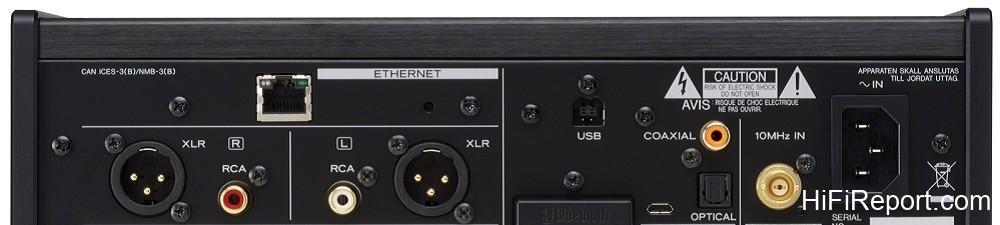
Physical Design and Connectivity
While the front panel still bears the “NT-505” mark, the new model, the NT-505-X, features newly designed Stressless Feet on the bottom. The previous four-point support system has been changed to a three-point design with two feet at the front and one at the rear.
From a circuit architecture perspective, I believe the previous NT-505 was already optimized to its fullest within its price range. The current NT-505-X further refines this existing architecture. For digital inputs, the unit uses a TI TMS320C6748 chip to handle USB digital audio input, supporting up to PCM 768kHz/32bit and DSD 22.5MHz. Music file playback from the network and USB storage devices supports DSD (DSP and DFF), FLAC, Apple Lossless (ALAC), WAV, AIFF, MQA, MP3, and AAC.
The maximum supported DSD specification is 5.6MHz, and multi-bit lossless music files are supported up to 384kHz/32bit. In terms of network streaming services, this unit is compatible with Spotify, TIDAL, Qobuz, and TuneIn. For Bluetooth transmission, the NT-505-X uses Bluetooth 4.0 and supports LDAC and aptX HD high-quality wireless transmission, as well as aptX, AAC, and SBC.
Advanced Digital Processing
From the NT-503 and NT-505 to the current NT-505-X, TEAC employs three significantly different approaches compared to typical streaming players. The first is in digital audio processing. Most streaming players merely decode and play music files, whereas the NT-505-X utilizes a Xilinx Spartan-6 FPGA chip for both music file decoding and digital audio optimization.
If a DSD music file or DSD digital audio is encountered, the unit remains faithful to the original source (passing it directly to the DAC without processing). For multi-bit music files and digital audio inputs, the unit’s “Upconvert” option allows users to choose conversion to a higher PCM specification or transformation into DSD.
When performing PCM conversion, the unit can expand all multi-bit formats (whether 16, 20, or 24bit) to 32 bits. This function enhances dynamic range and allows for more sensitive reproduction of subtle amplitude variations. The NT-505-X also performs “integer multiple” sample rate conversions.
Digital audio with sample rates of 44.1kHz, 88.2kHz, 176.4kHz, and 352.8kHz can be upconverted to a 705.6kHz sample rate, while digital audio at 48kHz, 96kHz, 192kHz, and 354kHz can be upsampled to a 768kHz sample rate (increasing the sample rate helps improve linearity). Another conversion method is “PCM to DSD”: converting the aforementioned digital audio with 44.1kHz and its integer multiples to DSD sampled at 11.2MHz or 22.5MHz.
Digital audio with 48kHz and its integer multiples can be optionally converted to DSD 12.2MHz or 24.5MHz, essentially transforming the original multi-bit audio into 1-bit DSD 256 or DSD 512.
DAC and Analog Circuit Architecture
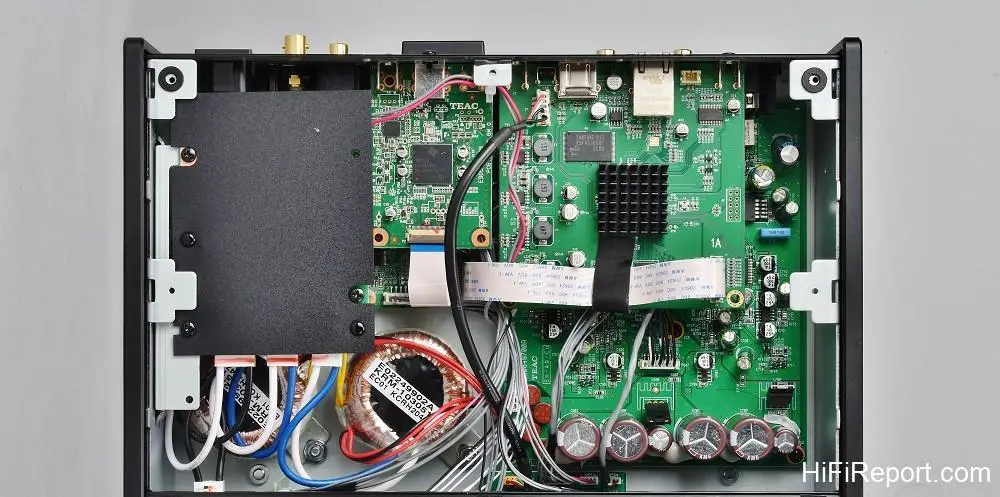
There are two other significant differences between the NT-505-X and other streaming players in a similar price range. One is that from the DAC to the two-channel analog audio output, the entire path adopts a “thoroughly” dual-mono fully balanced structure. This is undeniably beneficial for reducing crosstalk and improving channel separation, resulting in a wider soundstage.
In the power supply circuit, the digital and analog circuits for both channels are powered separately by a toroidal transformer with two secondary windings. Each channel has independent rectification, filtering, and voltage regulation circuits. After digital audio processing, the NT-505-X uses one high-end two-channel 32-bit DAC chip, the ESS ES9038Q2M, for digital-to-analog conversion in each of the left and right channels, replacing the AKM AK4497 used in the previous NT-505.
Comparing only the DAC chip specifications, the AK4497 has a dynamic range of 131 dB, while the ES9038Q2M has 128 dB. The ES9038Q2M’s dynamic range is slightly lower than the AK4497, but the ES9038Q2M’s THD+N is only -120 dB, whereas the AK4497 ranges from -116 to -113 dB. Therefore, the ES9038Q2M has a relative advantage over the AK4497 in terms of distortion characteristics, and the ES9038Q2M also features Time Domain Jitter Eliminator to reduce jitter.
Digital Filter Modes
TEAC takes advantage of the ES9038Q2M’s built-in features, adding up to seven digital filter modes beyond standard digital filtering. When playing multi-bit music files or selecting PCM digital audio input, the “Digital Filter (PCM)” option in the NT-505-X menu can be switched between Off, Linear Fast, Linear Slow, Minimum Fast, Minimum Slow, Apodizing Fast, Correct Mini Fast, and Brick Wall – a total of 8 options.
Users don’t need to fully understand the meaning behind these digital filter modes; they just need to know that they can be used for “sound tuning.”

Preamplifier and Headphone Amplifier
The unit’s dual-mono fully balanced design extends to the “preamplifier” circuit. Typically, streaming players that also function as preamplifiers often lack a “physical preamplifier circuit,” instead relying on digital audio processing circuits or the DAC’s built-in digital volume control to adjust volume, outputting audio directly from the OP Amp chips after the D/A conversion circuit. In essence, they merely make the D/A conversion circuit’s output variable to act as a preamplifier.
The NT-505X has a physical preamplifier circuit. Compared to a true preamplifier, it only lacks analog inputs and source switching. It features analog volume control and amplification circuits: using the JRC NJW1195A chip, known for its low noise, high channel separation, and low distortion, for “analog” balanced volume control and initial audio amplification.
After the NJW1195A, the previous NT-505 used OP Amps and power transistors to create the TEAC-HCLD (High Current Line Drive) circuit, and the headphone output adopted an “active ground” configuration.
The new NT-505X, after the volume control chip, uses two NS LME49600 chips per channel along with other components to build a buffer amplification circuit, which TEAC calls “TEAC-HCLD2.” This connects ultimately to the preamplifier output and headphone output.
The LME49600 was originally primarily intended as a buffer amplifier for driving headphones, offering high output current, a significantly wide bandwidth (110MHz), very low total harmonic distortion (0.00003%), and extremely fast speed (slew rate 2000 V/μs). I recently reviewed the Esoteric N-05XD, which also uses the JRC NJW1195A and NS LME49600 combination in its preamplifier section to create the HCLD circuit.

The main difference here is likely that the N-05XD uses four LME49600 chips per channel (whereas the NT-505-X uses two).
Although the NT-505X still features a 3.5mm 4-pole headphone jack like the NT-505, its headphone output method differs. The NT-505X can provide balanced output, and in single-ended headphone output mode, it connects the two LME49600 chips per channel in parallel, driving the headphones with double the output current.
While the NT-505-X looks identical to the NT-505 externally, the change in DAC chip and the upgrade of the preamplifier and headphone amplifier circuits to a design twinning that of the N-05XD is more than just a “minor update.”
Listening Impressions
When the NT-505-X is playing “CD quality” music files, the combination of “Upconvert” and “Digital Filter” mode switching offers as many as 34 variations. Regarding the Digital Filter section, you can take your time experimenting. If you prefer a softer treble, you can select modes with “Slow” in their name. Personally, I still prefer selecting “Off” to keep the sound straightforward and sharp.
The Upconvert feature is fascinating. Switching between converting digital audio to “high-spec multi-bit” and converting it to “DSD” with the NT-505-X is like switching between two streaming players with different sonic personalities. I first tried “converting to high-spec multi-bit.” While playing 44.1kHz and 48kHz music files, I sequentially listened to the same track switching between Off, 2x FS, 4x FS, and 8x FS.
By focusing slightly on the sound’s “texture,” you can clearly perceive that the higher the sample rate conversion via Upconvert, the more delicate the texture of instruments and vocals becomes. I particularly liked the “8x FS” mode; it can make music files equivalent to CD quality sound remarkably similar to Hi-Res music files in terms of sound quality, layering, and dynamics.
You can also hear the improvement in the refinement of sound texture and detail that Upconvert brings to 96kHz and 192kHz music files.
The higher the sample rate conversion, the more refined the sound becomes. However, when comparing sample rates, converting to “DSD” results in a much higher rate than converting to “high-spec multi-bit.” When the NT-505-X’s Upconvert is set to DSD 256 and DSD 512 (I recommend the latter), it sounds like a “super low-noise analog source.” The sound density is high, rich in charm, warm, and very approachable.
Between “converting to high-spec multi-bit” and “converting to DSD,” should I choose “8x FS” or “DSD 512”? To use Editor-in-Chief Liu’s “Five Elements of Audio” analogy, the unit in “8x FS” mode leans towards the element of Water: pure, transparent, highly visible, and with better contrast between soft and loud (dynamics) than when converted to DSD.
Although I can hear that the background noise when converted to DSD 512 is slightly higher than with “8x FS,” I still tend to choose DSD 512 for listening to most recordings. It makes me feel less like I’m listening to audio equipment; the sound is very natural, closer to the true sound of instruments and vocals, possessing better “musicality.”
Do you still need to ponder whether to choose “8x FS” or “DSD 512”? The NT-505-X allows you to break the rules like that, letting users change flavors at any time. I tend to choose “DSD 512” for classical music, jazz, and pop music from before the 1980s. When listening to contemporary pop music and recently recorded classical Hi-Res music files, I lean towards selecting “8x FS.”
Conclusion
With its hardware built beyond its price point, the NT-505-X’s sonic performance still has the capability to challenge digital sources in the $3,000 to $6,000 USD range. Its “switchable style” allows audio enthusiasts with different tastes to find satisfaction. The sound quality from the headphone output is consistent with the preamplifier output and has considerable driving power. I am certain that the evolution from NT-505 to NT-505-X is indeed an advancement.
The NT-505-X remains the most captivating and cost-effective streaming player under $3,000 USD, and its price is still far below that mark!
Specifications
* USB Audio Input: PCM 768kHz/32bit, DSD 22.5MHz
* Network/USB Storage Playback: DSD (DSP/DFF) up to 5.6MHz, FLAC, ALAC, WAV, AIFF up to 384kHz/32bit, MQA, MP3, AAC
* Network Streaming Services: Spotify, TIDAL, Qobuz, TuneIn
* Bluetooth: v4.0, supports LDAC, aptX HD, aptX, AAC, SBC
* Digital Processing Chip: TI TMS320C6748 (USB), Xilinx Spartan-6 FPGA (Decoding/Optimization)
* DAC Chip: ESS ES9038Q2M (dual-mono, one per channel)
* Digital Filter (PCM): Off, Linear Fast, Linear Slow, Minimum Fast, Minimum Slow, Apodizing Fast, Correct Mini Fast, Brick Wall (8 options)
* Upconvert: PCM (up to 8x FS, 32bit expansion), PCM to DSD (DSD 256/512)
* Analog Output Structure: Dual-mono fully balanced
* Preamplifier Circuit: Physical analog circuit with JRC NJW1195A (analog balanced volume control)
* Buffer Amplifier: TEAC-HCLD2 (NS LME49600 x2 per channel)
* Headphone Output: 3.5mm 4-pole, supports Balanced output, Parallel drive for single-ended output
* Feet: Stressless Foot (3-point support)