
TEAC UD-505-X Review
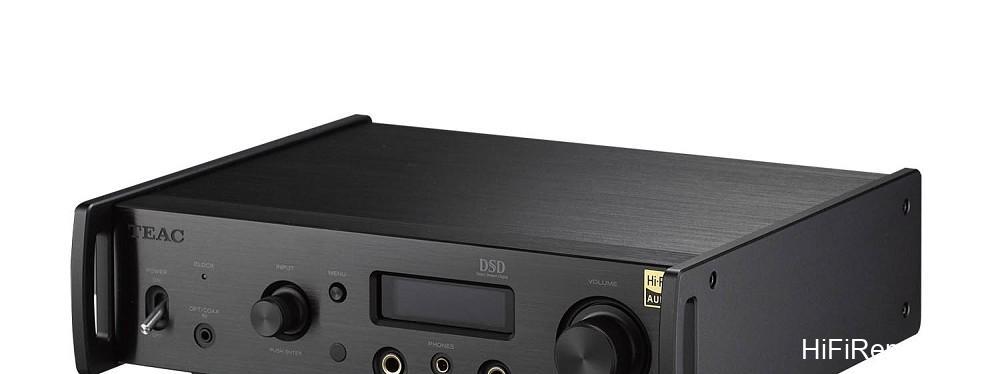
The TEAC UD-505-X, the star of this review, represents the third generation of TEAC’s high-resolution USB DAC/headphone amplifier series, following the UD-501 released in 2012. It features a versatile set of three headphone outputs: a 4.4mm 5-pole Pentaconn terminal supporting both balanced and ultra-low noise Active Ground modes, alongside two 6.3mm TRS terminals configurable via the menu for single-ended, balanced, or Active Ground operation.
Beyond its role as a headphone amplifier, the UD-505-X boasts comprehensive preamp capabilities and comes with a remote control. Its digital input suite is impressive, with the USB input supporting PCM up to 768kHz/32bit and DSD 22.5MHz – specifications more than double the maximum supported by most current digital sources. I am confident that this level of digital audio handling will remain more than sufficient for the next decade.
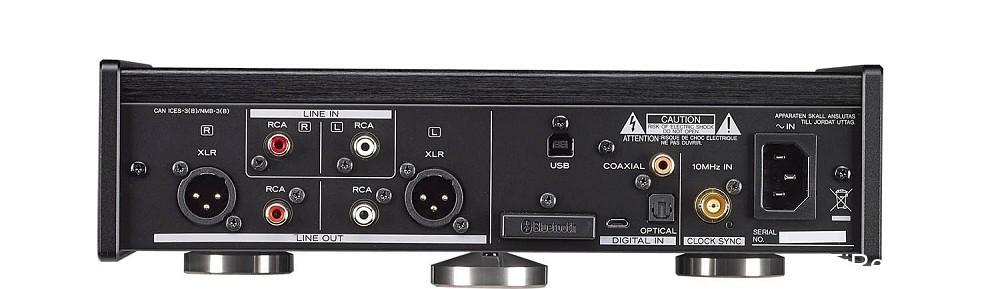
In addition to USB, it includes digital coaxial and optical inputs (the latter ideal for connecting to smart TVs) and an analog input.
For audio output, the UD-505-X provides both balanced and single-ended terminals. When set to fixed output, it serves as a source component in a system (feeding a preamplifier or integrated amplifier). However, for new users, I highly recommend utilizing its streaming preamp function by setting the output to variable and connecting directly to a power amplifier or active speakers.
Internal Architecture
Despite its compact “A4” footprint, the UD-505-X’s internal construction is more meticulous than many standard-sized digital sources. Regular readers of this publication will have heard me extol TEAC’s “Dual-Mono Full-Balanced” architecture numerous times. For other brands, this approach is seldom seen in components priced under $3,000, but TEAC consistently incorporates it, and the UD-505-X is no exception.
Internal Layout
The internal circuitry of the UD-505-X is generally divided into two layers. The upper layer houses the power connection board, the USB audio input interface (featuring a Texas Instruments TMS320C6748 DSP chip), and the analog single-ended input board. The main circuitry resides in the lower half: a digital circuit main board and an audio circuit board containing the DAC and preamp stages.
Digital Signal Processing
Upon receiving digital audio signals, the UD-505-X processes them on the digital main board using a Xilinx Spartan-6 FPGA chip. This processing primarily involves Sample Rate Upconversion and Digital Filtering. The Upconvert function allows the input PCM audio’s sample rate to be multiplied by 2 (2x Fs), 4 (4x Fs), or 8 (8x Fs), or left unchanged (Off). At 8x Fs, the sample rate can reach 352.8kHz (8 times 44.1kHz) or 384kHz (8 times 48kHz).
Regardless of whether the original PCM audio is 16, 20, or 24 bits, these three multiplication modes simultaneously expand the bit depth to 32 bits. This process not only makes CD-quality music files sound like higher-resolution multi-bit Hi-Res audio but also pushes digital noise frequencies well above the limit of human hearing by increasing the sample rate. Expanding the bit depth enhances dynamic range and allows for a more nuanced portrayal of subtle variations in loudness and intensity.
Users of this unit can also choose to convert incoming PCM audio to DSD 256 or DSD 512. In the DSD 512 setting, PCM audio can be converted up to a maximum specification of 24.5MHz, meaning the PCM is transformed into DSD audio with a pulse density roughly eight times that of the SACD standard before being sent to the DAC for digital-to-analog conversion.
When in the PCM Upconvert state (not converted to DSD), the unit offers eight selectable digital filter modes. Users don’t need complex descriptions to understand the differences; discerning the impact of each digital filter mode is quite straightforward. I’ll offer some setting recommendations later for owners of this unit.
DAC & Analog Stages
TEAC’s signature “Dual-Mono Full-Balanced” design, typically found in their high-end products, is applied here to both the audio and power supply circuitry. At the beginning of the audio circuit board, each channel utilizes a high-end ESS Technology ES9038Q2M 32-bit digital-to-analog converter chip. This DAC is known for its high dynamic range (128dB) and low distortion (THD+N: -120dB). The UD-505-X employs two of these two-channel DACs, using one chip per mono channel.
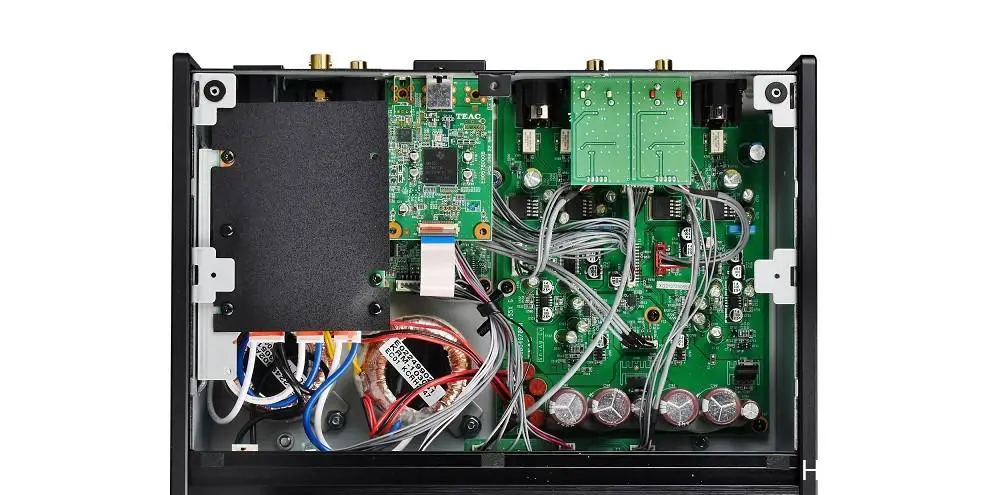
This not only boosts dynamic range but, crucially, keeps the left and right channel components separated from the very beginning of the audio signal path. This reduces crosstalk and improves separation, which translates into a wider soundstage and more precise imaging in the audio performance.
Analog Circuitry
In the small signal path following the DAC stage, the amplification components used are TI N5532A chips. This choice of components reveals that the developers weren’t solely focused on leveraging the FPGA for “Hi-Res” processing and high-end DAC chips for enhanced resolution and texture in the digital domain. They also incorporated more “seasoned” amplification components in the analog circuit to add sonic character and charm.
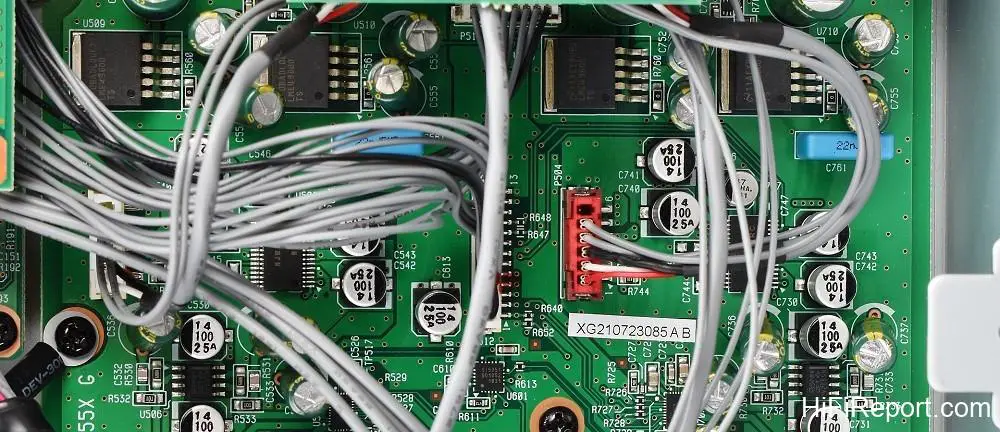
The UD-505-X features a complete, proper balanced preamp circuit. Each channel uses a JRC NJW1195A for input source selection and “analog full-balanced” volume control and initial amplification. In the latter stage of the preamp circuit, each channel is equipped with two high-performance, high-current headphone buffer amplifier chips, TI LME49600, to amplify the positive and negative phase signals independently.
These components boast an incredibly low total harmonic distortion of just 0.00003% and a high slew rate of 2000V/μs. Both TEAC’s proprietary TEAC-HCLD2 circuit and Esoteric’s Esoteric-HCLD, as stated by the manufacturers, use this very component to build their buffer amplifier circuits for preamp output and headphone drive.
Power Supply
The power supply section also adheres strictly to the dual-mono principle. It features two identical toroidal transformers, each dedicated to supplying power to the audio circuitry of one channel. Each channel has its own independent rectification, filtering, and voltage regulation circuitry. Additionally, the two transformers have another set of secondary windings to provide power for the digital circuitry.
Listening Impressions
For my listening test, I used three pairs of headphones, all with a generally neutral sound signature. The UD-505-X’s single-ended output has less power than its balanced output. To challenge its headphone driving capability initially, I deliberately used the 6.3mm single-ended output with the slightly less sensitive, older HifiMAN HE560 planar magnetic headphones.
Although I had to turn the volume up significantly more than with typical headphones, the UD-505-X was still able to produce sufficient volume and delivered surprisingly good bass thickness. This indicates that the UD-505-X, even using only half of its headphone amplifier circuit (with the other half idle), can adequately drive demanding headphones, providing ample current output to satisfy planar magnetic designs. Next, I listened using the Sennheiser HD 580 with the single-ended output.
Compared to the previous pairing, the UD-505-X seemed to drive the HD 580 with much less effort. I noted better stability and headroom, experiencing a firmer, richer sound, higher sound density, and a richer sense of layering during complex orchestral passages (especially in the mid-range).
The third pair of headphones I used was the Focal Stellia, employing balanced drive to further assess the UD-505-X’s characteristics. I find the UD-505-X to be a highly sensitive digital source. When pairing digital cables, I believe it already possesses ample resolution, making high-purity copper conductors a better match (compared to mid-to-low-priced silver or silver-plated wires). The treble has low harshness and a sheen.
Optimizing Performance
When connected to a computer, I strongly recommend using the TEAC HR Audio Player and enabling Control Panel with Bulk Pet Mode set to 1. This configuration yields a very transparent, pure sound with an exceptionally quiet background. The sound quality performance in this mode is absolutely superior to general music playback software (such as foobar2000).
Adding an external clock generator like the TEAC CG-10M further refines the sound texture, making it more delicate and elegant, and highlighting subtle sonic details more clearly. Therefore, I used the CG-10M during my formal listening sessions.
I don’t find the Focal Stellia particularly difficult to drive, and the UD-505-X drove them effortlessly with ample dynamics using the balanced output. The Stellia readily reveals differences in texture and smoothness. Throughout my listening tests with these three headphones, I consistently compared the differences between the various Upconvert modes. When playing multi-bit music files, if you want to intently listen for more detail, I recommend selecting 8x Fs.
In this mode, choosing Digital Filter ‘Off’ results in a quick, immediate sound. However, I personally preferred the slightly more gentle yet not dragging characteristic of the ‘Minimum Slow’ filter.
If I planned to listen for several hours or an entire day, I would absolutely set Upconvert to DSD 512. Its tonal color leans warmer than 8x Fs, the sound density is very high, and it’s smooth and quite natural. In terms of musical genres, I particularly enjoyed using this mode for classical and jazz. Playing music files digitized from analog recordings from the 1950s to the 1970s presented a sound remarkably close to the analog flavor of reel-to-reel tape and vinyl records.
Speaker System Use
Finally, I used Focal Trio6 Be monitoring speakers to assess the UD-505-X’s performance in a two-channel speaker system. The sound quality and tonal color I heard were virtually identical to what I experienced with the Focal Stellia headphones. This consistency isn’t just due to the speakers and headphones sharing the same lineage and both featuring Beryllium drivers.
Another reason is that the audio path (the circuits traversed) is exactly the same whether the UD-505-X is functioning as a headphone amplifier or a preamplifier. The tonal adjustments available via the menu settings in headphone output mode also translate to the two-channel system, where you can appreciate the blend of rich character and high resolution.
Listening through speakers further allowed me to appreciate the characteristics of the dual-mono full-balanced circuitry: a wide soundstage with ample detail, more concretely rendering the acoustics of the musical performance space. When adjusting the volume, if you imagine the singer performing right in front of you, or the sound level you’d experience from a seat in a concert hall, the UD-505-X allows the user to audibly perceive a naturally realistic live musical event.
Conclusion & Recommendation
That’s the TEAC UD-505-X. It possesses three qualities I particularly appreciate: construction that surpasses its class, functionality that satisfies audiophiles’ desire for sonic tuning, and impressive longevity. Perhaps younger users currently only plan to use it as a headphone amplifier.
Later, when they establish their own home, the UD-505-X, with its remote control, can serve as the core of a living room two-channel system simply by adding a music server capable of playing audio files and a pair of active speakers. Although the UD-505-X is modestly priced, I believe its sound quality transcends typical mid-range products and reaches the level of “high-end audio entry level.” Given its exceptional performance-to-price ratio, it deserves our highest recommendation.
Specifications
* USB Input: PCM up to 768kHz/32bit, DSD up to 22.5MHz
* Digital Coaxial Input
* Digital Optical Input
* Analog Input
* Balanced Output (XLR)
* Single-Ended Output (RCA)
* Headphone Outputs: 1x 4.4mm Pentaconn (Balanced/Active Ground), 2x 6.3mm TRS (Single-Ended/Balanced/Active Ground)
* DAC Chip: 2x ESS Technology ES9038Q2M (Dual-Mono configuration)
* FPGA for Digital Processing: Xilinx Spartan-6
* Preamp IC: JRC NJW1195A
* Headphone Buffer Amplifier: 4x TI LME49600
* Power Supply: Dual Toroidal Transformers (dedicated for left/right analog audio)