
Vincent CD-200 CD Player Review
Do you have a CD collection at home? Do you still listen to CDs? If the answer to both of these questions is yes, then you definitely need a CD player.
The problem arises when you consider that 15 or 20 years ago, this wouldn’t even be a question. Back then, the mainstream digital source was the CD player, and the market was overflowing with choices, from budget-friendly to high-end, from single-box units to separate components. Listening to music was as simple as putting in a CD.
However, today, the CD sales market is almost in terminal decline. Record sales are decreasing year by year, and the physical record market has shrunk dramatically.
Digital audio is now dominated by network streaming. CDs are no longer standard equipment in audio systems, and consumers are less inclined to buy CD players. So, who is still making CD players? Indeed, we’ve seen some manufacturers reduce or even completely stop CD player production.
Yet, there is one company that continues to release CD players, and even dedicates itself to producing “pure CD players”—that’s Vincent Audio.
Affordable Tube-Hybrid Design from Vincent
Vincent has always been known for offering exceptional value, making high-quality audio accessible at affordable prices.
They openly state that they are a German brand with German design, but to realize their ideal of affordable hi-fi, they base their manufacturing in China. This strategic decision allows Vincent to control costs and maintain competitive product pricing.
Beyond affordability, Vincent has a core design philosophy, almost like a DNA, that runs through their entire product line: tube-transistor hybrids.
While Vincent offers fully solid-state products, a significant portion of their lineup employs a hybrid architecture.
In their amplifiers, they often use solid-state amplification for the output stage, seeking superior drive and power, while incorporating vacuum tubes in the pre-amplifier or input stages to inject the sonic characteristics of tubes and enhance musicality.
They have numerous tube-hybrid amplifiers—preamps, power amps, integrated amps, and phono stages. They also utilize vacuum tubes in the analog output stages of their CD players and DACs, aiming for a smoother texture and warmer tonal color.
This is Vincent’s signature approach: affordability, making music and hi-fi accessible to everyone; and tubes, to make the sound softer, rounder, and more listenable.
If you prioritize origin and brand prestige, you certainly have other choices. However, if you value sound quality, practicality, and are mindful of budget, then Vincent is right up your alley.
Retro Half-Width CD Player
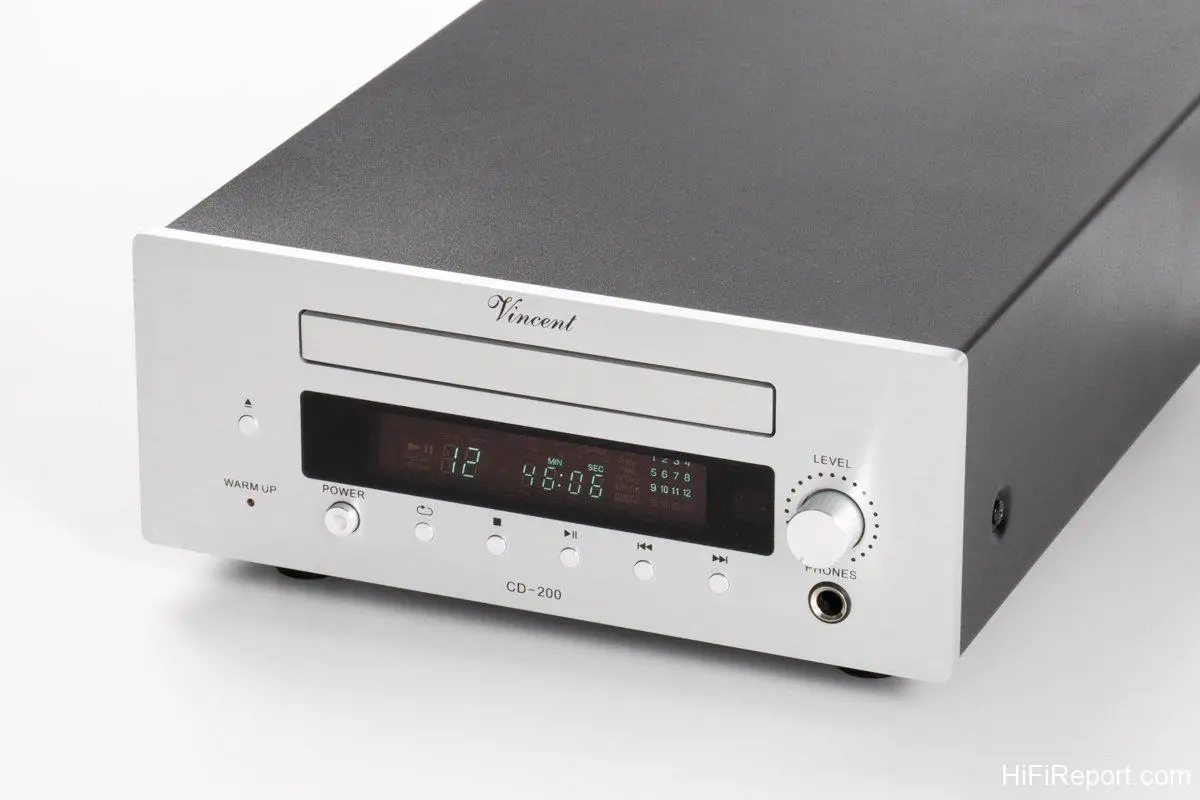
Vincent’s newly released CD-200 CD player is a half-width design, part of the same series as the SV-200 integrated amplifier.
With a faceplate just 21cm wide, placing both the CD-200 and SV-200 side-by-side takes up the same space as a single full-width component, making it ideal for users with limited space.
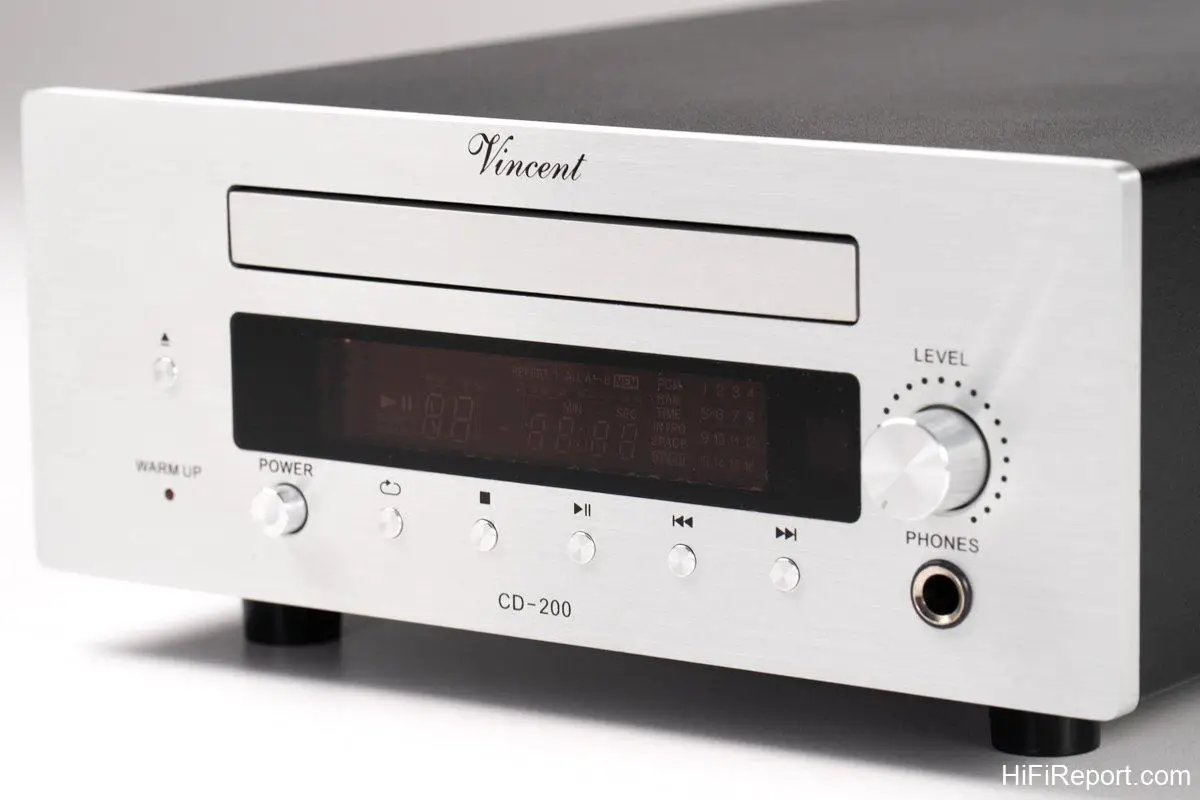
The CD-200’s chassis is robustly built, appearing simple yet solid. It is available with silver or black front panels.
The center-mounted drawer-type disc tray operates quickly and smoothly.
Below the tray is a display screen that provides comprehensive information, including track number, time, current operation status, and a 4×4 numerical array showing the current track.
This display immediately evokes a sense of nostalgia. It’s reminiscent of the CD player displays common 20 to 30 years ago, the numerical array instantly transporting you back to the golden age of CDs in the last century.
Most of the physical buttons are located below the display screen. These small, round buttons offer good tactile feedback. The Eject button is positioned to the left of the tray, ensuring it doesn’t interfere with tray operation.
Another retro feature of the CD-200 is its headphone output. In the early days, many CD players included headphone outputs, often with volume control, making headphone listening convenient—just plug directly into the player. Back then, headphones weren’t yet “Hi-End-ified.”
While headphone outputs are less common on CD players today, Vincent eschews high-end mystique and gets straight to the point: you want to listen to music, right? Here you go.
All Through-Hole Circuit Board with MIWA Capacitors
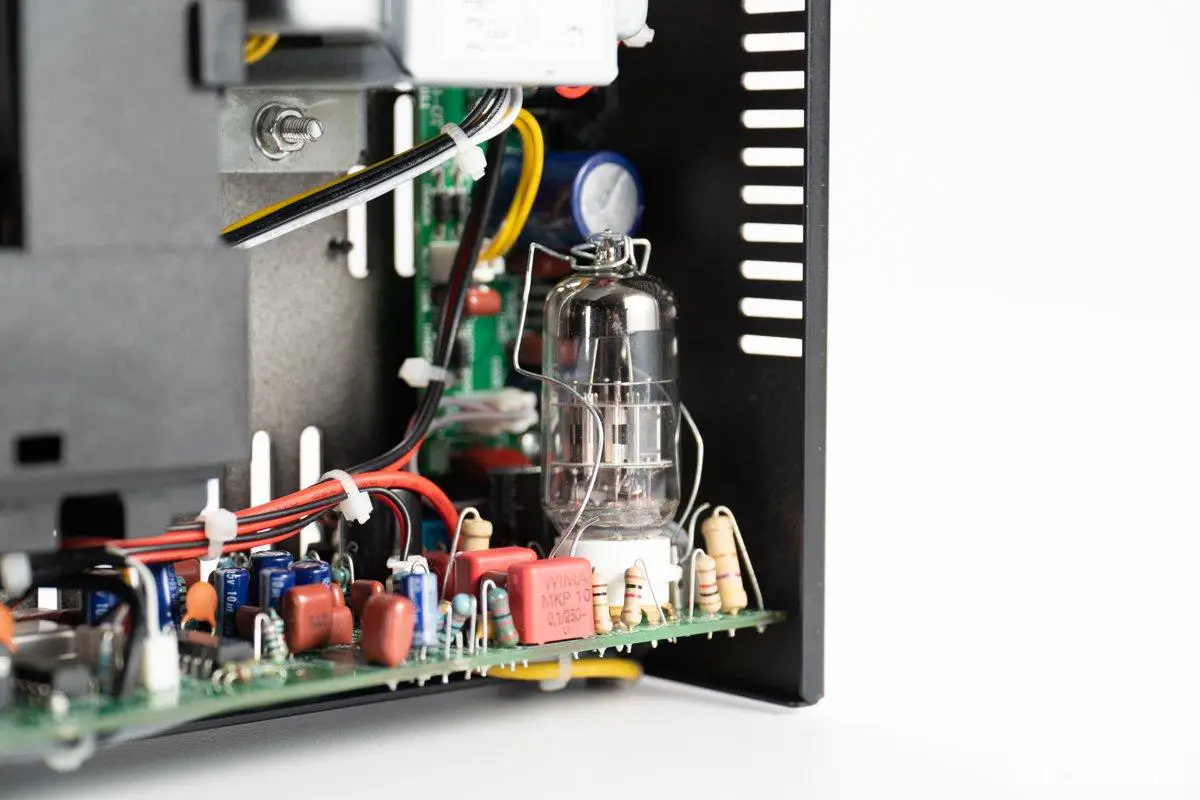
The compact chassis is densely packed. The majority of the internal space is occupied by the CD transport mechanism. A small transformer is located at the rear, while the power supply regulation, rectification, and filtering circuits are positioned vertically on the left side, close to the chassis side panel.
The analog amplification circuits are on the right side, with the circuit board also mounted vertically along the side. Vincent’s engineers have truly maximized space utilization.
Even more remarkably, all the circuit boards inside the chassis are through-hole soldered. I didn’t spot a single surface-mount device (SMD) component, a rarity these days.
Moreover, while not overflowing with boutique parts, there are a noticeable number of MIWA capacitors. Those red blocks are a pleasing sight for audiophiles.
How much do you think the Vincent CD-200 costs? Only NTD 25,000.
Yes, you read that right. This fully packed machine, with all through-hole circuitry and many WIMA capacitors, is priced at just NTD 25,000 (approximately $833 USD). Vincent has truly put in considerable effort and investment into this player.
24bit/192kHz Digital Upsampling
The CD-200 utilizes a Sanyo DA11 laser head, paired with Philips servo circuitry, further refined by Vincent’s engineers to ensure more accurate disc reading.
A Burr Brown PCM 1796 chip handles the digital-to-analog conversion. The extracted music signal is upsampled to 24bit/192kHz.
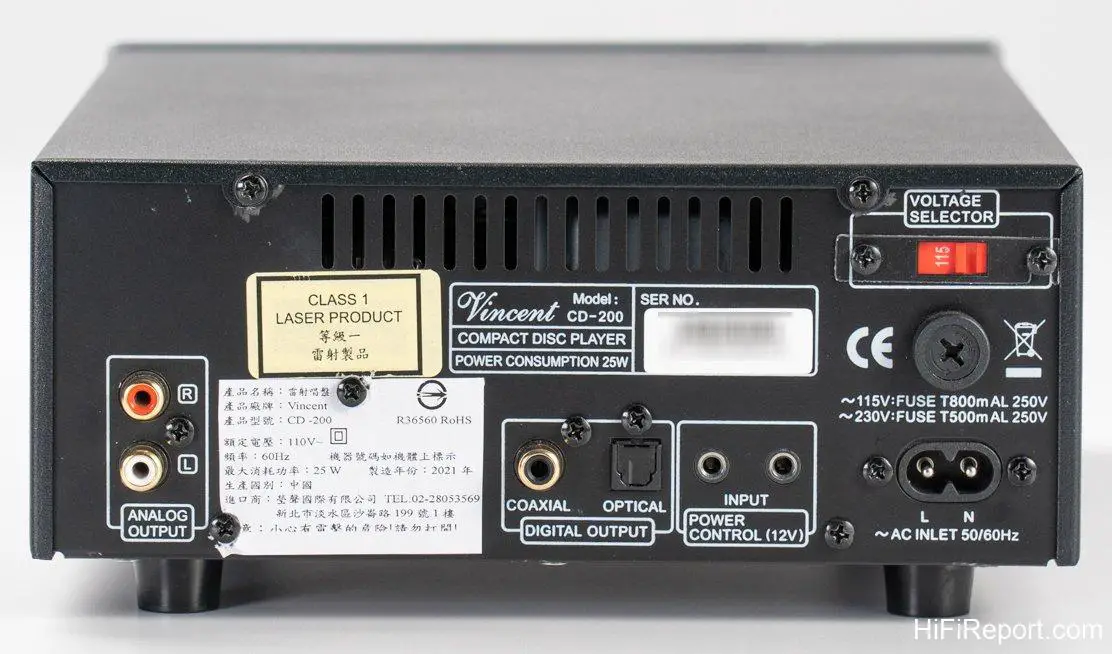
For analog output, it features a set of RCA connectors, along with coaxial and optical digital outputs, allowing users to connect to external DACs and use the CD-200 as a transport, providing an upgrade path.
6N2 Dual Triode Tube for Tube Warmth
Despite being an entry-level model, the Vincent CD-200 features independent filtering, amplification, and buffering for the left and right channels.
In the analog amplification stage, a 6N2 dual triode tube is employed to add “tube flavor” to the sound.
The manufacturer states that the inclusion of the 6N2 vacuum tube makes the CD sound more natural and warmer.
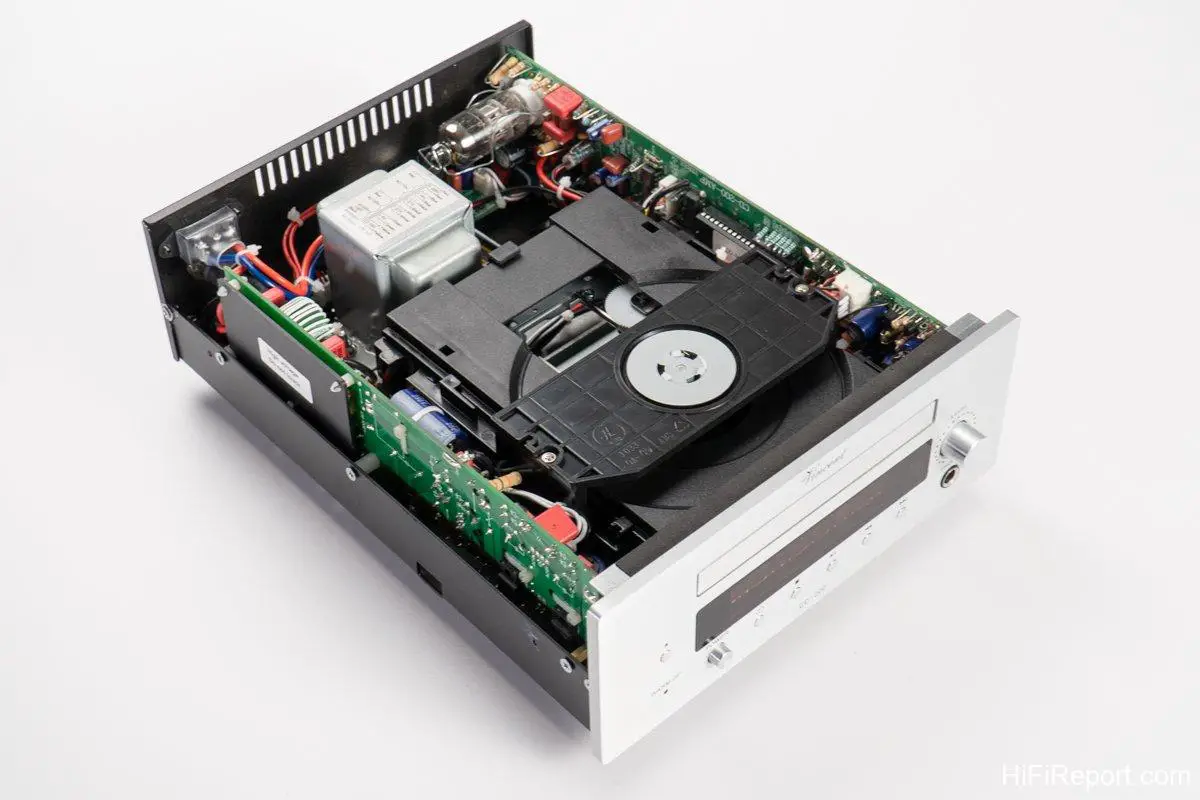
This Chinese-made 6N2 tube is interchangeable with the Russian 6N2P, making future tube replacement easy. The tube is also fitted with a retaining clip to prevent slippage and reduce vibration.
Separate Power Supplies for Digital and Analog
The power supply is also meticulously designed. A dual-winding transformer separates power for the digital and analog circuits. Ample power supply ensures full musical dynamics.
However, due to chassis size constraints, the CD-200 does not use a common IEC power socket. It requires an 8-figure power cord.
While only a few cable manufacturers offer 8-figure power cords, you can purchase an 8-figure to IEC adapter to use your existing audiophile power cables.
Upon power-up, because of the vacuum tube, it needs time to “light up.” The red indicator light next to the power switch illuminates, signaling the warm-up process. Once the light turns off, it’s ready to play music.
However, in my experience, the CD-200 needs at least ten to twenty minutes to fully reach its sonic potential. Before that, the sound thickness and roundness might be slightly lacking, and dynamic expression may be less relaxed.
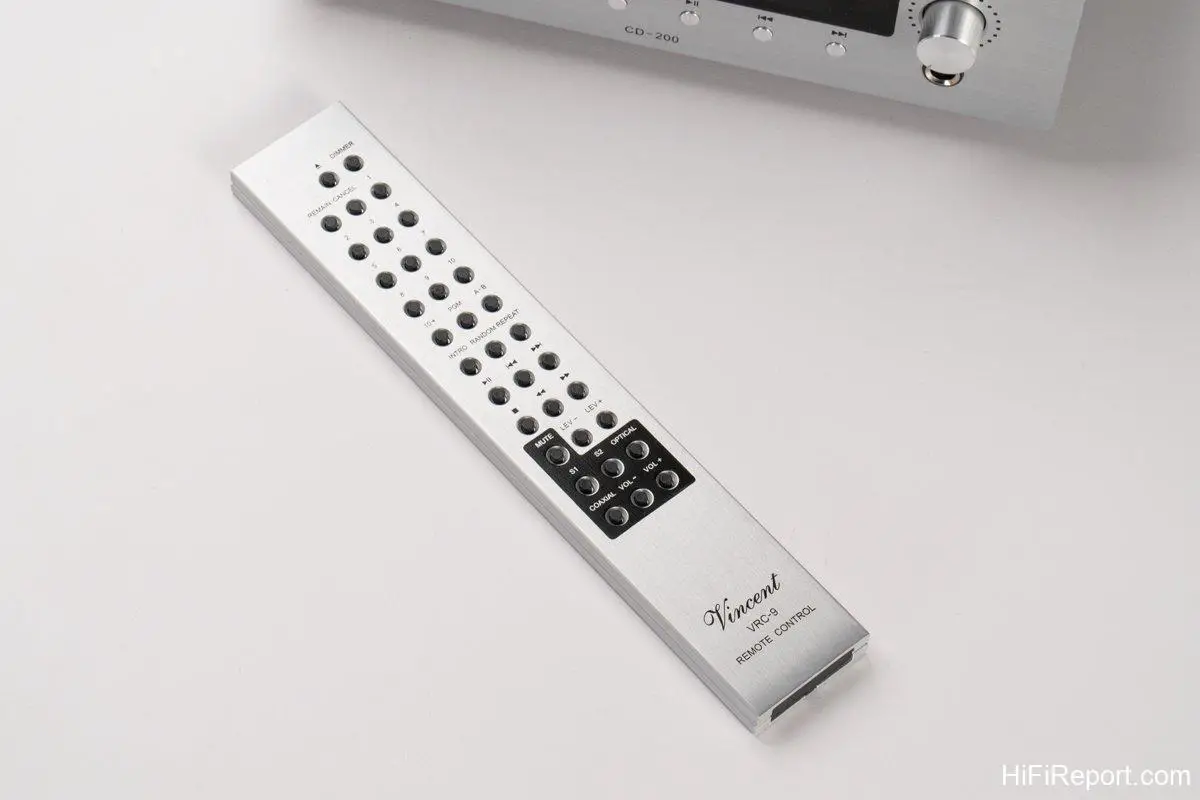
The slim remote control is about the same length as a regular remote but much thinner and narrower. Made entirely of aluminum alloy, it feels premium. The black area below the buttons controls the SV-200 integrated amplifier.
Full-Bodied Sound, Rich Tone, Detailed Yet Smooth
The sound performance of the Vincent CD-200 is very much in line with the Vincent signature.
What does that mean? My impression of Vincent components is that they deliver a full-bodied and powerful sound, rich yet not muddy, detailed but not harsh. This is especially true for their tube-hybrid models, which almost always possess this sonic character.
The CD-200 is no exception. Don’t let its small size fool you; its sound is remarkably full and rich. Don’t be misled by its simple, classic appearance; its performance in terms of tone, timbre, detail, and soundstage is anything but outdated, fully embodying contemporary audiophile preferences.
I myself own a vacuum tube output CD player, an Audio Aero Prima CD Player that I’ve had for over ten years and had the laser head replaced twice. It uses two JAN Philips 6021W military-grade tubes in its analog output stage. Its sound is smooth and refined, making it exceptionally pleasant for classical music, exhibiting a gentle and detailed character.
Compared to the Vincent CD-200, the Prima loses in almost every aspect of sonic performance. Detail, dynamics, weight, speed, impact, and imaging—the CD-200 is superior in all these areas.
Considering the original prices, the Prima, purchased over a decade ago, cost twice as much as the CD-200 today. Adjusting for inflation, the price difference is even greater. This highlights the exceptional value offered by the Vincent CD-200.
Large Soundstage and Rich Detail, Beautiful Piano Decay
This comparison further piqued my interest.
Perhaps due to the vacuum tube, the CD-200 renders sonic outlines not with sharp edges, but with a touch of poetic nuance and lingering decay.
Listening to vocals, the CD-200 adds a layer of charm and richness to voices.
Playing Diana Krall’s “All for You” album, a tribute to the Nat King Cole Trio, the CD-200 makes Diana Krall’s vocals sound truly beautiful. The sonic image is large and full-bodied, which alone lays a solid foundation for enjoyable jazz playback.
The CD-200’s sound possesses good brightness and color, sounding lively and energetic, even in slower songs like “Boulevard of Broken Dreams,” it remains vibrant.
Diana Krall’s articulation and vocal nuances—the throat sounds, the consonants—are rendered clearly, revealing every subtle expression in her singing. Even in soft passages, the vocal details are remarkably clear.
When the double bass is plucked, not only are there bouncy notes, but also the details of the string vibrations are present.
The rolling notes of the guitar are warm and rounded, both rhythmic and melodically rich.
The piano’s bright and colorful presentation is thoroughly enjoyable. Perhaps due to the vacuum tube in the analog stage, the lingering decay of the piano notes sounds particularly beautiful.
The CD-200’s sound is relatively focused and slightly forward, combined with a full-bodied image and rich colors, making its sonic presentation quite captivating.
Moreover, its sound isn’t overly analytical or tightly focused, but rather possesses a degree of spaciousness, making it very comfortable to listen to.
This is why I started with the “All for You” jazz album. Try it yourself, and you’ll find the CD-200 indeed delivers a convincing jazz performance.
Rounded and Rich Violin, Slightly Relaxed Yet Lively
Listening to DG’s famous compilation “Diabolus in Musica” featuring Salvatore Accardo, which includes his Paganini recordings for DG.
The CD-200 makes the violin sound both rounded and liquid, without any dryness. You can confidently turn up the volume and enjoy Accardo’s violin virtuosity.
Techniques like détaché, staccato, martelé, tremolo, glissando, pizzicato, double stops, and harmonics all sound vivid and exciting on the CD-200.
In comparison, my Prima CD sounds too gentle. The CD-200 better reveals the ingenuity of Paganini’s music.
The second track is the Rondo movement from Violin Concerto No. 2. Accardo elegantly masks his brilliance, and the subtle variations hidden within the seemingly effortless notes are all unveiled by the CD-200.
The ever-popular triangle, after a slightly lingering strike, releases colorful overtones, and the upward decay is truly beautiful! Do you think Vincent is cheap and therefore sounds rough? No, listen to the triangle here, listen to the violin here.
Then continue to the fourth track, the Adagio from Violin Concerto No. 4. From it, you can appreciate Paganini’s profound lyrical sentiment.
Because of the slower tempo, you can better hear the CD-200’s performance of the violin’s texture—full and rich, slightly relaxed yet detailed and clear—truly bringing the performance to life.
Energetic Performance with Powerful and Resilient Drums
I also appreciate the CD-200’s performance with rock music.
Its full-bodied, powerful, and expressive sound makes listening to rock music incredibly enjoyable.
Take Guns N’ Roses’ “Greatest Hits” compilation, for example. The opening monologue of the sixth track, “Civil War,” is a quote from the movie “Cool Hand Luke,” but it carries profound meaning.
This is followed by ethereal guitar, then Axl’s soft singing, building up tension. Finally, the fury erupts, with heavily distorted electric guitars and Axl’s screams unleashing all the pent-up anger.
The CD-200 presents the opening monologue as emotionally detached yet physically intimate.
The intense emotion under the explosive energy is full of tension. The drums are strong and powerful, truly blood-pumping.
Truly powerful drums appear in the next track, “You Could Be Mine.” The drummer delivers a barrage of thunderous strikes, the drums sounding fast, powerful, and resilient.
The irresistible “Don’t Cry” is a ballad loved by many. Here, too, are the bouncy yet weighty drums. Axl’s vocals, in stark contrast, exhibit both tender emotions and, as the song builds to a climax, a repressed and deep-seated heartache, sung with the fervor and soaring pitch of electric guitars.
Listening, the CD-200 effortlessly pulls you into this emotional vortex.
Headphone Output Also Follows a Large and Spacious Style
As for its headphone output, it’s not just a perfunctory addition. You can actually use it for serious music listening.
Paired with Sennheiser HD700 headphones, the CD-200 delivers music with a large and spacious soundstage. It doesn’t have sharply defined outlines or extreme separation, but it offers a warm and thick sound that is very listenable.
However, the CD-200’s headphone output and rear panel high-level outputs are independent. If you have an amplifier connected and it’s powered on, plugging in headphones will not cut off the output to the amplifier, and it will continue playing.
A Choice Not to be Missed Under $5000 (USD Converted from NTD 50,000 for Context)
As hi-fi gradually moves towards boutique and high-priced products, there are still manufacturers willing to leave a window open for consumers with limited budgets to glimpse the world of music. Vincent is one of them.
In an era where the music industry is fully embracing digital streaming, Vincent continues to create CD players, one after another, allowing those CD records collected over the years to have their inner souls awakened, extracting music, emotion, and stories from them.
The Vincent CD-200, while an entry-level model, is more than capable of letting you enjoy the beauty of music. It looks classically styled, yet delivers modern sonic performance.
If you happen to need a CD player and don’t want to spend a fortune, among the limited options under NTD 50,000 (approximately $1667 USD), the Vincent CD-200 is a choice you’d regret missing. In fact, you might even feel like you’ve struck gold! The CD-200 is expected to officially arrive in late September. Interested readers should keep an eye out!
Specifications
* Type: Vacuum Tube CD Player
* Frequency Response: 20 Hz – 20 kHz (+/- 1 dB)
* Total Harmonic Distortion: < 0.005%
* Signal-to-Noise Ratio: > 93dB
* Dynamic Range: > 100dB
* Channel Separation: > 80dB
* Analog Output: RCA x1, 6.3mm Headphone Output x1 (with Volume Control)
* Digital Output: Optical x1, Coaxial x1
* DAC Sampling Rate: 24bit/192kHz
* Headphone Output Impedance: 100 Ohms
* Headphone Output Power: 160 mW @ 300 Ohms
* Vacuum Tube Used: 6N2 x1
* Dimensions: 210 x 95 x 305 mm (W x H x D)
* Weight: 4 kg